Motley Fool on GILD

August 30, 2013

Motley Fool discusses the fundamentals that are driving Gilead Sciences’ earnings growth. Gilead Sciences is currently the biggest holding in the PowerShares DWA Technical Leaders Portfolio (PDP).

Of course, our investment process led us to Gilead Sciences because of its superior relative strength rather than any insight that we had from a fundamental point of view, but it is interesting to listen to analysts who can help provide some perspective on why it has been such a strong stock.

gild1 Motley Fool on GILD

Source: Dorsey Wright

Past performance is not indicative of future results. Potential for profits accompanied by possibility of loss. A list of all holdings for the trailing 12 months is available upon request. See www.powershares.com for more information.

Posted by:


Finance Theory vs. Portfolio Reality

August 30, 2013

Index Universe carried an interview with Tad Rivelle, the chief investment officer at Trust Company of the West, that touched on the difference between finance theory and the reality in the markets. Mr. Rivelle is mainly a bond guy and the interview mostly discussed interest rates and so on, but it contained this gem:

IU.com: We’re hearing projections of 3.5 percent rates by next year, 4.5 percent by 2015. What happens if the bond market decides to rush there at once rather than to gradually get to those levels? Could it derail the economic recovery?

Rivelle: Yes. In fact, that’s precisely what we saw when we had that taper tantrum back in May and June. It was catalyzed by Bernanke’s statement to the effect that the Fed was carefully considering an initiation of a taper late this year, and the bond market sold off horrifically in a very short period of time. It was a generalized deleveraging. I think it frightened the Fed, and consequently they walked those comments back.

The conflict here is that the Fed tends to approach things from a model-driven academic perspective—what’s supposed to happen in theory versus the realities of the marketplace. When people are looking to front-run one another to offload risk before the next guy does, these models basically go out the window.

How the bond market will respond is absolutely unknown, but it’s more typical for the bond market to move very rapidly, to gallop to what it believes is the next point of equilibrium and not to sell off gradually. I’ve never seen that happen.

I put the fun part in bold—in a real market, academic models go out the window and human behavior takes over. Mr. Rivelle points out that markets trade on perception, and often make adjustments abruptly when perceptions change.

To me, this is the real strength of tactical asset allocation driven by relative strength. As perceptions change, different securities or asset classes come to the forefront and others fade away. As relative strength investors, we don’t have to predict what these changes might be. We simply have to adapt our portfolio as the changes occur. Relative strength adapts to changes in human behavior, not some elusive equilibrium proposed by academics.

Posted by:


Sector Performance

August 30, 2013

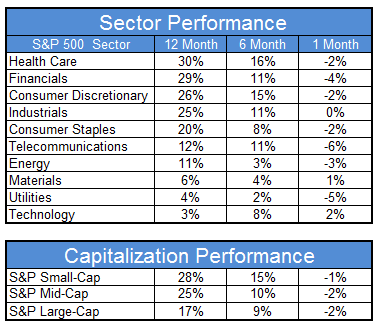
The chart below shows performance of US sectors and capitalizations over the trailing 12, 6, and 1 month(s). Performance updated through 8/29/2013.

s c 08.30.13 Sector Performance

Numbers shown are price returns only and are not inclusive of transaction costs. Source: iShares

Posted by:


Podcast #30 Forecasting vs. Trend Following From a Sales Perspective

August 29, 2013

Podcast #30 Forecasting vs. Trend Following From a Sales Perspective

Mike Moody and Andy Hyer

Posted by:


Fund Flows

August 29, 2013

Mutual fund flow estimates are derived from data collected by The Investment Company Institute covering more than 95 percent of industry assets and are adjusted to represent industry totals.

ici 08.29.13 Fund Flows

Posted by:


Relative Strength and Philosophy

August 28, 2013

At first, you might not think that relative strength and philosophy are related in any way. But they are, because every strategy is based on some philosophy of the market. Different philosophies lead to different strategies. We like relative strength because it is simple, straightforward, and performs well over time. Of course, there are other strategies that work also, including some that are quite complementary to relative strength. A nice encapsulation of philosophy leading to strategy appeared on The Bloodhound System blog. A couple of excerpts from the article are instructive. The first is a quote from Rick Ferri in a Morningstar interview:

“Strategy comes from philosophy. If you don’t have a philosophy, you can develop a strategy, but it’s only going to blow apart the next time it doesn’t work for a month or two. And you are going to go onto another strategy, and that’s the worst thing you can do.”

This is very true. Over my career, I’ve seen many investors careen from strategy to strategy, never sticking long enough with any of them to enjoy success. The author of the blog piece, Bill Moore, I think really cuts to the core of why a deeply held philosophy is so important to success. Having some kind of belief system is necessary to have conviction. With conviction comes discipline—and discipline is the key to everything. I put the good part in bold.

…what’s really important is that you have a philosophy that makes sense to you and that you believe in–and that you then create a strategy which you would execute with discipline. As much as pundits might dogmatically espouse one investing philosophy or another–making it seem like it’s their way or the highway–there are thousands of investment philosophies–and in turn strategies. The reason multiple philosophies can work out well is that inherent in having a philosophy, or belief system, is that you have conviction in it. That kind of discipline, not so much the philosophy itself, is the key to an investment plan.

One of our senior portfolio managers, Harold Parker, likes to say “to the disciplined go the spoils.” He’s right. Even a good strategy that is poorly executed will lead to bad results. Every strategy might be driven by some philosophy, but none of them are worth a darn without conviction and the resultant discipline to execute well.

Posted by:


Sound Smart on CNBC!

August 26, 2013

Henry Blodget of Business Insider wrote this timeless article about empty phrases that make you sound smart on CNBC. I’m pretty sure econ majors could turn this into a drinking game. If you had to drink every time a talking head on CNBC unloaded one of these phrases, you would be plastered before lunch.

  1. The easy money has been made.
  2. I’m cautiously optimistic.
  3. It’s a stockpicker’s market.
  4. It’s not a stock market. It’s a market of stocks.
  5. We’re constructive on the market.
  6. Stocks are down on profit-taking.
  7. Stocks are up on bargain hunting.
  8. More buyers than sellers.
  9. There’s a lot of cash on the sidelines. (Alternatively: dry powder.)
  10. We’re in a bottoming process. (Alternatively: forming a base, bumping along the bottom.)
  11. Overbought.
  12. Oversold.
  13. Buy on weakness.
  14. Sell on strength.
  15. Take a wait-and-see approach.
  16. It’s a show-me stock.

To these, I would add a few more throw-away phrases like:

  1. Undervalued. (Alternatively: offers good value here.)
  2. Fully valued.
  3. Overpriced. (Alternatively: extended.)

The common feature of all of these phrases, as Mr. Blodget aptly points out, is that they make you sound smart but they really don’t mean anything. You can use them in a wide variety of situations because they can mean whatever you want them to mean. The exact same stock can be undervalued, fully valued, or overpriced depending on your set of assumptions—and importantly, whether you happen to own it or not!

Note: Part of the problem, unacknowledged in the article, is that many of the questions asked by interviewers are ridiculous and deserve one of these classic responses. Personally, I think it would be great fun to see how many of these phrases I could jam into one interview.

Posted by:


Quote of the Week

August 23, 2013

Avoiding danger is no safer in the long run than outright exposure. The fearful are caught as often as the bold.—Helen Keller


I doubt that Helen Keller was thinking about bond investors when she wrote this, but she may as well have been. The safe haven trade hasn’t worked out too well since May. Bond investors sometimes think they have an extra measure of security versus stock investors. And it is true that most bonds are less volatile than stocks. Volatility, however, is a pretty poor way to measure risk. An alternative way to measure risk is to look at drawdown—and measured that way, bonds have had drawdowns in real returns that rival drawdowns in stocks.

In truth, bonds are securities just like stocks. They are subject to the same, sometimes irrational, swings in investor emotion. And given that bonds are priced based on the income they produce, they are very vulnerable to increases in interest rates and increases in inflation.

So I think that Helen Keller’s point is well taken—instead of pretending that you are safe, make sure you understand the exposures you have and make sure you take them on intentionally.

Helen Keller zps1558d561 Quote of the Week

Source: Wikipedia (click on image to enlarge)


Posted by:


Sector Performance

August 23, 2013

The chart below shows performance of US sectors and capitalizations over the trailing 12, 6, and 1 month(s). Performance updated through 8/22/2013.

gics2 08.23.13 Sector Performance

Numbers shown are price returns only and are not inclusive of transaction costs. Source: iShares

Posted by:


Fund Flows

August 22, 2013

Mutual fund flow estimates are derived from data collected by The Investment Company Institute covering more than 95 percent of industry assets and are adjusted to represent industry totals.

ici 08.22.13 Fund Flows

Posted by:


High RS Diffusion Index

August 21, 2013

The chart below measures the percentage of high relative strength stocks that are trading above their 50-day moving average (universe of mid and large cap stocks.) As of 8/20/13.

diffusion 08.21.13 High RS Diffusion Index

The 10-day moving average of this indicator is 83% and the one-day reading is 77%.

Posted by:


Relative Strength Spread

August 20, 2013

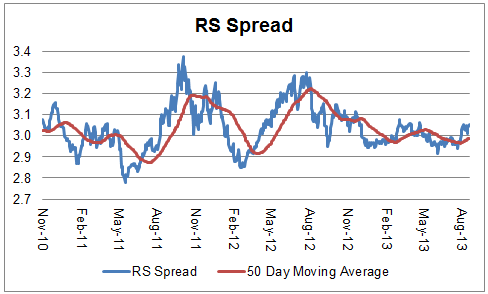
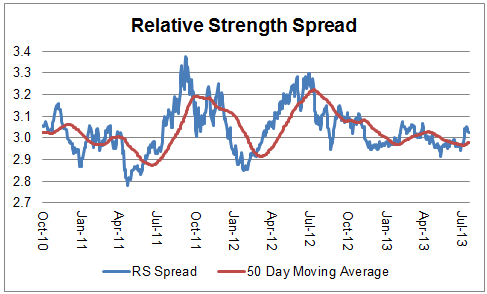
The chart below is the spread between the relative strength leaders and relative strength laggards (universe of mid and large cap stocks). When the chart is rising, relative strength leaders are performing better than relative strength laggards. As of 8/19/2013:

spread 08.20.13 Relative Strength Spread

Posted by:


Is Active Investing Hopeless?

August 19, 2013

Every time I read an article about how active investing is hopeless, I shake my head. Most of the problem is investor behavior, not active investing. The data on this has been around for a while, but is ignored by indexing fans. Consider for example, this article in Wealth Management that discusses a 2011 study conducted by Morningstar and the Investment Company Institute. What they found doesn’t exactly square out with most of what you read. Here are some excerpts:

But studies by Morningstar and the Investment Company Institute (ICI) suggest that fund shareholders may not be so dumb after all. According to the latest data, investors gravitate to low-cost funds with strong track records. “People make reasonably intelligent choices when they pick active funds,” says John Rekenthaler, Morningstar’s vice president of research.

The academic approach produces a distorted picture, says Rekenthaler. “It doesn’t matter what percentage of funds trail the index,” says Rekenthaler. “What matters most is how the big funds do. That’s where most of the money is.”

In order to get a realistic picture of fund results, Rekenthaler calculated asset-weighted returns—the average return of each invested dollar. Under his system, large funds carry more weight than small ones. He also calculated average returns, which give equal weight to each fund. Altogether Morningstar looked at how 16 stock-fund categories performed during the ten years ending in 2010. In each category, the asset-weighted return was higher than the result that was achieved when each fund carried the same weight.

Consider the small-growth category. On an equal-weighted basis, active funds returned 2.89 percent annually and trailed the benchmark, which returned 3.78 percent. But the asset-weighted figure for small-growth funds exceeded the benchmark by 0.20 percentage points. Categories where active funds won by wide margins included world stock, small blend, and health. Active funds trailed in large blend and mid growth. The asset-weighted result topped the benchmark in half the categories. In most of the eight categories where the active funds lagged, they trailed by small margins. “There is still an argument for indexing, but the argument is not as strong when you look at this from an asset-weighted basis,” says Rekenthaler.

The numbers indicate that when they are choosing from among the many funds on the market, investors tend to pick the right ones.

Apparently investors aren’t so dumb when it comes to deciding which funds to buy. Most of the actively invested money in the mutual fund industry is in pretty good hands. Academic studies, which weight all funds equally regardless of assets, don’t give a very clear picture of what investors are actually doing.

Where, then, is the big problem with active investing? There isn’t one—the culprit is investor behavior. As the article points out:

But investors display remarkably bad timing for their purchases and sales. Studies by research firm Dalbar have shown that over the past two decades, fund investors have typically bought at market peaks and sold at troughs.

Active investing is alive and well. (I added the bold.) In fact, the recent trend toward factor investing, which is just a very systematic method for making active bets, reinforces the value of the approach.

The Morningstar/ICI research just underscores that much of the value of an advisor may lie in helping the client control their emotional impulse to sell when they are fearful and to buy when they feel confident. I think this is often overlooked. If your client has a decent active fund, you can probably help them more by combatting their destructive timing than you can by switching them to an index fund. After all, owning an index fund does not make the investor immune to emotions after a 20% drop in the stock market!

Posted by:


Weekly RS Recap

August 19, 2013

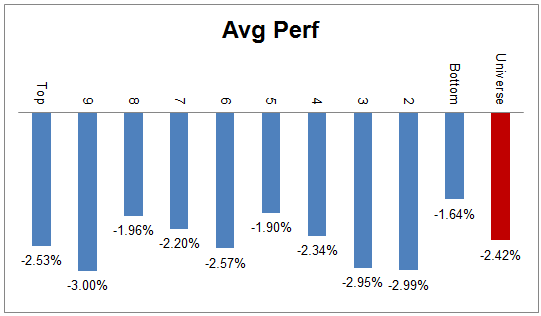
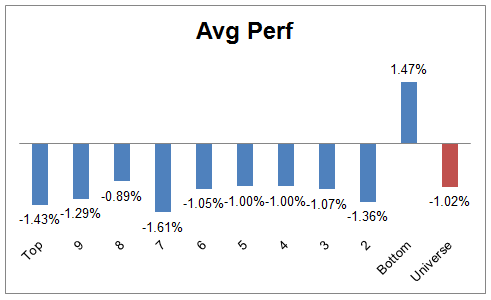
The table below shows the performance of a universe of mid and large cap U.S. equities, broken down by relative strength decile and then compared to the universe return. Those at the top of the ranks are those stocks which have the best intermediate-term relative strength. Relative strength strategies buy securities that have strong intermediate-term relative strength and hold them as long as they remain strong.

Last week’s performance (8/12/13 – 8/16/13) is as follows:

ranks 08.19.13 Weekly RS Recap

Posted by:


Sector Performance

August 16, 2013

The chart below shows performance of US sectors and capitalizations over the trailing 12, 6, and 1 month(s). Performance updated through 8/15/2013.

ranks 08.16.13 Sector Performance

Numbers shown are price returns only and are not inclusive of transaction costs. Source: iShares

Posted by:


Fund Flows

August 15, 2013

Mutual fund flow estimates are derived from data collected by The Investment Company Institute covering more than 95 percent of industry assets and are adjusted to represent industry totals.

ici 08.15.13 Fund Flows

Posted by:


Between Active and Passive

August 13, 2013

Yep, factor investing is somewhere between active and passive investing:

However, factor investing has taken off in recent years along with passive investing, though not nearly at the same torrid pace, as the shift away from actively managed equity funds continues.

“Passive and factor investing are joined at the hip,” said Samuel Lee, an analyst at Morningstar Inc.

“Passive is based on a lot of academic and finance theory that says it’s impossible to beat the market. Factor investing is an offshoot of that,” Mr. Lee said.

“Factor investors probably started off as Bogle-style buy-and-hold investors, then looked deeper into the research,” he said, referring to The Vanguard Group Inc. founder John Bogle.

The research shows that over time, overweighting companies with favorable prices, profitability, size or momentum can lead to better overall risk-adjusted returns. The key to that, though, is time.

Source: Investment News

Factor investing is passive in its systematic execution, transparency, and relatively low cost and active in its design to be built around return factors that have demonstrated the possibility of outperforming cap-weighted indexes over time.

HT: Abnormal Returns

Posted by:


Gains or Volume?

August 13, 2013

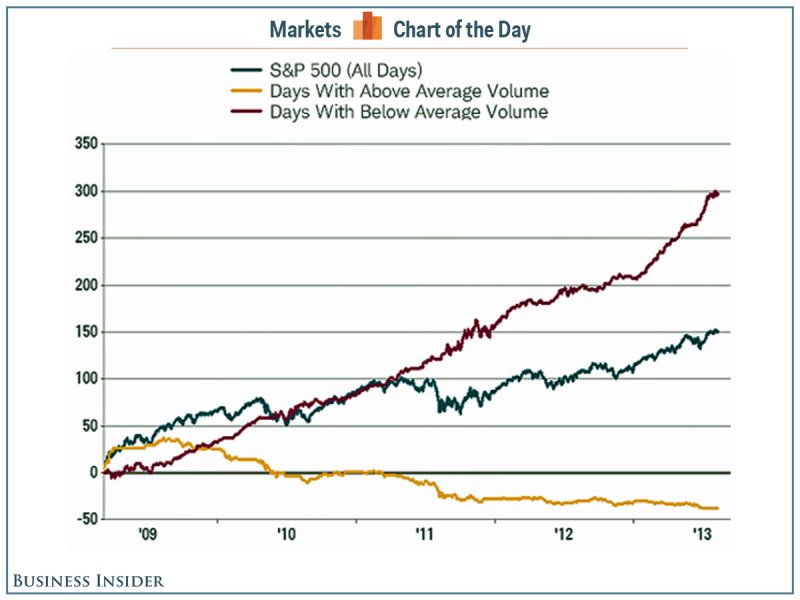
Although many technicians consider volume in their analysis, we have chosen to focus solely on price. As pointed out by Business Insider, those waiting for higher volume to confirm this uptrend are still waiting:

Almost every day since the the bull market began in March 2009, some stock market pundit has complained about low trading volumes.

Some fear that low volume means sell-offs could turn sharp due to lack of liquidity.

However, Charles Schwab’s Liz Ann Sonders points us to this interesting counterintuitive chart from the Bespoke Investment Group.

“The chart breaks out performance the current bull market based on days when volume (using the SPY exchange-traded fund as a proxy) has been above and below its 50-day moving average,” explained Sonders.

“On a cumulative basis, the S&P would be up nearly 300% if you were only invested on the days when volume was below average,” she added. “That’s nearly double the return of the entire bull market! On the other hand, if you were only invested when volume was above average, you would actually be down 37%. Complain if you’d like, but gains are preferred over volume, no?”

“Market bears seem never to be short reasons for gloom; but valuation and volume shouldn’t be among them,” she said.

volume Gains or Volume?


Posted by:


Relative Strength Spread

August 13, 2013

The chart below is the spread between the relative strength leaders and relative strength laggards (universe of mid and large cap stocks). When the chart is rising, relative strength leaders are performing better than relative strength laggards. As of 8/12/2013:

spread 08.13.13 Relative Strength Spread

Posted by:


Weekly RS Recap

August 12, 2013

The table below shows the performance of a universe of mid and large cap U.S. equities, broken down by relative strength decile and then compared to the universe return. Those at the top of the ranks are those stocks which have the best intermediate-term relative strength. Relative strength strategies buy securities that have strong intermediate-term relative strength and hold them as long as they remain strong.

Last week’s performance (8/5/13 – 8/9/13) is as follows:

ranks 08.12.13 Weekly RS Recap

Posted by:


Relative Strength Environments

August 9, 2013

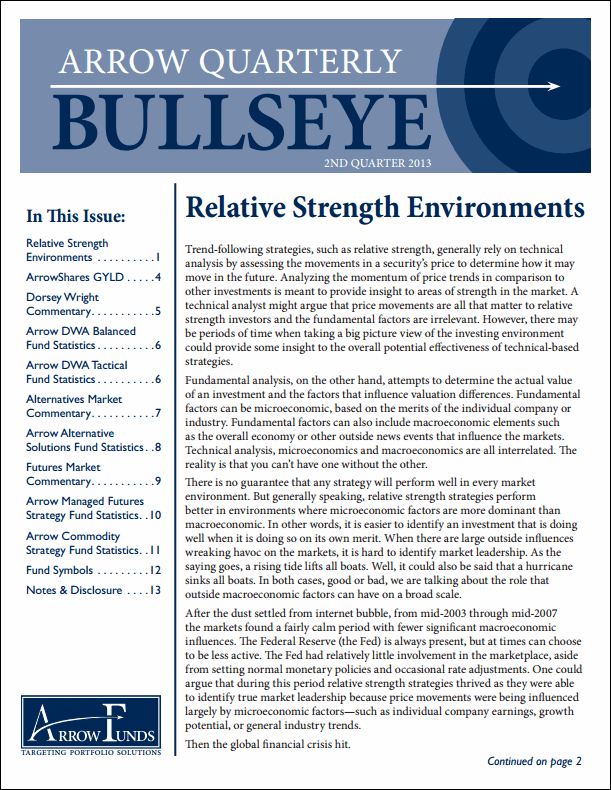
What market environments are best for relative strength strategies? Our partners at Arrow Funds recently completed a nice research piece that addresses that question. The essential factors are correlations and dispersions (both of which are looking better for relative strength by the way). Click below to read the report.

RS Environments Relative Strength Environments

Posted by:


Client Sentiment Survey - 8/9/13

August 9, 2013

Here we have the next round of the Dorsey, Wright Sentiment Survey, the first third-party sentiment poll. Participate to learn more about our Dorsey, Wright Polo Shirt raffle! Just follow the instructions after taking the poll, and we’ll enter you in the contest. Thanks to all our participants from last round.

As you know, when individuals self-report, they are always taller and more beautiful than when outside observers report their perceptions! Instead of asking individual investors to self-report whether they are bullish or bearish, we’d like financial advisors to weigh in and report on the actual behavior of clients. It’s two simple questions and will take no more than 20 seconds of your time. We’ll construct indicators from the data and report the results regularly on our blog–but we need your help to get a large statistical sample!

Click here to take Dorsey, Wright’s Client Sentiment Survey.

Contribute to the greater good! It’s painless, we promise.

Posted by:


July Arrow DWA Funds Review

August 9, 2013

7/31/2013

The Arrow DWA Balanced Fund (DWAFX)

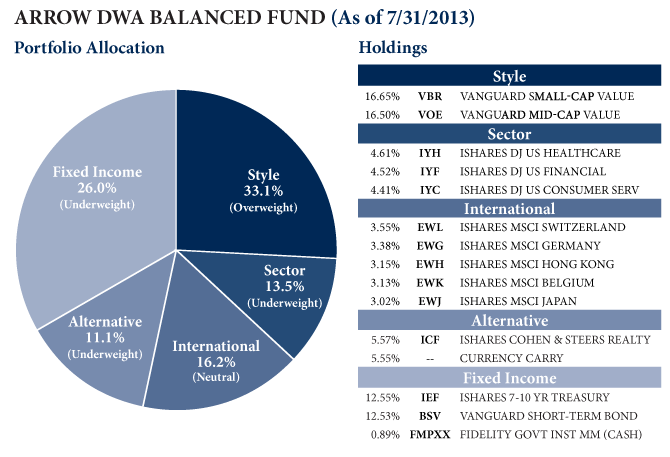
At the end of July, the fund had approximately 46% in U.S. Equities, 26% in Fixed Income, 16% in International Equities, and 11% in Alternatives. U.S. equities, our biggest overweight, had a very strong July after pulling back slightly in June. Among our best performing holdings were our positions in Healthcare and Small-Cap Value for the month of July. U.S. equities continue to be the dominant asset class from a relative strength perspective. Developed international equities continued their trend of outperforming Emerging Markets in July. European Central Bank President Mario Draghi sought to dispel doubts about the strength of the central bank’s recent guidance on interest rates by recently reaffirming its commitment to keep borrowing costs low for as long as Europe struggles to recover. The European equity markets responded favorably to those statements. We saw strong performance from our positions in Belgium and Germany in July. Reflecting the superior relative strength of Developed International Markets versus Emerging Markets, all five of our current international equity holdings are from Developed International Markets. After spiking higher in June on fears of Fed tapering of its quantitative easing program, interest rates were fairly stable in July. Our Fixed Income holdings remain near their lower constraint as this asset classes has been among the biggest laggards so far in 2013. Our Alternative holdings of real estate and a currency carry trade were fairly flat in July.

DWAFX gained 3.38% in July and is up 8.95% through 7/31/13.

We believe that a real strength of this strategy is its balance between remaining diversified, while also adapting to market leadership. When an asset class is weak its exposure will tend to be towards the lower end of the exposure constraints, and when an asset class is strong its exposure in the fund will trend toward the upper end of its exposure constraints. Relative strength provides an effective means of determining the appropriate weights of the strategy.
dwafx 08.09.13 July Arrow DWA Funds Review

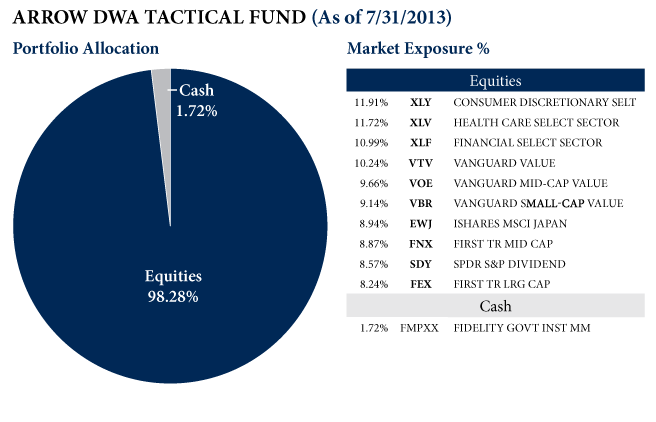
The Arrow DWA Tactical Fund (DWTFX)

At the end of July, the fund had approximately 90% in U.S. Equities and 9% in International Equities. The U.S. equity markets again broke out to a new all-time high in July. It has been more than 10 years since we have seen this kind of superior relative strength of U.S. equities compared to fixed income, international markets, real estate, and commodities. The nature of this strategy is to be flexible enough to adapt to new market environments and the market environment that we are seeing now has little in common with what we have seen for over a decade. For the year, small and mid-cap equities have had better relative strength than large caps and we have a number of small and mid-cap positions in the fund. We have seen fairly stable sector leadership this year with Healthcare, Consumer Discretionary, and Financials. According to Morningstar, this fund is currently outperforming 99% of its peers in the World Allocation category YTD. As trend followers, we benefit from environments with stable leadership and we are seeing that now.

DWTFX was up 5.03% in July and has gained 14.93% through 7/31/13.

This strategy is a go-anywhere strategy with very few constraints in terms of exposure to different asset classes. The strategy can invest in domestic equities, international equities, inverse equities, currencies, commodities, real estate, and fixed income. Market history clearly shows that asset classes go through secular bull and bear markets and we believe this strategy is ideally designed to capitalize on those trends. Additionally, we believe that this strategy can provide important risk diversification for a client’s overall portfolio.
dwtfx 08.09.13 July Arrow DWA Funds Review

Posted by:


Sector Performance

August 9, 2013

The chart below shows performance of US sectors and capitalizations over the trailing 12, 6, and 1 month(s). Performance updated through 8/8/2013.

s c 08.09.13 Sector Performance

Numbers shown are price returns only and are not inclusive of transaction costs. Source: iShares

Posted by:


Fund Flows

August 8, 2013

Mutual fund flow estimates are derived from data collected by The Investment Company Institute covering more than 95 percent of industry assets and are adjusted to represent industry totals.

ici 08.08.13 Fund Flows

Posted by: