Weekly RS Recap

September 30, 2013

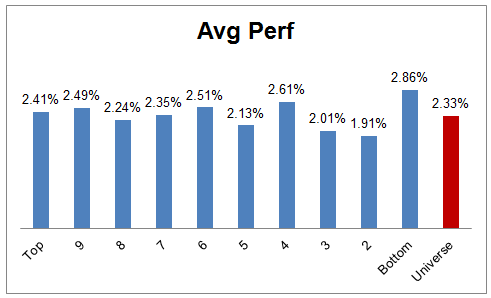
The table below shows the performance of a universe of mid and large cap U.S. equities, broken down by relative strength decile and then compared to the universe return. Those at the top of the ranks are those stocks which have the best intermediate-term relative strength. Relative strength strategies buy securities that have strong intermediate-term relative strength and hold them as long as they remain strong.

Last week’s performance (9/23/13 – 9/27/13) is as follows:

ranks 09.30.13 Weekly RS Recap

Posted by:


Quote of the Week

September 28, 2013

CAPE, the popular cyclically adjusted P/E ratio, for the S&P 500 has signaled an “overvalued” market in all but nine months in the last 22 years. Financial metrics can make lots of sense in theory but be flawed in practice.—-Morgan Housel, Motley Fool

You can always find some reason not to invest, or you can just let the trend be your friend.

Posted by:


Momentum Coming of Age

September 27, 2013

We’ve come a long way from the days of ”Wall Street is a random walk, and past price movements tell you nothing about the future,” as advocated by Efficient Market Hypothesis (EMH) proponents Burton Malkiel and Eugene Fama in the 1960s and 1970s. While practioners have been using relative strength strategies since at least the 1930s (Richard Wyckoff, H.M. Gartley, Robert Levy, George Chestnut, and many others), most academics stayed fairly loyal to the EMH until the early 1990s. Wesley Gray, PhD, of Turnkey Analyst, summarizes how academic studies on momentum in the early 1990s started to turn the tide in a academic community:

In the early 90s academics (e.g., Jagadeesh and Titman (1993) began to focus on the concept of “momentum,” which refers to the fact that, contrary to the EMH, past returns can predict future returns, via a trend effect. That is, if a stock has performed well in the recent past, it will continue to perform well in the future. EMH proponents were perplexed, but argued that momentum returns were likely related to additional risks borne: riskier smaller and cheaper companies drove the effect. Many researchers have responded with studies that find the effect persists even when controlling for company size and value factors. And the effect appears to hold across multiple asset classes, such as commodities, currencies and even bonds. (e.g., Check out Chris Geczy’s “World’s Longest Backtest”).

momentum Momentum Coming of Age

An EMH advocate reviews the momentum data

It seems that much of the research on momentum today is moving beyond the initial question of “Is it possible that momentum really does work?” to trying to better understand why it works.

Again, from Wesley Gray:

In short, it appears the evidence for momentum is only growing stronger (Gary Antonacci has some great research on the subject: http://optimalmomentum.blogspot.com/). Today researchers are going even farther by applying behavioral finance concepts in order to understand psychological factors that drive the momentum effect.

In “Demystifying Managed Futures,” by Brian Hurst, Yao Hua Ooi, and Lasse Heje Pedersen, the authors argue that the returns for even the largest and most successful Managed Futures Funds and CTAs can be attributed to momentum strategies. They also discuss a model for the lifecycle of a trend, and then draw on behavioral psychology to hypothesize the cognitive mechanisms that drive the underlying momentum effect. Below is a graph of a typical trend:

trend Momentum Coming of Age

Note that there are several distinct components to the trend: 1) initial under-reaction, when market price is below fundamental value, 2) over-reaction, as the market price exceeds fundamental value, and 3) the end of the trend, when the price converges with fundamental value. There are several behavioral biases that may systematically contribute to these components.

Under-reaction phase:

Adjustment and Anchoring. This occurs when we consider a value for a quantity before estimating that quantity. Consider the following 2 questions posed by Kahneman: Was Gandhi more or less than 144 years old when he died? How old was Gandhi when he died? Your guess was affected by the suggestion of his advanced age, which led you to anchor on it and then insufficiently adjust from that starting point, similar to how people under-react to news about a security. (also, Gandhi died at 79)

The disposition effect. This is the tendency of investors to sell their winners too early and hold onto losers too long. Selling early creates selling pressure on a long in the under-reaction phase, and reduces selling pressure on a short in the under-reaction phase, thus delaying the price discovery process in both cases.

Over-reaction phase:

Feedback trading and the herd effect. Traders follow positive feedback strategies. For instance, George Soros has described his concept of “reflexivity,” which involves buying in anticipation of further buying by uninformed investors in a self-reinforcing process. Additionally, herding can be a defense mechanism occurring when an animal reduces its risk of being eaten by a predator by staying with the crowd. As Charles MacKay put it in 1841 in his book, Extraordinary Popular Delusions and Madness of Crowds, “Men, it has been well said, think in herds; it will be seen that they go mad in herds, while they only recover their senses slowly, and one by one.”

Gray concludes:

The growing academic body of work supporting the existence of the momentum effect, along with a sensible psychological framework that explains it, are a potent combination. Indeed, momentum may have come of age as an investment tool, as more and more investors incorporate it into their portfolios.

Dorsey Wright has been refining work on relative strength/momentum for decades and the recent milestone of the PowerShares DWA Momentum ETFs (PDP, PIZ, PIE, and DWAS) passing $2 billion in assets is further confirmation that “momentum is coming of age.” Furthermore, users of the Dorsey Wright research have a great number of relative strength-based tools (RS Matrix, Favored Sector, Dynamic Asset Level Investing, Technical Attributes…) at their fingertips to be able to customize relative strength-based strategies for their clients. It’s been a long time coming, and acceptance of momentum still has a long way to go, but it is encouraging to see this factor begin to get the recognition that I believe it is due.

Posted by:


Underperformance

September 26, 2013

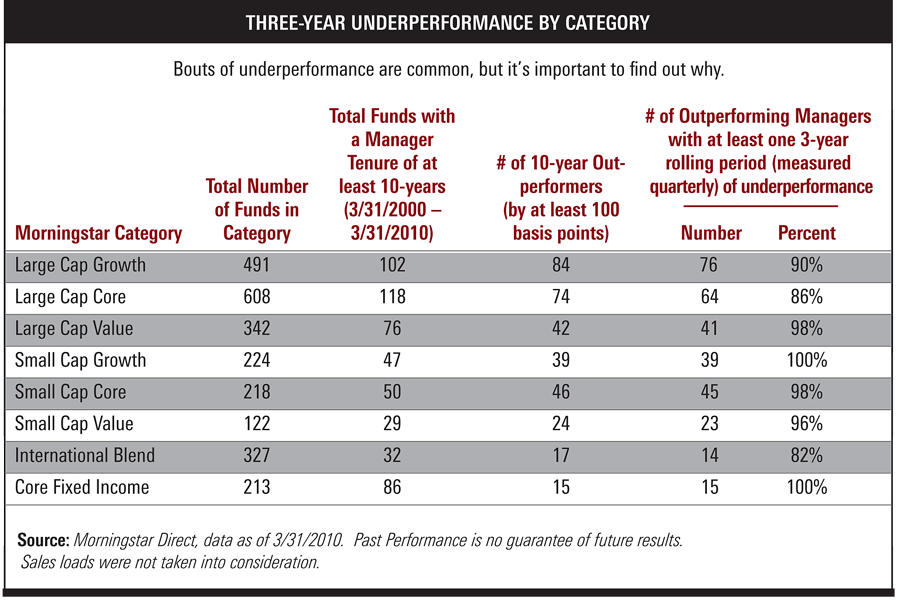
Whether you are an investment manager or a client, underperformance is a fact of life, no matter what strategy or methodology you subscribe to. If you don’t believe me, take a look at this chart from an article at ThinkAdvisor.

underperformancebouts zps8212b96b Underperformance

Source: Morningstar, ThinkAdvisor (click on image to enlarge)

Now, this chart is a little biased because it is looking at long periods of underperformance—3-year rolling periods—from managers that had top 10-year track records. In other words, these are exactly the kinds of managers you would hope to hire, and even they have long stretches of underperformance. When things are going well, clients are euphoric. Clients, though, often feel like even short periods of underperformance mean something is horribly wrong.

The entire article, written by Envestnet’s J. Gibson Watson, is worth reading because it makes the point that simply knowing about the underperformance is not very helpful until you know why the underperformance is occurring. Some underperformance may simply be a style temporarily out of favor, while other causes of underperformance might suggest an intervention is in order.

It’s quite possible to have a poor experience with a good manager if you bail out when you should hang in. Investing well can be simple, but that doesn’t mean it will be easy!

Posted by:


Fund Flows

September 26, 2013

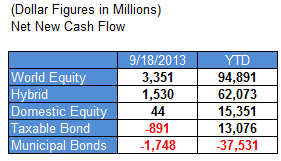
Mutual fund flow estimates are derived from data collected by The Investment Company Institute covering more than 95 percent of industry assets and are adjusted to represent industry totals.

ici 09.26.13 Fund Flows

Posted by:


The Case for Systematic Decision-Making

September 25, 2013

From Wes Gray comes an excellent video about expert decision making versus model-based decision making. Well worth the 17 minutes.

Posted by:


High RS Diffusion Index

September 25, 2013

The chart below measures the percentage of high relative strength stocks that are trading above their 50-day moving average (universe of mid and large cap stocks.) As of 9/24/13.

diffusion 09.25.13 High RS Diffusion Index

The 10-day moving average of this indicator is 78% and the one-day reading is 76%.

Posted by:


From the Archives: Market Anxiety Disorder

September 24, 2013

A recent article in the Personal Finance section of the Wall Street Journal had a prescription for anxious investors that Andy has been talking about for more than a year: consider asset allocation funds. Our Global Macro separate account has been very popular, partly because it allows investors to get into the market in a way that can be conservative when needed, but one that doesn’t lock investors into a product that can only be conservative.

The stock market’s powerful rally over the past year has gone a long way toward reducing the losses that many mutual-fund investors suffered in late 2007 and 2008.

But the rebound—with the Standard & Poor’s 500-stock index up 74% from its March 9, 2009, low—has done nothing for one group of investors: those who bailed out of stocks and have remained on the sidelines. Some of these investors have poured large sums into bond funds, even though those holdings may take a beating whenever interest rates rise from today’s unusually low levels, possibly later this year. Some forecasters, meanwhile, believe that stocks may finish 2010 up as much as 10%.

So, for investors who want to step back into stocks but are still anxious, here’s a modest suggestion: You don’t have to take your stock exposure straight up. You can dilute it by buying an allocation fund that spreads its assets across many market sectors, from stocks and bonds to money-market instruments and convertible securities.

While the WSJ article is a good general introduction to the idea, I think there are a few caveats that should be mentioned.

There’s still a big difference between a strategic asset allocation fund and a tactical asset allocation fund.

Many [asset allocation funds] keep their exposures within set ranges, while others may vary their mix widely.

Your fund selection will probably depend a lot on the individual client. A strategic asset allocation fund will more often have a tight range or even a fixed or target allocation for stocks or bonds. This can often target the volatility successfully–but can hurt returns if the asset classes themselves are out of favor. Tactical funds will more often have broader ranges or be unconstrained in terms of allocations. This additional flexibility can lead to higher returns, but it could be accompanied by higher volatility.

One thing the article does not mention at all, unfortunately, is that you also have a choice between a purely domestic asset allocation fund or a global asset allocation fund. A typical domestic asset allocation fund will provide anxious investors with a way to ease into the market, but will ignore many of the opportunities in international markets or in alternative assets like real estate, currencies, and commodities. With a variety of possible scenarios for the domestic economy, it might make sense to cast your net a little wider. Still, the article’s main point is valid: an asset allocation fund, especially a global asset allocation fund, is often a good way to deal with a client’s Market Anxiety Disorder and get them back into the game.

—-this article originally appeared 4/7/2010. Investors still don’t like this rally, even though we are a long way down the road from 2010! An asset allocation fund might still be a possible solution.

Posted by:


Relative Strength Spread

September 24, 2013

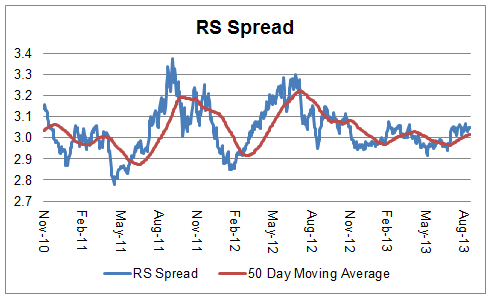
The chart below is the spread between the relative strength leaders and relative strength laggards (universe of mid and large cap stocks). When the chart is rising, relative strength leaders are performing better than relative strength laggards. As of 9/23/2013:

spread 09.24.13 Relative Strength Spread

Posted by:


On the Riskiness of a 60/40 Portfolio

September 23, 2013

The Capital Spectator weighs in on the riskiness of the traditional 60/40 portfolio:

It’s important to recognize that the US 60/40 strategy is a relatively risky allocation mix—one that’s paid off handsomely of late, but one that comes with higher risk vs. GMI or its equivalent.

The issue, of course, is that the US 60/40 strategy is cherry picking from the menu of global asset classes. The fact that this US-centric portfolio has delivered handsome gains will be mistakenly interpreted by some that more of the same is fate. Maybe, but maybe not. If we could muster a high degree of confidence about which asset classes would win or lose, we wouldn’t need to diversify globally. But in a world where uncertainty and surprise are forever harassing the best laid strategies of mice and men, the reality is somewhat different.

Good argument for employing a globally diversified portfolio.

HT: Abnormal Returns


Posted by:


Quote of the Week

September 23, 2013

When most people say they want to be a millionaire, what they really mean is “I want to spend a million dollars,” which is literally the opposite of being a millionaire.—-Morgan Housel, Motley Fool

Saving and investing intelligently make you wealthy, not spending. I know—seems obvious—but that’s not how most people act.

Posted by:


Weekly RS Recap

September 23, 2013

The table below shows the performance of a universe of mid and large cap U.S. equities, broken down by relative strength decile and then compared to the universe return. Those at the top of the ranks are those stocks which have the best intermediate-term relative strength. Relative strength strategies buy securities that have strong intermediate-term relative strength and hold them as long as they remain strong.

Last week’s performance (9/16/13 – 9/20/13) is as follows:

ranks 09.23.13 Weekly RS Recap

Posted by:


Emerging Markets Picking Up

September 20, 2013

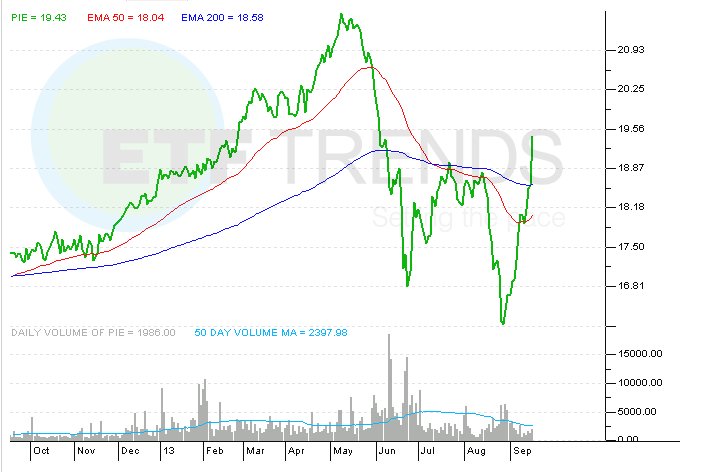
Tom Lydon covers the huge spike in PIE and other Emerging Market ETFs over the last week:

Emerging markets ETFs had been perking up for several weeks, but the group got the lift it really needed Wednesday when the Federal Reserve eschewed tapering. The U.S. central bank said its $85 billion in monthly bond purchases will remain in place and those comments could be just what the doctor ordered when it comes to confirming a significant rally for emerging markets ETFs.

There were multiple examples of the intensity with which emerging markets ETFs rallied on Wednesday. The Vanguard FTSE Emerging Markets ETF (VWO) jumped 4% while the iShares MSCI Brazil Capped ETF (EWZ) soared 5.1% and those are just two examples. With a Wednesday gain of 4.6%, the PowerShares DWA Emerging Markets Technical Leaders Portfolio (PIE) belongs on the list of emerging markets “no tapering” beneficiaries.

PIE does not follow the same cap-weighted methodology used by VWO and other larger, diversified emerging markets ETFs. Rather, PIE tracks the Dorsey Wright Emerging Markets Technical Leaders Index, which ranks its components based on relative strength traits. PIE and its index rebalance quarterly. That methodology previously helped PIE thwart larger rivals like VWO. Earlier this year when the BRIC nations were lagging, PIE was beating its rivals because it had scant BRIC exposure.

However, PIE was left vulnerable to the tapering-induced emerging markets swoon that started in earnest in May. Although PIE was not highly exposed to BRIC, the fund did have large allocations to some developing markets that waned in the face of tapering talk and higher U.S. interest rates. Think Turkey, Indonesia and Thailand as a few examples.

With tapering off the table, PIE could be in a position to thrive again. The ETF can hold stocks from the following countries: Argentina, Brazil, Chile, China, Colombia, Czech Republic, Egypt, Hungary, India, Indonesia, Israel, Malaysia, Mexico, Morocco, Pakistan, Peru, Philippines, Poland, Russia, South Africa, Taiwan, Thailand and Turkey.

PowerShares DWA Emerging Markets Technical Leaders Portfolio

PIE Emerging Markets Picking Up

Past performance is no guarantee of future returns. See www.powershares.com for more information.

Posted by:


Stocks for the Long Run

September 20, 2013

Unlike certain authors, I am not promoting some agenda about where stocks will be at some future date! Instead, I am just including a couple of excerpts from a paper by luminaries David Blanchett, Michael Finke, and Wade Pfau that suggests that stocks are the right investment for the long run—based on historical research. Their findings are actually fairly broad and call market efficiency into question.

We find strong historical evidence to support the notion that a higher allocation to equities is optimal for investors with longer time horizons, and that the time diversification effect is relatively consistent across countries and that it persists for different levels of risk aversion.

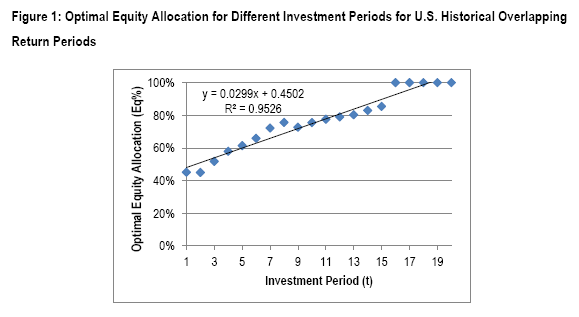
When they examine optimal equity weightings in a portfolio by time horizon, the findings are rather striking. Here’s a reproduction of one of their figures from the paper:

optimalequity zpsa19b1cfd Stocks for the Long Run

Source: SSRN/Blanchett, Finke, Pfau (click to enlarge)

They describe the findings very simply:

Figure 1 also demonstrates how to interpret the results we include later in Tables 2 and 3. In Figure 1 we note an intercept (α) of 45.02% (which we will assume is 45% for simplicity purposes) and a slope (β) of .0299 (which for simplicity purposes we will assume is .03). Therefore the optimal historical allocation to equities for an investor with a 5 year holding period would be 60% stocks, which would be determined by: 45% + 5(3%) = 60%.

In other words, if your holding period is 15-20 years or longer, the optimal portfolio is 100% stocks!

Reality, of course, can be different from statistical probability, but their point is that it makes sense to own a greater percentage of stocks the longer your time horizon is. The equity risk premium—the little extra boost in returns you tend to get from owning stocks—is both persistent and decently high, enough to make owning stocks a good long-term bet.

Posted by:


DWTFX Leading the Pack in 2013

September 20, 2013

Our partners at Arrow Funds have been making the case for some time now that we are generally in a favorable environment for tactical asset allocation (See Relative Strength Environments and Relative Strength Turns). Stable asset class leadership and widening dispersion in performance between the different asset classes have helped the Arrow DWA Tactical Fund rise to the front of the pack in 2013.

dwtfx DWTFX Leading the Pack in 2013

Source: Dorsey Wright, YTD through 9/19/13

morn dwtfx DWTFX Leading the Pack in 2013

Source: Morningstar

Although this fund has wide flexibility to invest in a number of different asset classes, including domestic equities, inverse equities, international equities, currencies, commodities, real estate, and fixed income, this year the allocation has been dominated by equities.


dwtfx hdgs DWTFX Leading the Pack in 2013


Source: Arrow Funds

Past performance is no guarantee of future returns. See www.arrowfunds.com for more information.

Posted by:


Sector Performance

September 20, 2013

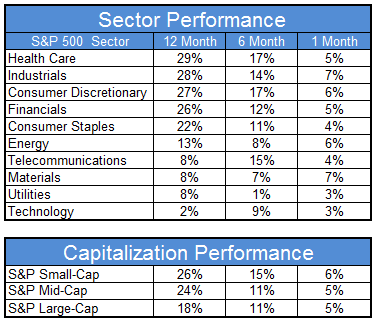
The chart below shows performance of US sectors and capitalizations over the trailing 12, 6, and 1 month(s). Performance updated through 9/19/2013.

gics 09.20.13 Sector Performance

Numbers shown are price returns only and are not inclusive of transaction costs. Source: iShares

Posted by:


From the Archives: Inherently Unstable Correlations

September 19, 2013

No, this is not a post on personality disorders.

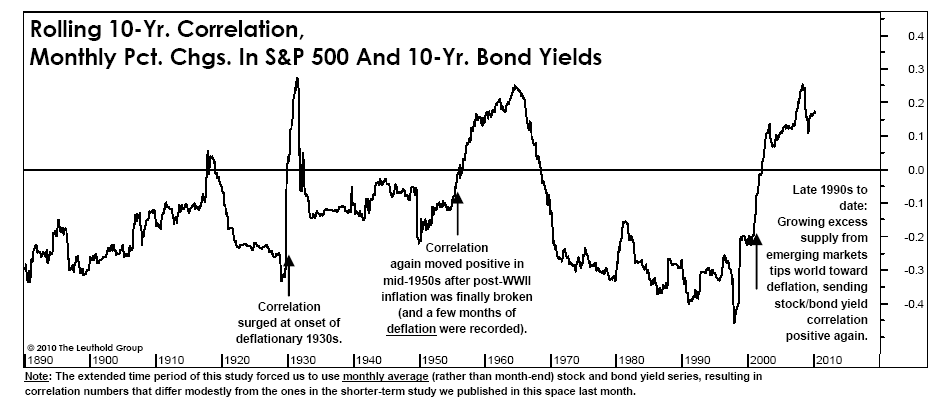
Rather, it is a post on the inherently unstable nature of correlations between securities and between asset classes. This is important because the success of many of the approaches to portfolio management make the erroneous assumption that correlations are fairly stable over time. I was reminded just how false this belief is while reading The Leuthold Group‘s April Green Book in which they highlighted the rolling 10-year correlations in monthly percentage changes between the S&P 500 and the 10-year bond yield. Does this look stable to you? Chart is shown by permission from The Leuthold Group.

Correlation From the Archives: Inherently Unstable Correlations

(Click to Enlarge)

If you are trying to use this data, would you conclude that higher bond yields are good for the stock market or bad? The answer is that the correlations are all over the map. In 2006, William J. Coaker II published The Volatility of Correlations in the FPA Journal. That paper details the changes in correlations between 15 different asset classes and the S&P 500 over a 34-year time horizon. To give you a flavor for his conclusions, he pointed out that Real Estate’s rolling 5-year correlations to the S&P 500 ranged from 0.17 to 0.75, and for Natural Resources the range was -0.34 to 0.49. History is conclusive – correlations are unstable.

This becomes a big problem for strategic asset allocation models that use historical data to calculate an average correlation between securities or asset classes over time. Those models use that stationary correlation as one of the key inputs into determining how the model should currently be allocated. That may well be of no help to you over the next five to ten years. Unstable correlations are also a major problem for “financial engineers” who use their impressive physics and computer programming abilities to identify historical relationships between securities. They may find patterns in the historical data that lead them to seek to exploit those same patterns in the future (i.e. LTCM in the 1990′s.) The problem is that the future is under no obligation to behave like the past.

Many of the quants are smart enough to recognize that unstable correlations are a major problem. The solution, which I have heard from several well-known quants, is to constantly be willing to reexamine your assumptions and to change the model on an ongoing basis. That logic may sound intelligent, but the reality is that many, if not most, of these quants will end up chasing their tail. Ultimately, they end up in the forecasting game. These quants are rightly worried about when their current model is going to blow up.

Relative strength relies on a different premise. The only historical pattern that must hold true for relative strength to be effective in the future is for long-term trends to exist. That is it. Real estate (insert any other asset class) and commodities (insert any other asset class) can be positively or negatively correlated in the future and relative strength models can do just fine either way. Relative strength models make zero assumptions about what the future should look like. Again, the only assumption that we make is that there will be longer-term trends in the future to capitalize on. Relative strength keeps the portfolio fresh with those securities that have been strong relative performers. It makes no assumptions about the length of time that a given security will remain in the portfolio. Sure, there will be choppy periods here and there where relative strength models do poorly, but there is no need (and it is counterproductive) to constantly tweak the model.

Ultimately, the difference between an adaptive relative strength model and most quant models is as different as a mule is from a horse. Both have four legs, but they are very different animals. One has a high probability of being an excellent performer in the future, while the other’s performance is a big unknown.

—-this article originally appeared 4/16/2010. It’s important to understand the difference between a model that relies on historical correlations and a model that just adapts to current trends.

Posted by:


Fund Flows

September 19, 2013

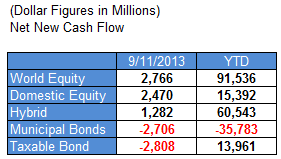
Mutual fund flow estimates are derived from data collected by The Investment Company Institute covering more than 95 percent of industry assets and are adjusted to represent industry totals.

ici 09.19.13 Fund Flows

Posted by:


Tail Risk

September 18, 2013

Tail risk, or sometimes hedging tail risk, has been a hot topic lately. Tail risk is essentially the song of the black swan—it’s what happens when a negative event with a 1% probability happens. Ever since 2008, concern of being caught in another large market decline has caused investors to be very aware of tail risk. Tail risk has also engendered some very interesting exercises in portfolio construction, with all manner of alternative assets.

Consider, however, this from Javier Estrada’s recent paper, Rethinking Risk:

The evidence discussed here, based on a comprehensive sample of 19 countries over 110 years, suggests that investors that focus on uncertainty are likely to view stocks as riskier than bonds, and those that focus on long‐term terminal wealth are likely to view stocks as less risky than bonds even if they are concerned with tail risks. This is the case because, even when tail risks do materialize, investors are more likely to have a higher terminal wealth (that is, more capital at the end of the holding period) by investing in stocks than by investing in bonds.

In other words, a lot of your definition of risk depends on whether you view risk as uncertainty (volatility, standard deviation) or you are focused on terminal wealth—how much money you have at the end of the day.

Here’s another important excerpt:

Obviously, it is for nobody but the investor himself to say what lets him sleep at night. That being said, Charlie Munger, Warren Buffett’s longtime partner at Berkshire, has some advice for investors in the setting described. In fact, Munger (1994) argues that if “you’re investing for 40 years in some pension fund, what difference does it make if the path from start to finish is a little more bumpy or a little different than everybody else’s so long as it’s all going to work out well in the end? So what if there’s a little extra volatility.”

To be sure, there may be long‐term investors that simply cannot help being concerned with, and react to, the short‐term fluctuations in the value of their portfolios. And if that is the case, short‐term volatility is how they assess risk and little of what is discussed in this article may be relevant to them. That being said, would it not make sense to at least also worry about whether a conservative strategy will, by the end of the holding period, enhance purchasing power or underperform an aggressive strategy by a wide margin?

Granted, an investor may be fully aware that a conservative strategy is likely to underperform an aggressive one and still be happy with choosing the former if he is concerned with tails risks, such as a big loss close to the end of the holding period, or a holding period of very low stock returns, however unlikely they may be. And yet, should not this investor also consider whether he will be better off (that is, end with a higher terminal wealth) by pursuing an aggressive strategy even in the case that tail risks do materialize?

That last part is critical. It is clear that the longer is the holding period the more likely is a riskier strategy to outperform a less risky one; that is, in fact, what theory suggests and what the evidence shows. And yet some investors may stay away from an aggressive strategy simply out of fear of tail risks without grasping that, even if these risks do materialize, their terminal wealth is likely to be higher than with a conservative strategy.

Pretty interesting stuff. The author notes that there are times and conditions when concern with volatility could dominate, but if you are talking about a long investment period, the data shows that being overly conservative can impact terminal wealth more negatively than tail risk. (I added the bold.)

This is just another way to point out that the costs you can measure (volatility, drawdown) are often swamped by the cost you cannot measure directly—opportunity cost.

Despite being embedded into Modern Portfolio Theory, volatility might not be the only kind of risk that matters. (In fact, I’ve pointed out that one handy use of volatility is to add on dips. Volatility can be harnessed productively in certain situations.) I am not suggesting that risk management be tossed aside, but if your primary concern is terminal wealth, you need to think about portfolio construction in a nuanced way.

Posted by:


Running to Cash

September 18, 2013

When investors are fearful, they often run to cash to try to protect themselves. However, most investors are fearful at the wrong times, so often they protect themselves from gains. Josh Brown of The Reformed Broker wrote such a good piece on this that I just had to include his awesome checklist here!

I went to cash because (please check one):

1. Sequestration

2. The Taper

3. Obamacare

4. Debt Ceiling

5. Egypt Revolution

6. Portuguese Bond Auctions

7. US Elections

8. Syria Threat

9. Sharknado

10. Chinese GDP

11. London Whale

12. High Frequency Trading

13. Nasdaq Freeze

14. Grexit

15. Marc Faber web video appearance on cnbc.com

16. Larry Summers

17. Low Volume

18. CAPE Valuation

19. Hindenburg Omen

20. Death Cross

21. Other (please explain): _____________

I don’t think Mr. Brown is necessarily suggesting that cash is never a good idea, but he is poking a little fun at the many excuses investors use to raise cash to make themselves feel better.

If emotional investing is not a good idea, what should investors be doing? While this is not an exhaustive list, here are some thoughts that might make raising cash a little less random—including some other ways to deal with portfolio volatility.

  • consider that good diversification is one way to deal with occasional bouts of portfolio discomfort. We often talk about diversifying by volatility, by asset class, and by strategy.
  • consider the use of a long-term moving average to raise cash on individual securities or the overall market. Using a moving average is not likely to help your returns, but it typically reduces volatility.
  • consider making no major portfolio changes when the market is within 8-10% of its recent high. 8-10% fluctuations are normal, fairly frequent, and shouldn’t warrant wholesale portfolio changes.
  • consider using relative performance when it is time to reduce your exposure. In other words, sell what’s been performing the worst (instead of hoping it will rebound) and hold on to the strongest performers.

There’s no perfect way to manage a portfolio. Every investor makes plenty of mistakes along the way, but minimizing the negative effects of those mistakes can really help in the long run.

Posted by:


From the Archives: Mebane Faber’s New White Paper on Relative Strength

September 17, 2013

Mebane Faber recently released a nice white paper, Relative Strength Strategies for Investing, in which he tested relative strength models consisting of US equity sectors from 1926-2009. He also tested relative strength models consisting of global assets like foreign stocks, domestic stocks, bonds, real estate, and commodities from 1973-2009. The relative strength measures that he used for the studies are publicly-known methods based on trailing returns. Some noteworthy conclusions from the paper:

  • Relative strength models outperformed buy-and-hold in roughly 70% of all years
  • Approximately 300-600 basis points of outperformance per year was achieved
  • His relative strength models outperformed in each of the 8 decades studied

I always enjoy reading white papers on relative strength. It is important to mention that the methods of calculating relative strength that were used in Faber’s white paper are publicly-known and have been pointed to for decades by various academics and practitioners. Yet, they continue to work! Those that argue that relative strength strategies will eventually become so popular that they will cease to work have some explaining to do.

—-this article originally appeared 4/20/2010. Of course, the white paper is no longer new at this point, but it is a reminder of the durability of relative strength as a return factor. Every investing method goes through periods of favor and disfavor. Investors are, unfortunately, likely to abandon even profitable methods at the worst possible time. This paper is a good reminder that return factors are durable, but patience may be required to harvest those returns. Most often, the investor that sticks to it will be rewarded.

Posted by:


Relative Strength Spread

September 17, 2013

The chart below is the spread between the relative strength leaders and relative strength laggards (universe of mid and large cap stocks). When the chart is rising, relative strength leaders are performing better than relative strength laggards. As of 9/16/2013:

RS Spread 09.17.13 Relative Strength Spread

Posted by:


Weekly RS Recap

September 16, 2013

The table below shows the performance of a universe of mid and large cap U.S. equities, broken down by relative strength decile and then compared to the universe return. Those at the top of the ranks are those stocks which have the best intermediate-term relative strength. Relative strength strategies buy securities that have strong intermediate-term relative strength and hold them as long as they remain strong.

Last week’s performance (9/9/13 – 9/13/13) is as follows:

ranks 09.16.13 Weekly RS Recap

Posted by:


Hope for the Great Rotation?

September 13, 2013

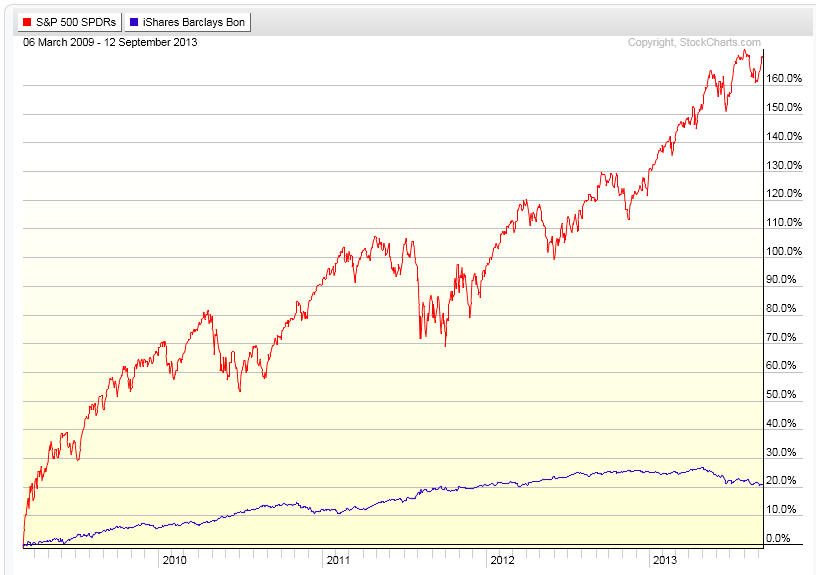
Numerous market observers over the past few years have wondered about the timing of ”the great rotation,” wherein investors would begin to rotate some of their massive bond holdings into the equity market. When would the great rotation happen, or would it happen at all?

There has been a big return differential in stocks and bonds—much in favor of stocks—since the market bottom in 2009, but that did not convince investors to leave the bond market. Stocks were doing great, but bonds were still going up.

stockbonddifferential zpsd9687824 Hope for the Great Rotation?

Stock-Bond Return Differential since 2009 Bottom

(click on image to enlarge)

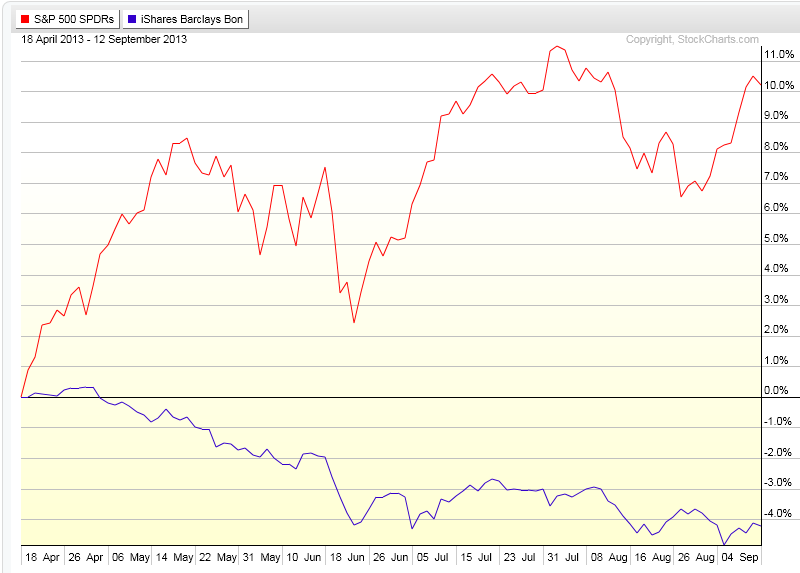
It’s only been quite recently that bond total returns have actually been negative. Maybe that will be the straw that breaks the camel’s back.

stockbonddifferential2 zpsde0e1aa4 Hope for the Great Rotation?

Stock-Bond Return Differential: Short-term View

(click on image to enlarge)

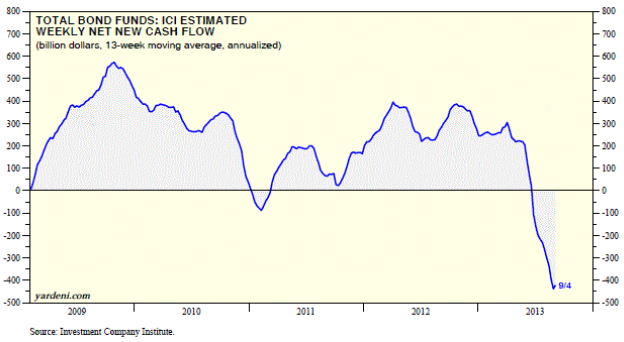
Dr. Ed Yardeni, an economist both respected and practical (which makes him very rare indeed!), suggests that we may possibly be seeing the beginnings of the great rotation. He writes:

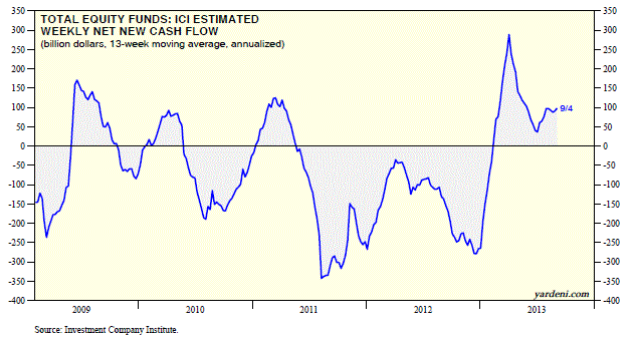
Over the past 13 weeks through the week of August 28, the Investment Company Institute estimates that bond funds had net cash outflows totaling $438 billion at an annual rate. Over the same period, equity funds had net cash inflows of $92 billion at an annual rate. I wouldn’t describe that as a “Great Rotation” just yet, but it could be the start of a big swing by retail investors into equities.

He accompanied his note with a couple of graphics that are interesting.

bondflow zps45dcaf66 Hope for the Great Rotation?

Source: Dr. Ed’s Blog (click on image to enlarge)

equityflow zpsf9bce516 Hope for the Great Rotation?

Source: Dr. Ed’s Blog (click on image to enlarge)

Things could certainly go the other way—all we really have right now are green shoots—but the implications of a great rotation could be significant.

One big reason for that is the difference in relative size of the stock and bond markets. I looked at current SIFMA data on bonds outstanding and found it was about $38.6 trillion. Total market capitalization for the Wilshire 5000, a super-broad stock index, is about $19.9 trillion right now. Stocks are only about 34% of the capital markets. The total US bond market is almost twice as large! Even money that migrates from the margin of the bond market has the potential to move the stock market quite a bit. (Global capital markets are even more lopsided, with the bond market estimated to be about 3 times larger than the equity market.)

I don’t know if we will see the great rotation going forward, but if the markets get even a whiff that we will, it could be pretty fun.

Posted by:


Quote of the Week

September 13, 2013

There are now more hedge funds in the U.S. than there are Taco Bells. This explains why the average hedge fund manager is about as talented as a bean burrito.—-Morgan Housel, Motley Fool

Posted by: