From the Archives: The Imprecision of Value

September 12, 2013

One of the reasons that we like to use relative strength as a return factor is its precision, its lack of assumptions, and its universality–basically its ability to rank even very disparate assets.

Although value managers often discuss assets or stocks that are undervalued, there is little agreement on how value works. Take, for example, a Bloomberg story from today, entitled U.S. Stocks Cheapest Since 1990 on Analyst Estimates. With a title like that, you would expect an article that discusses how cheap stocks are relative to earnings. And, indeed, the article cites such a source:

“The stock market is incredibly inexpensive,” said Kevin Rendino, who manages $11 billion in Plainsboro, New Jersey, for BlackRock, the world’s largest asset manager. “I don’t know how the bears can argue against how well corporations are doing.”

Not only are stocks cheap, but analysts seem reluctant to buy in, something that strikes me, from a contrary opinion point of view, as unabashedly positive.

While analysts are raising estimates, they’re not boosting investment ratings. Companies ranked “buy” make up 30 percent of all U.S. equities, the data show. That compares with 45 percent in September 2007, a month before the S&P 500 reached its record high of 1,565.15 and began a 17-month plunge that erased $11 trillion from the value U.S. shares.

But hold on a mintue– here is the part I find most fascinating about the article: no one can agree on the valuation. (I guess the tendency to cover both sides of the story in the same article comes from political opinion coverage, where the media thinks they have to give equal time to both sides, whether rational or not.)

David Rosenberg, chief economist of Gluskin Sheff & Associates Inc., says U.S. stocks are poised for losses because they’ve become too expensive. The S&P 500 is valued at 22.1 times annual earnings from the past 10 years, according to inflation-adjusted data since 1871 tracked by Yale University Professor Robert Shiller.

So while you have reputable analysts arguing that the market is cheap, you have equally reputable analysts arguing that the market is expensive! How does that happen? Well, it happens because everyone in the value camp operates from a (sometimes radically) different set of assumptions. Are you using trailing estimates, forward estimates, or 10-year normalized estimates? And, by the way, they are estimates.

Source: DenverPost.com

Relative strength is nice because it is precise. No one argues about what the trailing 6-month or 12-month return was. It’s cut and dried. Although different firms use slightly different relative strength calculations–Dorsey, Wright Money Management has a proprietary method–it is hard to imagine a scenario where there would be much disagreement about the strength or weakness of the same market.

Which is stronger, U.S. stocks or U.S. long-term bonds? Just looking at a comparative chart of the two assets makes it obvious, even to someone not sophisticated in quantitative analysis (SPY vs. TLT).

Click to enlarge. Source: Yahoo! Finance

On the other hand, determining which asset is a better value is quite indeterminate. It all depends on whether you take as your starting point the view that the U.S. stock market is cheap or expensive!

And what happens when you have to value a multi-asset portfolio? How do you determine whether real estate, international stocks, euros, or emerging market bonds are cheaper? The lack of agreed-upon metrics between markets, let alone within an individual market, make this kind of decision a nightmare from a valuation perspective.

Since prior performance is precise, relative strength measurements can be made easily and without argument. Relative strength can easily be used for multi-asset portfolios as well. And finally, the returns from using the relative strength factor are high–as high as the returns from the value factor, and in many studies, higher. Luckily for us, efficient-market types normally decline to use relative strength because theoretically it shouldn’t work! Their loss is our gain.

—-this article originally appeared 4/26/2010. The broad market is up about 40% since this article was written and the debate about valuations is still raging! That alone should tell you that trying to figure out who is right—and whether to invest or not—is not a productive use of time. Relative strength simply indicates what the strongest markets are at any given time.

Posted by:


High RS Diffusion Index

September 11, 2013

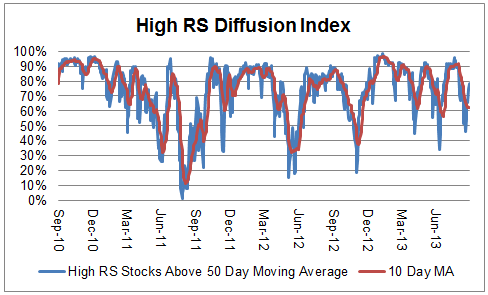
The chart below measures the percentage of high relative strength stocks that are trading above their 50-day moving average (universe of mid and large cap stocks.) As of 9/10/13.

diffusion 09.11.13 High RS Diffusion Index

The 10-day moving average of this indicator is 62% and the one-day reading is 79%.

Posted by:


Relative Strength Spread

September 10, 2013

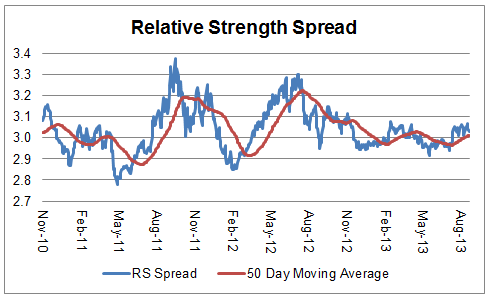
The chart below is the spread between the relative strength leaders and relative strength laggards (universe of mid and large cap stocks). When the chart is rising, relative strength leaders are performing better than relative strength laggards. As of 9/9/2013:

RS Spread 09.10.13 Relative Strength Spread

Posted by:


Buy and Hold

September 9, 2013

John Rekenthaler at Morningstar launched into a spirited defense of buy and hold investing over the weekend. His argument is essentially that since markets have bounced back since 2009, buy and hold is alive and well, and any arguments to the contrary are flawed. Here’s an excerpt:

There never was any logic behind the “buy-and-hold is dead” argument. Might it have lucked into being useful? Not a chance. Coming off the 2008 downturn, the U.S. stock market has roared to perhaps its best four and a half years in history. It has shone in absolute terms, posting a cumulative gain of 125% since spring 2009. It has been fabulous in real terms, with inflation being almost nonexistent during that time period. It’s been terrific in relative terms, crushing bonds, cash, alternatives, and commodities, and by a more modest amount, beating most international-stock markets as well. This is The Golden Age. We have lived The Golden Age, all the while thinking it was lead.

Critics will respond that mine is a bull-market argument. That’s backward. “Buy-and-hold is dead” is the strategy that owes its existence to market results. It only appears after huge bear markets, and it only looks good after such markets. It is the oddity, while buy-and-hold is the norm.

Generally, I think Morningstar is right about a lot of things—and Rekenthaler is even right about some of the points he makes in this article. But in broad brush, buy and hold has a lot of problems, and always has.

Here’s where Rekenthaler is indisputably correct:

  • “Buy and hold is dead” arguments always pop up in bear markets. (By the way, that says nothing about the accuracy of the argument.) It’s just the time that anti buy-and-holders can pitch their arguments when someone might listen. In the same fashion, buy and hold arguments are typically made after a big recovery or in the midst of a bull market—also when people are most likely to listen. Everyone has an axe to grind.
  • Buy and hold has looked good in the past, compared to forecasters. As he points out in the article, it is entirely possible to get the economic forecast correct and get the stock market part completely wrong.
  • The 2008 market crash gave the S&P 500 its largest calendar year loss in 77 years. No doubt.

The truth about buy and hold, I think, is considerably more nuanced. Here are some things to consider.

  • The argument for buy and hold rests on hindsight bias. Historical returns in the US markets have been among the strongest in history over very long time periods. That’s why US investors think buy and hold works. If buy and hold truly works, what about Germany, Argentina, or Japan at various time periods? The Nikkei peaked in 1989. Almost 25 years later, the market is still down significantly. Is the argument, then, that only the US is special? Is Mr. Rekenthaler willing to guarantee that US returns will always be positive over some time frame? I didn’t think so. If not, then buy and hold is not a slam dunk either.
  • Individual investors have time frames. We only live so long. A buy and hold retiree in 1929 or 1974 might be dead before they got their money back. Same for a Japanese retiree in 1989. Plenty of other equity markets around the world, due to wars or political crises, have gone to zero. Zero. That makes buy and hold a difficult proposition—it’s a little tough mathematically to bounce back from zero. (In fact, the US and the UK are the only two markets that haven’t gone to zero at some point in the last 200 years.) And plenty of individual stocks go to zero. Does buy and hold really make sense with stocks?
  • Rejecting buy and hold does not have the logical consequence of missing returns in the market since 2009. For example, a trend follower would be happily long the stock market as it rose to new highs.
  • Individual investors, maddeningly, have very individual tolerances for volatility in their portfolios. Some investors panic too often, some too late, and a very few not at all. How that works out is completely path dependent—in other words, the quality of our decision all depends on what happens subsequently in the market. And no one knows what the market will do going forward. You don’t know the consequences of your decision until some later date.
  • In our lifetimes, Japan. It’s funny how buy and hold proponents either never mention Japan or try to explain it away. “We are not Japan.” Easy to say, but just exactly how is human nature different because there is an ocean in between? Just how is it that we are superior? (Because in 1989, if you go back that far, there was much hand-wringing and discussions of how the Japanese economy was superior!)

Every strategy, including buy and hold, has risks and opportunity costs. Every transaction is a risk, as well as an implicit bet on what will happen in the future. The outcome of that bet is not known until later. Every transaction, you make your bet and you take your chances. You can’t just assume buy and hold is going to work forever, nor can you assume it will stop working. Arguments about any strategy being correct because it worked over x timeframe is just a good example of hindsight bias. Buy and hold doesn’t promise good returns, just market returns. Going forward, you just don’t know—nobody knows. Yes, ambiguity is uncomfortable, but that’s the way it is.

That’s the true state of knowledge in financial markets: no one knows what will happen going forward, whether they pretend to know or not.

Posted by:


Weekly RS Recap

September 9, 2013

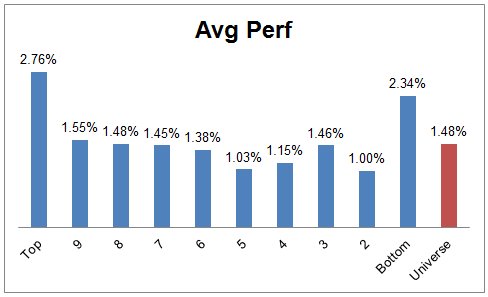
The table below shows the performance of a universe of mid and large cap U.S. equities, broken down by relative strength decile and then compared to the universe return. Those at the top of the ranks are those stocks which have the best intermediate-term relative strength. Relative strength strategies buy securities that have strong intermediate-term relative strength and hold them as long as they remain strong.

Last week’s performance (9/3/13 – 9/6/13) is as follows:


ranks 09.09.13 Weekly RS Recap

Posted by:


August Arrow DWA Funds Review

September 9, 2013

8/31/2013

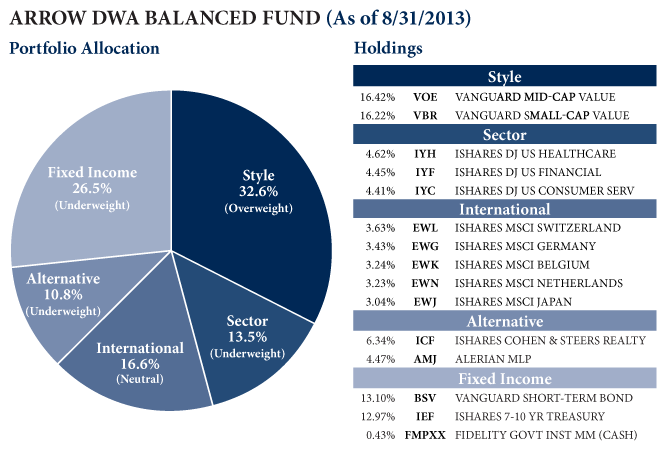
The Arrow DWA Balanced Fund (DWAFX)

At the end of August, the fund had approximately 46% in U.S. Equities, 26% in Fixed Income, 17% in International Equities, and 11% in Alternatives. For the year, our biggest gains have come from our U.S. equity positions, including Healthcare, Financials, Consumer Cyclicals, and Small and Mid-Cap Value. Although little has changed in terms of asset class relative strength (U.S. and Developed International equities remain strong and Fixed Income and Alternatives remain weak), August was a month where those relative strength leaders generally underperformed the relative strength laggards. Such “breathers” are common and don’t necessarily represent the beginnings of a change in trend. Of course, we monitor these relative strength rankings daily and will make changes when necessary.

We did have a few trades in August. In our International equity sleeve, Hong Kong was removed and the Netherlands were added. Our International equity exposure is now almost entirely to Europe. Although perhaps surprising to many who are just looking at the weak economic growth in Europe and high unemployment, many European equity markets have been performing relatively well. In our Alternative sleeve, we also had a change. Our currency carry trade was removed and was replaced with MLPs. The U.S. dollar remains one of the strongest currencies, while currencies like the Japanese Yen and Australian dollar have been weak. MLPs have been the one bright spot in the Alternative space this year, while others, especially commodities have generally not performed well. Real estate, which we also own, had a good start to the year, but has been weakening as the move higher in interest rates has picked up stream.

DWAFX lost 3.05% in August, but is up 5.63% through 8/31/13.

We believe that a real strength of this strategy is its balance between remaining diversified, while also adapting to market leadership. When an asset class is weak its exposure will tend to be towards the lower end of the exposure constraints, and when an asset class is strong its exposure in the fund will trend toward the upper end of its exposure constraints. Relative strength provides an effective means of determining the appropriate weights of the strategy.

dwafx 08.31.13 August Arrow DWA Funds Review

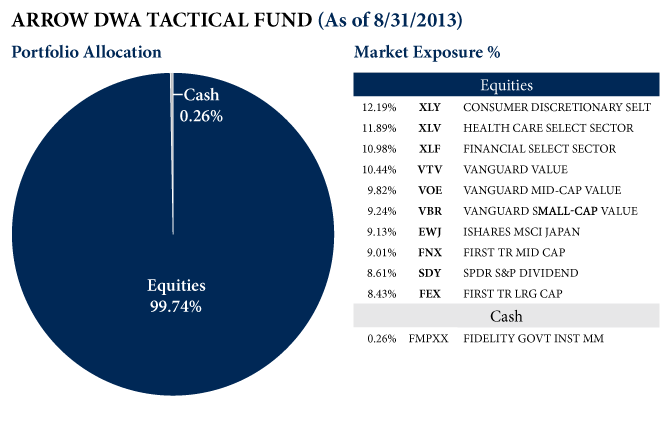
The Arrow DWA Tactical Fund (DWTFX)

At the end of August, the fund had approximately 90% in U.S. Equities and 9% in International equities. After breaking out to new all-time highs in July, U.S. equities pulled back in August. All of our holdings had modest losses in August, with positions like Consumer Discretionary holding up relatively well while Financials and our dividend-equity focused position having slightly greater losses. When interest rates were low and trending lower, dividend-paying stocks were in high demand, but now as interest rates have made a strong move higher they have lost some of their appeal. For now, this dividend-focused ETF remains in the fund, but if it continues to lose relative strength it will be sold. The overall trend of the U.S. equity markets remains positive, which is encouraging considering some of the concerns that have dominated the headlines in recent weeks, including Syria and anticipation of Fed tapering in coming months. This fund continues to outperform nearly all of its peers YTD, according to Morningstar, as its flexibility has been a significant advantage this year. The fund has been able to avoid much of the pain that has been felt in the fixed income market and in the alternative space.


DWTFX was down 3.73% in August, but has gained 10.65% through 8/31/13.

This strategy is a go-anywhere strategy with very few constraints in terms of exposure to different asset classes. The strategy can invest in domestic equities, international equities, inverse equities, currencies, commodities, real estate, and fixed income. Market history clearly shows that asset classes go through secular bull and bear markets and we believe this strategy is ideally designed to capitalize on those trends. Additionally, we believe that this strategy can provide important risk diversification for a client’s overall portfolio.

dwtfx 08.31.13 August Arrow DWA Funds Review


See www.arrowfunds.com for more information. Past performance is no guarantee of future returns.

Posted by:


Emerging Markets - Looking Forward

September 7, 2013

Dennis Hudachek at IndexUniverse makes some good points about Emerging Markets:

There is indeed a tremendous amount of pessimism around emerging markets at the moment.

Yet I think it’s important not to get too carried away and assume all emerging markets—as classified by MSCI and lumped together in popular funds like the iShares MSCI Emerging Markets ETF (EEM | B-96) and the Vanguard FTSE Emerging Markets ETF (VWO | B-85)—are destined to crash together.

Clearly some economies are holding up better than others.

It’s quite possible that any potential Fed tapering—assuming this hasn’t been fully priced in already—will be a game-changing event, but it won’t be the end of the game for all emerging markets.

It’s difficult to know the extent to which this sell-off will last, but when the dust settles, I wouldn’t be surprised if the resurgence in emerging markets could look very different from its prior meteoric rise over the past decade.

Looking forward, I think it’s possible that a different group countries, sectors and/or companies can lead the pack in the next leg of growth for these markets, now that the emerging middle class has blossomed.

Many of the smaller emerging markets like Indonesia and Turkey have been among the best performers for most of the last couple of years (until recently) while the larger markets like China and Brazil have lagged. Is a leadership change taking place in emerging markets or will those smaller emerging markets resume their leadership after this correction runs its course? Luckily, those employing the PowerShares DWA Emerging Markets Technical Leaders ETF (PIE) don’t have to guess. Our relative strength work will sort out the winners and the losers and the changes will be reflected in the new index weights (this index is reconstituted on a quarterly basis.)

See www.powershares.com for more information. Past performance is no guarantee of future returns.

Posted by:


Investment Process versus Investment Performance

September 6, 2013

Marshall Jaffe wrote an excellent article on investment process versus investment performance in the most recent edition of ThinkAdvisor. I think it is notable for a couple of reasons. First, it’s pithy and well-written. But more importantly, he’s very blunt about the problems of focusing only on investment performance for both clients and the industry. And make no mistake—that’s how the investment industry works in real life, even though it is a demonstrably poor way to do things. Consider this excerpt:

We see the disclaimer way too often. “Past performance is no guarantee of future results.” It is massively over-used—plastered on countless investment reports, statements and research. It’s not simply meaningless; it’s as if it’s not even there. And that creates a huge problem, because the message itself is really true: Past performance has no predictive value.

Since we are looking for something that does have predictive value—all the research, experience and hard facts say: Look elsewhere.

This is not a controversial finding. There are no fringe groups of investors or scholars penning op-ed pieces in the Wall Street Journal shooting holes in the logic of this reality. Each year there is more data, and each year that data reconfirms that past performance is completely unreliable as an investment tool. Given all that, you would think it would be next to impossible to find any serious investors still using past performance as a guideline. Indeed, that would be a logical conclusion.

But logical conclusions are often wrong when it comes to understanding human behavior. Not only does past performance remain an important issue in the minds of investors, for the vast majority it is the primary issue. In a study I referred to in my August column, 80% of the hiring decisions of large and sophisticated institutional pension plans were the direct result of outstanding past performance, especially recent performance.

The truth hurts! The bulk of the article discusses why investors focus on performance to their detriment and gives lots of examples of top performers that focus only on process. There is a reason that top performers focus on process—because results are the byproduct of the process, not an end in themselves.

The reason Nick Saban, our best athletes, leading scientists, creative educators, and successful investors focus on process is because it anchors them in reality and helps them make sensible choices—especially in challenging times. Without that anchor any investor observing the investment world today would be intimidated by its complexity, uncomfortable with its volatility and (after the meltdown in 2008) visibly fearful of its fragility. Of course we all want good returns—but those who use a healthy process realize that performance is not a goal; performance is a result.

Near the end of the article, I think Mr. Jaffe strikes right to the core of the investment problem for both individual investors and institutions. He frames the right question. Without the right question, you’re never going to get the right answer!

In an obsessive but fruitless drive for performance too many fund managers compromise the single most important weapon in their arsenal: their investment process.

Now we can see the flaw in the argument that an investor’s basic choice is active or passive. An investor indeed has two choices: whether to be goal oriented or process oriented. In reframing the investment challenge that way, the answer is self-evident and the only decision is whether to favor a mechanical process or a human one.

Reframing the question as “What is your investment process?” sidelines everything else. (I added the bold.) In truth, process is what matters most. Every shred of research points out the primacy of investment process, but it is still hard to get investors to look away from performance, even temporarily.

We focus on relative strength as a return factor—and we use a systematic process to extract whatever return is available—but it really doesn’t matter what return factor you use. Value investors, growth investors, or firms trying to harvest more exotic return factors must still have the same focus on investment process to be successful.

If you are an advisor, you should be able to clearly explain your investment process to a client. If you are an investor, you should be asking your advisor to explain their process to you. If there’s no consistent process, you might want to read Mr. Jaffe’s article again.

HT to Abnormal Returns

Posted by:


Bucket Portfolio Stress Test

September 4, 2013

I’ve long been a fan of portfolio buckets or sleeves, for two reasons. The first reason is that it facilitates good diversification, which I define as diversification by volatility, by asset class, and by strategy. (We happen to like relative strength as one of these primary strategies, but there are several offsetting strategies that might make sense.) A bucket portfolio makes this kind of diversification easy to implement.

The second benefit is largely psychological—but not to be underestimated. Investors with bucket portfolios had better performance in real life during the financial crisis because they didn’t panic. While the lack of panic is a psychological benefit, the performance benefit was very real.

Another champion of bucketed portfolios is Christine Benz at Morningstar. She recently wrote a series of article in which she stress-tested bucketed portfolios, first through the 2007-2012 period (one big bear market) and then through the 2000-2012 period (two bear markets). She describes her methodology for rebalancing and the results.

If you have any interest in portfolio construction for actual living, breathing human beings who are prone to all kinds of cognitive biases and emotional volatility, these articles are mandatory reading. Better yet for fans of portfolio sleeves, the results kept clients afloat. I’ve included the links below. (Some may require a free Morningstar registration to read.)

Article: A Bucket Portfolio Stress Test http://news.morningstar.com/articlenet/article.aspx?id=605387&part=1

Article: We Put the Bucket System Through Additional Stress Tests http://news.morningstar.com/articlenet/article.aspx?id=607086

Article: We Put the Bucket System Through a Longer Stress Test http://news.morningstar.com/articlenet/article.aspx?id=608619


Posted by:


Adventures in Fictive Learning

September 3, 2013

What the heck is fictive learning? Well, I’m glad you asked. Fictive learning refers to our ability to imagine “what if” situations. We learn not only from our actual actions, but from our perceptions of what would have happened if we had done something differently. It turns out that fictive learning has a lot to do with investor behavior too. Here are a few excerpts about relevant experiments discussed in an article in Wired magazine.

To better understand the source of our compulsive speculation, Read Montague, a neuroscientist now at Virginia Tech, has begun investigating the formation of bubbles from the perspective of the brain. He argues that the urge to speculate is rooted in our mental software. In particular, bubbles seem to depend on a unique human talent called “fictive learning,” which is the ability to learn from hypothetical scenarios and counterfactual questions. In other words, people don’t just learn from mistakes they’ve actually made, they’re able to learn from mistakes they might have made, if only they’d done something different.

Investors, after all, are constantly engaging in fictive learning, as they compare their actual returns against the returns that might have been, if only they’d sold their shares before the crash or bought Google stock when the company first went public. And so, in 2007, Montague began simulating stock bubbles in a brain scanner, as he attempted to decipher the neuroscience of irrational speculation. His experiment went like this: Each subject was given $100 and some basic information about the “current” state of the stock market. After choosing how much money to invest, the players watched nervously as their investments either rose or fell in value. The game continued for 20 rounds, and the subjects got to keep their earnings. One interesting twist was that instead of using random simulations of the stock market, Montague relied on distillations of data from famous historical markets. Montague had people “play” the Dow of 1929, the Nasdaq of 1998 and the S&P 500 of 1987, so the neural responses of investors reflected real-life bubbles and crashes.

Montague, et. al. immediately discovered a strong neural signal that drove many of the investment decisions. The signal was fictive learning. Take, for example, this situation. A player has decided to wager 10 percent of her total portfolio in the market, which is a rather small bet. Then, she watches as the market rises dramatically in value. At this point, the investor experiences a surge of regret, which is a side-effect of fictive learning. (We are thinking about how much richer we would be if only we’d invested more in the market.) This negative feeling is preceded by a swell of activity in the ventral caudate, a small area in the center of the cortex. Instead of enjoying our earnings, we are fixated on the profits we missed, which leads us to do something different the next time around.

When markets were booming, as in the Nasdaq bubble of the late 1990s, people perpetually increased their investments. In fact, many of Montague’s subjects eventually put all of their money into the rising market. They had become convinced that the bubble wasn’t a bubble. This boom would be different.

And then, just like that, the bubble burst. The Dow sinks, the Nasdaq collapses, the Nikkei implodes. At this point investors race to dump any assets that are declining in value, as their brain realizes that it made some very expensive mistakes. Our investing decisions are still being driven by regret, but now that feeling is telling us to sell. That’s when we get a financial panic.

Montague has also begun exploring the power of social comparison, or what he calls the “country club effect,” on the formation of financial bubbles. “This is what happens when you’re sitting around with your friends at the country club, and they’re all talking about how much money they’re making in the market,” Montague told me. “That casual conversation is going to change the way you think about investing.” In a series of ongoing experiments, Montague has studied what happens when people compete against each other in an investment game. While the subjects are making decisions about the stock market, Montague monitors their brain activity in two different fMRI machines. The first thing Montague discovered is that making more money than someone else is extremely pleasurable. When subjects “win” the investment game, Montague observes a large increase in activity in the striatum, a brain area typically associated with the processing of pleasurable rewards. (Montague refers to this as “cocaine brain,” as the striatum is also associated with the euphoric high of illicit drugs.) Unfortunately, this same urge to outperform others can also lead people to take reckless risks.

More recently, a team of Italian neuroscientists led by Nicola Canessa and Matteo Motterlini have shown that regret is also contagious, so that “observing the regretful outcomes of another’s choices reactivates the regret network.” (In other words, we internalize the errors of others. Or, as Motterlini wrote in an e-mail, “We simply live their emotions like these were our own.”) Furthermore, this empathy impacts our own decisions: The “risk-aptitude” of investors is significantly shaped by how well the risky decisions of a stranger turned out. If you bet the farm on some tech IPO and did well, then I might, too.

If you are an investment advisor, all of this is sounding pretty familiar. We’ve all seen clients make decisions based on social comparison, regret, or trying to avoid regret. Sometimes they are simply paralyzed, trapped between wanting to do as well as their brother-in-law and wanting to avoid the regret of losing money if their investment doesn’t work out.

The broader point is that a lot of what drives trends in the market is rooted in human behavior, not valuations and fundamentals. Human nature is unlikely to change, especially a feature like fictive learning which is actually incredibly helpful in many other contexts. As a result, markets will continue to trend and reverse, to form bubbles and to have those bubbles implode periodically.

While social science may be helpful in understanding why the market behaves as it does, we still have to figure out a way to navigate it. As long as markets trend, relative strength trend following should work. (That’s the method we follow.) As long as bubbles form and implode, other methods like buying deep value should help mitigate the risk of permanent loss. Most important, the discipline to execute a systematic investment plan and not get sucked into all of the cognitive biases will be necessary to prosper with whatever investment method you choose.

Posted by: