The New Death of Equities

May 21, 2012

From AdvisorOne, yet another article about how much investors hate the market these days:

Despite strong U.S. equity market returns in early 2012 that sent the Dow back above 13,000 by the end of February, indications are that many Americans remain investment spectators, reluctant to participate in the equity market rally, a Franklin Templeton global poll has found.

Investor skepticism appears to be tied to the extreme volatility witnessed in 2011, in which the Dow Jones Industrial Average had 104 days of triple-digit swings-representing a significant portion of the 252 total trading days last year. Indeed, when asked about the importance of various market scenarios when deciding to purchase an equity investment, market stability was most frequently identified by U.S. respondents as an important factor.

“The market volatility that has persisted since 2008 is keeping many investors on the sidelines, and their ability to view positive equity market performance constructively has been thwarted by the market ups and downs that are at odds with the stability they are seeking,” John Greer, executive vice president of corporate marketing and advertising at Franklin Templeton Investments, said in a statement. “But the reality is that investors who have been waiting for ‘the right time’ to get back into the equity market have been missing out on the market rally we’ve witnessed over the past few years.”

This is sadly typical of retail investors. Volatility tends to be greatest at market bottoms, and volatility tends to be what investors most avoid. As a result, investors often avoid returns as well!

This period strikes me as psychologically reminiscent of the late 1970s, when Business Week famously published a cover announcing the death of equities. Consider what investors had been through: in the late 1960s, the speculative names had gotten torched. By 1973-74 even the bluest of the blue chips had gotten ripped. By the late 1970s, 20% annual corrections were the norm. The economy was a mess and investors simply opted out. The Business Week cover just reflected the spirit of the time.

The late 1970s are not so different from now. The speculative names collapsed in 2000-2002, followed by a bear market in 2008-2009 that got everything. The last couple of summers have been punctuated by scary 15-20% corrections. The economy is still a mess. Psychologically, investors are in the same spot they were when the original cover came out. Based on fund flows, “anything but stocks” seems to be the battle cry.

Yet, consider how things unfolded subsequently. Only a few years later both the market and the economy were booming. (High relative strength stocks began to perform very well several years ahead of the 1982 bottom, by the way.) The Business Week cover is now famous as a contrary indicator. It wouldn’t shock me if the current investor disdain for stocks has a similar outcome down the road.

deathofequities 1 The New Death of Equities

Business Week: the famous "Death of Equities" cover


Posted by:


Fund Flows

May 17, 2012

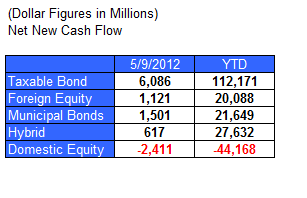
The Investment Company Institute is the national association of U.S. investment companies, including mutual funds, closed-end funds, exchange-traded funds (ETFs), and unit investment trusts (UITs). Members of ICI manage total assets of $11.82 trillion and serve nearly 90 million shareholders. Flow estimates are derived from data collected covering more than 95 percent of industry assets and are adjusted to represent industry totals.

flows 3 Fund Flows

Posted by:


Relative Strength Still Off the Radar

May 16, 2012

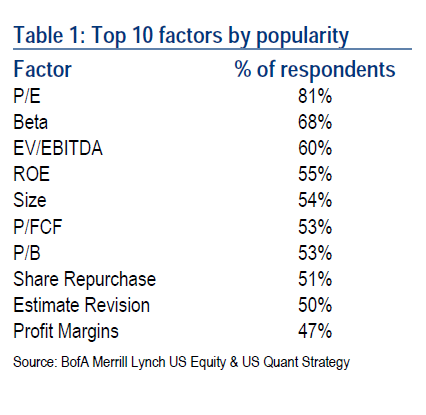
The Big Picture has a thumbnail summary of the annual Merrill Lynch US Equity and US Quant Strategy pieces, where they interview 100 large institutional managers. Of particular interest to me was the top ten return factors by popularity.

factorpopularity Relative Strength Still Off the Radar

via The Big Picture (click on image to enlarge)

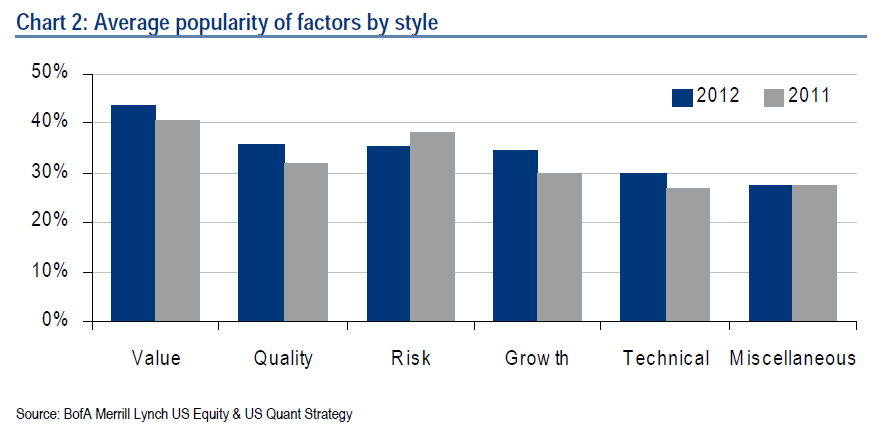
You can see that relative strength did not crack the top ten. On the bigger chart, which you can see in the article, relative strength came in at #11. Of course, there are many formulations of relative strength, so even that ranking probably covers a lot of different methods.

A number of the popular factors are value-related and some are based on profitability. All of these factors ultimately interact in complicated ways, but you don’t have to worry about a crowded trade in relative strength.

Value, quality, and risk-related factors are all much more popular than relative strength.

stylepopularity Relative Strength Still Off the Radar

via The Big Picture (click on image to enlarge)

Posted by:


Dorsey, Wright Client Sentiment Survey - 5/11/12

May 11, 2012

Here we have the next round of the Dorsey, Wright Sentiment Survey, the first third-party sentiment poll. Participate to learn more about our Dorsey, Wright Polo Shirt raffle! Just follow the instructions after taking the poll, and we’ll enter you in the contest. Thanks to all our participants from last round.

As you know, when individuals self-report, they are always taller and more beautiful than when outside observers report their perceptions! Instead of asking individual investors to self-report whether they are bullish or bearish, we’d like financial advisors to weigh in and report on the actual behavior of clients. It’s two simple questions and will take no more than 20 seconds of your time. We’ll construct indicators from the data and report the results regularly on our blog–but we need your help to get a large statistical sample!

Click here to take Dorsey, Wright’s Client Sentiment Survey.

Contribute to the greater good! It’s painless, we promise.

Posted by:


It’s Hard Out There for a Bear

May 9, 2012

I’m not trying to pick on Paul Farrell, really. He’s one of the most read columnists on Marketwatch. From time to time, however, I archive articles that are wildly optimistic or wildly pessimistic to demonstrate how difficult it is not to be carried away with emotion. This article just happened to fall into that category.

This particular article appeared August 17, 2010. The market had just gone through a near 20% decline, as well as the flash crash a few months before. Here is the front end of the article:

Yes, it’s going to get worse, a whole lot worse … Bill Gross warns this is the “New Normal. Forget 10% returns. Think 5%”. … Economist Larry Kotlikoff, author of The Coming Generational Storm, warns: “Let’s get real. The U.S. is bankrupt. Neither spending nor taxing will help the country pay its bills” … Economist Peter Morici warns: “Unemployment is stuck near 10%. Deflation coming. Stock market threatens collapse. The Federal Reserve and Barack Obama are out of bullets. Near zero federal funds rates, central bank purchases, a $1.6 trillion deficit have failed to revive the economy.” … Simon Johnson, co-author of 13 Bankers, warns: “We came close to another Great Depression, next time we may not be so lucky.” Why? Because Wall Street’s already well into the next bubble/bust cycle — the “doom cycle.”

The doom cycle sounds pretty bad and we are warned that things are going to get a whole lot worse. I’m not exaggerating. The whole paragraph was in heavy bold type.

Since then, we’ve gone through another 20% correction. And the market is more than 25% higher. Yes, higher.

Before you smirk and think you are immune from getting carried away, think again. We are all susceptible to emotion—it’s just part of our wiring. And it’s not just on the downside. It’s equally easy to get carried away with “new era” thinking on the upside.

Sentiment swings, I think, demonstrate one of the very best reasons to use a systematic investment process. Our happens to be an adaptive one driven by relative strength, but I’m sure other styles could also be successful. The important thing is to define a profitable process and then stick to it through thick and thin.

Posted by:


Dorsey, Wright Client Sentiment Survey Results - 4/27/12

May 8, 2012

Our latest sentiment survey was open from 4/27/12 to 5/4/12. The Dorsey, Wright Polo Shirt Raffle continues to drive advisor participation, and we greatly appreciate your support! This round, we had 55 advisors participate in the survey. If you believe, as we do, that markets are driven by supply and demand, client behavior is important. We’re not asking what you think of the market—since most of our blog readers are financial advisors, we’re asking instead about the behavior of your clients. Then we’re aggregating responses exclusively for our readership. Your privacy will not be compromised in any way.

After the first 30 or so responses, the established pattern was simply magnified, so we are comfortable about the statistical validity of our sample. Most of the responses were from the U.S., but we also had multiple advisors respond from at least three other countries. Let’s get down to an analysis of the data! Note: You can click on any of the charts to enlarge them.

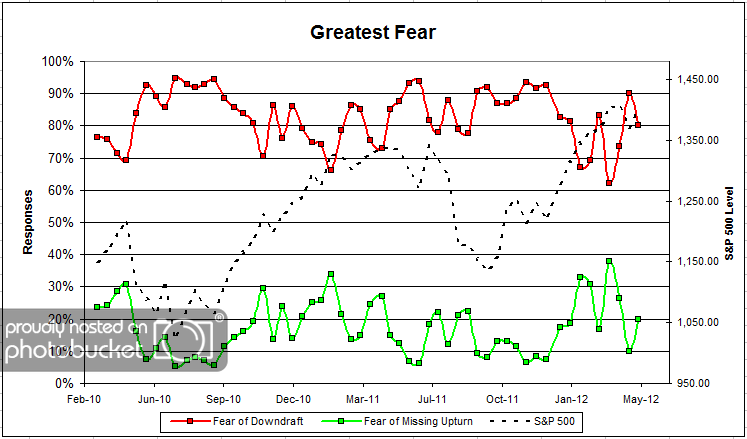
Question 1. Based on their behavior, are your clients currently more afraid of: a) getting caught in a stock market downdraft, or b) missing a stock market upturn?

greatestfear 53 Dorsey, Wright Client Sentiment Survey Results   4/27/12

Chart 1: Greatest Fear. From survey to survey, the S&P 500 rose +2.4%, and client sentiment improved as a result. The fear of downturn group fell from 90% to 80%, while the upturn group rose from 10% to 20%. Client sentiment is still poor overall, but it’s nice to see a rally have some effect.

spread 24 Dorsey, Wright Client Sentiment Survey Results   4/27/12

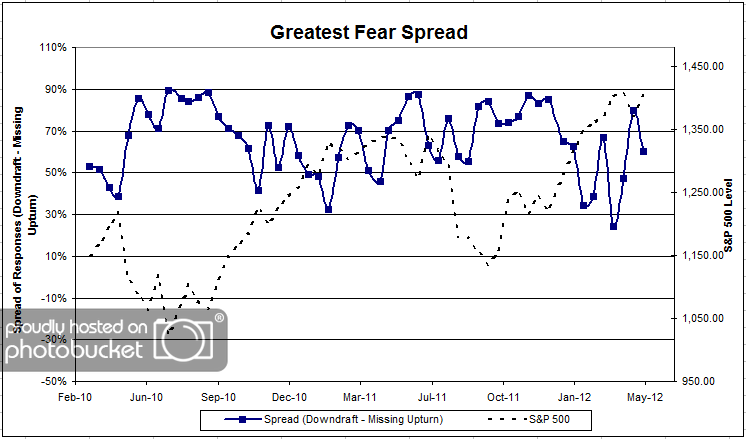
Chart 2. Greatest Fear Spread. Another way to look at this data is to examine the spread between the two groups. The spread dipped lower this round, from 80% to 60%.

Question 2. Based on their behavior, how would you rate your clients’ current appetite for risk?

avgrisk 2 Dorsey, Wright Client Sentiment Survey Results   4/27/12

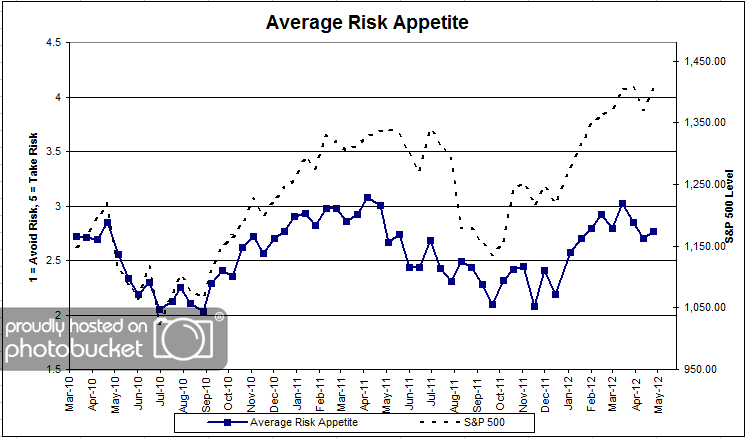
Chart 3: Average Risk Appetite. After falling for two straight surveys, the overall risk appetite bounced back this round (barely), from 2.70 to 2.77.

bellcurve 6 Dorsey, Wright Client Sentiment Survey Results   4/27/12

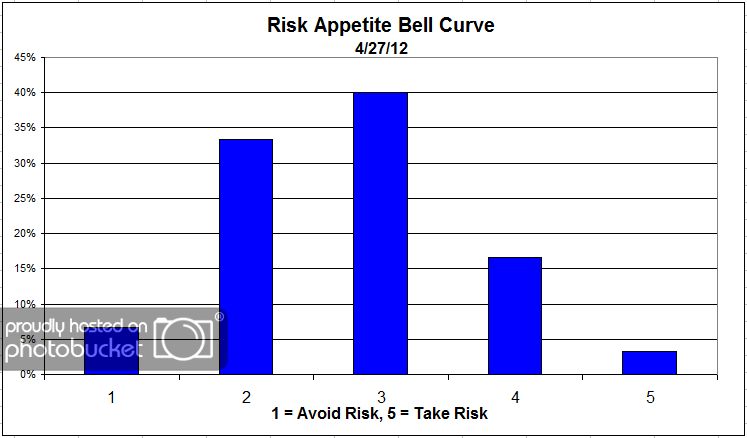
Chart 4: Risk Appetite Bell Curve. This chart uses a bell curve to break out the percentage of respondents at each risk appetite level. We saw a more even distribution this round, though tilted towards less risk.

bellcurvegroup 10 Dorsey, Wright Client Sentiment Survey Results   4/27/12

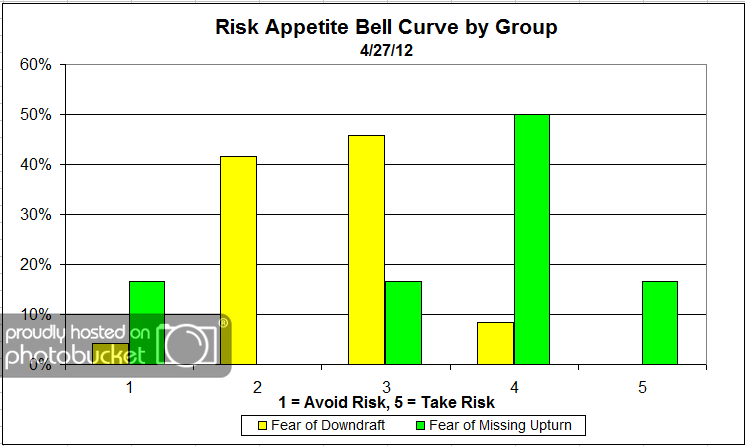
Chart 5: Risk Appetite Bell Curve by Group. The next three charts use cross-sectional data. This chart plots the reported client risk appetite separately for the fear of downdraft and for the fear of missing upturn groups. This chart sorts out mostly as expected, with the upturn group wanting more risk than the downturn group.

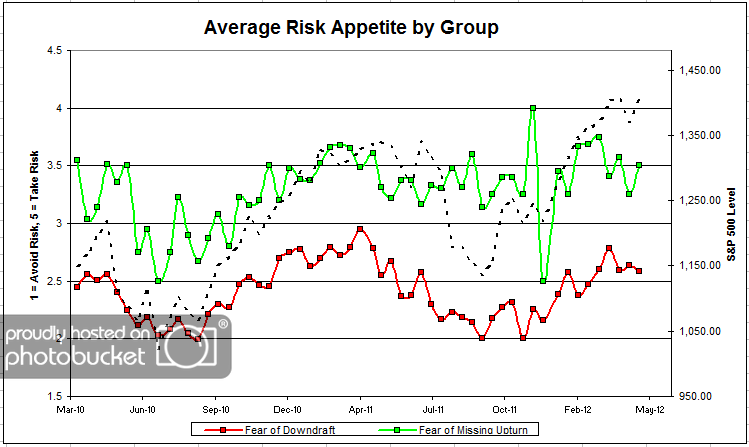
appgroup Dorsey, Wright Client Sentiment Survey Results   4/27/12

Chart 6: Average Risk Appetite by Group. This round, the upturn group’s average shot higher, while the downturn group’s average fell slightly. Keep in mind that overall risk ticked slightly higher with the market.

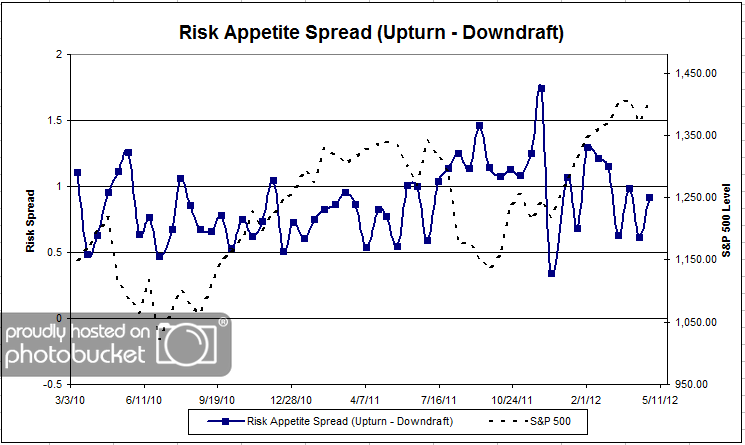
appspread 2 Dorsey, Wright Client Sentiment Survey Results   4/27/12

Chart 7: Risk Appetite Spread. This is a spread chart constructed from the data in Chart 6, where the average risk appetite of the downdraft group is subtracted from the average risk appetite of the missing upturn group. The spread moved higher this round and seems to be settled into a new range.

From survey to survey, the S&P rallied over +2%, and our client sentiment indicators responded as they should. The fear of a downturn group moved lower, while risk appetite moved higher. All in all, it was a pretty standard client sentiment reaction to market behavior.

No one can predict the future, as we all know, so instead of prognosticating, we will sit back and enjoy the ride. A rigorously tested, systematic investment process provides a great deal of comfort for clients during these types of fearful, highly uncertain market environments. Until next time, good trading and thank you for participating.

Posted by:


Two Rides the Public Missed…

May 7, 2012

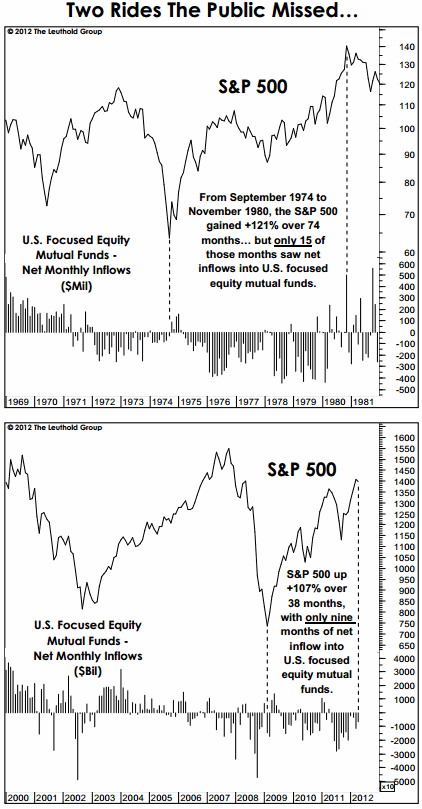
Mark Twain once said, “A cat who sits on a hot stove will never sit on a hot stove again. But, he won’t sit on a cold stove, either.” Surely, that applies to investors who have gone through a severe bear market, like 1973-74 or 2008.

leuthold 2 Two Rides the Public Missed...

Source: The Leuthold Group

Without an investment process that systematically allocates to where the action is, investors may be psychologically incapable of making much money for years to come.

Posted by:


Managing Volatility

May 4, 2012

Articles like this one in Investment News just confuse me. Apparently the latest trend among pension plan sponsors is to target volatility. I guess it is a human desire to eliminate volatility, but at the end of the day, you have to pay your pension benefits from your returns. Not risk-adjusted returns. Not volatility or standard deviation. Focusing primarily on volatility is completely missing the boat. From the article:

“There’s a big shift in terms of how plan sponsors are defining risk,” said Michael Thomas, chief investment officer for the institutional business in the Americas at Russell. “During the last 10 years, our industry has developed an unhealthy obsession with tracking error, but managing tracking error isn’t managing risk.”

He’s right—tracking error is not the same thing as risk. Nor is volatility the same thing as risk, I might add. Volatility management is just another unhealthy obsession. Besides, the source of all of the evil volatility is readily apparent.

So far, most of the target volatility asset allocation strategies focus on equity exposure, which is, “by far, the biggest contributor of [portfolio] volatility,” Russell’s Mr. Thomas said.

Equity exposure = volatility. To reduce it, just add some Treasury bills or bonds to the portfolio. Duh. That seems like a simpler solution if you really are concerned about reducing volatility.

I don’t think that investors are going to be any more successful targeting volatility than they are trying to target returns. We have no idea year to year what returns are going to be, even though we know exactly what they have been historically. We can’t forecast it or target it-we just put up with whatever returns we get. I don’t think volatility is going to be any more tractable.

Posted by:


The Approaching Reallocation Rally

May 1, 2012

From a large commentary from Doug Kass, found at TheStreet.com:

It remains my contention that it will take relatively large losses in bond funds to bring back the individual investor into equities. But this is likely coming — it almost always occurs coincident with higher stock prices — and when it does, one of the greatest reallocations out of bonds and into equities will commence.

Mr. Kass discusses also the flow of funds and many factors that he believes are impacting prices. It’s a nice piece because it hits most of the talking points that clients ask about.

Posted by:


High Correlations: We’ve Been Here Before

April 30, 2012

There has been a lot of talk in recent years about the rising correlation among US stocks. High correlations potentially make it harder for stock-pickers to really stand out and a commonly expressed fear is that this condition is the “new normal.” With that backdrop, consider the chart below that shows the correlations of large-cap US stocks going back to the late 1920s.

Source: iShares

Yes, correlations are higher today than they have been for decades, but the market has experienced periods of high correlations before-notably in the aftermath of the Great Depression. I think the explanation is pretty straightforward-when investor trading is primarily driven by “macro” concerns, the correlations tends to be high and as those fears subside, correlations tend to drop.

In a glass-is-half-full mindset, I find it encouraging that our Technical Leaders Index (PDP) has outperformed the S&P 500 over the last 5+ years notwithstanding the rising correlations (from 3/1/2007 - 4/27/2012, PDP is +17.08% while the S&P 500 is +0.01%). It may be possible for that margin of outperformance to expand once the correlations again begin to subside.

See www.powershares.com for more information about PDP.

Posted by:


Dorsey, Wright Client Sentiment Survey - 4/27/12

April 27, 2012

Here we have the next round of the Dorsey, Wright Sentiment Survey, the first third-party sentiment poll. Participate to learn more about our Dorsey, Wright Polo Shirt raffle! Just follow the instructions after taking the poll, and we’ll enter you in the contest. Thanks to all our participants from last round.

As you know, when individuals self-report, they are always taller and more beautiful than when outside observers report their perceptions! Instead of asking individual investors to self-report whether they are bullish or bearish, we’d like financial advisors to weigh in and report on the actual behavior of clients. It’s two simple questions and will take no more than 20 seconds of your time. We’ll construct indicators from the data and report the results regularly on our blog–but we need your help to get a large statistical sample!

Click here to take Dorsey, Wright’s Client Sentiment Survey.

Contribute to the greater good! It’s painless, we promise.

Posted by:


The Patience Problem

April 25, 2012

Jeremy Grantham of GMO posits a tension between doing the right thing for the client and getting terminated as a manager. Much of this, he believes, is a function of the client’s patience. He writes in Advisor Perspectives:

Ridiculous as our market volatility might seem to an intelligent Martian, it is our reality and everyone loves to trot out the “quote” attributed to Keynes (but never documented): “The market can stay irrational longer than the investor can stay solvent.” For us agents, he might better have said “The market can stay irrational longer than the client can stay patient.” Over the years, our estimate of “standard client patience time,” to coin a phrase, has been 3.0 years in normal conditions. Patience can be up to a year shorter than that in extreme cases where relationships and the timing of their start-ups have proven to be unfortunate. For example, 2.5 years of bad performance after 5 good ones is usually tolerable, but 2.5 bad years from start-up, even though your previous 5 good years are well known but helped someone else, is absolutely not the same thing! With good luck on starting time, good personal relationships, and decent relative performance, a client’s patience can be a year longer than 3.0 years, or even 2 years longer in exceptional cases. I like to say that good client management is about earning your firm an incremental year of patience.

On the one hand, this is kind of funny from a manager’s point of view because it is something we can all relate to. DALBAR has documented that a client’s average holding period is about three years, and that is exactly the conclusion that Mr. Grantham comes to also. (The bold is mine; I think Mr. Grantham’s twist on Keynes may become a classic.)

On another level, this is very sad. It’s sad that good client management is required to earn an extra year of patience. As an industry, we apparently do a poor job of educating our clients about realistic expectations. If we start a relationship promising sunshine and rainbows, of course the client will be disappointed when the first dark clouds appear. On the other hand, if we warn clients about the inevitability of rain, and the possibility or likelihood of hail, tornadoes, and earthquakes, they are likely to sign up with our sunshine-and-rainbows competitor.

And, honestly, part of the blame may lie with the clients. Many clients want to hear about sunshine and rainbows, not rain and hail. If both are mentioned, they tend to remember the sunshine and rainbows and have only a hazy recollection of anything else.

Here’s the problem: return factors, even historically reliable ones like relative strength or value, tend to play out over periods longer than three years. This is why there is such a disconnect between manager returns (NAV returns) and client returns (dollar-weighted returns). I guess if return factors were so uber-reliable that they worked every year, there would be no patience problem. Clients would be happy to sit on their hands and collect the premium.

Unfortunately, collecting on return premiums is a lumpy business. In extreme cases, you can have situations where there are a number of years that go nowhere, followed by all of the excess return in a six-month period. Clients ideally would like to be invested just for those six months, but no one ever knows at what point in the cycle the excess return will occur. This makes it really tough for clients, as they essentially have to make a leap of faith.

The ideal client is one whose “standard client patience time” is infinite. We have a few very long-term clients here that have been with us since 1994, almost twenty years. They’ve moved from capital accumulation mode when they first joined us to distribution mode some years ago. In a couple of cases, they’ve already withdrawn more money than they started with—and still have balances in excess of their original deposit. Every money manager would clone clients like these if they could.

Here’s an interesting thing that Mr. Grantham doesn’t mention: if you talk to any number of advisors, you will find that, inevitably, the clients with infinite patience tend to be the clients with the best performance! I don’t know what twist of karma makes it so, but advisors all know this phenomenon. Clients who can make that courageous leap of faith tend to be rewarded. It’s our job as advisors to allow the clients to feel comfortable doing something that is inherently uncomfortable for them.

Posted by:


More on 294 Chances to Screw Up

April 24, 2012

From MarketSci, a article with a graphic representation of all of the corrections!

Posted by:


Dorsey, Wright Client Sentiment Survey Results - 3/14/12

April 23, 2012

Our latest sentiment survey was open from 4/13/12 to 4/20/12. The Dorsey, Wright Polo Shirt Raffle continues to drive advisor participation, and we greatly appreciate your support! This round, we had 40 advisors participate in the survey. If you believe, as we do, that markets are driven by supply and demand, client behavior is important. We’re not asking what you think of the market—since most of our blog readers are financial advisors, we’re asking instead about the behavior of your clients. Then we’re aggregating responses exclusively for our readership. Your privacy will not be compromised in any way.

After the first 30 or so responses, the established pattern was simply magnified, so we are comfortable about the statistical validity of our sample. Most of the responses were from the U.S., but we also had multiple advisors respond from at least three other countries. Let’s get down to an analysis of the data! Note: You can click on any of the charts to enlarge them.

Question 1. Based on their behavior, are your clients currently more afraid of: a) getting caught in a stock market downdraft, or b) missing a stock market upturn?

greatestfear 52 Dorsey, Wright Client Sentiment Survey Results   3/14/12

Chart 1: Greatest Fear. From survey to survey the S&P 500 fell -2.7%, and the greatest fear levels snapped higher. The fear of a downdraft group rose from 74% to 90%, the highest levels we’ve seen all year. The missed opportunity group fell from 26% to 10%. Client sentiment is back in the doghouse.

spread 22 Dorsey, Wright Client Sentiment Survey Results   3/14/12

Chart 2. Greatest Fear Spread. Another way to look at this data is to examine the spread between the two groups. The spread shot higher this round from 47% to 80%. We’re a long way from par again!

Question 2. Based on their behavior, how would you rate your clients’ current appetite for risk?

avgrisk 1 Dorsey, Wright Client Sentiment Survey Results   3/14/12

Chart 3: Average Risk Appetite. The overall risk appetite number has fallen for two straight surveys in a row. This round the overall average fell from 2.85 to 2.7, dropping with the market.

bellcurve 5 Dorsey, Wright Client Sentiment Survey Results   3/14/12

Chart 4: Risk Appetite Bell Curve. This chart uses a bell curve to break out the percentage of respondents at each risk appetite level. This round, over half of all respodents wanted a risk appetite of 3. However, there has been a noticeable shift towards less risk, with both 1 and 2 gaining ground.

bellcurvegroup 9 Dorsey, Wright Client Sentiment Survey Results   3/14/12

Chart 5: Risk Appetite Bell Curve by Group. The next three charts use cross-sectional data. This chart plots the reported client risk appetite separately for the fear of downdraft and for the fear of missing upturn groups. This chart sorts out mostly as expected, with the upturn group wanting more risk than the downturn group. However, there were so few respondents in the opporunity camp, that the distribution is slightly skewed from normal.

riskavgroup Dorsey, Wright Client Sentiment Survey Results   3/14/12

Chart 6: Average Risk Appetite by Group. This round, the downturn group’s appetite rose slightly, and the upturn group’s appetite fell by a large degree. Keep in mind the overall average fell with the market.

riskappspread 43 Dorsey, Wright Client Sentiment Survey Results   3/14/12

Chart 7: Risk Appetite Spread. This is a spread chart constructed from the data in Chart 6, where the average risk appetite of the downdraft group is subtracted from the average risk appetite of the missing upturn group. The swung lower this round.

From survey to survey, the market took a sizeable hit, and our client sentiment indicators responded like they should. The greatest fear numbers rose to its highest level we’ve seen so far this year. The overall risk appetite fell for the second straight survey round in a row. When taking into account our client survey and the continued outflows from equities, it’s obvious that clients are not ready to jump back into the stock market. Keep in mind the market is still up more than 20% from its Fall 2011 lows.

No one can predict the future, as we all know, so instead of prognosticating, we will sit back and enjoy the ride. A rigorously tested, systematic investment process provides a great deal of comfort for clients during these types of fearful, highly uncertain market environments. Until next time, good trading and thank you for participating.

Posted by:


The Fund Flows Paradox

April 23, 2012

Great read by Wade Slome of Investing Caffeine about how the stock market has gone up so much over the past couple of years while fund flows for domestic equity funds have been massively negative.

Posted by:


Woeful State of Financial Literacy

April 20, 2012

The case for engaging our kids early and often on the topic of financial literacy.

HT: iShares, Brian Page

Posted by:


294 Chances to Screw Up

April 18, 2012

Being an investor is tough. Nothing moves in a straight line, except maybe a fake Bernie Madoff-type account. Everything proceeds in sawtooth fashion, and each up and down seems cleverly calculated to play on your emotions just enough to tempt you to take action at the wrong time. In fact, we could be headed into a correction right now. Carl Richards of Behavior Gap has an awesome illustration of the basic problem:

Source: Carl Richards/Behavior Gap (click to enlarge)

According to DALBAR data, the dips are pretty good at causing investors to bail out. DALBAR’s most recent study released in March 2012 showed that the average stock fund investor made annual returns of only 3.49% over the last 20 years versus an annual return of 7.81% for the S&P 500. The average investor “generally abandons investments at inopportune times,” according to their research. That’s a polite way of saying that investors panic when the market goes down and they sell out, often near the lows.

And there is plenty of temptation. According to uber-reliable Ned Davis Research, as summarized in this Wells Fargo market update, there have been 294 dips of 5% or more since 1928. In other words, you usually have three or four chances a year to screw up. Considering that most investors have a 20-30 year life cycle, that’s a lot of dips to deal with.

Source: Ned Davis Research/Wells Fargo (click on image to enlarge)

The abundance of opportunities to mess up probably accounts for the short average holding periods for both stock and bond funds—a little over three years. Maybe that really isn’t too surprising, given that there is a greater than 20% correction every three years or so. Perhaps investors white-knuckle it through all of the small dips and finally throw in the towel when they get whacked upside the head. Whatever is happening, it is costing retail investors a lot of money.

There’s a better way to handle this—buy on the dips instead. If you’ve got a reasonable investment strategy, buying on dips will help your returns. Even if you are investing in an index fund, buying on dips will reduce your average cost.

For example, you could look at the table above and decide to add new money each time there is a 10% correction. On average, you’d be adding new money about once a year. You would probably never hit the exact bottom, but you would be consistently adding at prices below the highs. Or you could use a different threshold, 5% or 12% or 15%, or whatever. The idea is just to force money in not at the highs.

Another option is to use a market indicator and add new money when the indicator is oversold. There’s an example using an ETF over the last five years here, including a calculation of how much it helped investor returns over that time.

Think about the math for the whole market: the average mutual fund investor is earning 3.49%, while the market is earning 7.81%. By definition, all investors in aggregate have to be earning 7.81%, since all investors are the market. (John Bogle makes this point all the time.) The corollary is that some investors have to be earning significantly more than 7.81%. In other words, if many investors have below-average results, someone has to have above-average results in order to have things average out.

That someone could be you. Instead of using a market pullback as just another opportunity to panic, why not add new money and give yourself the chance to be that someone with above-average results?

Posted by:


Quote of the Week

April 17, 2012

After several years of helter-skelter buying and selling, I learned that successful speculating is more a matter of character than mathematics, analysis, or luck. Obviously the latter are required, but the great gains and losses seem to occur in consequence to individual psychology. This has been my experience; perhaps you recognize it also.—-Al Frank

The late Al Frank ran an investment newletter, The Prudent Speculator. Besides being a good investor, Al was a nice guy. His work is now ably carried on by John Buckingham.

Al was a deep value investor who was not afraid to buy all kinds of cats and dogs. If it was cheap enough, he was willing to roll the dice. Quite a few of his cats and dogs went belly-up, but he held onto the big winners patiently. As a result, his performance was top-notch! The Prudent Speculator was always one of Hulbert’s highly ranked services. This quote comes from his very first issue on March 12, 1977, more than 35 years ago.

Relative strength investing is no different—the big gains and losses are due to individual psychology.

Posted by:


Lou Harvey on Investor Learning and Modern Portfolio Theory

April 16, 2012

Some time after 2008, Lou Harvey, the founder of DALBAR, did an interview with Barron’s. He discussed what had been learned in the 2008 bear market. It’s worth thinking about, especially his advice on what seemed to work. I’ve got some nice excerpts, but you can read the whole interview here.

In your study you point out that in spite of the “catastrophic” losses in 2008 “belief in modern portfolio theory has inexplicably remained strong.” MPT is grounded in the belief that asset classes are “predictably uncorrelated.” Because MPT is no longer good for all seasons you relegate it to one of several things investors need to consider.

Modern portfolio theory was pioneered by Harry Markowitz in a 1952 paper published in the Journal of Finance. It posited the construction of an “efficient frontier” of optimal portfolios offering the maximum possible expected return for a given level of risk. MPT is a principle-based investment strategy whose basic idea is that better returns can be produced if a portfolio’s holdings are diversified among different asset classes. The idea: to take advantage of the varying directions as each asset class fluctuates.

Nothing’s wrong with MPT. It’s how people use it. What is needed is a back-up plan to protect investors when the theory fails. And it will most likely happen again.

The pushback to our latest report has been strong. Who are we to criticize MPT, devised by a Nobel Prize winner? But this is our research and we stand by what we’ve found. I have lots of scars on my back to prove it. And I’m sure that after talking to you I’m going to get more. Investment results in 2008 showed clearly that correlation of asset classes varied unpredictably and with no warning. This brings into question the very basis for MPT and its ability to forecast an efficient frontier. MPT simply cannot be used in isolation. Instead it should be thought of as only one reference point for modeling the behavior of a potential portfolio. It is only one dimension of a more comprehensive investment-management process.

What’s the most important finding in your recent research?

For me the biggest recent issue stems from the 2008 market meltdown that defied many of the core beliefs in the financial community—the core belief that asset classes are not correlated. When stocks go down, bonds go up. So might real estate. By holding a little bit in each basket, the investor will make steadier returns and avoid losses. We found out that all of the methods based on modern portfolio theory worked within a certain range. Outside of that range, they all failed.

I added the bold. I’m not sure that a theory can be said to have worked if it fails repeatedly under extreme conditions, so I differ with Mr. Harvey on that. As another pundit said recently, it’s like having a seatbelt that only fails when you have a crash. Of more practical interest is his observation of what did work for investors.

We surveyed investors who outperformed in the crisis and tried to glean from them points to ensure success.

One I particularly like is to take your portfolio out and parse it out into smaller, purpose-driven components, and treat each component separately. Money you can’t afford to lose should not be put into the stock market, but rather in something else that guarantees repayment. It could be an annuity. It could be high-quality bonds. The approach functions on the different ways investors look at their holdings. You look differently at money you have set aside for a gay old time on the Riviera than you do at the money you use for breakfast tomorrow. Each basket should define the risk one should take in the market.

DALBAR’s always done interesting work and their research on investor returns versus NAV returns is now legendary. Here, Mr. Harvey suggests that investors who outperformed in the crisis were those who divided their money into buckets of differing volatilities. This is a psychological trick gleaned from behavioral finance—just a different way of looking at the same allocation. We’ve written about this before, but his observation suggests that it works in practice, not just in theory.

Best practices seem to suggest a belief in supply and demand rather than modern portfolio theory, and ratify the idea of using volatility buckets for clients.

Posted by:


Dorsey, Wright Client Sentiment Survey - 4/13/12

April 13, 2012

Here we have the next round of the Dorsey, Wright Sentiment Survey, the first third-party sentiment poll. Participate to learn more about our Dorsey, Wright Polo Shirt raffle! Just follow the instructions after taking the poll, and we’ll enter you in the contest. Thanks to all our participants from last round.

As you know, when individuals self-report, they are always taller and more beautiful than when outside observers report their perceptions! Instead of asking individual investors to self-report whether they are bullish or bearish, we’d like financial advisors to weigh in and report on the actual behavior of clients. It’s two simple questions and will take no more than 20 seconds of your time. We’ll construct indicators from the data and report the results regularly on our blog–but we need your help to get a large statistical sample!

Click here to take Dorsey, Wright’s Client Sentiment Survey.

Contribute to the greater good! It’s painless, we promise.

Posted by:


A Reminder About Predictions

April 13, 2012

After the 2008 market debacle, a couple of professors devised a Financial Trust Index to gauge how Americans were feeling about things. The idea was that a large sample would be surveyed every quarter and then the data tabulated. (You can see their website here.) My specific interest here is an article on the Financial Trust Index that appeared in the Wall Street Journal on July 20, 2010. This was a little more than one year from the market bottom in 2009. Prices had already advanced nicely, but this is what the article had to say:

About 45% of people think the stock market will drop by more than 30% in the next year, according to a survey by economists at the University of Chicago and Northwestern University. That’s even worse than the 42% a year ago who thought such a sharp decline in stocks was likely. (In December 2008, the share stood at 56%.)

And they’re not counting on much of a payback, either. The average expected return on investment in the next year was just 1.4%, versus 3.5% three months ago.

A huge percentage of investors were expecting another market drop of severe proportions. Why? Well, a big drop had happened in the not-too-distant past and like most forecasters, they were extrapolating more of the same into the near future. We’ve written a lot about the folly of forecasting before, so poor forecasting technique isn’t really surprising. Given the well-documented dismal performance of retail investors, why would the Wall Street Journal even run an article highlighting their forecasts?

Media is a business. Like all businesses, they are trying to maximize their revenues. Especially in this digital age, they can see which stories get the most clicks. Some websites even have a “most popular articles” list. The most popular stories are often stories that create fear. Fear is a much more powerful emotion than satisfaction. In fact, prospect theory shows that people react twice as strongly to negative outcomes as they do to positive outcomes. Therefore, many stories in the media are going to have a negative slant. And, of course, stories with a negative slant are most believable and appealing to us when things currently are going badly.

Ignoring forecasts in the media is a necessity for good investment performance. You’ve got to have a thoughtful investment process—and stick to it, especially when conditions are terrible. That was a good policy also when this article came out in 2010. Rather than the forecasted investment return of 1.4% for the following year, the S&P 500 was up more than 22%. That’s more than double the average annual return: it wasn’t just a decent year, it was a great year. Reflect on that before you deviate from a reasonable investment policy.

Posted by:


Clients Demanding Tactical Allocation

April 12, 2012

Advisor One had an article reprising the findings of the most recent Curian Capital survey of advisors. Their results will not surprise anyone.

• Nearly two-thirds of the advisors say that they have begun using more tactical asset allocation strategies to mitigate economic volatility, and more than half of respondents report they are using more alternative investing strategies.

• As a result of market volatility, nearly 4 out of 5 advisors report an increase in their clients’ demands for more conservative investments; in addition, 72% say their clients have an increased demand for guaranteed income features, 55% report an increase in demand for more tactical asset allocation, and 47% report an increase in demand for alternative investments.

Clients want tactical allocation strategies. This may be for diversification, but it may also be for risk mitigation, since strategic asset allocation didn’t help them much last time around. (I added the emphasis above.)

I find the demand for more tactical allocation interesting for a couple of reasons. Even ten years ago, tactical allocation was derided as market timing by hard core strategic allocation advocates. Now clients are objecting to holding asset classes during a prolonged nosedive, whether it is in service of diversification or not. There’s much more awareness of the risk inherent in strategic asset allocation given that we have gone through two bear markets in the last decade or so.

Now that everyone is a tactical asset allocator, the question really boils down to methodology. What process are you going to employ to make your allocation decisions? I will suggest that gut feel will get you in trouble almost immediately. Relying on emotion is not a good way to go. I think either valuation or relative strength methodologies will work in the long run, but they put different analytic demands on the allocator.

To run a valuation-based process, you need to have a reliable way of generating reasonably accurate expected returns for asset classes. (Simply using past history will not work, as many strategic allocators discovered over the past decade.) That’s not an easy task. It requires a ton a relevant data and a lot of testing to make sure your forecasting process has some validity. You’re still going to have a large margin of error, so your portfolios will never be optimal. Paradigm shifts are still going to create major problems.

Relative strength offers a reasonable alternative. You need to have a reliable ranking method for the assets included in your universe, but we like it because you don’t have to forecast. Instead, you are relying on the ability of the process to cast out losers and adapt to new trends.

Valuation and relative strength don’t have to be mutually exclusive. In fact, excess returns are typically negatively correlated. This is just a fancy way of saying that the two strategies tend to perform well at different times. Combining two tactical allocators, one using relative strength and one using valuation, is also a very good way to go.

Posted by:


Dorsey, Wright Client Sentiment Survey Results - 3/30/12

April 9, 2012

Our latest sentiment survey was open from 3/30/12 to 4/6/12. The Dorsey, Wright Polo Shirt Raffle continues to drive advisor participation, and we greatly appreciate your support! This round, we had 53 advisors participate in the survey. If you believe, as we do, that markets are driven by supply and demand, client behavior is important. We’re not asking what you think of the market—since most of our blog readers are financial advisors, we’re asking instead about the behavior of your clients. Then we’re aggregating responses exclusively for our readership. Your privacy will not be compromised in any way.

After the first 30 or so responses, the established pattern was simply magnified, so we are comfortable about the statistical validity of our sample. Most of the responses were from the U.S., but we also had multiple advisors respond from at least three other countries. Let’s get down to an analysis of the data! Note: You can click on any of the charts to enlarge them.

Question 1. Based on their behavior, are your clients currently more afraid of: a) getting caught in a stock market downdraft, or b) missing a stock market upturn?

greatestfear 51 Dorsey, Wright Client Sentiment Survey Results   3/30/12

Chart 1: Greatest Fear. From survey to survey, the S&P 500 was flat. After hitting all-time lows last round, the greatest fear number rose from 62% to 74%. On the flip side, the missed opportunity group fell from 38% to 26%.

greatestfearspread 50 Dorsey, Wright Client Sentiment Survey Results   3/30/12

Chart 2. Greatest Fear Spread. Another way to look at this data is to examine the spread between the two groups. The spread rose from 24% to 47%.

Question 2. Based on their behavior, how would you rate your clients’ current appetite for risk?

avgriskapp 41 Dorsey, Wright Client Sentiment Survey Results   3/30/12

Chart 3: Average Risk Appetite. In line with the greatest fear numbers, average risk appetite also ticked lower, from 3.02 to 2.85. It’s not too surprising, given the fact that the overall number has been rising steadily all year.

bellcurve 4 Dorsey, Wright Client Sentiment Survey Results   3/30/12

Chart 4: Risk Appetite Bell Curve. This chart uses a bell curve to break out the percentage of respondents at each risk appetite level. This round, over half of all respodents wanted a risk appetite of 3.

bellcurvegroup 8 Dorsey, Wright Client Sentiment Survey Results   3/30/12

Chart 5: Risk Appetite Bell Curve by Group. The next three charts use cross-sectional data. This chart plots the reported client risk appetite separately for the fear of downdraft and for the fear of missing upturn groups. This chart sorts out as expected, with the upturn group wanting more risk than the downturn group.

avgriskappgroup 29 Dorsey, Wright Client Sentiment Survey Results   3/30/12

Chart 6: Average Risk Appetite by Group. This round, the upturn group’s risk appetite rose, while the downturn group’s risk appetite fell. This is what we’d expect to see.

riskappspread 42 Dorsey, Wright Client Sentiment Survey Results   3/30/12

Chart 7: Risk Appetite Spread. This is a spread chart constructed from the data in Chart 6, where the average risk appetite of the downdraft group is subtracted from the average risk appetite of the missing upturn group. The spiked higher this round.

From survey to survey, the market was flat, and our indicators moved towards less risk. The overall fear number rose, and overall risk appetite fell. This is not too surprising, considering the greatest fear number hit all-time lows last round, and overall risk appetite was just off all-time highs. With any luck, client sentiment should continue to improve if the market continues to rally.

No one can predict the future, as we all know, so instead of prognosticating, we will sit back and enjoy the ride. A rigorously tested, systematic investment process provides a great deal of comfort for clients during these types of fearful, highly uncertain market environments. Until next time, good trading and thank you for participating.


Posted by:


An Observation on Bonds

April 5, 2012

…comes from Ed Yardeni and his excellent blog:

Over the past 36 months through February, net inflows into bond mutual funds totaled $1.0 trillion, while net inflows into equity funds were close to zero. Unfortunately for bond investors, the equity funds enjoyed capital gains of $2.7 trillion over this period, while the bond funds had gains of only $437 billion. Now that bond yields are starting to move higher, those gains are likely to decline. That might convince individual investors to move back into equities.

His chart of bond flows is actually pretty amazing. Net flows to stock funds, in contrast, have been pretty flat for the last five years.

Source: Dr. Ed’s Blog/ICI (click on image to enlarge)

There’s no doubt that good equity returns provide some competition for risk-off assets like bonds. However, stock returns have been pretty good for several years and it hasn’t resulted in significant behavior change on the part of bond buyers. In my opinion, that’s because bond investors are still making money on an absolute basis. Sure, they aren’t making what the stock market is making—but they are not losing money. If and when bond owners start to actually lose money on a nominal basis, we might see a change in the dynamic. (Many are already underwater in terms of real returns.) That change could provide fuel for the stock market, but maybe only if stocks are doing well at the time.

Although seems logical that money would flow immediately when relative performance changes, there is obviously a big emotional component to investor behavior too. Emotions and good investing don’t go well together.

Posted by:


Theory versus Practice

April 3, 2012

In finance there is often a marked difference between theory and practice. Advisor Perspectives carried an excellent commentary from Loomis Sayles on an alternative way to think about financial markets. It points out, very clearly, that what is often lost in theory is the human element.

In an often cynical world, standard financial and macroeconomic quantitative models give people the benefit of the doubt. Fundamental economic theory assumes the best of us, supposing that human beings are perfectly rational, know all the facts of a given situation, understand the risks, and optimize our behavior and portfolios accordingly. Reality, of course, is quite different. While a significant portion of individual and market behavior can be modeled reasonably well, the human emotions that drive cycles of fear and greed are not predictable and can often defy historical precedent.

Economic historian Charles Kindleberger can offer some insight. In his book Manias, Panics, and Crashes, Kindleberger explores the anatomy of a typical financial crisis and provides a framework that considers the impact of the powerful human dynamics of fear and greed. Economic historian Charles Kindleberger can offer some insight. In his book Manias, Panics, and Crashes, Kindleberger explores the anatomy of a typical financial crisis and provides a framework that considers the impact of the powerful human dynamics of fear and greed.

Kindleberger famously dubbed this sequence a “hardy perennial,” probably because the galvanizing human conditions of fear and greed are more often than not prone to overshoot fundamental values compared to the behavior of a rational individual, which exists only in macroeconomic theory.

Loomis Sayles contends that Kindleberger provides the qualitative framework for Hyman Minsky’s pioneering work on boom and bust cycles. Their graphic is remarkable in its simplicity and explanatory power—and in its distance from traditional economic equilibrium models. (You can see the image in the article.)

The cycles that Loomis Sayles discusses are driven by behavior, and often not behavior that would be considered ”rational” in the classic economic sense. Relying on precedent—the last time that happened, this happened—may or may not work. In fact, each time there is a paradigm shift, precedent will fail. Overshoots can be significant, so it’s important that an investing approach be adaptive enough to reflect changes in the environment. Most importantly, investing needs to take human behavior into account. Asset prices are a reflection of that behavior, suggesting that paying attention to prices may be far more useful than paying attention to economic theory.

Posted by: