The #1 Investment Return Factor No One Wants to Talk About-Still

November 22, 2011

I noticed another article on alternative beta indexes in Advisor Perspectives the other day. In it, Jason Hsu of Research Affiliates extols the virtues of a variety of alternatively constructed indexes. He concludes:

While the Fundamental Index strategy remains very close to our heart, we are very encouraged by the increasing innovation in the field of alternative betas. Despite often very different approaches, their respective results validate the entire idea of deviating from the binary active–passive world of the past. Some of the most compelling attributes of both are embedded in alternative betas. Like active managers, these methods can produce excess returns and produce different market exposures than mainstream indices, resulting in lower volatility and increased Sharpe ratios. Like traditional indices, most will have lower management costs, many will have similarly skinny implementation costs, and all will have lower governance/monitoring costs than active strategies. Furthermore, some of the most scalable approaches efficiently capture the value and small-cap effects without the long/short requirement, monthly maintenance, and illiquidity of a true Fama–French implementation.

Most investors make their biggest bets on equities, comprising more than 50% of their asset allocation. Accordingly, they have sought to diversify risk within equities by style, size, and geography. We assert that investors should go to greater lengths to diversify their equity portfolio. The past 10 years have brought considerable pain to both sides of the equity active–passive aisle. The third choice of alternative betas—even the simplest such as Equal-Weighting—would have resulted in a far better outcome. Will history repeat? Nobody knows. However, we think the evidence is far too compelling to ignore. We suggest moving alternative betas up your to-do list.

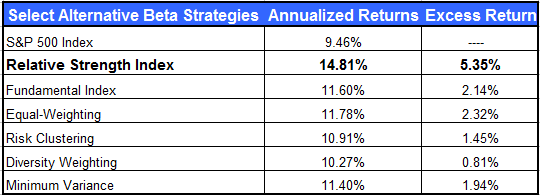
A wide variety of alternative indexes are discussed in the article—with the exception of relative strength. For some reason, no one ever wants to talk about it. However, for your convenience, we are including a table from a prior post that compares relative strength indexing to other methods.

index2 The #1 Investment Return Factor No One Wants to Talk About  Still

Source: Dorsey Wright Money Management

I understand why proponents of other indexing methods don’t like to discuss it—but it’s a good reason for investors to take a close look at it.

Posted by:


Has Momentum Lost Its Mojo?

November 14, 2011

Larry Swedroe at CBS Moneywatch gives a beatdown to a recently circulated paper. Fun stuff. Everyone wants to pick on relative strength.

Posted by:


High RS Diffusion Index

November 9, 2011

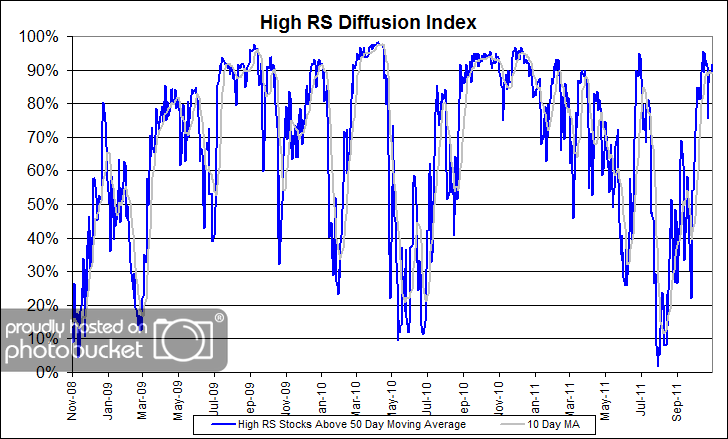
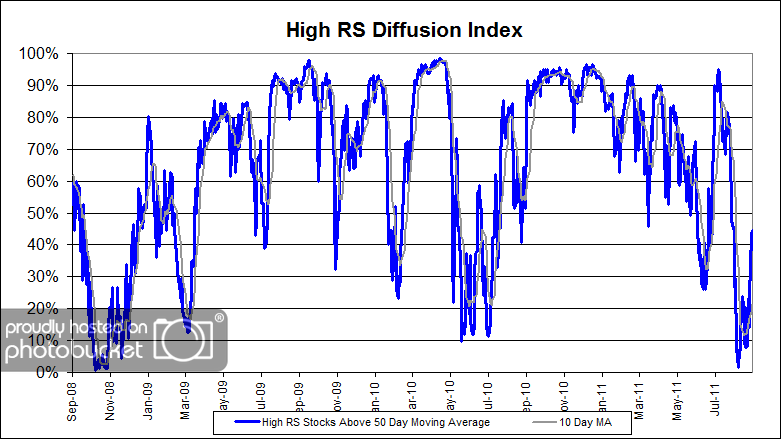
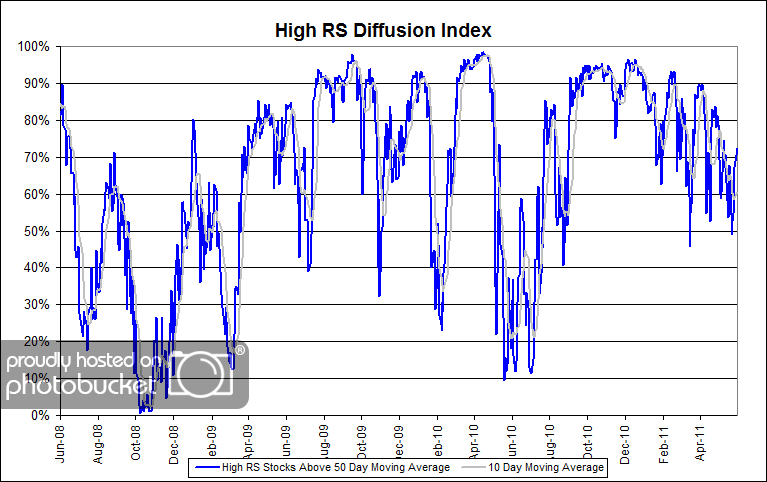
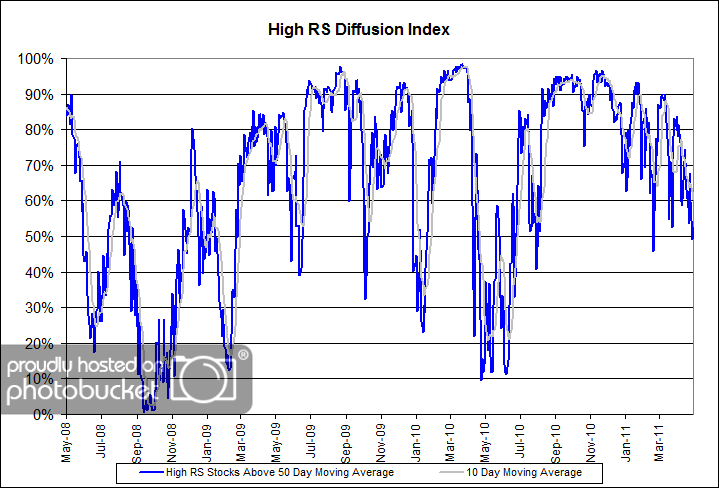
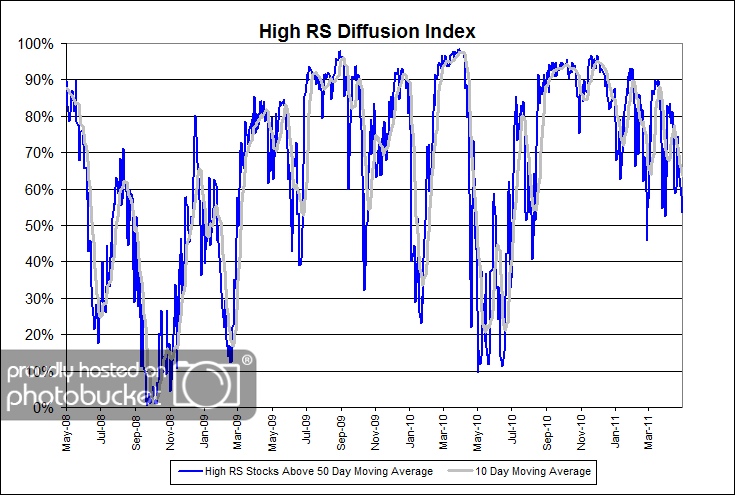
The chart below measures the percentage of high relative strength stocks that are trading above their 50-day moving average (universe of mid and large cap stocks.) As of 11/8/11.

highrss High RS Diffusion Index

The 10-day moving average of this indicator is 89% and the one-day reading is 92%. High RS stocks as a group have been able to hold on after a rough summer.

Posted by:


Momentum Blindness

November 8, 2011

I’m frequently puzzled and bemused by the hostile reception often accorded to relative strength strategies, known as momentum in academia. I saw a classic example recently in a Morningstar article discussing factor loading on various value indexes. In order to determine the value loading, the funds were all subjected to dissection with the Carhart four-factor model. The four-factor model uses regression to determine what the premiums are for size, value, and momentum—above and beyond market return, which is the fourth factor.

There was much discussion about how best to capture the value premium. Included was the following graphic:

momentumblindness Momentum Blindness

Momentum Blindness

Source: Morningstar (click on graph to enlarge)

I swear I am not making this up. As you can see from the graphic, momentum handily outperforms both value and size—and was the only factor to outperform the market. Momentum returns were described as “greed-inspiring and puzzlingly consistent.”

What is puzzling about it? It’s only puzzling if you are working from the assumption that value investing is better than momentum investing, something that is directly contradicted by the data! It’s not just Morningstar that has this bias, by the way. It’s pretty widespread throughout the industry. Relative strength has been a tremendous return factor over time and rarely gets the credit it should be due.

Posted by:


High RS Diffusion Index

October 25, 2011

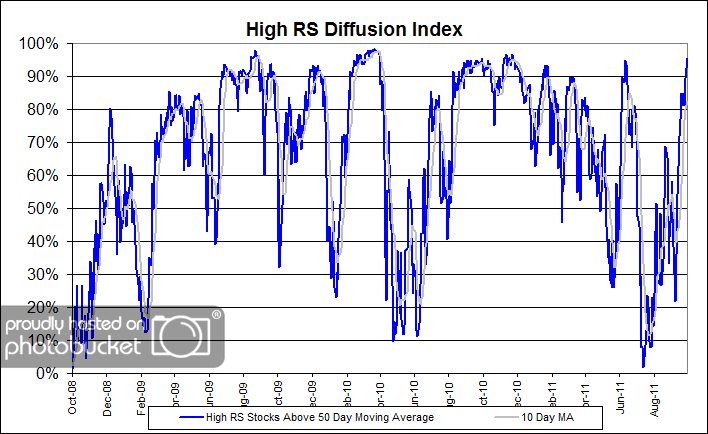
The chart below measures the percentage of high relative strength stocks that are trading above their 50-day moving average (universe of mid and large cap stocks.) As of 10/18/11.

HighRSDiff 2 High RS Diffusion Index

The 10-day moving average of this indicator is 82% and the one-day reading is 95%. Things have certainly turned around for the High RS stocks since mid-summer.

Posted by:


Combining Relative Strength and Low Volatility

October 12, 2011

The power of relative strength as a return factor has been well documented and that evidence is the reason that relative strength drives all of our investment strategies. However, just because it is a winning return factor over time doesn’t mean that anyone should or will construct an asset allocation composed entirely of relative strength-based strategies. Financial advisors who are in a position to decide which strategies to include in an asset allocation must then decide how to find complementary return factors. We have previously written about the benefits of combining relative strength and value, for example.

However, it appears that value is not the only suitable complement for relative strength strategies. Another option would be to consider combining the recently introducted PowerShares S&P Low Volatility Portfolio (SPLV) with our own PowerShares DWA Techical Leaders Portfolio (PDP).

A description of each is as follows:

The PowerShares DWA Technical Leaders Portfolio (PDP) is based on the Dorsey Wright Technical Leaders™ Index (Index). The Fund will normally invest at least 90% of its total assets in securities that comprise the Index and ADRs based on the securities in the Index. The Index includes approximately 100 U.S.-listed companies that demonstrate powerful relative strength characteristics. The Index is constructed pursuant to Dorsey Wright proprietary methodology, which takes into account, among other factors, the performance of each of the 3,000 largest U.S.-listed companies as compared to a benchmark index, and the relative performance of industry sectors and sub-sectors. The Index is reconstituted and rebalanced quarterly using the same methodology described above.

The PowerShares S&P 500® Low Volatility Portfolio (SPLV) is based on the S&P 500® Low Volatility Index (Index). The Fund will invest at least 90% of its total assets in common stocks that comprise the Index. The Index is compiled, maintained and calculated by Standard & Poor’s and consists of the 100 stocks from the S&P 500 Index with the lowest realized volatility over the past 12 months. Volatility is a statistical measurement of the magnitude of up and down asset price fluctuations over time.

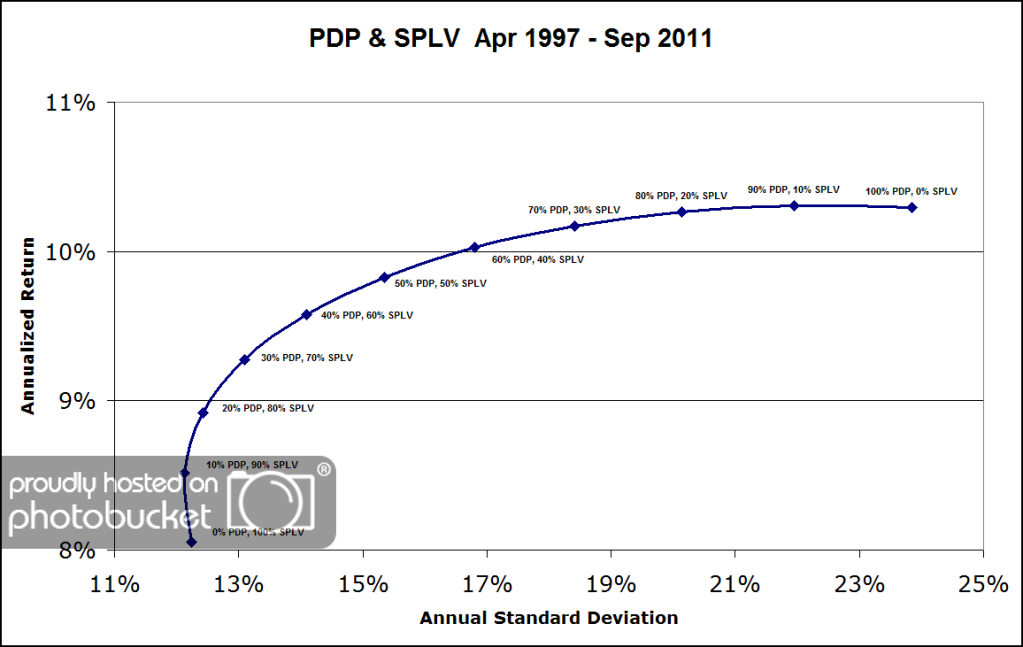
The efficient frontier below points out that combining the two can be an effective way to reduce the volatility and/or increase the return over using PDP or SPLV independently.

pdpsplv2 Combining Relative Strength and Low Volatility

(Click to enlarge)

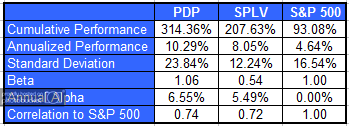
The table below is also for the period April 1997-September 2011. (The hypothetical returns for PDP only go back to April 1997.)

pdp3 Combining Relative Strength and Low Volatility

Perhaps most interesting to asset allocators is the fact that the correlation of excess returns of PDP and SPLV over this time period was -0.29. The goal of asset allocation is to not only add value, but to also construct an allocation that clients will stay with for the long-run. Rather than whip in and out of PDP, perhaps a more enlightened approach is to buy and hold positions in both PDP and SPLV for a portion of the allocation.

For the time periods when hypothetical returns were used, the returns are that of the PowerShares Dorsey Wright Technical Leaders Index and of the S&P 500 Low Volatility Index. The hypothetical returns have been developed and tested by the Manager (Dorsey Wright in the case of PDP and Standard & Poors in the case of SPLV), but have not been verified by any third party and are unaudited. The performance information is based on data supplied by the Dorsey Wright or from statistical services, reports, or other sources which Dorsey Wright believes are reliable. The performance of the Indexes, prior to the inception of actual management, was achieved by means of retroactive application of a model designed with hindsight. For the hypothetical portfolios, returns do not represent actual trading or reflect the impact that material economic and market factors might have had on the Manager’s decision-making under actual circumstances. Actual performance of PDP began March 1, 2007 and actual performance of SPLV began May 5, 2011. See PowerShares.com for more information.

Posted by:


Relative Strength and Market Volatility

September 30, 2011

Markets have been extremely volatile over the last couple of months. Volatile markets are very difficult to navigate. It is very easy to make mistakes, and when a mistake is made it is magnified by the volatility. From a relative strength standpoint, there are things you can do to help ease the pain of all of these large, unpredictable market moves. But judging by all the client calls we have taken over the years-almost always when volatility was high-the steps needed to make a relative strength model perform well are most definitely not what most investors would think!

Before we look at relative strength specifically, let’s take a step back and look at different investment strategies on a very broad basis. There are really two types of strategies: trend continuation and mean reversion. A trend continuation strategy buys a security and assumes it will keep moving in the same direction. A mean reversion (or value) strategy buys a security and assumes it will reverse course and come closer to a more “normal” state. Both strategies work over time if implemented correctly, but volatility affects them in different ways. Mean reversion strategies tend to thrive in high volatility markets, as those types of markets create larger mispricings for value investors to exploit.

When we construct systematic relative strength models, we have always preferred to use longer-term rather than shorter-term signals. This decision was made entirely on the basis of data—by testing many models over a lot of different types of markets. Judging by all the questions we get during periods of high volatility, I would guess that using a longer-term signal when the market is volatile strikes most investors as counter-intuitive. In my years at Dorsey Wright, I can’t remember talking to a single client or advisor that told me when markets get really volatile they look to slow things down!

During volatile markets, generally we hear the opposite view-everyone wants to speed up their process. Speeding up the process can take many forms. It might mean using a smaller box size on a point and figure chart, or using a 3-month look back instead of a 12-month look back when formulating your rankings. It might be as simple as rebalancing the portfolio more often, or tightening your stops. Whatever the case, most investors are of the opinion that being more proactive in these types of markets makes performance better.

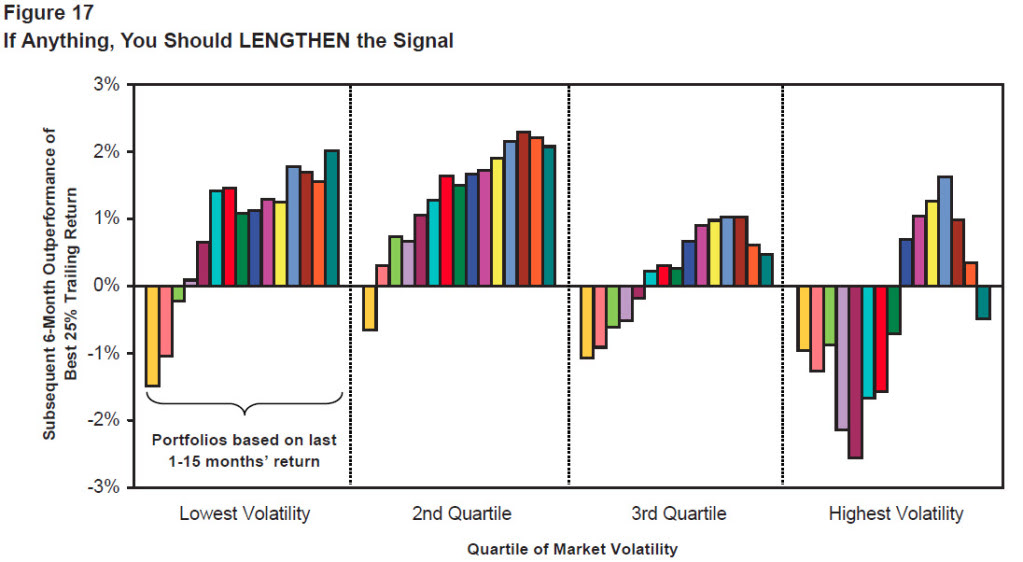
Their gut response, however, is contradicted by the data. As I mentioned before, our testing has shown that slowing down the process actually works better in volatile markets. And we aren’t the only ones who have found that to be the case! GMO published a whitepaper in March 2010 that discussed momentum investing (the paper can be found here). Figure 17 on page 11 specifically addresses what happens to relative strength models during different states of market volatility.

MomVol Relative Strength and Market Volatility

(Click Image To Enlarge. Source: GMO Whitepaper, Sept. 2010)

The chart clearly shows how shortening your look back period decreases performance in volatile markets. The 6-12 month time horizon has historically been the optimal time frame for formulating a momentum model. But when the market gets very volatile, the best returns come from moving all the way out to 12 months, not shortening your window to make your model more sensitive.

Psychologically, it is extremely difficult to lengthen your time horizon in volatile markets. Every instinct you have will tell you to respond more quickly in order to get out of what isn’t working and into something better. But the data says you shouldn’t shorten your window, and conceptually this makes sense. Volatile markets tend to be better for mean reversion strategies. But for a relative strength strategy, volatile markets also create many whipsaws. When thinking about how volatility interacts with relative strength, it makes sense to lengthen your time horizon. Hopping on every short term trend is problematic if the trends are constantly reversing! All the volatility creates noise, and the only way to cancel out the noise is to use more (not less) data. You can’t react to all the short-term swings because the mean reversion is so violent in volatile markets. It doesn’t make any sense to get on trends more rapidly when you are going through a period that is not optimal for a trend following strategy.

We use a data-driven process to construct models. We have found that using a relatively longer time horizon, while uncomfortable, ultimately leads to better performance over time. Outside studies show the same thing. If the data showed that reacting more quickly to short-term swings in volatile markets was superior we would advocate doing exactly that!

As is often the case in the investing world, this seems to be another situation where doing the most uncomfortable thing actually leads to better performance over time. Good investing is an uphill run against human nature. Of course, it stands to reason that that’s the way things usually are. If it were comfortable, everyone would do it and investors would find their excess return quickly arbitraged away.

Posted by:


The Power of Momentum

September 15, 2011

That is the title of a recent post on Eddy Elfenbein’s Crossing Wall Street blog. He has a nice reprise of the momentum data from the Ken French database. (Momentum is the academic name for the phenomenon that was known as relative strength more than 100 years before the academics re-discovered it.) His description is admirably concise:

The chart below shows the historical performance of stocks ranked by momentum decile (meaning 10% slices).

It turns out that stocks that are in motion have a very long record of continuing to stay in motion. Just to be clear, momentum is defined by performance over the 11-month period starting 12 months ago and ending one month ago.

The deciles are perfectly ranked by momentum. The portfolio with the highest momentum did the best. The second-best came in second and so on, all the way down to the worst momentum which came in last.

KenFrenchdeciles The Power of Momentum

(click on chart to enlarge)

Decile Gain
Low -1.58%
2 4.73%
3 5.85%
4 8.09%
5 8.46%
6 9.38%
7 10.68%
8 12.35%
9 13.11%
High 16.72%

Source: Crossing Wall Street

It’s hard to argue with data like that. It pays to stay with strong stocks over the long run.

Posted by:


High RS Diffusion Index

August 31, 2011

The chart below measures the percentage of high relative strength stocks that are trading above their 50-day moving average (universe of mid and large cap stocks.) As of 8/30/11.

HighRSddfff High RS Diffusion Index

After reaching the deeply oversold level of 2% on August 8th, this index has snapped back in a big way. The 10-day moving average of this index is 21% and the one-day reading is 44%. Dips in this index have often provided good opportunities to add money to relative strength strategies.

Posted by:


In Defense of “Chart Strength”

August 30, 2011

We’ve found another delusional-technical analysis hater. Jeff Nielson writes:

However, readers are right to be skeptical about the “chart strength” that gold has demonstrated. As I continually remind people, “technical analysis” is the least significant aspect of market analysis. This will naturally enrage the “T/A jockeys”, who like to pretend that technical analysis is all-powerful — simply because it is fast and easy, and requires no genuine comprehension, other than the ability to spot patterns in pictures.

This complete reliance upon charts rather than fundamentals is more than merely simplistic, it is dangerous. This is due to the fact that all technical analysis is based upon a long list of assumptions — all of which must be true, or all statistical validity of such analysis instantly evaporates. Thus, the appropriate way to demonstrate the “unsinkable” status of gold is through fundamentals-based analysis rather than statistical hocus pocus. It is here that gold shines even brighter.

Clearly, Mr. Nielson has a very limited/incorrect view of technical analysis. I challenge anyone to read this, this, and this and still conclude that relative strength is not effective over time. There may be many technical (and fundamental) investment methodologies that can not be statistically demonstrated to work over time, but there is no need to throw the baby out with the bath water.

 In Defense of Chart Strength

Posted by:


Should You Fear the New Normal?

August 26, 2011

This is a phrase popularized by the folks at PIMCO to denote a long period of slow economic growth and subpar equity returns. Forbes described their outlook like this:

According to the Pimco party line, those implications are rather grim for the U.S. A year ago Gross told FORBES that our future will likely include a lowered living standard, high unemployment, stagnant corporate profits, heavy government intervention in the economy and disappointing equity returns. Nor, with interest rates already low, can investors expect much from bonds, other than their mediocre coupons.

PIMCO is not the only firm in this camp. Other observers have talked about forward-looking returns for the stock market in the 5% range for the next decade. Here’s John Hussman in a recent commentary:

As a result of last week’s decline, the S&P 500 ended Friday priced, by our estimates, to achieve an average annual 10-year total return of about 4.9%, which is an improvement from the 3.4% level we observed a few months ago, but is nowhere near what would reasonably be viewed as undervalued.

Other observers on valuation are a little less pessimistic, like Jeremy Grantham at GMO, who is looking for returns that might average 8% for the next decade.

Another guru is Aswath Damodaran of NYU, who authored a common textbook on valuation. He wrote recently:

I am not much of a market timer but there is one number I do track on a consistent basis: the equity risk premium. I follow it for two reasons. First, it is a key input in estimating the cost of equity, when valuing individual companies. Second, it offers a window into the market mood, rising during market crises.

For the ERP to play this role, it has to be forward looking and dynamic. The. conventional approach of looking at the past won’t accomplish this. You can however use the current level of the index, with expected cashflows, to back out an expected return on stocks. (Think of it as an IRR for equities.) You can check out the spreadsheet that does this, on my website (http://www.damodaran.com) on the front page.Here is the link for the July 1 spreadsheet. Just replace the index and T.Bond rate with the current level and use the Goal seek in excel:
http://pages.stern.nyu.edu/~adamodar/pc/implprem/ERPJune11.xls

A little history on this “implied ERP”: it was between 3 and 3.5% through much of the 1960s, rose during the 1970s to peak at 6.5% in 1978 and embarked on a two decade decline to an astoundingly low 2% at the end of 1999 (the peak of the dot com boom). The dot com correction pushed it back to about 4% in 2002, where it stagnated until September 2008. The banking-induced crisis caused it to almost double by late November 2008. As the fear subsided, the premium dropped back to pre-crisis levels by January 2010. I have the month-by-month gyrations on my site, also on the front page. http://pages.stern.nyu.edu/~adamodar/pc/implprem/ERPbymonth.xls

Now, to the present. The ERP started this year at 5.20% and gradually climbed to 5.92% at the start of August. Today (8/8/11) at 11.15 am, in the midst of market carnage, with the S&P 500 at 1166 and the 10-year T. Bond at 2.41%, the implied ERP stood at 6.62%.

In this case, the expected return on stocks would be about 9.03% (2.41% plus an equity risk premium of 6.62%).

Why am I bringing all of this up, as I am clearly no expert on valuation or value investing? Well, for a couple of reasons. First, these commentators are largely driven by data, not opinions. Both Hussman and Damodaran, for example, have long-standing models and they change their minds when the data changes. Second, even within the camp that uses robust valuation models, there is quite a range of expectations. Hussman’s model suggests that the market is not undervalued, but Damodaran’s work shows the equity risk premium at multi-decade highs.

That the new normal will happen is no slam dunk, but it’s certainly not out of the question. After all, equity market returns have been extremely anemic over the last ten years and Japan’s experience shows that such a situation can last for much longer than anyone expects. The prospect of another decade of lousy returns is discouraging enough to keep many investors on the sidelines.

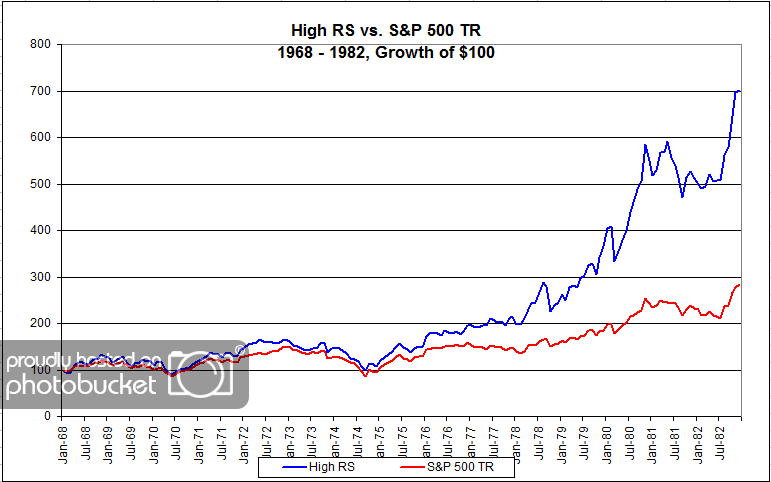
To help understand what the new normal might mean for relative strength investors, J.P. dug into US stock market data from the 1968-1982 period. This period is roughly analogous to our current markets, at least perhaps psychologically. 1968 saw a bear market for speculative names (2000-02), followed by a mega-bear market in 1973-74 in which blue chips got torched as well (2008). The public was turned off to stocks in general, culminating in disgust with the 1979 “Death of Equities” Business Week cover. The S&P 500 total return for the period was 7.2% annualized. Prices barely moved, but dividend yields were reasonably high and accounted for more of the total return than capital appreciation.

DeathofEquities Should You Fear the New Normal?

To get a robust estimate for relative strength returns during this period, J.P. went to the database of Ken French at Dartmouth. He looked at returns for portfolios formed from the top half of market capitalization (large cap) and the top third in relative strength. Dr. French constructs his relative strength ranks by calculating the 12-month trailing return, less the return of the most recent month. The portfolio is rebalanced each month with any new names. (Incidentally, this is the same model used by the AQR Momentum Fund.)
SPTR1982 Should You Fear the New Normal?

Source: Dorsey, Wright Money Management

As you can see, the new normal is not necessarily a problem for a disciplined relative strength investor. Although market returns were 7.2% annualized, the high relative strength segment returns were about 13.9% per year. It may be fashionable to talk gloom and doom, but the data is clear that good returns are still available in some segments of the market—even if the broad indexes don’t go anywhere.

Note: this chart may well understate the high RS returns, since Dr. French’s database does not incorporate total returns. Looking at price returns only, the comparison would be 13.9% annually for high RS and 2.3% annually for the market.
Posted by:


“Black Magic of Technical Analysis”

August 17, 2011

Just when I thought people were starting to like us:

Let’s make a crazy assumption and agree that investors are — at least in part — rational beings. Unless you exclusively worship the black magic of technical analysis, chances are your portfolio is built upon logical assumptions about the headlines and hard numbers like revenue, earnings and so on.

You know, facts.

-Jeff Reeves, InvestorPlace.com

So, my question is this: Can a “rational” person read this, this, and this, and still say that technical analysis is black magic? Sure, some approaches to technical analysis can’t be backed up by data (as is also true of some approaches to fundamental investing), but I’m not sure how a rational person can argue that relative strength has not been effective over time.

Posted by:


High RS Diffusion Index

July 27, 2011

The chart below measures the percentage of high relative strength stocks that are trading above their 50-day moving average (universe of mid and large cap stocks.) As of 7/19/11.

 High RS Diffusion Index

The vast majority of high relative strength stocks are now trending higher. The 10-day moving average of this indicator is 76% and the one-day reading is 72%.

Posted by:


How Track Records Are Achieved

July 25, 2011

Investment News on the role of proper due diligence:

Looking at a portfolio manager’s track record is one thing, but understanding how he or she achieved it, and whether it can be repeated, is another story and something that financial advisers should consider when selecting funds for their clients, according to those who study investor behavioral trends.

We agree — which is why we have released two white papers that, we believe, will help anyone become comfortable with relative strength strategies:

Relative Strength and Asset Class Rotation, John Lewis, CMT

Bringing Real-World Testing To Relative Strength, John Lewis, CMT

Posted by:


But, It’s Already Run Up So Much…

July 19, 2011

One of the main reasons that price momentum (aka relative strength) strategies have not been arbitraged away is because most of us are naturally born and bred contrarians. It’s just not in our psychological make-up to want to buy something that has already gone up in price, despite the fact that that is exactly what research tells us we should do. Therefore, those managers who are able to execute a relative strength strategy in a systematic fashion are in a position to do something that would likely otherwise be impossible.

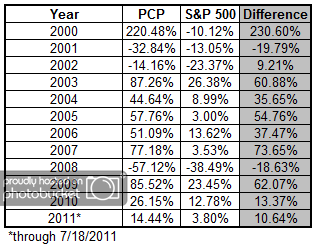
As an example, consider the performance of Precision Castparts (PCP) from 12/31/1999 - 7/18/2011. With a cumulative performance of 2,390% (compared to -11.15% for the S&P 500), PCP is among the best performing stocks in the S&P 900 over this time.

pcp But, Its Already Run Up So Much...

Honestly, without a systematic process in place, wouldn’t it have been psychologically difficult to buy PCP after many of the blowout years over this period? After all, it had already run up so much…

Disclosure: Precision Castparts is currently a holding in the PowerShares DWA Technical Leaders Index (PDP)

Posted by:


Global Flexible Investing: “Nonsensical…any other way”

July 14, 2011

Investment News recently asked Dennis Stattman, long-time manager of the BlackRock Global Allocation Fund, about the appeal of global asset allocation funds:

I believe that global flexible investing is what most investors ought to have at the foundation of their portfolios. It’s almost nonsensical to me to think, for most investors, that it would be any other way. Why would an investor not elect to choose from the broadest universe of investment possibilities that she or he could?

Anyone interested in the benefits of global tactical asset allocation, driven by relative strength, really should read Relative Strength and Asset Class Rotation by John Lewis, CMT, republished in February 2011.

whitepaper 2 Global Flexible Investing: Nonsensical...any other way

I would agree with Dennis Stattman that these types of flexible asset allocation strategies ought to make up the foundation of most investor’s portfolios. From the perspective of seeking to manage volatility and seeking to earn favorable returns in a wide variety of market environments, this flexible global asset allocation mandate just makes sense.

To receive the brochure for our Global Macro strategy, click here. For information about the Arrow DWA Tactical Fund (DWTFX), click here.

Click here and here for disclosures. Past performance is no guarantee of future returns.

Posted by:


The #1 Investment Return Factor No One Wants to Talk About

June 29, 2011

Relative strength is the #1 investment return factor no one wants to talk about. The reasons are not entirely clear to me, but perhaps it is because it is too simple. It does not require a CFA to forecast earnings or to determine an economic moat. It does not require a CPA to attempt to assess valuation. It does not require an MBA to assess strategic business decisions. In short, it does not play to the guild mentality wherein only certain masters of the universe have the elevated intellect, knowledge, and background to invest successfully.

Although relative strength is simple, I am not suggesting that relative strength is easy to implement. Losing weight is simple too: eat less, exercise more. That does not make it easy to do. Relative strength, probably like most successful investment strategies, requires an inordinate amount of discipline—and tolerance of a fair amount of randomness. Like most games that are easy to learn, but difficult to master—chess would be an apt example—proficient use of relative strength also requires deep study and experience.

Yet relative strength has been used successfully by practitioners for many generations. George Chestnutt of the American Investors Fund began using it to run money in the 1930s and said it had been in use by others for at least a generation before that. Relative strength has been shown to work in many asset classes, across many markets for more than 100 years. Since the early 1990s, even academics have gotten in on the act.

And for all that, relative strength remains ignored.

I was reminded of its apparent obscurity again this week when reading an excellent article on indexing by the macrocephalic Rob Arnott. He had a very nice piece in Advisor Perspectives about the virtues of alternative beta indexes.

In recent years, a whole new category of investments—called “alternative betas”—has emerged. Some of these alternative beta strategies, including the Fundamental Index® approach, use various structural schemes to select and/or weight securities in the index. In that sense, they fall between traditional cap-weighted approaches and active management: they pick up broadly diversified market exposure (beta) but seek to produce better results than cap-weighted indexes (what is desired from active managers).

Our CIO, Jason Hsu, and research staff have replicated the basic methodologies of many of these rules-based alternative betas, ranging from a simple equal-weighted approach to the straightforward Fundamental Index strategy to the truly exotic such as risk clustering and diversity weighting.7 The potential rewards are promising. Of the 10 non-cap-weighted U.S. equity strategies studied, all outperformed the passive cap-weighted benchmark. The range of excess returns by alternative beta strategies was between 0.4% and 3.0% per annum—matching a reasonable estimate of the top quartile of active managers—that is, the small cadre of managers who generally are successful at beating the benchmark (see Table 1). The bottom line: investors can obtain top-quartile performance with far less effort than is required to research and monitor traditional active equity managers.

Mr. Arnott has a very good point—and the numbers to prove it. Lots of alternative beta strategies are available that can potentially offer top-quartile performance relative to other active managers and that may also outperform traditional passive cap-weighted benchmarks. He is no doubt proselytizing on behalf of his firm’s Fundamental Index approach to some extent, but I think his underlying thesis is correct. He offers the following table as evidence that alternative beta strategies can outperform, using data from 1964- 2009:

index3 The #1 Investment Return Factor No One Wants to Talk About

Source: Advisor Perspectives, Research Affiliates (click to enlarge)

I would like to offer a slight modification of this table, since it is only a listing of “select” alternative beta strategies. Relative strength has been inexplicably excluded. Below, I present the same table of alternative beta strategies now including relative strength, the #1 investment return factor no one wants to talk about. (I have my own theory about why other indexers don’t want to talk about relative strength, but I will let you reach your own conclusions.) The relative strength returns presented in the table are for the exact same time period, 1964 through 2009. They are taken from Professor Ken French’s database and show the results of a simple relative strength selection process when using the top third (as ranked by relative strength) of the large cap universe.

index2 The #1 Investment Return Factor No One Wants to Talk About

Source: Research Affiliates, Dorsey Wright (click to enlarge)

Are you surprised that relative strength blows away the other alternative beta strategies?

You shouldn’t be. There are plenty of academic and practitioner studies attesting to the power of relative strength. In short, I agree with Mr. Arnott that alternative beta indexes are worth a close look. And I think it would be particularly prudent to consider relative strength weighted indexes.

See www.powershares.com for more information on our three DWA Technical Leaders Index ETFs (PDP, PIE, PIZ).

Click here for disclosures. Past performance is no guarantee of future results.

Posted by:


From the Archives: Evidence-Based Investing

June 15, 2011

Evidence of long-term outperformance is the first and foremost reason to invest in any actively managed strategy. There is no need to guess which strategies are likely to deliver outperformance over the long-term when empirical data is so readily accessible.

On our website, we have archived nearly 20 research papers that present the evidence for relative strength investing, including the following.

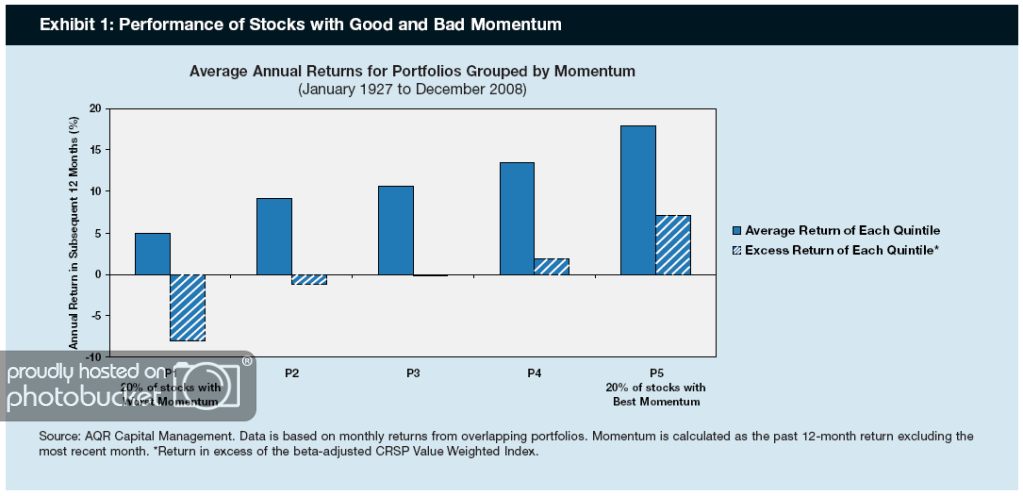
AQR Capital Management recently published a paper in which they present the results of a momentum strategy (as defined by trailing 12 month price return) from 1927 to 2008. They compared the performance of U.S. stocks, broken into quintiles as defined by momentum.

AQR From the Archives: Evidence Based Investing

(Click to Enlarge)

The top two quintiles were able to generate significant excess return over time. A proper understanding of the historical nature of relative strength investing is a critical factor in being able to commit to the strategy for the long run.

—-This article was originally posted on July 27, 2009. There is still no need to guess which strategies might generate long-term outperformance. Empirical data is still readily available!

Posted by:


Expectations vs. Reality

June 14, 2011

Index Universe reports the following from the “S&P Persistence Scorecard,” which analyzes the persistence of top performing fund managers over time.

S&P found that over a five-year period ended March 2011:

  • Of the funds with top-half rankings, only 0.96 percent of large-cap funds, 1.14 percent of midcap funds and 2.59 percent of small-cap funds maintained that top-half ranking over five consecutive 12-month periods. To put those numbers in perspective, random expectations would suggest a rate of 6.25 percent, S&P said.
  • Of the funds with top-quartile rankings, 19.15 percent of large-cap funds maintained that top-quartile ranking over the next five years. Also, only 9.38 percent of midcap funds and 23.26 percent of small-cap funds did so over the same period. Random expectations suggest a rate of 25 percent, S&P said.

Of these results, Index Universe states the following: “the persistence data paint a damning picture of the world of actively managed investments.” Really?! Because the funds in the top half of the rankings five years ago did not maintain top-half performance in each of the past 5 years they conclude that this is damning evidence against actively managed investments. As pointed out above, 19.15 percent of large-cap funds did maintain their top-quartile rankings over the next five years. However, just because they weren’t in the top of the ranks every single year, the conclusion is that active management fails. The article also completely fails to address the issue of large percentage of managers who profess to be active, but are really closet indexers.

Any investor that expects their actively managed strategy to outperform every single year is asking for for a lifetime of disappointment. Does that mean that there are not actively managed strategies that outperform over time? Hardly. The evidence is pretty clear about historical results of relative strength and value, for example. Furthermore, history tells us that relative strength has not outperformed in all 3 and 5 year periods, but it sure has outperformed a high percentage of the time.


Source: Psychology Today

Posted by:


High RS Diffusion Index

June 1, 2011

The chart below measures the percentage of high relative strength stocks that are trading above their 50-day moving average (universe of mid and large cap stocks.) As of 5/31/11.

diffusion 21 High RS Diffusion Index

The High RS Diffusion index has been fairly volatile for the last few months. Yesterday’s one day reading was 72%, and the 10-day moving average is 60%.


Posted by:


High RS Diffusion Index

May 25, 2011

The chart below measures the percentage of high relative strength stocks that are trading above their 50-day moving average (universe of mid and large cap stocks.) As of 5/24/11.

 High RS Diffusion Index

The High RS Diffusion index has been fairly volatile for the last few months. Yesterday’s one day reading was 52%, and the 10-day moving average is 61%.

Posted by:


High RS Diffusion Index

May 18, 2011

The chart below measures the percentage of high relative strength stocks that are trading above their 50-day moving average (universe of mid and large cap stocks.) As of 5/17/11.

 High RS Diffusion Index

The 10-day moving average of this indicator has remained above 50% since July of last year as the majority of high relative strength stocks have continued to trend higher. The 10-day moving average of this indicator is 64% and the one-day reading is 54%.


Posted by:


From the Archives: RS Primer

May 10, 2011

Good primer on relative strength by CSS Analytics:

I have done a lot of research in this area and the first conclusion I can make is that it should be a major portion of any trader or investors portfolio strictly because it is so durable and robust. Whether its asset classes, sectors, stocks, commodities, currencies—-you pick a time frame over the last 40-50 years and this simple method of buying strength and selling weakness has outperformed traditional buy and hold strategies. This outperformance or alpha is also robust to most transaction cost assumptions.

Four-stage model depicting how relative strength occurs:

Based on my own observation and theory I feel that a simple four-stage model best depicts how relative strength occurs and why it takes time to develop rather than occuring instantaneously. The relative strength effect is driven by behavioural feeback loops where investors sequentially pour money into the asset du jour for a plethora of reasons including positive perceived fundamentals, psychological beliefs such as fear or greed, or for positive economic or default risk factor sensitivity. Essentially it starts when certain investors create a theory such as: “emerging markets will outperform because of the accelerated pace of development” and begin to accumulate investments in assets tied to this theory (Stage 1: the early adopters). As time goes on the theory itself becomes more widely known and the rationale becomes more widely accepted. Others quickly catch on and start investing in the same idea (Stage 2: recognition and acceptance). The next stage (and longest stage) is where initial investors wait for hard proof that the idea or theory is supported by tangible evidence in a variety of forms whether economic indicators, qualitative or anectdotal accounts to mention a few. (Stage 3: validation). The “Validation Stage” tends to last long as the early investors are looking for ongoing proof that supports or refutes their theory. The nature of economic data and other information sources is that they require multiple readings to establish that a trend is in fact statistically valid. This is why it is impossible for markets to adjust instantaneously even with purely rational investors. There are two paths the validation stage can take—either the evidence to refute the theory is strong , and as a consequence momentum will fail as early investors bail out. Or if the evidence continues to support and even exceed expectations, the early investors will add to their positions alongside the second stage investors. This added money flowcements the trend and the relative strength begins to really accelerate. At this point we reach the final stage where everyone agrees that a given market is and should go up and people are hopping on the bandwagon simply because the market is going up. This is both the fastest stage and the most rewarding per unit of time (Stage 4: mania).

—This post was originally published on December 29,2009. It’s a good summary of a timeless cycle.

Posted by:


Abnormal Commodity Markets?

May 7, 2011

In case you thought the action in the commodity markets has been abnormal over the past couple of weeks, Jim Rogers begs to differ (from an interview with the Economic Times on May 6):

I am not buying any commodity right now. I am not selling any commodity. I am sitting and watching. Corrections like this are normal. It is the way the markets work. If you do not have corrections, you do not have the markets. So this is just normal. This is the way the world works.

This may not help any commodity investors feel better, but it is good perspective from a very successful investor who has been watching and investing in the commodity markets for many decades. This might also be a good time to re-read John Lewis’ white paper on Relative Strength and Asset Class Rotation.

Posted by:


David Ricardo’s Golden Rules

April 20, 2011

Most people, if they have heard of David Ricardo at all, associate him with classical economics and the law of comparative advantage. What they don’t know is that David Ricardo was a trend follower—and made a fortune doing it.

David Ricardo was born in 1772, which ought to give you some idea just how robust trend following is and for how long it has worked. His father was a stockbroker, so he had some familiarity with financial markets. After an estrangement from his family from marrying outside his faith, he started his own brokerage business. He retired in 1814 (age 42) with a fortune of $65 million (in today’s dollars; 600,000 pounds sterling then) and bought Gatcombe Park, in Gloucestershire. (Today, Princess Anne lives at Gatcombe Park, a modest 730-acre estate, described as having five main bedrooms, four secondary bedrooms, four reception rooms, a library, a billiard room and a conservatory, as well as staff accommodations.)

 David Ricardos Golden Rules

David Ricardo: Millionaire Trend Follower

source: www.econc10.bu.edu

What was David Ricardo’s secret? According to an 1838 book, The Great Metropolis, Volume 2, by James Grant, it was what Ricardo referred to as his golden rules:

As I have mentioned the name of Mr. Ricardo, I may observe that he amassed his immense fortune by a scrupulous attention to what he called his own three golden rules, the observance of which he used to press on his private friends. These were, ” Never refuse an option* when you can get it,”—”Cut short your losses,”— ” Let your profits run on.” By cutting short one’s losses, Mr. Ricardo meant that when a member had made a purchase of stock, and prices were falling, he ought to resell immediately. And by letting one’s profits run on he meant, that when a member possessed stock, and prices were raising, he ought not to sell until prices had reached their highest, and were beginning again to fall. These are, indeed, golden rules, and may be applied with advantage to innumerable other transactions than those connected with the Stock Exchange.

The emphasis is mine, although I feel like the whole segment should be in bold!

Timeless investment wisdom: cut your losses and let your profits run! And further, even clarification of what Ricardo meant! If the price starts to fall, sell. If it is rising, stay with it until it begins to fall. Finally, the author points out that these golden rules may be applied to transactions other than those connected to the Stock Exchange. Indeed, it turns out that relative strength investing works in stocks and across sectors and asset classes, both domestically and internationally. And based on the story of David Ricardo, things haven’t changed much since 1800.

I think David Ricardo is now one of my favorite economists.

Hat tip to the World Beta blog and the Au.Tra.Sy blog for pointing me in the direction of this fantastic story.

Posted by: