June Arrow DWA Funds Review

July 3, 2013

6/30/2013

The Arrow DWA Balanced Fund (DWAFX)

At the end of June, the fund had approximately 46% in U.S. Equities, 26% in Fixed Income, 16% in International Equities, and 12% in Alternatives. The U.S. equity markets pulled back in for the first couple weeks of June as the market continues to digest the likelihood of the eventual “tapering” of the Federal Reserve’s quantitative easing program which has served to hold interest rates down. However, the equity markets showed signs of stabilizing towards the end of the month. Most of our U.S. equity holdings held up relatively well in June, with some areas (Consumer Cyclicals) actually showing a small gain for the month. Small and mid-caps, which we own, also held up relatively well and continued to show positive relative strength compared to large caps for the year. U.S. equities continue to be an overweight in the fund. International equities pulled back even more sharply than U.S. equities in June. Developed international markets have been performing better than emerging markets this year and now all five of our current international equity positions are in developed markets (Mexico was replaced with Japan in June). Japanese equities pulled back sharply in May, but were actually positive in June and remain among the strongest international equity markets for the year. We had relatively weak performance in our alternatives (real estate and the currency carry trade). Our exposure to alternatives remains near its lower constraint of 10% of the fund. Interest rates made a pretty strong move higher in June and most sectors of fixed income declined. About half of our fixed income exposure is in short-term U.S. Treasurys and held up relatively well.

DWAFX lost 2.06% in June, but remains up 5.39% through 6/30/13.

We believe that a real strength of this strategy is its balance between remaining diversified, while also adapting to market leadership. When an asset class is weak its exposure will tend to be towards the lower end of the exposure constraints, and when an asset class is strong its exposure in the fund will trend toward the upper end of its exposure constraints. Relative strength provides an effective means of determining the appropriate weights of the strategy.

dwafx 07.03.13 June Arrow DWA Funds Review

The Arrow DWA Tactical Fund (DWTFX)

At the end of June, the fund had approximately 90% in U.S. Equities and 9% in International Equities. Historically, it has been pretty rare to have this much exposure to U.S. equities in this strategy. The fact that U.S. equities have had the best relative strength compared to other asset classes is certainly a different picture that we saw for most of the last decade. It has become “normal” to say that the U.S. equity markets are in a structural bear market, but with the breakout to new highs this year it is quite possible that we may have transitioned to more of a structural bull market. Of course, one never knows how long any trend will persist and our methodology is designed to adapt regardless of how the future ultimately plays out. There was a pullback in the equity markets in the first couple weeks of June. Our U.S. equity holdings held up relatively well with Consumer Cyclicals actually showing a small gain for the month and a number of our other positions, including small and mid-caps, holding up better than large caps. We did remove a position to international real estate in June and it was replaced with more U.S. equity exposure. The rise in interest rates has not helped the performance of real estate and fixed income. Although this fund also has the ability to invest in commodities, we currently have no exposure to this asset class due to its weakness. Japanese equities pulled back sharply in May, but were actually positive in June and remain among the strongest international equity markets for the year.

DWTFX was down 0.67% in June and has gained 10.16% through 6/30/13.

This strategy is a go-anywhere strategy with very few constraints in terms of exposure to different asset classes. The strategy can invest in domestic equities, international equities, inverse equities, currencies, commodities, real estate, and fixed income. Market history clearly shows that asset classes go through secular bull and bear markets and we believe this strategy is ideally designed to capitalize on those trends. Additionally, we believe that this strategy can provide important risk diversification for a client’s overall portfolio.

dwtfx 07.03.13 June Arrow DWA Funds Review


See www.arrowfunds.com for more information.

Posted by:


(Really) Long-Term Perspective on Interest Rates

June 20, 2013

With interest rates surging in recent days, I think it is interesting to stand back and look at a chart of the 10-Year Treasury Yield from a broader historical perspective. Via Business Insider:

image001 23 (Really) Long Term Perspective on Interest Rates

Source: Global Financial Data (click to enlarge)

Business Insider’s take:

So if you believe in the power of mean reversion, then it’s not unreasonable to expect yields to head back up toward 4%.

Although investors have grown accustomed to interest rates primarily moving in one direction (down) over the past 30+ years, history shows a number of periods of extended rising rate environments. Needless to say, it is quite possible that there will be opportunities to add value over a passive approach to fixed income exposure by being tactical in years ahead. In the context of multi-asset class portfolios, that may mean underweighting fixed income altogether. For allocations within fixed income, it may mean being more discriminating when determining what sectors of fixed income to own. I suspect that relative strength may prove to be very valuable in the years ahead as it relates to fixed income exposure.

Posted by:


Endowment-Style Investing

June 17, 2013

Institutional Investor interviews Eric Upin to discuss global-endowment style investing.

How do institutions approach global multiasset-class investing?

It’s all about asset allocation, manager selection and risk management. Global multiasset-class investing is a team sport, whether you’re an endowment, sovereign wealth fund or foundation. When you’re investing around the world, trying to bring professionals together to make judgments such as whether you should be overweight or underweight Europe, real estate or other asset classes, the more smart people you can bring into the tent who do what you do — and who can help provide opinions and spark ideas — the better.

As a quantitative manager, this description of how to ultimately determine an asset allocation is completely foreign. Maybe it works great for some, but the idea of trying to get an edge on the market by seeking out “smart people” who can help provide opinions and spark ideas seems problematic. We have no aversion to smart people, however we do have a strong preference for removing the role of judgement calls in the investment process. For us, the asset allocation decision goes something like this. We determine an investment universe that is comprised of a broad range of asset classes. We determine the model constraints (i.e. how much we can overweight or underweight a given asset class), and then apply our relative strength methodology to ranking the different asset classes and each of the individual components of the investment universe. Then, our weights to different asset classes and exact holdings are determined by a systematic relative strength model. Likewise, sell decisions are also based on this relative strength ranking process.

Those interested in seeing just how effective this quantitative approach to asset allocation can be over time, can read Tactical Asset Allocation Using Relative Strength by John Lewis. This approach is also working well this year, as discussed in DWTFX Tops Peers.

Past performance is no guarantee of future results. Please click here and here for disclosures.

Posted by:


DWTFX Tops Peers

June 14, 2013

Earlier this year, we featured an excellent resource published by our partners at Arrow Funds called Relative Strength Turns. You can access a PDF of the brochure by clicking here. This research discusses the type of behavior you can expect from a relative strength driven strategy in various market cycles and it makes the case for why relative strength strategies may experience favorable returns in the years ahead.

Interestingly, we have seen this corroborated by the performance of the Arrow DWA Tactical Fund, which employs a largely unconstrained application of relative strength to multiple asset classes. With YTD performance of 10.65% through 6/13/13, it is outperforming 99% of its peers in the Morningstar World Allocation category.

DWTFX DWTFX Tops Peers

Past performance is no guarantee of future returns.

This strategy is available in the Arrow DWA Tactical Fund (DWTFX) and also as a separately managed account as our Global Macro strategy, which is available on a number of major platforms, including the Wells Fargo Masters and DMA platforms.

Please click here and here for disclosures.

Posted by:


From the Archives: Perfect Sector Rotation

June 4, 2013

CXO Advisory has a very interesting blog piece on this topic. They review an academic paper that looks at the way conventional sector rotation is done. Typically, various industry sectors are categorized as early cycle, late cycle, etc. and then you are supposed to own those sectors at that point in the business cycle. Any number of money management firms (not including us) hang their hat on this type of cycle analysis.

In order to determine the potential of traditional sector rotation, the study assumes that you get to have perfect foresight into the business cycle and then you rotate your holdings with the conventional wisdom of when various industries perform best. A couple of disturbing things crop up, given that this is the best you could possibly do with this system.

1) You can squeak by with about 2.3% annual outperformance if you had a crystal ball. If you are even a month or two early or late on the cycle turns, your performance is statistically indistinguishable from zero.

2) 28 of the 48 industries studied (58.3%) underperformed during the times when they were supposed to perform well. There’s obviously enough noise in the system that a sector that is supposed to be strong or weak during a particular part of the cycle often isn’t.

CXO notes, somewhat ironically:

Note that NBER can take as long as two years after a turning point to designate its date and that one business cycle can be very different from another.

In other words, it’s clear that traditional business cycle analysis is not going to help you. You won’t be able to forecast the cycle turning points accurately and the cycles differ so much that industry performance is not consistent.

Sector rotation using relative strength is a big contrast to this. Relative strength makes no a priori assumptions about which industries are going to be strong or weak at various points in the business cycle. A systematic strategy just buys the strong sectors and avoids the weak ones. Lots of studies show that significant outperformance can be earned using relative strength (momentum) with absolutely no insight into the business cycle at all, including some studies done by CXO Advisory. Tactical asset allocation is finally coming into its own and various ways of implementing are available. Business cycle forecasting does not appear to be a feasible way to do it, but relative strength certainly is!

—-this article originally appeared 3/30/2010. Although the link to CXO Advisory is no longer live, you can get the gist of things from the article. Things don’t always perform in the expected fashion, and paying attention to relative strength can be some protection from the problem. Instead of making assumptions about strong or weak performance, relative strength just adapts.

Posted by:


The Pullback in Japan

May 23, 2013

In light of Thursday’s 7.3% drop in the Nikkei 225, we wanted to review Japan from a trend and relative strength perspective. Performance over the last two years is show below. The explosive move higher in Japanese equities has been driven in large part by expectations for Prime Minister Shinzo Abe’s plan which can be summed up in his own words, “With the strength of my entire cabinet, I will implement bold monetary policy, flexible fiscal policy and a growth strategy that encourages private investment, and with these three policy pillars, achieve results.”


Japan The Pullback in Japan

Source: Yahoo! Finance (click to enlarge)

A longer-term view of the Nikkei 225 reveals just how poor the performance for Japanese equities has been since its 1989 peak:

Japan22 The Pullback in Japan

Source: Yahoo! Finance (click to enlarge)

As expected from a trend following methodology, Japan also started to rise to the top of our relative strength ranks in recent months. In fact, the iShares MSCI Japan ETF (EWJ) was added to the Arrow DWA Tactical Fund (DWTFX) in April of this year. The strength in EWJ is just one of the reasons that DWTFX is currently outperforming 98% of its peers in the Morningstar World Allocation Category YTD. The relative strength of Japan can also be seen in the Dorsey Wright Fund Score Rank:

fund score The Pullback in Japan


Source: Dorsey Wright (click to enlarge)

So, let’s get to the question on everyone’s mind: What happens from here? Will Japan bounce back and resume its explosive move higher or is it the beginning of a trend reversal? Unfortunately, we don’t have the answer to that. As we do with every trade, we buy strength and stay with it as long as it remains strong. If a position weakens sufficiently in our relative strength ranks we will replace it with a stronger security.

However, I do think it is interesting to note the potential comparison to a position in China that we had in the Arrow DWA Balanced Fund from 2006 to 2008. That transaction had a cumulative return of 103% from its initial purchase, but during the start of this magical ride there was a 21% correction. This is documented in the chart below.

China The Pullback in Japan

Source: Arrow Funds (click to enlarge)

The mere fact that Japan is back on the radar for relative strength strategies is a powerful reminder of the need to remain adaptive. New themes are constantly developing and relative strength is adept at capitalizing on these trends. There are plenty of pundits who are betting that Japan will continue its move higher, including Marc Faber. This could well be a good opportunity to get exposure to DWTFX during a temporary period of weakness after the fund has climbed over 13% YTD.

Past performance is not indicative of future results. Potential for profits is accompanied by possibility of loss. See www.arrowfunds.com for more information. A list of all holdings for the trailing 12 months is available upon request.

Posted by:


“Reform-Oriented Emerging Economies”

May 21, 2013

Financial Times author, Ruchir Sharma, says that money flows into the emerging markets are more discriminate this decade.

As the printing presses continue to hum, however, the question remains: where will the money go? Policy makers cannot assume it will flow to the emerging markets, the way it did in the 2000s. That was an exceptional decade, when all emerging markets boomed, attracting huge new capital flows. Now the blind optimism about growth in many emerging markets has dimmed, as many face serious structural problems.

Brazil, Russia and South Africa may grow more slowly than the global average over the next few years. However, inflows remain high in some of the more reform-oriented emerging economies such as the Philippines, Thailand and Turkey.

Interestingly, countries—Philippines, Thailand, and Turkey—that he labels as “more reform-oriented emerging economies” are all countries where we have overweights in the PowerShares DWA Emerging Markets Technical Leaders ETF (PIE).

pie1 Reform Oriented Emerging Economies

As of 4/1/2013.

These overweights and underweights have had a very positive impact on YTD performance:

pie perf Reform Oriented Emerging Economies

Source: Yahoo! Finance

Performance numbers listed above are pure price returns, not inclusive of dividends, all fees, or other expenses. Past performance is not indicative of future results. Potential for profits is accompanied by possibility of loss. See www.powershares.com for more information.

HT: Abnormal Returns

Posted by:


April Arrow DWA Funds Review

May 10, 2013

4/30/2013

The Arrow DWA Balanced Fund (DWAFX)

At the end of April, the fund had approximately 45% in U.S. Equities, 25% in Fixed Income, 17% in International Equities, and 13% in Alternatives. The U.S. equity markets continue to power higher led by Healthcare, Financials, and Consumer Cyclicals—all sectors that we own in the fund. While broad economic growth remains tepid, corporate profits have been impressive and this is surely a large reason why equities have been so strong. Much of our best performance for the fund in April also came from our Alternatives sleeve which has exposure to real estate, which has been the best performing asset class so far this year, and our currency carry trade, which includes a short position in the Japanese Yen. In recent months, the Japanese have embraced aggressive monetary policy in an attempt to stimulate their economy and to raise inflation. Their currency has dropped sharply so far this year. Real estate continues to benefit from the low interest rate environment and the economic recovery. International equities also had a strong month in April and are among the best performers for the year. Our exposure to fixed income can range from 25-65 percent of the fund, but for now the exposure is at the lower end of its band.

DWAFX gained 1.56% in April and is up 8% through 4/30/13.

We believe that a real strength of this strategy is its balance between remaining diversified, while also adapting to market leadership. When an asset class is weak its exposure will tend to be towards the lower end of the exposure constraints, and when an asset class is strong its exposure in the fund will trend toward the upper end of its exposure constraints. Relative strength provides an effective means of determining the appropriate weights of the strategy.

dwafx April Arrow DWA Funds Review

The Arrow DWA Tactical Fund (DWTFX)

At the end of April, the fund had approximately 78% in U.S. Equities, 10% in International Equities, and 9% in Real Estate. Over the course of the month, we reduced our exposure to international equities—specifically to European equities and Pacific ex-Japan—and increased our exposure to U.S. equities. We also added a position to Japanese equities. Japanese equities have responded strongly to the aggressive monetary policy being employed in Japan in an attempt to stimulate their economy. This is noteworthy because Japanese equities have had poor relative strength for much of the past several decades. We are also capitalizing on the improvement in Japan by our position in international real estate as the largest position in that ETF is to Japanese real estate. Among our best performing positions for the year are our U.S. sector positions in Health Care, Consumer Discretionary, and Financials. Stable leadership in those sectors has been very helpful for the performance of the overall fund.

DWTFX was up 2.63% in April and has gained 9.79% through 4/30/13.

This strategy is a go-anywhere strategy with very few constraints in terms of exposure to different asset classes. The strategy can invest in domestic equities, international equities, inverse equities, currencies, commodities, real estate, and fixed income. Market history clearly shows that asset classes go through secular bull and bear markets and we believe this strategy is ideally designed to capitalize on those trends. Additionally, we believe that this strategy can provide important risk diversification for a client’s overall portfolio.

DWTFX1 April Arrow DWA Funds Review


See www.arrowfunds.com for more information.

Posted by:


DWTFX Leading the Pack YTD

May 1, 2013

According to Morningstar, The Arrow DWA Tactical Fund (DWTFX) is now outperforming 95% of its peers in the World Allocation category YTD. Through April, the fund is up 9.79%

DWTFX DWTFX Leading the Pack YTD


You can access the fact sheet for the fund by clicking below:

fact sheet DWTFX Leading the Pack YTD


See www.arrowfunds.com for more information. Past performance is not indicative of future results. Potential for profits is accompanied by possibility of loss.

Posted by:


Financial Repression Primer

May 1, 2013

Research Affliliates published a very nice primer on financial repression on Advisor Perspectives. It’s well worth reading to get the lay of the land. Here’s how they define financial repression:

Financial repression refers to a set of governmental policies that keep real interest rates low or negative and regulate or manipulate a captive audience into investing in government debt. This results in cheap funding and will be a prime tool used by governments in highly indebted developed market economies to improve their balance sheets over the coming decades.

When you hear talk about “the new normal,” this is one of the features. Most of us have not had to deal with financial repression during our investment careers. In fact, for advisors in the 1970s and early 1980s, the problem was that interest rates were too high, not too low!

There are disparate views on the endgame from financial repression. Some are expecting Japanese-style deflation, while others are looking for Weimar Republic inflation. Maybe we will just muddle through. In truth, there are many possible outcomes depending on the myriad of policy decisions that will be made in coming years.

In our view, guessing at the outcome of the political and economic process is hazardous. We think it makes much more sense to be alert to the possibilities embedded in tactical asset allocation. That allows you to pursue returns wherever they can be found at the time, without having to have a strong opinion on the eventual outcome. Relative strength can often be a very useful guide in that process.

Posted by:


Gold: Getting Personal

April 15, 2013

Interesting chart of the S&P vs. gold going back a few decades:

SP Gold Gold: Getting Personal

Joe Weisenthal’s take:

You can see that even with the recent upturn in stocks, relative to gold, gold has crushed stocks since 2000.

Arguably, 2000 represented a peak in belief in the capabilities of humans. The internet inspired all kinds of crazy optimism about how humans would re-shape the world for the better. The ebullience spread beyond the net. There was, for example, optimism about newways of transporting humans: Fuel cells! Segway!

Of course, the bubble crashed. Then we had 9/11. Then we had two wars. Then we had the housing implosion. Then we had the financial crisis. Then the horrible recession. Then the European crisis and the debt ceiling and everything else.

In other words, we had a series of a events that, for good reason, shook our faith in humanity. During this time, people thought about history on a large scale. And gold, having been used as a money for thousands of years, did pretty well, especially relative to stocks, which represent companies made up of humans.

So ultimately, the decline of gold and the rise of stocks is a big trend that everyone should cheer.

The huge corpus of economic research, which has informed the US’ efforts to stimulate the economy, is not a pile of garbage. You can do a lot without blowing things up, as the goldbugs claimed would happen.

And more broadly, this represents a breaking of the fever, and perhaps a return to thinking that humans aren’t such a horrible disappointment.

With gold’s recent declines, analysis such as that written by Weisenthal is all over the place. Gold really gets personal with people. For many, its strength or weakness has the ability to validate their economic and political views.

From a strictly trend following perspective, the S&P vs. gold relative strength relationship is potentially significant because of its history of providing long-term trends favoring one or the other. If this ultimately does result in a major inflection point for the S&P vs. gold relationship, there will be important implications for those of us employing tactical asset allocation strategies in the years ahead. Admittedly, simply observing the relative strength relationship between the two provides much less intrigue than can be found on talk radio or any number of other sources (but that can be a very good thing for investors who are just looking to make money).

HT: Business Insider

Posted by:


Evaluating the “Siegel Constant”

April 11, 2013

From Eddie Elfenbein comes what I consider to be among the biggest reasons for employing a tactical approach to asset allocation—an approach that seeks to overweight or underweight U.S. equities depending on their relative strength.

I want to revisit the Ibbotson data again to look at the often-cited claim that the stock market has historically returned (capital gains and dividends) 7% per year greater than inflation. This claim has been repeated so much by Jeremy Siegel that some have called it Siegel’s Constant.

Here’s the long-term real return in blue, with a 6.9% trendline in black.

image1327 Evaluating the Siegel Constant

I think this is a dangerous idea for several reason. For one, the long-term real return of stocks is no longer 7%. Thanks to two giant market crashes in less than a decade, the long-term number has fallen to 6.67% (that’s since 1925). Furthermore, much of that gained comes from the post-war boom. Over that last 50 years, that real return has been a much more reasonable 5.45%.

Another problem is that this data series is highly volatile. Too volatile to call the results a constant. There have been long periods when investors haven’t made a dime from the stock market in real terms.

Looking at the data, there seems to be periods of 15 to 20 years when stocks boom, or when they bust. Notice how the blue line runs above or below the black line for long periods at a time. Still, I would say that we don’t have enough data to make the claim that the stock market does this regularly.

During those 15-20 year periods when stocks boom it makes sense to seek to overweight them and during the extended periods when stocks are out of favor it is quite likely that an investors will benefit by seeking to overweight other asset classes. This theory of tactically allocating among different asset classes was put to the test here in a white paper published by John Lewis. It doesn’t work every year, but over time the results speak for themselves.

Posted by:


March Arrow DWA Funds Review

April 8, 2013

3/31/2013

The Arrow DWA Balanced Fund (DWAFX)

At the end of March, the fund had approximately 46% in U.S. Equities, 25% in Fixed Income, 17% in International Equities, and 12% in Alternatives. This is little changed from the allocations to the different asset classes as of the end of February. Our biggest overweight continues to be U.S. equities. Within the U.S. equity sleeve, we have exposure to Healthcare, Financial, and Consumer Services sector funds. These three sectors have maintained fairly stable leadership for some time now. We also have exposure to U.S. small and mid-cap value funds. Value has generally had much better relative strength than Growth style funds.

DWAFX gained 2.52% in March and is up 6.34% through 3/31/13. Although our best performing holdings in March came from our exposure to U.S. equities, we also had some strong performance from International equities—Mexico in particular. Fixed income was relatively flat in March. Our exposure to fixed income can range from 25-65 percent of the fund, but for now the exposure is at the lower end of its band.

We believe that a real strength of this strategy is its balance between remaining diversified, while also adapting to market leadership. When an asset class is weak its exposure will tend to be towards the lower end of the exposure constraints, and when an asset class is strong its exposure in the fund will trend toward the upper end of its exposure constraints. Relative strength provides an effective means of determining the appropriate weights of the strategy.

dwafx March Arrow DWA Funds Review

The Arrow DWA Tactical Fund (DWTFX)

At the end of March, the fund had approximately 63% in U.S. Equities, 27% in International Equities, and 9% in Real Estate. As part of our U.S. equity exposure, we own Healthcare, Financial, and Consumer Services sector funds. These three funds have maintained fairly stable market leadership. We also have exposure to U.S. small and mid-cap value funds. Value has generally had much better relative strength than Growth style funds.

DWTFX was up 3.07% in March and has gained 6.98% through 3/31/13. Much of the best performance for the month came from our exposure to domestic equities and real estate, while our exposure to International equities was relatively flat over the course of the month.

This strategy is a go-anywhere strategy with very few constraints in terms of exposure to different asset classes. The strategy can invest in domestic equities, international equities, inverse equities, currencies, commodities, real estate, and fixed income. Market history clearly shows that asset classes go through secular bull and bear markets and we believe this strategy is ideally designed to capitalize on those trends. Additionally, we believe that this strategy can provide important risk diversification for a client’s overall portfolio.

dwtfx March Arrow DWA Funds Review


See www.arrowfunds.com for more details.

Posted by:


February Arrow DWA Funds Review

March 7, 2013

February 28, 2013

The Arrow DWA Balanced Fund (DWAFX)

At the end of February, the fund had approximately 44% in U.S. Equities, 25% in Fixed Income, 17% in International Equities, and 12% in Alternatives. This is little changed from the allocations to the different asset classes as of the end of January. However, we did have some changes within the Alternative asset class: Our position in gold was removed and replaced with real estate. The balance of the Alternative exposure is to the currency carry trade. Our biggest overweight continues to be U.S. equities.

DWAFX gained 0.23% in February and is up 3.72% through 2/28/13. Much of the best performance for the month came from our exposure to domestic equities (small and mid caps in particular), while international equities pulled back over the course of the month. Our fixed income exposure also modestly advanced in February. Although interest rates declined in February, the overall trend of rates has been higher since the middle of last year. Our exposure to fixed income can range from approximately 25 to 65 percent and right now it is at its lower limit.

We believe that a real strength of this strategy is its balance between remaining diversified, while also adapting to market leadership. When an asset class is weak its exposure will tend to be towards the lower end of the exposure constraints, and when an asset class is strong its exposure in the fund will trend toward the upper end of its exposure constraints. Relative strength provides an effective means of determining the appropriate weights of the strategy.

dwafx February Arrow DWA Funds Review

The Arrow DWA Tactical Fund (DWTFX)

At the end of February, the fund had approximately 62% in U.S. Equities, 28% in International Equities, and 9% in Real Estate. Over the course of February, we added to our U.S. Equity exposure, and reduced our exposure to International Real Estate. When this bull market in U.S. equities began nearly four years ago, there were not many who projected the impressive gains that we have ultimately seen. In fact, without a disciplined approach to following trends, it may have been psychologically difficult to overweight this asset class. However, this continues to be our biggest overweight. Our U.S. equity exposure remains in areas that have shown some fairly stable leadership, such as Consumer Discretionary, Financials, and Healthcare. Stable leadership is very helpful for trend following strategies and Consumer Discretionary stocks have been fairly persistent leaders for the last 5 years. Notably absent from our exposure is commodities, which have been particularly weak for the last couple of years. Commodities were among the best performing asset classes over the past decade, but that strength has not so far carried over to this decade. Again, we see the benefits of being adaptive.

DWTFX was flat in February and is up 3.79% through 2/28/13. Much of the best performance for the month came from our exposure to domestic equities, while our exposure to European equities pulled back over the course of the month.

This strategy is a go-anywhere strategy with very few constraints in terms of exposure to different asset classes. The strategy can invest in domestic equities, international equities, inverse equities, currencies, commodities, real estate, and fixed income. Market history clearly shows that asset classes go through secular bull and bear markets and we believe this strategy is ideally designed to capitalize on those trends. Additionally, we believe that this strategy can provide important risk diversification for a client’s overall portfolio.

DWTFX February Arrow DWA Funds Review

Of interest to Wells Fargo Advisors: The Arrow DWA Tactical Fund is currently among the funds on the Wells Fargo Advisors Mutual Fund Recommended List.

Please see www.arrowfunds.com for more information about The Arrow DWA Balanced Fund and The Arrow DWA Tactical Fund. Holding for the trailing 12 months is available upon request. Past performance is no guarantee of future returns.


Posted by:


Target Date Fund Follies

March 7, 2013

Target date and lifecycle funds have taken off since 2006, when they were deemed qualified default investment alternatives in the Pension Protection Act. I’m sure it seemed like a good idea at the time. Unfortunately, it planted the idea that a glidepath that moved toward bonds as the investor moved toward retirement was a good idea. Assets in target date funds were nearly $400 billion at the end of 2011—and they have continued to grow rapidly.

In fact, bonds will prove to be a good idea if they perform well and a lousy idea if they perform poorly. Since 10-year future returns correlate closely with the current coupon yield, prospects for bonds going forward aren’t particularly promising at the moment. I’ve argued before that tactical asset allocation may provide an alternative method of accumulating capital, as opposed to a restrictive target-date glidepath.

A new research paper by Javier Estrada, The Glidepath Illusion: An International Perspective, makes a much broader claim. He looks at typical glidepaths that move toward bonds over time, and then at a wide variety of alternatives, ranging from inverse glidepaths that move toward stocks over time to balanced funds. His findings are stunning.

This lifecycle strategy implies that investors are aggressive with little capital and conservative with much more capital, which may not be optimal in terms of wealth accumulation. This article evaluates three alternative types of strategies, including contrarian strategies that follow a glidepath opposite to that of target-date funds; that is, they become more aggressive as retirement approaches. The results from a comprehensive sample that spans over 19 countries, two regions, and 110 years suggest that, relative to lifecycle strategies, the alternative strategies considered here provide investors with higher expected terminal wealth, higher upside potential, more limited downside potential, and higher uncertainty but limited to how much better, not how much worse, investors are expected to do with these strategies.

In other words, the only real question was how much better the alternative strategies performed. (I added the bold.)

Every strategy option they considered performed better than the traditional glidepath! True, if they were more focused on equities, they were more volatile. But, for the cost of the volatility, you ended up with more money—sometimes appreciably more money. This data sample was worldwide and extended over 110 years, so it wasn’t a fluke. Staying equity-focused didn’t work occasionally in some markets—it worked consistently in every time frame in every region. Certainly the future won’t be exactly like the past, so there is no way to know if these results will hold going forward. However, bonds have had terrific performance over the last 30 years and the glidepath favoring them still didn’t beat alternative strategies over an investing lifetime.

Bonds, to me, make sense to reduce volatility. Some clients simply must have a reduced-volatility portfolio to sleep at night, and I get that. But Mr. Estrada’s study shows that the typical glidepath is outperformed even by a 60/40-type balanced fund. (Balanced funds, by the way, are also designated QDIAs in the Pension Protection Act.) Tactical asset allocation, where bonds are held temporarily for defensive purposes, might also allow clients to sleep at night while retaining a growth orientation. The bottom line is that it makes sense to reduce volatility just enough to keep the client comfortable, but no more.

I’d urge you to read this paper carefully. Maybe your conclusions will be different than mine. But my take-away is this: Over the course of an investing lifetime, it is very important to stay focused on growth.

Posted by:


From the Archives: Was It Really a Lost Decade?

February 28, 2013

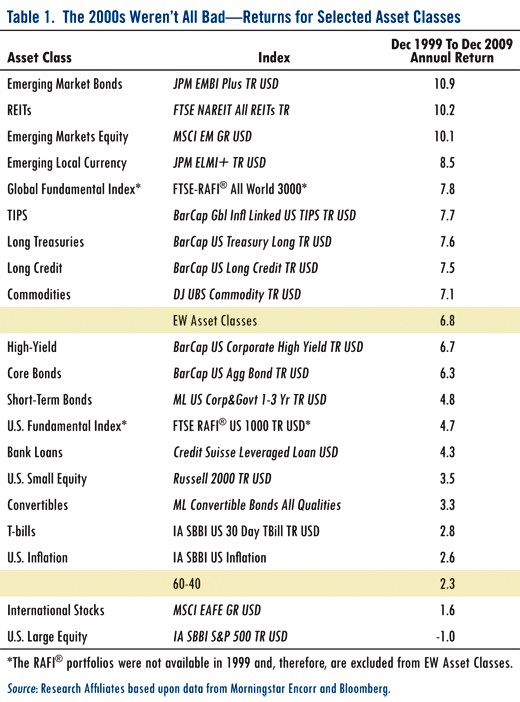
Index Universe has a provocative article by Rob Arnott and John West of Research Affiliates. Their contention is that 2000-2009 was not really a lost decade. Perhaps if your only asset was U.S. equities it would seem that way, but they point out that other, more exotic assets actually had respectable returns.

The table below shows total returns for some of the asset classes they examined.

 From the Archives: Was It Really a Lost Decade?

click to enlarge

What are the commonalities of the best performing assets? 1) Lots of them are highly volatile like emerging markets equities and debt, 2) lots of them are international and thus were a play on the weaker dollar, 3) lots of them were alternative assets like commodities, TIPs, and REITs.

In other words, they were all asset classes that would tend to be marginalized in a traditional strategic asset allocation, where the typical pie would primarily consist of domestic stocks and bonds, with only small allocations to very volatile, international, or alternative assets.

In an interesting way, I think this makes a nice case for tactical asset allocation. While it is true that most investors–just from a risk and volatility perspective–would be unwilling to have a large allocation to emerging markets for an entire decade, they might find that periodic significant exposure to emerging markets during strong trends would be quite acceptable. And even assets near the bottom of the return table like U.S. Treasury bills would have been very welcome in a portfolio during parts of 2008, for example. You can cover the waterfront and just own an equal-weighted piece of everything, but I don’t know if that is the most effective way to do things.

What’s really needed is a systematic method for determining which asset classes to own, and when. Our Systematic Relative Strength process does this pretty effectively, even for asset classes that might be difficult or impossible to grade from a valuation perspective. (How do you determine whether the Euro is cheaper than energy stocks, or whether emerging market debt is cheaper than silver or agricultural commodities?) Once a systematic process is in place, the investor can be slightly more comfortable with perhaps a higher exposure to high volatility or alternative assets, knowing that in a tactical approach the exposures would be adjusted if trends change.

—-this article originally appeared 2/17/2010. There is no telling what the weak or strong assets will be for the coming decade, but I think global tactical asset allocation still represents a reasonable way to deal with that uncertainty.

Posted by:


Assessing Fixed Income

February 27, 2013

Interesting perspective via ETF Trends on the potential risks in the fixed income markets—high-yield bonds in particular:

Michael Holland, chairman of Holland & Co., told Bloomberg that bond prices are acting like dot-com stocks during the Internet craze. “I’ve been in the business for 40 years, and the reality is that we’ve never had a situation like this because this is totally manufactured by the Fed,” he said.

“The interest-rate risk is just a law of nature,” said Craig Packer, head of Americas leveraged finance for Goldman Sachs, referring to junk bonds.

“I don’t know if it will be this year, but five years from now we’re going to look back and realize that investors were taking on real interest-rate risk when they were buying any of these products and that risk came to fruition,” Packer said in the Bloomberg story. “I feel pretty comfortable predicting that. It’s not the 2006-2007 credit risk. It’s the 2013 interest-rate risk.”

Will this prediction be any different than the countless other bearish predictions over the last couple years for fixed income? Who knows. However, at some point I do think it is highly likely that interest rates rise—perhaps substantially so. There are many different factors at work here, including Fed policy and the strength of the economic recovery. If and when rates do rise, there are going to be a lot of investors asking questions not only about yield, but also about risk management.

Right now, we do hold high-yield bonds in some of our investment strategies, due to their strong relative strength. However, I take comfort in the fact that we approach our exposure tactically. In other words, we are not married to any one position.

Dorsey Wright even introduced a Tactical Fixed Income strategy earlier this year (financial professionals can click here to view a video presentation on the strategy) that we believe may prove very valuable in the years ahead.

Dorsey Wright currently owns HYG. A list of all holdings for the trailing 12 months is available upon request. Please click here for disclosures.

Posted by:


Tame Inflation: Will It Last?

February 25, 2013

Brian Westbury and Bob Stein, Chief Economists for First Trust, have an interesting view of what may be in store for inflation in the coming years:

Inflation is tame. For now. The CPI (consumer price inflation) was flat in January and is up only 1.6% from a year ago. The PPI (producer prices) rose a small 0.2% in January and is up just 1.4% from a year ago.

And even though energy prices spiked in February, the year ago comparisons are likely to stay tame. The consensus expects the February CPI to rise 0.6% - the largest in 44 months. Nonetheless, it would still show just 1.9% inflation in the past year, which is still below the Federal Reserve’s target of 2%.

This won’t last. With the Fed loose; we expect consumer prices to rise toward 3% during 2013. Then rise to 4% in 2014 on its way to 5% gains, maybe even higher, in the next few years. In theory, the Fed has said that 6.5% unemployment and 2.5% or greater inflation would force it to tighten policy.

However, we believe the Fed will remain in denial about inflation. Ben Bernanke, Janet Yellen, and Bill Dudley – the power-elite – don’t believe inflation can head higher, so when it does, they will either ignore it or blame it on temporary, one-off shocks as the Fed did in the 1970s.

The first excuse will be that higher inflation is due to commodities, and they are just not that large a part of the economy. Moreover, “core” inflation remains tame.

But when rising housing prices (and rents) push “core” inflation above the 2% target, the Fed will resort to its second excuse: housing prices are just bouncing back to normal…and that this is just a temporary phenomenon.

The third excuse will be that “it is not actual inflation that matters, but what the Fed forecasts future inflation will be” over the next year or two. And, as long as the Fed is forecasting a return to 2% or lower, then there’s nothing to worry about.

If we are right and inflation persists above 2% and continues to rise, that excuse won’t work anymore, either.

Enter excuse number four: this is when the troika of Bernanke, Yellen and Dudley will argue that “it’s OK for inflation to exceed a 2% target because it has to make up for when inflation averaged below target during past years.”

Finally, the Fed will resort to excuse number five, which will blame increasing price pressures, not on loose money, but on things like temporary weakness in the dollar or a temporary increase in velocity or the money multiplier.

The fact that CPI has been so tame over the last couple years of this recovery has surprised many, but Wesbury and Stein may well be correct about inflation (and the Fed’s response to it) going forward. For those approaching asset allocation from a tactical perspective, this doesn’t necessarily have to be a bad thing. In fact, a portfolio that has the ability to make meaningful allocations to commodities and real estate, among other asset classes, may even thrive in that environment.

Posted by:


From the Archives: Rob Arnott and the Key to Better Returns

February 21, 2013

Rob Arnott is a thought leader in tactical asset allocation, currently well-known for his RAFI Fundamental Indexes. In his recent piece, Lessons from the Naughties, he discusses how investors will need to find return going forward.

The key to better returns will be to respond tactically to the shifting spectrum of opportunity, especially expanding and contracting one’s overall risk budget.

It’s a different way to view tactical asset allocation–looking at it from a risk budget point of view. The general concept is to own risk assets in good markets and safe assets in bad markets.

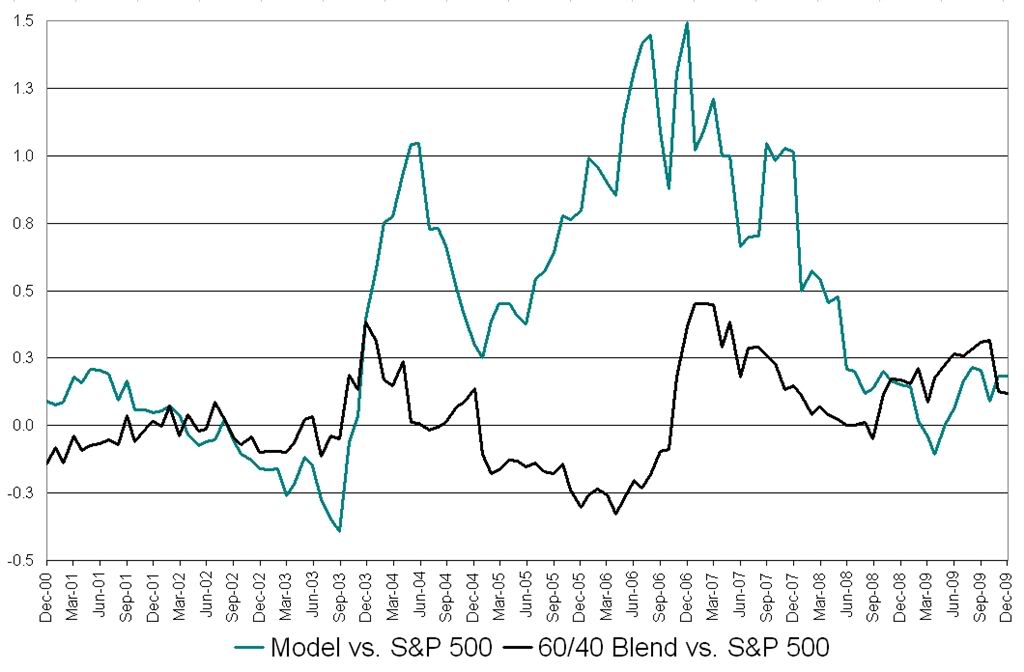
It turns out that systematic application of relative strength accomplishes this very well. The good folks at Arrow Funds recently asked us to take a look at how the beta in a tactically managed portfolio changed over time. When we examined that issue, it showed that as markets became risky, relative strength reduced the beta of the portfolio by moving toward low volatility (strong) assets. When markets were strong, allocating with relative strength pushed up the beta in the portfolio, thus taking good advantage of the market strength.

 From the Archives: Rob Arnott and the Key to Better Returns

click to enlarge

Using relative strength to do tactical asset allocation, the investor was not only able to earn an acceptable rate of return over time, but was able to have some risk mitigation going on the side. That’s a pretty tasty combination in today’s markets.

—-this article originally appeared on 2/26/2010. Amid all of the publicity given recently to risk parity, Arnott’s approach, which is to vary the risk budget over time depending on the opportunities available, has been largely ignored. I think this is unfortunate. His approach, although perhaps not easy, has merit. Tactical asset allocation driven by relative strength is one way to do that.

Posted by:


From the Archives: Getting Torched By Expert Opinion

January 29, 2013

Barry Ritholtz has posted a 5 minute clip of some of Ben Bernanke’s public comments between 2005-2007 on the housing market and the broader economy. The point of me posting this is not to say that Bernanke is a complete moron because I have little doubt that he is one of the brightest financial minds in the country. However, talk about being dead wrong! If you relied on these opinions in order to make investment decisions, you likely got torched. If you can’t rely on expert opinion when making investment decisions, then what options do you have?

This highlights the value of trend-following systems. Trend following requires zero reliance on expert opinion; it simply allows the investor to adapt to whatever trends the market offers, whether or not experts expected things to play out in a given way. With trend following, you’ll have plenty of losing trades, but you’ll also avoid sitting in losing trades for long periods of time. Furthermore, systematic trend-following has an excellent track record (see here and here.) Trend following allows you to cut your losses short and to hold on to your winners. Frequently, the strongest trends end up being very different from what even the brightest experts predicted.

—-this article originally appeared 2/11/2010. Well, heck, if you can’t trust Ben Bernanke, who can you trust? The answer should be obvious: follow the price trend and forget about the random guessing of experts.

Posted by:


Dealing With Financial Repression

January 28, 2013

James Montier, the investment strategist at GMO, published a long piece on financial repression in Advisor Perspectives in November 2012. It’s taken me almost that long to read it—and I’m still not sure I completely understand its implications. Financial repression itself is pretty easy to understand though. Along with a humorous description of Fed policy, Montier describes it like this:

Put another way, QE sets the short-term rate to zero, and then tries to persuade everyone to spend rather than save by driving down the rates of return on all other assets (by direct purchase and indirect effects) towards zero, until there is nothing left to hold savings in. Essentially, Bernanke’s first commandment to investors goes something like this: Go forth and speculate. I don’t care what you do as long as you do something irresponsible.

Not all of Bernanke’s predecessors would have necessarily shared his enthusiasm for recklessness. William McChesney Martin was the longest-serving Federal Reserve Governor of all time. He seriously considered training as a Presbyterian minister before deciding that his vocation lay elsewhere, a trait that earned him the beautifully oxymoronic moniker of “the happy puritan.” He is probably most famous for his observation that the central bank’s role was to “take away the punch bowl just when the party is getting started.” In contrast, Bernanke’s Fed is acting like teenage boys on prom night: spiking the punch, handing out free drinks, hoping to get lucky, and encouraging everyone to view the market through beer goggles.

So why is the Fed pursuing this policy? The answer, I think, is that the Fed is worried about the “initial condition” or starting point (if you prefer) of the economy, a position of over-indebtedness. When one starts from this position there are really only four ways out:

i. Growth is obviously the most “popular” but hardest route.

ii. Austerity is pretty much doomed to failure as it tends to lead to falling tax revenues, wider deficits, and public unrest. 2

iii. Abrogation runs the spectrum from default (entirely at the borrower’s discretion) to restructuring (a combination of borrower and lender) right out to the oft-forgotten forgiveness (entirely at the lender’s discretion).

iv. Inflation erodes the real value of the debt and transfers wealth from savers to borrowers. Inflating away debt can be delivered by two different routes: (a) sudden bursts of inflation, which catch participants off guard, or (b) financial repression.

Financial repression can be defined (somewhat loosely, admittedly) as a policy that results in consistent negative real interest rates. Keynes poetically called this the “euthanasia of the rentier.”3 The tools available to engineer this outcome are many and varied, ranging from explicit (or implicit) caps on interest rates to directed lending to the government by captive domestic audiences (think the postal saving system in Japan over the last two decades) to capital controls (favoured by emerging markets in days gone by).

The effects of financial repression are easy to see: very low yields in debt instruments, and the consequent temptation to reach for yield elsewhere. Advisors see the effects in clients every day.

If you are feeling jovial, I highly recommend reading Montier’s whole piece as an antidote to your good mood. His forecast is rather bleak—poor long-term returns in most all asset classes for a long period of time. My take-away was a little different.

Let’s assume for a moment that Montier is correct and long-term (they use seven years) equity real returns are approximately equivalent to zero. In fact, that’s pretty much exactly what we’ve seen during the last decade! The broad market has made very little progress since 1998, a period going on 15 years now. Buy-and-hold (we prefer the terminology “sit-and-take-it”) clearly didn’t work in that environment, but tactical asset allocation certainly did. Using relative strength to drive the process, tactical asset allocation steered you toward asset classes, sectors, and individual securities that were strong (for however long) and then pushed you out of them when they became weak.

I have no idea whether Montier’s forecast will pan out or not, but if it does, tactical asset allocation might end up being one of the few ways to survive. There’s almost always enough fluctuation around the trend—even if the trend is flat—to get a little traction with tactical asset allocation.

Source: Monty Python/Youtube

[In fact, might I suggest the Arrow DWA Balanced Fund and the Arrow DWA Tactical Fund as considerations? You can find more information at www.arrowfunds.com.]

Posted by:


Bond Buyer’s Dilemma

January 9, 2013

Morningstar details the risks facing fixed income investors seeking higher yields:

The ability for even very low-rated, highly leveraged companies to get financing has helped many firms stay afloat when they would otherwise have defaulted in a normal year. The high demand for these speculative issues has caused some investors to discard fundamentals in favor of searching for the highest yield without regard for quality. This strategy has worked so far, but at some point demand will soften, poor business fundamentals will catch up with firms, or the Fed will change its policy.

The article also included this chart showing historical drawdowns in high yield bonds:

High Yield Drawdowns Bond Buyers Dilemma

This is a pretty good argument for being tactical with your fixed income exposure.

To learn about our approach to tactically managing a broad universe of fixed income, including Treasurys, Corporates, High Yield, International, Convertible, and TIPs, click the image below to watch a short video presentation on our Tactical Fixed Income portfolio (financial professionals only).

tfi Bond Buyers Dilemma

Please click here for disclosures.

Posted by:


Disconnecting from Fundamentals

January 7, 2013

Mohamed El-Erian laments the impact that central banks are having on the markets:

But, critically for both economic prospects and investors, greater relative stability does not guarantee absolute stability. There is a limit to how far central banks can divorce prices from fundamentals. Moreover, as illustrated in the minutes of the latest Fed meeting, there is already discomfort among some policy makers due to the costs and risks of unconventional policies. Also, at some point, and it is hard to tell when exactly, the private sector will increasingly refuse to engage in situations deemed excessively artificial and overly rigged.

This is particularly relevant for asset classes (such as high yield corporate bonds, equities and certain highly leveraged products) outside the direct influence of central banks – an influence that is applied through direct market purchases and forward-looking policy guidance. With the weaker central bank impact, prices need to have greater consistency with the realities of balance sheets and income statements.

In such a world, investors should expect security and sector selections to get repeatedly overwhelmed by macro correlations. Since a growing number of asset classes are now exposed in a material fashion to the belief that central banks will deliver macroeconomic as well as market outcomes, investors have assumed considerable macro-driven correlations across their holdings. Moreover, with seemingly endless liquidity injections, the scaling of such exposure can easily disconnect from the extent to which prices deviate from fundamentals.

The topic of prices deviating from fundamentals is not new. How much of that deviation between price and fundamentals is a result of investor behavior, central bank policy, or any number of other factors is up for debate. While there may be a lot of truth to what El-Erian says about the impact of central bank’s policies, it becomes very difficult for an investor to know what actions to take based on those arguments. What is the correct measure of fundamental value? If a client places trades based on the expectation that the market will eventually reflect fundamental value, how long should they expect to wait? Days? Months? Years? Decades? Just how far can prices deviate from fundamental value?

Our approach to investing doesn’t get caught up in normative debates. Rather, all of our trend-following models focus on one core piece of information that reflects supply and demand- and that is price. Anything that can possibly affect the price – fundamentally, politically, psychologically, or otherwise – is actually reflected in the price. Furthermore, relative strength has the advantage of being able to rank trends by their strength.

We are likely to be debating the merits of current central bank policy for many years to come. In time, conclusions will be able to be drawn about their wisdom. However, relative strength offers pragmatists a robust and adaptive strategy to employ today.

Posted by:


Nimble Enough to Adapt?

December 4, 2012

Institutional Investor says that the Australian dollar is no longer a risk-on currency:

currencies Nimble Enough to Adapt?

If true, will investors be nimble enough to adapt? Certain securities or asset classes can exhibit a given risk profile for an extended period of time…until they don’t. It can be a very risky proposition to say “this” is a safe asset class, “this” one is risky, “this” one goes up when “this” one goes down…

Alternatively, relative strength approaches asset allocation from the perspective of a meritocracy: Does its relative strength justify inclusion in the portfolio? If so, it’s in (or overweighted); if not, it’s out (or underweighted).

Dorsey Wright does not currently have a position in the Australian dollar. A list of all holding for the trailing 12 months is available upon request.

Posted by:


Coping With the New Normal

November 28, 2012

The “new normal” is a phrase that strikes fear into the heart of many investors. It is shorthand for the belief that the US economy will grow very slowly going forward, as opposed to resuming its typical growth rate. For example, here is the Research Affliliates version of the new normal, as presented in a recent article from AdvisorOne:

Unless the U.S. makes politically difficult changes in immigration, employment and investment policies, Americans should expect a long-term “new normal” rate of growth of just 1%. So says investment management firm Research Affiliates, in a research note that brings a wealth of demographic and historic data to bear on current fiscal projections.

Christopher Brightman, the report’s author and head of investment management for the Newport Beach, Calif. Firm founded by indexing guru Rob Arnott, is critical of White House and Congressional Budget Office growth projections that assume 2.5% long-term growth.

Brightman argues the U.S. will find it nearly impossible to recapture the 3.3% average annual growth that prevailed from 1951 to 2000 as a result of negative trends in the key areas that affect GDP: population growth, employment rate growth and productivity.

PIMCO and other firms have also been exponents of the new normal view, and although the specifics may vary from strategist to strategist, the general outlook for sluggish growth is the same.

Investor response to date has been less than constructive and has mostly resembled curling up into the fetal position. Although I have no idea how likely it is the new normal theory will pan out, let’s think for a moment about some of the possible implications.

  • if US economic growth is slow, it may slow growth overseas, especially when the US is their primary export market.
  • economies less linked to the US may decouple and retain strong growth characteristics.
  • inflation and interest rates may stay low, leading to better-than-expected bond returns (where default is not an issue).
  • ever more heroic measures to stimulate US economic growth may backfire, creating a debt bomb and high future inflation.
  • growth may be priced at a premium multiple for those stocks and sectors that are demonstrating strong fundamentals. In other words, if growth is hard to find, investors may be willing to pay up for it.
  • slow economic growth may cause a collapse in multiples, as future growth is discounted at a much lower rate.

In other words, you can still get pretty much any investment scenario out of new normal assumptions. It’s just about whether a particular strategist is feeling pessimistic or optimistic that day, or more cynically, whether they are talking their book.

To me, this is one of the best arguments in favor of tactical asset allocation driven by relative strength. Relative strength lets the market decide, based on which assets are strong, what to buy. At any given time it could be currencies, commodities, stocks, bonds, real estate, or even inverse funds. And it might change over time, as new perceptions creep into the market or as policy responses and market consequences interact in a feedback loop. Relative strength doesn’t make any assumptions about what will happen; it treats good performance favorably regardless of the source. Tactical asset allocation, then, is just an attempt to extract returns from wherever they might be available. That trait may come in handy in a tough market.

Posted by: