The Myth of Buy-and-Hold

February 27, 2012

No one can dispute that Warren Buffett is a good investor—he’s made a ton of money over many years and it’s been well-documented.  He holds court periodically and even his public calls have been pretty good, like his “Buy American. I Am.” editorial in the New York Times on October 16, 2008.  (More recently he said bonds should come with a warning label, so take that for what it’s worth.)  You could do worse than trying to emulate Warren Buffett.

So what is St. Warren actually doing?  Well, fortunately some college professors did the heavy lifting.  They analyzed Berkshire Hathaway’s quarterly filings from 2006 all the way back to 1980, 2,140 quarter-stock observations.  CXO Advisory had a nice summary of their work.  In the words of the professors:

…we observe a median holding period of a year, with approximately 20% of stocks held for more than two years. At the other end of the spectrum, approximately 30% of stocks are sold within six months.

Yep, Warren Buffett has 100% turnover.  He blew out 30% of his portfolio selections within six months, and held about 20% of his picks for the longer run.  That is active trading by any definition.

A mythology has grown up around Mr. Buffett, that he has a somewhat magical ability to select stocks and then holds on to them forever.  The truth is far more pedestrian, and encouraging since it is something any investor can do.  He might be holding on to what is working, but his portfolio holdings are pared relentlessly.   If I had to guess, I suspect Warren Buffett is simply doing what every good investor does.  He’s using his best judgment to select stocks and then cutting the losers and letting the winners run.  (The casting-out process used in our Systematic Relative Strength portfolios does exactly the same thing.)

There’s no glory—or capital gain to be had—in holding an underperforming piece of garbage for the long run.  Mr. Buffett’s stock selection may be above average, but his genius is more likely in his discipline.

Don’t be conned by the myth of buy-and-hold.  Even Warren Buffett isn’t doing it.  Search everywhere for good investment opportunities, hang on to the winners and get rid of the losers.

Don't Be a Buy-and-Hold Sucker. I'm Not.

Source: Photobucket       (click on image to enlarge)


Unreliable Correlations

February 24, 2012

Bloomberg points out the unstable correlation between U.S. Treasurys and equities:

At the onset of the financial crisis in 2008, the volatility of stock returns increased dramatically as the equity markets plunged. At the same time, U.S. Treasury bond prices shot up. The correlation of bonds and stock prices has been mainly negative ever since.

This makes sense: In times of trouble, we dump stocks and buy safe Treasury bonds, and their prices should move inversely. This also would mean that in better times, we buy stocks and sell bonds, implying that the correlation between Treasuries and stocks should always be negative.

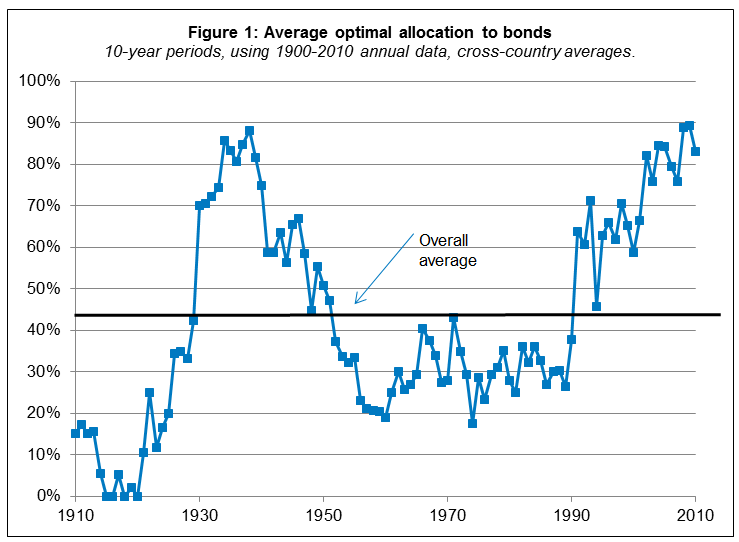
It isn’t. The correlation between the aggregate stock market and long-term Treasury bonds has been mainly positive and rising from the 1960s to the end of last millennium. With the new millennium, the correlation between stocks and Treasuries turned negative, and strongly so, especially around the last two recessions.

This is a strong argument for employing a flexible asset allocation approach.  One of the essential elements of relative strength-driven asset allocation strategies is that investments are made not based on how they should behave, but on how they are behaving.


Embracing Tracking Error

February 23, 2012

One characteristic of relative strength strategies is that they rarely track their benchmarks–and for good reason because they are designed to overweight areas with strong relative strength and underweight areas with weak relative strength.  The goal of this approach is to capitalize on long-term trends and it works well over time.  In environments with strong trends in place we tend to see outperformance and in environments with major leadership changes or choppy markets we tend to see underperformance.

In the case of the Arrow DWA Balanced Fund (DWAFX), the highlighted row below shows that we outperformed nearly all of our peers in 2007 and 2010; outperformed 74 percent of our peers in 2008; and underperformed the vast majority of our peers in 2009 and 2011.  So far in 2012, we are right in the middle of the pack.  Yet, over the past five years we have outperformed 66% of our peers.

Source: Morningstar

Those investors who understand and accept the fact that relative strength strategies won’t track a benchmark much of the time are in a much better position to reap the rewards that accrue to disciplined investors.

Dorsey Wright sub-advises The Arrow DWA Balanced Fund.  Please click here for more information.


May You Live In Interesting Times

February 14, 2012

“May you live in interesting times” –Chinese proverb

That is the quote that came to mind after reading this very thoughtful interview with legendary Swiss investor Felix Zulauf.  After reading the interview, I suggest that you watch this video on our Global Macro portfolio and I think you’ll see why such an approach may prove essential to investors in the years ahead.

Click here and here for disclosures.  Past performance is no guarantee of future returns.


More on the Endowment Model

February 2, 2012

David Swensen at Yale, due to his consistently excellent returns, made the endowment investing model famous.  Basically, he put together a widely diversified, growth-oriented portfolio.  In the case of Yale’s endowment, he used a significant amount of alternative investments as well.  Because he was thoughtful about his allocations, remained diversified, and was willing to stay the course during difficult periods, Mr. Swensen did very well for Yale.  Now the media reports endowment returns on a regular basis.  Smart Money had an article with the most recent fiscal year returns:

The figures, from the National Association of College and University Business Officers and the Commonfund, show total returns for university endowments averaged about 19% during fiscal year 2011, which ended June 30…

I don’t know if the returns are calculated on a dollar-weighted or equal-weighted basis, but any way you cut it, that’s not a bad year for a broadly diversified account.

You may or may not be aware that Dorsey Wright Money Management acts as a sub-advisor for the Arrow DWA Balanced Fund, a fund that was designed with the endowment model in mind.  It has dedicated sleeves for domestic equities, international equities, fixed income, and alternative assets.  According to Morningstar, our returns were similar over the fiscal year, coming in at 20.9%.

The balanced fund is not designed to be a high-octane vehicle.  It aims for steady performance in a wide variety of market environments and might be just the thing for clients who are looking for a little less volatility, while still having a chance for capital growth.

Click here to visit ArrowFunds.com for a prospectus & disclosures.  Click here for disclosures from Dorsey Wright Money Management.


From the Archives: Another Way To Look at Modern Portfolio Theory

January 27, 2012

This week the noted management consultant, Russell Ackoff, passed away.  He was famous for gathering data and trying to use it to make the correct decision.  His fundamental theory was this:

All of our social problems arise out of doing the wrong thing righter. The more efficient you are at doing the wrong thing, the wronger you become. It is much better to do the right thing wronger than the wrong thing righter! If you do the right thing wrong and correct it, you get better!

Since the origination of Modern Portfolio Theory in the 1950s, academics and practitioners have been polishing it up and implementing in better and better ways.  It may just have been a case of getting more efficient at doing the wrong thing—and the wronger it got.  After 2008, even many of its supporters began to acknowledge that there were problems with its implementation.

This recognition has fueled a rush to the new magic potion, tactical asset allocation.  If tactical asset allocation is indeed the “right” thing, it should work out better than doing something wrong.  Yet there are significant challenges in the design and execution of a systematic tactical asset allocation process as well.  I think going forward, it’s going to be important to distinguish between marketers who are trying to exploit the latest fad and practitioners who have a well-thought-out and well-executed process for tactical asset allocation.

—-this article was originally published 11/13/2009.  It’s hard to do the right thing right, but don’t settle for doing the wrong thing righter!


Tactical Management and Flawed Forecasting

January 26, 2012

Bob Veres is a highly respected columnist for Financial Planning magazine.  He’s been in the forefront of advocating good practices in financial planning.  He had an interesting article about the dangers of tactical management last month–and the longer I chew over that article, the more problems I see with forecasting, explicit and implicit.

First, let me set the scene for you.  Mr. Veres indicated that he had spent a month doing data analysis of a survey of over 1000 financial planners.  One of the most interesting takeaways:

Perhaps the most striking thing I learned is that, post-2008, activities once labeled “market timing” are now solidly in the mainstream.  No, planners are not moving into or out of the market based on reading the entrails of animal sacrifices. But they seem to be taking a much more active approach to protecting clients from downside risk. The survey asked whether advisors planned to raise or lower their allocations to each of 35 different investment classes or vehicles in the next three months. A remarkable 83% are anticipating at least one tactical adjustment – and the great majority expects to make several.

Mr. Veres raises a legitimate question about how accurate planner’s forecasts are, and what the possible consequences of poor forecasts could be.  As an example, he cites inflation forecasts:

One of the most provocative set of responses came when advisors were asked to forecast the inflation rate and the real (after-inflation) return of both equities and 10-year Treasuries over the next 10 years. On inflation, the majority of responses clustered between 3% and 5%, and the remaining responses had a center of gravity on the 6% to 7% part of the chart. If there is wisdom in the crowd, the crowd of advisors seems to believe we will experience above-average inflation for at least the remainder of this decade.

But we also had responses as low as -4% a year (projecting severe Japanese-style deflation), several as high as 10% and one advisor who anticipates annual inflation of 13% over the coming decade. One or the other group on the fringes is going to be spectacularly wrong (or both will), and I suspect that damaging consequences will show up in the portfolios they recommend.

He is absolutely correct in his belief that a strategic allocation based on a wildly incorrect forecast will be damaging to a client.  And, he indicated that expectations for real returns were even more widely dispersed.  It’s where he goes next that made me think.  He writes:

Say what you will about the buy-and-hold ethos that lasted until September 2008. It may not have been an ideal strategy during the worst of the bear markets, but it did keep the members of the herd from straying too far from the center – and, more important, it kept the profession from getting the kinds of black eyes I think advisors are going to encounter in the future.

I think there is a critical error in this line of thinking.  Buy-and-hold strategic allocations are typically based on historic returns.  Those historic returns, of course, are the same for everybody and they do have the effect of keeping everyone in the middle of the herd.

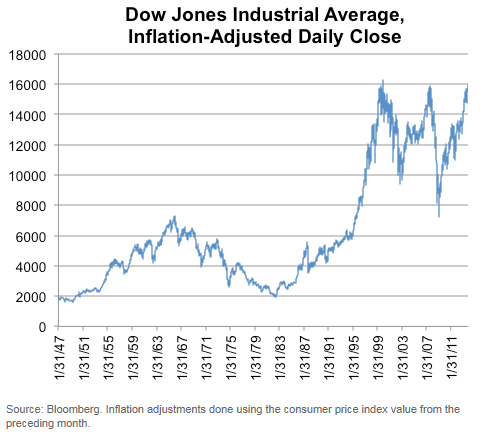
This is the critical error: basing your allocation on historic returns is also a forecast–it’s simply an implicit forecast that historic returns will continue along the same path!  If that doesn’t happen, you will end up just as horribly wrong as the advisors on the forecasting fringes!  Yes, you will fail conventionally along with everyone else in the middle of the herd, but you will fail nonetheless.  (How do you think most clients feel right now, with their equity allocations based for the last decade on an 8-10% historic return, a return that has not materialized?  And there’s always Japan.)

Frankly, if you’re going to do strategic asset allocation at all, research shows that naive equal-weighting performs as well as anything else.  The reason advisors are gravitating toward tactical management in the first place is because traditional strategic asset allocation has so much trouble with tail events, and 2008-2009 was a big tail event.  Clients have memories, and advisors are simply responding to client demand for a more active form of risk management.  Now, like Mr. Veres, I’m not very confident in the forecasting abilities of financial planners.  I’m not very confident in the forecasting abilities of anyone, for that matter, including me.

All forecasting is flawed, whether it is explicit or implicit.  To me, there are only two realistic choices for asset allocation.  Either 1) equal-weight a large number of asset classes and rebalance periodically or 2) commit to a systematic method of tactical asset allocation.  There are funds that use valuation triggers and funds that use relative strength to rotate among asset classes–and I suspect either will perform acceptably over time if it is systematic and disciplined.


From the Archives: Will I run out of money?

January 25, 2012

The number one concern among many investors approaching retirement is, “Will I run out of money?” This question is causing sleepless nights for many approaching retirement.  In fact, at the end of October, the U.S. Center for Retirement Research released a report that 51% of Americans are at risk of reduced living standards in retirement – including 42% of those in high income households. And if the cost of health care and long-term care were included, these numbers would be even higher.  It is just a fact that many people, including high-income earners, will enjoy a reduced standard of living in retirement due to inadequate savings.

However, simply pointing this reality out to a client with inadequate savings who is approaching retirement doesn’t do them a lot of good.  That information may be motivational to younger people who still have the time to increase their savings, but those approaching retirement need two things.  First, they need financial planning help to determine a prudent withdrawal rate on their portfolio to minimize the risk that they actually do run out of money.  Second, they need help determining a prudent approach to asset allocation to take them through the next 30 plus years.

One of the most influential studies on withdrawal rates and asset allocations in retirement was a 1998 paper by three professors of finance at Trinity University.

Its conclusions are often encapsulated in a “4% safe withdrawal rate rule-of-thumb.” It refers to one of the scenarios examined by the authors. The context is one of annual withdrawals from a retirement portfolio containing a mix of stocks and bonds. The 4% refers to the portion of the portfolio withdrawn during the first year; it’s assumed that the portion withdrawn in subsequent years will increase with the CPI index to keep pace with the cost of living. The withdrawals may exceed the income earned by the portfolio, and the total value of the portfolio may well shrink during periods when the stock market performs poorly. It’s assumed that the portfolio needs to last thirty years. The withdrawal regime is deemed to have failed if the portfolio is exhausted in less than thirty years and to have succeeded if there are unspent assets at the end of the period.

The authors backtested a number of stock/bond mixes and withdrawal rates against market data compiled by Ibbotson Associates covering the period from 1925 to 1995. They examined payout periods from 15 to 30 years, and withdrawals that stayed level or increased with inflation.   The table below shows the percentage of trials in which the portfolios survived for the entire testing period.

Table: Portfolio Success Rate: Percentage of all Past Payout Periods From 1926 to 1995 that are Supported by the Portfolio After Adjusting Withdrawals for Inflation and Deflation

Note: Numbers in the table are rounded to the nearest whole percentage. The number of overlapping 15-year payout periods from 1926 to 1995, inclusively, is 56; 20-year periods, 51; 25-year periods, 46; 30-year periods, 41. Stocks are represented by Standard and Poor’s 500 Index, bonds are represented by long-term, high-grade corporates, and inflation (deflation) rates are based on the Consumer Price Index (CPI). Data source: Calculations based on data from Ibbotson Associates.

Source: Retirement-Income.net

It becomes clear from reviewing this table that being “conservative” and allocating heavily to bonds may be safe in the short run, but it may very well lead to eating dog food over the long term.  Furthermore, any withdrawal rate over 3-4% is likely to be disastrous over a 30 year period of time.

The biggest opportunity for a financial advisor to be able to add value to their client’s dilemma is to be able to help them commit to an appropriate withdrawal rate and then to focus on the asset allocation.  The financial advisor who is able to clearly explain how a global tactical asset allocation strategy may be able to address the weakness of static asset allocation or strategic asset allocation and potentially decrease the probability of running out of money is the financial advisor who can make a real difference for their clients.

—-this article was originally published 11/24/2009.  The payout tables are based on 1926-1995 returns and suggest real conservatism in withdrawal rate assumptions.  Returns since 1995, and especially since 2000, have been lower than the long-term averages.  If you had opted for a high withdrawal rate, things would be tough right now.  Investors need to save more and invest intelligently and patiently to have retirement success.  Consider incorporating portfolio fecundity into your withdrawal assumptions because it will better reflect the current investing environment.


Anything Can Happen–and Probably Will

January 17, 2012

Investors have their hands full right now.  There are a lot of global political and economic uncertainties, as well as a few complicating factors that we haven’t seen before (i.e., interest rates at zero).  Trying to figure out what might happen next is next to impossible.  In a recent commentary in Advisor Perspectives, Neel Kashkari of PIMCO laid out a number of possible outcomes.

  1. Austerity and deflation
  2. Explicit default
  3. Mild inflation
  4. Runaway inflation
  5. Miraculous growth

He points out further that this state of affairs is pretty chaotic–and that every opinion can be supported with precedents and sound reasoning.  There’s no easy way to figure out what is more or less likely.  Not to mention that the range of outcomes pretty much covers the waterfront.

In a “normal” economic environment investors debate a narrow range of outcomes: will the U.S. grow by 2.8% or 3.2%? Will inflation remain at 2.0% or climb to 2.3%? Debating a future of inflation vs. deflation is radically new territory for investors. The chaotic nature of the choice facing societies is whipsawing equity markets and dominating bottom-up factors.

There is a wide range of opinions, each supported by relevant precedents and sound economic reasoning. Yet despite our intense focus, we don’t know the answer with certainty.

This is brutal for investors, at least if you are trying to construct a strategic asset allocation.  Your ideal allocations would be almost diametrically opposed if they were optimized for austerity/deflation or runaway inflation!

The situation is further complicated by the fact that different players may make different choices.  For example, what if Greece decides on explicit default, but the UK opts for austerity and deflation?  Trying to figure out the net result of that interaction for a multitude of financial assets is a daunting prospect.

No investment method is going to get everything right ever, and especially not in this environment.  Yet, it seems to me that an adaptive process powered by relative strength has a good chance of rolling with the punches enough to capture returns from some of the themes.  Different assets will respond to evidence of different outcomes, and while there will doubtless be any number of cross-currents, the strongest assets will probably point us toward the weight of the evidence.  A disciplined tactical asset allocation process might be the best we can do when the range of possible outcomes is so wide.


From the Archives: A Shocking U-Turn

January 13, 2012

After decades of some consultants and institutions ridiculing proponents of tactical asset allocation or deriding it as “market timing,” some have now apparently become convinced of its benefits as a risk diversifier and return enhancer.  OMG!  According to this article in Pensions & Investments, a number of firms are now poised to roll out their own tactical asset allocation solutions.  Bar the door and hide the children.

—-this article originally appeared 10/7/2009.  In the last couple of years, tactical asset allocation has actually become fashionable—because buy-and-hold isn’t working.  Of course, I don’t think buy-and-hold proponents are dead.  Like Monty Python’s parrot, they’re just resting.


It’s Not You, It’s Me…..

January 12, 2012

It’s not you, it’s me….  I think everyone has used that line at some point, but nobody does it better than George Costanza!

I have been putting data together to update our white papers.  It’s no secret that running a Global Tactical Asset Allocation (TAA) strategy was difficult last year.  But when I looked at the data it was very clear that the problem wasn’t the strategies.  The real problem was how the market behaved during 2011.  It’s not you, it’s me.  It’s not your trend following strategy, it’s what you’re trying to follow.  The market was essentially a psycho, stage 5 clinger last year!

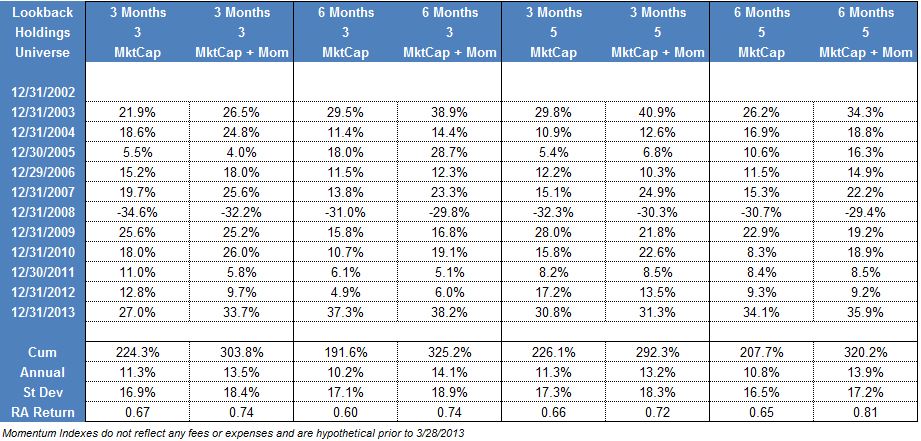
The data I will reference in this post is an extension of the data we published last year in two white papers.  If you haven’t read them you can find them here.  Our research process for this dataset takes a diverse universe of ETF’s and creates 100 different equity curves for a number of different momentum factors.  The universe has a number of different asset classes represented including Equities (Domestic & Foreign), Bonds, Commodities, Currencies, and Real Estate.  The results provide a good idea about how a momentum-based, global TAA strategy would have performed.  By creating 100 different equity curves we are taking luck out of the equation and showing a realistic range of outcomes from buying high relative strength securities out of our universe.

Most of the momentum factors we follow underperformed last year.  The factors we are showing refer to the lookback period to do our rankings.  The 1MORET factor (1-month return) means we used 1 month of data to calculate our momentum ranks (all securities are held until they fall out of the top of the ranks, which might be as short as one week or as long as a couple of years).  The 12MORET factor uses the prior 12 months of price data to rank the securities.  The 3-month factor actually performed the best in 2011, but only 40 out of the 100 trials outperformed the S&P 500, so you needed some luck to outperform.  The 6-month factor was the next best, but only 1 trial outperformed so you needed to be really lucky.  All the other trials were very poor.  There was so much short-term volatility back and forth last year that the very short 1-month formulation period was deadly.  It paid not to be too quick on the trigger last year!

Full Year 2011

(Click To Enlarge)

But looking at 2011 in aggregate doesn’t really tell the whole story.  The beginning of the year was good for these strategies.  That person you were dating held it together pretty well for the first couple of dates!  Through the end of April, most of the strategies were outperforming the S&P 500 on average.  The 6-month factor was doing great as all 100 trials were outperforming.  Ironically, the factor doing the worst was the 3-month factor.

2011 Through April

(Click To Enlarge)

The problems for trend following strategies began in May.  There were a series of sharp trend reversals in a number of different assets: Bonds, Stocks, Precious Metals, Currencies (Yen & Swiss Franc).  No matter what factor you were using from May to the end of the year it was difficult.  It was tough to get traction anywhere.  The only factor that did even so-so was the 3-month factor, and that was the worst factor through April.  That’s just one of many examples of how crazy the 2011 market was!

2nd Half 2011

(Click To Enlarge)

So where do we go from here?  Well, the, “It’s not you, it’s me…” line always leads to a breakup.  That’s probably not a bad idea when dealing with something that doesn’t change.  Does that psycho, stage 5 clinger ever get any better?  Nope.  It only gets worse.

But markets change, and TAA based on momentum is very adaptive.  We will not be in a choppy, range bound environment forever.  Trends will emerge. (If they don’t, it will be the first time in history.)

Investors were euphoric about momentum-based TAA strategies in the first part of the year.  Looking at the data you can see why – they were working exceptionally well.  After the last few months, people are certainly not as excited.  In reality, now is the time to be really excited about relative strength strategies, not back in April.  Now is the time you want to be adding money.


From the Archives: The Brave New World of Asset Allocation

January 11, 2012

“We think asset allocation, certainly over the next five to 10 years, begs for a tactical component that is very hard for many investors to deal with because they aren’t structured to think about macro things like equity exposure…”  Ah, yes. Now everyone is singing the praises of tactical asset allocation.  The quotation above is from a major article in Barron’s over the weekend, which is an interview with Mark Taborsky, the head of asset allocation at PIMCO. (subscription required)  If you don’t get Barron’s, at the very least you might want to borrow a friend’s copy and take a look at the interview.

Tactical asset allocation is gaining notice because it is a very useful way to navigate what markets are actually doing, instead of what they should be doing in theory.  Taborsky says, “The majority of people who use the modern-portfolio-theory approach — and it has been with us for more than 50 years — recognize that it has many shortcomings. Anyone who has done it more than a year recognizes how far off their estimates of expected returns are by asset class and how far off their expectations of volatilities and correlations are. It is a very elegant approach, but it doesn’t really work that well.”  It’s refreshing to hear someone else make these points for a change!

Mr. Taborsky sums up the shortcomings of traditional strategic asset allocation very concisely:  ”The traditional approach to asset allocation relies on looking back in history to what asset classes returned. There is a huge reliance on mean reversion. There is a huge reliance on historic volatilities and correlations.”  The problem with reliance on historical norms is that when there is a regime change, and the norms change, you are completely at sea.  PIMCO believes that we have had a regime change, which they call the “new normal.”  If they are correct, strategic asset allocation could have a rough go of it for a while.

Tactical asset allocation seems to be the only logical way to respond systematically to the constantly changing relationships between asset classes.  Our Systematic RS Global Macro strategy (in separate account form or in mutual fund form in the Arrow DWA Tactical Fund) is designed to handle the rotation among asset classes for investors.  Given the fear that retail investors still harbor, it might be just the thing to consider when moving cash from the sidelines back into the markets.

Click here to visit ArrowFunds.com for a prospectus & disclosures.  Click here for disclosures from Dorsey Wright Money Management.

—-this article originally appeared 10/5/2009.  It’s amazing that retail investors are still as nervous now as they were then!  Strategic asset allocation is still subject to breakage every time there is a regime change.  Tactical asset allocation won’t always have smooth sailing either, but it has the prospect of being able to adapt to new conditions.


You Scream, I Scream, We All Scream for Tactical Allocation

January 9, 2012

Client mindset has changed.  During the long bull run of the 1980s and 1990s, clients felt very comfortable with a buy-and-hold strategy.  Regardless of whether it was ever a good idea, it was hard to knock–it was working.  Now clients have been shaken up by two bear markets in the last ten years.  They are more aware of global politics and of alternative asset classes.  The world is a scarier place, and client have decided they need to be more active.  According to a recent article in Smart Money:

In Jefferson National’s 2010 survey, 66% of advisors said clients were more confident with a tactical asset management strategy, while only 34% said clients were more confident with a traditional buy-and-hold strategy.

That’s a big change.  The majority of clients are now more comfortable with a tactical strategy—the problem is that very few management firms embrace tactical allocation.  (In fact, many of them have gone out of their way to ridicule it in the past.)  There’s not a lot of proven product in the tactical allocation space because buy-and-hold was the mantra for the last 20 years.

It’s important to do your due diligence and find experienced managers with a robust strategy, whether it is relative strength or valuation-based.  Both styles should work over time, but are likely to perform well at different points in the market cycle.  (Of course, we are partial to the Arrow DWA Balanced Fund, a top-quartile fund with a five-year track record!)

Click here to visit ArrowFunds.com for a prospectus & disclosures.  Click here for disclosures from Dorsey Wright Money Management.


Japan: Prepare For The Unthinkable

December 22, 2011

Not that it could implode (everyone expects that), but that it might be a great buy.  Brett Arends writes:

The moment you read the word Japan, I’ll bet your eyes glazed over. I’ll bet you thought about flipping the page to see if there was something more interesting elsewhere in this month’s issue — on Greek bonds, maybe, or Apple. (Or gold?) You’re not alone. No one wants to hear about Japan. Fund managers have lost money on Japanese shares every year they can remember, except 2005. Tokyo has been in a bear market for 20 years — about as long as commodities were.

How are the mighty fallen! Twenty-two years ago, Japanese stocks accounted for nearly half the value of the world’s stock markets. The land occupied by the Imperial Palace in Tokyo was valued more highly than all of California. The Japanese were conquering the world. No one could stand in their path.

Today, according to FactSet, Tokyo’s share of global stock values is down to 7.5 percent, the smallest it’s been in decades.

His article then makes the case for Japan being a good value:

Most important of all, the stock market is cheap. Possibly very cheap — at a time when nearly everything else looks pricey. The Nikkei 225, Japan’s major stock market index, trades at just 10 times forecast earnings. The dividend yield is up to 2.3 percent — a hefty amount in a country with zero inflation.

Japanese equities today trade for half of annual revenues, according to FactSet. (The figure for the U.S.: 1.2 times revenues.) And they trade for less than book value, while U.S. stocks trade for twice book.

We all know that good values can become even better values, so that alone shouldn’t justify buying Japan.  However, I think it is an interesting exercise to take an absolutely hated investment (Japan in this case) and ask yourself if your investment process is flexible enough to capitalize on a change in a long-term trend.

One way to see if Japan’s apparently attractive valuations translate into strong relative strength is to watch the amount of exposure given to Japan in the PowerShares DWA Developed Markets Technical Leaders Portfolio (PIZ):

Source: PowerShares, PIZ

While the current exposure to Japanese equities in PIZ is less than the weight given to Japan in the MSCI EAFE Index (21.58%), Japanese exposure has increased from the 4% weight in PIZ at the beginning of 2011 to its current weight of 11.51%.

Please see www.powershares.com for more information about PIZ.


Bottom-Fishing Financials

December 16, 2011

By way of Global Macro Monitor comes a comparison of the post-bubble performance of U.S financials after the February 2007 top and the technology sector after the dot.com peak in March 2000.

Source: Bespoke Investment Group

Maybe it isn’t necessary to be too anxious to get right back in the financial sector with the theory that it must be a good value now.  Relative strength is ideal for determining when the long-term trend in relative performance of a given stock, sector, or asset class is back in favor.  For financials, the answer is still not favorable.

HT: Abnormal Returns


Risk On, Risk Off

December 7, 2011

Charles Sizemore explains his thought process surrounding the risk on, risk off decision:

So long as we remain in this high-correlation, risk on/risk off market, our investment performance will be closely tied to shifting political winds in Europe.

If Europe’s leaders manage to reestablish confidence in their respective sovereign bond markets, then it’s “risk on” and commodities and lower quality, more speculative stocks should do phenomenally well. But if we have another setback — say, if a major piece of reform legislation gets torpedoed by squabbling among Euro nations, or a botched referendum — then it’s “risk off” and you’d better be in cash.

In honor of the movie release of Michael Lewis’s Moneyball , I’ll use a baseball analogy. You run the risk of swinging big and missing if you bet on “risk on” and we end up with “risk off.” But, if you bet on “risk off” and we end up with “risk on” you run the risk of getting a called strike as a potential home run pitch whizzes right by you.

Having a mix of both “risk on” and “risk off” assets seems like a pretty good place to be given the current state of affairs.  Current allocations for The Arrow DWA Balanced Fund (DWAFX) and The Arrow DWA Tactical Fund (DWTFX) are shown below:

In times when the “risk on” or “risk off” trade is in a more sustainable trend both of these strategies will tend to take greater overweights and underweights to different asset classes, but for now relative strength dictates a pretty even mix.

See www.arrowfunds.com for more information about DWAFX and DWTFX.


From the Archives: Commodities Can Burn Your Fingers

December 2, 2011

The Financial Times of London had an interesting article about commodities that pointed out that buy-and-hold is not a useful strategy to employ.  Commodities, because of the frequent lack of correlation with other asset classes, can be an outstanding tool for risk diversification in a portfolio, but they cry out for use in a tactical fashion.  For retail clients, being able to get commodity exposure through ETFs and ETNs has been extremely helpful, but it may be important to have some kind of systematic tactical process in place as well.  Holding positions for long periods of time just to have exposure may not be the optimal strategy.

—-this article was originally published 10/13/2009.  Buy-and-hold in the commodity futures world is just as dangerous as ever, what with contango waiting to jump up and bite you.  A rotational strategy makes sense for exposure to this asset class.


Tax Mobility

November 22, 2011

In another demonstration of the fact that money goes where it is treated best, Investment News points out an interesting tidbit from the Census Bureau:

The percentage of Americans who moved residences reached its lowest point last year in more than six decades, the Census Bureau said. Those who did transfer often relocated for employment reasons. Many moved to states with no individual income tax.

I added the bold.  The biggest state-to-state migrations were from high-tax states to low-tax states, like California to Texas or New York to Florida.  This suggests one reason why tax increases rarely provide the additional revenues that are forecast.

Relocations generally were way down, primarily because it is difficult to move if your house is underwater.  Still, some savvy Americans moved to where the jobs were—or where the taxes weren’t.  In some cases, not surprisingly, those two things are related.

Global assets compete for capital in the same way.  Assets that have the potential to perform well pull capital toward them, across borders if necessary.  In a competitive global economy, it might make sense to have core assets in a global macro strategy.


The Return of the U.S. Consumer

November 16, 2011

The high unemployment and low consumer confidence that have plagued the U.S. over the past several years may lead you to believe that Consumer Discretionary stocks have been on the outs.  However, Bill Smead of Smead Capital Management speaks to why this has not been the case:

“People aren’t buying houses, they aren’t remodeling houses, they’re not buying cars as often, and all those things keep monthly payments off your income statement,” Smead told CNBC on Wednesday. “And the new good behaviors that are coming from the austerity are causing those income statements to get replenished very quickly.”

This has resulted in the deleveraging of U.S. household debt, Smead said. The U.S household debt service ratio has fallen to 11 percent in 2011 from a peak of around 14 percent in 2007, according to data from the U.S. Federal Reserve.

“The United States consumer has done an amazing job… they’ve [brought] historically high debt-service ratios down to within a few quarters; we’re going to have debt-service ratios in the United States comparable to 1982 and 1992 which were the beginning of five to seven year prosperity periods,” Smead said.

“Think of it like this. Who is likely to spend money and do it more consistently, someone who’s in very good shape on their income statement that lacks confidence or someone who is up to their eye-balls in payments but brims with confidence? The unconfident households with room in their income statement will ultimately be part of what we call “pent up demand” for goods and services.”

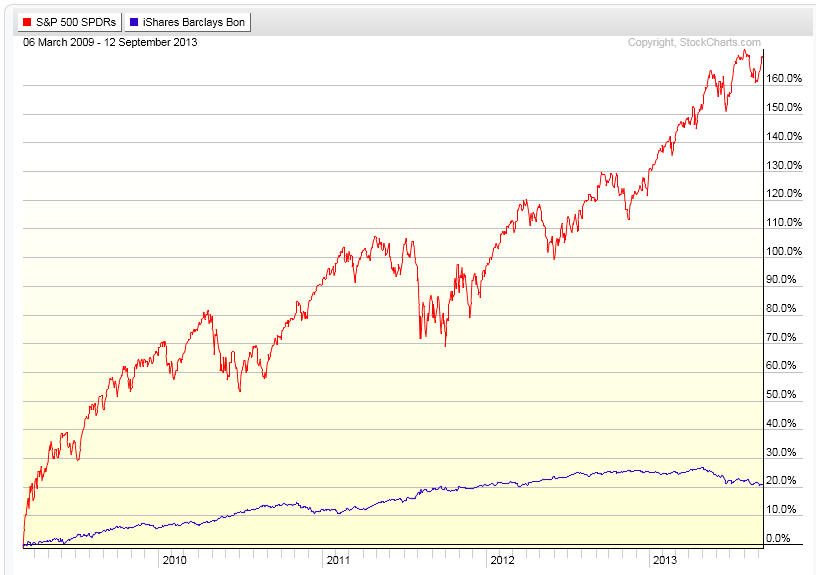
Interestingly, the Consumer Cyclical sector (IYC) is up 114.21% since the bear market lows (March 9, 2009 – November 15, 2011), outperforming the S&P 500 which is up 85.92% over this same period of time.  This is a theme that has been picked up by the PowerShares DWA Technical Leaders ETF (PDP):

See www.powershares.com for more information about PDP.

HT: CNBC


Quote of the Month

November 14, 2011

I believe the innovations of the 1970s and ’80s such as CAPM, alpha and beta–which started off being such useful intellectual tools–are now in danger of becoming obstacles to further innovation in financial mathematics. I would argue that too much current research effort, both academic and commercial, in this field has become–to paraphrase John Maynard Keynes–enslaved to some defunct, or not even defunct, economist.—-David Harding

It’s hard to exaggerate how entrenched efficient markets, MPT, and similar ideas have become in finance.  For some, acceptance of these ideas has led to a reluctance to even investigate other approaches.  When your mind is closed, things have gone too far.  For the brave few willing to actually work with the data, relative strength and tactical asset allocation have been a rich source of returns.


Volcker on Mathematical Precision

November 11, 2011

Paul Volcker on the causes of the recent financial crisis:

It should be clear that among the causes of the recent financial crisis was an unjustified faith in rational expectations, market efficiencies, and the techniques of modern finance. That faith was stoked in part by the huge financial rewards that enabled the extremes of borrowing, the economic imbalances, and the pretenses and assurances of the credit-rating agencies to persist so long. A relaxed approach by regulators and legislators reflected the new financial zeitgeist.

All the seeming mathematical precision that was brought to investment, all the complicated new products, including the explosion of derivatives, that were intended to diffuse and minimize risk, did not work as had been claimed. 

The whole article is worth the read, written by a very thoughtful man who essentially makes a call to action to governments and central banks around the world to make structural changes to the global financial system.  However, his observations also serve as a valuable warning to every investor who seeks investment strategies that promise precise risk and return profiles in all kinds of markets based on elegant financial theories (i.e. optimization).

Tactical Asset Allocation, in contrast, has a simple mandate: Seek out the strongest trends from a given investment universe.  Tactical Asset Allocation seeks to capitalize on secular bull and bear markets in asset classes, but it makes no bones about the fact that it isn’t a painless process.

Click here to view a video on our Global Macro portfolio, one of our Global Tactical Asset Allocation strategies.

To receive the brochure for our Global Macro strategy, click here.  For information about the Arrow DWA Tactical Fund (DWTFX), click here.

Click here and here for disclosures.  Past performance is no guarantee of future returns.


Global Macro Rules

November 4, 2011

Some interesting observations on macro investing from an article in Investment News:

Ignoring macro is like ignoring the seasons when trying to predict the weather. Any December day in New York City is likely to be a cold one. The “macro” backdrop dictates wearing a coat instead of shorts. The “stock-specific” issues determine whether that coat should be a winter parka or a lighter jacket. It’s possible to decide incorrectly on the choice of coat, but regardless, one is usually better off wearing a coat than shorts in December in New York City.

Macro trends influence everything that happens in the markets, but the extent of its sway probably is a surprise even to those who embrace these trends. Investors who actively harness the powerful influence of macro and use it to their advantage can set themselves apart from the pack.

Investors often have a difficult time explaining the performance of their stock picks. This is largely because they underestimate the influence that macroeconomic forces have on individual stocks. They search for a connection between returns and earnings or management strength, but the truth is that an overmost stock performance is explained by forces that go beyond the income and cash flow statements. In fact, the data show that historically, 71% of equity returns could be explained by macro trends. This means that all of the time stock pickers spend poring over balance sheets and talking with company management gives them only a third-better chance that the stock they choose will perform well. How many investment managers would willingly admit that they are investing blindly with respect to two-thirds of the factors driving their portfolio’s return?

One of the prevailing trends over the past several years has been the heightened influence of top-down analysis and a renewed focus on macro. While some stock pickers may have been fortunate enough to pick winners that outperformed their benchmark indexes, most stocks’ relative performance trends have been whipsawed by the macro-induced market peaks and troughs. Since late 2008, the percentage of equity returns explained by macro forces has risen steadily and reached a record high 90% by the end of 2010. Getting the “big picture” right has become a necessity for top performance results.

The influence of macro factors over the past several years may change at some point, but it may well be one of the factors currently driving investors into Global Macro-type portfolios.  It seems that global uncertainty, especially the uncertainty added by political intervention in financial markets, has caused investors to become increasingly aware of macro factors.  Watching the relative strength change among global asset classes may certainly aid in getting the big picture right.


Recipe for Disaster

November 3, 2011

This is the title of a 2009 article in Wired that discusses the huge problem that occurred in collateralized debt.  At the heart of it all was a simple formula to calculate a correlation.

“The corporate CDO world relied almost exclusively on this copula-based correlation model,” says Darrell Duffie, a Stanford University finance professor who served on Moody’s Academic Advisory Research Committee. The Gaussian copula soon became such a universally accepted part of the world’s financial vocabulary that brokers started quoting prices for bond tranches based on their correlations. “Correlation trading has spread through the psyche of the financial markets like a highly infectious thought virus,” wrote derivatives guru Janet Tavakoli in 2006.

The damage was foreseeable and, in fact, foreseen. In 1998, before Li had even invented his copula function, Paul Wilmott wrote that “the correlations between financial quantities are notoriously unstable.” Wilmott, a quantitative-finance consultant and lecturer, argued that no theory should be built on such unpredictable parameters. And he wasn’t alone. During the boom years, everybody could reel off reasons why the Gaussian copula function wasn’t perfect. Li’s approach made no allowance for unpredictability: It assumed that correlation was a constant rather than something mercurial. Investment banks would regularly phone Stanford’s Duffie and ask him to come in and talk to them about exactly what Li’s copula was. Every time, he would warn them that it was not suitable for use in risk management or valuation.

I didn’t even have to add the bold–it was in the original article.  It bears repeating that correlations between financial quantities are notoriously unstable.  And it bears mentioning that mean variance optimization is based on returns, standard deviation, and correlation.  Most formulas reduce each of these quantities to a single number, as if they were a constant.  (Complex problems generally require complex solutions.  Unfortunately, to paraphrase H.L. Mencken, most complex problems have a solution that is simple, plausible, and wrong.)

None of the inputs for a mean variance optimization model are constants.  And, in fact, a return change of just a few percentage points will materially impact the weights in a strategic asset allocation.  Adaptive, tactical asset allocation driven by relative strength makes sense when you realize how many assumptions are baked into the pie chart for a traditional strategic allocation.


From the Archives: Is the Endowment Model Dead?

November 3, 2011

Mike Hennessy, co-founder and managing director of investments at $9 billion Morgan Creek Capital Management, doesn’t think so.

The “endowment model” practiced by most of the big university endowments and many big foundations (but also by some astute smaller endowments and foundations) has overwhelmingly outperformed virtually all other models over any reasonable time period, and has done so for a very long time now…The model employs the broadest asset allocation possible, literally encompassing all asset classes globally and virtually all strategies globally.

Hennessy’s comments also touch on the role that ETFs play in making this type of  model available to all investors, not just the endowments.

One relatively new twist on the model is a result of the industry having evolved to make available a staggering array of efficient, inexpensive and highly liquid investment vehicles such as ETFs (Exchange Traded Funds) and other liquid investments which make it easier, more effective and less punitive than ever to infuse liquidity within the model.

The expansion of the ETF universe has made possible our Arrow DWA Balanced Fund (DWAFX) and Arrow DWA Tactical Fund (DWTFX).  As a reminder, last month the Arrow DWA Tactical Fund (DWTFX) completed its conversion to a global macro style so that the strategy is now aligned with our Systematic RS Global Macro strategy which is available as a separately managed account.

Click here to visit ArrowFunds.com for a prospectus & disclosures.  Click here for disclosures from Dorsey Wright Money Management.


—-this article was originally published 9/15/2009.  Judging from the asset flow to our ETF funds, investors still find the endowment model fairly compelling!


From the Archives: The Global Flow of Business

November 2, 2011

The Times Online reports that Brevan Howard, the UK’s largest hedge fund ($27 billion), is planning to relocate  to Switzerland due to  a new performance tax of 50% facing the firm.  More firms are likely to follow.

Some politicians seem totally unfamiliar with the concept of elasticity, which is taught in every basics economics course.  They seem to think that the imposition of higher taxes will simply result in more revenue without realizing that onerous taxes could have just the opposite impact on revenue.  In economics, elasticity is the ratio of the percent change  in one variable to the percent change in another variable. It is a tool for measuring the responsiveness of a function to changes in parameters in a relative way.  A good or service is considered to be highly elastic if a slight change in price leads to a sharp change in the quantity demanded or supplied.   On the other hand, an inelastic good or service is one in which changes in price witness only modest changes in the quantity demanded or supplied, if any at all.   In the case of Brevan Howard, and many, many others, apparently the elasticity  associated with this tax hike is greater than imagined by the politicians.

In our global economy, talent is willing to relocate to locations where business is treated more favorably.  Therefore, an investment strategy should be able to do the same.   We take great comfort in knowing that our global tactical asset allocation strategies are able to adapt to these changes in the flows of business from one part of the world to the other with great ease.

—-this article first appeared 9/28/2009.  If anything, globalization has increased since this article was first published.  Politics in Europe—or anywhere else—have the potential to impact economic growth in the US and other regions.  The one thing that hasn’t changed is that money still goes wherever it is treated best.  Your investment strategy should be elastic as well.