Alternative Beta

July 22, 2013

…has been discovered by the Wall Street Journal. Recently, they wrote an article about better ways to index—alternative beta—and referenced a study by Cass Business School. (We wrote about this study here in April.)

Here’s the WSJ’s take on the Cass Business School study:

The Cass Business School researchers examined how 13 alternative index methodologies would have performed for the 1,000 largest U.S. stocks from 1968 to 2011.

All 13 of the alternative indexes produced higher returns than a theoretical market-cap index the researchers created. While the market-cap index generated a 9.4% annualized return over the full period, the other indexes delivered between 9.8% and 11.4%. The market-cap-weighted index was the weakest performer in every decade except the 1990s.

The most interesting part of the article, to me, was the discussion of the growing acceptance of alternative beta. This is truly exciting.

Indeed, a bevy of funds tracking alternative indexes have been launched in recent years. And their popularity is soaring: 43% of inflows into U.S.-listed equity exchange-traded products in the first five months of 2013 went to products that aren’t weighted by market capitalization, up from 20% for all of last year, according to asset manager BlackRock Inc.

And then there was one mystifying thing: although one of the best-performing alternative beta measures is relative strength (“momentum” to academics), relative strength was not mentioned in the WSJ article at all!

Instead there was significant championing of fundamental indexes. Fundamental indexes are obviously a valid form of alternative beta, but I am always amazed how relative strength flies under the radar. (See The #1 Investment Return Factor No One Wants to Talk About.) Indeed, as you can see from the graphic below, the returns of two representative ETFs, PRF and PDP are virtually indistinguishable. One can only hope that relative strength will eventually gets its due.
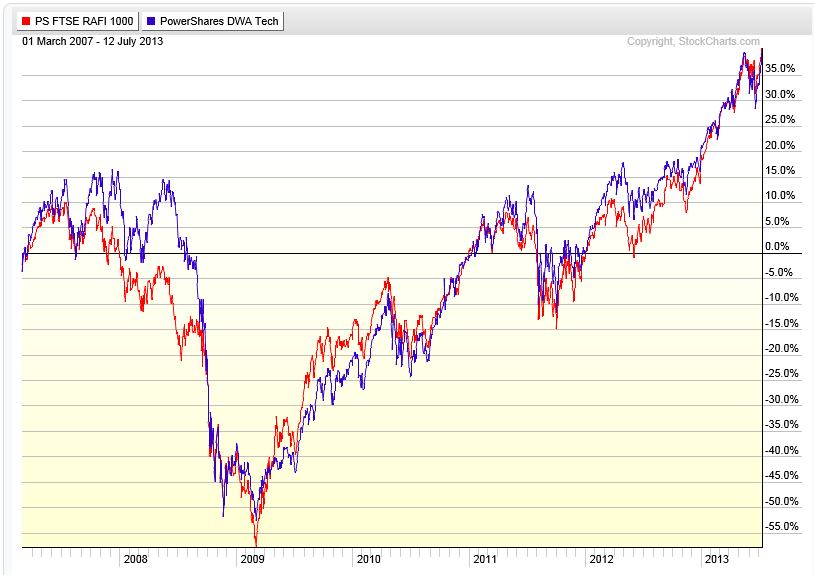
PDPvPRF zps323d99f1 Alternative Beta

The performance numbers above are pure price returns, based on the applicable index not inclusive of dividends, fees, commissions, or other expenses. Past performance not indicative of future results. Potential for profits accompanied by possibility of loss. See www.powershares.com for more information.

Posted by:


Smart Beta vs. Monkey Beta

April 9, 2013

Andy wrote a recent article entitled Smart Beta Gains Momentum. It’s gaining momentum for a good reason! A recent study at Cass Business School in London found that cap-weighting was not a very good way to construct an index. Lots of methods to get exposure to smart beta do better. The results were discussed in an article at Index Universe. Some excerpts:

Researchers have found that equity indices constructed randomly by ‘monkeys’ would produce higher risk-adjusted returns than an equivalent market capitalisation-weighted index over the last 40 years…

The findings come from a recent study by Cass Business School (CBS), which was based on monthly US share data from 1968 to 2011. The authors of the study found that a variety of alternative index weighting schemes all delivered superior returns to the market cap approach.

According to Dr. Nick Motson of CBS, co-author of the study, “all of the 13 alternative indices we studied produced better risk-adjusted returns than a passive exposure to a market-cap weighted index.”

The study included an experiment that saw a computer randomly pick and weight each of the 1,000 stocks in the sample. The process was then repeated 10 million times over each of the 43 years. Clare describes this as “effectively simulating the stock-picking abilities of a monkey”.

…perhaps most shockingly, we found that nearly every one of the 10 million monkey fund managers beat the performance of the market cap-weighted index,” said Clare.

The findings will be a boost to investors already looking at alternative indexing. Last year a number of European pension funds started reviewing their passive investment strategies, switching from capitalisation-weighting to alternative index methodologies.

Relative strength is one of the prominent smart beta methodologies. Of course, cap-weighting has its uses—the turnover is low and rebalancing is minimized. But purely in terms of performance, the researchers at Cass found that there are better ways to do things. Now that ETFs have given investors a way to implement some of these smart beta methods in a tax-efficient, low-cost manner, I suspect we will see more movement toward smart beta in the future.

Posted by:






