From the Archives: The Math Behind Manager Selection

May 31, 2012

Hiring and firing money managers is a tricky business. Institutions do it poorly (see background post here ), and retail investors do it horribly (see article on DALBAR ). Why is it so difficult?

This white paper on manager selection from Intech/Janus goes into the mathematics of manager selection. Very quickly it becomes clear why it is so hard to do well.

Many investors believe that a ten-year performance record for a group of managers is sufficiently long to make it easy to spot the good managers. In fact, it is unlikely that the good managers will stand out. Posit a good manager whose true average relative return is 200 basis points (bps) annually and true tracking error (standard deviation of relative return) is 800 bps annually. This manager’s information ratio is 0.25. To put this in perspective, an information ratio of 0.25 typically puts a manager near or into the top quartile of managers in popular manager universes.

Posit twenty bad managers with true average relative returns of 0 bps annually, true tracking error of 1000 bps annually, hence an information ratio of 0.00.

There is a dramatic difference between the good manager and the bad managers.

The probability that the good manager beats all twenty bad managers over a ten-year period is only about 9.6%. This implies that chasing performance leaves the investor with the good manager only about 9.6% of the time and with a bad manager about 90.4% of the time.

In other words, 90% of the time the manager with the top 10-year track record in the group will be a bad manager! Maybe a longer track record would help?

A practical approach is to ask how long a historical performance record is necessary to be 75% sure that the good manager will beat all the bad managers, i.e., have the highest historical relative return. Assuming the same good manager as before and twenty of the same bad managers as before, a 157 year historical performance record is required to achieve a 75% probability that the good manager will beat all the bad managers.

It turns out that it would help, but since none of the manager databases have 150-year track records, in practice it is useless. The required disclaimer that past performance is no guarantee of future results turns out to be true.

There is still an important practical problem to be solved here. Assuming that bad managers outnumber good ones and assuming that we don’t have 150 years to wait around for better odds, how can we increase our probability of identifying one of the good money managers?

The researchers show mathematically how combining an examination of the investment process with historical returns makes the decision much simpler. If the investor can make a reasonable assumption about a manager’s investment process leading to outperformance, the math is straightforward and can be done using Bayes’ Theorem to combine probabilities.

…the answer changes based on the investor’s assessment of the a priori credibility of the manager’s investment process.

It turns out that the big swing factor in the answer is the credibility of the underlying investment process. What are the odds that an investment process using Fibonacci retracements and phases of the moon will generate outperformance over time? What are the odds that relative strength or deep value will generate outperformance over time?

The research paper concludes with the following words of wisdom:

A careful examination of almost any investor’s investment manager hiring and firing process is likely to reveal that there is a substantial component of performance chasing. Sometimes it is obvious, e.g., when there is a policy of firing a manager if he has negative performance after three years. Other times it is subtle, e.g., when the initial phase of the manager search process strongly weights attractive historical performance. No matter the form that performance chasing takes, it tends to produce future relative returns that are disappointing compared to expectations.

Historical performance alone is not an effective basis for identifying a good manager among a group of bad managers. This does not mean that historical performance is useless. Rather, it means that it must be combined efficiently with other information. The correct use of historical performance relegates it to a secondary role. The primary focus in manager choice should be an analysis of the investment process. [emphasis added]

This research paper is eye-opening in several respects.

1) It shows pretty clearly that historical performance alone–despite what our intuition tells us–is not sufficient to select managers. This probably accounts for a great deal of the poor manager selection, the subsequent disappointment, and rapid manager turnover that goes on.

2) It is very clear from the math that only credible investment processes are likely to generate long-term outperformance. Fortunately, lots of substantive academic and practitioner research has been done on factor analysis leading to outperformance. The only two broadly robust factors discovered so far have been relative strength and value, both in various formulations–and, obviously, they have to be implemented in a disciplined and systematic fashion. If your investment process is based on something else, there’s a decent chance you’re going to be disappointed.

3) Significant time is required for the best managers to stand out from the much larger pack of mediocre managers.

This is a demanding process for consultants and clients. They have to willfully reduce their focus on even 10-year track records, limit their selection to rigorous managers using proven factors for outperformance, and then exercise a great deal of patience to allow enough time for the cream to rise to the top. The rewards for doing so, however, might be quite large–especially since almost all of your competition will ignore the correct process and and simply chase performance.

—-this article originally appeared 1/28/2010. I have seen no evidence since then that most consultants have improved their manager selection process, which is a shame.

Posted by:


Are Equities Dead or Just Resting?

May 29, 2012

CNBC carried an article today, via Financial Times, that talked about how much investors hate stocks. Some excerpts from the article:

…institutional investors, from pension funds to mutual funds sold directly to the public, have slashed holdings in the past decade. Stocks have not been so far out of favor for half a century. Many declare the “cult of the equity” dead.

Compared with bonds, stocks have not looked so cheap for half a century. During this period, the dividend yield — the amount paid out in dividends per share divided by the share price, a key measure of value — has been lower than the yield paid by bonds (which moves in the opposite direction to prices). In other words, investors were happy to take a lower interest rate from stocks than from bonds, despite their greater volatility, reflecting their confidence that returns from stocks would be higher in the long run.

But now investors want a higher yield from equities. According to Robert Shiller of Yale University, the dividend yield on U.S. stocks is today 1.97 percent — above the 1.72 percent yield on 10-year U.S. Treasury bonds.

Some hope that the cycle is about to turn and that the preconditions for a new cult of the equity will emerge even if it takes time. Few people doubt, however, that the old cult of the equity — which steered long-term savers into loading their portfolios with shares — has died.

Indeed, equities have not been so cheap relative to bonds since 1956, which turned out to be one of the best moments in history to have bought stocks.

In the U.S., inflows to bond funds have exceeded equity inflows every year since 2007, with outright net redemptions from equity funds in each of the past five years.

I swear I’m not making this up. Side-by-side, the article discusses the death of the equity cult while it mentions that stocks are at the best buying point in 50 years, apparently without irony. Wow.

Somewhere down the road there will be a catalyst—I have no idea what it will be, but it could be much sooner than most think. Contrary opinion would suggest that we look closely at the presumption that equities are really dead. It’s quite possible that stocks, like Monty Python’s Norwegian Blue, are just resting. When sentiment gets so highly tilted to one side it is worth examining to see if, in fact, the opposite is true.

deadparrot Are Equities Dead or Just Resting?

Are Equities Dead or Just Resting?


Posted by:


The New Death of Equities

May 21, 2012

From AdvisorOne, yet another article about how much investors hate the market these days:

Despite strong U.S. equity market returns in early 2012 that sent the Dow back above 13,000 by the end of February, indications are that many Americans remain investment spectators, reluctant to participate in the equity market rally, a Franklin Templeton global poll has found.

Investor skepticism appears to be tied to the extreme volatility witnessed in 2011, in which the Dow Jones Industrial Average had 104 days of triple-digit swings-representing a significant portion of the 252 total trading days last year. Indeed, when asked about the importance of various market scenarios when deciding to purchase an equity investment, market stability was most frequently identified by U.S. respondents as an important factor.

“The market volatility that has persisted since 2008 is keeping many investors on the sidelines, and their ability to view positive equity market performance constructively has been thwarted by the market ups and downs that are at odds with the stability they are seeking,” John Greer, executive vice president of corporate marketing and advertising at Franklin Templeton Investments, said in a statement. “But the reality is that investors who have been waiting for ‘the right time’ to get back into the equity market have been missing out on the market rally we’ve witnessed over the past few years.”

This is sadly typical of retail investors. Volatility tends to be greatest at market bottoms, and volatility tends to be what investors most avoid. As a result, investors often avoid returns as well!

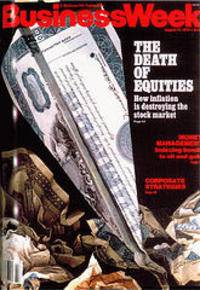
This period strikes me as psychologically reminiscent of the late 1970s, when Business Week famously published a cover announcing the death of equities. Consider what investors had been through: in the late 1960s, the speculative names had gotten torched. By 1973-74 even the bluest of the blue chips had gotten ripped. By the late 1970s, 20% annual corrections were the norm. The economy was a mess and investors simply opted out. The Business Week cover just reflected the spirit of the time.

The late 1970s are not so different from now. The speculative names collapsed in 2000-2002, followed by a bear market in 2008-2009 that got everything. The last couple of summers have been punctuated by scary 15-20% corrections. The economy is still a mess. Psychologically, investors are in the same spot they were when the original cover came out. Based on fund flows, “anything but stocks” seems to be the battle cry.

Yet, consider how things unfolded subsequently. Only a few years later both the market and the economy were booming. (High relative strength stocks began to perform very well several years ahead of the 1982 bottom, by the way.) The Business Week cover is now famous as a contrary indicator. It wouldn’t shock me if the current investor disdain for stocks has a similar outcome down the road.

deathofequities 1 The New Death of Equities

Business Week: the famous "Death of Equities" cover


Posted by:


Two Rides the Public Missed…

May 7, 2012

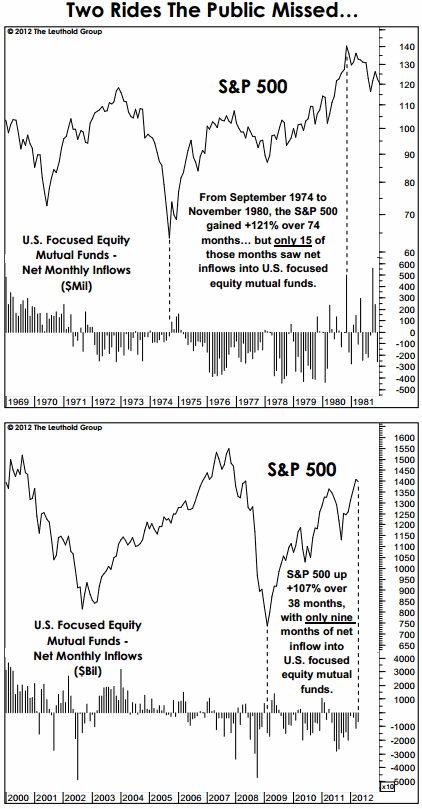
Mark Twain once said, “A cat who sits on a hot stove will never sit on a hot stove again. But, he won’t sit on a cold stove, either.” Surely, that applies to investors who have gone through a severe bear market, like 1973-74 or 2008.

leuthold 2 Two Rides the Public Missed...

Source: The Leuthold Group

Without an investment process that systematically allocates to where the action is, investors may be psychologically incapable of making much money for years to come.

Posted by: