The chart below shows performance of US sectors and capitalizations over the trailing 12, 6, and 1 month(s). Performance updated through 5/30/2013.
Numbers shown are price returns only and are not inclusive of transaction costs. Source: iShares
The chart below shows performance of US sectors and capitalizations over the trailing 12, 6, and 1 month(s). Performance updated through 5/30/2013.
Numbers shown are price returns only and are not inclusive of transaction costs. Source: iShares
 Leave a Comment » |
  Markets |
  Permalink

Posted by: Andy Hyer
Mutual fund flow estimates are derived from data collected by The Investment Company Institute covering more than 95 percent of industry assets and are adjusted to represent industry totals.
Leave a Comment » | Markets | Permalink
Posted by: Andy Hyer
Mark Hulbert has been tracking advisory newsletters for more than 20 years. Lots of these newsletters do active market timing, so in a recent column, he asked an obvious question:
The first question: How many stock market timers, of the several hundred monitored by the Hulbert Financial Digest, called the bottom of the bear market a year ago?
And a follow-up: Of those that did, how many also called the top of the bull market in March 2000 — or, for that matter, the major market turning points in October 2002 and October 2007?
If you are relying on some type of market timing to get you out of the way of bear markets and to get you into bull markets, this is exactly what you want to know. Although there are pundits who claim to have called the bottom to the day, Mr. Hulbert allowed a far more generous window for labeling a market timing call as correct.
… my analysis actually relied on a far more relaxed definition: Instead of moving 100% from cash to stocks in the case of a bottom, or 100% the other way in the case of a top, I allowed exposure changes of just ten percentage points to qualify.
Furthermore, rather than requiring the change in exposure to occur on the exact day of the market’s top or bottom, I looked at a month-long trading window that began before the market’s juncture and extending a couple of weeks thereafter.
That’s a pretty liberal definition: the market timer gets a four-week window and only has to change allocations by 10% to be considered to have “called” the turn. And here’s the bottom line:
Even with these relaxed criteria, however, none of the market timers that the Hulbert Financial Digest has tracked over the last decade were able to call the market tops and bottoms since March 2000.
Yep, zero. [The bold and underline is from me.] It’s not that advisors aren’t trying; it’s just that no one can do it successfully, even with a one-month window and a very modest change in allocations. Obviously, there is lots of hindsight bias going on where advisors claim to have detected market turning points, but when Mr. Hulbert goes back to look at the actual newsletters, not one got it right! You can safely assume anyone who claims to be able to time the market is lying. At the very least, the burden on proof is on them.
We don’t bother trying to figure out what the market will do going forward. We simply follow trends as they present themselves. We use relative strength in a systematic way to identify the trends we want to follow: the strongest ones. We stay with the trend as long as it continues, whether that is for a short time or an extended period. When a trend weakens, as evidenced by its relative strength ranking, we knock that asset out of the portfolio and replace it with a stronger asset. The two white papers we have produced (Relative Strength and Asset Class Rotation and Bringing Real World Testing to Relative Strength) show quite clearly that it is possible to have very favorable investment results over time without any recourse to market timing at all. Discipline and patience are needed, of course, but you don’t have to have a crystal ball.
—-this article originally appeared 3/17/2010. It is especially apropos now that many market pundits are busy predicting a top. It’s certainly possible they are right—but probably equally likely is the proposition that they are just guessing. Over the long run there is weak evidence that market timing is effective.
3 Comments | From the Archives, Markets, Thought Process | Tagged: market timing, relative strength, trend following | Permalink
Posted by: Mike Moody
Here we have the next round of the Dorsey, Wright Sentiment Survey, the first third-party sentiment poll. Participate to learn more about our Dorsey, Wright Polo Shirt raffle! Just follow the instructions after taking the poll, and we’ll enter you in the contest. Thanks to all our participants from last round.
As you know, when individuals self-report, they are always taller and more beautiful than when outside observers report their perceptions! Instead of asking individual investors to self-report whether they are bullish or bearish, we’d like financial advisors to weigh in and report on the actual behavior of clients. It’s two simple questions and will take no more than 20 seconds of your time. We’ll construct indicators from the data and report the results regularly on our blog–but we need your help to get a large statistical sample!
Click here to take Dorsey, Wright’s Client Sentiment Survey.
Contribute to the greater good! It’s painless, we promise.
Leave a Comment » | Investor Behavior, Markets, Sentiment | Permalink
Posted by: JP Lee
Among the biggest investor-driven trends in the market right now is the thirst for yield. The paltry yields available in most sectors of fixed income just are not providing the type of income that investors are looking for and so they are increasingly looking at earning that yield from dividend-paying stocks. However, an exclusive focus on yield provides an incomplete picture of the returns that an investor may achieve. There is also the performance of the stock itself that must be factored into the evaluation.
When we rank our universe of securities to construct the First Trust Dorsey Wright Dividend UITs, our relative strength ranks are determined by the total return of the stocks (price return + yield). For comparison’s sake, consider the construction methodology of the S&P Dividend SPDR (SDY) which is based upon the S&P High Yield Dividend Aristocrats Index. That index is designed to measure the performance of the highest dividend yielding S&P Composite 1500 Index constituents that have followed a managed-dividends policy of consistently increasing dividends every year for at least 20 consecutive years.
In the table below, I show the top 10 holdings for both SDY and for the First Trust Dorsey Wright Dividend UIT, Series 9. While the top 10 holdings for SDY have a slightly higher yield, the top 10 holdings of the Dorsey Wright UIT have had better total returns over the past 12 months.
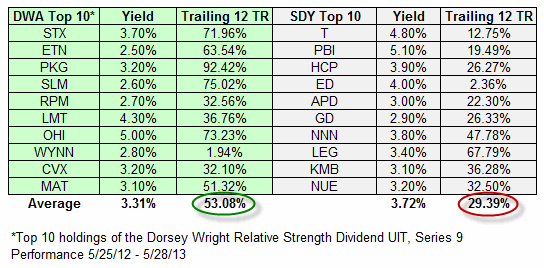
Source: AllETF.com and First Trust; Performance Source: Yahoo! Finance
Evaluating dividend-paying stocks from a total return perspective seems to be fairly uncommon, yet it can make a significant difference in performance for the client while still allowing them to seek above-market yields.
Past performance is not indicative of future results. Potential for profits is accompanied by possibility of loss. See http://www.ftportfolios.com for more information.
3 Comments | Markets, Thought Process | Permalink
Posted by: Andy Hyer
You’ve got to check out this video of a Bloomberg analyst putting up scenes from Predator while talking about our PowerShares DWA Emerging Markets Technical Leaders ETF (PIE). Starts at the 1 hour 15 minute mark. PIE is getting a lot of attention this year due to its large outperformance versus other emerging market ETFs.
Past performance is not indicative of future results. Potential for profits is accompanied by possibility of loss. See www.powershares.com for more information. A list of all holdings for the trailing 12 months is available upon request.
Posted by: Andy Hyer
The chart below measures the percentage of high relative strength stocks that are trading above their 50-day moving average (universe of mid and large cap stocks.) As of 5/28/13.
The 10-day moving average of this indicator is 88% and the one-day reading is 84%.
Leave a Comment » | Markets | Permalink
Posted by: Andy Hyer
One way to improve your stock market forecasts is to revise them! Bespoke has a nice piece where they show graphically how Wall Street strategists just change their forecast when the market moves past them. Whether the market goes up or down here is immaterial—the forecast will be changed to accommodate the market. Investors might give credence to some of these forecasts if they didn’t know they were a moving target. Who knew stock market forecasting was so easy?
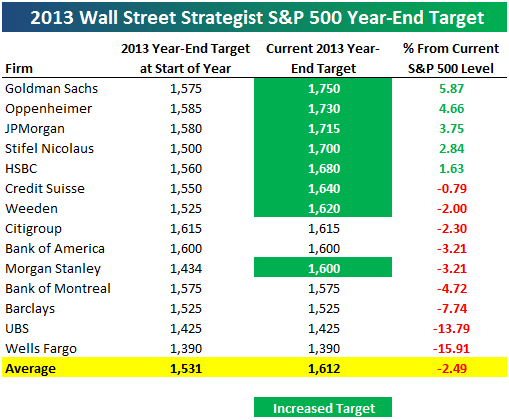
Source: Bespoke (click on image to enlarge)
1 Comment | Just for Fun, Markets | Tagged: market, stock market | Permalink
Posted by: Mike Moody
The chart below is the spread between the relative strength leaders and relative strength laggards (universe of mid and large cap stocks). When the chart is rising, relative strength leaders are performing better than relative strength laggards. As of 5/27/13:
Leave a Comment » | Markets | Permalink
Posted by: JP Lee
Bloomberg has high praise the the PowerShares DWA Emerging Markets Technical Leaders ETF (PIE):
It’s been a challenging year for emerging markets. The hugely popular Vanguard FTSE Emerging Markets ETF (VWO) is down about 1 percent so far in 2013; the iShares MSCI Emerging Markets Index (EEM) has fallen 2.1 percent. Bucking the trend is the PowerShares DWA Emerging Markets Technical Leaders Portfolio (PIE). That ETF is up 14.6 percent during the same period. How is that possible?
It all comes down to the design of the index that PIE tracks — the Dorsey Wright Emerging Markets Technical Leaders Index, developed by technical analysis pioneer Tom Dorsey’s firm.
Here’s how it works: Every quarter the index looks through more than 2,000 emerging market stocks and picks the 100 that have performed the best relative to the group over the past six to 12 months. That’s a wildly different approach from that taken by VWO and EEM. Those are traditional market-cap-weighted ETFs, in which the largest stocks in a group dominate the index.
Let’s look at the year-to-date performance of the four countries PIE weighs most heavily:*
- Indonesia: 16.2% of assets; up 18.2%
- Thailand: 14.3% of assets; up 10%
- Mexico: 11.1% of assets; down 2.8%
- Turkey: 11% of assets; up 19.4%
Therein lies the reason for PIE’s outperformance. It has heavy weightings in the smaller, more successful emerging market countries and lighter weightings in struggling BRIC countries. Chinese stocks make up 7 percent of the fund and Brazilian companies 4 percent. In VWO, Chinese stocks are 14.5 percent of the fund and Brazilian stocks are another 14.5 percent. For EEM, it’s 13.6 percent and 12.7 percent. Unlike many of its peers, PIE isn’t beholden to any country or region or sector — it simply follows the heat.
See www.powershares.com for more information about PIE. A list of all holdings for the trailing 12 months is available upon request.
Leave a Comment » | Media | Permalink
Posted by: Andy Hyer
The chart below shows performance of US sectors and capitalizations over the trailing 12, 6, and 1 month(s). Performance updated through 5/23/2013.

Numbers shown are price returns only and are not inclusive of transaction costs. Source: iShares
Leave a Comment » | Markets | Permalink
Posted by: Andy Hyer
In light of Thursday’s 7.3% drop in the Nikkei 225, we wanted to review Japan from a trend and relative strength perspective. Performance over the last two years is show below. The explosive move higher in Japanese equities has been driven in large part by expectations for Prime Minister Shinzo Abe’s plan which can be summed up in his own words, “With the strength of my entire cabinet, I will implement bold monetary policy, flexible fiscal policy and a growth strategy that encourages private investment, and with these three policy pillars, achieve results.”

Source: Yahoo! Finance (click to enlarge)
A longer-term view of the Nikkei 225 reveals just how poor the performance for Japanese equities has been since its 1989 peak:

Source: Yahoo! Finance (click to enlarge)
As expected from a trend following methodology, Japan also started to rise to the top of our relative strength ranks in recent months. In fact, the iShares MSCI Japan ETF (EWJ) was added to the Arrow DWA Tactical Fund (DWTFX) in April of this year. The strength in EWJ is just one of the reasons that DWTFX is currently outperforming 98% of its peers in the Morningstar World Allocation Category YTD. The relative strength of Japan can also be seen in the Dorsey Wright Fund Score Rank:

Source: Dorsey Wright (click to enlarge)
So, let’s get to the question on everyone’s mind: What happens from here? Will Japan bounce back and resume its explosive move higher or is it the beginning of a trend reversal? Unfortunately, we don’t have the answer to that. As we do with every trade, we buy strength and stay with it as long as it remains strong. If a position weakens sufficiently in our relative strength ranks we will replace it with a stronger security.
However, I do think it is interesting to note the potential comparison to a position in China that we had in the Arrow DWA Balanced Fund from 2006 to 2008. That transaction had a cumulative return of 103% from its initial purchase, but during the start of this magical ride there was a 21% correction. This is documented in the chart below.

Source: Arrow Funds (click to enlarge)
The mere fact that Japan is back on the radar for relative strength strategies is a powerful reminder of the need to remain adaptive. New themes are constantly developing and relative strength is adept at capitalizing on these trends. There are plenty of pundits who are betting that Japan will continue its move higher, including Marc Faber. This could well be a good opportunity to get exposure to DWTFX during a temporary period of weakness after the fund has climbed over 13% YTD.
Past performance is not indicative of future results. Potential for profits is accompanied by possibility of loss. See www.arrowfunds.com for more information. A list of all holdings for the trailing 12 months is available upon request.
2 Comments | Markets, Tactical Asset Alloc | Tagged: relative strength, Tactical Asset Allocation | Permalink
Posted by: Andy Hyer
Mutual fund flow estimates are derived from data collected by The Investment Company Institute covering more than 95 percent of industry assets and are adjusted to represent industry totals.
Leave a Comment » | Markets | Permalink
Posted by: Andy Hyer
The chart below measures the percentage of high relative strength stocks that are trading above their 50-day moving average (universe of mid and large cap stocks.) As of 1/19/10.
The 10-day moving average of this indicator is 90% and the one-day reading is 91%.
4 Comments | Markets | Permalink
Posted by: Andy Hyer
Financial Times author, Ruchir Sharma, says that money flows into the emerging markets are more discriminate this decade.
As the printing presses continue to hum, however, the question remains: where will the money go? Policy makers cannot assume it will flow to the emerging markets, the way it did in the 2000s. That was an exceptional decade, when all emerging markets boomed, attracting huge new capital flows. Now the blind optimism about growth in many emerging markets has dimmed, as many face serious structural problems.
Brazil, Russia and South Africa may grow more slowly than the global average over the next few years. However, inflows remain high in some of the more reform-oriented emerging economies such as the Philippines, Thailand and Turkey.
Interestingly, countries—Philippines, Thailand, and Turkey—that he labels as “more reform-oriented emerging economies” are all countries where we have overweights in the PowerShares DWA Emerging Markets Technical Leaders ETF (PIE).

As of 4/1/2013.
These overweights and underweights have had a very positive impact on YTD performance:

Source: Yahoo! Finance
Performance numbers listed above are pure price returns, not inclusive of dividends, all fees, or other expenses. Past performance is not indicative of future results. Potential for profits is accompanied by possibility of loss. See www.powershares.com for more information.
HT: Abnormal Returns
Leave a Comment » | Markets, Tactical Asset Alloc | Permalink
Posted by: Andy Hyer
The chart below is the spread between the relative strength leaders and relative strength laggards (universe of mid and large cap stocks). When the chart is rising, relative strength leaders are performing better than relative strength laggards. As of 5/20/2013:
Leave a Comment » | Markets | Permalink
Posted by: Andy Hyer
The table below shows the performance of a universe of mid and large cap U.S. equities, broken down by relative strength decile and then compared to the universe return. Those at the top of the ranks are those stocks which have the best intermediate-term relative strength. Relative strength strategies buy securities that have strong intermediate-term relative strength and hold them as long as they remain strong.
Last week’s performance (5/13/13 – 5/17/13) is as follows:
Leave a Comment » | Markets | Permalink
Posted by: Andy Hyer
Where is the ETF industry headed? Tom Dorsey answers in this Q&A with IndexUniverse.
IU.com:In the first four months of 2013, asset gathering for U.S. ETFs was in the neighborhood of $64 billion, and on pace to beat 2012’s record of $188 billion. Are you surprised? Is the sky the limit? How far is this ETF juggernaut going to go?
Dorsey: Well, I don’t think the sky is going to be the limit. I don’t know that there are any more ETFs that anyone can bring out that will be the new fandango. The key word here is a phrase I coined: “ETF alchemy.”
IU.com:ETF alchemy?
Dorsey: Think about this for a second: If I take H2 and I add O, what do I get?
IU.com:Water.
Dorsey: Yes, water. Each one of those two elements is separate. But when I combine the two, I come up with a substance—water—that you can’t live without. Each one separately is not as good as the two combined. And the concept here is, What’s out there in terms of ETFs I can combine together to make a better product?
Take for instance the Standard & Poor’s Low Volatility Index—and if you add that to PDP, which is our Technical Leaders Index, and combine the two, it’s like taking two glasses of water and pouring them into one bigger glass of water, 50-50. I end up with a better product than either one of them separately.
You’ll find this as we go along: the ability to combine different ETFs to create a better unit where the whole is better than the sum of its parts.
A little later in the interview, Tom Dorsey speaks to just how important the ETF has been to the industry:
IU.com:So that’s really the first ETF.
Dorsey: Yes, and I can’t tell you how many seminars I have taught to professionals on ETFs and the eyes that widen and the lives that change once they understand it and understand how to use it; it tells me we’re on the right path and this is the exact right product.
Like I’ve said to you before, it’s probably the most important product ever created in my 39 years in this business. And I believe back then when I talked to you that we’re in the first foot of a 26-mile marathon.
Dorsey Wright is the index provider for PDP. For more information, please see www.powershares.com.
Posted by: Andy Hyer
The chart below shows performance of US sectors and capitalizations over the trailing 12, 6, and 1 month(s). Performance updated through 5/16/2013.
Numbers shown are price returns only and are not inclusive of transaction costs. Source: iShares
Leave a Comment » | Markets | Permalink
Posted by: Andy Hyer
Mutual fund flow estimates are derived from data collected by The Investment Company Institute covering more than 95 percent of industry assets and are adjusted to represent industry totals.
Leave a Comment » | Markets | Permalink
Posted by: JP Lee
The chart below measures the percentage of high relative strength stocks that are trading above their 50-day moving average (universe of mid and large cap stocks.) As of 4/30/13.
The 10-day moving average of this indicator is 84% and the one-day reading is 92%.
Leave a Comment » | Markets | Permalink
Posted by: JP Lee
This is the title of a nice article by Brett Arends at Marketwatch. He points out that a lot of our assumptions, especially regarding risk, are open to question.
Risk is an interesting topic for a lot of reasons, but principally (I think) because people seem to be obsessed with safety. People gravitate like crazy to anything they perceive to be “safe.” (Arnold Kling has an interesting meditation on safe assets here.)
Risk, though, is like matter–it can neither be created nor destroyed. It just exists. When you buy a safe investment, like a U.S. Treasury bill, you are not eliminating your risk; you are just switching out of the risk of losing your money into the risk of losing purchasing power. The risk hasn’t gone away; you have just substituted one risk for another. Good investing is just making sure you’re getting a reasonable return for the risk you are taking.
In general, investors–and people generally–are way too risk averse. They often get snookered in deals that are supposed to be “low risk” mainly because their risk aversion leads them to lunge at anything pretending to be safe. Psychologists, however, have documented that individuals make more errors from being too conservative than too aggressive. Investors tend to make that same mistake. For example, nothing is more revered than a steady-Eddie mutual fund. Investors scour magazines and databases to find a fund that (paradoxically) is safe and has a big return. (News flash: if such a fund existed, you wouldn’t have to look very hard.)
No one goes looking for high-volatility funds on purpose. Yet, according to an article, Risk Rewards: Roller-Coaster Funds Are Worth the Ride at TheStreet.com:
Funds that post big returns in good years but also lose scads of money in down years still tend to do better over time than funds that post slow, steady returns without ever losing much.
The tendency for volatile investments to best those with steadier returns is even more pronounced over time. When we compared volatile funds with less volatile funds over a decade, those that tended to see big performance swings emerged the clear winners. They made roughly twice as much money over a decade.
That’s a game changer. Now, clearly, risk aversion at the cost of long-term returns may be appropriate for some investors. But if blind risk aversion is killing your long-term returns, you might want to re-think. After all, eating Alpo is not very pleasant and Maalox is pretty cheap. Maybe instead of worrying exclusively about volatility, we should give some consideration to returns as well.
—-this article originally appeared 3/3/2010. A more recent take on this theme are the papers of C. Thomas Howard. He points out that volatility is a short-term factors, while compounded returns are a long-term issue. By focusing exclusively on volatility, we can often damage long term results. He re-defines risk as underperformance, not volatility. However one chooses to conceptualize it, blind risk aversion can be dangerous.
Leave a Comment » | From the Archives, From the MM, Investor Behavior, Markets, Thought Process | Tagged: behavioral finance, decision-making, investor behavior, return, volatility | Permalink
Posted by: Mike Moody
The chart below is the spread between the relative strength leaders and relative strength laggards (universe of mid and large cap stocks). When the chart is rising, relative strength leaders are performing better than relative strength laggards. As of 5/13/2013:
Leave a Comment » | Markets | Permalink
Posted by: JP Lee
The financial industry spends little focus on 20-somethings for the obvious reason that they don’t tend to have much money. It’s a shame because this really is “the defining decade of adulthood.” Habits, like saving and investing, established in this decade lay the foundation for success for the long run. Although the TED talk below (Meg Jay: Why 30 is not the new 20) focuses on a number of topics, including career and marriage, it serves up plenty of food for thought for us in the financial industry about how we serve this demographic.
Leave a Comment » | Retirement/Saving | Permalink
Posted by: Andy Hyer

Source: The Economist, via Greg Mankiw.
Americans, as well as citizens of many other advanced nations, now spend about twice as many years in retirement as they did a generation or two ago. Aggressive saving and adherence to a well-thought-out investment plan are more important today than they have ever been. It is a big mistake for today’s 65-year olds to no longer consider themselves to be “long-term investors.”
—-this article originally appeared 3/1/2010. As you can see from the graphic, the average US 66-year old retiree spends another 15-20 years in retirement. That’s long enough that investment performance is going to be important.
Leave a Comment » | From the Archives, Retirement/Saving | Tagged: retirement | Permalink
Posted by: Mike Moody
You are currently browsing the Systematic Relative Strength blog archives for May, 2013.








