Is Active Investing Hopeless?

August 19, 2013

Every time I read an article about how active investing is hopeless, I shake my head. Most of the problem is investor behavior, not active investing. The data on this has been around for a while, but is ignored by indexing fans. Consider for example, this article in Wealth Management that discusses a 2011 study conducted by Morningstar and the Investment Company Institute. What they found doesn’t exactly square out with most of what you read. Here are some excerpts:

But studies by Morningstar and the Investment Company Institute (ICI) suggest that fund shareholders may not be so dumb after all. According to the latest data, investors gravitate to low-cost funds with strong track records. “People make reasonably intelligent choices when they pick active funds,” says John Rekenthaler, Morningstar’s vice president of research.

The academic approach produces a distorted picture, says Rekenthaler. “It doesn’t matter what percentage of funds trail the index,” says Rekenthaler. “What matters most is how the big funds do. That’s where most of the money is.”

In order to get a realistic picture of fund results, Rekenthaler calculated asset-weighted returns—the average return of each invested dollar. Under his system, large funds carry more weight than small ones. He also calculated average returns, which give equal weight to each fund. Altogether Morningstar looked at how 16 stock-fund categories performed during the ten years ending in 2010. In each category, the asset-weighted return was higher than the result that was achieved when each fund carried the same weight.

Consider the small-growth category. On an equal-weighted basis, active funds returned 2.89 percent annually and trailed the benchmark, which returned 3.78 percent. But the asset-weighted figure for small-growth funds exceeded the benchmark by 0.20 percentage points. Categories where active funds won by wide margins included world stock, small blend, and health. Active funds trailed in large blend and mid growth. The asset-weighted result topped the benchmark in half the categories. In most of the eight categories where the active funds lagged, they trailed by small margins. “There is still an argument for indexing, but the argument is not as strong when you look at this from an asset-weighted basis,” says Rekenthaler.

The numbers indicate that when they are choosing from among the many funds on the market, investors tend to pick the right ones.

Apparently investors aren’t so dumb when it comes to deciding which funds to buy. Most of the actively invested money in the mutual fund industry is in pretty good hands. Academic studies, which weight all funds equally regardless of assets, don’t give a very clear picture of what investors are actually doing.

Where, then, is the big problem with active investing? There isn’t one—the culprit is investor behavior. As the article points out:

But investors display remarkably bad timing for their purchases and sales. Studies by research firm Dalbar have shown that over the past two decades, fund investors have typically bought at market peaks and sold at troughs.

Active investing is alive and well. (I added the bold.) In fact, the recent trend toward factor investing, which is just a very systematic method for making active bets, reinforces the value of the approach.

The Morningstar/ICI research just underscores that much of the value of an advisor may lie in helping the client control their emotional impulse to sell when they are fearful and to buy when they feel confident. I think this is often overlooked. If your client has a decent active fund, you can probably help them more by combatting their destructive timing than you can by switching them to an index fund. After all, owning an index fund does not make the investor immune to emotions after a 20% drop in the stock market!

Posted by:


3 Keys to a Simple Investment Strategy

August 8, 2013

Simplicity is the ultimate sophistication.—-Leonardo di Vinci

This quotation doubles as the title of a Vanguard piece discussing the merits of a simple fund portfolio. However, it occurred to me that their guidelines that make the simple fund portfolio work are the same for making any investment strategy work. They are:

  • adopt the investment strategy
  • embrace it with confidence, and
  • endure the inevitable ups and downs in the markets

Perhaps this seems obvious, but we see many investors acting differently, more like this:

  • adopt the investment strategy that has been working lately
  • embrace it tentatively, as long as it has good returns
  • bail out during the inevitable ups and downs in the markets
  • adopt another investment strategy that has been working lately…

You can see the problem with this course of action. The investment strategy is only embraced at the peak of popularity—usually when it’s primed for a pullback. Even that would be a minor problem if the commitment to the investment strategy were strong. But often, investors bail out somewhere near a low. This is the primary cause of poor investor returns according to DALBAR.

Investing well need not be terribly complicated. Vanguard’s three guidelines are good ones, whether you adopt relative strength as we have or some different investment strategy. If the strategy is reasonable, commitment and patience are the big drivers of return over time. As Vanguard points out:

Complexity is not necessarily sophisticated, it’s just complex.

Words to live by.


Posted by:


Quote of the Week

August 7, 2013

The efficient-market hypothesis is nonsense. Markets are driven by humans, humans are irrational, thus markets are irrational.—-Hugh Young, Aberdeen Asset Management

This quotation comes from a longer opinion piece on FT.com. The behavioral component of markets generally swamps the fundamental component—the same fundamentals are viewed very differently during periods of optimism or pessimism. The upside of irrational markets is that rational investors with good tools and discipline are able to take advantage.

Posted by:


Correlation and Expected Returns

July 31, 2013

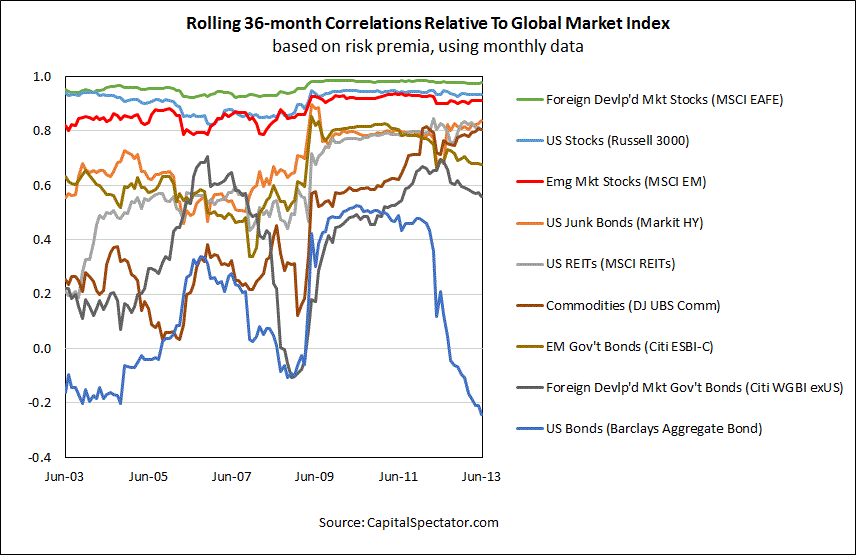
Modern portfolio theory imagines that you can construct an optimal portfolio, especially if you can find investments that are uncorrelated. There’s a problem from the correlation standpoint, though. As James Picerno of The Capital Spectator points out, correlations are rising:

A new study from the Bank of International Settlements (BIS) raises doubts about the value of commodities as a tool for enhancing portfolio diversification. The paper’s smoking gun, so to speak, is that “the correlation between commodity and equity returns has substantially increased after the onset of the recent financial crisis.”

Correlations are a key factor in the design and management of asset allocation, but they’re not the only factor. And even if we can find assets and strategies with reliably low/negative correlations with, say, equities, that alone isn’t enough, as I discussed last week. You also need to consider other factors, starting with expected return. It may be tempting to focus on one pair of assets and consider how the trailing correlation stacks up today. But that’s hardly the last word on making intelligent decisions on how to build a diversified portfolio.

As more investors pile into commodities, REITs, hedge funds, and other formerly obscure corners, the historical diversification benefits will likely fade. Granted, the outlook for expected diversification benefits fluctuates through time, and so what looks unattractive today may look considerably more compelling tomorrow (and vice versa). But as a general proposition, it’s reasonable to assume that correlations generally will inch closer to 1.0. That doesn’t mean that diversifying across asset classes is destined to become worthless, but the expected payoff is likely to dim with the passage of time.

Mathematically, any two items that are not 100% correlated will reduce volatility when combined. But that doesn’t necessarily mean it’s a good addition to your portfolio—or that modern portfolio theory is a very good way to construct a portfolio. (We will set aside for now the MPT idea that volatility is necessarily a bad thing.) The article includes a nice graphic, reproduced below, that shows how highly correlated many asset classes are with the US market, especially if you keep in mind that these are 36-month rolling correlations. Many asset classes may not reduce portfolio volatility much at all.

correlations36month zpsef265698 Correlation and Expected Returns

Source: The Capital Spectator (click on image to enlarge)

As Mr. Picerno points out, optimal allocations are far more sensitive to returns than to correlations or volatility. So even if you find a wonderfully uncorrelated investment, if it has a lousy return it may not help the overall portfolio much. It would reduce volatility, but quite possibly at a big cost to overall returns. The biggest determinant of your returns, of course, is what assets you actually hold and when. The author puts this a slightly different way:

Your investment results also rely heavily on how and when you rebalance the mix.

Indeed they do. If you hold equities when they are doing well and switch to other assets when equities tail off, your returns will be quite different than an investor holding a static mix. And your returns will be way different than a scared investor that holds cash when stocks or other assets are doing well.

In other words, the return of your asset mix is what impacts your performance, not correlations or volatility. This seems obvious, but in the fog of equations about optimal portfolio construction, this simple fact is often overlooked. Since momentum (relative strength) is generally one of the best-performing and most reliable return factors, that’s what we use to drive our global tactical allocation process. The idea is to own asset classes as long as they are strong—and to replace them with a stronger asset class when they begin to weaken. In this context, diversification can be useful for reducing volatility, if you are comfortable with the potential reduction in return that it might entail. (We generally advocate diversifying by volatility, by asset class, and by strategy, although the specific portfolio mix might change with the preference of the individual investor.) If volatility is well-tolerated, maybe the only issue is trying to generate the strongest returns.

Portfolio construction can’t really be reduced to some “optimal” set of tradeoffs. It’s complicated because correlations change over time, and because investor preferences between return and volatility are in constant flux. There is nothing stable about the portfolio construction process because none of the variables can be definitively known; it’s always an educated approximation. Every investor gets to decide—on an ongoing basis—what is truly important: returns (real money you can spend) or volatility (potential emotional turmoil). I always figure I can afford Maalox with the extra returns, but you can easily see why portfolio management is overwhelming to so many individual investors. It can be torture.

Portfolio reality, with all of its messy approximations, bears little resemblance to the seeming exactitude of Modern Portfolio Theory.

Posted by:


Factor Performance and Factor Failure

July 30, 2013

Advisor Perspectives recently carried an article by Michael Nairne of Tacita Capital about factor investing. The article discussed a number of aspects of factor investing, including factor performance and periods of factor underperformance (factor failure). The remarkable thing about relative strength (termed momentum in his article) is the nice combination of strong performance and relatively short periods of underperformance that it affords the investor seeking alpha.

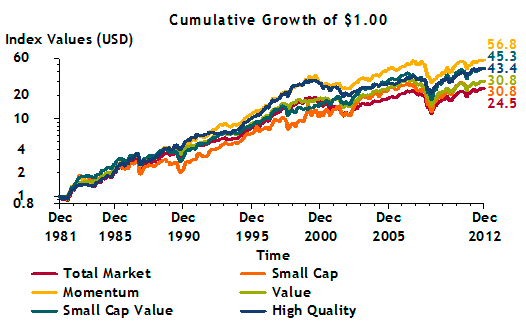
Mr. Nairne discusses a variety of factors that have been shown to generate excess returns over time. He includes a chart showing their performance versus the broad market.

factorperformance zps037b7505 Factor Performance and Factor Failure

Source: Advisor Perspectives/Tacita Capital (click on image to enlarge)

Yep, the one at the top is momentum.

All factors, even very successful ones, underperform from time to time. In fact, the author points out that these periods of underperformance might even contribute to their factor returns.

No one can guarantee that the return premia originating from these dimensions of the market will persist in the future. But, the enduring nature of the underlying causes – cognitive biases hardwired into the human psyche, the impact of social influences and incremental risk – suggests that higher expected returns should be available from these factor-based strategies.

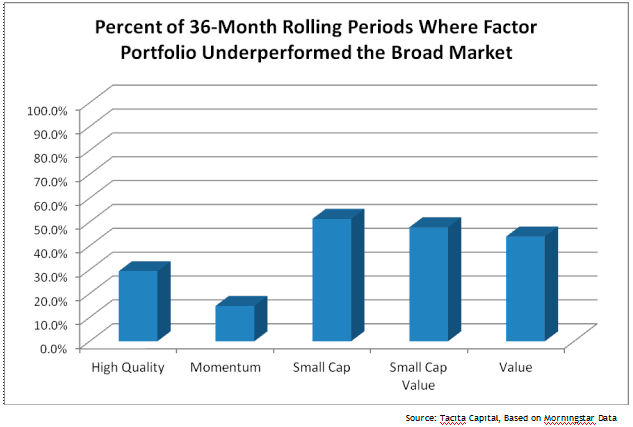
There is another reason to believe that these strategies offer the prospect of future return premia for patient, long-term investors. These premia are very volatile and can disappear or go negative for many years. The chart on the following page highlights the percentage of 36-month rolling periods where the factor-based portfolios – high quality, momentum, small cap, small cap value and value – underperformed the broad market.

To many investors, three years of under-performance is almost an eternity. Yet, these factor portfolios underperformed the broad market anywhere from almost 15% to over 50% of the 36-month periods from 1982 to 2012. If one were to include the higher transaction costs of the factor-based portfolios due to their higher turnover, the incidence of underperformance would be more frequent. One of the reasons that these premia will likely persist is that many investors are simply not patient enough to stay invested to earn them.

The bold is mine, but I think Mr. Nairne has a good point. Many investors seem to believe in magic and want their portfolio to significantly outperform—all the time.

That’s just not going to happen with any factor. Not surprisingly, though, momentum has tended to have shorter stretches of underperformance than many other factors, a consideration that might have been partially responsible for its good performance over time. Mr. Nairne’s excellent graphic on periods of factor failure is reproduced below.

factorfailure zps55a7cd1c Factor Performance and Factor Failure

Source: Advisor Perspectives/Tacita Capital (click on image to enlarge)

Once again, whether you choose to try to harvest returns from relative strength or from one of the other factors, patience is an underrated component of actually receiving those returns. The market can be a discouraging place, but in order to reap good factor performance you have to stay with it during the inevitable periods of factor failure.

Posted by:


Factor Investing

July 18, 2013

Factor investing is one of the new frontiers in portfolio construction. We love this trend because relative strength (known as momentum to academics) is one of the premier factors typically used when constructing portfolios. The Technical Leaders ETFs that we construct for Powershares have really benefited from the movement toward factor investing.

Larry Swedroe recently wrote a glowing article on factor investing for Index Universe that serves as a good introduction. His article is full of great points distilled from a paper in the Journal of Index Investing. (The link to the journal paper is included in his article if you want to read the original source.)

The basic idea is that you can generate superior performance by building a portfolio of return factors. A corollary benefit is that because some of the factors are negatively correlated, you can often reduce the portfolio volatility as well. A couple of excerpts from his article should give you the flavor:

The evidence keeps piling up that investors can benefit from building portfolios that diversify across factors that not only explain stock market returns but that also generate superior returns.

The authors found that investors benefited not only from the exposure to each of the factors individually, but also from the low or negative correlations across these factors. The result was more efficient portfolios than ones that were concentrated in a market portfolio or in single factors.

They concluded: “The fact that momentum and value independently deliver market outperformance, with negatively correlated active returns and a low probability of simultaneous market underperformance, provides the motivation for pursuing a momentum and value diversification strategy.”

We concur with the research that shows momentum and value make a great pairing in a portfolio. The table included in the article showed that these two factors were negatively correlated over the period of the study, 1979-2011.

What brought a smile is that Mr. Swedroe is a well-known and passionate advocate for “passive” investing. Factor investing is about as far from passive investing as you can get.

Think about how a value index or relative strength index is constructed—you have to build it actively, picking and choosing to get the focused factor exposure you want. What is a value stock at the beginning of one period may not be a value stock after an extended run-up in price, so activity is also required to reconstitute and rebalance the index on a regular basis. Stocks that lose their high relative strength ranking similarly need to be actively replaced at every rebalance. Whether the picking and choosing is done in a systematic, rules-based fashion or some other way is immaterial.

Market capitalization-weighted indexes, as a broad generality, might be able to “kinda sorta” claim the passive investing label because they don’t generally have to be constantly rebalanced—although the index component changes are active. A factor index, on the other hand, might require a lot of activity to reconstitute and rebalance it on a regular schedule. But that’s the point—the end result of the activity is focused factor exposure designed to generate superior performance and volatility characteristics.

And spare me the argument that indexing is passive investing. Take a look at the historical level of turnover in indexes like the S&P 500, the S&P Midcap 400, the S&P Smallcap 600, or the Russell 2000 and then try to make the argument that nothing active is going on. I don’t think you can do it. The only real difference is that you have hired the S&P index committee to manage your portfolio instead of some registered investment advisor. (In fact, the index committees typically incorporate some element of relative strength in their decisions as they dump out poor performers and add up-and-coming stocks. Look at the list of additions and deletions if you don’t believe me.) Certainly the level of turnover in a value or momentum index belies the passive label as well.

Index investing is active investing.

I think where passive investing advocates get confused is on the question of cost. Index investing is often low-cost investing—and cost is an important consideration for investors. I suspect that many fans of passive investing are more properly described as fans of low-cost investing. I’m not sure they are really even fans of indexing, since research shows that many so-called actively managed funds are really closet index funds. Presumably their objection is the big fee charged for indexing while masquerading as an active fund, not the indexing itself. (But the same research suggests that an active fund that is truly active—one with high active share—is not necessarily a bad deal.)

Even a factor index is active by definition, but if it is well-constructed and low cost to boot, it might worth taking a close look at.

Posted by:


The World According to Investors

July 17, 2013

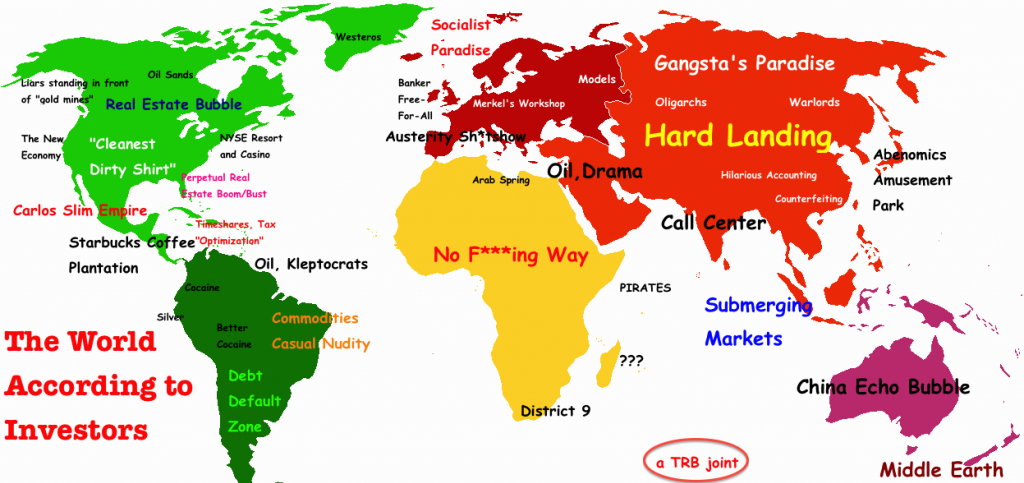
A funny and clever graphic from Josh Brown’s blog, The Reformed Broker. Good for a laugh or two.

world investors JoshBrown zps7e2a11d5 The World According to Investors

Source: The Reformed Broker (click to enlarge to full size)

Posted by:


The Yield Curve Speaks

July 16, 2013

The yield curve is a measurement of the relationship between short-term and long-term interest rates. When long-term rates are high relative to short-term rates, the economy is typically strong. The opposite case is not so rosy—when short-term rates are higher than long-term rates, a recession is often in the offing.

Mark Hulbert of Marketwatch makes this point about the yield curve in a recent column. He writes:

You’re wrong if you think that interest rate increases over the last month are bad for the stock market.

That’s because not all rate hikes are created equal. And the kind that we’ve seen over the last month is not the type that typically kills a bull market.

In fact, a strong argument can be made that the last month’s rate increases are actually good news for the stock market: Because the greatest increases have come at the longer end of the maturity spectrum, the yield curve in recent weeks has become steeper — just the opposite of the direction it would be heading if the odds of a recession were growing.

Later in the article, Mr. Hulbert quantifies the chances of a recession based on the yield curve indicator.

It’s a shame that because of concern that the yield curve might be manipulated, many in recent years have tended to dismiss its utility as a leading economic indicator. Its record, in fact, has been creditable — if not impressive.

Consider one famous econometric model based on the slope of the yield curve that was introduced more than a decade ago by Arturo Estrella, currently an economics professor at Rensselaer Polytechnic and, from 1996 through 2008, senior VP of the New York Federal Reserve Bank’s Research and Statistics Group, and Frederic
Mishkin, a Columbia University professor who was a member of the Federal Reserve’s Board of Governors from 2006 to 2008. The model last spiked upward in late 2007 and 2008, when it gauged the odds of a recession at more than 40% — just before the Great Recession. Click here to go to the page of the NY Fed’s website devoted to this model.

Today, in contrast, the model is reporting the odds of a recession in the next 12 months at a minuscule 2.5%.

Now, I have no way of knowing or even guessing if the yield curve will be accurate this time around, but it’s worth noting in the sea of bearishness surrounding the recent increase in long-term interest rates. When pundits are nearly unanimous, it’s always worth considering if the opposite might in fact be the case.

Posted by:


Market Breadth

July 15, 2013

Measurements of market breadth are a staple for technical analysts. Market breadth refers to measures of participation. Common market breadth indicators would include things like advance-decline lines or the NYSE Bullish Percent.

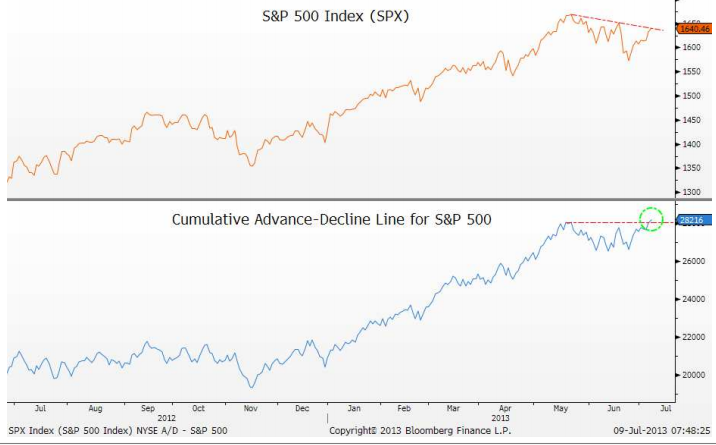
This has got to be one of the more hated rallies I can remember, possibly because so few people have been on board for it. But some measures of market breadth are confirming the move to new all-time highs.

Josh Brown of The Reformed Broker highlighted a chart of market breadth recently, as you can see below.

breadth1 JoshBrown zps67456d54 Market Breadth

Source: The Reformed Broker, Bloomberg (click on image to enlarge)

This breadth breakout appeared on July 9 and the S&P 500 powered higher from there.

The typical take on market breadth from market technicians is that negative divergences in breadth will normally appear prior to a drop in the market. That’s not what’s happening now—in fact, just the opposite is the case. Market breadth expanded this time prior to the stock market moving to an all-time high.

Bulls and bears can both be articulate. It’s easy to listen to a well-spoken commentator who presents just one side of the story and have it feel very convincing. It’s useful to look at market-generated data as a check; sometimes the data has a very different picture of the issue.

Posted by:


Ritholtz on Prediction

July 12, 2013

In Financial Advisor, Barry Ritholtz of The Big Picture blog gets asked about his market outlook. He answers with his view on prediction, which I would very much endorse.

Let’s start out with a basic question: What’s your outlook on the markets and the economy?

Let me begin with an answer you will hate: My opinion as to the future state of the economy or where the market might be going will be of no value to your readers. Indeed, as my blog readers will tell you, I doubt anyone’s perspectives on these issues are of any value whatsoever.

Here’s why: First, we have learned that you Humans are not very good at making these sorts of predictions about the future. The data overwhelmingly shows that you are, as a species, quite awful at it.

Second, given the plethora of conflicting conjectures in the financial firmament, how can any reader determine which author to believe and which to ignore? You can find an opinion to confirm any prior view, which is a typical way many investors make erroneous decisions. (Hey, that agrees with my perspective, I’ll read THAT!)

And third, relevant to the above, studies have shown that the most confident, specific and detailed forecasts about the future are: a) most likely to be believed by readers and TV viewers; and b) least likely to be correct. (So you have that going for you, which is nice.)

Last, across the spectrum of possible opinions, forecasts and outlooks, someone is going to be correct—how can you ever tell if it was the result of repeatable skill or merely random chance?

Kudos to Mr. Ritholtz for telling it like it is.

There is no way to know what is going to happen in the future. Prediction is neither useful or necessary.

Later in the article, Mr. Ritholtz makes the point that most investors do not know even what is going on right now. That is where relative strength can be a useful technique. Relative strength can identify what is strong, and trend following is a practical way to implement it, by owning what is strong as long as it remains strong. Long-term mean reversion methodologies will work too, of course. In other words, you don’t need to predict the future as long as you can assume that trends and reversion to the mean will continue to occur as they always have.

Posted by:


Stock Market Sentiment Surveys: AAII Edition

July 2, 2013

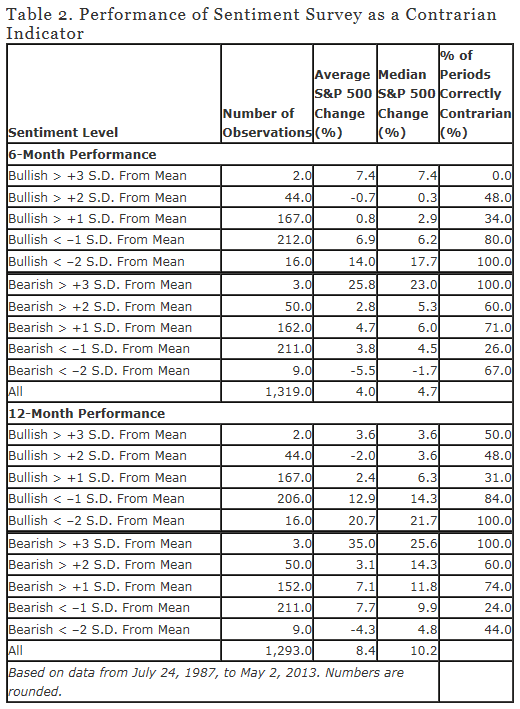
Greenbackd, a deep value blog, had a recent piece on the value of stock market sentiment. Stock market sentiment surveys have been a staple of technical analysis for decades, ever since the advent of Investors Intelligence in the 1960s, so I was curious to read it. The study that Greenbackd referenced was done by Charles Rotblut, CFA. The excerpts from Mr. Rotblut that are cited give the impression that the results from the survey are unimpressive. However, they showed a data table from the article. I’ll reproduce it here and let you draw your own conclusions.

AAIIsentiment zpsb291a50e Stock Market Sentiment Surveys: AAII Edition

Source: Greenbackd (click on image to enlarge)

From Greenbackd, here’s an explanation of what you are looking at:

Each week from Thursday 12:01 a.m. until Wednesday at 11:59 p.m. the AAII asks its members a simple question:

Do you feel the direction of the stock market over the next six months will be up (bullish), no change (neutral) or down (bearish)?

AAII members participate by visiting the Sentiment Survey page (www.aaii.com/sentimentsurvey) on AAII.com and voting.

Bullish sentiment has averaged 38.8% over the life of the survey. Neutral sentiment has averaged 30.5% and bearish sentiment has averaged 30.6% over the life of the survey.

In order to determine whether there is a correlation between the AAII Sentiment Survey and the direction of the market, Rotblut looked at instances when bullish sentiment or bearish sentiment was one or more standard deviations away from the average. He then calculated the performance of the S&P 500 for the following 26-week (six-month) and 52-week (12-month) periods. The data for conducting this analysis is available on the Sentiment Survey spreadsheet, which not only lists the survey’s results, but also tracks weekly price data for the S&P 500 index.

There are some possible methodological problems with the survey since it is not necessarily the same investors answering the question each week (Investors Intelligence uses something close to a fixed sample of newsletter writers), but let’s see if there is any useful information embedded in their responses.

The way I looked at it, even the problematic AAII poll results were very interesting at extremes. When there were few bulls (more than 2 standard deviations from the mean) or tons of bears (more than 3 standard deviations from the mean), the average 6-month and 12-month returns were 2x to 5x higher than normal for the 1987-2013 sample. These extremes were rare—only 19 instances in 26 years—but very useful when they did occur. (And it’s possible that there were really only 16 instances if they were coincident.)

Despite the methodology problems, the data shows that it is very profitable to go against the crowd at extremes. Extremes are times when the emotions of the crowd are likely to be most powerful and tempting to follow—and most likely to be wrong. Instead of bailing out at times when the crowd is negative, the data shows that it is better to add to your position.

HT to Abnormal Returns

Posted by:


Saving Investors From Themselves

June 28, 2013

Jason Zweig has written one of the best personal finance columns for years, The Intelligent Investor for the Wall Street Journal. Today he topped it with a piece that describes his vision of personal finance writing. He describes his job as saving investors from themselves. It is a must read, but I’ll give you a couple of excerpts here.

I was once asked, at a journalism conference, how I defined my job. I said: My job is to write the exact same thing between 50 and 100 times a year in such a way that neither my editors nor my readers will ever think I am repeating myself.

That’s because good advice rarely changes, while markets change constantly. The temptation to pander is almost irresistible. And while people need good advice, what they want is advice that sounds good.

The advice that sounds the best in the short run is always the most dangerous in the long run. Everyone wants the secret, the key, the roadmap to the primrose path that leads to El Dorado: the magical low-risk, high-return investment that can double your money in no time. Everyone wants to chase the returns of whatever has been hottest and to shun whatever has gone cold. Most financial journalism, like most of Wall Street itself, is dedicated to a basic principle of marketing: When the ducks quack, feed ‘em.

In practice, for most of the media, that requires telling people to buy Internet stocks in 1999 and early 2000; explaining, in 2005 and 2006, how to “flip” houses; in 2008 and 2009, it meant telling people to dump their stocks and even to buy “leveraged inverse” exchange-traded funds that made explosively risky bets against stocks; and ever since 2008, it has meant touting bonds and the “safety trade” like high-dividend-paying stocks and so-called minimum-volatility stocks.

It’s no wonder that, as brilliant research by the psychologist Paul Andreassen showed many years ago, people who receive frequent news updates on their investments earn lower returns than those who get no news. It’s also no wonder that the media has ignored those findings. Not many people care to admit that they spend their careers being part of the problem instead of trying to be part of the solution.

My job, as I see it, is to learn from other people’s mistakes and from my own. Above all, it means trying to save people from themselves. As the founder of security analysis, Benjamin Graham, wrote in The Intelligent Investor in 1949: “The investor’s chief problem – and even his worst enemy – is likely to be himself.”

……..

From financial history and from my own experience, I long ago concluded that regression to the mean is the most powerful law in financial physics: Periods of above-average performance are inevitably followed by below-average returns, and bad times inevitably set the stage for surprisingly good performance.

But humans perceive reality in short bursts and streaks, making a long-term perspective almost impossible to sustain – and making most people prone to believing that every blip is the beginning of a durable opportunity.

……..

But this time is never different. History always rhymes. Human nature never changes. You should always become more skeptical of any investment that has recently soared in price, and you should always become more enthusiastic about any asset that has recently fallen in price. That’s what it means to be an investor.

Simply brilliant. Unless you write a lot, it seems deceptively easy to write this well and clearly. It is not. More important, his message that many investment problems are actually investor behavior problems is very true—and has been true forever.

To me, one of the chief advantages of technical analysis is that it recognizes that human nature never changes and that, as a result, behavior patterns recur again and again. Investors predictably panic when market indicators get deeply oversold, just when they should consider buying. Investors predictably want to pile into a stock that has been a huge long-term winner when it breaks a long-term uptrend line—because “it’s a bargain”—just when they might want to think about selling. Responding deliberately at these junctures doesn’t usually require the harrowing activity level that CNBC commentators seem to believe is necessary, but can be quite effective nonetheless. Technical indicators and sentiment surveys often show these turning points very clearly, but as Mr. Zweig describes elsewhere in the article, the financial universe is arranged to deceive us—or at least to tempt us to deceive ourselves.

Investing is one of the many fields where less really is more.

Posted by:


Recession Watch 2013

June 28, 2013

Every time the market corrects, pundits start looking for a recession. It’s not a crazy idea, since the S&P 500 is a leading indicator of the economy. Recessions are typically led by market corrections, but market corrections have also forecast ten of the last two recessions. The stock market alone is not a reliable indicator.

Those voting against the recession idea often cite the steep yield curve as a sign the economy is strong. (See, for example, here and here.) Recessions typically are preceded by an inverted yield curve, where short-term yields are higher than long-term yields, and we are far from that right now.

Those voting in favor of the recession point out a variety of weakening data series that often forecast recessions, especially new order indexes, credit spreads, and oil prices. (See, for example, here, here, here, and here.) Earnings and revenues are decelerating and that causes economists to fear for the future. Many indicators of this type are not actually negative yet, but the fear is that they will become so.

The truth is that no one knows what will happen.

You are right to be skeptical of economic forecasts. Most economists did not see the 2008 housing bust and recession coming—and on the other side of the coin, a few economists are still stubbornly clinging to their 2011 recession calls. The market corrected sharply, the economy slowed, but a recession was ultimately avoided as the economy picked back up.

Part of the rationale for the way we do tactical asset allocation is that we do not have to forecast—we change when the relative strength of asset classes or sectors changes. The biggest problem with forecasting is that people tend to have an opinion, which they proceed to back up by only looking at confirming evidence. Both bulls and bears can always point to signs of improvement or signs of deterioration. Trend following avoids that whole problem and just goes with the flow. As market expectations change, holdings in a relative strength portfolio change right along with them. Trend following is never ideal, but it’s mostly in the ballpark most of the time—and it’s way less stressful than worrying about the economy constantly.

Posted by:


“Doing God’s Work”

June 27, 2013

Nice fake Lloyd Blankfein quote—from an article on The Onion.

“It’s been about five or six years since we last crippled every major market on the planet, so it seems like the time is right for us to get back out there and start ruining the lives of billions of people again,” said Goldman Sachs CEO Lloyd Blankfein. “We gave it some time and let everyone get a little comfortable, and now we’re looking to get back on the old horse, shatter some consumer confidence, and flat-out kill any optimism for a stable global economy for years to come.”

“People are beginning to feel at ease spending money and investing in their futures again,” Blankfein continued. “That’s the perfect time to step in and do what we do best: rip the heart right out of the world’s economy.”

I’m beginning to think about using The Onion as a market timing tool! They cranked this satirical article out right as the markets took a tumble and everyone was feeling nervous. Funny, but maybe a little too close to home!


Posted by:


Cage Match: Pension vs. 401k

June 26, 2013

Chuck Jaffe recently had a good retirement article on Marketwatch. He covered a number of topics, especially longevity estimates, but he also had the most succinct explanation of the difference between how a pension and a 401k plan works. Here it is:

In the days when corporate pensions were the primary supplement to Social Security, Americans were able to generate a lifetime income, effectively, by putting everyone’s lifetime in a pool, then saving and managing the pooled assets to meet the target.

The individuals in a pension plan would live out their lives, but the actuaries and money managers would adjust the pool based on the life experience of the group. Thus, if the group had a life expectancy of living to age 75 – which statistically would mean that half of the pensioners would die before that age, and half would die afterwards – longevity risk was balanced out by the group experience.

Now that we have shifted to making individuals responsible for generating their lifetime income stream, there is no pool that shares the risk of outliving assets.

The bold is mine, but the distinction should be pretty clear. With a pension plan, you’re covered if you live a long time—because your extra payouts are covered by the early mortality of some of the other participants. It’s a shared-risk pool.

In a 401k, there’s only one participant. You. In other words, you’re on your own.

With a 401k, the only way to cover yourself adequately is to assume you are going to live a long time and save a lot to reserve for it. If you’ve got enough assets to cover yourself to age 100, the most negative outcome is that your heirs will think very fondly of you. If you are covered for only a few years of retirement, you’ll need to either keep working, eat Alpo, move in with your kids, or possibly take up motorcycle racing and sky-diving. None of those sound like great options to me.

Posted by:


The Stock Market - Economy Disconnect

June 13, 2013

One of the most difficult things for investors to understand is the stock market - economy disconnect. New investors almost always assume that if the economy is doing well, the stock market will perform well also. In fact, it is usually the other way around!

Liz Ann Sonders, the market strategist at Charles Schwab & Co., has an interesting piece on this apparent disconnect. She writes:

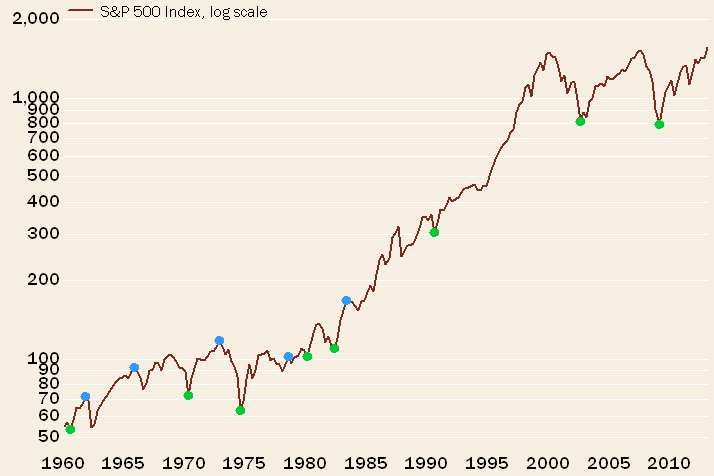
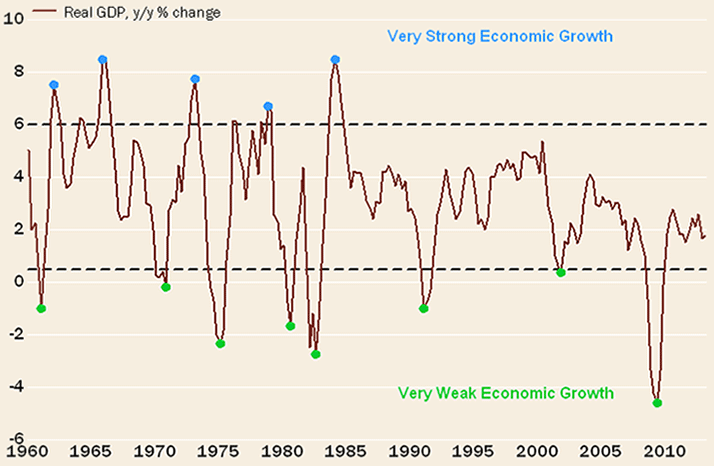
Remember, the stock market (as measured by the S&P 500) is one of 10 sub-indexes in the Conference Board’s Index of Leading Indicators. Many investors assume it’s the opposite—that economic growth is a leading indicator of the stock market. For a compelling visual of the relationship, see the following pair of charts, which I’ll explain below.

The most compelling part of her article follow, in the form of her charts that show the GDP growth rate and peaks and troughs in the stock market.

schwab1 zpsd3b29c36 The Stock Market   Economy Disconnect

schwab2 zpsbf5a6d8c The Stock Market   Economy Disconnect

Source: Charles Schwab & Co. (click on images to enlarge)

More often than not, poor economic growth corresponds with a trough in the market. Super-heated economic growth is usually a sign that someone is about to take away the punch bowl.

In truth, there is really no disconnect if you accept that the stock market usually leads the economy. As Ms. Sonders points out, the S&P 500 is part of the Index of Leading Indicators. A lot of investors have trouble wrapping their heads around that concept—and it continues to cost them money.

The contrast to economic forecasting (i.e., guessing) is trend following. The trend follower is usually fairly safe in believing that if the market is continuing up that is economy is probably ok for the time being. When the trend becomes uncertain or tilts down, it might be time to look for clues that the economy is softening. You’re not going to be right all the time either way, but at least you’ve got the odds on your side if you let the market lead.

Posted by:


Competency Transference

June 12, 2013

From Barry Ritholz at The Big Picture comes a great article about what he calls “competency transference.“ His article was triggered by a Bloomberg story about a technology mogul who turned his $1.8 billion payoff into a bankruptcy just a few years later. Mr. Ritholz points out that the problem is generalizable:

Be aware of what I call The Fallacy of Competency Transference. This occurs when someone successful in one field jumps in to another and fails miserably. The most widely known example is Michael Jordan, the greatest basketball player the game has ever known, deciding he was also a baseball player. He was a .200 minor league hitter.

I have had repeated conversations with Medical Doctors about this: They are extremely intelligent accomplished people who often assume they can do well in markets. (After all, they conquered what I consider a much more challenging field of medicine).

The problem they run into is that competency transference. After 4 years of college (mostly focused on pre-med courses), they spend 4 years in Medical school; another year as an Interns, then as many as 8 years in Residency. Specialized fields may require training beyond residency, tacking on another 1-3 years. This process is at least 12, and as many as 20 years (if we include Board certification).

What I try to explain to these highly educated, highly intelligent people is that they absolutely can achieve the same success in markets that they have as medical professionals — they just have to put the requisite time in, immersing themselves in finance (like they did in medicine) for a decade or so. It is usually around this moment that the light bulb goes off, and the cause of prior mediocre performance becomes understood.

To me, the funny thing is that competency transference mostly applies to the special case of financial markets. For example, no successful stock market professional would ever, ever assume themselves to be a competent thoracic surgeon without the requisite training. Nor would a medical doctor ever assume that he or she could play a professional sport or run a nuclear submarine without the necessary skills. (I think the Michael Jordan analogy is a poor one, since there have been numerous multi-sport athletes. Many athletes letter in multiple sports in high school and some even play more than one in college. Michael Jordan may have been wrong about his particular case, but it wasn’t necessarily a crazy idea.)

Nope, competency transference is mostly restricted to the idea that anyone watching CNBC can become a market maven. (Apparently even talking heads on CNBC believe this.) This creates no end of grief in advisor-client relationships if 1) the advisor isn’t very far up the learning curve, and 2) if the client thinks they know better. You would have the same problem if you had a green medical doctor and you thought you knew more than the doctor did. That is a situation that is ripe for problems!

Advisors need to work continuously to expand their skills and knowledge if they are to be of use to investors. And investors, in general, would do well to spend their efforts vetting advisors carefully rather than assuming financial markets are a piece of cake.

Posted by:


The Million-Dollar Illusion

June 11, 2013

Over the weekend, the New York Times had an article about retirement and the million-dollar illusion. What, you may ask, is the million-dollar illusion? Quite simply it’s the idea that $1 million dollars will be ample for retirement. Jeff Sommer writes:

…as a retirement nest egg, $1 million is relatively big. It may seem like a lot to live on.

But in many ways, it’s not.

Inflation isn’t the only thing that’s whittled down the $1 million. The topsy-turvy world of today’s financial markets — particularly, the still-ultralow interest rates in the bond market — is upending what many people thought they understood about how to pay for life after work.

“We’re facing a crisis right now, and it’s going to get worse,” said Alicia Munnell, director of the Center for Retirement Research at Boston College. “Most people haven’t saved nearly enough, not even people who have put away $1 million.”

The article proceeds to go through the math of low interest rates and increasing longevity. This is not new, but sometimes it is difficult to get clients to focus on the big picture.

The big picture is not whether the most recent quarterly return on their balanced account was +6.3% or +6.4%, but whether that account balance was $300,000 or $3 million.

Since industry sources suggest that only 3% of retail accounts ever have balances over $2 million, it’s probably most important to focus on savings. This might be particularly important with younger clients, who, by and large, do not have defined benefit pensions to supplement Social Security. (In fact, it’s not clear how Social Security might be modified or eliminated by the time they get around to collect it.) The one thing younger clients do have on their side is time—time to contribute steadily to their 401k and to an outside investment account. With enough nagging from a qualified investment advisor and a reasonable investment plan, there is no reason that clients shouldn’t succeed.

Posted by:


From the Archives: If You Miss the 10 Best Days

June 7, 2013

We’ve all seen numerous studies that purport to show how passive investing is the way to go because you don’t want to be out of the market for the 10 best days. No one ever mentions that the “best days” most often occur during the declines!

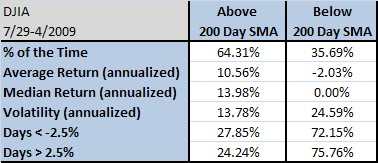
It turns out that the majority of the best days and the worst days occur near one another, during the declines. Why? Because the market is more volatile during declines. It is true that the market goes down 2-3x as fast as it goes up. (World Beta has a nice post on this topic of volatility clustering, which is where this handy-dandy table comes from.)

 From the Archives: If You Miss the 10 Best Days

from World Beta

You can see how volatility increases and the number of days with daily moves greater than 2.5% really spikes when the market is in a downward trend. It would seem to be a very straightforward proposition to improve your returns simply by avoiding the market when it is in a downtrend.

However, not every strategy can be improved by going to cash. Think about the math: if your investing methodology makes enough extra money on the good days to offset the bad days, or if it can make money during a significant number of the declines, you might be better off just gritting your teeth during the declines and banking the higher returns. Although the table above suggests it should help, a simple strategy of exiting the market (i.e., going to cash) when it is below its 200-day moving average may not always live up to its theoretical billing.

 From the Archives: If You Miss the 10 Best Days

 From the Archives: If You Miss the 10 Best Days

click to enlarge

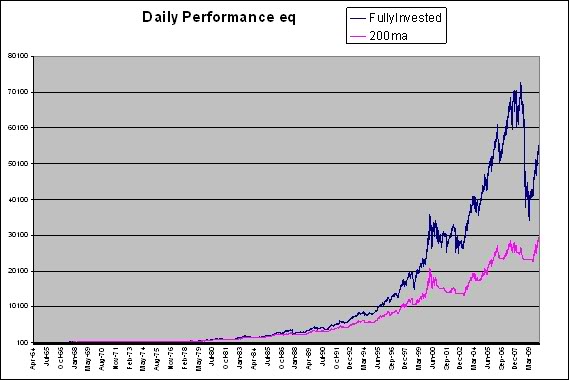
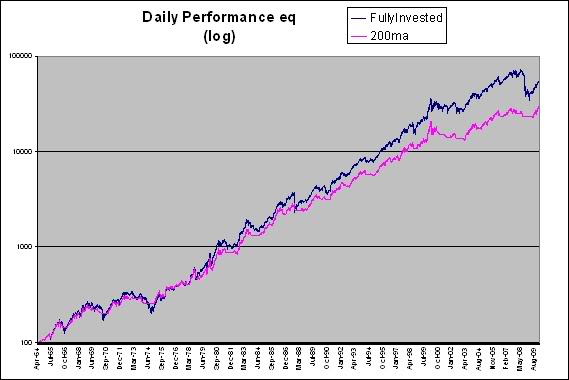
Consider the graphs above. (The first graph uses linear scaling; the second uses logarithmic scaling for the exact same data.) This test uses Ken French’s database to get a long time horizon and shows the returns of two portfolios constructed with market cap above the NYSE median and in the top 1/3 for relative strength. In other words, the two portfolios are composed of mid- and large-cap stocks with good relative strength. The only difference between the two portfolios is that one (red line) goes to cash when it is below its 200-day moving average. One portfolio (blue line) stays fully invested. The fully invested portfolio turns $100 into $49,577, while the cash-raising portfolio yields only $26,550.

If you would rather forego the extra money in return for less volatility, go right ahead and make that choice. But first stack up 93 boxes of Diamond matches so that you can burn 23,027 $1 bills, one at a time, to represent the difference–and then make your decision.

 From the Archives: If You Miss the 10 Best Days

The drawdowns are less with the 200-day moving average, but it’s not like they are tame–equities will be an inherently volatile asset class as long as human emotions are involved. There are still a couple of drawdowns that are greater than 20%. If an investor is willing to sit through that, they might as well go for the gusto.

As surprising as it may seem, the annualized return over a long period of time is significantly higher if you just stay in the market and bite the bullet during train wrecks–and even two severe bear markets in the last decade have not allowed the 200-day moving average timer to catch up.

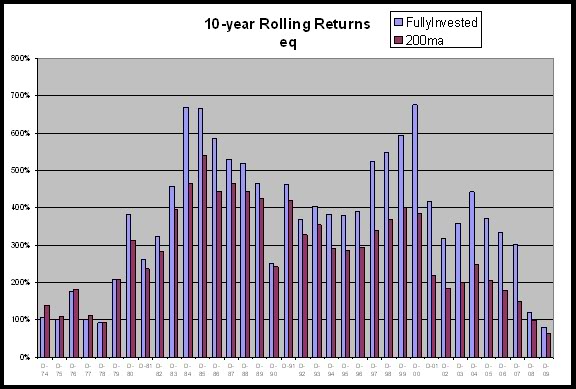
At the bottom of every bear market, of course, it certainly feels like it would have been a good idea (in hindsight) to have used the 200-day moving average to get out. In the long run, though, going to cash with a high-performing, high relative strength strategy might be counterproductive. When we looked at 10-year rolling returns, the fully invested high relative strength model has maintained an edge in returns for the last 30 years running.

 From the Archives: If You Miss the 10 Best Days

click to enlarge

Surprising, isn’t it? Counterintuitive results like this are one of the reasons that we find testing so critical. It’s easy to fall in line with the accepted wisdom, but when it is actually put to the test, the accepted wisdom is often wrong. (We often find that even when shown the test data, many people refuse, on principle, to believe it! It is not in their worldview to accept that one of their cherished beliefs could be false.) Every managed portfolio in our Systematic RS lineup has been subjected to heavy testing, both for returns and–and more importantly–for robustness. We have a high degree of confidence that these portfolios will do well in the long run.

—-this article originally appeared 3/5/2010. We find that many investors continue to refuse, on principle, to believe the data! If you have a robust investment method, the idea that you can improve your returns by getting out of the market during downturns appears to be false. (Although it could certainly look true for small specific samples. And, to be clear, 100% invested in a volatile strategy is not the appropriate allocation for most investors.) Volatility can generally be reduced somewhat, but returns suffer. One of our most controversial posts ever—but the data is tough to dispute.

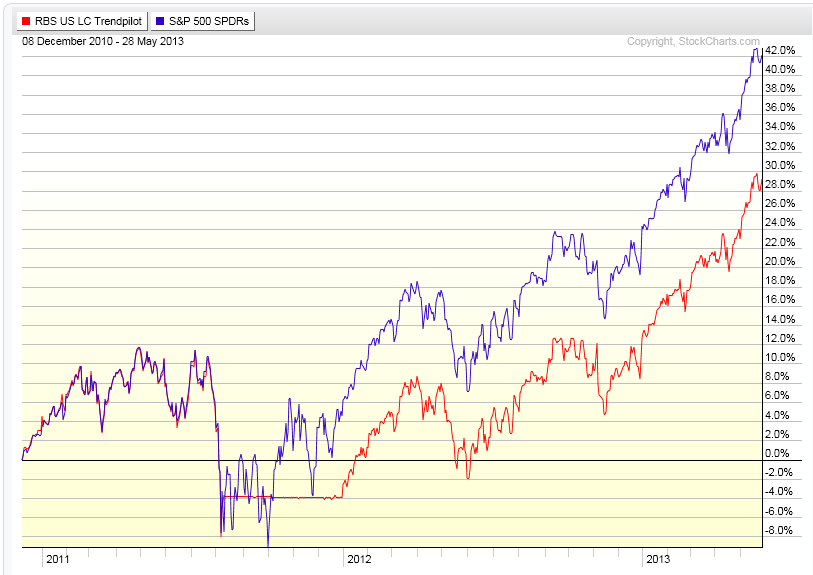
In more recent data, the effect can be seen in this comparison of an S&P 500 ETF and an ETN that switches between the S&P 500 and Treasury bills based on a 200-day moving average system. The volatility has been muted a little bit, but so have the returns.

trendpilot zps9227da43 From the Archives: If You Miss the 10 Best Days

(click on image to enlarge)

Posted by:


The Emotional Roller Coaster

June 6, 2013

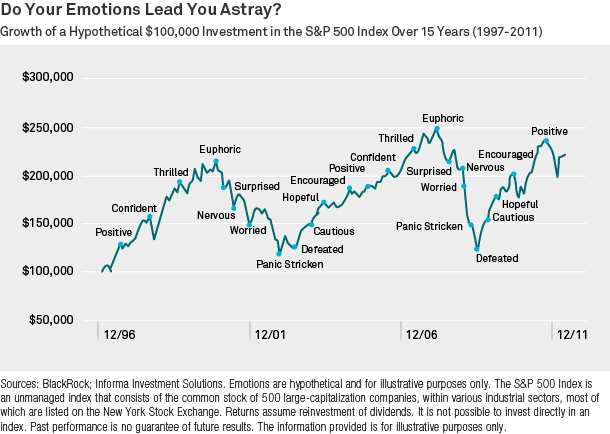
From Josh Brown at The Reformed Broker, a nice picture of investor emotions as they ride the market roller coaster. All credit to Blackrock, who came up with this funny/sad/true graphic.

emotions zps526a96f7 The Emotional Roller Coaster

Blackrock’s emotional roller coaster

(click on image to enlarge)

One of the important roles of a financial advisor, I think, is to keep clients from jumping out of the roller coaster when it is particularly scary. At an amusement park, when people are faced with tangible physical harm, jumping does not seem like a very good idea to them—but investors are tempted to jump out of the market roller coaster all the time.

Posted by:


Cognitive Biases

June 5, 2013

Motley Fool had an excellent article by Morgan Housel on a couple of the most common cognitive biases that cause problems for investors, cognitive dissonance and confirmation bias. The information is not new, but what makes this article so fun is Housel’s writing style and good analogies. A couple of excerpts should suffice to illuminate the problem with cognitive biases.

Study successful investors, and you’ll notice a common denominator: They are masters of psychology. They can’t control the market, but they have complete control over the gray matter between their ears.

And lucky them. Most of us, on the other hand, are mental catastrophes. As investor Barry Ritholtz once put it:

You’re a monkey. It all comes down to that. You are a slightly clever, pants-wearing primate. If you forget that you’re nothing more than a monkey who has been fashioned by eons on the plains, being chased by tigers, you shouldn’t invest. You have to be aware of how your own psychology affects what you do.

Take one of the most powerful theories in behavior psychology: cognitive dissonance. It’s the term psychologists use for the uncomfortable feeling you get when having two conflicting thoughts at the same time. “Smoking is bad for me. I’m going to go smoke.” That’s cognitive dissonance.

We hate cognitive dissonance, and jump through hoops to reduce it. The easiest way to reduce it is to engage in mental gymnastics that justifies behavior we know is wrong. “I had a stressful day and I deserve a cigarette.” Now you can smoke guilt-free. Problem solved.

Classic. And this:

Cognitive dissonance is especially toxic in the emotional cesspool that is managing money. Raise your hand if this is you:

  • You criticize Wall Street for being a casino while checking your portfolio twice a day.
  • You sold your stocks in 2009 because the Fed was printing money. When stocks doubled in value soon after, you blamed it on the Fed printing money.
  • You put $1,000 on a hyped penny stock your brother convinced you is the next Facebook. After losing everything, you tell yourself you were just investing for the entertainment.
  • You call the government irresponsible for running a deficit while simultaneously saddling yourself with an unaffordable mortgage.
  • You buy a stock only because you think it’s cheap. When you realize you were wrong, you decide to hold it because you like the company’s customer service.

Almost all of us do something similar with our money. We have to believe our decisions make sense. So when faced with a situation that doesn’t make sense, we fool ourselves into believing something else.

And this about confirmation bias:

Worse, another bias — confirmation bias — causes us to bond with people whose self-delusions look like our own. Those who missed the rally of the last four years are more likely to listen to analysts who forecast another crash. Investors who feel burned by the Fed visit websites that share the same view. Bears listen to fellow bears; bulls listen to fellow bulls.

Before long, you’ve got a trifecta of failure: You make a bad decision, rationalize it by fighting cognitive dissonance, and reinforce it with confirmation bias. No wonder the average investor does so poorly.

It’s worth reading the whole article, but the gist of it is that we are all susceptible to these cognitive biases. It’s possible to mitigate the problem with some kind of systematic investment process, but you still have to be careful that you’re not fooling yourself. Investing well is not easy and mastering one’s own psyche may be the most difficult part of all.

Posted by:


Investor Knowledge

June 4, 2013

Newsflash: investors are overconfident about their financial knowledge. Business Insider reports:

A new survey by the FINRA Investor Education Foundation found that 75% of U.S. adults say they’re pros at managing their finances, but only 14% could ace a five-question quiz on basic financial concepts.

This was no small study sample size either. A whopping 25,000 consumers took the quiz.

The quiz is, in fact, laughably easy for a competent investment professional. I am shocked that only 14% of consumers could ace the quiz. I wouldn’t necessarily expect a plumber to go 5-for-5, but I would think that most adults would get most questions correct.

You can see the Business Insider story here, and take the quiz. If you are a financial advisor and miss any of these questions that would freak me out. It does go to show, though, that we need to do a thorough job of educating and communicating information to clients.


Posted by:


From the Archives: Perfect Sector Rotation

June 4, 2013

CXO Advisory has a very interesting blog piece on this topic. They review an academic paper that looks at the way conventional sector rotation is done. Typically, various industry sectors are categorized as early cycle, late cycle, etc. and then you are supposed to own those sectors at that point in the business cycle. Any number of money management firms (not including us) hang their hat on this type of cycle analysis.

In order to determine the potential of traditional sector rotation, the study assumes that you get to have perfect foresight into the business cycle and then you rotate your holdings with the conventional wisdom of when various industries perform best. A couple of disturbing things crop up, given that this is the best you could possibly do with this system.

1) You can squeak by with about 2.3% annual outperformance if you had a crystal ball. If you are even a month or two early or late on the cycle turns, your performance is statistically indistinguishable from zero.

2) 28 of the 48 industries studied (58.3%) underperformed during the times when they were supposed to perform well. There’s obviously enough noise in the system that a sector that is supposed to be strong or weak during a particular part of the cycle often isn’t.

CXO notes, somewhat ironically:

Note that NBER can take as long as two years after a turning point to designate its date and that one business cycle can be very different from another.

In other words, it’s clear that traditional business cycle analysis is not going to help you. You won’t be able to forecast the cycle turning points accurately and the cycles differ so much that industry performance is not consistent.

Sector rotation using relative strength is a big contrast to this. Relative strength makes no a priori assumptions about which industries are going to be strong or weak at various points in the business cycle. A systematic strategy just buys the strong sectors and avoids the weak ones. Lots of studies show that significant outperformance can be earned using relative strength (momentum) with absolutely no insight into the business cycle at all, including some studies done by CXO Advisory. Tactical asset allocation is finally coming into its own and various ways of implementing are available. Business cycle forecasting does not appear to be a feasible way to do it, but relative strength certainly is!

—-this article originally appeared 3/30/2010. Although the link to CXO Advisory is no longer live, you can get the gist of things from the article. Things don’t always perform in the expected fashion, and paying attention to relative strength can be some protection from the problem. Instead of making assumptions about strong or weak performance, relative strength just adapts.

Posted by:


From the Archives: Trend Following Beats Market Timing

May 30, 2013

Mark Hulbert has been tracking advisory newsletters for more than 20 years. Lots of these newsletters do active market timing, so in a recent column, he asked an obvious question:

The first question: How many stock market timers, of the several hundred monitored by the Hulbert Financial Digest, called the bottom of the bear market a year ago?

And a follow-up: Of those that did, how many also called the top of the bull market in March 2000 — or, for that matter, the major market turning points in October 2002 and October 2007?

If you are relying on some type of market timing to get you out of the way of bear markets and to get you into bull markets, this is exactly what you want to know. Although there are pundits who claim to have called the bottom to the day, Mr. Hulbert allowed a far more generous window for labeling a market timing call as correct.

… my analysis actually relied on a far more relaxed definition: Instead of moving 100% from cash to stocks in the case of a bottom, or 100% the other way in the case of a top, I allowed exposure changes of just ten percentage points to qualify.

Furthermore, rather than requiring the change in exposure to occur on the exact day of the market’s top or bottom, I looked at a month-long trading window that began before the market’s juncture and extending a couple of weeks thereafter.

That’s a pretty liberal definition: the market timer gets a four-week window and only has to change allocations by 10% to be considered to have “called” the turn. And here’s the bottom line:

Even with these relaxed criteria, however, none of the market timers that the Hulbert Financial Digest has tracked over the last decade were able to call the market tops and bottoms since March 2000.

Yep, zero. [The bold and underline is from me.] It’s not that advisors aren’t trying; it’s just that no one can do it successfully, even with a one-month window and a very modest change in allocations. Obviously, there is lots of hindsight bias going on where advisors claim to have detected market turning points, but when Mr. Hulbert goes back to look at the actual newsletters, not one got it right! You can safely assume anyone who claims to be able to time the market is lying. At the very least, the burden on proof is on them.

We don’t bother trying to figure out what the market will do going forward. We simply follow trends as they present themselves. We use relative strength in a systematic way to identify the trends we want to follow: the strongest ones. We stay with the trend as long as it continues, whether that is for a short time or an extended period. When a trend weakens, as evidenced by its relative strength ranking, we knock that asset out of the portfolio and replace it with a stronger asset. The two white papers we have produced (Relative Strength and Asset Class Rotation and Bringing Real World Testing to Relative Strength) show quite clearly that it is possible to have very favorable investment results over time without any recourse to market timing at all. Discipline and patience are needed, of course, but you don’t have to have a crystal ball.

—-this article originally appeared 3/17/2010. It is especially apropos now that many market pundits are busy predicting a top. It’s certainly possible they are right—but probably equally likely is the proposition that they are just guessing. Over the long run there is weak evidence that market timing is effective.

Posted by:


Flawless Stock Market Forecasting

May 28, 2013

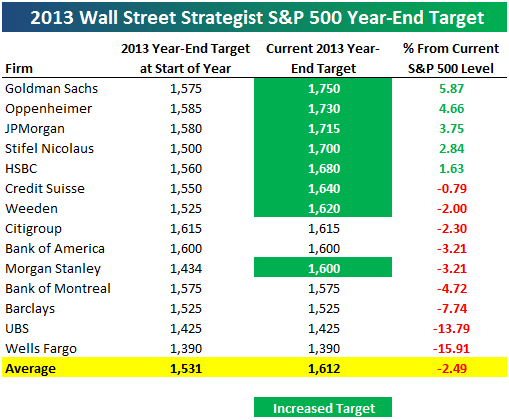
One way to improve your stock market forecasts is to revise them! Bespoke has a nice piece where they show graphically how Wall Street strategists just change their forecast when the market moves past them. Whether the market goes up or down here is immaterial—the forecast will be changed to accommodate the market. Investors might give credence to some of these forecasts if they didn’t know they were a moving target. Who knew stock market forecasting was so easy?

flawlessforecasting zps014a227a Flawless Stock Market Forecasting

Source: Bespoke (click on image to enlarge)

Posted by: