Saving Investors From Themselves

June 28, 2013

Jason Zweig has written one of the best personal finance columns for years, The Intelligent Investor for the Wall Street Journal. Today he topped it with a piece that describes his vision of personal finance writing. He describes his job as saving investors from themselves. It is a must read, but I’ll give you a couple of excerpts here.

I was once asked, at a journalism conference, how I defined my job. I said: My job is to write the exact same thing between 50 and 100 times a year in such a way that neither my editors nor my readers will ever think I am repeating myself.

That’s because good advice rarely changes, while markets change constantly. The temptation to pander is almost irresistible. And while people need good advice, what they want is advice that sounds good.

The advice that sounds the best in the short run is always the most dangerous in the long run. Everyone wants the secret, the key, the roadmap to the primrose path that leads to El Dorado: the magical low-risk, high-return investment that can double your money in no time. Everyone wants to chase the returns of whatever has been hottest and to shun whatever has gone cold. Most financial journalism, like most of Wall Street itself, is dedicated to a basic principle of marketing: When the ducks quack, feed ‘em.

In practice, for most of the media, that requires telling people to buy Internet stocks in 1999 and early 2000; explaining, in 2005 and 2006, how to “flip” houses; in 2008 and 2009, it meant telling people to dump their stocks and even to buy “leveraged inverse” exchange-traded funds that made explosively risky bets against stocks; and ever since 2008, it has meant touting bonds and the “safety trade” like high-dividend-paying stocks and so-called minimum-volatility stocks.

It’s no wonder that, as brilliant research by the psychologist Paul Andreassen showed many years ago, people who receive frequent news updates on their investments earn lower returns than those who get no news. It’s also no wonder that the media has ignored those findings. Not many people care to admit that they spend their careers being part of the problem instead of trying to be part of the solution.

My job, as I see it, is to learn from other people’s mistakes and from my own. Above all, it means trying to save people from themselves. As the founder of security analysis, Benjamin Graham, wrote in The Intelligent Investor in 1949: “The investor’s chief problem – and even his worst enemy – is likely to be himself.”

……..

From financial history and from my own experience, I long ago concluded that regression to the mean is the most powerful law in financial physics: Periods of above-average performance are inevitably followed by below-average returns, and bad times inevitably set the stage for surprisingly good performance.

But humans perceive reality in short bursts and streaks, making a long-term perspective almost impossible to sustain – and making most people prone to believing that every blip is the beginning of a durable opportunity.

……..

But this time is never different. History always rhymes. Human nature never changes. You should always become more skeptical of any investment that has recently soared in price, and you should always become more enthusiastic about any asset that has recently fallen in price. That’s what it means to be an investor.

Simply brilliant. Unless you write a lot, it seems deceptively easy to write this well and clearly. It is not. More important, his message that many investment problems are actually investor behavior problems is very true—and has been true forever.

To me, one of the chief advantages of technical analysis is that it recognizes that human nature never changes and that, as a result, behavior patterns recur again and again. Investors predictably panic when market indicators get deeply oversold, just when they should consider buying. Investors predictably want to pile into a stock that has been a huge long-term winner when it breaks a long-term uptrend line—because “it’s a bargain”—just when they might want to think about selling. Responding deliberately at these junctures doesn’t usually require the harrowing activity level that CNBC commentators seem to believe is necessary, but can be quite effective nonetheless. Technical indicators and sentiment surveys often show these turning points very clearly, but as Mr. Zweig describes elsewhere in the article, the financial universe is arranged to deceive us—or at least to tempt us to deceive ourselves.

Investing is one of the many fields where less really is more.

Posted by:


Competency Transference

June 12, 2013

From Barry Ritholz at The Big Picture comes a great article about what he calls “competency transference.“ His article was triggered by a Bloomberg story about a technology mogul who turned his $1.8 billion payoff into a bankruptcy just a few years later. Mr. Ritholz points out that the problem is generalizable:

Be aware of what I call The Fallacy of Competency Transference. This occurs when someone successful in one field jumps in to another and fails miserably. The most widely known example is Michael Jordan, the greatest basketball player the game has ever known, deciding he was also a baseball player. He was a .200 minor league hitter.

I have had repeated conversations with Medical Doctors about this: They are extremely intelligent accomplished people who often assume they can do well in markets. (After all, they conquered what I consider a much more challenging field of medicine).

The problem they run into is that competency transference. After 4 years of college (mostly focused on pre-med courses), they spend 4 years in Medical school; another year as an Interns, then as many as 8 years in Residency. Specialized fields may require training beyond residency, tacking on another 1-3 years. This process is at least 12, and as many as 20 years (if we include Board certification).

What I try to explain to these highly educated, highly intelligent people is that they absolutely can achieve the same success in markets that they have as medical professionals — they just have to put the requisite time in, immersing themselves in finance (like they did in medicine) for a decade or so. It is usually around this moment that the light bulb goes off, and the cause of prior mediocre performance becomes understood.

To me, the funny thing is that competency transference mostly applies to the special case of financial markets. For example, no successful stock market professional would ever, ever assume themselves to be a competent thoracic surgeon without the requisite training. Nor would a medical doctor ever assume that he or she could play a professional sport or run a nuclear submarine without the necessary skills. (I think the Michael Jordan analogy is a poor one, since there have been numerous multi-sport athletes. Many athletes letter in multiple sports in high school and some even play more than one in college. Michael Jordan may have been wrong about his particular case, but it wasn’t necessarily a crazy idea.)

Nope, competency transference is mostly restricted to the idea that anyone watching CNBC can become a market maven. (Apparently even talking heads on CNBC believe this.) This creates no end of grief in advisor-client relationships if 1) the advisor isn’t very far up the learning curve, and 2) if the client thinks they know better. You would have the same problem if you had a green medical doctor and you thought you knew more than the doctor did. That is a situation that is ripe for problems!

Advisors need to work continuously to expand their skills and knowledge if they are to be of use to investors. And investors, in general, would do well to spend their efforts vetting advisors carefully rather than assuming financial markets are a piece of cake.

Posted by:


Dorsey Wright Corporate Overview

June 4, 2013

We’ve added a DWA Corporate Overview area to the DorseyWright.com homepage, which provides access to the individual components of our corporate brochure, as well as a link to the entire brochure.

This is a relatively brief document outlining the history of DWA, our investment methodology, and existing products & services. We get frequent requests for this type of material from advisors introducing a tactical strategy or an RS-based product, so feel free to use it in any way that you feel it can help you explain your own investment process and support system.

Posted by:


From the Archives: Investing Lies We Grew Up With

May 15, 2013

This is the title of a nice article by Brett Arends at Marketwatch. He points out that a lot of our assumptions, especially regarding risk, are open to question.

Risk is an interesting topic for a lot of reasons, but principally (I think) because people seem to be obsessed with safety. People gravitate like crazy to anything they perceive to be “safe.” (Arnold Kling has an interesting meditation on safe assets here.)

Risk, though, is like matter–it can neither be created nor destroyed. It just exists. When you buy a safe investment, like a U.S. Treasury bill, you are not eliminating your risk; you are just switching out of the risk of losing your money into the risk of losing purchasing power. The risk hasn’t gone away; you have just substituted one risk for another. Good investing is just making sure you’re getting a reasonable return for the risk you are taking.

In general, investors–and people generally–are way too risk averse. They often get snookered in deals that are supposed to be “low risk” mainly because their risk aversion leads them to lunge at anything pretending to be safe. Psychologists, however, have documented that individuals make more errors from being too conservative than too aggressive. Investors tend to make that same mistake. For example, nothing is more revered than a steady-Eddie mutual fund. Investors scour magazines and databases to find a fund that (paradoxically) is safe and has a big return. (News flash: if such a fund existed, you wouldn’t have to look very hard.)

No one goes looking for high-volatility funds on purpose. Yet, according to an article, Risk Rewards: Roller-Coaster Funds Are Worth the Ride at TheStreet.com:

Funds that post big returns in good years but also lose scads of money in down years still tend to do better over time than funds that post slow, steady returns without ever losing much.

The tendency for volatile investments to best those with steadier returns is even more pronounced over time. When we compared volatile funds with less volatile funds over a decade, those that tended to see big performance swings emerged the clear winners. They made roughly twice as much money over a decade.

That’s a game changer. Now, clearly, risk aversion at the cost of long-term returns may be appropriate for some investors. But if blind risk aversion is killing your long-term returns, you might want to re-think. After all, eating Alpo is not very pleasant and Maalox is pretty cheap. Maybe instead of worrying exclusively about volatility, we should give some consideration to returns as well.

—-this article originally appeared 3/3/2010. A more recent take on this theme are the papers of C. Thomas Howard. He points out that volatility is a short-term factors, while compounded returns are a long-term issue. By focusing exclusively on volatility, we can often damage long term results. He re-defines risk as underperformance, not volatility. However one chooses to conceptualize it, blind risk aversion can be dangerous.

Posted by:


Retirement Success

April 30, 2013

Financial Advisor had a recent article in which they discussed a retirement success study conducted by Putnam. Quite logically, Putnam defined retirement success by being able to replace your income in retirement. They discovered three keys to retirement success:

  1. Working with a financial advisor
  2. Having access to an employer-sponsored retirement plan
  3. Being dedicated to personal savings

None of these things is particularly shocking, but taken together, they illustrate a pretty clear path to retirement success.

  • Investors who work with a financial advisor are on track to replace 80 percent of their income in retirement, Putnam says. Those who do not are on track to replace 56 percent.
  • Workers who are eligible for a workplace plan are on track to replace 73 percent of their income while those without access replace only 41 percent.
  • The ability to replace income in retirement is not tied to income level but rather to savings level, Putnam says. Those families that save 10 percent or more of their income, no matter what the income level, are on track to replace 106 percent of their income in retirement, which underscores the importance of consistent savings, the study says.

I added the bold. It’s encouraging that retirement success is tied to savings level, not income level. Everyone has a chance to succeed in retirement if they are willing to save and invest wisely. It’s not just an opportunity restricted to top earners. Although having a retirement plan at work is very convenient, you can still save on your own.

It’s also interesting to me how much working with a financial advisor can increase the ability to replace income in retirement. Maybe advisors are helping clients invest more wisely, or maybe they are just nagging them to save more. Whatever the combination of factors, it’s clearly making a big difference. Given that the average income replacement level found in the study was 61%, working with an advisor moved clients from below average (56%) to well above average (80%) success.

This study, like pretty much every other study of retirement success, also shows that nothing trumps savings. After all, no amount of clever investment management can help you if you have no capital to work with. For investors, Savings is Job One.

Posted by:


DWA Technical Leaders Webinar Replay

April 16, 2013

Click below to access.

dwa DWA Technical Leaders Webinar Replay

Posted by:


Investment Manager Selection

April 12, 2013

Investment manager selection is one of several challenges that an investor faces. However, if manager selection is done well, an investor has only to sit patiently and let the manager’s process work—not that sitting patiently is necessarily easy! If manager selection is done poorly, performance is likely to be disappointing.

For some guidance on investment manager selection, let’s turn to a recent article in Advisor Perspectives by C. Thomas Howard of AthenaInvest. AthenaInvest has developed a statistically validated method to forecast fund performance. You can (and should) read the whole article for details, but good investment manager selection boils down to:

  • investment strategy
  • strategy consistency
  • strategy conviction

This particular article doesn’t dwell on investment strategy, but obviously the investment strategy has to be sound. Relative strength would certainly qualify based on historical research, as would a variety of other return factors. (We particularly like low-volatility and deep value, as they combine well with relative strength in a portfolio context.)

Strategy consistency is just what it says—the manager pursues their chosen strategy without deviation. You don’t want your value manager piling into growth stocks because they are in a performance trough for value stocks (see Exhibit 1999-2000). Whatever their chosen strategy or return factor is, you want the manager to devote all their resources and expertise to it. As an example, every one of our portfolio strategies is based on relative strength. At a different shop, they might be focused on low-volatility or small-cap growth or value, but the lesson is the same—managers that pursue their strategy with single-minded consistency do better.

Strategy conviction is somewhat related to active share. In general, investment managers that are willing to run relatively concentrated portfolios do better. If there are 250 names in your portfolio, you might be running a closet index fund. (Our separate accounts, for example, typically have 20-25 positions.) A widely dispersed portfolio doesn’t show a lot of conviction in your chosen strategy. Of course, the more concentrated your portfolio, the more it will deviate from the market. For managers, career risk is one of the costs of strategy conviction. For investors, concentrated portfolios require patience and conviction too. There will be a lot of deviation from the market, and it won’t always be positive. Investors should take care to select an investment manager that uses a strategy the investor really believes in.

AthenaInvest actually rates mutual funds based on their strategy consistency and conviction, and the statistical results are striking:

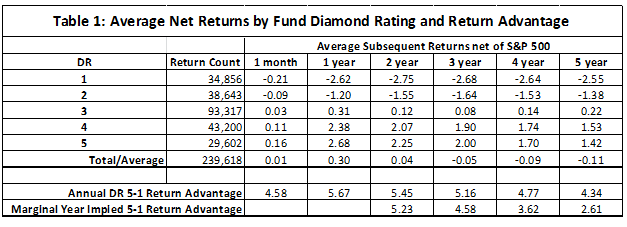
The higher the DR [Diamond Rating], the more likely it will outperform in the future. The superior performance of higher rated funds is evident in Table 1. DR5 funds outperform DR1 funds by more than 5% annually, based on one-year subsequent returns, and they continue to deliver outperformance up to five years after the initial rating was assigned. In this fashion, DR1 and DR2 funds underperform the market, DR3 funds perform at the market, and DR4 and DR5 funds outperform. The average fund matches market performance over the entire time period, consistent with results reported by Bollen and Busse (2004), Brown and Goetzmann (1995) and Fama and French (2010), among others.

Thus, strategy consistency and conviction are predictive of future fund performance for up to five years after the rating is assigned.

The bold is mine, as I find this remarkable!

I’ve reproduced a table from the article below. You can see that the magnitude of the outperformance is nothing to sniff at—400 to 500 basis points annually over a multi-year period.

diamondratings zps3970f53e Investment Manager Selection

Source: Advisor Perspectives/AthenaInvest (click on image to enlarge)

The indexing crowd is always indignant at this point, often shouting their mantra that “active managers don’t outperform!” I regret to inform them that their mantra is false, because it is incomplete. What they mean to say, if they are interested in accuracy, is that “in aggregate, active managers don’t outperform.” That much is true. But that doesn’t mean you can’t locate active managers with a high likelihood of outperformance, because, in fact, Tom Howard just demonstrated one way to do it. The “active managers don’t outperform” meme is based on a flawed experimental design. I tried to make this clear in another blog post with an analogy:

Although I am still 6’5″, I can no longer dunk a basketball like I could in college. I imagine that if I ran a sample of 10,000 random Americans and measured how close they could get to the rim, very few of them could dunk a basketball either. If I created a distribution of jumping ability, would I conclude that, because I had a large sample size, the 300 people would could dunk were just lucky? Since I know that dunking a basketball consistently is possible–just as Fama and French know that consistent outperformance is possible–does that really make any sense? If I want to increase my odds of finding a portfolio of people who could dunk, wouldn’t it make more sense to expose my portfolio to dunking-related factors–like, say, only recruiting people who were 18 to 25 years old and 6’8″ or taller?

In other words, if you look for the right characteristics, you have a shot at finding winning investment managers too. This is valuable information. Think of how investment manager selection is typically done: “What was your return last year, last three years, last five years, etc.?” (I know some readers are already squawking, but the research literature shows clearly that flows follow returns pretty closely. Most “rigorous due diligence” processes are a sham—and, unfortunately, research shows that trailing returns alone are not predictive.) Instead of focusing on trailing returns, investors would do better to locate robust strategies and then evaluate managers on their level of consistency and conviction.

Posted by:


Manager Insights - First Quarter Review

April 8, 2013

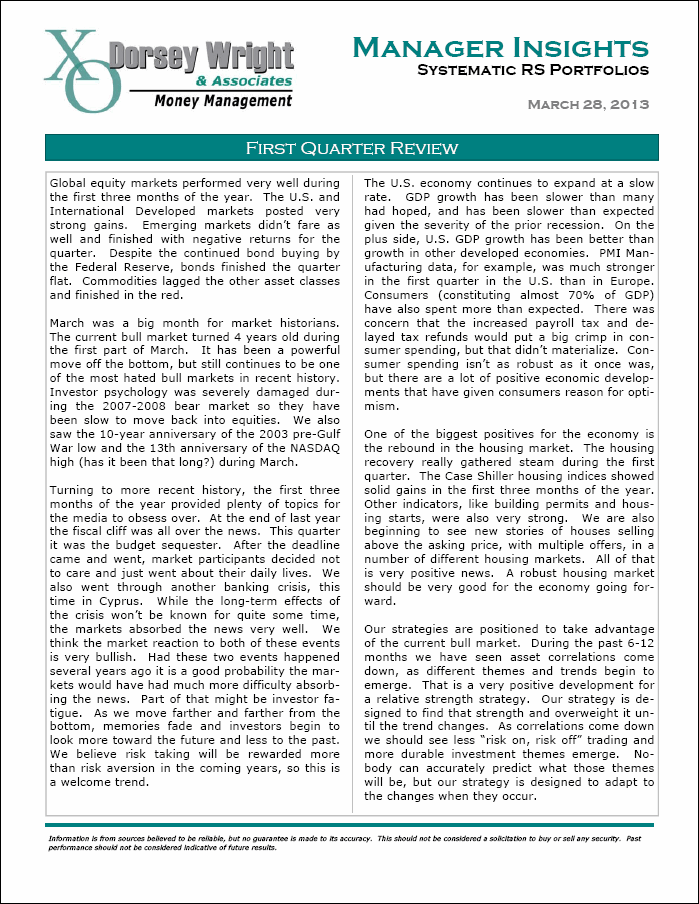
First Quarter Review for our Systematic RS Portfolios:

insights Manager Insights   First Quarter Review

Posted by:


Dorsey Wright’s Podcast: DWA Products Update

March 7, 2013

Dorsey Wright’s Podcast: DWA Products Update

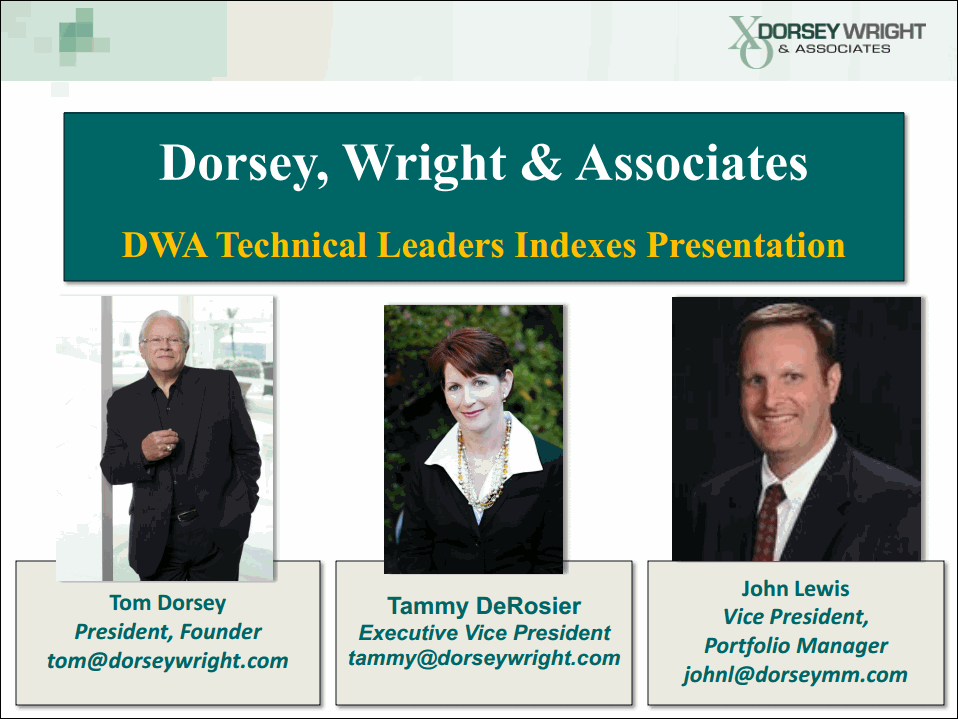
Tom Dorsey, Tammy DeRosier, and John Lewis

Posted by:


From the Archives: Was It Really a Lost Decade?

February 28, 2013

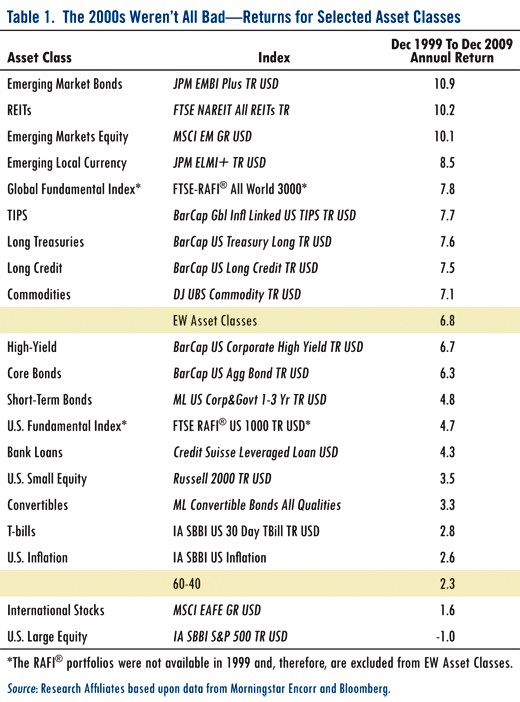
Index Universe has a provocative article by Rob Arnott and John West of Research Affiliates. Their contention is that 2000-2009 was not really a lost decade. Perhaps if your only asset was U.S. equities it would seem that way, but they point out that other, more exotic assets actually had respectable returns.

The table below shows total returns for some of the asset classes they examined.

 From the Archives: Was It Really a Lost Decade?

click to enlarge

What are the commonalities of the best performing assets? 1) Lots of them are highly volatile like emerging markets equities and debt, 2) lots of them are international and thus were a play on the weaker dollar, 3) lots of them were alternative assets like commodities, TIPs, and REITs.

In other words, they were all asset classes that would tend to be marginalized in a traditional strategic asset allocation, where the typical pie would primarily consist of domestic stocks and bonds, with only small allocations to very volatile, international, or alternative assets.

In an interesting way, I think this makes a nice case for tactical asset allocation. While it is true that most investors–just from a risk and volatility perspective–would be unwilling to have a large allocation to emerging markets for an entire decade, they might find that periodic significant exposure to emerging markets during strong trends would be quite acceptable. And even assets near the bottom of the return table like U.S. Treasury bills would have been very welcome in a portfolio during parts of 2008, for example. You can cover the waterfront and just own an equal-weighted piece of everything, but I don’t know if that is the most effective way to do things.

What’s really needed is a systematic method for determining which asset classes to own, and when. Our Systematic Relative Strength process does this pretty effectively, even for asset classes that might be difficult or impossible to grade from a valuation perspective. (How do you determine whether the Euro is cheaper than energy stocks, or whether emerging market debt is cheaper than silver or agricultural commodities?) Once a systematic process is in place, the investor can be slightly more comfortable with perhaps a higher exposure to high volatility or alternative assets, knowing that in a tactical approach the exposures would be adjusted if trends change.

—-this article originally appeared 2/17/2010. There is no telling what the weak or strong assets will be for the coming decade, but I think global tactical asset allocation still represents a reasonable way to deal with that uncertainty.

Posted by:


Investment Process

November 9, 2012

You don’t know jack about what the market is going to do. Neither do I. None of us really do. Falling back on investment process is the only way to survive in the long run. Bob Seawright of Above the Market has a great commentary on investment process and randomness:

In what [Daniel] Kahneman calls the “planning fallacy,” our ability even to forecast the future, much less control the future, is extremely limited and is far more limited than we want to believe. In his terrific book, Thinking, Fast and Slow, Kahneman describes the “planning fallacy” as a corollary to optimism bias (think Lake Wobegon – where all the children are above average) and self-serving bias (where the good stuff is my doing and the bad stuff is always someone else’s fault). Most of us overrate our own capacities and exaggerate our abilities to shape the future. The planning fallacy is our tendency to underestimate the time, costs, and risks of future actions and at the same time overestimate the benefits thereof. It’s at least partly why we underestimate bad results. It’s why we think it won’t take us as long to accomplish something as it does. It’s why projects tend to cost more than we expect. It’s why the results we achieve aren’t as good as we expect. It’s why I take three trips to Home Depot on Saturdays. We are all susceptible – clients and financial professionals alike.

As a consequence, in all probabilistic fields, the best performers dwell on process. This is true for great value investors, great poker players, and great athletes. A great hitter focuses upon a good approach, his mechanics, being selective and hitting the ball hard. If he does that – maintains a good process – he will make outs sometimes (even when he hits the ball hard) but the hits will take care of themselves. Maintaining good process is really hard to do psychologically, emotionally, and organizationally. But it is absolutely imperative for investment success.

I flipped Mr. Seawright’s paragraphs around, but that’s just how I think. The emphasis is mine, but I think Mr. Seawright is correct about all of this. We are often attracted by shiny things, by the hedge fund manager that had the big hit last year, but the real winners are the investors with a great process that they stick with through thick and thin. Those investors often sustain good track records for decades. Maintaining good process is really hard to do, but the rewards over time make it worth the effort.

Posted by:


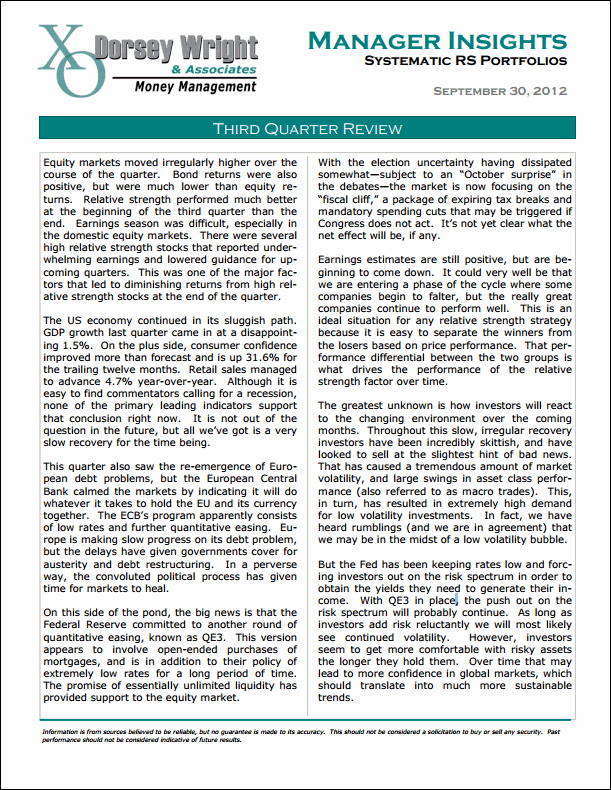
Manager Insights: Third Quarter Review

October 19, 2012

Click below for our take on the economy, the financial markets, and what it may mean for relative strength.

ManagerInsightsQ3 Manager Insights: Third Quarter Review


Posted by:


Net Wealth Shock and Portfolio Diversification

October 19, 2012

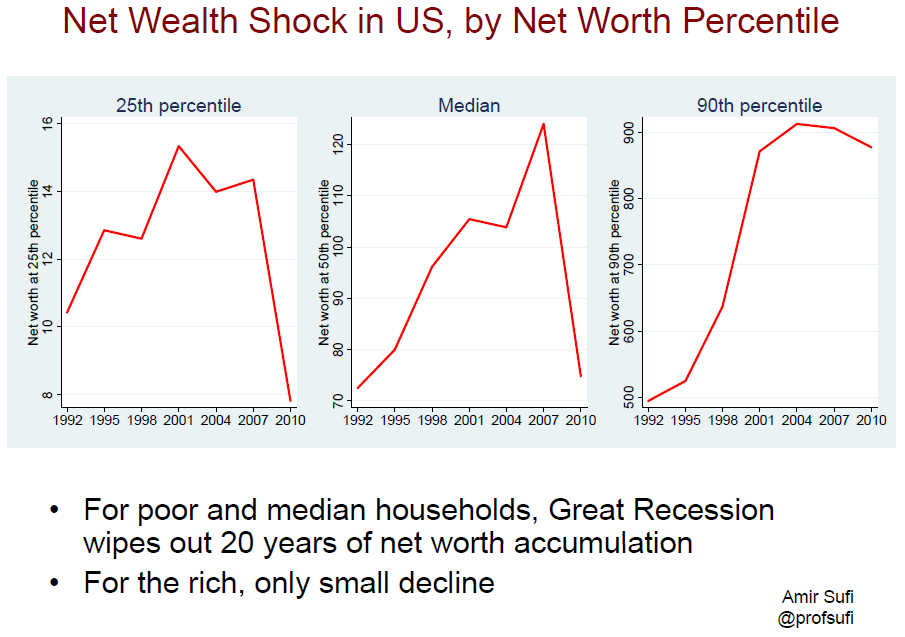
Professor Amir Sufi (University of Chicago Booth School of Business) is an interesting researcher. He recently tweeted a picture of what he called “net wealth shock” to show how the recession had affected various families. It’s reproduced below, but in effect, it shows that low and median net worth families have had a large negative impact from the recession while high net worth families have been impacted much less. I think portfolio diversification has everything to do with it.

netwealthshock Net Wealth Shock and Portfolio Diversification

The Effect of Buying One Stock on Margin

Source: Amir Sufi (click on image to enlarge)

For clues to why this happened, consider an earlier paper that Dr. Sufi co-wrote on household balance sheets. I’ve linked to the entire paper here (you should read it for insight into very clever experimental design), but here’s the front end of the abstract:

The large accumulation of household debt prior to the recession in combination with the decline in house prices has been the primary explanation for the onset, severity, and length of the subsequent consumption collapse.

Later in the paper, he reiterates that it is the combination of these two things that is deadly.

The household balance sheet shock in high leverage counties came from two sources: high ex ante debt levels and a large decline in house prices. One natural question to ask is: could the decline in house prices alone explain the collapse in consumption in these areas?

Our answer to this question is a definitive no-it was the combination of house price declines and high debt levels that drove the consumption decline.

And he and his co-authors, through clever data analysis, proceed to explain why they believe that to be the case.

Now consider what this is saying from a portfolio management point of view: why was the impact of falling home prices so devastating to low and median net worth households?

The negative impact came primarily from lack of diversification. Low and median net worth households had essentially one stock on margin. I know people don’t think they are buying their house on margin, but the net effect of a home loan—magnifying gains and losses—is the same. When that stock (their house) went south, their net worth went right along with it.

High net worth households were simply better diversified. It’s not that their houses didn’t decline in value also; it’s just that their house was not their only asset. In addition, they were less leveraged.

There are probably a couple of things to take away from this.

  • Diversify broadly. It’s no fun to have everything in one asset when things go wrong, whether it’s your house or Enron stock in your pension plan.
  • Debt kills. Having a single asset that nosedives is bad, but having it on margin is disastrous. There’s no room for error with leverage—and no way to wait things out.

Perhaps high net worth families are more diversified simply because they have greater wealth. Maybe they took the same path as everyone else and just got lucky not to have a recession in the middle of their journey. However, I think it’s also worth contemplating the converse: maybe those families achieved greater wealth because they diversified more broadly and opted to use less leverage.

Posted by:


Retirement Income Karma Boomerang

October 11, 2012

From time to time, I’ve written about karma boomerang: the harder you try to avoid getting nailed, the more likely it is that you’ll get nailed by exactly what you are trying to avoid. This concept came up again in the area of retirement income in an article I saw at AdvisorOne. The article discussed a talk given by Tim Noonan at Russell Investments. The excerpt in question:

In [Noonan's] talk, “Disengagement: Creating the Future You Fear,” he observed that lack of engagement in retirement planning is leading people toward the very financial insecurity they dread. What they need to know, and are not finding out, is simply whether they’ll have enough money for their needs.

I added the bold. This is a challenge for investment professionals. Individuals are not likely on their own to go looking for their retirement number. They are also not likely to go looking for you, the financial professional. They may realize they need help, but are perhaps intimidated to seek it—or fearful of what they might find out if they do investigate.

Retirement income is probably not an area where you want to tempt karma! Retirement income is less secure than ever for many Americans, due to under-funded pension plans, neglected 401k’s, and a faltering Social Security safety net. The only way to secure retirement income for investors is to reach out to them and get them engaged in the process.

Mr. Noonan, among other suggestions, mentioned the following:

  • “Personalization” is tremendously appealing. “Tailoring” may be an even more useful term, since “people don’t mind if the tailor reuses the pattern,” Noonan explained. They may even enjoy feeling part of an elite group.
  • “Tactical investing” is viewed positively. “People know they should be more adaptive, but they aren’t sure what of,” said Noonan. Financial plans should adapt to the outcomes they’re producing, not to hypothetical market forecasts.

Perhaps personalization and tactical investing can be used as hooks to get clients moving. To reach their retirement income goals, they are going to need to save big and invest intelligently, but none of that will happen if they aren’t engaged in the first place.

Posted by:


Serenity for Investors

October 9, 2012

Grant me the serenity to accept the things I cannot change, the courage to change the things I can, and the wisdom to know the difference—-Reinhold Niebuhr

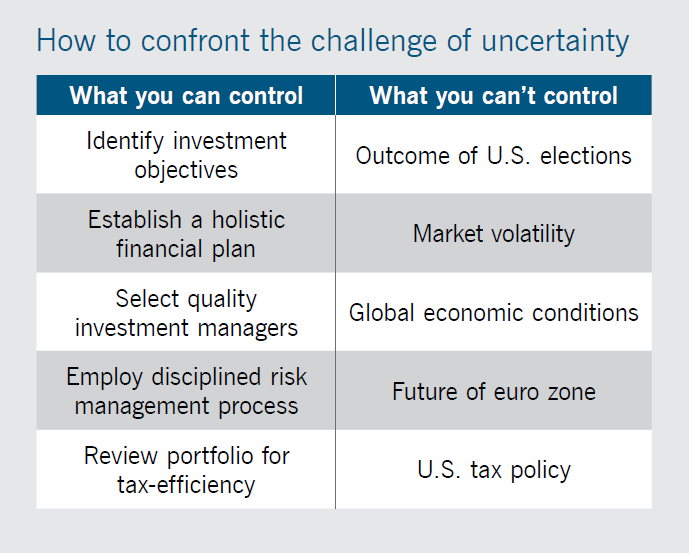
Serenity is in short supply in the investment community! Capital Group/American Funds recently posted a fantastic commentary on uncertainty, pointing out that investors are much better off if they focus on what they can control and don’t sweat the other stuff. Here are some excerpts that struck me—but you should really read the whole thing.

Powerless. That’s how a lot of investors feel. In a recent Gallup poll, 57% of investors said they feel they have little or no control over their efforts to build and maintain their retirement savings. What’s causing them to feel so lost? According to 70% of those polled, the most important factor affecting the investment climate is something they can’t control, the federal budget deficit.

On the flip side, among investors with a written financial plan having specific goals or targets, the poll showed 80% of nonretirees and 88% of retirees said their plan gives them the confidence to achieve their financial goals. It seems like some investors have figured out what they can control and what they can’t.

Life for investors would be simpler if there were a handy timetable by which these issues would be resolved in a quick and orderly fashion. But successful investors know they can’t control the outcome of the euro-zone summits or American fiscal debates, much less plug politics into a spreadsheet.

They can, however, review their goals, manage risk, be mindful of valuation and yield and remember that diversification may matter now more than ever. It’s easy to overlook in such a challenging environment, but unsettled times can also offer opportunities for long-term investors. In the midst of uncertainty, there are companies with strong balance sheets, smart management and innovative products that continue to thrive, and whose shares may be attractively valued.

All true! We’ve written before about what an important investment attribute patience is. Maybe in some important way, serenity contributes to patience. It’s hard to be patient when you’re worried about everything, especially things you have no control over! They even include a handy-dandy graphic with suggested responses to all of those things disturbing your serenity.

Serenity AmericanFundsDistributors Serenity for Investors

Source: American Funds Distributors (click on image to enlarge)

At some level, perhaps we are all control freaks. Unfortunately for us, in a relationship with the market, it’s the market that is in control! We can’t control market events, but we can control our responses to those events. Finding healthy ways to manage market anxiety is a primary focus for every successful investor.

Posted by:


Target-Date Fund-mageddon

September 26, 2012

Markets are rarely tractable, which is one reason why significant flexibility is required over an investment lifespan. Flexibility is something that target-date funds don’t have much of. In fact, target-date funds have a glidepath toward a fixed allocation at a specified time. I’ve written about the problems with target-date funds extensively—and why I think balanced funds are a much better QDIA (Qualified Default Investment Alternative). It appears that my concerns were justified, now that Rob Arnott at Research Affiliates has put some numbers to it. According to an article in Smart Money on target-date funds:

A target-date fund is a one-decision mutual fund that you can invest in over the course of your entire career.

Each fund is designed for those aiming to retire at a certain date. The fund starts with a lot of “risky” stocks, and over time it moves to “safer” bonds. The fundamental idea is that at any given moment between age 21 and age 65 you should be invested in a particular balance of assets — more stocks when you are younger, and more bonds when you are older.

The track to retirement, according to the industry jargon, is a “glidepath.”

Billions of dollars are invested in these target-date funds. They are today the default investment option in many 401(k) plans. Now comes Rob Arnott, the chairman of Research Affiliates and one of the handful of serious money managers in the country. In a new research paper he published yesterday, “The Glidepath Illusion,” he has blown this idea full of holes. “Shockingly,” he says, “the basic premise upon which these billions [of dollars] are invested is flawed.”

When Mr. Arnott investigated the results of such target-date funds, he found them to be incredibly variable—and possibly upside-down. (I put the fun part in bold.)

Arnott has mined data from the stock and bond markets going back to 1871 and then run simulations to see how these target-date portfolios would have worked in practice. He considered a fund that started out with 80% stocks and 20% bonds, and then adjusted gradually over an investing life of 41 years so that it ended up 80% bonds and 20% stocks. He considered an investor who invested $1,000 a year, adjusted for inflation, from the day she started work at age 22 to when she retired at 63.

Bottom line? This investor could have done very well — or very badly. Far from enjoying a smooth “glidepath” to a secure retirement, she could have retired with as little as $50,000 in savings or as much as $211,000. She could have ended up with a retirement annuity of $2,400 a year — or $13,100 a year. There was no way of knowing in advance.

That wasn’t all. Arnott found that in most eras, investors would have actually been better off if they had stood this target-date strategy on its head — in other words, if they had started out with 80% bonds, and then took on more risk as they got older, so that they ended up with 80% stocks.

No kidding. Really.

The median person following the target date strategy ended up with $120,000 in savings. The median person who did the opposite, Arnott’s team found, ended up with $148,000. The minimum outcome from doing the opposite was better. The maximum outcome of doing the opposite was also better.

Amazing. Even the minimum outcome from going opposite the glidepath was better! Using even a static 50/50 balanced fund was also better. Perhaps this will dissuade a client or two from piling into bonds only because they are older. No doubt path dependence had something to do with the way returns laid out, but it’s clear that age-based asset allocation is a cropper.

Asset allocation, diversification, and strategy selection are important. Decision of this magnitude need to be made consciously, not put on autopilot.

[You can read Mr. Arnott's full article here. Given that most 401k investors are unfortunately using target-date funds instead of balanced funds, this is a must read. I would modestly suggest the Arrow DWA Balanced Fund as a possible alternative!]

Click here to visit ArrowFunds.com for a prospectus & disclosures. Click here for disclosures from Dorsey Wright Money Management.

Posted by:


Technical Leaders Webinar

September 14, 2012

In case you missed our “Technical Leaders Webinar” featuring Tom Dorsey, Tammy DeRosier, and John Lewis yesterday, here is a link to the replay.

tlwebinar Technical Leaders Webinar

See www.powershares.com for more information. Click here for disclosures.

Posted by:


Upcoming event: DWA Technical Leaders Index Webinar

September 6, 2012

It is that time of year again - back to school and back to basics. The spontaneity of summer living has come to an end, and the regular routine picks back up again. Cycles like these are not as clear cut in the market; there is no such thing as a “normal routine” in the financial markets. With that in mind, you must have the knowledge and tools to be able to adapt to changing markets. This concept of positioning your investments toward current trends serves as the driving force behind our DWA Technical Leaders Indexes. As many of you are already aware, our relative strength-driven Technical Leaders Indexes serve as the underlying indexes for four PowerShares ETFs, each focusing in different segments of the global equity market.

DWA Technical Leaders Index PowerShares ETFs:

  • PowerShares DWA Technical Leaders Portfolio [PDP]
  • PowerShares DWA SmallCap Technical Leaders Portfolio [DWAS]
  • PowerShares DWA Developed Markets Technical Leaders [PIZ]
  • PowerShares DWA Emerging Markets Technical Leaders [PIE]

Next week we will be conducting a Webinar discussing the RS strategies behind the Technical Leaders Indexes, and practical implementation ideas for using these products to access market leaders and help leverage your business. Tom Dorsey, President of DWA; Tammy DeRosier, Executive Vice President; and John Lewis, Vice President & Portfolio Manager, will host the discussion on Thursday, September 13th, 2012 at 12:15 PM EST. There is no cost to attend the webinar. If you are interested in attending, please register today.

Note: This webinar will be recorded and made accessible for viewing at a later date. In order to receive the recording, please sign up here.

Breaking news: PDP Breakout

On a related note, the PowerShares DWA Technical Leaders Index (PDP) had a double top breakout on Tuesday (Sept 4). This breakout continues a series of higher highs and higher lows above the bullish support line. The daily momentum is getting closer to turning back to positive as well after having been negative for almost two weeks. The breakout on the chart provides an excellent entry point for new positions. A couple of points to note about the PDP:

  • The PDP continues to perform well this year, up 15.11% compared to 11.72% for the S&P 500.
  • The largest sector weighting remains Consumer Discretionary at 31.70% and Financials are next at 18.14%.
  • We continue to see advisors using the PDP as a sector rotation solution, in a PDP / SPLV strategy, as well as for general equity exposure as US equities remain the strongest asset class in DALI.

(These are pure price returns which are not inclusive of dividends, fees, or expenses.)

Please take advantage of this webinar for timely market updates and strategies.


The information contained herein has been prepared without regard to any particular investor’s investment objectives, financial situation, and needs. Accordingly, investors should not act on any recommendation (express or implied) or information in this material without obtaining specific advice from their financial advisors and should not rely on information herein as the primary basis for their investment decisions. Information contained herein is based on data obtained from recognized statistical services, issuer reports or communications, or other sources believed to be reliable (“information providers”). However, such information has not been verified by Dorsey, Wright & Associates, LLC (DWA) or the information provider and DWA and the information providers make no representations or warranties or take any responsibility as to the accuracy or completeness of any recommendation or information contained herein. DWA and the information provider accept no liability to the recipient whatsoever whether in contract, in tort, for negligence, or otherwise for any direct, indirect, consequential, or special loss of any kind arising out of the use of this document or its contents or of the recipient relying on any such recommendation or information (except insofar as any statutory liability cannot be excluded). Any statements nonfactual in nature constitute only current opinions, which are subject to change without notice. Neither the information nor any opinion expressed shall constitute an offer to sell or a solicitation or an offer to buy any securities, commodities or exchange traded products. This document does not purport to be complete description of the securities or commodities, markets or developments to which reference is made.

The Dorsey Wright SmallCap Technical Leaders Index is calculated by Dow Jones, the marketing name and a licensed trademark of CME Group Index Services LLC (“CME Indexes”). “Dow Jones Indexes” is a service mark of Dow Jones Trademark Holdings LLC (“Dow Jones”).

Products based on the Dorsey Wright SmallCap Technical Leaders IndexSM, are not sponsored, endorsed, sold or promoted by CME Indexes, Dow Jones and their respective affiliates make no representation regarding the advisability of investing in such product(s).

Past performance is not indicative of future results. Potential for profits is accompanied by possibility of loss. You should consider this strategy’s investment objectives, risks, charges and expenses before investing. The examples and information presented do not take into consideration commissions, tax implications, or other transaction costs.

Each investor should carefully consider the investment objectives, risks and expenses of any Exchange-Traded Fund (“ETF”) prior to investing. Before investing in an ETF investors should obtain and carefully read the relevant prospectus and documents the issuer has filed with the SEC. To obtain more complete information about the product the documents are publicly available for free via EDGAR on the SEC website (http://www.sec.gov)

Posted by:


More on the Value of a Financial Advisor

September 5, 2012

I noticed an article the other day in Financial Advisor magazine that discussed a study that was completed by Schwab Retirement Plan Services. The main thrust of the study was how more employers were encouraging 401k plan participation. More employers are providing matching funds, for example, and many employers have instituted automatic enrollment and automatic savings increases. These are all important, as we’ve discussed chronic under-saving here for a long time. All of these things together can go a long way toward a client’s successful retirement.

What really jumped out at me, though, was the following nugget buried in the text:

Schwab data also indicates that employees who use independent professional advice services inside their 401(k) plan have tended to save twice as much, were better diversified and stuck to their long-term plan, even in the most volatile market environments.

Wow! That really speaks to the value of a good professional advisor! It hits all of the bases for retirement success.

  • boost your savings rate,
  • construct a portfolio that is appropriately diversified by asset class and strategy, and
  • stay the course.

If investors were easily able to do this on their own, there wouldn’t be any difference between self-directed accounts and accounts associated with a professional advisor. But there is a big difference—and it points out what a positive impact a good advisor can have on clients’ financial outcomes.

Posted by:


Quote of the Week: The Ebb and Flow of Investment Style

August 14, 2012

Ninety percent of what passes for brilliance, or incompetence, in investing is the ebb and flow of investment style (i.e., growth, value, foreign vs. domestic, etc.). Since opportunities by style regress, past performance tends to be negatively correlated with future relative performance. Therefore, managers are often harder to pick than stocks. Clients have to choose between fact (past performance) and the conflicting marketing claims of various managers. As sensible businessmen, clients usually feel they have to go with the past facts. They therefore rotate into previously strong styles, which regress [to the mean], dooming most active clients to failure.—-Jeremy Grantham

This is a pretty long quote, but it’s a gem I found sandwiched into an Advisor Perspectives commentary by Jeffrey Saut. (I commend Mr. Saut for having the perspicacity to throw the quote out there in the first place.)

Mr. Grantham not only has a way with words—he has a valid point in every single sentence. That paragraph pretty much sums up everything that goes wrong for clients.

It’s also true from the standpoint of an investment manager. Our investment style constantly exposes clients to high relative strength stocks or asset classes. Some quarters they perceive us to be brilliant; other quarters, not so much! In reality, we are doing exactly the same thing all the time. Clients are actually reacting to the ebb and flow of investment style, as Mr. Grantham puts it, rather than to anything different we are doing.

The ebb and flow of investment style takes place over a fairly long cycle, often three to five years—in other words, usually an entire business cycle. During the flow period, clients are very excited by good performance and seem quite confident that it will never end. During the ebb period, it’s easy to become discouraged and to become convinced that somehow the investment process is “broken.” Clients become confident that performance will never improve! Grantham’s observation about the when and why of clients changing managers corresponds exactly with DALBAR’s reported poor investor performance and average 3-year holding periods.

Patience and the acknowledgment of ebb and flow would go a long way toward improving investor performance.

ebb and flow mike dawson Quote of the Week: The Ebb and Flow of Investment Style

Is the ocean broken, or does it just ebb and flow?

Source: Eve Sob blogspot

Posted by:


Advisors to the Rescue: Savings Edition

July 16, 2012

There’s already lots of evidence that individuals on their own don’t do very well investing. Compounding your net worth is extra difficult when you also don’t know how much to save. (As we’ve shown before, savings is actually much more important than investment performance in the early years of asset growth.)

An article at AdvisorOne discussed a recent survey that had some surprising findings on consumer savings, but ones that will be welcome for advisors. To wit:

The survey found that, regardless of income level, more than 60% of consumers who work with an advisor are contributing to a retirement plan or IRA, compared with just 38% of those without an advisor.

Furthermore, 61% of consumers who work with an advisor contribute at least 7% of their salary to their plan. Just 36% of consumers without an advisor save at this rate.

The guidance and education that advisors provide their clients to bring on these good saving habits translate to higher confidence, too. Of non-retired consumers with an advisor, half said their advisor provided guidance on how much to save. More than 70% of Americans with an advisor say they’re confident they’re saving enough. Just 43% of consumers without an advisor felt the same.

The differences in savings are really shocking to me. Less than half of the consumers without an advisor are even contributing to a retirement plan! And when they do have a retirement plan, only about a third of them are contributing 7% or more!

Vanguard estimates that appropriate savings rates are 12-15% or more.

I find it interesting that many consumers point out that their advisors gave them guidance on how much to save. It is pretty clear that even simple guidance like that can add a lot of value.

Posted by:


The Big Trend: Professional Asset Management Within the 401k

July 10, 2012

According to a Vanguard report, one of the big trends in the 401k market is the move toward professional asset management. An article at AdvisorOne on this topic says:

One-third of all Vanguard 401(k) plan participants invested their entire account balance in a professionally managed asset allocation and investment option in 2011, according to Vanguard’s How America Saves 2012, an annual report on how U.S. workers are saving and investing for retirement.

The report notes that “the increasing prominence of so-called professionally managed allocations—in a single target-date or balanced fund or through a managed account advisory service—is one of the most important trends in 401(k) and other defined contribution (DC) plans today.”

Two things concerned me about the report. I’m not at all surprised by more and more 401k participants moving toward professionally managed allocations. QDIAs (qualified default investment alternatives) make sense for a lot of participants because they are legally allowed to be your entire investment program. I was surprised about the make-up of the account allocations, given the problems encountered by target-date funds during the last bear market.

In 2011, 33% of all Vanguard participants were invested a professionally managed allocation program: 24% in a single target-date fund (TDF); 6% in a single traditional balanced fund, and 3% in a managed account advisory program. The total number is up from 9% at the end of 2005.

I am amazed that target-date funds are preferred to balanced funds. No doubt target-date funds are an improvement over investors hammering themselves by trading in and out, but target-date funds have some well-publicized problems, not the least of which is that they tend to push the portfolio more toward bonds as the target date nears. That could end up exposing retirees to significant inflation risk right at the time they can least cope with it. It seems to me that a balanced fund with some ability to tactically adjust the portfolio allocation over time is a much better solution.

The other significant problem I see is that savings rates are still far too low. Consider these statements from the AdvisorOne article:

The average participant deferral rate rose to 7.1% and the median (the median reflects the typical participant) was unchanged at 6%.

and then…

Vanguard’s view is that investors should save 12% to 15% or more.

I added the emphasis, but it’s easy to see the disconnect. Investors are saving 6%, but they probably need to be saving more than 15%!

Advisors, for the most part, have very little control over their client’s 401k plans. Clients sometimes ask for advice informally, but advisors are often not compensated for the advice and firms are sometimes reluctant to let them provide it for liability reasons anyway. (A few advisors handle client 401k’s through the independent brokerage window, but not every plan has that option and not every firm lets advisors do it. It would be great if the financial powers-that-be could figure out a way to reverse this problem, but the recent Department of Labor regulations appear to be going in the other direction.)

If you’re an advisor, it’s probably worthwhile to have a serious discussion with your clients about their 401k plans. They may not be handling things in the optimal way and they could probably use your help.

401k The Big Trend: Professional Asset Management Within the 401k

Your client may need your help

Source: investortrip.com

Posted by:


PDP in the News

June 26, 2012

Bloomberg has an article today entitled “ETFs Passive No More.” It’s an article about the rise of intelligent indexation. Here’s their thesis:

Exchange-traded funds are posing a new threat to the $7.8 trillion market for active mutual funds by challenging the notion ETFs are only good for tracking benchmarks.

Here’s their blurb about PDP:

The PowerShares DWA fund, which invests in U.S.-listed companies, uses an index that selects them based on “relative strength,” a proprietary screening methodology developed by Richmond, Virginia-based Dorsey, Wright & Associates Inc. The fund has advanced at an annual rate of 2 percent since its inception in March 2007, compared with the 1.2 percent gain for the Standard & Poor’s 500 Index over the same period, and the 3.8 percent increase in the Russell 3000 Growth Index.

Their offerings may further erode the market share of active mutual funds, sold by traditional money managers such as Fidelity Investments, Capital Group Cos. and Franklin Resources Inc. The companies tout the ability of their managers to beat benchmarks mostly through individual security selection.

“Historically, active managers held a unique appeal to prospective investors,” said Steven Bloom, who helped develop the first ETF in the 1980s and is now an assistant professor of economics at the U.S. Military Academy at West Point, New York.“Now, ETFs are infringing on that territory by holding out the prospect of alpha.”

The article points out that by using a rules-based investment process within an ETF, you can shoot for alpha, while getting the tax benefits of the ETF structure. Rules-based ETFs are going to continue to blur the line with active mutual funds over time. It’s also going to be interesting to see how many of the rules-based processes are robust and how many have been optimized. Curve-fitted performance will tend to degrade over time, while a truly adaptive model should be more consistent.

We think the trend toward intelligent indexes will continue and we’re excited to be one of the pioneers.

See www.powershares.com for more information about PDP. Past performance is no guarantee of future returns. A list of all holdings for the trailing 12 months is available upon request.

Posted by:


From the Archives: The $ Value of Patience

June 25, 2012

The annals of investor behavior make for some pretty scary reading. Yet this story from the Wall Street Journal may take the cake. It is an article about the top-performing mutual fund of the decade and it shows with remarkable clarity how badly investors butcher their long-term returns. The article hits the premise right up front:

Meet the decade’s best-performing U.S. diversified stock mutual fund: Ken Heebner’s $3.7 billion CGM Focus Fund, which rose more than 18% annually and outpaced its closest rival by more than three percentage points.

Too bad investors weren’t around to enjoy much of those gains. The typical CGM Focus shareholder lost 11% annually in the 10 years ending Nov. 30, according to investment research firm Morningstar Inc.

It’s hard to know whether to laugh or cry. In a brutal decade, Mr. Heebner did a remarkable job, gaining 18% per year for his investors. The only investment acumen required to reap this 18% return was leaving the fund alone. Yet in the single best stock fund of the decade investors managed to misbehave and actually lose substantial amounts of money—11% annually.

Even Morningstar is not sure what to do with Mr. Heebner:

The fund, a highly concentrated portfolio typically holding fewer than 25 large-company stocks, offers “a really potent investment style, but it’s really hard for investors to use well,” says Christopher Davis, senior fund analyst at Morningstar.

I beg to differ. It’s really hard to use well?? What does that even mean? If it is, it’s only in the sense that a pet rock is really hard to care for.

Investor note: actively managed or adaptive products need to be left alone! The whole idea of an active or adaptive product is that the manager will handle things for you, instead of you having to do it yourself.

Unfortunately, there is an implicit belief among investors—and their advisors—that they can do a better job than the professionals running the funds, but every single study shows that belief to be false. There is not one study of which I am aware that shows retail investors (or retail investors assisted by advisors) outperforming professional investors. So where does that widespread belief come from?

From the biggest bogeyman in behavioral finance: overconfidence. Confidence is a wonderful trait in human beings. It gets us to attempt new things and to grow. From an evolutionary point of view, it is probably quite adaptive. In the financial arena, it’s a killer. Like high blood pressure, it’s a silent killer too, because no one ever believes they are overconfident.

At a Harvard conference on behavioral finance, I heard Nobel Prize winner Daniel Kahneman talk about the best way to combat overconfidence. He suggested intentionally taking what he called an “outside view.” Instead of placing yourself—with all of your incredible and unique talents and abilities—in the midst of the situation, he proposed using an outside individual, like your neighbor, for instance. Instead of asking, “What are the odds that I can quit my day job and open a top-performing hedge fund or play in the NBA?” ask instead, “What are the odds that my neighbor (the plumber, or the realtor, or the unemployed MBA) can quit his day job and open a top performing hedge fund or play in the NBA?” When you put things in an outside context like that, they always seem a lot less likely according to Kahneman. We all think of ourselves as special; in reality, we’re pretty much like everyone else.

Why, then, are investors so quick to bail out on everyone else? Overconfidence again. Our generally mistaken belief that we are special makes everyone else not quite as special as us. Overconfidence and belief in our own specialness makes us frame things completely differently: when we have a bad quarter, it was probably bad luck on a couple of stock picks; if Bill Miller (to choose a recent example) has a bad quarter, it’s probably because he’s lost his marbles and his investment process is irretriveably broken. We’d better bail out, fast. (A lot of people came to that conclusion over the past couple of years. In 2009, Legg Mason Value Trust was +40.6%, more than 14% ahead of its category peers.)

Think about an adaptive Dorsey, Wright Research model like DALI. As conditions change, it attempts to adapt by changing its holdings. Does it make sense to jump in and out of DALI depending on what happened last quarter or last year? Of course not. You either buy into the tactical approach or you don’t. Once you decide to buy into—presumably because you agree with the general premise—a managed mutual fund, a managed account, or an active index, for goodness sakes, leave it alone.

In financial markets, overconfidence is the enemy of patience. Overconfidence is expensive; patience with managed products can be quite rewarding. In the example of the CGM Focus Fund, Mr. Heebner grew $10,000 into $61,444 over the course of the last ten years. Investors in the fund, compounding at -11% annually, turned $10,000 into $3,118. The difference of $58,326 is the dollar value of patience in black and white.

—-this article originally appeared 1/6/2010. Unfortunately, human nature has not changed in the last two years! Investors still damage their returns with their impatience. Try not to be one of them!

Posted by:


From the Archives: Is Buy-and-Hold Dead?

June 20, 2012

The Journal of Indexes has the entire current issue devoted to articles on this topic, along with the best magazine cover ever. (Since it is, after all, the Journal of Indexes, you can probably guess how they came out on the active versus passive debate!)

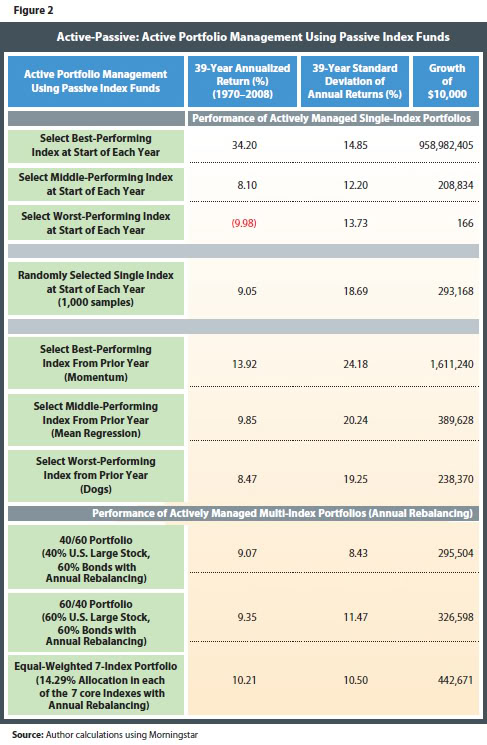
One article by Craig Israelson, a finance professor at Brigham Young University, stood out. He discussed what he called “actively passive” portfolios, where a number of passive indexes are managed in an active way. (Both of the mutual funds that we sub-advise and our Global Macro separate account are essentially done this way, as we are using ETFs as the investment vehicles.) With a mix of seven asset classes, he looks at a variety of scenarios for being actively passive: perfectly good timing, perfectly poor timing, average timing, random timing, momentum, mean reversion, buying laggards, and annual rebalancing with various portfolio blends. I’ve clipped one of the tables from the paper below so that you can see the various outcomes:

 From the Archives: Is Buy and Hold Dead?

Click to enlarge

Although there is only a slight mention of it in the article, the momentum portfolio (you would know it as relative strength) swamps everything but perfect market timing, with a terminal value more than 3X the next best strategy. Obviously, when it is well-executed, a relative strength strategy can add a lot of return. (The rebalancing also seemed to help a little bit over time and reduced the volatility.)

Maybe for Joe Retail Investor, who can’t control his emotions and/or his impulsive trading, asset allocation and rebalancing is the way to go, but if you have any kind of reasonable systematic process and you are after returns, the data show pretty clearly that relative strength should be the preferred strategy.

—-this article originally appeared 1/8/2010. Relative strength rocks.

Posted by: