Option Income Isn’t Really Income

November 22, 2013

Fans of the free lunch will disappointed to find out that option income isn’t really income—it’s just part of the total return stream of an option income strategy. There’s nothing wrong with option income, but a buy-write strategy is just a way to slightly reduce the volatility of an equity portfolio by trading away some of the potential upside. I get concerned when I see articles promoting it as a way to generate extra income, especially when the trade-off is not fully explained.

According to a recent story in the Wall Street Journal, investors are increasingly turning to option income.

So far this year more than $3.4 billion in options contracts have changed hands on U.S. exchanges, according to the Options Industry Council in Chicago. That’s almost as much as 2008′s full-year volume and is on pace to be the second-best year in options trading history. The all-time record came in 2011 with $4.6 billion in contracts changing hands.

A buy-write strategy to generate option income might make sense if it is part of a total-return strategy. All too often, investors have the wrong idea.

How big of a dent can it make on a portfolio’s long-term prospects? A lot, says Philip Guziec, a Morningstar analyst who studies various options strategies. He recently looked at six years worth of performance data through April 2010 using the CBOE S&P 500 BuyWrite Index, which follows a strategy of selling call options on the S&P 500 Index every month and reinvesting premiums.

During that period, a covered-call strategy where premiums were reinvested would have increased the portfolio’s return by around 19%. By contrast, spending each month’s options payments resulted in reducing the options portfolio’s value by more than 50%, according to Mr. Guziec.

“Too many people sell covered calls to generate extra income to live on, not realizing how severely that type of a strategy can eat into a portfolio’s upside over time,” he says.

Many investors would be shocked to learn that their portfolio could take a 50% haircut in only six years if they spent the option income! As always, the bottom line is total return.

Posted by:


Sector Performance

November 22, 2013

The chart below shows performance of US sectors and capitalizations over the trailing 12, 6, and 1 month(s). Performance updated through 11/21/2013.

s c 11.22.13 Sector Performance

Numbers shown are price returns only and are not inclusive of transaction costs. Source: iShares

Posted by:


Structural Bull Market

November 21, 2013

Tom Dorsey sits down with IndexUniverse to explain why we are in a structural bull market.

Posted by:


Fund Flows

November 21, 2013

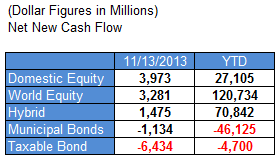
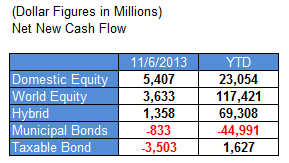
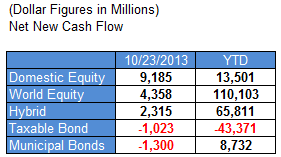
Mutual fund flow estimates are derived from data collected by The Investment Company Institute covering more than 95 percent of industry assets and are adjusted to represent industry totals.

ici 11.21.13 Fund Flows

Posted by:


A Reminder About Real Return

November 20, 2013

The main thing that should matter to a long-term investor is real return. Real return is return after inflation is factored in. When your real return is positive, you are actually increasing your purchasing power— and purchasing goods and services is the point of having a medium of exchange (money) in the first place.

A recent article in The New York Times serves as a useful reminder about real return.

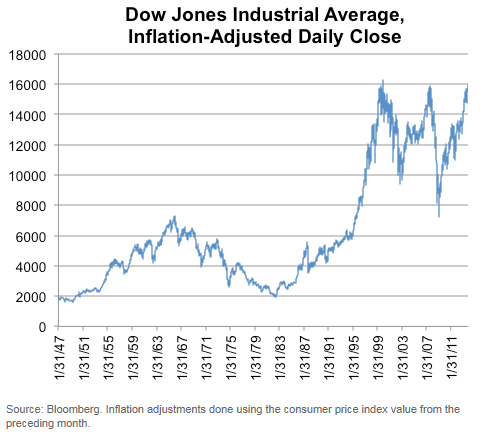
The Dow Jones industrial average broke through 16,000 on Monday for the first time on record — well, at least in nominal terms. If you adjust for inflation, technically the highest level was on Jan. 14, 2000.

Adjusting for price changes, the Dow’s high today was still about 1.3 percent below its close on Jan. 14, 2000 (and about 1.6 percent below its intraday high from that date).

There’s a handy graphic as well, of the Dow Jones Industrial Average adjusted for inflation.

DJIAinflationadjusted zps196c90a6 A Reminder About Real Return

Source: New York Times/Bloomberg

(click on image to enlarge)

This chart, I think, is a good reminder that buy-and-hold (known in our office as “sit-and-take-it”) is not always a good idea. In most market environments there are asset classes that are providing real return, but that asset class is not always the broad stock market. There is value in tactical asset allocation, market segmentation, strategy diversification, and other ways to expose yourself to assets that are appreciating fast enough to augment your purchasing power.

I’ve read a number of pieces recently that contend that “risk-adjusted” returns are the most important investment outcome. Really? This would be awesome if I could buy a risk-adjusted basket of groceries at my local supermarket, but strangely, they seem to prefer the actual dollars. Your client could have wonderful risk-adjusted returns rolling Treasury bills, but would then also get to have a lovely risk-adjusted retirement in a mud hut. If those dollars are growing more slowly than inflation, you’re just moving in reverse.

Real returns are where it’s at.

Posted by:


Andy Hyer on Money Truth with Michael Klonsky

November 20, 2013

Click here for my recent appearance on the Money Truth radio show with Michael Klonsky.

Posted by:


High RS Diffusion Index

November 20, 2013

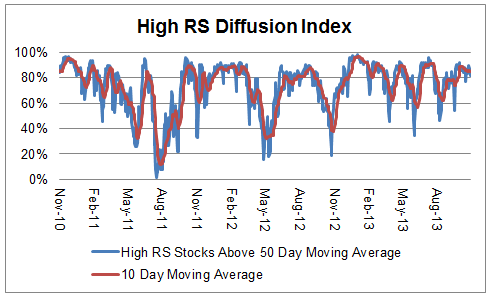
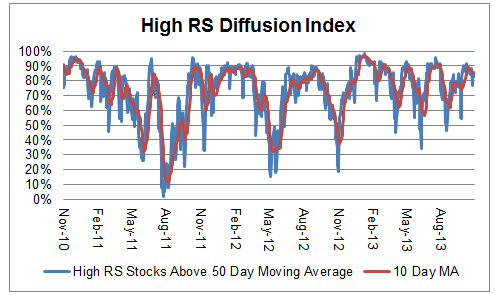
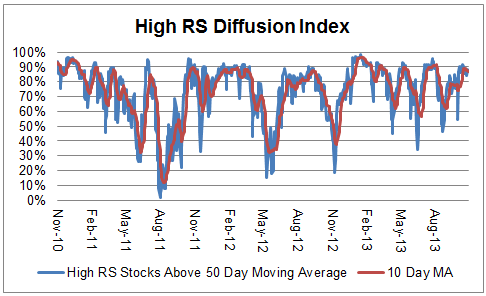
The chart below measures the percentage of high relative strength stocks that are trading above their 50-day moving average (universe of mid and large cap stocks.) As of 11/19/13.

diffusion 11.20.13 High RS Diffusion Index

The 10-day moving average of this indicator is 85% and the one-day reading is 82%.

Posted by:


Stock Market Sentiment Review

November 19, 2013

I’m still getting back into the swing of things after having the flu most of last week. In the midst of my stock market reading, I was struck by an article over the weekend from Abnormal Returns, a blog you should be reading, if you aren’t already. The editor had a selection of the blog posts that were most heavily trafficked from the prior week. Without further ado:


I count five of the top ten on the topic of market tops/bubbles/crashes!

Markets tend to top out when investors are feeling euphoric, not when they are tremendously concerned about the downside. In my opinion, investors are still quite nervous—and fairly far from euphoric right now.

Posted by:


Upcoming Webinar: What’s Next For Relative Strength

November 19, 2013

Upcoming Webinar: What’s Next for Relative Strength

Thursday, December 5th, 2013 at 12:00 PM EST

Dorsey, Wright and Associates has teamed up with Elkhorn Investments to bring to market two strategies in the form of structured products. In this upcoming webinar, you will have a chance to hear from Tom Dorsey, Co-founder and President of Dorsey Wright, and Ben Fulton, CEO of Elkhorn Invesments, on applying momentum strategies to structured products and managed accounts.

Listen as these two innovators weigh in on each of the following topics:

  • The 2014 market outlook
  • Tectonic shifts now underways in the ETF industry
  • Accessing relative strength through managed accounts and structured products
  • Applying the relative strength process to the MLP sector

Click here to register for the webinar today!

bw111813 wya Upcoming Webinar: Whats Next For Relative Strength

Posted by:


Momentum in Rising Rate Environments

November 19, 2013

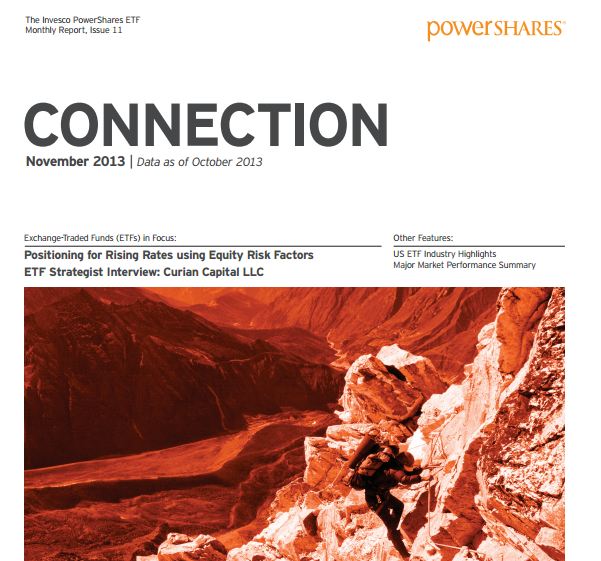
The latest PowerShares Connection report is out. There is a nice writeup about the PowerShares DWA Small Cap Momentum ETF and what happens to high momentum securities during rising rate environments. You can view the report here.

PSConnection zps6dc00387 Momentum in Rising Rate Environments

Posted by:


Relative Strength Spread

November 19, 2013

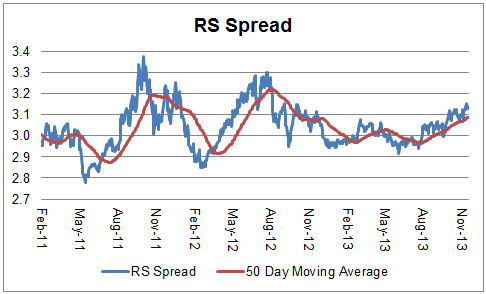
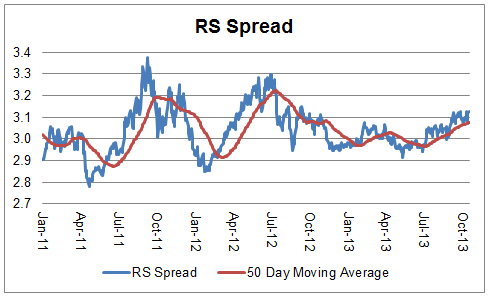
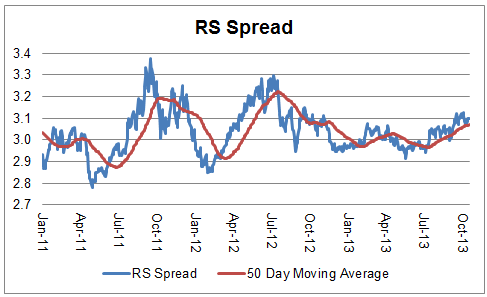
The chart below is the spread between the relative strength leaders and relative strength laggards (universe of mid and large cap stocks). When the chart is rising, relative strength leaders are performing better than relative strength laggards. As of 11/18/2013:

spread 11.19.13 Relative Strength Spread

Posted by:


Weekly RS Recap

November 18, 2013

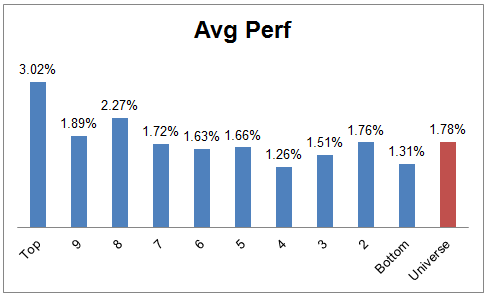
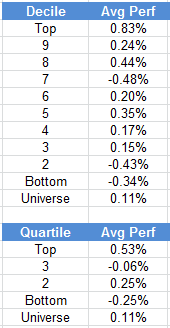
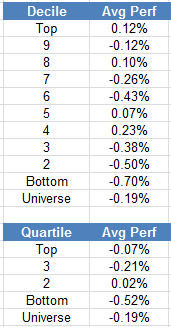
The table below shows the performance of a universe of mid and large cap U.S. equities, broken down by relative strength decile and then compared to the universe return. Those at the top of the ranks are those stocks which have the best intermediate-term relative strength. Relative strength strategies buy securities that have strong intermediate-term relative strength and hold them as long as they remain strong.

Last week’s performance (11/11/13 – 11/15/13) is as follows:

ranks 11.18.13 Weekly RS Recap

It was generally a good week for high relative strength stocks—especially the top decile of our ranks.

Posted by:


Fund Flows

November 14, 2013

Mutual fund flow estimates are derived from data collected by The Investment Company Institute covering more than 95 percent of industry assets and are adjusted to represent industry totals.

ici 11.14.13 Fund Flows

Posted by:


High RS Diffusion Index

November 13, 2013

The chart below measures the percentage of high relative strength stocks that are trading above their 50-day moving average (universe of mid and large cap stocks.) As of 11/12/13.

diffusion 11.13.13 High RS Diffusion Index

The 10-day moving average of this indicator is 85% and the one-day reading is 83%.

Posted by:


Your Plan vs. Reality

November 12, 2013

Great pic from @ThinkingIP:

plan thinkingip1 Your Plan vs. Reality

Posted by:


Relative Strength Spread

November 12, 2013

The chart below is the spread between the relative strength leaders and relative strength laggards (universe of mid and large cap stocks). When the chart is rising, relative strength leaders are performing better than relative strength laggards. As of 11/11/2013:

spread 11.12.13 Relative Strength Spread


The RS Spread is in a healthy rising trend, reflecting an environment that tends to be favorable for relative strength strategies.

Posted by:


Weekly RS Recap

November 11, 2013

The table below shows the performance of a universe of mid and large cap U.S. equities, broken down by relative strength decile and quartile and then compared to the universe return. Those at the top of the ranks are those stocks which have the best intermediate-term relative strength. Relative strength strategies buy securities that have strong intermediate-term relative strength and hold them as long as they remain strong.

Last week’s performance (11/4/13 – 11/8/13) is as follows:

ranks 11.11.13 Weekly RS Recap

Posted by:


October Arrow DWA Funds Review

November 7, 2013

10/31/2013

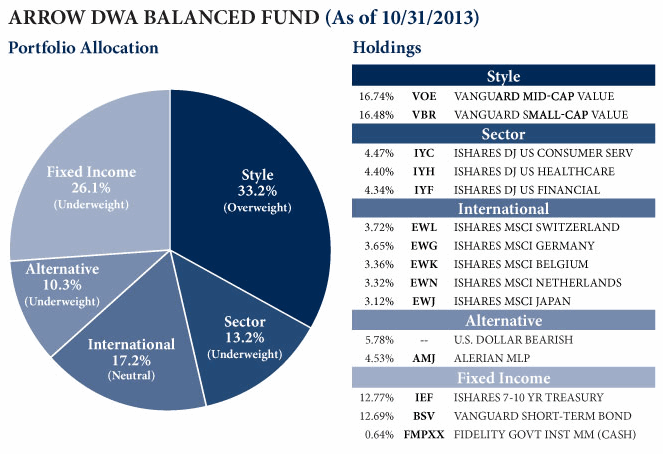
The Arrow DWA Balanced Fund (DWAFX)

At the end of October, the fund had approximately 47% in U.S. Equities, 25% in Fixed Income, 17% in International Equities, and 11% in Alternatives.

We had strong gains from our equity positions in October. For the month of October, Germany was up 5.54%, our Consumer Cyclical position was up 5.04%, Netherlands was up 4.95%, and our Mid-Cap Value position was up 4.65%. Our fixed income and currency positions were fairly flat for the month.

In U.S. equities, Small and Mid-Caps continue to have superior relative strength versus Large-Caps. Also, the composition of our international equity holdings has changed significantly over the last year. For most of 2012, the majority of our international holdings were from Emerging Markets. However, we started to see some important relative strength changes between Developed International Markets and Emerging Markets towards the middle of 2012. Currently, all five of our international holdings are from developed markets.

In the Alternative sleeve, we have exposure to MLPs and currencies. Commodities remain weak and are not represented in the fund.

DWAFX rose 2.75% in October, and is up 12.52% through 10/31/13.

We believe that a real strength of this strategy is its balance between remaining diversified, while also adapting to market leadership. When an asset class is weak its exposure will tend to be towards the lower end of the exposure constraints, and when an asset class is strong its exposure in the fund will trend toward the upper end of its exposure constraints. Relative strength provides an effective means of determining the appropriate weights of the strategy.

dwafx 11.07.13 October Arrow DWA Funds Review

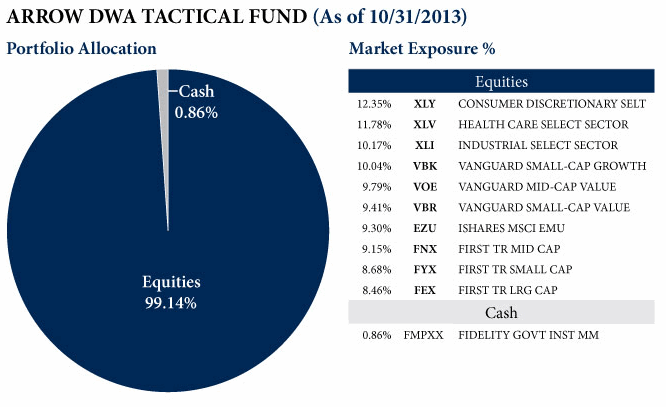
The Arrow DWA Tactical Fund (DWTFX)

At the end of October, the fund had approximately 90% in U.S. equities and 9% in International equities.

Some years it is helpful to remain widely diversified and other years it is better to be more concentrated. This is a year where our concentration in U.S. equities has really helped the performance of the fund as U.S. equities have generated some impressive returns. We did have a number of trades in October. We removed a Large Cap Value position, a Financial sector position, Japan, and a dividend-focused ETF. We added two Small-Cap ETFs, a European equity ETF, and an Industrials sector position. As is the nature of relative strength, if positions aren’t keeping up with other options in a rising market they can be sold even if they are rising (albeit more slowly than other positions in the universe).

DWTFX was up 3.60% in October, and has gained 19.71% through 10/31/13.

This strategy is a go-anywhere strategy with very few constraints in terms of exposure to different asset classes. The strategy can invest in domestic equities, international equities, inverse equities, currencies, commodities, real estate, and fixed income. Market history clearly shows that asset classes go through secular bull and bear markets and we believe this strategy is ideally designed to capitalize on those trends. Additionally, we believe that this strategy can provide important risk diversification for a client’s overall portfolio.

dwtfx 11.07.13 October Arrow DWA Funds Review

A list of all holdings for the trailing 12 months is available upon request. See www.arrowfunds.com for more information.

Posted by:


High RS Diffusion Index

November 6, 2013

The chart below measures the percentage of high relative strength stocks that are trading above their 50-day moving average (universe of mid and large cap stocks.) As of 11/5/13.

diffusion 11.06.13 High RS Diffusion Index

The 10-day moving average of this indicator is 87% and the one-day reading is also 87%.

Posted by:


Relative Strength Spread

November 5, 2013

The chart below is the spread between the relative strength leaders and relative strength laggards (universe of mid and large cap stocks). When the chart is rising, relative strength leaders are performing better than relative strength laggards. As of 11/4/2013:

spread 11.05.13 Relative Strength Spread

Since June of this year, the RS Spread has generally been trending higher—a potentially positive sign for relative strength strategies.

Posted by:


The Top Ten Ways to Sabotage Your Portfolio

November 4, 2013

Good portfolio management is difficult, while poor portfolio management is almost effortless! In the spirit of David Letterman’s Top Ten list, here is my contribution to the genre of things to avoid, with a special nod to our brand of investing. I made a version of this presentation originally at a 1996 Dorsey Wright Broker Institute.


THE TOP TEN WAYS TO SABOTAGE YOUR PORTFOLIO

1. BE ARROGANT. Assume your competition is lazy and stupid. Don’t do your homework and don’t bother with a game plan. Panic if things don’t go well.

2. WHEN A SECTOR OR THE MARKET REVERSES UP, WAIT UNTIL YOU FEEL COMFORTABLE TO BUY. This is an ideal method for catching stocks 10 points higher.

3. BE AFRAID TO BUY STRONG STOCKS. This way you can avoid the big long-term relative strength winners.

4. SELL A STOCK ONLY BECAUSE IT HAS GONE UP. This is an excellent way to cut your profits short. (If you can’t stand prosperity, trim if you must, but don’t sell it all.)

5. BUY STOCKS IN SECTORS THAT ARE SUPER EXTENDED BECAUSE IT’S DIFFERENT THIS TIME. Not.

6. TRY TO BOTTOMFISH A STOCK IN A DOWNTREND. Instead, jump off a building and try to stop 5 floors before you hit the ground. Ouch.

7. BUY A STOCK ONLY BECAUSE IT’S A GOOD VALUE. There are two problems with this. 1) It can stay a good value by not moving for the next decade, or worse 2) it can become an even better value by dropping another 10 points.

8. HOLD ON TO LOSING STOCKS AND HOPE THEY COME BACK. An outstanding way to let your losses run. Combined with cutting your profits short, over time you can construct a diversified portfolio of losers and register it with the Kennel Club.

9. PURSUE PERFECTION. There are two diseases. 1) Hunting for the perfect method. Trying a new “system” each week will not get you to your goal. It requires remaining focused on one method, maintaining consistency and discipline, and making incremental improvements. 2) Waiting for the perfect trade. The sector is right, the market is supporting higher prices, the chart is good—try to buy it a point cheaper and miss it entirely. Doh. Better to be approximately right than precisely wrong.

10. MAKE INVESTMENT DECISIONS BASED ON A MAGAZINE COVER, MEDIA ARTICLES, OR PUNDITS. Take investment advice from a journalist or a hedge fund manager talking his book! Get fully engaged with your emotions of fear and greed! This is the method of choice for those interested in the fastest route to the poorhouse.

Posted by:


Quote of the Week

November 4, 2013

It is remarkable how much long-term advantage people like us have gotten by trying to be consistently not stupid, instead of trying to be very intelligent.—-Charlie Munger

Warren Buffett and Charlie Munger think that some of their advantage is just in trying not to do anything stupid. Indeed, it is doing stupid stuff that is usually the problem in investing. Of course, it doesn’t seem stupid at the time—indeed, it usually seems very compelling—which is why it is difficult to recognize and stop. I follow with my contribution to the genre.

HT: Morgan Housel and Abnormal Returns

Posted by:


‘Smart Beta’ Equity ETFs Gather $45B YTD

November 4, 2013

IndexUniverse reports:

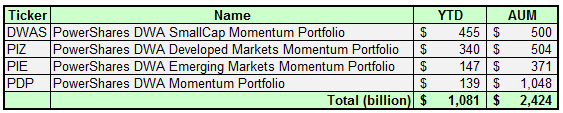
Investors have poured $45.93 billion into so-called “smart beta” equities ETFs so far this year, in what amounts to a 20 percent increase in total assets in the segment. The increase reflects just how strong an appetite there is for nonmarket-cap-weighted funds seeking excess returns—or outperformance—in one form or another.

Our contribution to that growth is as follows:

ps 11.04.13 Smart Beta Equity ETFs Gather $45B YTD

Source: PowerShares (click to enlarge)

With this year’s growth, the assets in our four momentum ETFs has nearly doubled.

Posted by:


Weekly RS Recap

November 4, 2013

The table below shows the performance of a universe of mid and large cap U.S. equities, broken down by relative strength decile and quartile and then compared to the universe return. Those at the top of the ranks are those stocks which have the best intermediate-term relative strength. Relative strength strategies buy securities that have strong intermediate-term relative strength and hold them as long as they remain strong.

Last week’s performance (10/28/13 – 11/1/13) is as follows:

ranks 11.04.13 Weekly RS Recap


High relative strength stocks generally performed better than the universe and better than the laggards last week.

Posted by:


Fund Flows

October 31, 2013

Mutual fund flow estimates are derived from data collected by The Investment Company Institute covering more than 95 percent of industry assets and are adjusted to represent industry totals.

ici 10.31.13 Fund Flows

Posted by: