Momentum Coming of Age

September 27, 2013

We’ve come a long way from the days of “Wall Street is a random walk, and past price movements tell you nothing about the future,” as advocated by Efficient Market Hypothesis (EMH) proponents Burton Malkiel and Eugene Fama in the 1960s and 1970s. While practioners have been using relative strength strategies since at least the 1930s (Richard Wyckoff, H.M. Gartley, Robert Levy, George Chestnut, and many others), most academics stayed fairly loyal to the EMH until the early 1990s. Wesley Gray, PhD, of Turnkey Analyst, summarizes how academic studies on momentum in the early 1990s started to turn the tide in a academic community:

In the early 90s academics (e.g., Jagadeesh and Titman (1993) began to focus on the concept of “momentum,” which refers to the fact that, contrary to the EMH, past returns can predict future returns, via a trend effect. That is, if a stock has performed well in the recent past, it will continue to perform well in the future. EMH proponents were perplexed, but argued that momentum returns were likely related to additional risks borne: riskier smaller and cheaper companies drove the effect. Many researchers have responded with studies that find the effect persists even when controlling for company size and value factors. And the effect appears to hold across multiple asset classes, such as commodities, currencies and even bonds. (e.g., Check out Chris Geczy’s “World’s Longest Backtest”).

momentum

An EMH advocate reviews the momentum data

It seems that much of the research on momentum today is moving beyond the initial question of “Is it possible that momentum really does work?” to trying to better understand why it works.

Again, from Wesley Gray:

In short, it appears the evidence for momentum is only growing stronger (Gary Antonacci has some great research on the subject: http://optimalmomentum.blogspot.com/). Today researchers are going even farther by applying behavioral finance concepts in order to understand psychological factors that drive the momentum effect.

In “Demystifying Managed Futures,” by Brian Hurst, Yao Hua Ooi, and Lasse Heje Pedersen, the authors argue that the returns for even the largest and most successful Managed Futures Funds and CTAs can be attributed to momentum strategies. They also discuss a model for the lifecycle of a trend, and then draw on behavioral psychology to hypothesize the cognitive mechanisms that drive the underlying momentum effect. Below is a graph of a typical trend:

trend

Note that there are several distinct components to the trend: 1) initial under-reaction, when market price is below fundamental value, 2) over-reaction, as the market price exceeds fundamental value, and 3) the end of the trend, when the price converges with fundamental value. There are several behavioral biases that may systematically contribute to these components.

Under-reaction phase:

Adjustment and Anchoring. This occurs when we consider a value for a quantity before estimating that quantity. Consider the following 2 questions posed by Kahneman: Was Gandhi more or less than 144 years old when he died? How old was Gandhi when he died? Your guess was affected by the suggestion of his advanced age, which led you to anchor on it and then insufficiently adjust from that starting point, similar to how people under-react to news about a security. (also, Gandhi died at 79)

The disposition effect. This is the tendency of investors to sell their winners too early and hold onto losers too long. Selling early creates selling pressure on a long in the under-reaction phase, and reduces selling pressure on a short in the under-reaction phase, thus delaying the price discovery process in both cases.

Over-reaction phase:

Feedback trading and the herd effect. Traders follow positive feedback strategies. For instance, George Soros has described his concept of “reflexivity,” which involves buying in anticipation of further buying by uninformed investors in a self-reinforcing process. Additionally, herding can be a defense mechanism occurring when an animal reduces its risk of being eaten by a predator by staying with the crowd. As Charles MacKay put it in 1841 in his book, Extraordinary Popular Delusions and Madness of Crowds, “Men, it has been well said, think in herds; it will be seen that they go mad in herds, while they only recover their senses slowly, and one by one.”

Gray concludes:

The growing academic body of work supporting the existence of the momentum effect, along with a sensible psychological framework that explains it, are a potent combination. Indeed, momentum may have come of age as an investment tool, as more and more investors incorporate it into their portfolios.

Dorsey Wright has been refining work on relative strength/momentum for decades and the recent milestone of the PowerShares DWA Momentum ETFs (PDP, PIZ, PIE, and DWAS) passing $2 billion in assets is further confirmation that “momentum is coming of age.” Furthermore, users of the Dorsey Wright research have a great number of relative strength-based tools (RS Matrix, Favored Sector, Dynamic Asset Level Investing, Technical Attributes…) at their fingertips to be able to customize relative strength-based strategies for their clients. It’s been a long time coming, and acceptance of momentum still has a long way to go, but it is encouraging to see this factor begin to get the recognition that I believe it is due.

Posted by:


The Case for Systematic Decision-Making

September 25, 2013

From Wes Gray comes an excellent video about expert decision making versus model-based decision making. Well worth the 17 minutes.

Posted by:


From the Archives: Mebane Faber’s New White Paper on Relative Strength

September 17, 2013

Mebane Faber recently released a nice white paper, Relative Strength Strategies for Investing, in which he tested relative strength models consisting of US equity sectors from 1926-2009. He also tested relative strength models consisting of global assets like foreign stocks, domestic stocks, bonds, real estate, and commodities from 1973-2009. The relative strength measures that he used for the studies are publicly-known methods based on trailing returns. Some noteworthy conclusions from the paper:

  • Relative strength models outperformed buy-and-hold in roughly 70% of all years
  • Approximately 300-600 basis points of outperformance per year was achieved
  • His relative strength models outperformed in each of the 8 decades studied

I always enjoy reading white papers on relative strength. It is important to mention that the methods of calculating relative strength that were used in Faber’s white paper are publicly-known and have been pointed to for decades by various academics and practitioners. Yet, they continue to work! Those that argue that relative strength strategies will eventually become so popular that they will cease to work have some explaining to do.

—-this article originally appeared 4/20/2010. Of course, the white paper is no longer new at this point, but it is a reminder of the durability of relative strength as a return factor. Every investing method goes through periods of favor and disfavor. Investors are, unfortunately, likely to abandon even profitable methods at the worst possible time. This paper is a good reminder that return factors are durable, but patience may be required to harvest those returns. Most often, the investor that sticks to it will be rewarded.

Posted by:


Relative Strength Environments

August 9, 2013

What market environments are best for relative strength strategies? Our partners at Arrow Funds recently completed a nice research piece that addresses that question. The essential factors are correlations and dispersions (both of which are looking better for relative strength by the way). Click below to read the report.

RS Environments

Posted by:


Factor Performance and Factor Failure

July 30, 2013

Advisor Perspectives recently carried an article by Michael Nairne of Tacita Capital about factor investing. The article discussed a number of aspects of factor investing, including factor performance and periods of factor underperformance (factor failure). The remarkable thing about relative strength (termed momentum in his article) is the nice combination of strong performance and relatively short periods of underperformance that it affords the investor seeking alpha.

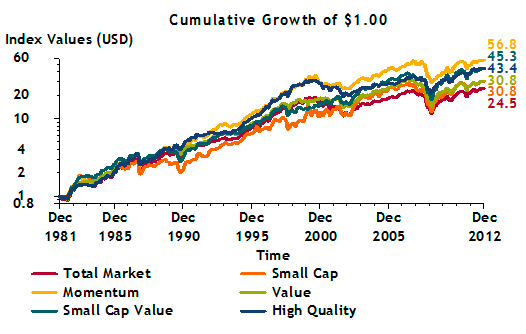
Mr. Nairne discusses a variety of factors that have been shown to generate excess returns over time. He includes a chart showing their performance versus the broad market.

Source: Advisor Perspectives/Tacita Capital (click on image to enlarge)

Yep, the one at the top is momentum.

All factors, even very successful ones, underperform from time to time. In fact, the author points out that these periods of underperformance might even contribute to their factor returns.

No one can guarantee that the return premia originating from these dimensions of the market will persist in the future. But, the enduring nature of the underlying causes – cognitive biases hardwired into the human psyche, the impact of social influences and incremental risk – suggests that higher expected returns should be available from these factor-based strategies.

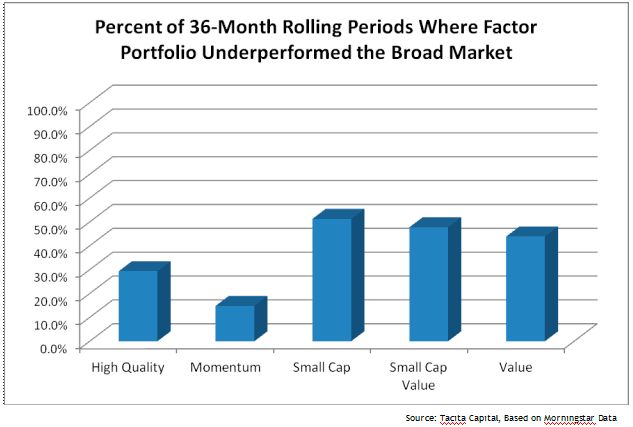
There is another reason to believe that these strategies offer the prospect of future return premia for patient, long-term investors. These premia are very volatile and can disappear or go negative for many years. The chart on the following page highlights the percentage of 36-month rolling periods where the factor-based portfolios – high quality, momentum, small cap, small cap value and value – underperformed the broad market.

To many investors, three years of under-performance is almost an eternity. Yet, these factor portfolios underperformed the broad market anywhere from almost 15% to over 50% of the 36-month periods from 1982 to 2012. If one were to include the higher transaction costs of the factor-based portfolios due to their higher turnover, the incidence of underperformance would be more frequent. One of the reasons that these premia will likely persist is that many investors are simply not patient enough to stay invested to earn them.

The bold is mine, but I think Mr. Nairne has a good point. Many investors seem to believe in magic and want their portfolio to significantly outperform—all the time.

That’s just not going to happen with any factor. Not surprisingly, though, momentum has tended to have shorter stretches of underperformance than many other factors, a consideration that might have been partially responsible for its good performance over time. Mr. Nairne’s excellent graphic on periods of factor failure is reproduced below.

Source: Advisor Perspectives/Tacita Capital (click on image to enlarge)

Once again, whether you choose to try to harvest returns from relative strength or from one of the other factors, patience is an underrated component of actually receiving those returns. The market can be a discouraging place, but in order to reap good factor performance you have to stay with it during the inevitable periods of factor failure.

Posted by:


Relative Strength Spread

July 23, 2013

The chart below is the spread between the relative strength leaders and relative strength laggards (universe of mid and large cap stocks). When the chart is rising, relative strength leaders are performing better than relative strength laggards. As of 7/22/2013:

Capture

Posted by:


212 Years of Price Momentum

July 23, 2013

Christopher Geczy, University of Pennsylvania, and Mikhail Samonov, Octoquant.com, recently published the world’s longest backtest on momentum (1801 – 2012). This is a truly fascinating white paper. So much of the testing on momentum has been done on the CRSP database of U.S. Securities which goes back to 1926. Now, we can get a much longer-term perspective on the performance of momentum investing.

Abstract:

We assemble a dataset of U.S. security prices between 1801 and 1926, and create an out-of-sample test of the price momentum strategy, discovered in the post-1927 data. The pre-1927 momentum profits remain positive and statistically significant. Additional time series data strengthens the evidence that momentum is dynamically exposed to market beta, conditional on the sign and duration of the tailing market state. In the beginning of each market state, momentum’s beta is opposite from the new market direction, generating a negative contribution to momentum profits around market turning points. A dynamically hedged momentum strategy significantly outperforms the un-hedged strategy.

Yep, momentum worked then too! As pointed out in the white paper, those looking for a return factor that outperforms every single year will not find it with price momentum (or any other factor), but momentum has a long track record of generating excess returns.

So much for the theory that ideas in investing tend to streak, get overinvested, then die. Some, like momentum (or value), go in an out of favor, but they have generated very robust returns over long periods of time.

HT: Abnormal Returns and Turnkey Analyst

Past performance is no guarantee of future returns.

Posted by:


How to Pick a Winner

July 23, 2013

Scientific American takes a look at the best way to select a winner:

Given the prevalence of betting and the money at stake, it is worth considering how we pick sides. What is the best method for predicting a winner? One might expect that, for the average person, an accurate forecast depends on the careful analysis of specific, detailed information. For example, focusing on the nitty-gritty knowledge about competing teams (e.g., batting averages, recent player injuries, coaching staff) should allow one to predict the winner of a game more effectively than relying on global impressions (e.g., overall performance of the teams in recent years). But it doesn’t.

In fact, recent research by Song-Oh Yoon and colleagues at the Korea University Business School suggests that when you zero in on the details of a team or event (e.g., RBIs, unforced errors, home runs), you may weigh one of those details too heavily. For example, you might consider the number of games won by a team in a recent streak, and lose sight of the total games won this season. As a result, your judgment of the likely winner of the game is skewed, and you are less accurate in predicting the outcome of the game than someone who takes a big picture approach. In other words, it is easy to lose sight of the forest for the trees.

So often people that consider employing relative strength strategies, which measure overall relative price performance of securities rather than delving into the weeds with various accounting level details, feel like they must not be doing an adequate job of analyzing the merits of a given security. As pointed out in this research, the best results came from focusing on less data, not more.

Whether trying to select a winner in sports or in the stock market, it is important to remember that “detailed analysis fog the future.”

Posted by:


Alternative Beta

July 22, 2013

…has been discovered by the Wall Street Journal. Recently, they wrote an article about better ways to index—alternative beta—and referenced a study by Cass Business School. (We wrote about this study here in April.)

Here’s the WSJ’s take on the Cass Business School study:

The Cass Business School researchers examined how 13 alternative index methodologies would have performed for the 1,000 largest U.S. stocks from 1968 to 2011.

All 13 of the alternative indexes produced higher returns than a theoretical market-cap index the researchers created. While the market-cap index generated a 9.4% annualized return over the full period, the other indexes delivered between 9.8% and 11.4%. The market-cap-weighted index was the weakest performer in every decade except the 1990s.

The most interesting part of the article, to me, was the discussion of the growing acceptance of alternative beta. This is truly exciting.

Indeed, a bevy of funds tracking alternative indexes have been launched in recent years. And their popularity is soaring: 43% of inflows into U.S.-listed equity exchange-traded products in the first five months of 2013 went to products that aren’t weighted by market capitalization, up from 20% for all of last year, according to asset manager BlackRock Inc.

And then there was one mystifying thing: although one of the best-performing alternative beta measures is relative strength (“momentum” to academics), relative strength was not mentioned in the WSJ article at all!

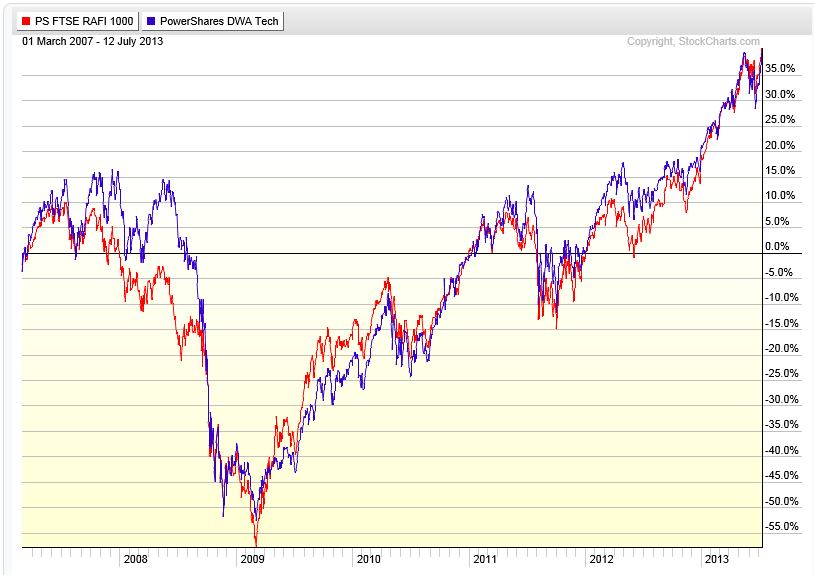
Instead there was significant championing of fundamental indexes. Fundamental indexes are obviously a valid form of alternative beta, but I am always amazed how relative strength flies under the radar. (See The #1 Investment Return Factor No One Wants to Talk About.) Indeed, as you can see from the graphic below, the returns of two representative ETFs, PRF and PDP are virtually indistinguishable. One can only hope that relative strength will eventually gets its due.

The performance numbers above are pure price returns, based on the applicable index not inclusive of dividends, fees, commissions, or other expenses. Past performance not indicative of future results. Potential for profits accompanied by possibility of loss. See www.powershares.com for more information.

Posted by:


Academic Perspective on Momentum-Based Investing Webinar

July 2, 2013

Come listen to an academic perspectives as to why momentum-based investing makes sense, and how you may be able to take advantage of it, from one of the pioneers in momentum and relative strength investing, Dorsey Wright & Associates. This webinar features Tom Dorsey and Andy Hyer.

Click here for a replay of the webinar.

powershares

Posted by:


DWTFX Tops Peers

June 14, 2013

Earlier this year, we featured an excellent resource published by our partners at Arrow Funds called Relative Strength Turns. You can access a PDF of the brochure by clicking here. This research discusses the type of behavior you can expect from a relative strength driven strategy in various market cycles and it makes the case for why relative strength strategies may experience favorable returns in the years ahead.

Interestingly, we have seen this corroborated by the performance of the Arrow DWA Tactical Fund, which employs a largely unconstrained application of relative strength to multiple asset classes. With YTD performance of 10.65% through 6/13/13, it is outperforming 99% of its peers in the Morningstar World Allocation category.

DWTFX

Past performance is no guarantee of future returns.

This strategy is available in the Arrow DWA Tactical Fund (DWTFX) and also as a separately managed account as our Global Macro strategy, which is available on a number of major platforms, including the Wells Fargo Masters and DMA platforms.

Please click here and here for disclosures.

Posted by:


From the Archives: If You Miss the 10 Best Days

June 7, 2013

We’ve all seen numerous studies that purport to show how passive investing is the way to go because you don’t want to be out of the market for the 10 best days. No one ever mentions that the “best days” most often occur during the declines!

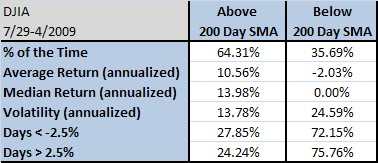
It turns out that the majority of the best days and the worst days occur near one another, during the declines. Why? Because the market is more volatile during declines. It is true that the market goes down 2-3x as fast as it goes up. (World Beta has a nice post on this topic of volatility clustering, which is where this handy-dandy table comes from.)

 If You Miss the 10 Best Days

from World Beta

You can see how volatility increases and the number of days with daily moves greater than 2.5% really spikes when the market is in a downward trend. It would seem to be a very straightforward proposition to improve your returns simply by avoiding the market when it is in a downtrend.

However, not every strategy can be improved by going to cash. Think about the math: if your investing methodology makes enough extra money on the good days to offset the bad days, or if it can make money during a significant number of the declines, you might be better off just gritting your teeth during the declines and banking the higher returns. Although the table above suggests it should help, a simple strategy of exiting the market (i.e., going to cash) when it is below its 200-day moving average may not always live up to its theoretical billing.

 If You Miss the 10 Best Days

 If You Miss the 10 Best Days

click to enlarge

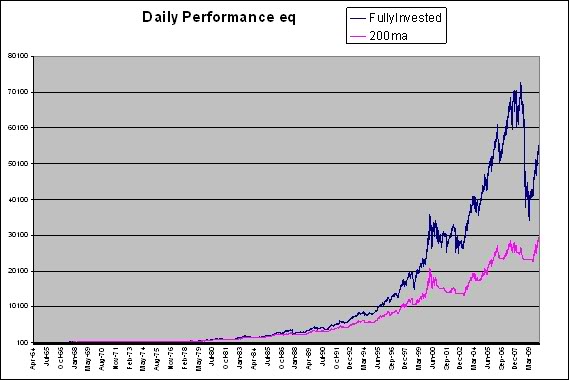
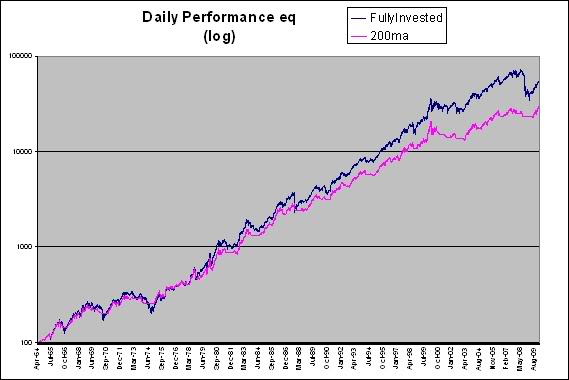
Consider the graphs above. (The first graph uses linear scaling; the second uses logarithmic scaling for the exact same data.) This test uses Ken French’s database to get a long time horizon and shows the returns of two portfolios constructed with market cap above the NYSE median and in the top 1/3 for relative strength. In other words, the two portfolios are composed of mid- and large-cap stocks with good relative strength. The only difference between the two portfolios is that one (red line) goes to cash when it is below its 200-day moving average. One portfolio (blue line) stays fully invested. The fully invested portfolio turns $100 into $49,577, while the cash-raising portfolio yields only $26,550.

If you would rather forego the extra money in return for less volatility, go right ahead and make that choice. But first stack up 93 boxes of Diamond matches so that you can burn 23,027 $1 bills, one at a time, to represent the difference–and then make your decision.

 If You Miss the 10 Best Days

The drawdowns are less with the 200-day moving average, but it’s not like they are tame–equities will be an inherently volatile asset class as long as human emotions are involved. There are still a couple of drawdowns that are greater than 20%. If an investor is willing to sit through that, they might as well go for the gusto.

As surprising as it may seem, the annualized return over a long period of time is significantly higher if you just stay in the market and bite the bullet during train wrecks–and even two severe bear markets in the last decade have not allowed the 200-day moving average timer to catch up.

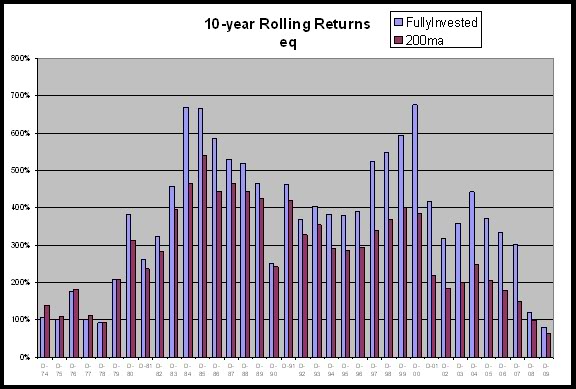
At the bottom of every bear market, of course, it certainly feels like it would have been a good idea (in hindsight) to have used the 200-day moving average to get out. In the long run, though, going to cash with a high-performing, high relative strength strategy might be counterproductive. When we looked at 10-year rolling returns, the fully invested high relative strength model has maintained an edge in returns for the last 30 years running.

 If You Miss the 10 Best Days

click to enlarge

Surprising, isn’t it? Counterintuitive results like this are one of the reasons that we find testing so critical. It’s easy to fall in line with the accepted wisdom, but when it is actually put to the test, the accepted wisdom is often wrong. (We often find that even when shown the test data, many people refuse, on principle, to believe it! It is not in their worldview to accept that one of their cherished beliefs could be false.) Every managed portfolio in our Systematic RS lineup has been subjected to heavy testing, both for returns and–and more importantly–for robustness. We have a high degree of confidence that these portfolios will do well in the long run.

—-this article originally appeared 3/5/2010. We find that many investors continue to refuse, on principle, to believe the data! If you have a robust investment method, the idea that you can improve your returns by getting out of the market during downturns appears to be false. (Although it could certainly look true for small specific samples. And, to be clear, 100% invested in a volatile strategy is not the appropriate allocation for most investors.) Volatility can generally be reduced somewhat, but returns suffer. One of our most controversial posts ever—but the data is tough to dispute.

In more recent data, the effect can be seen in this comparison of an S&P; 500 ETF and an ETN that switches between the S&P; 500 and Treasury bills based on a 200-day moving average system. The volatility has been muted a little bit, but so have the returns.

(click on image to enlarge)

Posted by:


From the Archives: Perfect Sector Rotation

June 4, 2013

CXO Advisory has a very interesting blog piece on this topic. They review an academic paper that looks at the way conventional sector rotation is done. Typically, various industry sectors are categorized as early cycle, late cycle, etc. and then you are supposed to own those sectors at that point in the business cycle. Any number of money management firms (not including us) hang their hat on this type of cycle analysis.

In order to determine the potential of traditional sector rotation, the study assumes that you get to have perfect foresight into the business cycle and then you rotate your holdings with the conventional wisdom of when various industries perform best. A couple of disturbing things crop up, given that this is the best you could possibly do with this system.

1) You can squeak by with about 2.3% annual outperformance if you had a crystal ball. If you are even a month or two early or late on the cycle turns, your performance is statistically indistinguishable from zero.

2) 28 of the 48 industries studied (58.3%) underperformed during the times when they were supposed to perform well. There’s obviously enough noise in the system that a sector that is supposed to be strong or weak during a particular part of the cycle often isn’t.

CXO notes, somewhat ironically:

Note that NBER can take as long as two years after a turning point to designate its date and that one business cycle can be very different from another.

In other words, it’s clear that traditional business cycle analysis is not going to help you. You won’t be able to forecast the cycle turning points accurately and the cycles differ so much that industry performance is not consistent.

Sector rotation using relative strength is a big contrast to this. Relative strength makes no a priori assumptions about which industries are going to be strong or weak at various points in the business cycle. A systematic strategy just buys the strong sectors and avoids the weak ones. Lots of studies show that significant outperformance can be earned using relative strength (momentum) with absolutely no insight into the business cycle at all, including some studies done by CXO Advisory. Tactical asset allocation is finally coming into its own and various ways of implementing are available. Business cycle forecasting does not appear to be a feasible way to do it, but relative strength certainly is!

—-this article originally appeared 3/30/2010. Although the link to CXO Advisory is no longer live, you can get the gist of things from the article. Things don’t always perform in the expected fashion, and paying attention to relative strength can be some protection from the problem. Instead of making assumptions about strong or weak performance, relative strength just adapts.

Posted by:


The Wonders of Momentum

April 18, 2013

Relative strength investors will be glad to know that James Picerno’s Capital Spectator blog has an article on the wonders of momentum. He discusses the momentum “anomaly” and its history briefly:

Momentum is one of the oldest and most persistent anomalies in the financial literature. The tendency of positive or negative returns to persist for a time seems like a ridiculously simple predictor, but it works. There’s an ongoing debate about why it works, but the results in numerous tests speak loud and clear. Unlike many (most?) reported sources of alpha, the market-beating and risk-lowering results linked to momentum strategies appear to be immune to arbitrage.

Informally, it’s fair to say that investors have been exploiting momentum in various forms for as long as humans have been trading assets. Formally, the concept dates to at least 1937, when Alfred Cowles and Herbert Jones reviewed momentum in their paper “Some A Priori Probabilities in Stock Market Action.” In the 21st century, an inquiring reader can easily find hundreds of papers on the subject, most of it published in the wake of Jegadeesh and Titman’s seminal 1993 work: “Returns to Buying Winners and Selling Losers: Implications for Stock Market Efficiency,” which marks the launch of the modern age of momentum research.

I think his observation that momentum (relative strength to us) has been around since humans have been trading assets is spot on. It’s important to keep that in mind when thinking about why relative strength works—and why it has been immune to arbitrage. He writes:

Momentum, it seems, is one of the rare risk factors with features that elude so many other strategies: It’s persistent, conceptually straightforward, robust across asset classes, and relatively easy to implement. It’s hardly a silver bullet, but nothing else is either.

The only mystery: Why are we still talking about this factor in glowing terms? We still don’t have a good answer to explain why this anomaly hasn’t been arbitraged away, or why it’s unlikely to meet an untimely demise anytime soon.

Mr. Picerno raises a couple of important points here. Relative strength does have a lot of attractive features. The reason it is not a silver bullet is that it underperforms severely from time to time. Although that is also true of other strategies, I think the periodic underperformance is one of the reasons why the excess returns have not been arbitraged away.

Although he suggests we don’t have a good answer about why momentum works, I’d like to offer my explanation. I don’t know if it’s a good answer or not, but it’s what I’ve arrived at after years of research and working with relative strength portfolios—not to mention a degree in psychology and a couple of decades of seeing real investors operate in the market laboratory.

  • Relative strength straddles both fundamental analysis and behavioral finance.
  • High relative strength securities or assets are generally strong because they are undergoing fundamental improvement or are in a sweet spot for fundamentals. In other words, if oil prices are trending strongly higher, it’s not surprising that certain energy stocks are strong. That’s to be expected from the fundamentals. Often there is improvement at the margin, perhaps in revenue growth or operating margin—and that improvement is often underestimated by analysts. (Research shows that investors are more responsive to changes at the margin than to the absolute level of fundamental factors. For example, while Apple’s operating margin grew from 2.2% in 2003 to 37.4% in 2012, the stock performed beautifully. Even though the operating margin is expected to be in the 35% range this year—which is an extremely high level—the stock is getting punished. Valero’s stock price plummeted when margins went from 10.0% in 2006 to 2.4% in 2009, but has doubled off the low as margins rebounded to 4.8% in 2012. Apple’s operating margin on an absolute basis is drastically higher than Valero’s, but the delta is going the wrong way.) High P/E multiples can often be maintained as long as margin improvement continues, and relative strength tends to take advantage of that trend. Often these trends persist much longer than investors expect.
  • From the behavioral finance side, social proof helps reinforce relative strength. Investors herd and they gravitate toward what is already in motion, and that reinforces the price movement. They are attracted to the popular and repelled by the unpopular.
  • Periodic bouts of underperformance help keep the excess returns of relative strength high. When momentum goes the wrong way it can be ugly. Perhaps margins begin to contract and financial results are worse than analysts expect. The security has been rewarded with a high P/E multiple, which now begins to unwind. The herd of investors begins to stampede away, just as they piled in when things were going well. Momentum can be volatile and investors hate volatility. Stretches of underperformance are psychologically painful and the unwillingness to bear pain (or appropriately manage risk) discourages investors from arbitraging the excess returns away.

In short, I think there are multiple reasons why relative strength works and why it is difficult to arbitrage away the excess returns. Those reasons are both fundamental and behavioral and I suspect will defy easy categorization. Judging from my morning newspaper, human nature doesn’t change much. Until it does, markets are likely to work the same way they always have—and relative strength is likely to continue to be a powerful return factor.

Posted by:


Momentum: “A Powerful Way To Enhance Returns”

April 10, 2013

Morningstar does a pretty deep dive into momentum in their article Does Momentum Investing Work? I highly recommend reading the whole article as it covers some excellent long-term studies of momentum. It also has a nice profile of our PowerShares DWA Technical Leaders ETF (PDP).

While practitioners have been exploiting this relationship for decades, the idea has gained broad acceptance in the academic community only within the past 20 years. Momentum runs counter to the predictions of the efficient market hypothesis, but the evidence is too overwhelming to ignore.

Included in their article was the following study of momentum on U.S. and global stocks:

The tables below illustrate the momentum effect among large-cap U.S. and global stocks. Each column represents a fifth of the total number of stocks in the sample, which are ranked by their momentum. While there is not a linear relationship between the momentum quintiles, stocks with the highest momentum consistently outperform those in the lowest momentum quintile. Small-cap stocks tend to exhibit a stronger momentum effect. However, they can be more expensive to trade.

french

I also enjoyed this part about how the persistence of excess returns from momentum strategies continues to baffle people:

This evidence creates a puzzle. If the market were efficient, a simple trading rule should not produce superior returns. Arbitrage is a powerful force that should eliminate any excess profits, and yet, momentum has persisted 20 years after it was first widely published. Perhaps more troubling to disciples of Ben Graham and Warren Buffett, momentum appears to be at odds with decades of research, which suggest that stocks trading at low valuations tend to outperform.

The article also makes a strong case for why momentum makes a better companion for value than does growth:

In their paper, “Value and Momentum Everywhere,” Asness, Moskowitz, and Pedersen found that momentum worked well when value didn’t, and vice versa. Because they are two sides of the same coin, each with excess returns, combining value and momentum in a portfolio can offer powerful diversification benefits.

It’s not necessary, or advisable, to abandon value investing to benefit from momentum. Instead, momentum may be a good substitute for investors’ growth allocations. Momentum offers higher expected returns than growth and tends to be less correlated with value. The chart below compares the performance of a portfolio consisting equal weights in the Russell 1000 Value and Growth indexes, with a portfolio that replaces the growth allocation with the AQR Momentum Index. The two portfolios have similar volatility, but the value and momentum portfolio offers slightly better absolute and risk-adjusted returns.

momentum_value

Finally, I agree with Morningstar’s assessment of why the excess returns from momentum are likely to persist:

While a diversified and systematic momentum strategy can offer a powerful way to enhance returns, selecting a few stocks on the 52-week high list is a very bad idea. It is difficult to anticipate when a run will end and there may be no greater fool to bail you out. Although momentum is a short-term phenomenon, it is best suited for long-term investors. It won’t always work, but there’s a good chance that a disciplined momentum strategy will continue to outperform over the long term. After all, investor behavior won’t change overnight.

HT: Abnormal Returns

Posted by:


The Capitalism Distribution

March 21, 2013

Why relative strength?

Longboard Asset Management completed a study called The Capitalism Distribution that examined stock returns from the top 3000 stocks from 1983-2007. They found that:

-39% of stocks were unprofitable investments.

-19% of stocks lost at least 75% of their value.

-64% of stocks underperformed the index.

-25% of stocks were responsible for all the market’s gains.

Simply picking a stock out of a hat means you have a 64% chance of underperforming a basic index fund, and roughly a 40% chance of losing money!

Luckily, investors don’t need to picks stocks out of a hat and hope they get lucky in order to find the winners. Relative strength provides an effective framework for building a portfolio of winners and capitalizing on long term trends. Click here to read Relative Strength and Portfolio Management by John Lewis to see the results of relative strength tests on U.S. equities over a 16 year period. As summarized in the paper:

Relative strength and momentum strategies have delivered market-beating returns for many years. There has been a great deal of research in this area by both practitioners and academics. However, despite this public disclosure of information, these strategies continue to outperform over time. Many of the testing methodologies used over the years are not consistent with real-world portfolio construction and do not address the possible range of outcomes when implementing a relative strength strategy. Our continuous, Monte Carlo testing process corrects for both of these deficiencies. Similar to other research, our process shows simple relative strength factors to be extremely robust over intermediate horizon formation periods, and weak over very short-term and long-term horizons. We also find there can be great variation in portfolio returns over short time periods, but over long holding periods the portfolios perform exceptionally well.

HT: Mebane Faber Research

Posted by:


Emerging Markets ETFs

March 21, 2013

Morningstar came out with a piece yesterday titled Are There Better Emerging-Markets ETF Choices? The article discussed the availability of alternative beta funds in the area, and had this to say, in part, about momentum:

While there has been relatively little academic research done on momentum in emerging-markets stocks, it has been observed in this asset class. There is currently one ETF that looks to capitalize on momentum in emerging-markets stocks–PowerShares DWA Emerging Markets (PIE), which was launched in December 2007. Over the five year period ending Feb. 28, 2013, this fund’s benchmark index produced annualized returns that outstripped the MSCI Emerging Markets Index by 155 basis points while exhibiting fairly similar levels of volatility.

Risk-tolerant investors looking for more growth-oriented exposure to emerging markets may want to consider PIE; it is currently the only emerging-markets ETF of reasonable size to provide a growth tilt.

The article also discusses some of the funds that offer low-volatility exposure, but did not mention that the low-vol and high relative strength return factors often complement one another nicely. In the domestic market, we’ve seen that these factors have excess returns that are negatively correlated. Although usage of low volatility in emerging markets has a much shorter history, it’s possible that we’ll see the same thing there over time.

It’s nice to see Morningstar give relative strength some attention!

Source: Yahoo! Finance

See www.powershares.com for more information. Past performance is no guarantee of future returns.

Posted by:


Relative Strength Turns

March 21, 2013

Our partners at Arrow Funds have recently published some relative strength research that should be essential reading for any advisor who is looking to provide value to their clients. Relative Strength Turns provides important insights into the cyclical nature of relative strength performance and makes a compelling case why now may be a great time to be allocating to relative strength strategies.

Historically, over very long periods of time, each of these relative strength models outperforms a buy-and-hold equity model. However, like many investment approaches, relative strength will sometimes underperform the market, and at other times it may outperform. This comparative performance, also known as RS Alpha, can be cyclical resulting in long-term trends with significant tops followed by underperformance and bottoms folloed by outperformance, as the chart below illustrates.

When the trend turns upward, it starts long periods of time when relative strength performance above the historical average.

The normal course of business in this industry is for fund companies to pound the table on a strategy or return factor that has already had an extended run of outperformance. Arrow Funds has taken a different approach with this research. Using historical data, they make a solid case for why relative strength is a winning long-term return factor and why the opportunity to enter relative strength strategies now may be particularly profitable.

Click below to read the entire piece.

Past performance is no guarantee of future returns. Click here for disclosures.

Posted by:


86 Years of High Relative Strength

February 5, 2013

Ken French’s database is an unparalleled and *free* source of all types of stock market data. We’ve used this database to track high relative strength performance versus the broad market, other indices, against moving averages, and other return factors (like value).

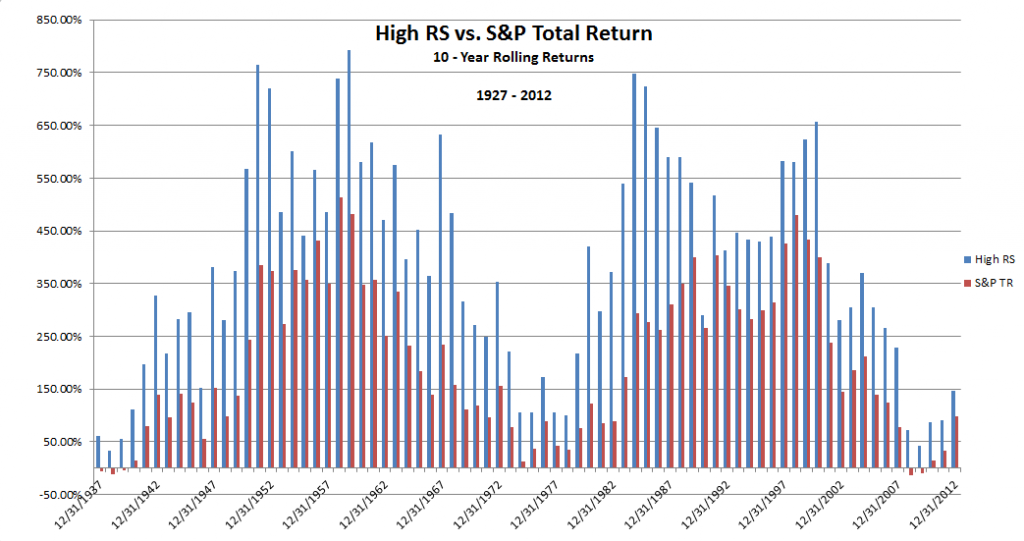
Let’s dip back into the well for another go-round. Today, we updated our database to account for the full year of 2012. The chart below shows the 10-year rolling return numbers for the High RS portfolio on the Ken French website. Click here to read the description of how this portfolio is constructed. In layman’s terms, it’s the biggest stocks by market capitalization (top half), and the best performing stocks by price performance (top third). The results speak for themselves. Since 1927, the 10-year rolling return of the High RS portfolio has outperformed the S&P; 500 Total Return index an astonishing 100% of the time.

“All I do is win”

Source: Ken French Database, Global Financial Data, Click to enlarge

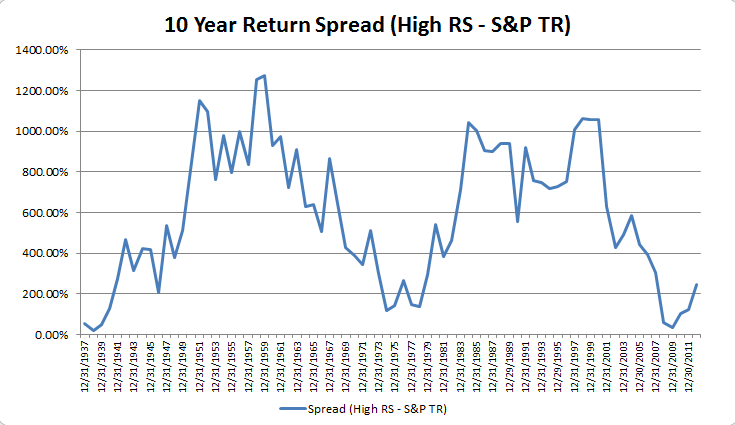
Using that data, we constructed a linear graph of the spread between the two indexes. The spread was constructed by subtracting the 10-year rolling return of the S&P; Total Return from the returns of the High RS portfolio.

Source: Ken French Database, Click to enlarge

The spread looks to be exiting a recent low. Over the last near-century, these types of lows in the High RS Spread have led to extreme outperformance in the 10-year rolling numbers. Of course, there is no way to tell what will happen in the future. However, using the past as our guide, we believe that going forward, the relative strength factor will continue to be a source for outperformance in a constantly changing market.

Posted by:


Relative Strength: A Solid Investment Method

January 28, 2013

We are fond of relative strength. It’s a solid investment method that have proven itself over a long period of time. Sure, it has its challenges and there are certainly periods of time during which it underperforms, but all-in-all it works and it’s been good to us. It’s always nice, though, when I run across another credible source that sings its praises. Consider the following excerpt from an article on the Optimal Momentum blog:

Momentum, on the other hand, has always made sense. It is based on the phrase “cut your losses; let your profits run on,” coined by the famed economist David Ricardo in the 1700s. Ricardo became wealthy following his own advice. [Editor’s note: We wrote about this in David Ricardo’s Golden Rules.] Many others, such as Livermore, Gartley, Wycoff, Darvas, and Driehaus, have done likewise over the following years. Behavioral finance has given solid reasons why momentum works. The case for momentum is now so strong that two of the fathers of modern finance, Fama and French, call momentum “the premier market anomaly” that is “above suspicion.”

Momentum, on the other hand, is pretty simple. Every approach, including momentum, must determine what assets to use and when to rebalance a portfolio. The single parameter unique to momentum is the look back period for determining an asset’s relative strength. In a 1937, using data from 1920 through 1935, Cowles and Jones found stocks that performed best over the past twelve months continued to perform best afterwards. In 1967, Bob Levy came to the same conclusion using a six-month look back window applied to stocks from 1960 through 1965. In 1993, using data from 1962 through 1989 and rigorous testing methods, Jegadeesh and Titman (J&T;) reaffirmed the validity of momentum. They found the same six and twelve months look back periods to be best. Momentum is not only simple, but it has been remarkably consistent over the past seventy-five years.

Momentum, on the other hand, is one of the most robust approaches in terms of its applicability and reliability. Following the 1993 seminal study by J&T;, there have been nearly 400 published momentum papers, making it one of the most heavily researched finance topics over the past twenty years. Extensive academic research has shown that price momentum works in virtually all markets and time periods, from Victorian ages up to the present.

Of course, momentum is just the academic term for relative strength. For more on the history of relative strength—and how it became known as momentum in academia—see CSI Pasadena: Relative Strength Identity Theft. The bigger point is that relative strength has a lot of backing from both academics and practitioners. There are more complicated investment methods, but not many that are better than relative strength.

Posted by:


Fascinating Data on Trend Following

December 27, 2012

Very interesting data published by Mark Hanna that explains much of the challenges that trend followers have had over the past couple of years:

Historically the idea with basic technical analysis is to be very cautious when the market breaks key technical moving averages – especially the longer term ones i.e. 200 day moving average; and conversely be aggressive when above said averages. Since 1940 you’d get an outperformance of some 10% on the S&P; 500 by following that simple rule. However in his weekly letter John Hussman points out that policy makers have created a “new normal” with their interventionist policies since 2009. It helps explain why things have been quite backwards for much of the past few years and certainly had me a bit shocked at the data. But it makes sense when you think of all the “V shaped” moves off of broken charts when an explicit intervention was announced by this central bank or that one, or one government body or another. That said the incredible lack of progress when markets are over their 200 day MA and their incredible bounces when below since 2009 (or even 2010) are quite eye opening.

To put some numbers on this, it’s worth noting that since 1940, the S&P; 500 has achieved an average annual total return of 14.5% in weeks where it was above its 200-day moving average as of the prior week’s close, and just 4.4% when it was below its 200-day moving average.

By contrast, since 2009, the S&P; 500 has achieved an average total return of just 5.4% annually when it has been above its 200-day average, versus 36.7% when it has been below. Put another way, advancing trends above the 200-day average have repeatedly failed, making limited net progress overall, but declines have been halted and often breathtakingly reversed with each intervention. This pattern also reflects an unfinished cycle, the completion of which is likely to significantly damage the appeal of reflexively “buying the dip.”

The recent pattern isn’t just an artifact of the rebound from the 2009 low. Even since 2010, the S&P; 500 has gained just 1.5% annually when it has been above its 200-day moving average, versus a striking 46.3% annual return when it has been below. Needless to say, this pattern is not necessarily indicative of how the S&P; 500 will behave in the future, and is in fact contrary to the historical pattern.

It is common to hear explanations for why the interventionist tendencies of policy makers are here to stay. However, I think it much more likely that “this too shall pass.” After all, this is surely not the first time in our history where interventionist policies have been elevated for periods of time.

HT: Abnormal Returns

Posted by:


Fama and French Love Relative Strength?

December 17, 2012

Although relative strength investors are not always happy about having their return factor co-opted by academics (who re-named it “momentum”), it’s always nice to see that academics love the power of momentum. In their 2007 paper, Dissecting Anomalies, Eugene Fama and Ken French cover the waterfront on return anomalies, examining them both through style sorts and regression analysis. CXO Advisory put together a very convenient summary of their findings, reproduced below.

Source: CXO Advisory (click to enlarge)

CXO’s conclusion is especially succinct: In summary, some anomalies are stronger and more consistent than others. Momentum appears to be the strongest and most consistent.

We couldn’t have said it better ourselves.

Posted by:


Relative Strength Everywhere

December 14, 2012

Eric Falkenstein has an interesting argument in his paper Risk and Return in General: Theory and Evidence. He proposes what is essentially a relative strength argument about risk and return. He contends that investors care only about relative wealth and that risk is really about deviating from the social norm. Here is the summary of his draft from the excellent CXO Advisory:

Directly measured risk seldom relates positively to average returns. In fact, there is no measure of risk that produces a consistently linear scatter plot with returns across a variety of investments (stocks, banks, stock options, yield spread, corporate bonds, mutual funds, commodities, small businesses, movies, lottery tickets and bets on horse races).

  • Humans are social animals, and processing of social information (status within group) is built into our brains. People care only about relative wealth.
  • Risk is a deviation from what everyone else is doing (the market portfolio) and is therefore avoidable and unpriced. There is no risk premium.

The whole paper is a 150-page deconstruction of the flaws in the standard model of risk and return as promulgated by academics. The two startling conclusions are that 1) people care only about relative wealth and that 2) risk is simply a deviation from what everyone else is doing.

This is a much more behavioral interpretation of how markets operate than the standard risk-and-return tradeoff assumptions. After many years in the investment management industry dealing with real clients, I’ve got to say that Mr. Falkenstein re-interpretation has a lot going for it. It explains many of the anomalies that the standard model cannot, and it comports well with how real clients often act in relation to the market.

In terms of practical implications for client management, a few things occur to me.

  • Psychologists will tell you that clients respond more visually and emotionally than mathematically. Therefore, it may be more useful to motivate clients emotionally by showing them how saving money and managing their portfolio intelligently is allowing them to climb in wealth and status relative to their peers, especially if this information is presented visually.
  • Eliminating market-related benchmarks from client reports (i.e., the reference to what everyone else is doing) might allow the client to focus just on the growth of their relative wealth, rather than worrying about risk in Falkenstein’s sense of deviation from the norm. (In fact, the further one gets from the market benchmark, the better performance is likely to be, according to studies on active share.) If any benchmark is used at all, maybe it should be related to the wealth levels of the peer group to motivate the client to strive for higher status and greater wealth.

I’m sure there is a lot more to be gleaned from this paper and I’m looking forward to having time to read it again.

Posted by:


From the Archives: How to Find the Winners

October 26, 2012

Martjin Cremers, a professor at Yale, and his colleague, Antti Petajisto, authored a paper on the concept of active share. Advisor Perspectives recently interviewed Mr. Cremers to ask about his research. (This link is worth checking out, as it has links to additional articles such as From Yale University: New Research Confirms the Value of Active Management and Compelling Evidence That Active Management Really Works.)

Active share is a holdings-based measure of how different the holdings in an active portfolio are from the benchmark portfolio. As an example, an S&P; 500 index fund would have an active share of 0%, since the holdings would be identical to the benchmark. Portfolios with low active shares around 20-60% are still so close to the benchmark that they are considered closet indexers.

Where Cremers and Petajisto differ from the establishment is that by segmenting managers in this way, they believe they are able to identify a subset of managers–those with high active share–who can outperform the benchmark over time.

That result is probably the most controversial. We find significant evidence, in our view, that a lot of managers actually do have some skill.

What I find refreshing about their approach is their willingness to examine aggregate data more thoroughly. In aggregate, their data also shows that fund managers do not outperform the benchmark. Most studies stop there, pretend not to notice that numerous tested factors show evidence of long-term outperformance, and then advise investors to buy index funds and to forget about active management.

Cremers and Petajisto were not content to take the lazy road. And, in fact, when looked at in more granular fashion, the data tells a different story. Closet indexers do worse than the market, but many managers with high active share show evidence of skill. This is much more in accord with other academic research that shows that broad, robust factors like relative strength and deep value can outperform over time. A manager that pursued such a strategy would have high active share and would have a good chance of long-term outperformance. That’s exactly what our systematic relative strength strategies are designed to do.

—-this article originally appeared 2/10/2010. Last week, another well-known pundit was advancing the results of their study, which showed that managers do not outperform the market. They also took the lazy road, claiming that investors should just buy index funds. The truth is more nuanced, as Cremers and Petajisto show. There are several tested return factors that show long-term outperformance, such as value and relative strength. Managers pursuing a factor-based strategy would be likely to have high active share, and according to Cremers and Petajisto, might be just the type of manager that shows evidence of significant skill.

Posted by:


High RS Diffusion Index

September 19, 2012

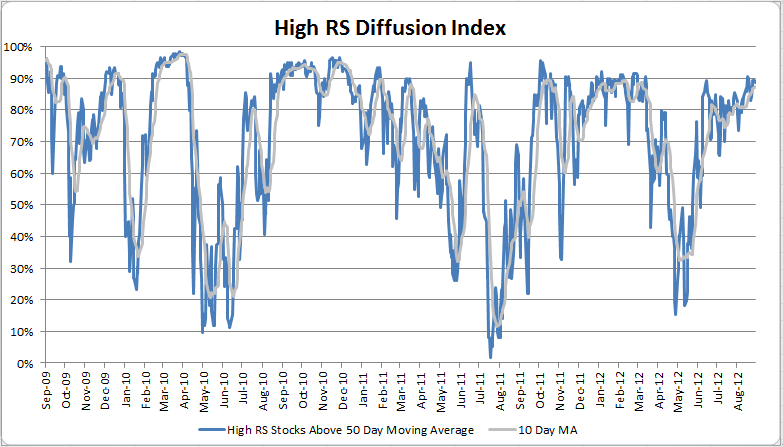
The chart below measures the percentage of high relative strength stocks that are trading above their 50-day moving average (universe of mid and large cap stocks.) As of 9/18/12.

The 10-day moving average of this indicator is 87% and the one-day reading is 88%.

Posted by: