Endowment-Style Investing

June 17, 2013

Institutional Investor interviews Eric Upin to discuss global-endowment style investing.

How do institutions approach global multiasset-class investing?

It’s all about asset allocation, manager selection and risk management. Global multiasset-class investing is a team sport, whether you’re an endowment, sovereign wealth fund or foundation. When you’re investing around the world, trying to bring professionals together to make judgments such as whether you should be overweight or underweight Europe, real estate or other asset classes, the more smart people you can bring into the tent who do what you do — and who can help provide opinions and spark ideas — the better.

As a quantitative manager, this description of how to ultimately determine an asset allocation is completely foreign. Maybe it works great for some, but the idea of trying to get an edge on the market by seeking out “smart people” who can help provide opinions and spark ideas seems problematic. We have no aversion to smart people, however we do have a strong preference for removing the role of judgement calls in the investment process. For us, the asset allocation decision goes something like this. We determine an investment universe that is comprised of a broad range of asset classes. We determine the model constraints (i.e. how much we can overweight or underweight a given asset class), and then apply our relative strength methodology to ranking the different asset classes and each of the individual components of the investment universe. Then, our weights to different asset classes and exact holdings are determined by a systematic relative strength model. Likewise, sell decisions are also based on this relative strength ranking process.

Those interested in seeing just how effective this quantitative approach to asset allocation can be over time, can read Tactical Asset Allocation Using Relative Strength by John Lewis. This approach is also working well this year, as discussed in DWTFX Tops Peers.

Past performance is no guarantee of future results. Please click here and here for disclosures.

Posted by:


The Stock Market - Economy Disconnect

June 13, 2013

One of the most difficult things for investors to understand is the stock market - economy disconnect. New investors almost always assume that if the economy is doing well, the stock market will perform well also. In fact, it is usually the other way around!

Liz Ann Sonders, the market strategist at Charles Schwab & Co., has an interesting piece on this apparent disconnect. She writes:

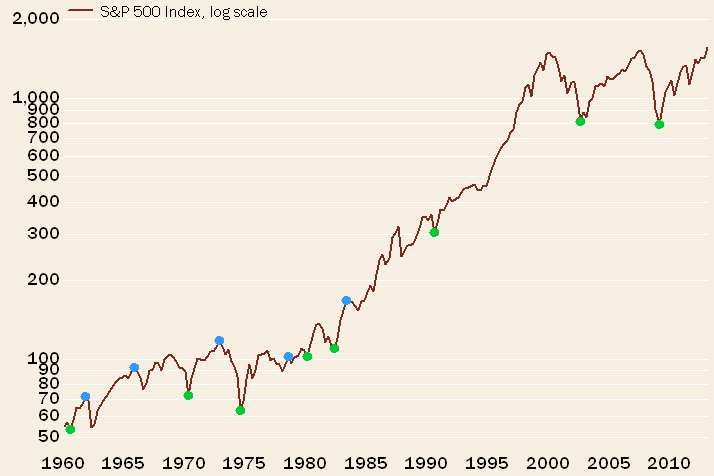
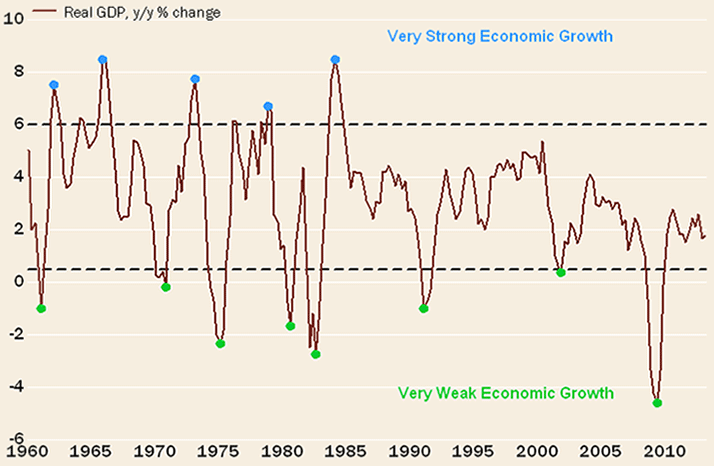
Remember, the stock market (as measured by the S&P 500) is one of 10 sub-indexes in the Conference Board’s Index of Leading Indicators. Many investors assume it’s the opposite—that economic growth is a leading indicator of the stock market. For a compelling visual of the relationship, see the following pair of charts, which I’ll explain below.

The most compelling part of her article follow, in the form of her charts that show the GDP growth rate and peaks and troughs in the stock market.

schwab1 zpsd3b29c36 The Stock Market   Economy Disconnect

schwab2 zpsbf5a6d8c The Stock Market   Economy Disconnect

Source: Charles Schwab & Co. (click on images to enlarge)

More often than not, poor economic growth corresponds with a trough in the market. Super-heated economic growth is usually a sign that someone is about to take away the punch bowl.

In truth, there is really no disconnect if you accept that the stock market usually leads the economy. As Ms. Sonders points out, the S&P 500 is part of the Index of Leading Indicators. A lot of investors have trouble wrapping their heads around that concept—and it continues to cost them money.

The contrast to economic forecasting (i.e., guessing) is trend following. The trend follower is usually fairly safe in believing that if the market is continuing up that is economy is probably ok for the time being. When the trend becomes uncertain or tilts down, it might be time to look for clues that the economy is softening. You’re not going to be right all the time either way, but at least you’ve got the odds on your side if you let the market lead.

Posted by:


From the Archives: If You Miss the 10 Best Days

June 7, 2013

We’ve all seen numerous studies that purport to show how passive investing is the way to go because you don’t want to be out of the market for the 10 best days. No one ever mentions that the “best days” most often occur during the declines!

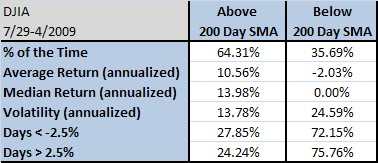
It turns out that the majority of the best days and the worst days occur near one another, during the declines. Why? Because the market is more volatile during declines. It is true that the market goes down 2-3x as fast as it goes up. (World Beta has a nice post on this topic of volatility clustering, which is where this handy-dandy table comes from.)

 From the Archives: If You Miss the 10 Best Days

from World Beta

You can see how volatility increases and the number of days with daily moves greater than 2.5% really spikes when the market is in a downward trend. It would seem to be a very straightforward proposition to improve your returns simply by avoiding the market when it is in a downtrend.

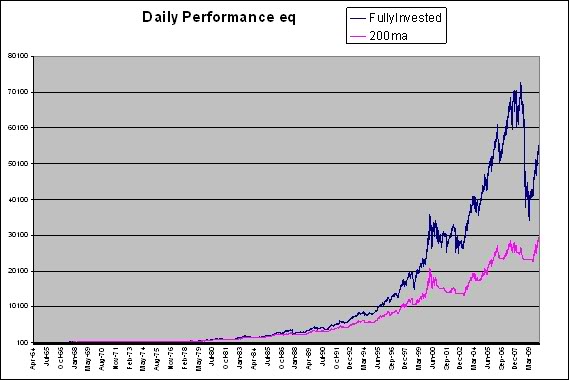
However, not every strategy can be improved by going to cash. Think about the math: if your investing methodology makes enough extra money on the good days to offset the bad days, or if it can make money during a significant number of the declines, you might be better off just gritting your teeth during the declines and banking the higher returns. Although the table above suggests it should help, a simple strategy of exiting the market (i.e., going to cash) when it is below its 200-day moving average may not always live up to its theoretical billing.

 From the Archives: If You Miss the 10 Best Days

 From the Archives: If You Miss the 10 Best Days

click to enlarge

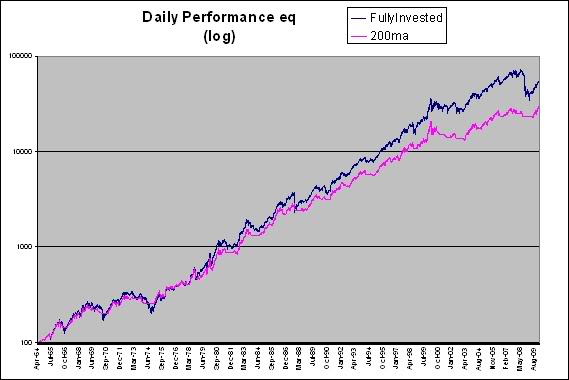
Consider the graphs above. (The first graph uses linear scaling; the second uses logarithmic scaling for the exact same data.) This test uses Ken French’s database to get a long time horizon and shows the returns of two portfolios constructed with market cap above the NYSE median and in the top 1/3 for relative strength. In other words, the two portfolios are composed of mid- and large-cap stocks with good relative strength. The only difference between the two portfolios is that one (red line) goes to cash when it is below its 200-day moving average. One portfolio (blue line) stays fully invested. The fully invested portfolio turns $100 into $49,577, while the cash-raising portfolio yields only $26,550.

If you would rather forego the extra money in return for less volatility, go right ahead and make that choice. But first stack up 93 boxes of Diamond matches so that you can burn 23,027 $1 bills, one at a time, to represent the difference–and then make your decision.

 From the Archives: If You Miss the 10 Best Days

The drawdowns are less with the 200-day moving average, but it’s not like they are tame–equities will be an inherently volatile asset class as long as human emotions are involved. There are still a couple of drawdowns that are greater than 20%. If an investor is willing to sit through that, they might as well go for the gusto.

As surprising as it may seem, the annualized return over a long period of time is significantly higher if you just stay in the market and bite the bullet during train wrecks–and even two severe bear markets in the last decade have not allowed the 200-day moving average timer to catch up.

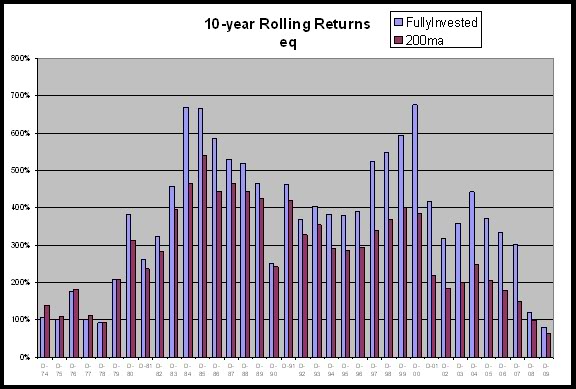
At the bottom of every bear market, of course, it certainly feels like it would have been a good idea (in hindsight) to have used the 200-day moving average to get out. In the long run, though, going to cash with a high-performing, high relative strength strategy might be counterproductive. When we looked at 10-year rolling returns, the fully invested high relative strength model has maintained an edge in returns for the last 30 years running.

 From the Archives: If You Miss the 10 Best Days

click to enlarge

Surprising, isn’t it? Counterintuitive results like this are one of the reasons that we find testing so critical. It’s easy to fall in line with the accepted wisdom, but when it is actually put to the test, the accepted wisdom is often wrong. (We often find that even when shown the test data, many people refuse, on principle, to believe it! It is not in their worldview to accept that one of their cherished beliefs could be false.) Every managed portfolio in our Systematic RS lineup has been subjected to heavy testing, both for returns and–and more importantly–for robustness. We have a high degree of confidence that these portfolios will do well in the long run.

—-this article originally appeared 3/5/2010. We find that many investors continue to refuse, on principle, to believe the data! If you have a robust investment method, the idea that you can improve your returns by getting out of the market during downturns appears to be false. (Although it could certainly look true for small specific samples. And, to be clear, 100% invested in a volatile strategy is not the appropriate allocation for most investors.) Volatility can generally be reduced somewhat, but returns suffer. One of our most controversial posts ever—but the data is tough to dispute.

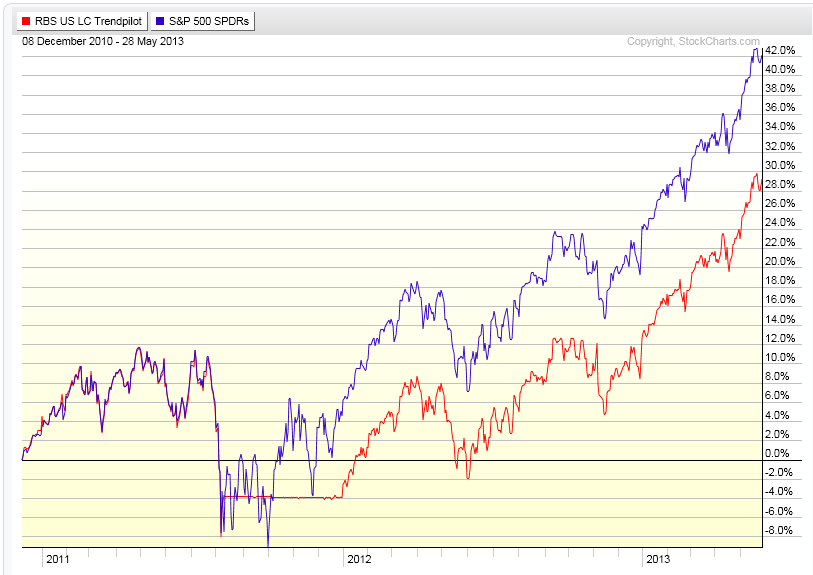
In more recent data, the effect can be seen in this comparison of an S&P 500 ETF and an ETN that switches between the S&P 500 and Treasury bills based on a 200-day moving average system. The volatility has been muted a little bit, but so have the returns.

trendpilot zps9227da43 From the Archives: If You Miss the 10 Best Days

(click on image to enlarge)

Posted by:


The Emotional Roller Coaster

June 6, 2013

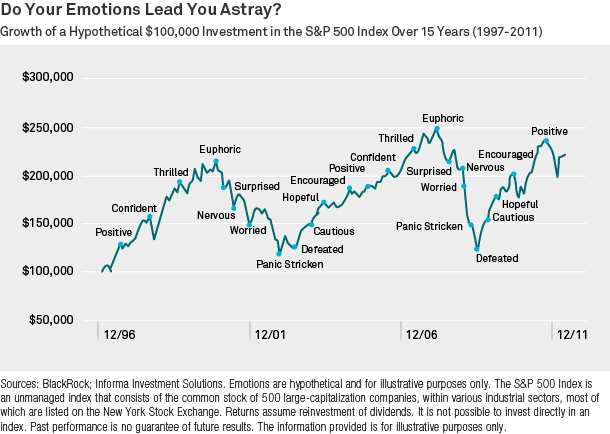
From Josh Brown at The Reformed Broker, a nice picture of investor emotions as they ride the market roller coaster. All credit to Blackrock, who came up with this funny/sad/true graphic.

emotions zps526a96f7 The Emotional Roller Coaster

Blackrock’s emotional roller coaster

(click on image to enlarge)

One of the important roles of a financial advisor, I think, is to keep clients from jumping out of the roller coaster when it is particularly scary. At an amusement park, when people are faced with tangible physical harm, jumping does not seem like a very good idea to them—but investors are tempted to jump out of the market roller coaster all the time.

Posted by:


From the Archives: Perfect Sector Rotation

June 4, 2013

CXO Advisory has a very interesting blog piece on this topic. They review an academic paper that looks at the way conventional sector rotation is done. Typically, various industry sectors are categorized as early cycle, late cycle, etc. and then you are supposed to own those sectors at that point in the business cycle. Any number of money management firms (not including us) hang their hat on this type of cycle analysis.

In order to determine the potential of traditional sector rotation, the study assumes that you get to have perfect foresight into the business cycle and then you rotate your holdings with the conventional wisdom of when various industries perform best. A couple of disturbing things crop up, given that this is the best you could possibly do with this system.

1) You can squeak by with about 2.3% annual outperformance if you had a crystal ball. If you are even a month or two early or late on the cycle turns, your performance is statistically indistinguishable from zero.

2) 28 of the 48 industries studied (58.3%) underperformed during the times when they were supposed to perform well. There’s obviously enough noise in the system that a sector that is supposed to be strong or weak during a particular part of the cycle often isn’t.

CXO notes, somewhat ironically:

Note that NBER can take as long as two years after a turning point to designate its date and that one business cycle can be very different from another.

In other words, it’s clear that traditional business cycle analysis is not going to help you. You won’t be able to forecast the cycle turning points accurately and the cycles differ so much that industry performance is not consistent.

Sector rotation using relative strength is a big contrast to this. Relative strength makes no a priori assumptions about which industries are going to be strong or weak at various points in the business cycle. A systematic strategy just buys the strong sectors and avoids the weak ones. Lots of studies show that significant outperformance can be earned using relative strength (momentum) with absolutely no insight into the business cycle at all, including some studies done by CXO Advisory. Tactical asset allocation is finally coming into its own and various ways of implementing are available. Business cycle forecasting does not appear to be a feasible way to do it, but relative strength certainly is!

—-this article originally appeared 3/30/2010. Although the link to CXO Advisory is no longer live, you can get the gist of things from the article. Things don’t always perform in the expected fashion, and paying attention to relative strength can be some protection from the problem. Instead of making assumptions about strong or weak performance, relative strength just adapts.

Posted by:


From the Archives: Trend Following Beats Market Timing

May 30, 2013

Mark Hulbert has been tracking advisory newsletters for more than 20 years. Lots of these newsletters do active market timing, so in a recent column, he asked an obvious question:

The first question: How many stock market timers, of the several hundred monitored by the Hulbert Financial Digest, called the bottom of the bear market a year ago?

And a follow-up: Of those that did, how many also called the top of the bull market in March 2000 — or, for that matter, the major market turning points in October 2002 and October 2007?

If you are relying on some type of market timing to get you out of the way of bear markets and to get you into bull markets, this is exactly what you want to know. Although there are pundits who claim to have called the bottom to the day, Mr. Hulbert allowed a far more generous window for labeling a market timing call as correct.

… my analysis actually relied on a far more relaxed definition: Instead of moving 100% from cash to stocks in the case of a bottom, or 100% the other way in the case of a top, I allowed exposure changes of just ten percentage points to qualify.

Furthermore, rather than requiring the change in exposure to occur on the exact day of the market’s top or bottom, I looked at a month-long trading window that began before the market’s juncture and extending a couple of weeks thereafter.

That’s a pretty liberal definition: the market timer gets a four-week window and only has to change allocations by 10% to be considered to have “called” the turn. And here’s the bottom line:

Even with these relaxed criteria, however, none of the market timers that the Hulbert Financial Digest has tracked over the last decade were able to call the market tops and bottoms since March 2000.

Yep, zero. [The bold and underline is from me.] It’s not that advisors aren’t trying; it’s just that no one can do it successfully, even with a one-month window and a very modest change in allocations. Obviously, there is lots of hindsight bias going on where advisors claim to have detected market turning points, but when Mr. Hulbert goes back to look at the actual newsletters, not one got it right! You can safely assume anyone who claims to be able to time the market is lying. At the very least, the burden on proof is on them.

We don’t bother trying to figure out what the market will do going forward. We simply follow trends as they present themselves. We use relative strength in a systematic way to identify the trends we want to follow: the strongest ones. We stay with the trend as long as it continues, whether that is for a short time or an extended period. When a trend weakens, as evidenced by its relative strength ranking, we knock that asset out of the portfolio and replace it with a stronger asset. The two white papers we have produced (Relative Strength and Asset Class Rotation and Bringing Real World Testing to Relative Strength) show quite clearly that it is possible to have very favorable investment results over time without any recourse to market timing at all. Discipline and patience are needed, of course, but you don’t have to have a crystal ball.

—-this article originally appeared 3/17/2010. It is especially apropos now that many market pundits are busy predicting a top. It’s certainly possible they are right—but probably equally likely is the proposition that they are just guessing. Over the long run there is weak evidence that market timing is effective.

Posted by:


Dividend-Paying Stocks: Getting a Broader Picture

May 29, 2013

Among the biggest investor-driven trends in the market right now is the thirst for yield. The paltry yields available in most sectors of fixed income just are not providing the type of income that investors are looking for and so they are increasingly looking at earning that yield from dividend-paying stocks. However, an exclusive focus on yield provides an incomplete picture of the returns that an investor may achieve. There is also the performance of the stock itself that must be factored into the evaluation.

When we rank our universe of securities to construct the First Trust Dorsey Wright Dividend UITs, our relative strength ranks are determined by the total return of the stocks (price return + yield). For comparison’s sake, consider the construction methodology of the S&P Dividend SPDR (SDY) which is based upon the S&P High Yield Dividend Aristocrats Index. That index is designed to measure the performance of the highest dividend yielding S&P Composite 1500 Index constituents that have followed a managed-dividends policy of consistently increasing dividends every year for at least 20 consecutive years.

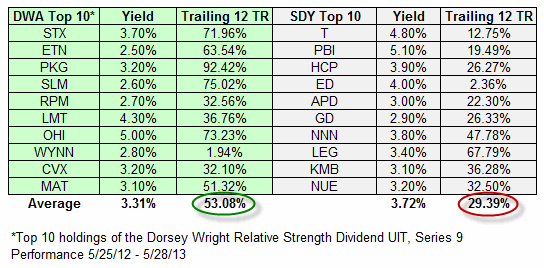
In the table below, I show the top 10 holdings for both SDY and for the First Trust Dorsey Wright Dividend UIT, Series 9. While the top 10 holdings for SDY have a slightly higher yield, the top 10 holdings of the Dorsey Wright UIT have had better total returns over the past 12 months.

uit2 05.29.131 Dividend Paying Stocks: Getting a Broader Picture

Source: AllETF.com and First Trust; Performance Source: Yahoo! Finance

Evaluating dividend-paying stocks from a total return perspective seems to be fairly uncommon, yet it can make a significant difference in performance for the client while still allowing them to seek above-market yields.

Past performance is not indicative of future results. Potential for profits is accompanied by possibility of loss. See http://www.ftportfolios.com for more information.

Posted by:


From the Archives: Investing Lies We Grew Up With

May 15, 2013

This is the title of a nice article by Brett Arends at Marketwatch. He points out that a lot of our assumptions, especially regarding risk, are open to question.

Risk is an interesting topic for a lot of reasons, but principally (I think) because people seem to be obsessed with safety. People gravitate like crazy to anything they perceive to be “safe.” (Arnold Kling has an interesting meditation on safe assets here.)

Risk, though, is like matter–it can neither be created nor destroyed. It just exists. When you buy a safe investment, like a U.S. Treasury bill, you are not eliminating your risk; you are just switching out of the risk of losing your money into the risk of losing purchasing power. The risk hasn’t gone away; you have just substituted one risk for another. Good investing is just making sure you’re getting a reasonable return for the risk you are taking.

In general, investors–and people generally–are way too risk averse. They often get snookered in deals that are supposed to be “low risk” mainly because their risk aversion leads them to lunge at anything pretending to be safe. Psychologists, however, have documented that individuals make more errors from being too conservative than too aggressive. Investors tend to make that same mistake. For example, nothing is more revered than a steady-Eddie mutual fund. Investors scour magazines and databases to find a fund that (paradoxically) is safe and has a big return. (News flash: if such a fund existed, you wouldn’t have to look very hard.)

No one goes looking for high-volatility funds on purpose. Yet, according to an article, Risk Rewards: Roller-Coaster Funds Are Worth the Ride at TheStreet.com:

Funds that post big returns in good years but also lose scads of money in down years still tend to do better over time than funds that post slow, steady returns without ever losing much.

The tendency for volatile investments to best those with steadier returns is even more pronounced over time. When we compared volatile funds with less volatile funds over a decade, those that tended to see big performance swings emerged the clear winners. They made roughly twice as much money over a decade.

That’s a game changer. Now, clearly, risk aversion at the cost of long-term returns may be appropriate for some investors. But if blind risk aversion is killing your long-term returns, you might want to re-think. After all, eating Alpo is not very pleasant and Maalox is pretty cheap. Maybe instead of worrying exclusively about volatility, we should give some consideration to returns as well.

—-this article originally appeared 3/3/2010. A more recent take on this theme are the papers of C. Thomas Howard. He points out that volatility is a short-term factors, while compounded returns are a long-term issue. By focusing exclusively on volatility, we can often damage long term results. He re-defines risk as underperformance, not volatility. However one chooses to conceptualize it, blind risk aversion can be dangerous.

Posted by:


From the Archives: Forecasting, Schmorecasting

May 6, 2013

We’ve written about the uselessness of forecasting in the past and even cited James Montier’s wonderful piece, The Seven Sins of Fund Management. This citation comes from Mebane Faber’s World Beta blog. Montier writes:

The two most common biases are over-optimism and overconfidence. Overconfidence refers to a situation whereby people are surprised more often than they expect to be. Effectively people are generally much too sure about their ability to predict. This tendency is particularly pronounced amongst experts. That is to say, experts are more overconfident than lay people. This is consistent with the illusion of knowledge driving overconfidence.

Dunning and colleagues have documented that the worst performers are generally the most overconfident. They argue that such individuals suffer a double curse of being unskilled and unaware of it. Dunning et al argue that the skills needed to produce correct responses are virtually identical to those needed to self-evaluate the potential accuracy of responses. Hence the problem.

This is irony in action. Knowledge drives overconfidence, so people who actually know something about a topic are more prone to think they can forecast, and they probably even sound more believable. And finally, the worst performers are the most overconfident!

This may be one of the few instances in which ignorance is bliss. If you have the Zen “beginner’s mind” and don’t make any assumptions about what might happen, you’re going to be better off than if you are knowledgeable and try to guess.

Systematic trend-following eliminates the need to forecast (although apparently not the desire, since we have clients constantly asking us what we think is going to happen). We use relative strength to drive our trend-following; it is able to pick out the strongest trends, and those are the trends we are interested in following. We stay with an asset as long as it remains strong. When it weakens, we kick it out of the portfolio and replace it with something stronger. This kind of casting-out method allows the portfolio to adapt to the market environment, as it is constantly refreshed with new, strong assets.

Despite having a logical and simple method that performs well over time and eliminates the need to forecast, soothsayers will probably always be with us—but your best bet is to ignore them.

—-this article originally appeared 3/2/2013. Of course the lesson is timeless.

Posted by:


From the Archives: Psychology That Drives Bull Markets

May 2, 2013

The Leuthold Group’s Doug Ramsey on the psychology that drives bull markets:

Cashing in on bull markets is not a matter of waiting for everything to line up, anyway. There must be a set of intellectually appealing bear arguments keeping some players on the sidelines…it is these same players who will eventually drive prices even higher when “new” and intellectually appealing bull arguments belatedly appear on the scene. I have found that some of the best bull market action occurs when the “bull/bear” arguments superficially appear to be in relative balance, confounding many market players. When the balance tips too heavily to one side or the other, the odds are that most of the related market move is already in the books.

—-this article originally appeared 3/3/2010. Thinking about this paradox is one of the things that led us to start our own sentiment survey focusing on client investment behavior. Even now, many years into the bull market, clients are still behaving fairly cautiously, indicating they do not yet fully believe the bull argument.

Posted by:


Financial Repression Primer

May 1, 2013

Research Affliliates published a very nice primer on financial repression on Advisor Perspectives. It’s well worth reading to get the lay of the land. Here’s how they define financial repression:

Financial repression refers to a set of governmental policies that keep real interest rates low or negative and regulate or manipulate a captive audience into investing in government debt. This results in cheap funding and will be a prime tool used by governments in highly indebted developed market economies to improve their balance sheets over the coming decades.

When you hear talk about “the new normal,” this is one of the features. Most of us have not had to deal with financial repression during our investment careers. In fact, for advisors in the 1970s and early 1980s, the problem was that interest rates were too high, not too low!

There are disparate views on the endgame from financial repression. Some are expecting Japanese-style deflation, while others are looking for Weimar Republic inflation. Maybe we will just muddle through. In truth, there are many possible outcomes depending on the myriad of policy decisions that will be made in coming years.

In our view, guessing at the outcome of the political and economic process is hazardous. We think it makes much more sense to be alert to the possibilities embedded in tactical asset allocation. That allows you to pursue returns wherever they can be found at the time, without having to have a strong opinion on the eventual outcome. Relative strength can often be a very useful guide in that process.

Posted by:


The Wonders of Momentum

April 18, 2013

Relative strength investors will be glad to know that James Picerno’s Capital Spectator blog has an article on the wonders of momentum. He discusses the momentum “anomaly” and its history briefly:

Momentum is one of the oldest and most persistent anomalies in the financial literature. The tendency of positive or negative returns to persist for a time seems like a ridiculously simple predictor, but it works. There’s an ongoing debate about why it works, but the results in numerous tests speak loud and clear. Unlike many (most?) reported sources of alpha, the market-beating and risk-lowering results linked to momentum strategies appear to be immune to arbitrage.

Informally, it’s fair to say that investors have been exploiting momentum in various forms for as long as humans have been trading assets. Formally, the concept dates to at least 1937, when Alfred Cowles and Herbert Jones reviewed momentum in their paper “Some A Priori Probabilities in Stock Market Action.” In the 21st century, an inquiring reader can easily find hundreds of papers on the subject, most of it published in the wake of Jegadeesh and Titman’s seminal 1993 work: “Returns to Buying Winners and Selling Losers: Implications for Stock Market Efficiency,” which marks the launch of the modern age of momentum research.

I think his observation that momentum (relative strength to us) has been around since humans have been trading assets is spot on. It’s important to keep that in mind when thinking about why relative strength works—and why it has been immune to arbitrage. He writes:

Momentum, it seems, is one of the rare risk factors with features that elude so many other strategies: It’s persistent, conceptually straightforward, robust across asset classes, and relatively easy to implement. It’s hardly a silver bullet, but nothing else is either.

The only mystery: Why are we still talking about this factor in glowing terms? We still don’t have a good answer to explain why this anomaly hasn’t been arbitraged away, or why it’s unlikely to meet an untimely demise anytime soon.

Mr. Picerno raises a couple of important points here. Relative strength does have a lot of attractive features. The reason it is not a silver bullet is that it underperforms severely from time to time. Although that is also true of other strategies, I think the periodic underperformance is one of the reasons why the excess returns have not been arbitraged away.

Although he suggests we don’t have a good answer about why momentum works, I’d like to offer my explanation. I don’t know if it’s a good answer or not, but it’s what I’ve arrived at after years of research and working with relative strength portfolios—not to mention a degree in psychology and a couple of decades of seeing real investors operate in the market laboratory.

  • Relative strength straddles both fundamental analysis and behavioral finance.
  • High relative strength securities or assets are generally strong because they are undergoing fundamental improvement or are in a sweet spot for fundamentals. In other words, if oil prices are trending strongly higher, it’s not surprising that certain energy stocks are strong. That’s to be expected from the fundamentals. Often there is improvement at the margin, perhaps in revenue growth or operating margin—and that improvement is often underestimated by analysts. (Research shows that investors are more responsive to changes at the margin than to the absolute level of fundamental factors. For example, while Apple’s operating margin grew from 2.2% in 2003 to 37.4% in 2012, the stock performed beautifully. Even though the operating margin is expected to be in the 35% range this year—which is an extremely high level—the stock is getting punished. Valero’s stock price plummeted when margins went from 10.0% in 2006 to 2.4% in 2009, but has doubled off the low as margins rebounded to 4.8% in 2012. Apple’s operating margin on an absolute basis is drastically higher than Valero’s, but the delta is going the wrong way.) High P/E multiples can often be maintained as long as margin improvement continues, and relative strength tends to take advantage of that trend. Often these trends persist much longer than investors expect.
  • From the behavioral finance side, social proof helps reinforce relative strength. Investors herd and they gravitate toward what is already in motion, and that reinforces the price movement. They are attracted to the popular and repelled by the unpopular.
  • Periodic bouts of underperformance help keep the excess returns of relative strength high. When momentum goes the wrong way it can be ugly. Perhaps margins begin to contract and financial results are worse than analysts expect. The security has been rewarded with a high P/E multiple, which now begins to unwind. The herd of investors begins to stampede away, just as they piled in when things were going well. Momentum can be volatile and investors hate volatility. Stretches of underperformance are psychologically painful and the unwillingness to bear pain (or appropriately manage risk) discourages investors from arbitraging the excess returns away.

In short, I think there are multiple reasons why relative strength works and why it is difficult to arbitrage away the excess returns. Those reasons are both fundamental and behavioral and I suspect will defy easy categorization. Judging from my morning newspaper, human nature doesn’t change much. Until it does, markets are likely to work the same way they always have—and relative strength is likely to continue to be a powerful return factor.

Posted by:


Gold: Getting Personal

April 15, 2013

Interesting chart of the S&P vs. gold going back a few decades:

SP Gold Gold: Getting Personal

Joe Weisenthal’s take:

You can see that even with the recent upturn in stocks, relative to gold, gold has crushed stocks since 2000.

Arguably, 2000 represented a peak in belief in the capabilities of humans. The internet inspired all kinds of crazy optimism about how humans would re-shape the world for the better. The ebullience spread beyond the net. There was, for example, optimism about newways of transporting humans: Fuel cells! Segway!

Of course, the bubble crashed. Then we had 9/11. Then we had two wars. Then we had the housing implosion. Then we had the financial crisis. Then the horrible recession. Then the European crisis and the debt ceiling and everything else.

In other words, we had a series of a events that, for good reason, shook our faith in humanity. During this time, people thought about history on a large scale. And gold, having been used as a money for thousands of years, did pretty well, especially relative to stocks, which represent companies made up of humans.

So ultimately, the decline of gold and the rise of stocks is a big trend that everyone should cheer.

The huge corpus of economic research, which has informed the US’ efforts to stimulate the economy, is not a pile of garbage. You can do a lot without blowing things up, as the goldbugs claimed would happen.

And more broadly, this represents a breaking of the fever, and perhaps a return to thinking that humans aren’t such a horrible disappointment.

With gold’s recent declines, analysis such as that written by Weisenthal is all over the place. Gold really gets personal with people. For many, its strength or weakness has the ability to validate their economic and political views.

From a strictly trend following perspective, the S&P vs. gold relative strength relationship is potentially significant because of its history of providing long-term trends favoring one or the other. If this ultimately does result in a major inflection point for the S&P vs. gold relationship, there will be important implications for those of us employing tactical asset allocation strategies in the years ahead. Admittedly, simply observing the relative strength relationship between the two provides much less intrigue than can be found on talk radio or any number of other sources (but that can be a very good thing for investors who are just looking to make money).

HT: Business Insider

Posted by:


Investment Manager Selection

April 12, 2013

Investment manager selection is one of several challenges that an investor faces. However, if manager selection is done well, an investor has only to sit patiently and let the manager’s process work—not that sitting patiently is necessarily easy! If manager selection is done poorly, performance is likely to be disappointing.

For some guidance on investment manager selection, let’s turn to a recent article in Advisor Perspectives by C. Thomas Howard of AthenaInvest. AthenaInvest has developed a statistically validated method to forecast fund performance. You can (and should) read the whole article for details, but good investment manager selection boils down to:

  • investment strategy
  • strategy consistency
  • strategy conviction

This particular article doesn’t dwell on investment strategy, but obviously the investment strategy has to be sound. Relative strength would certainly qualify based on historical research, as would a variety of other return factors. (We particularly like low-volatility and deep value, as they combine well with relative strength in a portfolio context.)

Strategy consistency is just what it says—the manager pursues their chosen strategy without deviation. You don’t want your value manager piling into growth stocks because they are in a performance trough for value stocks (see Exhibit 1999-2000). Whatever their chosen strategy or return factor is, you want the manager to devote all their resources and expertise to it. As an example, every one of our portfolio strategies is based on relative strength. At a different shop, they might be focused on low-volatility or small-cap growth or value, but the lesson is the same—managers that pursue their strategy with single-minded consistency do better.

Strategy conviction is somewhat related to active share. In general, investment managers that are willing to run relatively concentrated portfolios do better. If there are 250 names in your portfolio, you might be running a closet index fund. (Our separate accounts, for example, typically have 20-25 positions.) A widely dispersed portfolio doesn’t show a lot of conviction in your chosen strategy. Of course, the more concentrated your portfolio, the more it will deviate from the market. For managers, career risk is one of the costs of strategy conviction. For investors, concentrated portfolios require patience and conviction too. There will be a lot of deviation from the market, and it won’t always be positive. Investors should take care to select an investment manager that uses a strategy the investor really believes in.

AthenaInvest actually rates mutual funds based on their strategy consistency and conviction, and the statistical results are striking:

The higher the DR [Diamond Rating], the more likely it will outperform in the future. The superior performance of higher rated funds is evident in Table 1. DR5 funds outperform DR1 funds by more than 5% annually, based on one-year subsequent returns, and they continue to deliver outperformance up to five years after the initial rating was assigned. In this fashion, DR1 and DR2 funds underperform the market, DR3 funds perform at the market, and DR4 and DR5 funds outperform. The average fund matches market performance over the entire time period, consistent with results reported by Bollen and Busse (2004), Brown and Goetzmann (1995) and Fama and French (2010), among others.

Thus, strategy consistency and conviction are predictive of future fund performance for up to five years after the rating is assigned.

The bold is mine, as I find this remarkable!

I’ve reproduced a table from the article below. You can see that the magnitude of the outperformance is nothing to sniff at—400 to 500 basis points annually over a multi-year period.
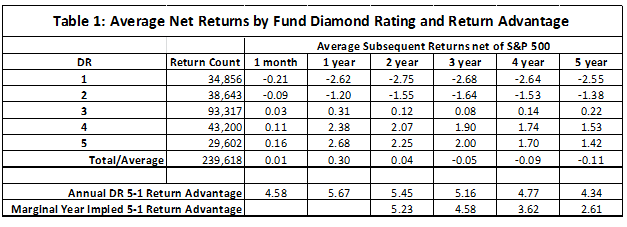
diamondratings zps3970f53e Investment Manager Selection

Source: Advisor Perspectives/AthenaInvest (click on image to enlarge)

The indexing crowd is always indignant at this point, often shouting their mantra that “active managers don’t outperform!” I regret to inform them that their mantra is false, because it is incomplete. What they mean to say, if they are interested in accuracy, is that “in aggregate, active managers don’t outperform.” That much is true. But that doesn’t mean you can’t locate active managers with a high likelihood of outperformance, because, in fact, Tom Howard just demonstrated one way to do it. The “active managers don’t outperform” meme is based on a flawed experimental design. I tried to make this clear in another blog post with an analogy:

Although I am still 6’5″, I can no longer dunk a basketball like I could in college. I imagine that if I ran a sample of 10,000 random Americans and measured how close they could get to the rim, very few of them could dunk a basketball either. If I created a distribution of jumping ability, would I conclude that, because I had a large sample size, the 300 people would could dunk were just lucky? Since I know that dunking a basketball consistently is possible–just as Fama and French know that consistent outperformance is possible–does that really make any sense? If I want to increase my odds of finding a portfolio of people who could dunk, wouldn’t it make more sense to expose my portfolio to dunking-related factors–like, say, only recruiting people who were 18 to 25 years old and 6’8″ or taller?

In other words, if you look for the right characteristics, you have a shot at finding winning investment managers too. This is valuable information. Think of how investment manager selection is typically done: “What was your return last year, last three years, last five years, etc.?” (I know some readers are already squawking, but the research literature shows clearly that flows follow returns pretty closely. Most “rigorous due diligence” processes are a sham—and, unfortunately, research shows that trailing returns alone are not predictive.) Instead of focusing on trailing returns, investors would do better to locate robust strategies and then evaluate managers on their level of consistency and conviction.

Posted by:


Smart Beta vs. Monkey Beta

April 9, 2013

Andy wrote a recent article entitled Smart Beta Gains Momentum. It’s gaining momentum for a good reason! A recent study at Cass Business School in London found that cap-weighting was not a very good way to construct an index. Lots of methods to get exposure to smart beta do better. The results were discussed in an article at Index Universe. Some excerpts:

Researchers have found that equity indices constructed randomly by ‘monkeys’ would produce higher risk-adjusted returns than an equivalent market capitalisation-weighted index over the last 40 years…

The findings come from a recent study by Cass Business School (CBS), which was based on monthly US share data from 1968 to 2011. The authors of the study found that a variety of alternative index weighting schemes all delivered superior returns to the market cap approach.

According to Dr. Nick Motson of CBS, co-author of the study, “all of the 13 alternative indices we studied produced better risk-adjusted returns than a passive exposure to a market-cap weighted index.”

The study included an experiment that saw a computer randomly pick and weight each of the 1,000 stocks in the sample. The process was then repeated 10 million times over each of the 43 years. Clare describes this as “effectively simulating the stock-picking abilities of a monkey”.

…perhaps most shockingly, we found that nearly every one of the 10 million monkey fund managers beat the performance of the market cap-weighted index,” said Clare.

The findings will be a boost to investors already looking at alternative indexing. Last year a number of European pension funds started reviewing their passive investment strategies, switching from capitalisation-weighting to alternative index methodologies.

Relative strength is one of the prominent smart beta methodologies. Of course, cap-weighting has its uses—the turnover is low and rebalancing is minimized. But purely in terms of performance, the researchers at Cass found that there are better ways to do things. Now that ETFs have given investors a way to implement some of these smart beta methods in a tax-efficient, low-cost manner, I suspect we will see more movement toward smart beta in the future.

Posted by:


From the Archives: I Want to Buy Losers

April 4, 2013

I cringe every time I read an article by a value investor that says something like, “You should buy stocks that are on sale, just like you buy [pick your consumer item] on sale.” In the financial markets that can be dangerous.

In a great essay titled, I Want to Buy Losers, Clay Allen of Market Dynamics discusses the problems with this analogy. [You've got to read the whole essay to really appreciate it.]

Many investors buy stocks the way many consumers buy paper towels or any other staple. They are attracted to a sale and loss leaders are a proven method for a retailer to increase the traffic in their store. The value of the item is well known and a sale price gets the attention of potential buyers.

Mr. Allen explains brilliantly and succinctly why this analogy is bunk:

But stocks are not like paper towels. Paper towels can be used to satisfy a need and this is what gives the item its value to the consumer. What gives a stock its value? A stock cannot be used to satisfy a need or accomplish a task. The value of a stock is derived from the financial performance of the company, either actual or expected. The fact that the stock is down in price is usually a sure sign that the financial performance of the company is declining.

…if the value of the stock was constant, then buying bargain stocks would be the correct way to invest in stocks. But stock values are constantly changing as business conditions change for the company and the expectations of investors change.

All in all, it seems to me that relative strength often more closely reflects what the expectations of investors are–and the expectations are what counts. Let’s face it: strong stocks are usually strong because business conditions or fundamentals are good, and weak stocks are usually weak for a reason.

—-this article was originally published 3/26/2010. In the intervening years, my friend Clay Allen has passed away. His wisdom, however, is still with us. His point that a stock is not a paper towel is absolutely correct. The only purpose of an equity investment is to make money.

Posted by:


Buy the Unloved

March 25, 2013

Morningstar has a market-beating strategy call “Buy the Unloved” that they update from time to time. Essentially, it consists of buying the fund categories with the most outflows and holding on to them for three years, on the theory that retail investors generally get things wrong. Sadly, “Buy the Unloved” has a good track record, indicating that their thesis is largely correct!

Here are a couple of key excerpts from their 2013 update on the Buy the Unloved strategy:

Morningstar has followed this strategy since the early 1990s, using annual net cash flows to identify each year’s three most unloved and loved equity categories, which feed into two separate portfolios (unloved and loved). We track the average returns for those categories for the subsequent three years, adding in new categories each year and swapping out categories after three years are up. We’ve found that holding a portfolio of the three most unpopular equity categories for at least three years is an effective approach: From 1993 through 2012, the “unloved” strategy gained 8.4% annualized to the “loved” strategy’s 5.1% annualized. The unloved strategy has also beaten the MSCI World Index’s 6.9% annualized gain and has slightly beat the Morningstar US Market Index’s 8.3% return.

According to Morningstar fund flow data, the most popular equity categories in 2012 were diversified emerging markets (inflows of $23.2 billion), foreign large value (inflows of $4.6 billion), and real estate (inflows of $3.8 billion). Those looking across asset classes might want to be cautious on sending new money to intermediate-term bond (inflows of $112.3 billion), short-term bond (inflows of $37.6 billion), and high-yield bond (inflows of $23.6 billion), particularly as interest rates have nowhere to go but up.

The most unloved equity categories are also the most unpopular overall: large growth (outflows of $39.5 billion), large value (outflows of $16 billion), and large blend (outflows of $14.4 billion). These categories have seen outflows despite posting double-digit gains in 2012. The money leaving from these categories reflects a broader trend of investors fleeing equity funds while piling into fixed-income offerings and passive ETFs.

Now that we are almost a full quarter into 2013, it might be worthwhile to think about what we have seen so far this year: good performance from large-cap equities and sluggish performance from bonds.

Morningstar should get a public service award for publishing this data—and it’s worth thinking about what you can learn from it. The most popular investment trends are not always the profitable ones. In fact, their work indicates that it could be valuable to spend time thinking about going into areas that are currently unpopular. Obviously, this does not need to be used (and probably shouldn’t be) as a stand-alone strategy, but it might be useful as a guide to portfolio adjustments.

Posted by:


Inextricable Link Between the Economy and the Stock Market?

March 15, 2013

Abnormal Returns hits on one of the single most important topics for investors to understand if they want a shot at making money over time. Without understanding the reality that the economy and the stock market are two very different things investors are doomed to a frustrating, and likely unfruitful, experience with the financial markets. By the way, this also happens to be one of the key arguments for the use of technical analysis. For example, relative strength calculations are derived from the price of the security only. After all, there is no reason to include additional inputs in the analysis if there is no clear relationship between the data point and the future performance of the security.

I think one of the hardest things for novice investors to grasp is the idea that the economy and stock market are two very different animals. In fact I start a chapter on Equities in my book Abnormal Returns: Winning Strategies from the Frontlines of the Investment Blogosphere with the title: “The Stock Market is Not the Economy.” There is ample data to show that a negative relationship exists between economic growth and equity market returns. What this relationship omits is valuation. Starting valuations have a big role in future returns, not economic growth.

This theme about the perceived disconnect between the stock market and economy has been touched on by a number of writers this past week.* Josh Brown at The Reformed Broker post-debate on the link between the two had this to say:

It’s a difficult concept to grasp when you’re trained to look for narratives and storylines as most journalists are. Steve is a very good economic reporter and brings a wealth of information to the viewers each time he’s on. I was simply trying to make the point that the Greek stock market had risen by 30% last year despite a contracting economy while in Shanghai stocks were down all year as the Chinese economy grew by 7%. Thus, the Economy ≠ the Stock Market.

Barry Ritholtz writing at the Washington Post has an article arguing not only does economic have a limited role in investor decision making but so do political machinations as well. Barry also notes the importance of valuation on decision making as well.

Most folks seem surprised when I tell them the sequester will have “little or no” impact on markets. The correlation between how markets perform relative to economic events is actually quite weak…Indeed, the correlation between economic noise and how equity markets perform has been wildly overemphasized. To quote Warren Buffett: “If you knew what was going to happen in the economy, you still wouldn’t necessarily know what was going to happen in the stock market.”

Peter Coy at Businessweek had this to say about the relationship between the economy and the stock market.

The stock market’s importance is more symbolic than economic. Only a handful of companies use it to raise money in a typical year, and most families have more wealth in real estate than in stocks. What higher stock prices do is signal to CEOs that investors want them to put their money to work. Farmer argues that rising stock prices may yet rouse dormant animal spirits and get the economy going again. If that’s so, then the Fed’s strategy will have worked.

Although not directly related to the earlier discussion I thought this piece by François Sicart at AlphaNow was interesting in that it delineates the differences between the goals of the entrepreneur and the stock market investor. They have very different outlooks and one shouldn’t approach stock market investing with the same attitude entrepreneurs bring to the table.

The primary goal of an entrepreneur is to create a fortune, in part by taking significant risk when necessary and when the potential return warrants it. The goal of an investment manager is to protect a patrimony against (or through) economic, political, or financial crises – as well as against the loss of purchasing power due to inflation. With the right discipline, this patrimony should also grow over time.

But the successful entrepreneur and the successful investment manager have different skill sets and instincts. Good judgment demands that one should not attempt to practice in the other’s field of excellence.

We want to believe the stock market and economy are inextricably linked. That is what the financial news industry is built upon. The economic indicator announcement is a staple of business TV. Maybe that is yet another good reason to go on a “news diet.”

*Although one could argue like Joe Weisenthal at Money Game does that the stock market has been moving in lockstep with initial weekly unemployment claims over the past six years.

Posted by:


From the Archives: Hobo Investing

March 12, 2013

Investing, at its core, is a simple process. You need to determine if the train is going north or south, or just sitting on a track siding doing nothing. Once you’ve found a train going north, you need only to hop aboard. If the train starts to go south, you need to jump off.

The concept is simple, but sometimes investors make the execution more complicated. For us, relative strength and trend following provide the tools and methodology to find the northbound trains. The same tools and methodology can be used to tell you when the switch engine has come along and started to move the train south.

The problems happen when investors deviate from the simple goal-directed hobo mentality and get too clever for their own good. Can you imagine how irrational some investor behavior must look to a hobo? Here are the top six dysfunctional hobo sayings:

1. I wanted to go north, so I hopped on an out-of-favor southbound train, hoping it would go north eventually. (value hobo)

2. I got on a northbound train, but it only went north a few miles. A switch engine came along and started to take my boxcar south. How embarrassing! This train owes me. I’m not getting off. (ego-attached hobo)

3. There are so many trains going north. I want to hop on one eventually, but I’m afraid it will go south right after I get on it. (failure to launch hobo)

4. This northbound train is picking up speed. I’d better get off. (premature ejection hobo)

5. I want to go north, but my train pulled on to a siding and stopped. Maybe I’ll just sit here and see what happens. (buy-and-hold hobo)

6. There are so many trains going north without me. Eventually they will all have to go south, and then I’ll have my revenge! (bitter hobo with economics background)

If you want to go north, get on a northbound train. KISS really applies here. On our good days, we all know this, but it’s so easy to forget.

—-this article originally appeared 5/26/2010. Investing need not be complicated. Relative strength investing, in fact, is pretty simple. However, simple is not the same thing as easy! There is a real skill to the disciplined execution of this strategy—or any other strategy.

Posted by:


From the Archives: Was It Really a Lost Decade?

February 28, 2013

Index Universe has a provocative article by Rob Arnott and John West of Research Affiliates. Their contention is that 2000-2009 was not really a lost decade. Perhaps if your only asset was U.S. equities it would seem that way, but they point out that other, more exotic assets actually had respectable returns.

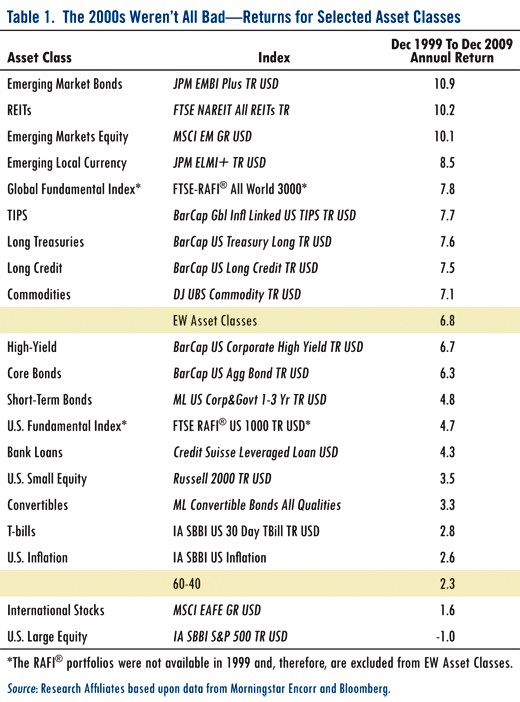
The table below shows total returns for some of the asset classes they examined.

 From the Archives: Was It Really a Lost Decade?

click to enlarge

What are the commonalities of the best performing assets? 1) Lots of them are highly volatile like emerging markets equities and debt, 2) lots of them are international and thus were a play on the weaker dollar, 3) lots of them were alternative assets like commodities, TIPs, and REITs.

In other words, they were all asset classes that would tend to be marginalized in a traditional strategic asset allocation, where the typical pie would primarily consist of domestic stocks and bonds, with only small allocations to very volatile, international, or alternative assets.

In an interesting way, I think this makes a nice case for tactical asset allocation. While it is true that most investors–just from a risk and volatility perspective–would be unwilling to have a large allocation to emerging markets for an entire decade, they might find that periodic significant exposure to emerging markets during strong trends would be quite acceptable. And even assets near the bottom of the return table like U.S. Treasury bills would have been very welcome in a portfolio during parts of 2008, for example. You can cover the waterfront and just own an equal-weighted piece of everything, but I don’t know if that is the most effective way to do things.

What’s really needed is a systematic method for determining which asset classes to own, and when. Our Systematic Relative Strength process does this pretty effectively, even for asset classes that might be difficult or impossible to grade from a valuation perspective. (How do you determine whether the Euro is cheaper than energy stocks, or whether emerging market debt is cheaper than silver or agricultural commodities?) Once a systematic process is in place, the investor can be slightly more comfortable with perhaps a higher exposure to high volatility or alternative assets, knowing that in a tactical approach the exposures would be adjusted if trends change.

—-this article originally appeared 2/17/2010. There is no telling what the weak or strong assets will be for the coming decade, but I think global tactical asset allocation still represents a reasonable way to deal with that uncertainty.

Posted by:


Quote of the Week

February 28, 2013

Fascinating story written by Jeff Lin about the perseverance of Ang Lee, who recently won the Academy Award for Best Director for Life of Pi.

Much is made of genius and talent, but the foundation of any life where you get to realize your ambitions is simply being able to out-last everyone through the tough, crappy times — whether through sheer determination, a strong support network, or simply a lack of options.

HT: Abnormal Returns

Posted by:


Waiting for Clarity

February 21, 2013

Grim rhetoric about Europe’s economic prospects are plentiful. For example, consider Martin Wolf’s view, as recently detailed in the Financial Times:

Those who believe the eurozone’s trials are now behind it must assume either an extraordinary economic turnaround or a willingness of those trapped in deep recessions to soldier on, year after grim year. Neither assumption seems at all plausible.

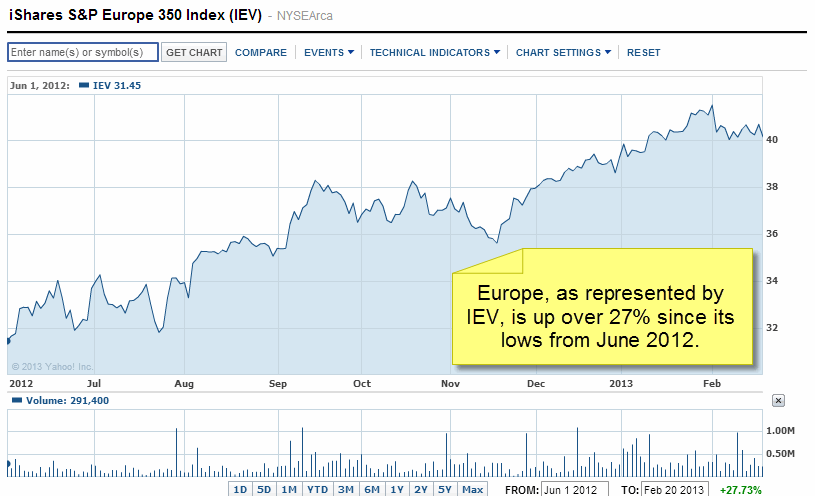
And then there is the chart:

iev Waiting for Clarity

Source: Yahoo! Finance

So what gives? Perhaps, Martin Wolf is just plain wrong and there is reason for optimism in Europe. Alternatively, maybe the market is just failing to see how bad things really are in Europe and Wolf will eventually be proven correct. Maybe investors should just sit this one out and wait for some clarity.

This type of thought process goes on constantly with investors. As is obvious to anyone who has been around the markets for a while, waiting for clarity before making an investment is a recipe for disaster. Markets climb a wall of worry—an adage that has been around for decades is a market reality. Trend following doesn’t wait for clarity. It leads investors to enter positions after signs of strength and to exit after signs of weakness. Europe is currently strong. We have seen the trends and relative strength of international equities, including Europe, improve dramatically in recent months. Of course we don’t know whether or not this trend has legs (one never does until after the fact), but trend followers can’t be overly concerned about whether or not each particular trade will work out. Some trades will quickly fail, while others will lead to long-term investments that produce spectacular gains. Embracing a logical methodology, like trend following, is likely to be a much more productive exercise than trying to gain investment wisdom from the current market prognosticators.

HT: Abnormal Returns

Dorsey Wright currently owns IEV and other positions in Europe. A list of all holdings for the trailing 12 months is available upon request. Past performance is no guarantee of future returns.

Posted by:


From the Archives: Rob Arnott and the Key to Better Returns

February 21, 2013

Rob Arnott is a thought leader in tactical asset allocation, currently well-known for his RAFI Fundamental Indexes. In his recent piece, Lessons from the Naughties, he discusses how investors will need to find return going forward.

The key to better returns will be to respond tactically to the shifting spectrum of opportunity, especially expanding and contracting one’s overall risk budget.

It’s a different way to view tactical asset allocation–looking at it from a risk budget point of view. The general concept is to own risk assets in good markets and safe assets in bad markets.

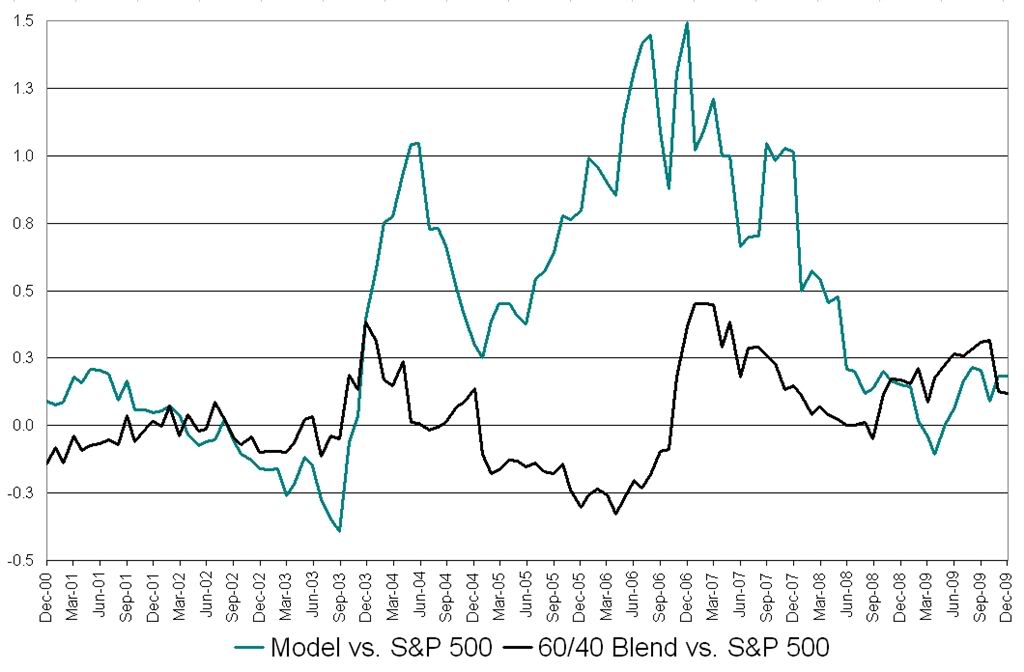
It turns out that systematic application of relative strength accomplishes this very well. The good folks at Arrow Funds recently asked us to take a look at how the beta in a tactically managed portfolio changed over time. When we examined that issue, it showed that as markets became risky, relative strength reduced the beta of the portfolio by moving toward low volatility (strong) assets. When markets were strong, allocating with relative strength pushed up the beta in the portfolio, thus taking good advantage of the market strength.

 From the Archives: Rob Arnott and the Key to Better Returns

click to enlarge

Using relative strength to do tactical asset allocation, the investor was not only able to earn an acceptable rate of return over time, but was able to have some risk mitigation going on the side. That’s a pretty tasty combination in today’s markets.

—-this article originally appeared on 2/26/2010. Amid all of the publicity given recently to risk parity, Arnott’s approach, which is to vary the risk budget over time depending on the opportunities available, has been largely ignored. I think this is unfortunate. His approach, although perhaps not easy, has merit. Tactical asset allocation driven by relative strength is one way to do that.

Posted by:


Bonds and Risk Parity

February 13, 2013

I had risk parity in mind when I noted that a recent article at Financial Advisor quoted long-time awesome bond manager Dan Fuss on the state of the bond market:

Dan Fuss, whose Loomis Sayles Bond Fund beat 98 percent of its peers in the last three years, said the fixed-income market is more “overbought” than at any time in his 55-year career as he prepares to open a fund to British individual investors.

“This is the most overbought market I have ever seen in my life in the business,” Fuss, 79, who oversees $66 billion in fixed-income assets as vice chairman of Boston-based Loomis Sayles & Co., said in an interview in London. “What I tell my clients is, ‘It’s not the end of the world, but for heaven’s sakes don’t go out and borrow money to buy bonds right now.’”

The reason this intrigues me is the strong institutional interest in “risk parity” portfolios at the moment. The base idea behind risk parity is that in a typical investment portfolio, equities provide most of the volatility. A risk parity portfolio typically tries to equalize the volatility contribution of different asset classes, which often means reducing the equity allocation—and also often leveraging the bond allocation. (Equating volatility with risk is a whole different discussion.) In other words, risk parity portfolios often borrow money to buy bonds, just the thing Dan Fuss is urging his clients to avoid right now.

To me, the marker of a bubble is irrational behavior. By that standard, bonds are in a bubble. Consider that at the end of last week the 10-year Treasury could be purchased with a yield of about 2.00%. Yet, the 10-year breakeven yield was about 2.57%, indicating that a buyer of 10-year Treasurys expected a negative real return.

Is it rational to buy something with the expectation of a negative return? Think about it this way: Imagine telling a prospective client, “If you buy this stock portfolio, we expect that you’ll lose about a half percent a year for the next decade.” Think you would have any buyers? Would people bid at auction to get a piece of the action?

Expectations, of course, could be wrong. Maybe bonds will continue to do well for an extended period of time, or maybe buying with the expectation of a slight negative return will turn out to be a genius move because every other asset class does much worse.

The problem with bubbles is not really that they exist. Bubbles are great for investors and for the economy on the way up. Bubbles often have an evolutionary financial purpose as well—probably the foundation for many later businesses was laid during the internet bubble. Much of the first internet generation might have died off, but their offspring populate Silicon Valley now. We’ll always have bubbles, human nature being what it is.

The more specific problem with bubbles concerns the investors trapped in them as they deflate—and the absolute impossibility of determining when that might happen. It’s way easier to identify a bubble than to guess when it will pop. Trends of all types, including bubbles, can go on for a lot longer than people think.

The most practical way to handle bubbles, I think, is to use some type of trend following tactical approach. You’ll never be out at the top, of course, but you might be able to be along for much of the ride and be able to exit without extensive damage. If you’re a bond market investor today that might be one way to think about your exposure. Committing to bonds as a permanent part of a risk parity strategy, especially with leverage, is a different animal.

Posted by:


Quote of the Week

February 12, 2013

To attain knowledge, add things every day. To attain wisdom, subtract things every day.—-Lao-Tzu

There are many theories about investing in the market. Some are simple, while others are mind-numbingly complex. Relative strength is one of the simple methods. Because it is simple, it is robust and much more difficult to break than a multi-factor method that relies on many relationships between factors. Complicated things are fragile and tend to break easily. That’s not to say that relative strength is perfect—it will underperform periodically like every other method. But relative strength subtracts everything except price, and asserts that strong price action is typically a precursor of good relative performance. History bears that out.

Posted by: