Quote of the Week

February 4, 2013

“..Amazon’s sky-high price-earnings ratio compared with rival retailers or rival tech companies illustrates the point that investing is hard and the stock market is weird.” —Matthew Yglesias, Slate

Classic example of a statement you make when you think there is some reason why the stock market should conform to a philosophy that you happen to hold. Investing becomes a lot less frustrating once you embrace the reality that the market is under no obligation to adhere to any one philosophy or expectation. Investment strategy then becomes an effort to effectively react to whatever the market offers as opposed to waiting for the market to eventually come around to your way of thinking. Relative strength is pretty effective at this task, I might add.

HT: Abnormal Returns

Dorsey Wright currently owns AMZN. A list of holding for the trailing 12 months is available upon request. Past performance is no guarantee of future results.

Posted by:


Timeless Portfolio Lessons

February 1, 2013

The only thing new under the sun is the history you haven’t read yet.—-Mark Twain

Investors often have the conceit that they are living in a new era. They often resort to new-fangled theories, without realizing that all of the old-fangled things are still around mainly because they’ve worked for a long time. While circumstances often change, human nature doesn’t change much, or very quickly. You can generally count on people to behave in similar ways every market cycle. Most portfolio lessons are timeless.

As proof, I offer a compendium of quotations from an old New York Times article:

WHEN you check the performance of your fund portfolio after reading about the rally in stocks, you may feel as if there is a great party going on and you weren’t invited. Perhaps a better way to look at it is that you were invited, but showed up at the wrong time or the wrong address.

It isn’t just you. Research, especially lately, shows that many investors don’t match market performance, often by a wide margin, because they are out of sync with downturns and rallies.

Christine Benz, director of personal finance at Morningstar, agrees. “It’s always hard to speak generally about what’s motivating investors,” she said, “but it’s emotions, basically,” resulting in “a pattern we see repeated over and over in market cycles.”

Those emotions are responsible not only for drawing investors in and out of the broad market at inopportune times, but also for poor allocations to its niches.

Where investors should be allocated, many professionals say, is in a broad range of assets. That will smooth overall returns and limit the likelihood of big losses resulting from an excessive concentration in a plunging market. It also limits the chances of panicking and selling at the bottom.

In investing, as in party-going, it’s often safer to let someone else drive.

This is not ground-breaking stuff. In fact, investors are probably bored to hear this sort of advice over and over—but it gets repeated because investors ignore the advice repeatedly! This same article could be written today, or written 20 years from now.

You can increase your odds of becoming a successful investor by constructing a reasonable portfolio that is diversified by volatility, by asset class, and by complementary strategy. Relative strength strategies, for example, complement value and low-volatility equity strategies very nicely because the excess returns tend to be uncorrelated. Adding alternative asset classes like commodities or stodgy asset classes like bonds can often benefit a portfolio because they respond to different return drivers than stocks.

As always, the bottom line is not to get carried away with your emotions. Although this is certainly easier said than done, a diversified portfolio and a competent advisor can help a lot.

Posted by:


From the Archives: Getting Torched By Expert Opinion

January 29, 2013

Barry Ritholtz has posted a 5 minute clip of some of Ben Bernanke’s public comments between 2005-2007 on the housing market and the broader economy. The point of me posting this is not to say that Bernanke is a complete moron because I have little doubt that he is one of the brightest financial minds in the country. However, talk about being dead wrong! If you relied on these opinions in order to make investment decisions, you likely got torched. If you can’t rely on expert opinion when making investment decisions, then what options do you have?

This highlights the value of trend-following systems. Trend following requires zero reliance on expert opinion; it simply allows the investor to adapt to whatever trends the market offers, whether or not experts expected things to play out in a given way. With trend following, you’ll have plenty of losing trades, but you’ll also avoid sitting in losing trades for long periods of time. Furthermore, systematic trend-following has an excellent track record (see here and here.) Trend following allows you to cut your losses short and to hold on to your winners. Frequently, the strongest trends end up being very different from what even the brightest experts predicted.

—-this article originally appeared 2/11/2010. Well, heck, if you can’t trust Ben Bernanke, who can you trust? The answer should be obvious: follow the price trend and forget about the random guessing of experts.

Posted by:


Dealing With Financial Repression

January 28, 2013

James Montier, the investment strategist at GMO, published a long piece on financial repression in Advisor Perspectives in November 2012. It’s taken me almost that long to read it—and I’m still not sure I completely understand its implications. Financial repression itself is pretty easy to understand though. Along with a humorous description of Fed policy, Montier describes it like this:

Put another way, QE sets the short-term rate to zero, and then tries to persuade everyone to spend rather than save by driving down the rates of return on all other assets (by direct purchase and indirect effects) towards zero, until there is nothing left to hold savings in. Essentially, Bernanke’s first commandment to investors goes something like this: Go forth and speculate. I don’t care what you do as long as you do something irresponsible.

Not all of Bernanke’s predecessors would have necessarily shared his enthusiasm for recklessness. William McChesney Martin was the longest-serving Federal Reserve Governor of all time. He seriously considered training as a Presbyterian minister before deciding that his vocation lay elsewhere, a trait that earned him the beautifully oxymoronic moniker of “the happy puritan.” He is probably most famous for his observation that the central bank’s role was to “take away the punch bowl just when the party is getting started.” In contrast, Bernanke’s Fed is acting like teenage boys on prom night: spiking the punch, handing out free drinks, hoping to get lucky, and encouraging everyone to view the market through beer goggles.

So why is the Fed pursuing this policy? The answer, I think, is that the Fed is worried about the “initial condition” or starting point (if you prefer) of the economy, a position of over-indebtedness. When one starts from this position there are really only four ways out:

i. Growth is obviously the most “popular” but hardest route.

ii. Austerity is pretty much doomed to failure as it tends to lead to falling tax revenues, wider deficits, and public unrest. 2

iii. Abrogation runs the spectrum from default (entirely at the borrower’s discretion) to restructuring (a combination of borrower and lender) right out to the oft-forgotten forgiveness (entirely at the lender’s discretion).

iv. Inflation erodes the real value of the debt and transfers wealth from savers to borrowers. Inflating away debt can be delivered by two different routes: (a) sudden bursts of inflation, which catch participants off guard, or (b) financial repression.

Financial repression can be defined (somewhat loosely, admittedly) as a policy that results in consistent negative real interest rates. Keynes poetically called this the “euthanasia of the rentier.”3 The tools available to engineer this outcome are many and varied, ranging from explicit (or implicit) caps on interest rates to directed lending to the government by captive domestic audiences (think the postal saving system in Japan over the last two decades) to capital controls (favoured by emerging markets in days gone by).

The effects of financial repression are easy to see: very low yields in debt instruments, and the consequent temptation to reach for yield elsewhere. Advisors see the effects in clients every day.

If you are feeling jovial, I highly recommend reading Montier’s whole piece as an antidote to your good mood. His forecast is rather bleak—poor long-term returns in most all asset classes for a long period of time. My take-away was a little different.

Let’s assume for a moment that Montier is correct and long-term (they use seven years) equity real returns are approximately equivalent to zero. In fact, that’s pretty much exactly what we’ve seen during the last decade! The broad market has made very little progress since 1998, a period going on 15 years now. Buy-and-hold (we prefer the terminology “sit-and-take-it”) clearly didn’t work in that environment, but tactical asset allocation certainly did. Using relative strength to drive the process, tactical asset allocation steered you toward asset classes, sectors, and individual securities that were strong (for however long) and then pushed you out of them when they became weak.

I have no idea whether Montier’s forecast will pan out or not, but if it does, tactical asset allocation might end up being one of the few ways to survive. There’s almost always enough fluctuation around the trend—even if the trend is flat—to get a little traction with tactical asset allocation.

Source: Monty Python/Youtube

[In fact, might I suggest the Arrow DWA Balanced Fund and the Arrow DWA Tactical Fund as considerations? You can find more information at www.arrowfunds.com.]

Posted by:


From the Archives: Why We Like Price

January 25, 2013

Relative strength calculations rely on a single input: price. We like price because it is a known quantity, not an assumption. In this deconstruction of the Price-to-Earnings Growth (PEG) ratio, the author, Tom Brakke, discusses all of the uncertainties when calculating even a simple ratio like PEG. And amidst all of the uncertainties he mentions is this:

In looking at that calculation, only one of the three variables has any precision: We can observe the market price (P) at virtually any time and be assured that we have an accurate number. The E is a different matter entirely. Which earnings? Forward, trailing, smoothed, operating, adjusted, owner? Why? How deep into accounting and the theory of finance do you want to go?

For most investors, not very far. We like our heuristics clean and easy, not hairy. So, in combining the first two variables we get the P/E ratio, the “multiple” upon which most valuation work rests, despite the questionable assumptions that may be baked in at any time. The addition of the third element, growth (G), gives us not the epiphany we seek, but even more confusion.

The emphasis is mine. This isn’t a knock on fundamental analysis. It can be valuable, but there is an inherent squishiness to it. The only precision is found in price. And price is dynamic: it adapts in real time as expectations of the asset change. (Fundamental data is often available only on a quarterly schedule.) As a result, systematic models built using relative strength adapt quite nicely as conditions change.

—-this article originally appeared 2/10/2010. We still like using prices as an input, especially now that there are so many cross-currents. Every pundit has a different take on what will happen down the road, but prices in a free market will eventually sort it all out.

Posted by:


From the Archives: The 80/20 Rule in Action

January 17, 2013

According to a fascinating study discussed in Time Magazine based on 27 million hands of Texas Hold’em, it turns out that the more hands poker players win, the more money they lose! What’s going on here?

I suspect it has to do with investor preferences–gamblers often think the same way. Most people like to have a high percentage of winning trades; they are less happy with a lower percentage of winning trades, even if the occasional winner is a big one. In other words, investors will often prefer a system with 65% winning trades over a system with 45% winning trades, even if the latter method results in much greater overall profits.

People overweigh their frequent small gains vis-à-vis occasional large losses,” Siler says.

In fact, you are generally best off if you cut your losses and let your winners run. This is the way that systematic trend following tends to work. Often this results in a few large trades (the 20% in the 80/20 rule) making up a large part of your profits. Poker players and amateur investors obviously tend to work the other way, preferring lots of small profits–which all tend to be wiped away by a few large losses. Taking lots of small profits is the psychological path of least resistance, but the easy way is the wrong way in this case.

—-this article was originally published 2/10/2010. Investors still have irrational preferences about making money. They usually want profits—but apparently only if they are in a certain distribution! Real life doesn’t work that way. Making money is a fairly messy process. Only a few names turn out to be big winners, so you’ve got to give them a chance to run.

Posted by:


Stocks and the Economy: It’s Complicated

January 15, 2013

Seeking to understand the relationship between the economy and the stock market is a rather complex undertaking. We can certainly argue that the economy impacts corporate earnings in terms of revenues and costs. Stock prices generally reflect investor expectations for future corporate earnings and future economic growth. As a result, one might expect that there is a fairly direct relationship between U.S. GDP growth and U.S. stock market performance. However, it is also generally accepted that the stock market is a leading indicator and its movements should precede U.S. economic growth. Stocks and the economy don’t always move in lockstep. Let’s look at some real life examples and see what conclusions can be drawn.

Consider the following chart which shows U.S. GDP growth since the early 1980s. The shaded areas indicate U.S. recessions.

FRED GDP Stocks and the Economy: Its Complicated

The table below shows GDP growth and stock market performance in the years following the last four recessions.

recession2 Stocks and the Economy: Its Complicated

It can be observed that U.S. economic growth following the most recent recession is weaker than that of the preceding three—and yet the stock market performance was the second highest return of those shown. In other words, the strength of U.S. economic growth has not always been a good indicator of stock market performance. What is driving those returns then? Monetary policy? Fiscal policy? Globalization? A combination of many, many different factors?

At Dorsey Wright, our investment decisions are based on relative strength models that seek to capitalize on trends. We spend little time trying to understand the exact relationship between price movement and the various fundamental factors influencing those price returns. After all, investors are not primarily concerned about making sure that whatever gains or losses they have in their portfolio are symbiotic with the prevailing economic and financial theories of the day. Rather, they want to make as much money as possible given their risk management considerations.

I suspect that many investors are failing to fully take advantage of the returns in the financial markets because they correctly observe the rather weak economic growth and then incorrectly assume that the stock market must necessarily also be doing poorly. The financial markets don’t wait for us to feel good before generating strong returns, nor do they seem to worry much about behaving in a way that fits anyone’s philosophical theories. It’s up to us to respond and seek to profit from whatever the financial markets throw our way. The good news for investors is that the financial markets have a long history of providing ample return (and risk) for investors who are seeking to build and manage wealth.

Source: National Bureau of Economic Research, U.S. Department of Commerce, Global Financial Data

In the table that shows subsequent three-year average GDP growth, I began measuring the three year GDP growth in the first full quarter following the end of the recession, as defined by the National Bureau of Economic Research. S&P 500 returns are total returns, inclusive of dividends. Past performance is no guarantee of future returns.

Posted by:


Disconnecting from Fundamentals

January 7, 2013

Mohamed El-Erian laments the impact that central banks are having on the markets:

But, critically for both economic prospects and investors, greater relative stability does not guarantee absolute stability. There is a limit to how far central banks can divorce prices from fundamentals. Moreover, as illustrated in the minutes of the latest Fed meeting, there is already discomfort among some policy makers due to the costs and risks of unconventional policies. Also, at some point, and it is hard to tell when exactly, the private sector will increasingly refuse to engage in situations deemed excessively artificial and overly rigged.

This is particularly relevant for asset classes (such as high yield corporate bonds, equities and certain highly leveraged products) outside the direct influence of central banks – an influence that is applied through direct market purchases and forward-looking policy guidance. With the weaker central bank impact, prices need to have greater consistency with the realities of balance sheets and income statements.

In such a world, investors should expect security and sector selections to get repeatedly overwhelmed by macro correlations. Since a growing number of asset classes are now exposed in a material fashion to the belief that central banks will deliver macroeconomic as well as market outcomes, investors have assumed considerable macro-driven correlations across their holdings. Moreover, with seemingly endless liquidity injections, the scaling of such exposure can easily disconnect from the extent to which prices deviate from fundamentals.

The topic of prices deviating from fundamentals is not new. How much of that deviation between price and fundamentals is a result of investor behavior, central bank policy, or any number of other factors is up for debate. While there may be a lot of truth to what El-Erian says about the impact of central bank’s policies, it becomes very difficult for an investor to know what actions to take based on those arguments. What is the correct measure of fundamental value? If a client places trades based on the expectation that the market will eventually reflect fundamental value, how long should they expect to wait? Days? Months? Years? Decades? Just how far can prices deviate from fundamental value?

Our approach to investing doesn’t get caught up in normative debates. Rather, all of our trend-following models focus on one core piece of information that reflects supply and demand- and that is price. Anything that can possibly affect the price – fundamentally, politically, psychologically, or otherwise – is actually reflected in the price. Furthermore, relative strength has the advantage of being able to rank trends by their strength.

We are likely to be debating the merits of current central bank policy for many years to come. In time, conclusions will be able to be drawn about their wisdom. However, relative strength offers pragmatists a robust and adaptive strategy to employ today.

Posted by:


Keeping It Simple in the New Year

January 3, 2013

Barry Ritholtz at The Big Picture has some musings about portfolios for the New Year. I think he’s right about keeping it simple—but I also think his thought is incomplete. He writes:

May I suggest taking control of your portfolio as a worthwhile goal this year?

I have been thinking about this for awhile now. Last year (heh), I read a quote I really liked from Tadas Viskanta of Abnormal Returns. He was discussing the disadvantages of complexity when creating an investment plan:

“A simple, albeit less than optimal, investment strategy that is easily followed trumps one that will abandoned at the first sign of under-performance.”

I am always mindful that brilliant, complex strategies more often than not fail. Why? A simple inability of the Humans running them to stay with them whenever there are rising fear levels (typically manifested as higher volatility and occasional drawdowns).

Let me state this more simply: Any strategy that fails to recognize the psychological foibles and quirks of its users has a much higher probability of failure than one that anticipates and adjusts for that psychology.

Let me just say that there is a lot of merit to keeping things simple. It’s absolutely true that complex things break more easily than simple things, whether you’re talking about kid’s Christmas toys or investor portfolios. I believe in simplicity over complexity.

However, complexity is only the tip of the iceberg that is human nature. Mr. Ritholtz hints at it when he mentions human inability to stay with a strategy when fear comes into the picture. That is really the core issue, not complexity. Adjust for foibles all you want; many investors will still find a way to express their quirks. You can have an obscenely simple strategy, but most investors will still be unable to stay with it when they are fearful.

Trust me, human nature can foil any strategy.

Perhaps a simple strategy will be more resilient than a complex one, but I think it’s most important to work on our resilience as investors.

Tuning out news and pundits is a good start. Delving deeply into the philosophy and inner workings of your chosen strategy is critical too. Understand when it will do well and when it will do poorly. The better you understand your return factor, whether it is relative strength, value, or something else, the less likely you are to abandon it at the wrong time. Consider tying yourself to the mast like Ulysses—make it difficult or inconvenient to make portfolio strategy changes. Maybe use an outside manager in Borneo that you can only contact once per year by mail. I tell clients just to read the sports pages and skip the financial section. (What could be more compelling soap opera than the Jet’s season?) Whether you choose distraction, inconvenience, or steely resolve as your method, the goal is to prevent volatility and the attendant fear it causes from getting you to change course.

The best gift an investor has is self-discipline. As one of our senior portfolio managers likes to point out, “To the disciplined go the spoils.”

Posted by:


Quote of the Day

December 26, 2012

A man should look for what is, and not for what he thinks should be.—Albert Einstein

Einstein 1921 portrait2 Quote of the Day


Posted by:


Tax-Efficient Alpha

December 20, 2012

As the national debate about taxes, spending, and “fairness” rages on, wealthy investors are justifiably concerned about what this means for their after-tax returns. We can expect that our clients are going to be asking a lot more questions about tax efficiency in the coming months and years. With that in mind, consider the good news released by PowerShares this past week:

CHICAGO – December 18, 2012 – Invesco PowerShares Capital Management LLC, a leading global provider of exchange-traded funds (ETFs), announced today that it expects to deliver zero long-term capital gains distributions across 120 of 123 equity and fixed-income ETFs for 2012.

“At Invesco PowerShares we are proud of our product line’s tax efficient track record,” said Ben Fulton, Invesco PowerShares managing director of global ETFs. “For the tenth consecutive year, we are pleased that the vast majority of PowerShares ETFs did not deliver capital gains distributions. This accomplishment highlights one of the many advantages ETFs can potentially provide shareholders seeking to maximize real returns.”

We are pleased to announce that the four ETFs in the PowerShares DWA family of Technical Leaders ETFs (PDP, PIE, PIZ, and DWAS) are among the ETFs that are expected to deliver zero long-term capital gains distributions in 2012. In fact, PDP is now coming up on six years since its inception and it has not delivered a capital gains distribution in any of those years. And, it has outperformed the S&P 500 since inception.

That is not a bad combination: Delivering alpha through the investment process AND delivering tax-efficient alpha through the ETF structure.

For a review of the way that ETFs are able to provide tax efficiency, consider the following from PowerShares’ website:

How do ETFs deliver tax efficiency?

Taxes may be one of the most critical and yet overlooked factors in wealth creation over time as they can erode even the best fund’s returns. Because of their unique structure, ETFs may serve as a tax-efficient investment tool for shareholders who wish to defer capital gains until the point of sale.

While it is not Invesco PowerShares intention, there is no guarantee that the Funds will not distribute capital gains to its shareholders. Invesco Powershares does not offer tax advice. Please consult your own tax advisor for information regarding your own tax situation.

How is the in-kind redemption process unique?

PowerShares ETFs use a LI-FO (lowest in - first out) in-kind tax management strategy unique to ETFs. This method typically allows the fund manager, during the creation and redemption process, to purge the lowest cost basis stocks through in-kind, no-taxable stock transfers. This unique operational trait leaves the fund with the highest cost basis securities, which systematically reduces tax exposure.

See www.powershares.com for more information. Past performance is no guarantee of future returns.

Posted by:


Fama and French Love Relative Strength?

December 17, 2012

Although relative strength investors are not always happy about having their return factor co-opted by academics (who re-named it “momentum”), it’s always nice to see that academics love the power of momentum. In their 2007 paper, Dissecting Anomalies, Eugene Fama and Ken French cover the waterfront on return anomalies, examining them both through style sorts and regression analysis. CXO Advisory put together a very convenient summary of their findings, reproduced below.

famafrench CXO Fama and French Love Relative Strength?

Source: CXO Advisory (click to enlarge)

CXO’s conclusion is especially succinct: In summary, some anomalies are stronger and more consistent than others. Momentum appears to be the strongest and most consistent.

We couldn’t have said it better ourselves.

Posted by:


Relative Strength Everywhere

December 14, 2012

Eric Falkenstein has an interesting argument in his paper Risk and Return in General: Theory and Evidence. He proposes what is essentially a relative strength argument about risk and return. He contends that investors care only about relative wealth and that risk is really about deviating from the social norm. Here is the summary of his draft from the excellent CXO Advisory:

Directly measured risk seldom relates positively to average returns. In fact, there is no measure of risk that produces a consistently linear scatter plot with returns across a variety of investments (stocks, banks, stock options, yield spread, corporate bonds, mutual funds, commodities, small businesses, movies, lottery tickets and bets on horse races).

  • Humans are social animals, and processing of social information (status within group) is built into our brains. People care only about relative wealth.
  • Risk is a deviation from what everyone else is doing (the market portfolio) and is therefore avoidable and unpriced. There is no risk premium.

The whole paper is a 150-page deconstruction of the flaws in the standard model of risk and return as promulgated by academics. The two startling conclusions are that 1) people care only about relative wealth and that 2) risk is simply a deviation from what everyone else is doing.

This is a much more behavioral interpretation of how markets operate than the standard risk-and-return tradeoff assumptions. After many years in the investment management industry dealing with real clients, I’ve got to say that Mr. Falkenstein re-interpretation has a lot going for it. It explains many of the anomalies that the standard model cannot, and it comports well with how real clients often act in relation to the market.

In terms of practical implications for client management, a few things occur to me.

  • Psychologists will tell you that clients respond more visually and emotionally than mathematically. Therefore, it may be more useful to motivate clients emotionally by showing them how saving money and managing their portfolio intelligently is allowing them to climb in wealth and status relative to their peers, especially if this information is presented visually.
  • Eliminating market-related benchmarks from client reports (i.e., the reference to what everyone else is doing) might allow the client to focus just on the growth of their relative wealth, rather than worrying about risk in Falkenstein’s sense of deviation from the norm. (In fact, the further one gets from the market benchmark, the better performance is likely to be, according to studies on active share.) If any benchmark is used at all, maybe it should be related to the wealth levels of the peer group to motivate the client to strive for higher status and greater wealth.

I’m sure there is a lot more to be gleaned from this paper and I’m looking forward to having time to read it again.

Posted by:


Legendary Investors

December 13, 2012

Certain kinds of investment and certain investors have been accorded legendary status in the investment community. Most of the time, this amounts to worshipping a false idol. Either that or legendary investors are just exceptionally good at public relations. Here are some stories about legendary investors you might find illuminating.


Ben Graham, the father of Value Investing (from the Psy-Fi blog)

Following the Wall Street Crash he geared up, borrowing money to invest in the huge range of cheap value stocks that were available in the market. Not being psychic he failed to divine that the recovery in ’30 was the prelude to the even greater drop in ’31.

Faced with ruination for himself and his clients he was lucky enough to be recapitalised by his partner’s father-in-law and restored his and their wealth over the next few years, as the markets stabilised and some sort of normality took hold again.

Yep, Ben Graham blew up and needed a bailout.


John Maynard Keynes, the father of Keynesian economics and manager of the King’s College, Cambridge endowment (from the Psy-Fi blog)

For Keynes investing was about figuring out what everyone else would want to buy and buying it ahead of them. Back in the Roaring Twenties he expressed this approach through currency speculation. Prior to the First World War this would have been an exercise in futility as major currencies were all pegged to the immovable Gold Standard: exchange rates didn’t move. However, the disruption to major economies caused by the conflict forced countries off gold and into a world of strangely shifting valuations.

In this new world Keynes saw the opportunity to apply his animal spirits philosophy and rapidly managed to generate a small fortune, by trading heavily on margin, as the German economy collapsed into hyperinflation, France struggled with an accelerating rate of change of governments and financial scandals, Britain failed to recognise its new place in the world order and the USA lapsed into protectionism. And then, as is the way of the investing world, there was a sudden and inexplicable reversal in the trajectory of exchange rates and Keynes found himself and his fellow investors suddenly short of the cash needed to make good their positions.

As Ben Graham found, when you’re in dire need the best thing to have handy is a wealthy friend. In this case it was Keynes’ father who bailed him out.

Yep, Keynes blew up and needed a bailout from Dad.


Warren Buffett, the King of Buy-and-Hold (from CXO Advisory)

In their July 2010 paper entitled “Overconfidence, Under-Reaction, and Warren Buffett’s Investments”, John Hughes, Jing Liu and Mingshan Zhang investigate how other experts/large traders contribute to market underreaction to Berkshire Hathaway’s moves. Using return, analyst recommendation, insider trading and institutional holdings data for publicly traded stocks listed in Berkshire Hathaway’s quarterly SEC Form 13F filings during 1980-2006 (2,140 quarter-stock observations), they find that:

The median holding period is one year, with approximately 20% (30%) of stocks held for more than two years (less than six months).

Yep, Warren Buffett has 100% turnover. He blew out 30% of his portfolio selections within six months, and held about 20% of his picks for the longer run. That is active trading by any definition.


All three of these investors were quite successful over time, but the reality varies from the perception. What can we learn from the actual trading of these legendary investors?

  • Using a lot of leverage probably isn’t a good idea. If you do use leverage, then make sure you have a big pile of cash set aside for when the margin call arrives. Because it will arrive.
  • A variety of investment methods probably work over time, but no method works all the time. All methods have the ability to create a painful drawdown. In other words, there is no magic method and no free lunch.
  • It makes sense to keep a portfolio fresh. In Buffett’s portfolio, about 20% of the holdings make the grade and turn into longer term investments. Things that are not working out should probably be sold. (In passing, I note that relative strength rankings make this upgrading process rather simple.) In Buffett’s portfolio, the bulk of the return obviously comes from the relative strength monsters—those stocks that have performed well for a very long period of time. Those are the stocks he holds on to. That merits some attention as a best practice.

As in most arenas in life, it is usually more productive to pay attention to what people do, not what they say!

Posted by:


Winners and Losers

December 12, 2012

If you’ve ever wondered why clients remember their winners so well—and are so quick to sell them-while forgetting the losers and how badly they have done, some academics have done you a favor. You can read this article for the full explanation. Or you can look at this handy graphic from CXO Advisory that explains how clients use different reference points for winners and losers. In short, the winners are compared with their highest-ever price, while losers are compared with their break-even purchase price.

winnersandlosers cxo Winners and Losers

Source: CXO Advisory

It explains a lot, doesn’t it? It explains why clients make bizarre self-estimates of their investment performance. And it explains why clients are perpetually disappointed with their advisors—because they are comparing their winners with the highest price achieved. Any downtick makes it a loser in their eyes. The losers are ignored, in hopes they will get back to even.

The antidote to this cognitive bias, of course, is to use a systematic investment process that ruthlessly evaluates every position against a common standard. If you are a value investor, presumably you are estimating future expected returns as your holding criterion. For relative strength investors like ourselves, we’re constantly evaluating the relative strength ranking of each security in the investment universe. Strong securities are retained, and securities that weaken are swapped out for stronger ones. Only a systematic process is going to keep you from looking at reference points differently for winners and losers.

Posted by:


From the Archives: Zut Alors!

December 9, 2012

If you need another reason to hate the French, besides envy of their excellent cuisine, it turns out that a bevy of winemakers were fined and given suspended sentences for foisting cheap, lousy wine on American consumers and charging them premium prices for it.

On the other hand, it shows that cognitive biases are everywhere. Neither the American company the wine was shipped to nor consumers drinking it ever complained! Because the wine was labeled as premium pinot noir, wine enthusiasts apparently thought it tasted great. In fact, it turns out that wine drinkers think expensive wine tastes better, even when you trick them and give them two glasses of wine from the same bottle.

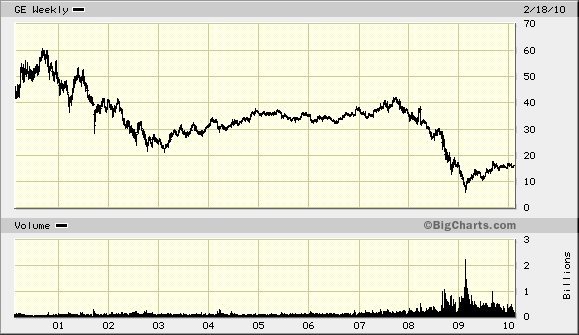
This behavior is not unknown in the stock market, where cognitive biases run unbridled down Wall Street. Ten years ago, everyone was in love with General Electic. It, too, was high-priced and tasted great. Ten years later, GE is considered cheap swill that leaves a bitter taste in the mouths of investors.

 From the Archives: Zut Alors!

The moral of the story is that you can’t fall in love with your stocks or your wine. You have to like it on its own merits. In the case of our Systematic RS accounts, we like a stock only as long as it has high relative strength. When it becomes weaker and drops in its ranking–indicating that other, stronger stocks are available–we sell it and move on to a better class of grape. (We’ve been known to break a bottle here and there, but the idea is to adapt as tastes change.) In this way, we strive to keep our wine cellar stocked with the best vintages all the time.

 From the Archives: Zut Alors!

—-this article originally appeared 2/19/2012. Cognitive biases are still running wild on Wall Street.

Posted by:


It’s All Relative

November 29, 2012

James Montier points out that absolute concepts of valuation make no sense:

We don’t like stocks as an asset class compared to what we think fair value should be. However, the alternatives are generally really awful. This problem is exacerbated if financial repression lasts beyond our forecast horizon of seven years. So, at the margin, an investor would probably be wise to give equities a little more benefit of the doubt, and hence a little more weight in their portfolio than they would do, if the Fed weren’t pursuing policies of financial repression.

HT: Abnormal Returns

Posted by:


Coping With the New Normal

November 28, 2012

The “new normal” is a phrase that strikes fear into the heart of many investors. It is shorthand for the belief that the US economy will grow very slowly going forward, as opposed to resuming its typical growth rate. For example, here is the Research Affliliates version of the new normal, as presented in a recent article from AdvisorOne:

Unless the U.S. makes politically difficult changes in immigration, employment and investment policies, Americans should expect a long-term “new normal” rate of growth of just 1%. So says investment management firm Research Affiliates, in a research note that brings a wealth of demographic and historic data to bear on current fiscal projections.

Christopher Brightman, the report’s author and head of investment management for the Newport Beach, Calif. Firm founded by indexing guru Rob Arnott, is critical of White House and Congressional Budget Office growth projections that assume 2.5% long-term growth.

Brightman argues the U.S. will find it nearly impossible to recapture the 3.3% average annual growth that prevailed from 1951 to 2000 as a result of negative trends in the key areas that affect GDP: population growth, employment rate growth and productivity.

PIMCO and other firms have also been exponents of the new normal view, and although the specifics may vary from strategist to strategist, the general outlook for sluggish growth is the same.

Investor response to date has been less than constructive and has mostly resembled curling up into the fetal position. Although I have no idea how likely it is the new normal theory will pan out, let’s think for a moment about some of the possible implications.

  • if US economic growth is slow, it may slow growth overseas, especially when the US is their primary export market.
  • economies less linked to the US may decouple and retain strong growth characteristics.
  • inflation and interest rates may stay low, leading to better-than-expected bond returns (where default is not an issue).
  • ever more heroic measures to stimulate US economic growth may backfire, creating a debt bomb and high future inflation.
  • growth may be priced at a premium multiple for those stocks and sectors that are demonstrating strong fundamentals. In other words, if growth is hard to find, investors may be willing to pay up for it.
  • slow economic growth may cause a collapse in multiples, as future growth is discounted at a much lower rate.

In other words, you can still get pretty much any investment scenario out of new normal assumptions. It’s just about whether a particular strategist is feeling pessimistic or optimistic that day, or more cynically, whether they are talking their book.

To me, this is one of the best arguments in favor of tactical asset allocation driven by relative strength. Relative strength lets the market decide, based on which assets are strong, what to buy. At any given time it could be currencies, commodities, stocks, bonds, real estate, or even inverse funds. And it might change over time, as new perceptions creep into the market or as policy responses and market consequences interact in a feedback loop. Relative strength doesn’t make any assumptions about what will happen; it treats good performance favorably regardless of the source. Tactical asset allocation, then, is just an attempt to extract returns from wherever they might be available. That trait may come in handy in a tough market.

Posted by:


Behavioral Finance: Inside the Client’s Brain

November 27, 2012

I admit to a prurient interest in behavioral finance. Perhaps this is due to my background in psychology—or just from having dealt with a broad range of clients for many years. Investor behavior is sometimes amazing, and behavioral finance, the academic specialty that has grown up to examine it, is equally interesting. One of the most practical discussions of behavioral finance I have seen appeared recently on AdvisorOne. It was written by Michael Finke, the coordinator for the financial planning program at Texas Tech.

It is my strong recommendation that you read the entire article, but here are a few of the behavioral finance highlights that jumped out at me:

  • Breaking habits requires deliberate intention to change routines by using our rider to change the direction of the elephant. How do we motivate people to change behavior to meet long-term goals? Neuroscience suggests that the worst way to motivate people is to focus on numbers. Telling someone they need to save a certain amount to achieve an adequate retirement accumulation goal may be convincing to the rational brain, but not so convincing to the elephant.
  • Explaining a concept in a visual or emotional sense uses much more of our brain functions than is used by numbers. If you think of people as being emotional and visual, you’ve essentially tapped into 70% of the brain real estate. There is that rational side, but that rational side might be more like 20% of the real estate. The rational side used to solve math problems might be 8% of the real estate.
  • It can be useful to frame desired actions as the status quo in order to take advantage of this preference. For example, setting defaults that are beneficial can have an unexpectedly large impact on improving behavior.
  • The most powerful emotional response related to financial choice is fear. Fear leads to a number of observed decision anomalies identified in behavioral finance such as the excessive attention paid to a loss. Framing decisions so that they do not necessarily involve a loss is an important tool advisors can use to avoid bringing the amygdala to the table.
  • “Dollar cost averaging is an illusion,” notes James. “Unless we have mean reversion in the market (and if we do we can make lots of market timing bets and make ourselves rich), dollar cost averaging does not work. But if people believe that they are buying shares cheaper in a recession, the story makes people stay in the market at the times when their fear-driven emotional side wants them to get out of the market. We have a story that, even if it’s completely false, is generating the behavior that is going to be portfolio maximizing in the end. So maybe the answer to the usefulness of dollar cost averaging isn’t ‘well we’ve figured it out and it doesn’t work, so don’t use it,’ the answer is ‘actually it’s not true but it gets your clients to behave the right way so keep telling them that.’”

The biggest impediment to good returns is typically investor psychology. If behavioral finance ideas can help clients control their behavior better—and thus lead to better investment outcomes—some of these ideas may prove useful.

gear head leanfrog Behavioral Finance: Inside the Clients Brain

Source: Lean Frog (click on image to enlarge)

Posted by:


Compound Interest

November 21, 2012

Paul Merriman, in a column for Marketwatch, has a nice discussion about the power of compound interest. He shows that the effect of compound interest is exponential, not linear, and points out what a huge difference time and a somewhat higher compounding rate can make.

One big mistake clients often make is that they don’t allow enough time for their investments to compound. DALBAR documents that the holding periods for both stock and bond funds average around three years. Although compound interest is astonishing, that is not nearly enough time to let an exponential function kick in. With exponential growth, by definition, much of the growth is going to be backloaded. Investment growth will be much more noticeable after twenty good years than after three.

Advisors that can get their clients to be patient and leave their investment funds alone, whether achieved through a strong and trusting relationship or through a calming asset allocation, will allow the clients a chance to reap rewards over time. If the client is changing course every three years, there’s almost no chance for that to happen. In the investment industry, we like to think of ourselves as investment gurus-but it might be better to re-imagine ourselves as compound interest gurus.

Posted by:


Quote of the Week

November 21, 2012

Why when we see nothing but improvement behind us, do we see nothing but deterioration before us - Macaulay

HT: Jim Pethokoukis

Posted by:


Changing With The Times

November 20, 2012

Josh Brown’s tweet this morning pretty much sums up the problem that BBY, HPQ, and JCP face:

There is also a shortage of demand for the company’s stocks, as reflected by the chart below (the red line is the S&P 500):

Source: Yahoo! Finance

Times change. There are no guarantees that companies that achieve great success will stay at the top forever. In fact, the nature of capitalism makes the strategy of buying and holding individual stocks a very risky proposition over time. Enter relative strength, which does an effective job of keeping you with the winners while they are strong, but also provides an efficient way to exit when it’s time to move on.

A list of all Dorsey Wright holdings for the trailing 12 months is available upon request.

Posted by:


Yet Another Blow to Modern Portfolio Theory

November 19, 2012

Modern Portfolio Theory is predicated on the ability to construct an efficient frontier based on returns, correlations, and volatility. Each of these parameters needs to be accurate for the efficient frontier to be accurate. Since forecasting is tough, often historical averages are used. Since the next five or ten years is never exactly like the last 50 years, that method has significant problems. Apologists for modern portfolio theory claim that better efficient frontiers can be generated by estimating the inputs. Let’s imagine, for a moment, that this can actually be done with some accuracy.

There’s still a big problem. Volatility bumps up during adverse market conditions, as reported by Research Affiliates. And correlations change during declines—and not in a good way.

From the abstract of a recent paper, Quantifying the Behavior of Stock Correlations Under Market Stress:

Understanding correlations in complex systems is crucial in the face of turbulence, such as the ongoing financial crisis. However, in complex systems, such as financial systems, correlations are not constant but instead vary in time. Here we address the question of quantifying state-dependent correlations in stock markets. Reliable estimates of correlations are absolutely necessary to protect a portfolio. We analyze 72 years of daily closing prices of the 30 stocks forming the Dow Jones Industrial Average (DJIA). We find the striking result that the average correlation among these stocks scales linearly with market stress reflected by normalized DJIA index returns on various time scales. Consequently, the diversification effect which should protect a portfolio melts away in times of market losses, just when it would most urgently be needed.

I bolded the part that is most inconvenient for modern portfolio theory. By the way, this isn’t really cutting edge. The rising correlation problem isn’t new, but I find it interesting that academic papers are still being written on it in 2012.

The quest for the magical efficient portfolio should probably be ended, especially since there are a number of useful ways to build durable portfolios. We’re just never going to get to some kind of optimal portfolio. Mean variance optimization, in fact, turns out to be one of the worst methods in real life. We’ll have to make do with durable portfolio construction. It may be messy, but a broadly diversified portfolio should be serviceable under a broad range of market conditions.

Posted by:


The Disposition Effect

November 15, 2012

“Everyone” knows that you are supposed to cut your losses and let your winners run—except maybe actual investors. Real-life investors do the opposite, something that behavioral finance types call the “disposition effect.” Aswath Damodaran has a nice summary of the disposition effect on his blog, Musings on Markets.

In particular, there is significant evidence that investors sell winners too early and hold on to losing stocks much too long, using a mixture of rationalization and denial to to justify doing so. Shefrin and Statman coined this the “disposition effect” and Terrence O’Dean looked at the trading records of 10,000 investors in the 1980s to conclude that this irrationality cost them, on average, about 4.4% in annual returns. Behavioral economists attribute the disposition effect to a variety of factors including over confidence (that your original analysis was right and the market is wrong), mental accounting (a paper loss is less painful than a realized loss) and lack of self control (where you abandon rules that you set for yourself).

Whatever the presumed psychological attribution of the disposition effect, 440 basis points of return per year is a lot!

Mr. Damodaran explores a few possible solutions to eliminate the disposition effect. They boil down to this:

  • Regular evaluation of your portfolio
  • A rules-based, automated way to make portfolio decisions

This is very good advice indeed! Although we are not quants in a traditional sense, we use a systematic process for all of our investment products. It requires us to do regular portfolio evaluations and adhere to a rules-based method for making portfolio buy-and-sell decisions. That’s not to say that every decision will be correct—just that we’re not letting irrational psychological factors dictate our investment behavior. If we can recapture some of that 4.4% annual return that average investors give up, it will be a pretty good trade-off.

Posted by:


Durable Portfolio Construction

November 14, 2012

Durable portfolio construction comes from diversification, but diversification can mean a lot of different things. Most investors, unfortunately, give portfolio construction very little thought. As a result, their portfolios are not durable. In fact, they tend to come unglued during every downturn. Why does that happen?

I think there are a couple of inter-related problems.

  • Volatility tends to increase during downturns
  • Certain correlations tend to increase during declines

Volatility is an artifact of uncertainty. Once a downturn starts, no one is sure where the bottom is. That uncertainty often creates selling, which may cause the market to decline, which in turn may create more selling. We’ve all seen this happen. Eventually there is capitulation and the market bottoms, but it can be quite frightening in the middle of the move when no one knows where the bottom will be.

Research Affiliates had a recent article on diversification, and included in it was a table that showed the change in volatility that accompanied recessions. The bump is typically pretty large.
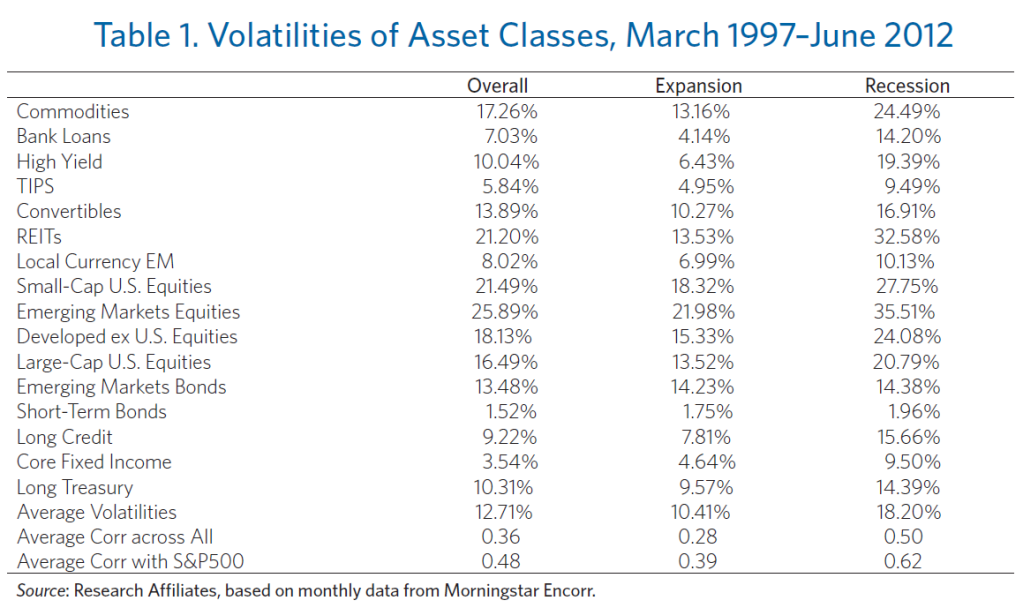
volatility rafi Durable Portfolio Construction

Source: Research Affiliates, via RealClearMarkets (click to enlarge image)

In general, riskier assets had the biggest jumps in volatility when the economy was under pressure. Thus, it makes perfect sense how a relatively sedate portfolio under typical conditions becomes much more volatile when conditions are tough.

Correlations are also observed to rise during declines. ”Risk on” assets, especially, often have rising correlations among themselves as risk is shunned. Similarly, “risk off” assets may see their internal correlations rise. However, it may be the case that correlations between dissimilar asset classes don’t change nearly as much. In other words, risk-on and risk-off assets might not have rising correlations during a period of market stress. In fact, it wouldn’t be surprising to see those correlations actually fall. So, one way to make portfolios more durable is to diversify by volatility.

There are probably multiple ways to do this. You could use volatility buckets for low-volatility assets like bonds and high-volatility assets like stocks. Or, you could just make sure that your portfolios have exposure to a broad range of asset classes, including asset classes with different responses to market stress.

Within an individual asset class, you are likely to see rising correlations between members of your investment universe. For example, during a sharp market decline, you’re likely to see increasing correlations among stocks. However, it’s possible to think about diversifying by return factor within an asset class.

AQR and others have shown, for example, that the excess returns of value and relative strength stocks are uncorrelated. That means that years where relative strength outperforms the market are likely to be years when value lags, and vice versa. Both types of stocks might go up in a rising market or fall in a declining market, but they will likely have different performance profiles. Diversifying by using complementary strategies is another way to make portfolios more durable.

As Research Affiliates points out, simple diversification is not a panacea. As their table shows, almost every asset class (possible exception: short-term bonds) has higher volatility in a bad economy.

Durable portfolio construction, then, might consist of multiple forms of diversification:

  • diversification by volatility
  • diversification by asset class
  • diversification by strategy

While there might be rising correlations between some types of assets, you are also likely to see falling correlations between others. Although the entire portfolio might have an elevated level of volatility, an absence of surging cross-correlations might make tail events a little more manageable. Good portfolio construction obviously won’t eliminate market risk, but it might make regular market volatility a little more palatable for a broad range of investors.

Posted by: