The Dilemma for Bond Investors

July 31, 2012

A recent Vanguard commentary has a very good description of the confusion facing bond investors right now—and judging from the recent heavy flows into bond funds, that’s a lot of investors.

These days, the airwaves seem filled with market commentators offering one of three popular suggestions for bond investors. All three groups urge investors to alter their investment strategy in this low-rate environment.

The first group suggests bond investors take on more interest-rate risk in an effort to earn more income today, say, by moving your assets from a short-maturity bond fund to a longer-maturity bond fund. The second group suggests investors do the exact opposite and reduce interest rate risk, say, by moving assets out of one’s bond portfolio into a savings vehicle in an attempt to sidestep a future rise in interest rates. Obviously, both groups of investors are trading with each other. Which group “wins” will ultimately depend on the future path of interest rates (more on this in a moment).

Like the first group, a third group of market commentators suggests taking on more risk, but of a different sort. They point to the U.S. investment experience of the late 1940s and early 1950s—the last time U.S. interest rates were this low—as a rationale for moving strategically out of low-yielding conservative bond portfolios and into traditionally more-volatile assets, namely stock funds.

I think that is a pretty good encapsulation of what bond investors are hearing right now. And, exactly as Vanguard points out, the “right” answer if you go with a forecast will only be determined in hindsight. You could have a pretty horrific experience in the meantime if you guess wrong. Their article points out, correctly I think, that although some of these outcomes may be more probable than others, there’s no way to know what will happen. The endgame could be anything from Japan to hyper-inflation. There are just too many variables in play.

If you are a strategic asset allocator, Vanguard suggests broad diversification. I am a little surprised by this, as they make a salient point about bonds.

We as investors first need to recalibrate our expectations for future bond returns. Unfortunately, the most direct implication of this low-rate environment is that bond portfolio returns are likely to be fairly puny going forward. As I wrote in March (“Why I still own Treasuries“), arguably the single best predictor of the future return on a bond portfolio is its current yield to maturity, or coupon.

I would think that a strategic asset allocator would severely underweight bonds if future forecasted bond returns are going to be small. (At least that’s what Harry Markowitz says to do.)

Another path through this minefield is tactical asset allocation. Hold the asset classes that are strong and avoid the rest. If bonds are strong because rates continue to fall, because Treasurys continue to be a safe haven, or because the US enters a low-growth Japan-like environment, then they will be welcome in a portfolio. If bonds are weak because rates start to rise or because the US begins to flirt with solvency concerns at some point, then many other asset classes are likely to perform better.

In the end, tactical asset allocation might be safer. Bond returns may be low, but they might end up being higher than the returns from some alternatives. Or bonds could turn out to be an unmitigated disaster. Tactical asset allocation driven by relative strength frees you from the need to forecast. Bonds will be in your portfolio—or not—depending only upon their performance.

Bond Investors Have a Dilemma

Source: buzzle.com

Posted by:


Quote of the Week

July 20, 2012

Legendary trend follower, Ed Seykota:

A surfer does not need to know the theory of fluid mechanics to learn how to surf a wave in the ocean– he needs only to be able to make probabilistic estimates and adjustments.

Source: Wikipedia

HT: Abnormal Returns, CSS Analytics

Posted by:


Advisors to the Rescue: Savings Edition

July 16, 2012

There’s already lots of evidence that individuals on their own don’t do very well investing. Compounding your net worth is extra difficult when you also don’t know how much to save. (As we’ve shown before, savings is actually much more important than investment performance in the early years of asset growth.)

An article at AdvisorOne discussed a recent survey that had some surprising findings on consumer savings, but ones that will be welcome for advisors. To wit:

The survey found that, regardless of income level, more than 60% of consumers who work with an advisor are contributing to a retirement plan or IRA, compared with just 38% of those without an advisor.

Furthermore, 61% of consumers who work with an advisor contribute at least 7% of their salary to their plan. Just 36% of consumers without an advisor save at this rate.

The guidance and education that advisors provide their clients to bring on these good saving habits translate to higher confidence, too. Of non-retired consumers with an advisor, half said their advisor provided guidance on how much to save. More than 70% of Americans with an advisor say they’re confident they’re saving enough. Just 43% of consumers without an advisor felt the same.

The differences in savings are really shocking to me. Less than half of the consumers without an advisor are even contributing to a retirement plan! And when they do have a retirement plan, only about a third of them are contributing 7% or more!

Vanguard estimates that appropriate savings rates are 12-15% or more.

I find it interesting that many consumers point out that their advisors gave them guidance on how much to save. It is pretty clear that even simple guidance like that can add a lot of value.

Posted by:


The Big Trend: Professional Asset Management Within the 401k

July 10, 2012

According to a Vanguard report, one of the big trends in the 401k market is the move toward professional asset management. An article at AdvisorOne on this topic says:

One-third of all Vanguard 401(k) plan participants invested their entire account balance in a professionally managed asset allocation and investment option in 2011, according to Vanguard’s How America Saves 2012, an annual report on how U.S. workers are saving and investing for retirement.

The report notes that “the increasing prominence of so-called professionally managed allocations—in a single target-date or balanced fund or through a managed account advisory service—is one of the most important trends in 401(k) and other defined contribution (DC) plans today.”

Two things concerned me about the report. I’m not at all surprised by more and more 401k participants moving toward professionally managed allocations. QDIAs (qualified default investment alternatives) make sense for a lot of participants because they are legally allowed to be your entire investment program. I was surprised about the make-up of the account allocations, given the problems encountered by target-date funds during the last bear market.

In 2011, 33% of all Vanguard participants were invested a professionally managed allocation program: 24% in a single target-date fund (TDF); 6% in a single traditional balanced fund, and 3% in a managed account advisory program. The total number is up from 9% at the end of 2005.

I am amazed that target-date funds are preferred to balanced funds. No doubt target-date funds are an improvement over investors hammering themselves by trading in and out, but target-date funds have some well-publicized problems, not the least of which is that they tend to push the portfolio more toward bonds as the target date nears. That could end up exposing retirees to significant inflation risk right at the time they can least cope with it. It seems to me that a balanced fund with some ability to tactically adjust the portfolio allocation over time is a much better solution.

The other significant problem I see is that savings rates are still far too low. Consider these statements from the AdvisorOne article:

The average participant deferral rate rose to 7.1% and the median (the median reflects the typical participant) was unchanged at 6%.

and then…

Vanguard’s view is that investors should save 12% to 15% or more.

I added the emphasis, but it’s easy to see the disconnect. Investors are saving 6%, but they probably need to be saving more than 15%!

Advisors, for the most part, have very little control over their client’s 401k plans. Clients sometimes ask for advice informally, but advisors are often not compensated for the advice and firms are sometimes reluctant to let them provide it for liability reasons anyway. (A few advisors handle client 401k’s through the independent brokerage window, but not every plan has that option and not every firm lets advisors do it. It would be great if the financial powers-that-be could figure out a way to reverse this problem, but the recent Department of Labor regulations appear to be going in the other direction.)

If you’re an advisor, it’s probably worthwhile to have a serious discussion with your clients about their 401k plans. They may not be handling things in the optimal way and they could probably use your help.

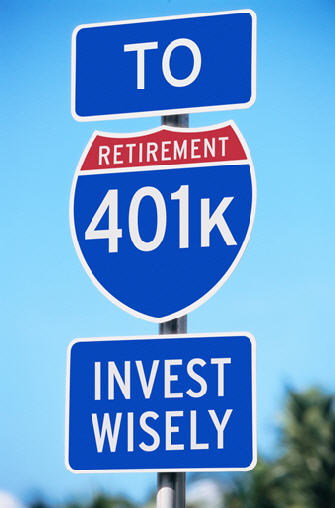
401k The Big Trend: Professional Asset Management Within the 401k

Your client may need your help

Source: investortrip.com

Posted by:


Investor Sentiment

July 6, 2012

Rick Ferri has an interesting blog piece that was brought to my attention through Abnormal Returns. (Maybe I can stir up a little controversy for a blog you should be reading every day.) In it, Mr. Ferri suggests that investor sentiment surveys don’t work because they are equal-weighted. He contends that only the opinion of large investors matters and says to follow the money.

He says explicitly, in the case of bonds, that large investors were right and predicted falling interest rates—and he implies that large investors are typically right, and that by following the money you can be right as well. (In a recent well-publicized case, in fact, the largest private bond investor in the world, Bill Gross of PIMCO, exited all of his Treasury positions and called for higher rates. He got that call wrong.)

Rick Ferri has many interesting and valuable ideas, but I think he is off base on this one. Lot of studies of institutional big-money investors show they get things wrong just as often as retail investors. If Mr. Ferri were correct in his assertion, studies would show that institutions typically outperform and individuals typically underperform. That’s not what the data show at all. Institutions aren’t that different from retail investors.

Investor sentiment surveys work very well-it’s just that they work in a contrary fashion. The reason they work in a contrary fashion, I believe, is a psychological phenomenon known as cognitive dissonance. We’ve written about this before.

Cognitive dissonance leads to the desire to reconcile your actions and beliefs. The naive view is that we all have certain firmly-held core beliefs and we endeavor to act appropriately, so that our beliefs and actions are aligned. Lots of psychological research shows otherwise. In fact, we make decisions (act) and then construct our beliefs so as to rationalize those decisions!

Think about how this might operate in the financial markets. First we buy (sell), and then we report ourselves in the survey as bullish (bearish). We’re just trying to reconcile our beliefs with our actions. “Of course I’m bullish-I’m long” is the train of thought. How uncomfortable would a CNBC interview get if the investor was known to be short, but had a wildly bullish market outlook? Cognitive dissonance predicts that people will talk their book. I think that’s a pretty good description with what happens with all of us.

Contrary interpretation works with investor sentiment at the extremes. At one extreme, there are no bulls to be found. Why? Because they’ve already sold and are now reporting themselves as bearish. When the last investor sells, the selling pressure is gone and there is only one direction for the market to go—up. Colby and Meyer’s book The Encyclopedia of Technical Market Indicators has statistics on the Investors Intelligence sentiment survey that are quite remarkable.

In short, individuals do not have an insurmountable gap relative to investment committees at big-money firms. Intelligent decision-making may be rare in both places, but thoughtful and disciplined investors have an opportunity to perform well if they make good choices. It is not the size of the investor, but rather their mindset, that makes the difference.

Posted by:


More on the Death of Equities

July 3, 2012

This is getting serious! We’ve written about this “death of equities” theme before. The strategist at Bank of America Merrill Lynch rolled out some interesting data today regarding the “death of equities.” Despite generally rising prices for the past three years, stocks have gotten very little respect—and now there’s this from an article at CNBC:

For a group notorious for its irrational exuberance at the very worst times, Wall Street strategists have taken a decidedly bearish tack as of late.

In fact, their current consensus allocation to stocks versus bonds and other asset classes makes the group the most bearish since 1997, according to data compiled by Bank of America Merrill Lynch.

This average equity allocation at 49.3 percent is “the first time below 50 in nearly 15 years, suggesting that sell side strategists are now more bearish on equities than they were at any point during the collapse of the tech bubble or the recent financial crisis,” wrote Savita Subramanian, chief U.S. equity and quant strategist for the firm, in a note entitled, “Wall Street Proclaims the Death of Equities.”

I put the fun part in bold. This is the most bearish that strategists have been for 15 years! The best thing about their bearishness, though, is the implication from contrary opinion.

Bank of America’s Subramanian actually has the data that backs up this contrarian view. According to her report, when the indicator has hit levels this low over the last 27 years, total returns for the market have been positive 100 percent of the time, with a median return of more than 30 percent.

It makes perfect sense, given what we know about investor sentiment and subsequent returns. Who knows what will happen this time around—but those odds seem pretty good for stock investors.

tombstoneDEATHOFEQUITIES More on the Death of Equities

Have Equities Kicked the Bucket?

Source: jjchandler.com

Posted by:


From the Archives: Markets Act Like Real People

July 3, 2012

Critics of the Efficient Markets Hypothesis continue to get more press. Newsweek’s Barrett Sheridan recently wrote an article that discusses the Efficient Markets Hypothesis (EMH) versus the adaptive-markets hypothesis (AMH). He mentions one of the key flaws in EMH: that market participants are rational.

He goes on to focus on MIT professor Andrew Lo and his AMH work. Lo does not share the EMH tenet that the financial markets consist of cool, calm, and rational investors. He suggests that investors will behave differently depending on their psychology at any given moment. (Some of the old brokers I knew called it the fear-greed pendulum.) It follows that any investment rule based on a fixed measurement of value for the market such as yield, P/E ratio, etc. will work only sporadically over time if the AMH is valid. Nothing is set in stone because investors continually change and adapt to the market ecosystem.

Our Systematic RS portfolios use relative measurements. We believe in an adaptive approach to investing that recognizes that since markets are controlled by real people, they act like real people.

—-this article originally appeared 1/5/2010. Every advisor knows that the risk tolerance of clients changes over the course of a market cycle. I still can’t figure out why anyone thinks that the Efficient Markets Hypothesis ever made sense.

Posted by:


When Will The Market Get Back To “Normal?”

July 2, 2012

When will the market get back to “normal?” Dan Bortolotti looks at stock market returns over 112 years to provide some perspective:

How often in the last few years have investors said they’re staying out of the equity markets because of the volatility we’ve experienced recently? Many of them are waiting on the sidelines “until things are back to normal.” That raises the question: what exactly is normal for equity returns?

Usually when people think of “normal” returns, they look at historical averages. According to the Credit Suisse Global Investment Yearbook, stock markets in the developed world delivered an annualized return of 8.5% over the last 112 years. Using that average as the midpoint in a range, it seems fair to say that “normal” historical stock returns are between 6% and 11%.

You might conclude, therefore, that it will be time to get back into equities once we’ve seen a couple of years with returns in this neighbourhood. That would be signal that things have “returned to normal,” right?

To test this idea, I looked at equity index returns for Canada, the US and international developed markets (in Canadian dollars) since 1970. Sure enough, during this 42-year period, annualized returns for all three asset class returns were within our expected range: 9.1%, 10.6%, and 8.9%, respectively. But what about year-by-year returns? If you were investing throughout these four decades, what years would you have considered “normal”?

You may be shocked to learn that a portfolio with equal amounts of Canadian, US and international stocks would have posted returns between 6% and 11% exactly five times in the last 42 years. Think about that: in any given year, the chance that stock returns will be within this “normal” range was less than one in eight.

(my emphasis added)

Having a working knowledge of historical market volatility can be an essential component of helping investors set appropriate expectations for the market returns going forward. Given that the annualized return of the S&P 500 over the past 3 years (as of 6/30/12) has been 16.38%, maybe we shouldn’t be so anxious to get back to normal.

HT: Abnormal Returns

Posted by:


From the Archives: Two Approaches to Motivating Clients

June 28, 2012

Ken Haman, a managing director at the Advisor Institute at AllianceBernstein responds to the following question posed by an advisor and published in Investment News:

Q: I’ve had some frustrating conversations with clients recently—trying to get them back in the market. Very few are taking my advice, even though they seem to know that staying on the sidelines is a mistake. What’s going on, and how can I get them “unstuck”?

A: Problems like this have to do with how people make decisions. Behavioral finance uses the term “inappropriate extrapolation”–and insights about it can help you understand your clients and respond to them more effectively.

To make any decision, human beings create a mental picture of the future. That’s what “expectations” are–the ability to take information from the past and present, and project it into the future. Unlike most animals, human beings can project far into the future; as a result, we are able to “plan ahead.” Unfortunately, we usually don’t create these future images terribly well. Instead of making a thoughtful assessment of what’s likely to happen in the future, we typically picture the future as just a continuation of the recent past.

Essentially, you want to learn how to install a positive picture of the future that the client feels is likely to happen in reality. Start by explaining the mechanisms of the market and illustrating visually how those mechanisms work. Many investors have only the vaguest understanding of the cause-effect dynamics in the markets. Instead of making thoughtful, well-informed decisions, they react to their perception of patterns and trends. Market “mechanisms” are those cause-effect relationships that equip financial professionals to invest rationally instead of speculating randomly.

By looking at how market mechanisms operated in both the recent and more distant past, you teach your clients how to think more strategically about the markets. This allows them to build a more vivid mental picture of market behaviors in the future. Make sure you explain market mechanisms visually as well as verbally: use charts and graphs that show market behaviors over time. Whenever possible, connect your investment recommendations to a clear explanation of the mechanism that is involved.

Second, provide an adequate level of detail about the mechanisms you explain. There’s a commonly held myth that clients aren’t interested in hearing about the markets. So, many financial advisors gloss over important information and rush to their proposal without creating a case the client understands. But clients are interested in understanding the mechanisms that drive their investment results–as long as your explanation is clearly illustrated and easy to understand.

Finally, you have to deliver your message with personal conviction–that you fully believe the future will look the way you anticipate. Your clients need to borrow your conviction and clarity about the future. That’s how they’ll build their sense of confidence in the decisions you’re asking them to make. Take a stand on what you believe about the future, and add the courage of your own convictions to the clarity of your explanation.

There is also an alternative approach of just being frank with the client and telling them that you don’t know exactly what the future holds, nor does anyone else. However, you adhere to a systematic relative strength process that gives you great flexibility to allocate to a wide range of asset classes depending on how the future unfolds. At times, the approach can be allocated very conservatively and at times it can be allocated quite aggressively. My experience has been that clients appreciate the honesty and are willing to embrace a trend-following approach that deals very effectively with not being able to see into the future.

—-this article originally appeared 1/12/2010. More than two years later, many clients are still on the sidelines. Many of them definitely do engage in inappropriate extrapolation! An advisor’s first duty is to be honest, but you’ve got to do it in a way that is motivating and not paralyzing.

Posted by:


The Purpose of Fixed Income

June 27, 2012

Bill Bernstein is an asset allocation expert and the author of The Four Pillars of Investing. He happened to be at the current Morningstar Investment Conference and had an interview with Christine Benz, one of my favorite writers at Morningstar. She asked him about the purpose of fixed income in portfolios. I thought his answer was very revealing. It might not be controversial among financial advisors, but I doubt it is the thought process behind the retail public, which is currently pouring money into bond funds. (I’ve bolded the fun parts. You can read the whole transcript of the interview here.) I don’t agree with Mr. Bernstein’s view on a lot of things, but this seems pretty sensible to me.

Benz: Bill, I would like to focus on fixed income today. You are an expert on asset allocation, and I think that everywhere you go right now, you hear gloomy prognostications about the outlook for fixed income. I’m wondering if you can talk about how investors should approach that allocation right now given the prospective headwinds that could face fixed-income investors in the decades ahead?

Bernstein: Well, first of all, there’s a lot of concern about fixed income as you’ve already alluded to. People are worried that the returns are going to be low, and I think that’s almost a mathematical certainty. If yields stay where they are you’re going to get a very low yield; that’s the best-case scenario. If yields rise from here, then you are going to achieve probably negative returns with any duration at all. Yields on Treasuries have fallen over the past 30 years from the midteens down to 0%, 1%, or 2%; they can’t fall another 14% from here. And I think unfortunately people are expecting that to happen. So you have to back up and ask yourself, what is the purpose of your fixed-income assets? Well, they’re for emergency needs. They’re to buy stocks when they are cheap, so you can sleep at night. And they’re to buy that corner lot from your impecunious neighbor who suddenly has a need of cash. It’s not to achieve a return.

In short, bonds are part of your portfolio as a placeholder. You buy bonds when you don’t want the money to evaporate because you will need it later for an emergency, or because you will use it to buy other productive assets at a favorable price. Mr. Bernstein doesn’t think you should buy bonds here and expect a return. Sure, they might cushion a portfolio’s overall volatility, but his main point is that bonds right now should be held tactically in favor of deploying into other assets when the time is right.

I’d say this is pretty close to our view on fixed income. It’s a risk-off asset class, but it doesn’t make sense to have a large allocation when risk assets are performing well. Individuals might want bonds to reduce their portfolio volatility to levels they deem acceptable, but the focus should always be on assets that can grow.

Posted by:


PDP in the News

June 26, 2012

Bloomberg has an article today entitled “ETFs Passive No More.” It’s an article about the rise of intelligent indexation. Here’s their thesis:

Exchange-traded funds are posing a new threat to the $7.8 trillion market for active mutual funds by challenging the notion ETFs are only good for tracking benchmarks.

Here’s their blurb about PDP:

The PowerShares DWA fund, which invests in U.S.-listed companies, uses an index that selects them based on “relative strength,” a proprietary screening methodology developed by Richmond, Virginia-based Dorsey, Wright & Associates Inc. The fund has advanced at an annual rate of 2 percent since its inception in March 2007, compared with the 1.2 percent gain for the Standard & Poor’s 500 Index over the same period, and the 3.8 percent increase in the Russell 3000 Growth Index.

Their offerings may further erode the market share of active mutual funds, sold by traditional money managers such as Fidelity Investments, Capital Group Cos. and Franklin Resources Inc. The companies tout the ability of their managers to beat benchmarks mostly through individual security selection.

“Historically, active managers held a unique appeal to prospective investors,” said Steven Bloom, who helped develop the first ETF in the 1980s and is now an assistant professor of economics at the U.S. Military Academy at West Point, New York.“Now, ETFs are infringing on that territory by holding out the prospect of alpha.”

The article points out that by using a rules-based investment process within an ETF, you can shoot for alpha, while getting the tax benefits of the ETF structure. Rules-based ETFs are going to continue to blur the line with active mutual funds over time. It’s also going to be interesting to see how many of the rules-based processes are robust and how many have been optimized. Curve-fitted performance will tend to degrade over time, while a truly adaptive model should be more consistent.

We think the trend toward intelligent indexes will continue and we’re excited to be one of the pioneers.

See www.powershares.com for more information about PDP. Past performance is no guarantee of future returns. A list of all holdings for the trailing 12 months is available upon request.

Posted by:


The Market Doesn’t Follow Orders

June 25, 2012

That’s the title of a wonderful piece from Jonathan Hoenig writing for Smart Money. It’s an excellent reminder that the market is always the final arbiter.

Think of our job not as proclaiming how the markets will act, but observing how they are acting now, and attempting to position our own portfolios to hop along the trend.

So rather than command the markets to act as we think they should, investors should instead rely on the price action to observe how they’re performing and position him/herself accordingly. Because we’re not all-knowing: not you or I or Ben Bernanke, Bill Gross, Barton Biggs or anyone else. The market doesn’t know, care or consider anything we say or do.

That humility offers a more honest and realistic context by which to evaluate our next move.

In truth, the only way to make money is to follow the price trend. Relative strength is a good way to identify the strongest trends.

Posted by:


Howard Ruff: Marketing Genius

June 25, 2012

Howard Ruff is quite the marketing genius. His 1979 book might have been terrible investment advice, but he clearly knows how to sell books.

ruff Howard Ruff: Marketing Genius

Published in 1979

And right in the depths of despair of 2008, he rolled it out again (with a slightly changed title).

ruff2 Howard Ruff: Marketing Genius

Published in 2008

Alhambra Investment Partners concluded their entertaining read The Apocalypse Bubble with the following:

I know it isn’t popular to be optimistic right now. A book about our bright economic future couldn’t even get published right now much less make the best seller list. But the best seller list is a lousy place to get investment advice. One of the most popular financial advice writers of the late 70s was Howard Ruff whose book How To Prosper During the Coming Bad Years was a best seller in 1979. He followed that up with Survive and Win in the Inflationary Eighties (1981). He recently updated his first best seller by adding In the 21st Century to the title. While you ponder the significance of that contrarian nugget, you might also consider the possibility that the Mayan calendar ends where it does because they ran out of government funding.

HT: Abnormal Returns

Posted by:


From the Archives: The $ Value of Patience

June 25, 2012

The annals of investor behavior make for some pretty scary reading. Yet this story from the Wall Street Journal may take the cake. It is an article about the top-performing mutual fund of the decade and it shows with remarkable clarity how badly investors butcher their long-term returns. The article hits the premise right up front:

Meet the decade’s best-performing U.S. diversified stock mutual fund: Ken Heebner’s $3.7 billion CGM Focus Fund, which rose more than 18% annually and outpaced its closest rival by more than three percentage points.

Too bad investors weren’t around to enjoy much of those gains. The typical CGM Focus shareholder lost 11% annually in the 10 years ending Nov. 30, according to investment research firm Morningstar Inc.

It’s hard to know whether to laugh or cry. In a brutal decade, Mr. Heebner did a remarkable job, gaining 18% per year for his investors. The only investment acumen required to reap this 18% return was leaving the fund alone. Yet in the single best stock fund of the decade investors managed to misbehave and actually lose substantial amounts of money—11% annually.

Even Morningstar is not sure what to do with Mr. Heebner:

The fund, a highly concentrated portfolio typically holding fewer than 25 large-company stocks, offers “a really potent investment style, but it’s really hard for investors to use well,” says Christopher Davis, senior fund analyst at Morningstar.

I beg to differ. It’s really hard to use well?? What does that even mean? If it is, it’s only in the sense that a pet rock is really hard to care for.

Investor note: actively managed or adaptive products need to be left alone! The whole idea of an active or adaptive product is that the manager will handle things for you, instead of you having to do it yourself.

Unfortunately, there is an implicit belief among investors—and their advisors—that they can do a better job than the professionals running the funds, but every single study shows that belief to be false. There is not one study of which I am aware that shows retail investors (or retail investors assisted by advisors) outperforming professional investors. So where does that widespread belief come from?

From the biggest bogeyman in behavioral finance: overconfidence. Confidence is a wonderful trait in human beings. It gets us to attempt new things and to grow. From an evolutionary point of view, it is probably quite adaptive. In the financial arena, it’s a killer. Like high blood pressure, it’s a silent killer too, because no one ever believes they are overconfident.

At a Harvard conference on behavioral finance, I heard Nobel Prize winner Daniel Kahneman talk about the best way to combat overconfidence. He suggested intentionally taking what he called an “outside view.” Instead of placing yourself—with all of your incredible and unique talents and abilities—in the midst of the situation, he proposed using an outside individual, like your neighbor, for instance. Instead of asking, “What are the odds that I can quit my day job and open a top-performing hedge fund or play in the NBA?” ask instead, “What are the odds that my neighbor (the plumber, or the realtor, or the unemployed MBA) can quit his day job and open a top performing hedge fund or play in the NBA?” When you put things in an outside context like that, they always seem a lot less likely according to Kahneman. We all think of ourselves as special; in reality, we’re pretty much like everyone else.

Why, then, are investors so quick to bail out on everyone else? Overconfidence again. Our generally mistaken belief that we are special makes everyone else not quite as special as us. Overconfidence and belief in our own specialness makes us frame things completely differently: when we have a bad quarter, it was probably bad luck on a couple of stock picks; if Bill Miller (to choose a recent example) has a bad quarter, it’s probably because he’s lost his marbles and his investment process is irretriveably broken. We’d better bail out, fast. (A lot of people came to that conclusion over the past couple of years. In 2009, Legg Mason Value Trust was +40.6%, more than 14% ahead of its category peers.)

Think about an adaptive Dorsey, Wright Research model like DALI. As conditions change, it attempts to adapt by changing its holdings. Does it make sense to jump in and out of DALI depending on what happened last quarter or last year? Of course not. You either buy into the tactical approach or you don’t. Once you decide to buy into—presumably because you agree with the general premise—a managed mutual fund, a managed account, or an active index, for goodness sakes, leave it alone.

In financial markets, overconfidence is the enemy of patience. Overconfidence is expensive; patience with managed products can be quite rewarding. In the example of the CGM Focus Fund, Mr. Heebner grew $10,000 into $61,444 over the course of the last ten years. Investors in the fund, compounding at -11% annually, turned $10,000 into $3,118. The difference of $58,326 is the dollar value of patience in black and white.

—-this article originally appeared 1/6/2010. Unfortunately, human nature has not changed in the last two years! Investors still damage their returns with their impatience. Try not to be one of them!

Posted by:


From the Archives: Is Buy-and-Hold Dead?

June 20, 2012

The Journal of Indexes has the entire current issue devoted to articles on this topic, along with the best magazine cover ever. (Since it is, after all, the Journal of Indexes, you can probably guess how they came out on the active versus passive debate!)

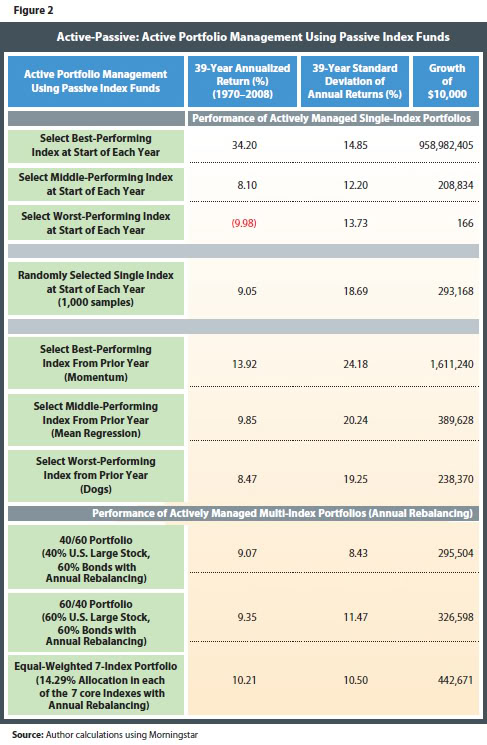
One article by Craig Israelson, a finance professor at Brigham Young University, stood out. He discussed what he called “actively passive” portfolios, where a number of passive indexes are managed in an active way. (Both of the mutual funds that we sub-advise and our Global Macro separate account are essentially done this way, as we are using ETFs as the investment vehicles.) With a mix of seven asset classes, he looks at a variety of scenarios for being actively passive: perfectly good timing, perfectly poor timing, average timing, random timing, momentum, mean reversion, buying laggards, and annual rebalancing with various portfolio blends. I’ve clipped one of the tables from the paper below so that you can see the various outcomes:

 From the Archives: Is Buy and Hold Dead?

Click to enlarge

Although there is only a slight mention of it in the article, the momentum portfolio (you would know it as relative strength) swamps everything but perfect market timing, with a terminal value more than 3X the next best strategy. Obviously, when it is well-executed, a relative strength strategy can add a lot of return. (The rebalancing also seemed to help a little bit over time and reduced the volatility.)

Maybe for Joe Retail Investor, who can’t control his emotions and/or his impulsive trading, asset allocation and rebalancing is the way to go, but if you have any kind of reasonable systematic process and you are after returns, the data show pretty clearly that relative strength should be the preferred strategy.

—-this article originally appeared 1/8/2010. Relative strength rocks.

Posted by:


Value and Bias

June 19, 2012

Aswath Damodaran wrote the book on valuation, literally. He is a valuation guru, or as close to it as you are going to find. He readily admits that valuation is a biased process. From Business Insider:

Something that Aswath Damodaran reiterated frequently during his lecture is that valuation is not some sort of magical, objective science that will let you know what others don’t. It provides an anchor for your thinking and investment behavior.

Here are the three biggest myths of valuation from Professor Damodaran’s presentation:

  • A valuation is an objective search for true value
  • A good valuation provides a precise estimate of value
  • The more quantitative a model, the better the valuation

Here’s the anecdote Professor Damodaran told to illustrate the first point:

“I have valued Microsoft every year since 1986, the year of their IPO. 26 years in a row. Every year through 2011 when I valued Microsoft I found it to be overvalued. You name the price, I found it overvalued. $2, $4, $8, “don’t buy, don’t buy, don’t buy.” Strange right? One of the great success stories of US equity markets over the last 50 years, and I wouldn’t have touched it one step of the way. Now I can give you access to every one of those models… You can dig through these models looking for clues as to why I found Microsoft to be overvalued, but you’d be looking in the wrong place. If you really want to know why I found Microsoft to be overvalued all of these years, all you need to do is walk up my office and look around. What you’re going to see is a bunch of computers with fruits on the back.”

Although there are multiple ways in which relative strength can be calculated, all investors using the same method are going to get the same result. There is no subjectivity in terms of assumptions and inputs. That kind of objectivity can really help eliminate emotions and biases from the investment process. To take Damodaran’s example, if Microsoft qualifies as one of the great success stories of the past 50 years, it would have had high relative strength somewhere along the line, by definition. End of story.

Damodaran Value and Bias

Posted by:


The Purpose of Financial Advice

June 13, 2012

This little piece from The Economist takes the position that it is silly to pay for financial advice, as even experts cannot predict what the markets will do. While the article is completely right about the forecasting abilities of experts, skipping financial advice is crazy.

The true function of financial advice is not based on guessing what the market will do over the next month, quarter, or year.

Several studies show that investors with advisors do better than investors without—and it’s not because they have advisors who can predict the market. What good can an advisor do? Here is a partial list of important benefits to having a good financial advisor.

  • Behavior modification. Most investing problems are, in truth, caused by investor behavior. Switching and/or abandoning strategies when they are temporarily out of favor tops the list of no-no’s. There is voluminous research showing that clients are terrible at managing their own behavior. Any advisor than can improve a client’s staying power is worth the fee. An advisor that can persuade a client to add money when a strategy is out of favor, when returns have been poor, or when markets have been exceptionally volatile should get an award. Maybe even be knighted. Behavior modification is really difficult, but it can have an enormous positive impact on returns. An advisor who has worse behavior than the client should be flogged with a wet noodle.
  • Portfolio construction. Asset allocation is an important first step, but a skillful advisor will move right along to combining strategies or return factors that have low correlations. A great advisor will do a great job creating real diversification in a portfolio.
  • Accountability. You know how you are more likely to go to your exercise session if you have a trainer or a buddy? It’s not just because you’ve paid for it or because you’ve put it on your calendar—it’s because you are accountable to another person. A good financial advisor makes you accountable for all of those things that you would otherwise procrastinate about, like that IRA beneficiary paperwork or that account contribution you’ve been meaning to send in. We all have good intentions, but it’s pretty easy to blow things off if there is no one to hold us accountable. A good advisor helps you do the things you know you need to do.

It goes without saying that an advisor that is not doing any of these things is not adding a lot of value. If all you’re getting is a generic pie chart allocation and a few good jokes, well, it might be time to look around again.

Posted by:


From the Archives: The Future of Decision-Making

June 13, 2012

Man versus machine, art versus science, intuition versus logic—all of these are ways of expressing what we often think of as contradictory approaches to problem solving. Should we be guided more by data and precedent, or is it more important to allow for the human element? Is it critical to be able to step aside and say, with the benefit of our judgment, “maybe this time really is different?”

The Harvard Business Review recently took on this topic and a few of their points were quite provocative.

A huge body of research has clarified much about how intuition works, and how it doesn’t. Here’s some of what we’ve learned:

  • It takes a long time to build good intuition. Chess players, for example, need 10 years of dedicated study and competition to assemble a sufficient mental repertoire of board patterns.
  • Intuition only works well in specific environments, ones that provide a person with good cues and rapid feedback . Cues are accurate indications about what’s going to happen next. They exist in poker and firefighting, but not in, say, stock markets. Despite what chartists think, it’s impossible to build good intuition about future market moves because no publicly available information provides good cues about later stock movements. [Needless to say, I don't agree with his assessment of stock charts!] Feedback from the environment is information about what worked and what didn’t. It exists in neonatal ICUs because babies stay there for a while. It’s hard, though, to build medical intuition about conditions that change after the patient has left the care environment, since there’s no feedback loop.
  • We apply intuition inconsistently. Even experts are inconsistent. One study determined what criteria clinical psychologists used to diagnose their patients, and then created simple models based on these criteria. Then, the researchers presented the doctors with new patients to diagnose and also diagnosed those new patients with their models. The models did a better job diagnosing the new cases than did the humans whose knowledge was used to build them. The best explanation for this is that people applied what they knew inconsistently — their intuition varied. Models, though, don’t have intuition.
  • We can’t know or tell where our ideas come from. There’s no way for even an experienced person to know if a spontaneous idea is the result of legitimate expert intuition or of a pernicious bias. In other words, we have lousy intuition about our intuition.
  • It’s easy to make bad judgments quickly. We have many biases that lead us astray when making assessments. Here’s just one example. If I ask a group of people “Is the average price of German cars more or less than $100,000?” and then ask them to estimate the average price of German cars, they’ll “anchor” around BMWs and other high-end makes when estimating. If I ask a parallel group the same two questions but say “more or less than $30,000″ instead, they’ll anchor around VWs and give a much lower estimate. How much lower? About $35,000 on average, or half the difference in the two anchor prices. How information is presented affects what we think.

We’ve written before about how long it takes to become world-class. Most studies show that it takes about ten years to become an expert if you apply yourself diligently. Obviously, the “intuition” of an expert is much better than the intuition of a neophyte. If you think about that for a minute, it’s pretty clear that intuition is really just judgment in disguise. The expert is better than the novice simply because they have a bigger knowledge base and more experience.

Really, the art versus science debate is over and the machines have won it going away. Nowhere is this more apparent than in chess. Chess is an incredibly complex mental activity. Humans study with top trainers for a decade to achieve excellence. There is no question that training and practice can cause a player to improve hugely, but it is still no contest. As processing power and programming experience has become more widespread, a $50 CD-ROM off-the-shelf piece of software can defeat the best players in the world in a match without much problem. Most of the world’s top grandmasters now use chess software to train with and to check their ideas. (In fact, so do average players since the software is so cheap and ubiquitous.)

How did we get to this state of affairs? Well, the software now incorporates the experience and judgment of many top players. Their combined knowledge is much more than any one person can absorb in a lifetime. In addition, the processing speed of a standard desktop computer is now so fast that no human can keep it with it. It doesn’t get tired, upset, nervous, or bored. Basically, you have the best of both worlds—lifetimes of human talent and experience applied with relentless discipline.

A 2000 paper on clinical versus mechanical prediction by Grove, Zald, Lebow, Snitz, & Nelson had the following abstract:

>The process of making judgments and decisions requires a method for combining data. To compare the accuracy of clinical and mechanical (formal, statistical) data-combination techniques, we performed a meta-analysis on studies of human health and behavior. On average, mechanical-prediction techniques were about 10% more accurate than clinical predictions. Depending on the specific analysis, mechanical prediction substantially outperformed clinical prediction in 33%–47% of studies examined. Although clinical predictions were often as accurate as mechanical predictions, in only a few studies (6%–16%) were they substantially more accurate. Superiority for mechanical-prediction techniques was consistent, regardless of the judgment task, type of judges, judges’ amounts of experience, or the types of data being combined. Clinical predictions performed relatively less well when predictors included clinical interview data. These data indicate that mechanical predictions of human behaviors are equal or superior to clinical prediction methods for a wide range of circumstances.

That’s a 33-47% win rate for the scientists and a 6-16% win rate for the artists, and that was ten years ago. That’s not really very surprising. Science is what has allowed us to develop large-scale agriculture, industrialize, and build a modern society. Science and technology are not without their problems, but if the artists have stayed in charge we might still be living in caves, although no doubt we would have some pretty awesome cave paintings.

This is the thought process behind our Systematic Relative Strength accounts. We were able to codify our own best judgment, include lifetimes of other experience from investors we interviewed or relative strength studies that we examined, and have it all run in a disciplined fashion. We chose relative strength because it was the best-performing factor and also because, since it is relative, it is adaptive. There is always cooperation between man and machine in our process, but moving more toward data-driven decisions is indeed the future of decision making.

—-this article originally appeared 1/15/2010. Our thought process hasn’t changed—we still believe that a systematic, adaptive investment process is the way to go.

Posted by:


Why Michael Jordan and Active Management Are Failures

June 12, 2012

Professor Mark Perry at the University of Michigan cites the following study to prove that active management is a loser’s game:

CBS Money Watch: “Twice each year, Standard & Poor’s puts out its active versus passive investor scorecard, reporting on how actively managed funds have done against their respective benchmark indexes. Every time, the results are pretty much the same, demonstrating that active management is a loser’s game - in aggregate those playing leave on the table tens of billions of dollars forever seeking alpha (outperformance, adjusted for risk).”

The following is a summary of the latest scorecard’s findings:

  • For the five years ending March 2012, only 5.23% of large-cap funds, 5.46% of mid-cap funds and 5.14% of small-cap funds maintained a top-half ranking over five consecutive 12-month periods. Random expectations would suggest a rate of 6.25%.
  • Looking at longer-term performance, 5.97% of large-cap funds with a top-quartile ranking over the five years ending March 2007 maintained a top-quartile ranking over the next five years. Only 4.35% of mid-cap funds and 15.56% of small-cap funds maintained a top-quartile performance over the same period. Random expectations would suggest a repeat rate of 25%.

Obviously, the majority of investors in active funds are taking all the risks of investing and not being properly rewarded for taking those risks, transferring tens of billions from their accounts to the wallets of active managers. The question is why do they keep doing this? Evidence suggests that one explanation is that they are simply unaware of how poorly they are doing.”

According to Professor Perry, active management is only a success if it outperforms in each 12-month period. I know of a number of return factors that have outperformed over time, but I know of nothing that outperforms in every single period.

In related news, Michael Jordan is now considered to be a loser because he did not win the NBA championship in every year he played.

michael jordan Why Michael Jordan and Active Management Are Failures

Loser: 15 seasons, only 6 rings

Posted by:


One-Trick Pony

June 12, 2012

Crosshairs Trader has an excerpt from Jack Schwager’s Hedge Fund Market Wizards. The interview with Steve Clark makes an interesting point.

Schwager: You have seen a lot of traders. What are the characteristics of traders who succeed?

Clark: They all work hard. Nearly all the successful traders I know are one-trick ponies. They do one thing, and they do it very well.

I find it interesting that most successful traders specialize in one method or return factor. The takeaway is that it is almost impossible to be an expert at everything.

Although I wouldn’t rule out expanding our expertise at some point, relative strength has always been our focus. It’s an incredible bonus that relative strength is so adaptive that it can be used in many different systematic processes.

(By the way, you’re missing a treat if you haven’t read any of Jack Schwager’s books. I haven’t read the most recent one yet, but his first Market Wizards book is one of my all-time favorites.)

onetrickpony One Trick Pony

One-Trick Pony

Source: dgdesignnetwork (click on image to enlarge)

HT to Abnormal Returns

Posted by:


Pickiness and Persistence

June 11, 2012

Here is a visual way of getting at the same point that Mike made in his post, “The Art of Doing Nothing.”

Source: Carl Richards, The New York Times

Posted by:


Pre-Determined Plans For Drawdowns

June 7, 2012

Fact: The S&P 500 has had an annualized return of 9.41% since 1928*.

Fact: That didn’t come without a few bumps (and some serious crashes) along the way…as illustrated by the following data showing maximum S&P 500 intra-year declines.

Among the many observations that can be made from this data is that drawdowns are part of the game. Drawdowns are best handled when there is a pre-determined plan for how they are going to be managed. Some may choose to take no action and just ride them out. Others will choose to take certain defensive action when drawdowns reach a specified magnitude. Others will seek to address these drawdowns in the context of a broadly diversified portfolio. There are a number of ways that will ultimately work. However, what probably won’t work is to haphazardly react based on your gut feelings—those that do will likely find that they would have just been better off to stick to CDs (5-year CDs currently yielding 1.47%**).

Data shown with permission from The Leuthold Group. *12/31/1927 - 5/31/2012 **Source: Bankrate.com

Posted by:


Another Take on Market Valuation

June 7, 2012

Not too long ago, we showed a market fair value estimate done by the analysts at Morningstar. Another take on it comes from Kelley Wright at Investment Quality Trends. Their valuation method is based on where dividend yields are for individual companies, based on the typical range for that particular company. What’s nice about this particular measure of valuation is that it has been statistically tested. A couple of excerpts from the story by Mark Hulbert at Marketwatch:

Wright classifies each of the stocks that make the grade into four categories according to how its current dividend yield compares to the historical range of that stock’s yield.

The “Undervalued” category contains those stocks with yields at or close to the high end of their respective ranges, while the “Overvalued” category contains stocks with relatively low yields.

The statistic that is most relevant to market timers, I found upon analyzing the data, is the percentage of stocks that make it into this “Overvalued” category. At the 95% confidence level that statisticians often use to determine if a correlation is genuine, this Overvalued percentage is inversely related to the stock market’s return over the next several years.

That is, a high percentage of Overvalued stocks is a bad omen, while a low percentage is a good one.

Currently, Wright’s Overvalued category contains just 35 of the 254 stocks in his dataset, or 13.8% of the total.

That is well below the five-decade average of 21%. In fact, it is lower than 69% of comparable readings back to the mid 1960s.

My finding suggests that the stock market is poised to produce above-average returns over the next couple of years.

It’s interesting to me that sentiment is so negative toward equities that stock funds have been seeing outflows, despite a number of measures suggesting that stocks may have reasonable returns going forward.

Posted by:


Puttnam’s Law

June 6, 2012

A sweet article from Above the Market on why David Puttnam got fired at Columbia Pictures. He tried something different.

Many money managers are afraid to deviate from industry norms, cap weighting, Modern Portfolio Theory, and other shibboleths for the same reason.

On the other hand, the only way to outperform is to embrace doing things differently. Each of us gets to decide to try to succeed by going off the beaten path, or to fail conventionally.

David Puttnam

via Abnormal Returns

Posted by: