Retirement Income Failure Rates

September 13, 2012

Retirement income is the new buzzword. New sales initiatives are being planned by seemingly every fund company on the planet, and there’s no end in sight. Every week sees the launch of some new income product. There are two, probably inter-related, reasons for this. One is the buyers right now are generally leery of equities. That will probably be temporary. If the stock market gets going again, risk appetites could change in a hurry. The second reason is that the front-end of the post-WWII baby boom is hitting retirement age. The desire for retirement income in that demographic cohort probably won’t be temporary. The trailing edge of the baby boom will likely keep demand for retirement income high until at least 2030.

Much retirement income planning is done with the trusty 4% withdrawal rule. Often, however, investors don’t understand how many assumptions go into the idea that a portfolio can support a 4% withdrawal rate. The AdvisorOne article Retirement in a Yield-Free World makes some of those assumptions more explicit. The 4% rule is based on historical bond yields and historical equity returns—but when you look at the current situation, the yield is no longer there. In fact, many bonds currently have negative real yields. Stock market yields are also fairly low by historical standards, leading to lower expected future returns. Here’s what the author, professor Michael Finke, had to say:

Estimating withdrawal rate strategies without real yield is a gruesome task. So I asked my good friend, occasional co-author and withdrawal rate guru Wade Pfau, associate professor at the National Graduate Institute for Policy Studies, to calculate how zero real returns would impact traditional safe withdrawal rates.

When real rates of return on bonds are reduced to zero, Pfau estimates that the failure rate of a 4% withdrawal strategy increases the 30-year failure rate to 15%, or just over one out of every seven retirees. This near tripling of retirement default risk is disturbing, but it is not technically accurate because we also assume historical real equity returns.

If we use a more accurate set of equity returns with a market-correct risk-free rate of return, the results are even more alarming. The failure rate of a 4% strategy with zero bond yield and a zero risk-free rate on equities is 34% over a 30-year time horizon. If real bond rates of return do not increase during a new retiree’s lifetime, they will have a greater than one in three chance of running out of money in 30 years.

The bottom line is that low expected returns may not support a 4% withdrawal rate as easily as occurred in the past. (There may be a couple of more efficient ways to withdraw retirement income than the 4% rule, but the basic problem will remain.)

The practical implication of lower expected returns for future retirees is that they will have to save more and invest better to reach their goals. Retirement income will not be so easy to come by, and behavioral errors by investors will have a greater impact than ever before.

We may not like what Bill Gross calls the “new normal,” but we’ve got to deal with it. What can clients and advisors do proactively to ensure the best shot at a good retirement income stream?

  • encourage savings. Maybe boost that 401k contribution a few percentage points and hector the client for regular investment contributions.
  • diversify by asset class, investment strategy, and volatility. Don’t put all your eggs in one basket. It may become important to pursue returns wherever they are, not just in stocks and bonds. Diversifying your equity return factors may not be a bad idea. We love relative strength, but value and low volatility mix well. And it’s probably not a good idea to put all of your assets into cash or highly volatile categories.
  • get help. There’s a wealth of evidence that good advisors can make a big difference in client outcomes. A steady advisor may also reduce the chance of bad investor behavior, which can be one of the biggest barriers to good long-term returns.

Investing, even in good times, is not an easy endeavor. With low or non-existent real yields, it may be even tougher for a while.

Posted by:


Investor Sentiment: July Edition

September 12, 2012

Why, you may ask, am I writing about investor sentiment from July now that it is mid-September? I think it’s often a useful exercise to look back at the primary sources—the historical data—as my US history teacher used to point out. We all have a way of mis-remembering history. We modify it to fit the present, so that whatever happened seems inevitable. The future, of course, is always uncertain.

Investor sentiment is a peculiar form of history because it generally works in contrary fashion. Studies show that when investors are most bullish, the market tends to go down. And when investors are bearish, the market perversely tends to go up.

July was just such a period. Consider, for example, a CNBC article on the weekly sentiment poll conducted by the American Association of Individual Investors (AAII):

Main Street bulls are fast becoming an endangered species.

Despite the fact that the broad U.S. stock market is up 8.4 percent in 2012, only 22 percent of mom-and-pop investors said they were bullish, the American Association of Individual Investors found in its latest weekly poll.

That’s the lowest sentiment reading since summer 2010, when markets were careening lower in the face of the first post-recession global growth scare and the emergence of Europe’s debt crisis.

But to drive home just how pessimistic Main Street investors have become in the face of a weak U.S. economy, slowing growth in China and continued uncertainty about Europe’s financial crisis, consider that:

• Bullishness now is more depressed than in the fall of 2008, when Wall Street titan Lehman Bros. declared bankruptcy, thrusting the financial crisis into a more dangerous phase.

• The percentage of bulls today is barely above the 18.9 percent on March 5, 2009, just four days before the bottom of the worst stock slide since the Great Depression.

I think it’s fair to say that investor sentiment was pretty negative in July.

So what’s happened since then? All of the bearish investors were not able to make the market go down. Instead, it has risen—the S&P 500 level has gone from about 1350 to 1435!

In fact, this is a typical outcome:

But all the negativity may turn out to be a positive: History shows that super-low sentiment readings tend to act as a contrarian signal. In other words, when everyone is worried, stocks tend to rally.

In fact, according to Bespoke, going back to November 2009, U.S. stocks have posted average gains of 5 percent — with gains 100 percent of the time — in the month after AAII’s sentiment poll showed bullish sentiment readings below 25 percent.

I added the bold to emphasize the cost of bad investor behavior. What if you had exited the market in July because you were bearish? About half of the gains year-to-date have occurred since then. Things always seem darkest before the dawn, but it’s important to resist bailing out when frightened. Better to structure your portfolio so that you can sit tight regardless of the current situation—or to cut back when things seem to be going exceptionally well. It’s tough to get the upside exit right, but it’s relatively easier to flag time periods marked by poor sentiment that are likely to be bad times to get out. If you stay the course, it could make a big positive difference to your returns.

Posted by:


Uncertainty and its Investment Implications

September 6, 2012

Uncertainty is usually problematic for investors. If the economy is clearly good or decidedly bad, it’s often easier to figure out what to do. I’d argue that investors typically overreact anyway, but they at least feel like they are justified in swinging for the fence or crawling into a bomb shelter. But when there is a lot of uncertainty and things are on the cusp—and could go either way—it’s tough to figure out what to do.

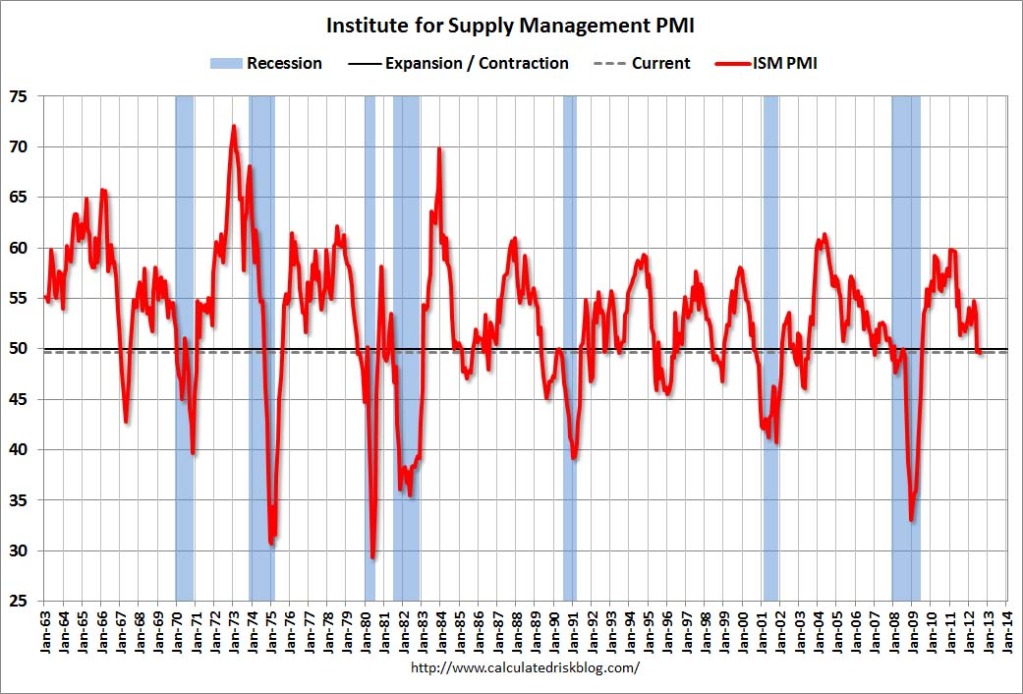
The chart below, from the wonderful Calculated Risk blog, demonstrates the point perfectly.

ISMAug2012 1 Uncertainty and its Investment Implications

Source: Calculated Risk (click to enlarge)

You can see the problem. The Purchasing Managers’ Index is hovering right near the line that separates an expanding economy from a contracting one. There’s no slam dunk either way—there are numerous cases of the PMI dropping below 50 that didn’t result in a recession, but also a number that did have a nasty outcome.

So what’s an investor to do?

One possibility is an all-weather fund that has the ability to adapt to a wide variety of environments. The old-school version of this is the traditional 60/40 balanced fund. The idea was that the stocks would behave well when the economy was good and that the bonds would provide an offset when the economy was bad. There are a lot of 60/40 funds still around, largely because they’ve actually done a pretty reasonable job for investors.

The new-school version is the global tactical asset allocation fund. The flexibility inherent in a tactical fund allows it to tilt toward stocks when the market is doing well, or to tilt toward bonds if equities are having a rough go. Many funds also have the potential to invest across alternative asset classes like real estate, commodities, or foreign currencies.

For a client that is wary of the stock market—and that might include most clients these days—a balanced fund or a global tactical asset allocation fund might be just the way to get them to dip their toe in the water. They are going to need exposure to growth assets over the long run anyway and a flexible fund might make that necessary exposure more palatable.

Click here to visit ArrowFunds.com for a prospectus & disclosures. Click here for disclosures from Dorsey Wright Money Management.

Posted by:


The Refrain of the Pessimists

August 29, 2012

Chuck Jaffe wrote a nice article for Marketwatch, pointing out that fund investors are actually more intelligent than they are given credit for. It’s worth pointing out because nearly every change in the industry is greeted with skepticism by the pessimists. His article ends with a nice summary:

“The knee-jerk reaction to almost all of the advances we have seen has been ‘Oh my goodness, what is going to happen to the industry?’ and ‘Investors will blow themselves up with this,’” said Geoff Bobroff of Bobroff Consulting, a leading fund industry observer. “Surprise, surprise, the world hasn’t come to an end yet and, in fact, the fund world has gotten better for each of these developments.

“Joe Six-Pack is going to do exactly what he has always done,” Bobroff added. “He is not going to change, just because the technology exists for him to do something different. He will adapt, and over time become comfortable with the newer products and newer ways. That doesn’t mean he will always make money; the market won’t always work for Joe Six-Pack, but that won’t be because the fund industry is evolving, it will be because that’s just what the way the market is sometimes.”

The article addresses the concern expressed by many that investors will blow themselves up with ETFs because of their daily liquidity. (John Bogle has expressed this view frequently and loudly.) Mr. Jaffe pulls out some data from a Vanguard (!) study that shows, in fact, that’s not how investors are acting.

Over the years, we’ve heard the same refrain about tactical asset allocation: investors will never be able to get it right, they’ll blow themselves up chasing performance, etc., etc. In fact, tactical allocation funds have acquitted themselves quite nicely over the past few years in a very difficult market environment. For the most part, they’ve behaved pretty much as advertised—better than the worst asset classes, and not as well as the best asset classes—somewhere in the middle of the pack. That kind of consistency, over time, can lead to reasonable returns with moderate volatility.

Reasonable returns with moderate volatility is a laudable goal, which probably explains why hybrid funds have seen new assets this year, even as equity funds are seeing outflows.

In markets, pessimism is almost never the way to go. It’s more productive to be optimistic and to try to find investment strategies that will work for you over the long run.

Posted by:


Emotional Investment and How to Escape It

August 16, 2012

Let’s face it; investors often make bad investment decisions. Commonly, this is due to our emotions getting in the way. BlackRock lists some of the emotional investment tendencies that often cloud our judgment and steer us toward poor decisions:

  • Anchoring: Holding onto a reference point, even if it’s irrelevant. For example, a $1.5 million house, being presented on its own, might sound expensive. But if you were first shown a $2 million house, and afterwards shown the $1.5 million house, it might then sound like a good deal.
  • Herding: Following the crowd. People often pile into the markets when they are doing well and they see “everyone else” doing it.
  • Mental Accounting: Separating money into buckets that are treated differently. Earmarking funds for college savings or a vacation home allows you to save for specific goals. But treating those dollars differently may not make sense when they all have the same buying power.
  • Framing: Making a different decision based on context. In a research study, when a four-ounce glass had 2 ounces of water poured out of it, 69% of people said it was now “half empty.” If the same glass starts out empty and has 2 ounces of water poured into it, 88% of people say it is “half full.”

Emotional investment tendencies can result in all sorts of problems. Typically these behaviors are so ingrained that we don’t even recognize them as irrational!

One way to combat our emotions is to hire a good advisor. As explained in this previous blog post, one important benefit—maybe even the primary benefit—of having a good advisor is behavior modification. An advisor persuading a client to invest more when the market is doing poorly, instead taking money out, is extremely valuable.

Another option is to invest in a managed product like an ETF or mutual fund (here are some of ours) that will make the decisions for you. For an emotional investor, this may be an easier (and presumably safer) option than picking and obsessively monitoring a few random stocks. Even then, it is important try to avoid the herd mentality. Data shows that it’s most important to avoid panic at market bottoms. Although it is difficult not to panic if other people around you are fearful, the potential difference in your investment return can be significant.

In short, understanding your emotional tendencies may help keep them from interfering in investment decisions. If that isn’t enough, try enlisting the help of an outside source. With the steady hand of a good advisor, it may be possible to mitigate emotional investment tendencies.

Posted by:


Stupid Investing Tricks

July 26, 2012

That’s the title of a Jason Zweig article for the Wall Street Journal. In the article, he points out how investors over-react to short-term information.

According to new research, this area of the “rational” brain [frontopolar cortex] forms expectations of future rewards based largely on how the most recent couple of bets paid off. We don’t ignore the long term completely, but it turns out that we weight the short term more heavily than we should – especially in environments (like the financial markets) where the immediate feedback is likely to be random.

In short, the same abilities that make us smart at many things may make us stupid when it comes to investing.

For the ultimate in over-reaction, he writes:

For quick confirmation, look no further than this recent study, which analyzed the accounts of nearly 1.5 million 401(k) investors and found that many of them switch back and forth from stocks to bonds and other “safe” accounts based on data covering very short periods.

You might argue that the long run is nothing but a string of short runs put together, or that you can get peace of mind by limiting your risk to fluctuating markets when prices fall, or that major new information should immediately be factored into even your longest-term decision-making. But many of these 401(k) investors were overhauling their portfolios based entirely on how markets performed on the very same day.

Yep—by “very short period,” he means the same day. That’s what the authors in the academic article, Julie Agnew and Pierluigi Balduzzi, found. They write:

We find that transfers into “safe” assets (money market funds and GICs) correlate strongly and negatively with equity returns. These results hold even after controlling for lead-lag relationships between returns and transfers, day-of-the-week effects, and macro-economic announcements. Furthermore, we find evidence of contemporaneous positive-feedback trading. That is, we find a positive effect of an asset class’ performance on the transfers into that asset class on the same day. Overall, these results are surprising, in light of the limited amount of rebalancing activity documented in 401(k) plans. It appears that while 401(k) investors rarely change allocations, when they do so their decisions are strongly correlated with market returns.

This is a very polite way for academics to say “when the stock market went down, investors panicked and piled into ‘safe’ assets.” Jason Zweig’s article points out that people react to how their last two trials worked out. That’s pretty much in line with anecdotal stories that buyers of profitable trading systems will stop using them after two or three losses in a row. The long-term is ignored in favor of the very short term.

With typical understatement, Agnew and Balduzzi write:

This is potentially worrisome, as it suggests that some investors may deviate from their long-run investment objectives in response to one-day market returns. We provide evidence that these deviations can lead to substantial utility costs.

“Substantial utility costs” in plain English means investors are screwing themselves.

Now, none of this is a surprise for advisors. We all have the same discussion with clients during every decline. The party line is that more investor education is needed, but these neurological studies suggest that people, in general, are just wired to be bad investors. They might overemphasize the last two trials no matter how we educate them.

So what is the takeaway from all of this? I certainly don’t have a simple solution. Perhaps it will be helpful to reframe what a “trial” is for clients as something much bigger than the last couple of quarters or the last two trades. It might help, at the margin, to continue to emphasize process. Maybe our best bet is just to distract them. Like I said, I don’t have a simple solution—but I think that a lot of any advisor’s value proposition is how successful they are at getting the client to invert their normal thought process and get them to focus on the long term rather than the short term.

stupidtrick Stupid Investing Tricks

Source of Stupid Trick: StupidHumans.org

Posted by:


Dow 20,000

July 23, 2012

Seth J. Masters, Chief Investment Officer of Bernstein Global Wealth Management says the odds of the Dow hitting 20,000 by the end of the decade are excellent:

Over 10-year periods since 1900, stocks have outperformed bonds 75 percent of the time, according to Bernstein’s calculations. But today, bond prices are relatively high — their yields, which move in the opposite direction, are extraordinarily low — and stock prices are relatively low. So the firm sees the chance of stocks beating bonds over the next 10 years at 88 percent.

Stocks have been cruel and it is hard to love them now. Still, Mr. Masters writes, “We think that 10 years from now, investors will wish they had stayed in stocks — or added to them.”

The damage done to investor psychology over the past decade is going to stay with investors for a long time, maybe even a generation. The fact that the S&P 500 has had an annualized return of 16.38% over the past three years ending 6/30 has not kept investors from scrambling to get out of equities and piling into fixed income (The Barclays Aggregate Bond Index has only had an annualized return of 6.94% over the past three years, ending 6/30).

Being optimistic about stocks is uncommon to say the least right now. Kind of like being pessimistic about stocks in 1999 was uncommon. It could be a big mistake to swear off stocks for the next 5-10 years. Understandably, investors feel an enormous amount of trepidation if they are made to feel that it is an either/or decision. Enter tactical asset allocation strategies that have the ability to increase or decrease exposure to multiple asset classes, including equities and fixed income. Having a framework for dispassionately allocating to strong asset classes, which is the goal of relative strength-driven tactical asset allocation strategies, can be an effective way to deal with the challenge of emotional asset allocation. Clients are open to tactical asset allocation because it speaks to both their hearts and their minds.

HT: Real Clear Markets

Posted by:


More on the Death of Equities

July 3, 2012

This is getting serious! We’ve written about this “death of equities” theme before. The strategist at Bank of America Merrill Lynch rolled out some interesting data today regarding the “death of equities.” Despite generally rising prices for the past three years, stocks have gotten very little respect—and now there’s this from an article at CNBC:

For a group notorious for its irrational exuberance at the very worst times, Wall Street strategists have taken a decidedly bearish tack as of late.

In fact, their current consensus allocation to stocks versus bonds and other asset classes makes the group the most bearish since 1997, according to data compiled by Bank of America Merrill Lynch.

This average equity allocation at 49.3 percent is “the first time below 50 in nearly 15 years, suggesting that sell side strategists are now more bearish on equities than they were at any point during the collapse of the tech bubble or the recent financial crisis,” wrote Savita Subramanian, chief U.S. equity and quant strategist for the firm, in a note entitled, “Wall Street Proclaims the Death of Equities.”

I put the fun part in bold. This is the most bearish that strategists have been for 15 years! The best thing about their bearishness, though, is the implication from contrary opinion.

Bank of America’s Subramanian actually has the data that backs up this contrarian view. According to her report, when the indicator has hit levels this low over the last 27 years, total returns for the market have been positive 100 percent of the time, with a median return of more than 30 percent.

It makes perfect sense, given what we know about investor sentiment and subsequent returns. Who knows what will happen this time around—but those odds seem pretty good for stock investors.

tombstoneDEATHOFEQUITIES More on the Death of Equities

Have Equities Kicked the Bucket?

Source: jjchandler.com

Posted by:


From the Archives: Two Approaches to Motivating Clients

June 28, 2012

Ken Haman, a managing director at the Advisor Institute at AllianceBernstein responds to the following question posed by an advisor and published in Investment News:

Q: I’ve had some frustrating conversations with clients recently—trying to get them back in the market. Very few are taking my advice, even though they seem to know that staying on the sidelines is a mistake. What’s going on, and how can I get them “unstuck”?

A: Problems like this have to do with how people make decisions. Behavioral finance uses the term “inappropriate extrapolation”–and insights about it can help you understand your clients and respond to them more effectively.

To make any decision, human beings create a mental picture of the future. That’s what “expectations” are–the ability to take information from the past and present, and project it into the future. Unlike most animals, human beings can project far into the future; as a result, we are able to “plan ahead.” Unfortunately, we usually don’t create these future images terribly well. Instead of making a thoughtful assessment of what’s likely to happen in the future, we typically picture the future as just a continuation of the recent past.

Essentially, you want to learn how to install a positive picture of the future that the client feels is likely to happen in reality. Start by explaining the mechanisms of the market and illustrating visually how those mechanisms work. Many investors have only the vaguest understanding of the cause-effect dynamics in the markets. Instead of making thoughtful, well-informed decisions, they react to their perception of patterns and trends. Market “mechanisms” are those cause-effect relationships that equip financial professionals to invest rationally instead of speculating randomly.

By looking at how market mechanisms operated in both the recent and more distant past, you teach your clients how to think more strategically about the markets. This allows them to build a more vivid mental picture of market behaviors in the future. Make sure you explain market mechanisms visually as well as verbally: use charts and graphs that show market behaviors over time. Whenever possible, connect your investment recommendations to a clear explanation of the mechanism that is involved.

Second, provide an adequate level of detail about the mechanisms you explain. There’s a commonly held myth that clients aren’t interested in hearing about the markets. So, many financial advisors gloss over important information and rush to their proposal without creating a case the client understands. But clients are interested in understanding the mechanisms that drive their investment results–as long as your explanation is clearly illustrated and easy to understand.

Finally, you have to deliver your message with personal conviction–that you fully believe the future will look the way you anticipate. Your clients need to borrow your conviction and clarity about the future. That’s how they’ll build their sense of confidence in the decisions you’re asking them to make. Take a stand on what you believe about the future, and add the courage of your own convictions to the clarity of your explanation.

There is also an alternative approach of just being frank with the client and telling them that you don’t know exactly what the future holds, nor does anyone else. However, you adhere to a systematic relative strength process that gives you great flexibility to allocate to a wide range of asset classes depending on how the future unfolds. At times, the approach can be allocated very conservatively and at times it can be allocated quite aggressively. My experience has been that clients appreciate the honesty and are willing to embrace a trend-following approach that deals very effectively with not being able to see into the future.

—-this article originally appeared 1/12/2010. More than two years later, many clients are still on the sidelines. Many of them definitely do engage in inappropriate extrapolation! An advisor’s first duty is to be honest, but you’ve got to do it in a way that is motivating and not paralyzing.

Posted by:


From the Archives: The $ Value of Patience

June 25, 2012

The annals of investor behavior make for some pretty scary reading. Yet this story from the Wall Street Journal may take the cake. It is an article about the top-performing mutual fund of the decade and it shows with remarkable clarity how badly investors butcher their long-term returns. The article hits the premise right up front:

Meet the decade’s best-performing U.S. diversified stock mutual fund: Ken Heebner’s $3.7 billion CGM Focus Fund, which rose more than 18% annually and outpaced its closest rival by more than three percentage points.

Too bad investors weren’t around to enjoy much of those gains. The typical CGM Focus shareholder lost 11% annually in the 10 years ending Nov. 30, according to investment research firm Morningstar Inc.

It’s hard to know whether to laugh or cry. In a brutal decade, Mr. Heebner did a remarkable job, gaining 18% per year for his investors. The only investment acumen required to reap this 18% return was leaving the fund alone. Yet in the single best stock fund of the decade investors managed to misbehave and actually lose substantial amounts of money—11% annually.

Even Morningstar is not sure what to do with Mr. Heebner:

The fund, a highly concentrated portfolio typically holding fewer than 25 large-company stocks, offers “a really potent investment style, but it’s really hard for investors to use well,” says Christopher Davis, senior fund analyst at Morningstar.

I beg to differ. It’s really hard to use well?? What does that even mean? If it is, it’s only in the sense that a pet rock is really hard to care for.

Investor note: actively managed or adaptive products need to be left alone! The whole idea of an active or adaptive product is that the manager will handle things for you, instead of you having to do it yourself.

Unfortunately, there is an implicit belief among investors—and their advisors—that they can do a better job than the professionals running the funds, but every single study shows that belief to be false. There is not one study of which I am aware that shows retail investors (or retail investors assisted by advisors) outperforming professional investors. So where does that widespread belief come from?

From the biggest bogeyman in behavioral finance: overconfidence. Confidence is a wonderful trait in human beings. It gets us to attempt new things and to grow. From an evolutionary point of view, it is probably quite adaptive. In the financial arena, it’s a killer. Like high blood pressure, it’s a silent killer too, because no one ever believes they are overconfident.

At a Harvard conference on behavioral finance, I heard Nobel Prize winner Daniel Kahneman talk about the best way to combat overconfidence. He suggested intentionally taking what he called an “outside view.” Instead of placing yourself—with all of your incredible and unique talents and abilities—in the midst of the situation, he proposed using an outside individual, like your neighbor, for instance. Instead of asking, “What are the odds that I can quit my day job and open a top-performing hedge fund or play in the NBA?” ask instead, “What are the odds that my neighbor (the plumber, or the realtor, or the unemployed MBA) can quit his day job and open a top performing hedge fund or play in the NBA?” When you put things in an outside context like that, they always seem a lot less likely according to Kahneman. We all think of ourselves as special; in reality, we’re pretty much like everyone else.

Why, then, are investors so quick to bail out on everyone else? Overconfidence again. Our generally mistaken belief that we are special makes everyone else not quite as special as us. Overconfidence and belief in our own specialness makes us frame things completely differently: when we have a bad quarter, it was probably bad luck on a couple of stock picks; if Bill Miller (to choose a recent example) has a bad quarter, it’s probably because he’s lost his marbles and his investment process is irretriveably broken. We’d better bail out, fast. (A lot of people came to that conclusion over the past couple of years. In 2009, Legg Mason Value Trust was +40.6%, more than 14% ahead of its category peers.)

Think about an adaptive Dorsey, Wright Research model like DALI. As conditions change, it attempts to adapt by changing its holdings. Does it make sense to jump in and out of DALI depending on what happened last quarter or last year? Of course not. You either buy into the tactical approach or you don’t. Once you decide to buy into—presumably because you agree with the general premise—a managed mutual fund, a managed account, or an active index, for goodness sakes, leave it alone.

In financial markets, overconfidence is the enemy of patience. Overconfidence is expensive; patience with managed products can be quite rewarding. In the example of the CGM Focus Fund, Mr. Heebner grew $10,000 into $61,444 over the course of the last ten years. Investors in the fund, compounding at -11% annually, turned $10,000 into $3,118. The difference of $58,326 is the dollar value of patience in black and white.

—-this article originally appeared 1/6/2010. Unfortunately, human nature has not changed in the last two years! Investors still damage their returns with their impatience. Try not to be one of them!

Posted by:


Dorsey, Wright Client Sentiment Survey Results – 6/8/12

June 18, 2012

Our latest sentiment survey was open from 6/8/12 to 6/15/12. The Dorsey, Wright Polo Shirt Raffle continues to drive advisor participation, and we greatly appreciate your support! We will announce the winner early next week. This round, we had 44 advisors participate in the survey. If you believe, as we do, that markets are driven by supply and demand, client behavior is important. We’re not asking what you think of the market—since most of our blog readers are financial advisors, we’re asking instead about the behavior of your clients. Then we’re aggregating responses exclusively for our readership. Your privacy will not be compromised in any way.

After the first 30 or so responses, the established pattern was simply magnified, so we are comfortable about the statistical validity of our sample. Most of the responses were from the U.S., but we also had multiple advisors respond from at least four other countries. Let’s get down to an analysis of the data! Note: You can click on any of the charts to enlarge them.

Question 1. Based on their behavior, are your clients currently more afraid of: a) getting caught in a stock market downdraft, or b) missing a stock market upturn?

GreatestFear6812 Dorsey, Wright Client Sentiment Survey Results – 6/8/12

Chart 1: Greatest Fear. From survey to survey, the S&P 500 increased 0.59%, and the greatest fear numbers did not perform as expected. The fear of downturn group increased from 80% to 86%, while fear of a missed opportunity decreased from 20% to 14%. Client sentiment is still poor overall.

GreatestFearSpread6812 Dorsey, Wright Client Sentiment Survey Results – 6/8/12

Chart 2: Greatest Fear Spread. Another way to look at this data is to examine the spread between the two groups. The spread decreased from 61% to 73%.

Question 2. Based on their behavior, how would you rate your clients’ current appetite for risk?

AverageRiskAppetite6812 Dorsey, Wright Client Sentiment Survey Results – 6/8/12

Chart 3: Average Risk Appetite. Once again, the average risk appetite performed as expected, rising from 2.48 to 2.62. As the market rose slightly, so did average risk appetite.

RiskAppetiteBellCurve6812 Dorsey, Wright Client Sentiment Survey Results – 6/8/12

Chart 4: Risk Appetite Bell Curve. This chart uses a bell curve to break out the percentage of respondents at each risk appetite level. We are still seeing a low amount of risk, with most clients having a risk appetite of 2 or 3.

RiskAppetiteBellCurvebyGroup6812 Dorsey, Wright Client Sentiment Survey Results – 6/8/12

Chart 5: Risk appetite Bell Curve by Group. The next three charts use cross-sectional data. The chat plots the reported client risk appetite separately for the fear of downdraft and for the fear of missing upturn groups. This chart performs as expected, with the upturn group wanting more risk than the downturn group. However, even the fear of missing an upturn group doesn’t want a very high amount of risk.

AverageRiskAppetitebyGroup6812 Dorsey, Wright Client Sentiment Survey Results – 6/8/12

Chart 6: Average Risk Appetite by Group. The average risk appetite of those who fear a downturn slightly decreased, even as the market rose. The average risk appetite of those who fear missing an upturn increased.

RiskAppetiteSpread6812 Dorsey, Wright Client Sentiment Survey Results – 6/8/12

Chart 7: Risk Appetite Spread. This is a chart constructed from the data in Chart 6, where the average risk appetite of the downdraft group is subtracted from the average risk appetite of the missing upturn group. The spread increased this round, but is still within its normal range.

The S&P 500 rose by 0.59% from survey to survey, and some of our indicators responded accordingly. Average risk appetite increased, but the amount of risk desired is still low. As the market does well, we would expect more people to fear missing an upturn; instead, more people feared a downturn. Overall, client sentiment remains poor.

No one can predict the future, as we all know, so instead of prognosticating, we will sit back and enjoy the ride. A rigorously tested, systematic investment process provides a great deal of comfort for clients during these types of fearful, highly uncertain market environments. Until next time, good trading and thank you for participating.

Posted by:


Puttnam’s Law

June 6, 2012

A sweet article from Above the Market on why David Puttnam got fired at Columbia Pictures. He tried something different.

Many money managers are afraid to deviate from industry norms, cap weighting, Modern Portfolio Theory, and other shibboleths for the same reason.

On the other hand, the only way to outperform is to embrace doing things differently. Each of us gets to decide to try to succeed by going off the beaten path, or to fail conventionally.

David Puttnam

via Abnormal Returns

Posted by:


One Good Data Point

May 30, 2012

This just in. We are now back at 5/25 levels for the S&P 500. From Tobias Levkovich at Citigroup, as reported by Business Insider:

Last Friday our panic-euphoria model, one of our proprietary sentiment models went into panic, that gives us a very high probability, almost 90 percent probability that markets are up in 6 months, and 96 percent probability that they’re are up in 12 months.

I have no idea how they come up with those probabilities, but it would be nice if it’s true. More generally, other analysts have also found a correlation between very negative investor sentiment and higher markets 6-12 months later.

Posted by:


Are Equities Dead or Just Resting?

May 29, 2012

CNBC carried an article today, via Financial Times, that talked about how much investors hate stocks. Some excerpts from the article:

…institutional investors, from pension funds to mutual funds sold directly to the public, have slashed holdings in the past decade. Stocks have not been so far out of favor for half a century. Many declare the “cult of the equity” dead.

Compared with bonds, stocks have not looked so cheap for half a century. During this period, the dividend yield — the amount paid out in dividends per share divided by the share price, a key measure of value — has been lower than the yield paid by bonds (which moves in the opposite direction to prices). In other words, investors were happy to take a lower interest rate from stocks than from bonds, despite their greater volatility, reflecting their confidence that returns from stocks would be higher in the long run.

But now investors want a higher yield from equities. According to Robert Shiller of Yale University, the dividend yield on U.S. stocks is today 1.97 percent — above the 1.72 percent yield on 10-year U.S. Treasury bonds.

Some hope that the cycle is about to turn and that the preconditions for a new cult of the equity will emerge even if it takes time. Few people doubt, however, that the old cult of the equity — which steered long-term savers into loading their portfolios with shares — has died.

Indeed, equities have not been so cheap relative to bonds since 1956, which turned out to be one of the best moments in history to have bought stocks.

In the U.S., inflows to bond funds have exceeded equity inflows every year since 2007, with outright net redemptions from equity funds in each of the past five years.

I swear I’m not making this up. Side-by-side, the article discusses the death of the equity cult while it mentions that stocks are at the best buying point in 50 years, apparently without irony. Wow.

Somewhere down the road there will be a catalyst—I have no idea what it will be, but it could be much sooner than most think. Contrary opinion would suggest that we look closely at the presumption that equities are really dead. It’s quite possible that stocks, like Monty Python’s Norwegian Blue, are just resting. When sentiment gets so highly tilted to one side it is worth examining to see if, in fact, the opposite is true.

deadparrot Are Equities Dead or Just Resting?

Are Equities Dead or Just Resting?


Posted by:


Two Rides the Public Missed…

May 7, 2012

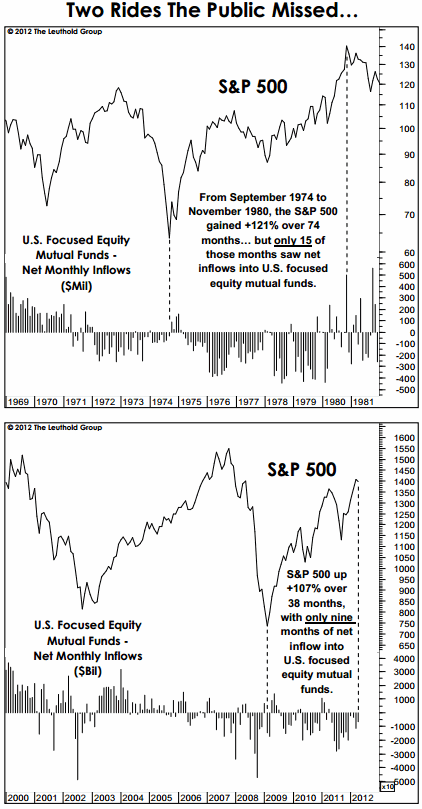
Mark Twain once said, “A cat who sits on a hot stove will never sit on a hot stove again. But, he won’t sit on a cold stove, either.” Surely, that applies to investors who have gone through a severe bear market, like 1973-74 or 2008.

leuthold 2 Two Rides the Public Missed...

Source: The Leuthold Group

Without an investment process that systematically allocates to where the action is, investors may be psychologically incapable of making much money for years to come.

Posted by: