Small-Cap Relative Strength Performance

July 25, 2012

We’ve just released a small-cap ETF with PowerShares (DWAS), which is the first U.S. relative strength small-cap ETF. We’ve done our own testing, of course, but it might also be instructive to take a look at other small-cap relative strength returns. Once again, we used the Ken French data library to calculate annualized returns and standard deviation. The construction of their relative strength index is explained here. The difference this time around is that we used small-cap stocks instead of large-cap stocks. Generally speaking, a small-cap stock is one whose price times number of outstanding shares (market capitalization) is between $300 million and $2 billion. However, the Ken French data used also includes micro-cap stocks which have an even smaller market capitalization (typically between $50-$300 million). Market cap is above $10 billion for large-cap stocks.
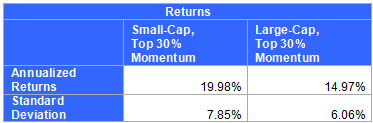
SmallCapReturns Small Cap Relative Strength Performance

In the past, small-cap stocks have yielded high returns. They often perform well because companies in early stages of development have large growth potential. However, the potential of high earnings also comes with high risk. Small-cap companies face limited reserves, which make them more vulnerable than larger ones. Furthermore, in order to grow, they need to be able to replicate their business model on a bigger scale.

This is the sort of tradeoff investors must think about when choosing how to structure their portfolio. Typical factor models suggest that there are excess returns to be had in areas like value, relative strength, and small-cap, often at the cost of a little extra volatility. If you’re willing to take on more risk for the chance of higher returns, a portfolio that combines relative strength with small-cap stocks might be a good place to look!

Posted by:


Emerging Markets Investing

May 23, 2012

Index Universe has an article pointing out that simply buying a large, cap-weighted index might not be the way to go in emerging markets. For one thing, China, Brazil, South Korea, Taiwan are 60% of the fund. The article discusses potential problems in some of the BRIC markets, and then proceeds to pick out a bunch of promising countries like Poland, Turkey, and Indonesia.

Personally, I suspect that buying a large cap-weighted index and then hoping for the best was never a very viable strategy. Perhaps it happened to work out over certain time periods, but things change and different economies can have really different stock market performance. And I have to say that I don’t have a lot of confidence in analyst’s guesses either, although I’m sure they know a lot more about the fundamentals of overseas economies than I do.

Here’s a thought: let relative strength sort out where you should be investing. For example, here’s the current country breakdown for the DWA Emerging Markets Technical Leaders Index, as seen through the holdings of PIE, the Powershares ETF based on the index:

PIEallocations 2 Emerging Markets Investing

Source: Powershares (data as of 3/31/2012)

Malaysia, Mexico, and Indonesia are the largest weights right now—and those weights are based entirely on the objective performance of the underlying stocks in the market, not on someone’s opinion about what market will be good. When performance changes, the weights will change, often substantially. As an investor, you don’t have to contemplate whether or when the Czech Republic might outperform India. The weights change quarterly without you having to worry about it.

Relative strength is a different, and dynamic, way of investing globally.

See www.powershares.com for more information about PDP, PIE and PIZ. Past performance is no guarantee of future returns. A list of all holdings for the trailing 12 months is available upon request.

Posted by:






