Quote of the Week

August 23, 2013

Avoiding danger is no safer in the long run than outright exposure. The fearful are caught as often as the bold.—Helen Keller


I doubt that Helen Keller was thinking about bond investors when she wrote this, but she may as well have been. The safe haven trade hasn’t worked out too well since May. Bond investors sometimes think they have an extra measure of security versus stock investors. And it is true that most bonds are less volatile than stocks. Volatility, however, is a pretty poor way to measure risk. An alternative way to measure risk is to look at drawdown—and measured that way, bonds have had drawdowns in real returns that rival drawdowns in stocks.

In truth, bonds are securities just like stocks. They are subject to the same, sometimes irrational, swings in investor emotion. And given that bonds are priced based on the income they produce, they are very vulnerable to increases in interest rates and increases in inflation.

So I think that Helen Keller’s point is well taken—instead of pretending that you are safe, make sure you understand the exposures you have and make sure you take them on intentionally.

Helen Keller zps1558d561 Quote of the Week

Source: Wikipedia (click on image to enlarge)


Posted by:


Relative Strength Everywhere

December 14, 2012

Eric Falkenstein has an interesting argument in his paper Risk and Return in General: Theory and Evidence. He proposes what is essentially a relative strength argument about risk and return. He contends that investors care only about relative wealth and that risk is really about deviating from the social norm. Here is the summary of his draft from the excellent CXO Advisory:

Directly measured risk seldom relates positively to average returns. In fact, there is no measure of risk that produces a consistently linear scatter plot with returns across a variety of investments (stocks, banks, stock options, yield spread, corporate bonds, mutual funds, commodities, small businesses, movies, lottery tickets and bets on horse races).

  • Humans are social animals, and processing of social information (status within group) is built into our brains. People care only about relative wealth.
  • Risk is a deviation from what everyone else is doing (the market portfolio) and is therefore avoidable and unpriced. There is no risk premium.

The whole paper is a 150-page deconstruction of the flaws in the standard model of risk and return as promulgated by academics. The two startling conclusions are that 1) people care only about relative wealth and that 2) risk is simply a deviation from what everyone else is doing.

This is a much more behavioral interpretation of how markets operate than the standard risk-and-return tradeoff assumptions. After many years in the investment management industry dealing with real clients, I’ve got to say that Mr. Falkenstein re-interpretation has a lot going for it. It explains many of the anomalies that the standard model cannot, and it comports well with how real clients often act in relation to the market.

In terms of practical implications for client management, a few things occur to me.

  • Psychologists will tell you that clients respond more visually and emotionally than mathematically. Therefore, it may be more useful to motivate clients emotionally by showing them how saving money and managing their portfolio intelligently is allowing them to climb in wealth and status relative to their peers, especially if this information is presented visually.
  • Eliminating market-related benchmarks from client reports (i.e., the reference to what everyone else is doing) might allow the client to focus just on the growth of their relative wealth, rather than worrying about risk in Falkenstein’s sense of deviation from the norm. (In fact, the further one gets from the market benchmark, the better performance is likely to be, according to studies on active share.) If any benchmark is used at all, maybe it should be related to the wealth levels of the peer group to motivate the client to strive for higher status and greater wealth.

I’m sure there is a lot more to be gleaned from this paper and I’m looking forward to having time to read it again.

Posted by:


Hedge Fund Alternatives

May 29, 2012

From Barron’s, an interesting insight into the alternative space:

Investor interest in hedge-fund strategies has never been higher—but it’s the mutual-fund industry that seems to be benefiting.

Financial advisors and institutions are increasingly turning to alternative strategies to manage portfolio risk, though the flood of money into that area tapered off a bit last year, according to an about-to-be-released survey of financial advisors and institutional managers conducted by Morningstar and Barron’s. Many of them are finding the best vehicle for those strategies to be mutual funds.

Very intriguing, no? There are quite a few ways now, through ETFs or mutual funds, to get exposure to alternatives. We’ve discussed the Arrow DWA Tactical Fund (DWTFX) as a hedge fund alternative in the past as well. Tactical asset allocation is one way to go, but there are also multi-strategy hedge fund trackers, macro fund trackers, and absolute-return fund trackers, to say nothing of managed futures.

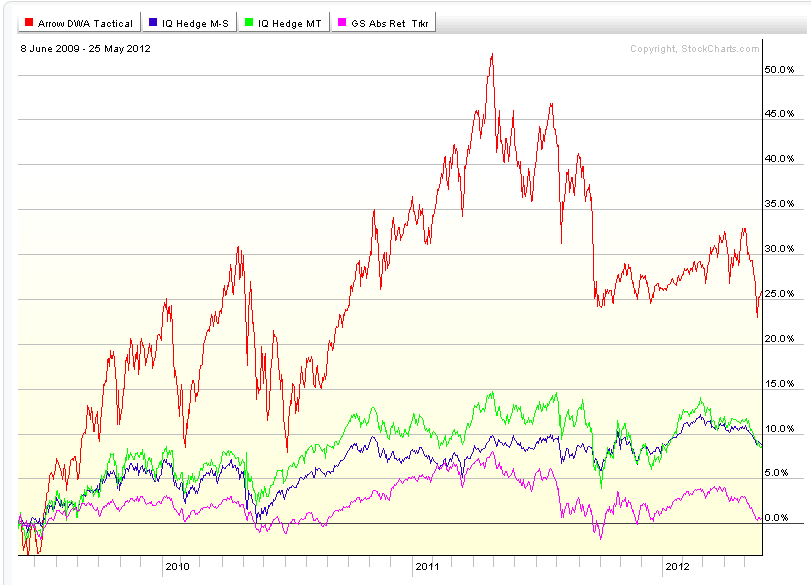
Each of these options has a different set of trade-offs in terms of potential return and volatility. For example, the chart below shows the Arrow DWA Tactical Fund, the IQ Hedge Macro Tracker, the IQ Hedge Multi-Strategy Tracker, and the Goldman Sachs Absolute Return Fund for the maximum period of time that all of the funds have overlapped.

hedgefundalternatives Hedge Fund Alternatives

(click on image to enlarge)

You can see that each of these funds moves differently. For example, the Arrow DWA Tactical Fund, which is definitely directional, has a very different profile than the Goldman Sachs Absolute Return Fund, which presumably is not (as) directional.

Very few of these options were even available to retail investors ten years ago. Now they are numerous, giving individuals the opportunity to diversify like never before. With proper due diligence, it’s quite possible you will find an alternative strategy that can improve your overall portfolio.

Posted by:


From the Archives: Is Modern Portfolio Theory Obsolete?

May 29, 2012

It all depends on who you ask. Apologists for MPT will say that diversification worked, but that it just didn’t work very well last go round. That’s a judgment call, I suppose. Correlations between assets are notoriously unstable and nearly went to 1.0 during the last decline, but not quite. So I guess you could say that diversification “worked,” although it certainly didn’t deliver the kind of results that investors were expecting.

Now even Ibbotson Associates is saying that certain aspects of modern portfolio theory are flawed, in particular using standard deviation as a measurement of risk. In a recent Morningstar interview, Peng Chen, the president of Ibbotsen Associates, addresses the problem.

It’s one thing to say modern portfolio theory, the principle, remained to work. It’s another thing to examine the measures. So when we started looking at the measures, we realized, and this has been documented by many academics and practitioners, we also realized that one of the traditional measures in modern portfolio theory, in particular on the risk side, standard deviation, does not work very well to measure and present the tail risks in the return distribution.

Meaning that, when you have really, really bad market outcomes, modern portfolio theory purely using standard deviation underestimates the probability and severity of those tail risks, especially in short frequency time periods, such as monthly or quarterly.

Leaving aside the issue of how the theory could work if the components do not, this is a pretty surprising admission. Ibbotson is finally getting around to dealing with the “fat tails” problem. It’s a known problem but it makes the math much less tractable. Essentially, however, Mr. Chen is arguing that market risk is actually much higher than modern portfolio theory would have you believe.

In my view, the debate about modern portfolio theory is pretty much done. Stick a fork in it. Rather than grasping about for a new theory, why not look at tactical asset allocation, which has been in plain view the entire time?

Tactical asset allocation, when executed systematically, can generate good returns and acceptable volatility without regard to any of the tenets of modern portfolio theory. It does not require standard deviation as the measure of risk, and it makes no assumptions regarding the correlations between assets. Instead it makes realistic assumptions: some assets will perform better than others, and you ought to consider owning the good assets and ditching the bad ones. It’s the ultimate pragmatic solution.

—-this article originally appeared 1/21/2010. As we gain distance from the 2008 meltdown, investors are beginning to forget how badly their optimized portfolios performed and are beginning to climb back on the MPT bandwagon. Combining uncorrelated strategies always makes for a better portfolio, but the problem of understated risk remains. The tails are still fat. Let’s hope that we don’t get another chance to experience fat tails with the Eurozone crisis. Tactical asset allocation, I think, may still be the most viable solution to the problem.

Posted by:


From the Archives: Inflation Rears Its Ugly Head

May 25, 2012

Howard Marks is chairman of Oaktree Capital, a large and well-known institutional alternative fixed income manager. Mr. Marks’s memos are always thoughtful and worth reading. This go round he has a discussion of all of the things that could go wrong with the world economy—essentially a list of all of the things that could go wrong. One of the things that could go wrong is inflation.

He believes rates are more likely to go higher than lower, and that inflation, long forgotten as a risk factor, might return. In addition, he has a list of suggestions on how to deal with inflation including TIPs, floating rate debt, gold, real assets like commodities, oil, and real estate, and foreign currencies. His catalog of alternatives is even longer, but you get the idea. (If you want to read the whole memo, you can find it here.)

That’s quite a list, but the first thing that I noticed about it is that not one of these items is generally considered as an investment option by retail investors. Most investors are mentally stuck in the domestic stocks/domestic bonds arena. Diversification consists of hitting more than one Morningstar style box. If inflation does come back, that’s not going to cut it. In fact, Mr. Marks asks investors, “How much of your portfolio are you willing to devote to protect against these macro forces?” He says if the answer is 5%, or 10%, or 15% that those levels are pretty close to doing nothing. He thinks a portfolio will need to devote at least 30-40% of assets toward inflation protection if it recurs.

Investment flexibility and risk diversification were the primary reasons that we launched the Systematic RS Global Macro account as a retail product last year. Many of the inflation hedges in Mr. Marks’ list are asset classes that are available in the Global Macro portfolio, including TIPs, gold, commodities, oil, real estate, and foreign currencies. Given our basket rotation strategy and our adherence to relative strength, the Global Macro portfolio could easily have 40% of its assets, or more, in inflation hedges if inflation were to recur. I think the jury is still out about how the world economy will respond to decreased levels of fiscal stimulus, but it’s good to know that you have options.

—-this article originally appeared 1/25/2010. We have not seen runaway inflation so far, but the point Howard Marks makes is valid. If/when inflation does occur, you might need to devote a lot of your portfolio to inflation protection. Is your investment process up for the challenge?

Posted by: