The Refrain of the Pessimists

August 29, 2012

Chuck Jaffe wrote a nice article for Marketwatch, pointing out that fund investors are actually more intelligent than they are given credit for. It’s worth pointing out because nearly every change in the industry is greeted with skepticism by the pessimists. His article ends with a nice summary:

“The knee-jerk reaction to almost all of the advances we have seen has been ‘Oh my goodness, what is going to happen to the industry?’ and ‘Investors will blow themselves up with this,’” said Geoff Bobroff of Bobroff Consulting, a leading fund industry observer. “Surprise, surprise, the world hasn’t come to an end yet and, in fact, the fund world has gotten better for each of these developments.

“Joe Six-Pack is going to do exactly what he has always done,” Bobroff added. “He is not going to change, just because the technology exists for him to do something different. He will adapt, and over time become comfortable with the newer products and newer ways. That doesn’t mean he will always make money; the market won’t always work for Joe Six-Pack, but that won’t be because the fund industry is evolving, it will be because that’s just what the way the market is sometimes.”

The article addresses the concern expressed by many that investors will blow themselves up with ETFs because of their daily liquidity. (John Bogle has expressed this view frequently and loudly.) Mr. Jaffe pulls out some data from a Vanguard (!) study that shows, in fact, that’s not how investors are acting.

Over the years, we’ve heard the same refrain about tactical asset allocation: investors will never be able to get it right, they’ll blow themselves up chasing performance, etc., etc. In fact, tactical allocation funds have acquitted themselves quite nicely over the past few years in a very difficult market environment. For the most part, they’ve behaved pretty much as advertised—better than the worst asset classes, and not as well as the best asset classes—somewhere in the middle of the pack. That kind of consistency, over time, can lead to reasonable returns with moderate volatility.

Reasonable returns with moderate volatility is a laudable goal, which probably explains why hybrid funds have seen new assets this year, even as equity funds are seeing outflows.

In markets, pessimism is almost never the way to go. It’s more productive to be optimistic and to try to find investment strategies that will work for you over the long run.

Posted by:


The Truth About the “Impending” Recession

August 15, 2012

Doug Short at Advisor Perspectives performs a very valuable public service. He presents very clear charts of major economic indicators without a lot of heavy interpretation and spin. Pundits who have forecast a recession—and therefore have a vested interest in a recession occurring—often pick and choose their indicators. There’s always some part of the economy that’s lagging, and with the right spin you can probably make it look like the sky is falling.

Here is Mr. Short’s brief comment:

Official recession calls are the responsibility of the NBER Business Cycle Dating Committee, which is understandably vague about the specific indicators on which they base their decisions. This committee statement is about as close as they get to identifying their method.

There is, however, a general understanding that there are four big indicators that the committee weighs heavily in their cycle identification process. They are:

  • Industrial Production
  • Real Income (excluding transfer payments)
  • Employment
  • Real Retail Sales

The weight of these four in the decision process is sufficient rationale for the St. Louis FRED repository to feature a chart four-pack of these indicators along with the statement that “the charts plot four main economic indicators tracked by the NBER dating committee.”

Bear in mind that the NBER dating committee identifies recessions after the fact. These are not leading indicators, but rather coincident indicators. Only after they have turned down solidly can the NBER agree that a recession has started.

So, what do the indicators actually look like? There are more charts in Mr. Short’s indicator update, but this chart summarizes it nicely.

BigFour The Truth About the Impending Recession

Are these indicators going up or down?

Source: Advisor Perspectives/Doug Short (click to enlarge)

I highly recommend reading the entire article, but even a cursory inspection of this chart shows no current evidence of a recession. The stock market is one of the leading indicators in the LEI also, and it is near the high for the year. Our global tactical allocation accounts hold a lot of domestic equity because that’s where the strength has been. (Despite, or maybe because of, investors’ reluctance to own stocks, the market is having a decent year so far.) Instead of freaking out about an impending recession, maybe you could just look at the primary source data.

It’s not impossible that a recession is on the way, of course, but you’d have to present data that the NBER is not using. Anything can happen, but it’s pretty tough to make the recession argument from the data in this chart.

Posted by:


From the Archives: Is Buy-and-Hold Dead?

June 20, 2012

The Journal of Indexes has the entire current issue devoted to articles on this topic, along with the best magazine cover ever. (Since it is, after all, the Journal of Indexes, you can probably guess how they came out on the active versus passive debate!)

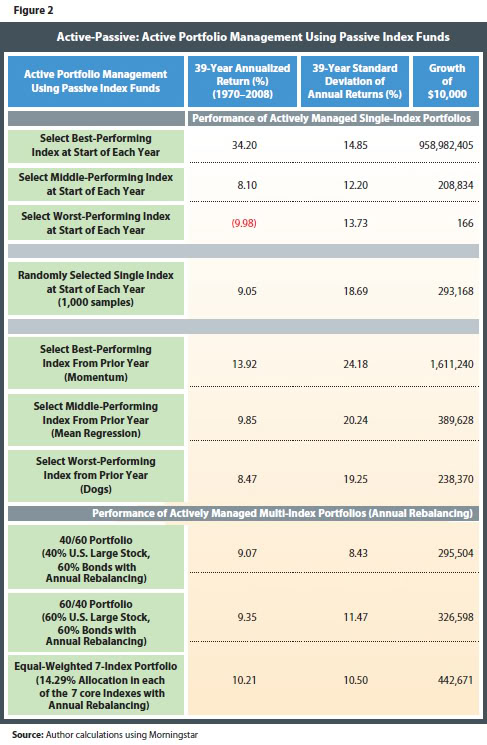
One article by Craig Israelson, a finance professor at Brigham Young University, stood out. He discussed what he called “actively passive” portfolios, where a number of passive indexes are managed in an active way. (Both of the mutual funds that we sub-advise and our Global Macro separate account are essentially done this way, as we are using ETFs as the investment vehicles.) With a mix of seven asset classes, he looks at a variety of scenarios for being actively passive: perfectly good timing, perfectly poor timing, average timing, random timing, momentum, mean reversion, buying laggards, and annual rebalancing with various portfolio blends. I’ve clipped one of the tables from the paper below so that you can see the various outcomes:

 From the Archives: Is Buy and Hold Dead?

Click to enlarge

Although there is only a slight mention of it in the article, the momentum portfolio (you would know it as relative strength) swamps everything but perfect market timing, with a terminal value more than 3X the next best strategy. Obviously, when it is well-executed, a relative strength strategy can add a lot of return. (The rebalancing also seemed to help a little bit over time and reduced the volatility.)

Maybe for Joe Retail Investor, who can’t control his emotions and/or his impulsive trading, asset allocation and rebalancing is the way to go, but if you have any kind of reasonable systematic process and you are after returns, the data show pretty clearly that relative strength should be the preferred strategy.

—-this article originally appeared 1/8/2010. Relative strength rocks.

Posted by:


Memo to US Investors

January 5, 2010

Yesterday, an article in the Financial Times shed light on the global implications of President Obama’s recent trip to Copenhagen for the climate summit. President Obama arrived for a meeting on global climate change (check that debate at the door), and instead, became a spectator of the global economy at work. The FT article focuses specifically on four developing nations that are emerging as dominant global forces – India, South Africa, Brazil and Turkey.

Mr Obama must have felt something of a chump when he arrived for a last-minute meeting with Wen Jiabao, the Chinese prime minister, only to find him already deep in negotiations with the leaders of none other than Brazil, South Africa and India. Symbolically, the leaders had to squeeze up to make space for the American president around the table.

Let’s skip over the political implications of this scenario to examine what this means for US investors. As a US-based investor, we are presented with 2 options: we can participate in a global economy or we can shut ourselves off from it. Andy’s article from last week highlights exactly this point. Only 3% of assets managed by US fund managers are exposed to emerging markets.

Luckily for us, and unlike President Obama, we have no political ties that bind us. We are free to put our money to work where we want to, and this economic freedom allows us to participate in developing and emerging markets as we see fit. The Systematic Global Macro Account and the Arrow Tactical Fund both have the flexibility to invest in the global market without restraints. Don’t let yourself be shouldered off the table.

Click here to visit ArrowFunds.com for a prospectus & disclosures. Click here for disclosures from Dorsey Wright Money Management.

Posted by: