
How the Stock Market Really Works
This is from the great strip Real Life Adventures by Gary Wise and Lance Aldrich. It’s funny because it’s true. Seriously, one of these guys must have been a financial advisor!
HT to The Big Picture.
How the Stock Market Really Works
This is from the great strip Real Life Adventures by Gary Wise and Lance Aldrich. It’s funny because it’s true. Seriously, one of these guys must have been a financial advisor!
HT to The Big Picture.
 Leave a Comment » |
  Just for Fun, Markets |
  Permalink

Posted by: Mike Moody
A recent Vanguard commentary has a very good description of the confusion facing bond investors right now—and judging from the recent heavy flows into bond funds, that’s a lot of investors.
These days, the airwaves seem filled with market commentators offering one of three popular suggestions for bond investors. All three groups urge investors to alter their investment strategy in this low-rate environment.
The first group suggests bond investors take on more interest-rate risk in an effort to earn more income today, say, by moving your assets from a short-maturity bond fund to a longer-maturity bond fund. The second group suggests investors do the exact opposite and reduce interest rate risk, say, by moving assets out of one’s bond portfolio into a savings vehicle in an attempt to sidestep a future rise in interest rates. Obviously, both groups of investors are trading with each other. Which group “wins” will ultimately depend on the future path of interest rates (more on this in a moment).
Like the first group, a third group of market commentators suggests taking on more risk, but of a different sort. They point to the U.S. investment experience of the late 1940s and early 1950s—the last time U.S. interest rates were this low—as a rationale for moving strategically out of low-yielding conservative bond portfolios and into traditionally more-volatile assets, namely stock funds.
I think that is a pretty good encapsulation of what bond investors are hearing right now. And, exactly as Vanguard points out, the “right” answer if you go with a forecast will only be determined in hindsight. You could have a pretty horrific experience in the meantime if you guess wrong. Their article points out, correctly I think, that although some of these outcomes may be more probable than others, there’s no way to know what will happen. The endgame could be anything from Japan to hyper-inflation. There are just too many variables in play.
If you are a strategic asset allocator, Vanguard suggests broad diversification. I am a little surprised by this, as they make a salient point about bonds.
We as investors first need to recalibrate our expectations for future bond returns. Unfortunately, the most direct implication of this low-rate environment is that bond portfolio returns are likely to be fairly puny going forward. As I wrote in March (“Why I still own Treasuries“), arguably the single best predictor of the future return on a bond portfolio is its current yield to maturity, or coupon.
I would think that a strategic asset allocator would severely underweight bonds if future forecasted bond returns are going to be small. (At least that’s what Harry Markowitz says to do.)
Another path through this minefield is tactical asset allocation. Hold the asset classes that are strong and avoid the rest. If bonds are strong because rates continue to fall, because Treasurys continue to be a safe haven, or because the US enters a low-growth Japan-like environment, then they will be welcome in a portfolio. If bonds are weak because rates start to rise or because the US begins to flirt with solvency concerns at some point, then many other asset classes are likely to perform better.
In the end, tactical asset allocation might be safer. Bond returns may be low, but they might end up being higher than the returns from some alternatives. Or bonds could turn out to be an unmitigated disaster. Tactical asset allocation driven by relative strength frees you from the need to forecast. Bonds will be in your portfolio—or not—depending only upon their performance.
Source: buzzle.com
Leave a Comment » | Markets, Tactical Asset Alloc, Thought Process | Permalink
Posted by: Mike Moody
The chart below is the spread between the relative strength leaders and relative strength laggards (universe of mid and large cap stocks). When the chart is rising, relative strength leaders are performing better than relative strength laggards. As of 7/30/2012:
As it has since February, the RS Spread continues to trend higher reflecting the better performance of the RS leaders compared to the RS laggards.
Leave a Comment » | Markets | Permalink
Posted by: Andy Hyer
Those investors looking to build a portfolio with low correlation to the stock market are going to have to do more than just add bonds. BlackRock points out that the correlation of a 60/40 balanced portfolio and a 100% equity portfolio has been 0.99 over the past 15 years!
It is important for investors to understand the sources of risks in their portfolios. Take the traditional 60/40 portfolio as an example. Even though 40% of this portfolio is invested in bonds, almost all of the risk in the portfolio is equity risk. This chart shows that over the last 15 years, the correlation of returns between a 60/40 portfolio and a 100% equity portfolio was 0.99, meaning that they were almost perfectly correlated. Even a portfolio that is exceptionally overweight bonds shows a similar trend. A 30% stock/70% bond portfolio had a 0.82 correlation to a 100% stock portfolio. To us, that says that a long-only stock and bond portfolio isn’t full diversification.
However, when you also add commodities, currencies, and real estate into the portfolio it is a different story. Click here to learn how we incorporate a broad range of asset classes into our Global Macro portfolio (financial advisors only).
To receive the brochure for our Global Macro strategy, click here. For information about the Arrow DWA Tactical Fund (DWTFX), click here.
Click here and here for disclosures. Past performance is no guarantee of future returns.
4 Comments | Tactical Asset Alloc | Tagged: alternatives | Permalink
Posted by: Andy Hyer
The table below shows the performance of a universe of mid and large cap U.S. equities, broken down by relative strength decile and quartile and then compared to the universe return. Those at the top of the ranks are those stocks which have the best intermediate-term relative strength. Relative strength strategies buy securities that have strong intermediate-term relative strength and hold them as long as they remain strong.
Last week’s performance (7/23/12 – 7/27/12) is as follows:
The best performance largely came from the relative strength laggards last week.
Leave a Comment » | Markets | Permalink
Posted by: Andy Hyer
Our latest sentiment survey was open from 7/20/12 to 7/27/12. The Dorsey, Wright Polo Shirt Raffle continues to drive advisor participation, and we greatly appreciate your support! We will announce the winner early next week. This round, we had 49 advisors participate in the survey. If you believe, as we do, that markets are driven by supply and demand, client behavior is important. We’re not asking what you think of the market—since most of our blog readers are financial advisors, we’re asking instead about the behavior of your clients. Then we’re aggregating responses exclusively for our readership. Your privacy will not be compromised in any way.
After the first 30 or so responses, the established pattern was simply magnified, so we are fairly comfortable about the statistical validity of our sample. Some statistical uncertainty this round comes from the fact that we only had four investors say that thier clients are more afraid of missing a stock upturn than being caught in a downdraft. Most of the responses were from the U.S., but we also had multiple advisors respond from at least two other countries. Let’s get down to an analysis of the data! Note: You can click on any of the charts to enlarge them.
Question 1. Based on their behavior, are your clients currently more afraid of: a) getting caught in a stock market downdraft, or b) missing a stock market upturn?
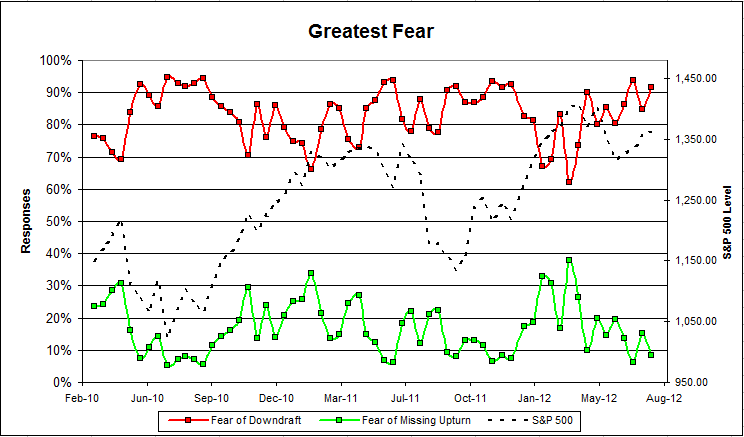
Chart 1: Greatest Fear. From survey to survey, the S&P 500 rose 1.5%, but the greatest fear numbers did not perform as expected. The size of the fear of downturn group increased 85% to 91%, while fear of a missed upturn fell from 15% to 9%. Client sentiment remains poor even as the S&P has risen.
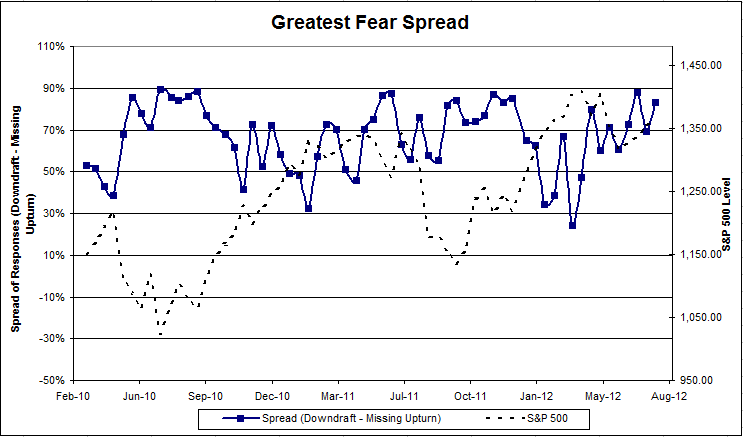
Chart 2: Greatest Fear Spread. Another way to look at this data is to examine the spread between the two groups. The spread increased from 69% to 83%.
Question 2. Based on their behavior, how would you rate your clients’ current appetite for risk?
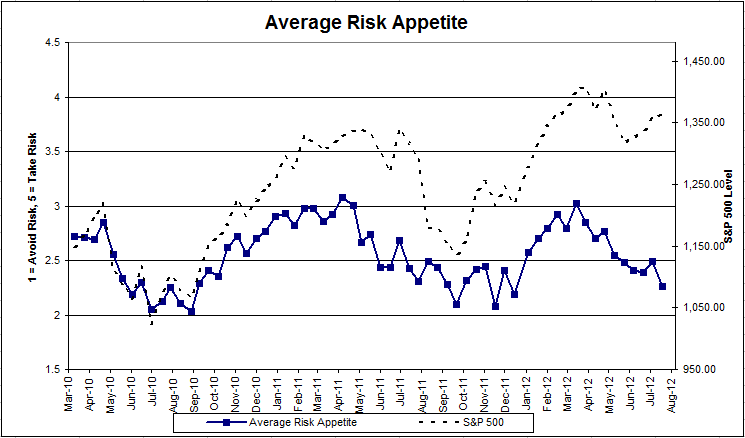
Chart 3: Average Risk Appetite. Average risk appetite usually falls in line with the market, but this week it did not. As the S&P rose, average risk appetite fell from 2.49 to2.27.
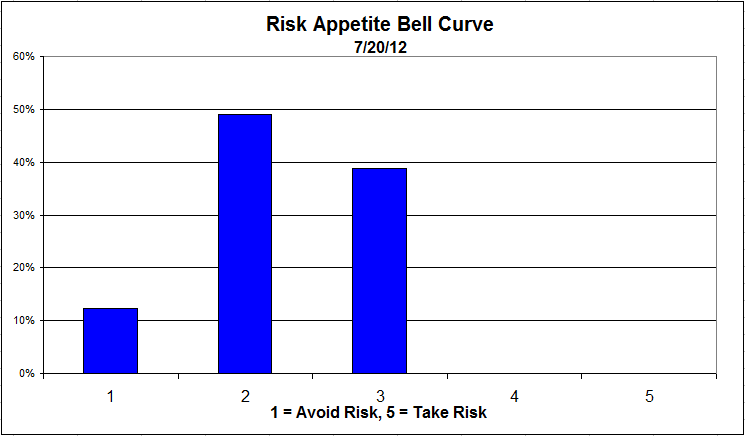
Chart 4: Risk Appetite Bell Curve. This chart uses a bell curve to break out the percentage of respondents at each risk appetite level. We are still seeing low risk appetites, with most clients having a risk appetite of 2 or 3. We had zero advisers say that their clients were looking for high risk investments this week.
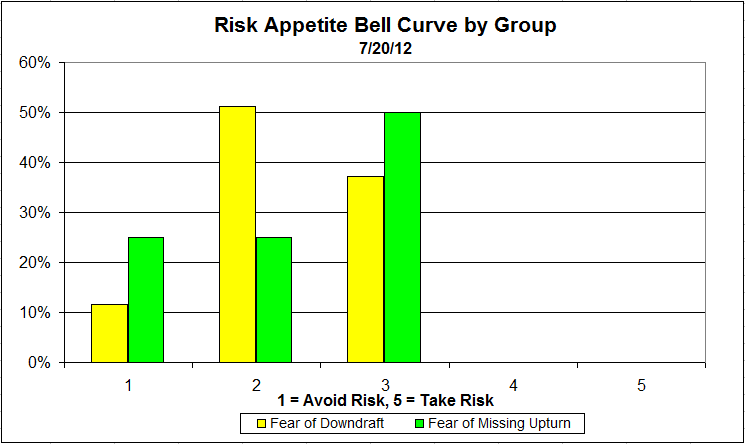
Chart 5: Risk appetite Bell Curve by Group. The next three charts use cross-sectional data. The chat plots the reported client risk appetite separately for the fear of downdraft and for the fear of missing upturn groups. This chart performs partially as expected. A higher percentage of the fear of missing an upturn respondents have a risk appetite of 3. However, a higher percentage of the upturn respondents have a risk appetite of 1. Both groups prefer a relatively low amount of risk.
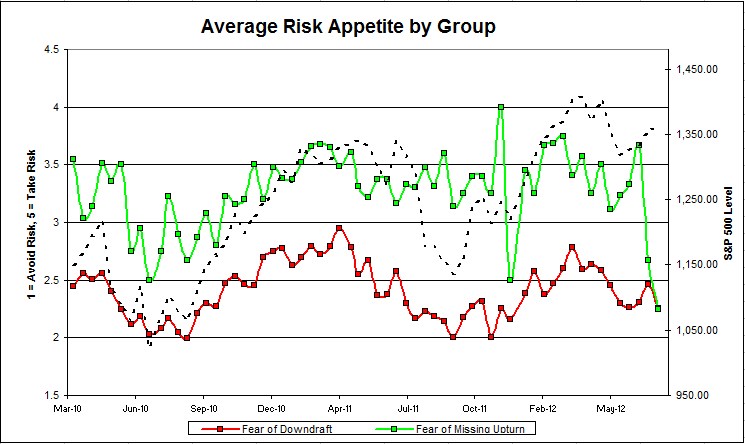
Chart 6: Average Risk Appetite by Group. The average risk appetite of both groups decreased this week, even as the market did well. The average risk appetite for the fear of missing an upturn group dropped to the lowest it has been since we started the survey. In fact, it converged with the average risk appetite of the fear of downdraft group.
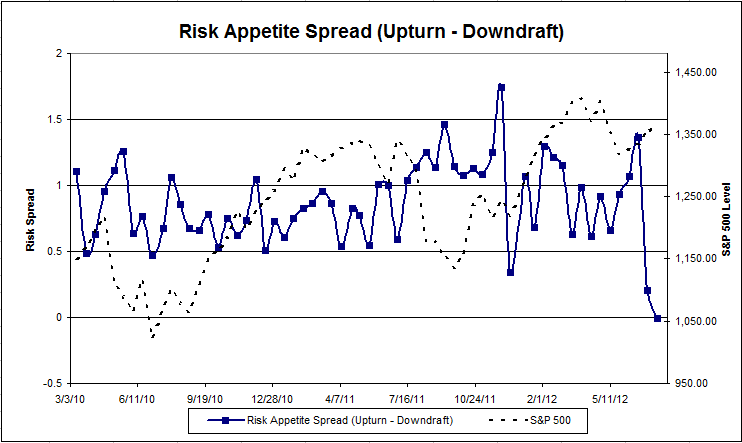
Chart 7: Risk Appetite Spread. This is a chart constructed from the data in Chart 6, where the average risk appetite of the downdraft group is subtracted from the average risk appetite of the missing upturn group. The spread decreased this round, and is the smallest spread we’ve seen yet.
The S&P 500 rose by 0.59% from survey to survey, but most of our indicators did not respond accordingly. Average risk appetite fell, and more people feared a downturn. We’re not sure what caused such strange results this round.
No one can predict the future, as we all know, so instead of prognosticating, we will sit back and enjoy the ride. A rigorously tested, systematic investment process provides a great deal of comfort for clients during these types of fearful, highly uncertain market environments. Until next time, good trading and thank you for participating.
Leave a Comment » | Investor Behavior, Markets, Sentiment | Permalink
Posted by: Amanda Schaible
The chart below shows performance of US sectors and capitalizations over the trailing 12, 6, and 1 month(s). Performance updated through 7/26/2012.

Leave a Comment » | Markets, Uncategorized | Permalink
Posted by: Amanda Schaible
The Investment Company Institute is the national association of U.S. investment companies, including mutual funds, closed-end funds, exchange-traded funds (ETFs), and unit investment trusts (UITs). Flow estimates are derived from data collected covering more than 95 percent of industry assets and are adjusted to represent industry totals.
Leave a Comment » | Investor Behavior | Permalink
Posted by: JP Lee
That’s the title of a Jason Zweig article for the Wall Street Journal. In the article, he points out how investors over-react to short-term information.
According to new research, this area of the “rational” brain [frontopolar cortex] forms expectations of future rewards based largely on how the most recent couple of bets paid off. We don’t ignore the long term completely, but it turns out that we weight the short term more heavily than we should – especially in environments (like the financial markets) where the immediate feedback is likely to be random.
In short, the same abilities that make us smart at many things may make us stupid when it comes to investing.
For the ultimate in over-reaction, he writes:
For quick confirmation, look no further than this recent study, which analyzed the accounts of nearly 1.5 million 401(k) investors and found that many of them switch back and forth from stocks to bonds and other “safe” accounts based on data covering very short periods.
You might argue that the long run is nothing but a string of short runs put together, or that you can get peace of mind by limiting your risk to fluctuating markets when prices fall, or that major new information should immediately be factored into even your longest-term decision-making. But many of these 401(k) investors were overhauling their portfolios based entirely on how markets performed on the very same day.
Yep—by “very short period,” he means the same day. That’s what the authors in the academic article, Julie Agnew and Pierluigi Balduzzi, found. They write:
We find that transfers into “safe” assets (money market funds and GICs) correlate strongly and negatively with equity returns. These results hold even after controlling for lead-lag relationships between returns and transfers, day-of-the-week effects, and macro-economic announcements. Furthermore, we find evidence of contemporaneous positive-feedback trading. That is, we find a positive effect of an asset class’ performance on the transfers into that asset class on the same day. Overall, these results are surprising, in light of the limited amount of rebalancing activity documented in 401(k) plans. It appears that while 401(k) investors rarely change allocations, when they do so their decisions are strongly correlated with market returns.
This is a very polite way for academics to say “when the stock market went down, investors panicked and piled into ‘safe’ assets.” Jason Zweig’s article points out that people react to how their last two trials worked out. That’s pretty much in line with anecdotal stories that buyers of profitable trading systems will stop using them after two or three losses in a row. The long-term is ignored in favor of the very short term.
With typical understatement, Agnew and Balduzzi write:
This is potentially worrisome, as it suggests that some investors may deviate from their long-run investment objectives in response to one-day market returns. We provide evidence that these deviations can lead to substantial utility costs.
“Substantial utility costs” in plain English means investors are screwing themselves.
Now, none of this is a surprise for advisors. We all have the same discussion with clients during every decline. The party line is that more investor education is needed, but these neurological studies suggest that people, in general, are just wired to be bad investors. They might overemphasize the last two trials no matter how we educate them.
So what is the takeaway from all of this? I certainly don’t have a simple solution. Perhaps it will be helpful to reframe what a “trial” is for clients as something much bigger than the last couple of quarters or the last two trades. It might help, at the margin, to continue to emphasize process. Maybe our best bet is just to distract them. Like I said, I don’t have a simple solution—but I think that a lot of any advisor’s value proposition is how successful they are at getting the client to invert their normal thought process and get them to focus on the long term rather than the short term.

Source of Stupid Trick: StupidHumans.org
Leave a Comment » | Investor Behavior, Markets | Tagged: 401k, behavioral finance, decision-making, investor behavior | Permalink
Posted by: Mike Moody
We’ve just released a small-cap ETF with PowerShares (DWAS), which is the first U.S. relative strength small-cap ETF. We’ve done our own testing, of course, but it might also be instructive to take a look at other small-cap relative strength returns. Once again, we used the Ken French data library to calculate annualized returns and standard deviation. The construction of their relative strength index is explained here. The difference this time around is that we used small-cap stocks instead of large-cap stocks. Generally speaking, a small-cap stock is one whose price times number of outstanding shares (market capitalization) is between $300 million and $2 billion. However, the Ken French data used also includes micro-cap stocks which have an even smaller market capitalization (typically between $50-$300 million). Market cap is above $10 billion for large-cap stocks.
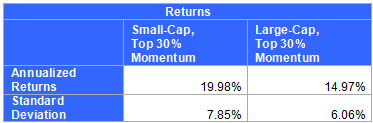
In the past, small-cap stocks have yielded high returns. They often perform well because companies in early stages of development have large growth potential. However, the potential of high earnings also comes with high risk. Small-cap companies face limited reserves, which make them more vulnerable than larger ones. Furthermore, in order to grow, they need to be able to replicate their business model on a bigger scale.
This is the sort of tradeoff investors must think about when choosing how to structure their portfolio. Typical factor models suggest that there are excess returns to be had in areas like value, relative strength, and small-cap, often at the cost of a little extra volatility. If you’re willing to take on more risk for the chance of higher returns, a portfolio that combines relative strength with small-cap stocks might be a good place to look!
Leave a Comment » | Relative Strength Research | Tagged: cap, capitalization, etf, large, large cap, market, relative strength, small | Permalink
Posted by: Amanda Schaible
The chart below is the spread between the relative strength leaders and relative strength laggards (universe of mid and large cap stocks). When the chart is rising, relative strength leaders are performing better than relative strength laggards. As of 7/24/2012:
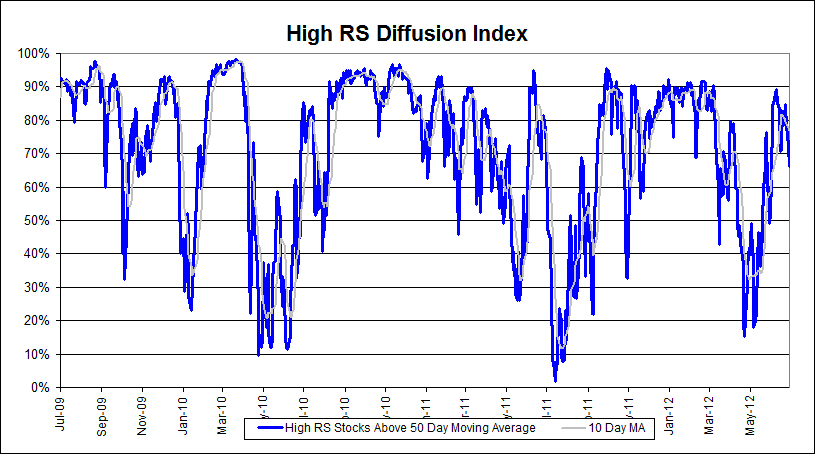
The index has taken a hit over the last few weeks. The one day reading is 66% and the 10-day reading is 77%.
Leave a Comment » | Relative Strength Research | Permalink
Posted by: JP Lee
And it’s not even from me! This article from Smart Money is by Brett Arends in which he discusses some of the potential pitfalls of the traditional 60/40 balanced account. Here is part of his critique:
This entire strategy is based on a dubious reading of history, a misrepresentation of the facts and a fair amount of sleight of hand. And it’s terrifying to think that so many people are relying on it nonetheless.
I never cease to be amazed at what passes for logic and historical analysis in the finance industry. With a click of a mouse, analysts extrapolate the future from the recent past. They claim to derive universal rules from a few decades’ data.
Here’s the ugly truth. Contrary to what you are being told, this 60/40 portfolio of stocks and bonds comes with no guarantees. There have been long periods during which it has done very badly.
And why should we be surprised? There is nothing magic about stocks or bonds. They are just investments.
I don’t always agree with Mr. Arends’ take on things, but I do agree with this. The fact that stocks or bonds have done well in certain time periods in the past certainly does not guarantee that they will do well in the future. He’s right that even US stocks and bonds have sometimes done poorly for extended periods—to say nothing of the Japanese experience since 1990.
This, I think, is a good argument in favor of tactical asset allocation as part of a core portfolio. When you have the ability to use many asset classes, you increase the odds that one or two of them may be working. Depending on the investing environment, your returns might come from real estate or commodities. Maybe emerging market bonds will be the ticket at some point in the future. Even if you maintain a balanced portfolio that includes stocks and bonds, it might be wise to allow exposure to a lot of other asset classes as well.
In an uncertain environment, it’s probably best not to tie your hands and to have a wide range of investment options.
2 Comments | Markets, Tactical Asset Alloc, Thought Process | Tagged: alternative assets, balanced account, balanced fund, balanced portfolio, Tactical Asset Allocation | Permalink
Posted by: Mike Moody
The chart below is the spread between the relative strength leaders and relative strength laggards (universe of mid and large cap stocks). When the chart is rising, relative strength leaders are performing better than relative strength laggards. As of 7/23/2012:

The RS Spread continues to trade above its 50 day moving average.
Leave a Comment » | Relative Strength Research | Tagged: spread | Permalink
Posted by: Amanda Schaible
Seth J. Masters, Chief Investment Officer of Bernstein Global Wealth Management says the odds of the Dow hitting 20,000 by the end of the decade are excellent:
Over 10-year periods since 1900, stocks have outperformed bonds 75 percent of the time, according to Bernstein’s calculations. But today, bond prices are relatively high — their yields, which move in the opposite direction, are extraordinarily low — and stock prices are relatively low. So the firm sees the chance of stocks beating bonds over the next 10 years at 88 percent.
Stocks have been cruel and it is hard to love them now. Still, Mr. Masters writes, “We think that 10 years from now, investors will wish they had stayed in stocks — or added to them.”
The damage done to investor psychology over the past decade is going to stay with investors for a long time, maybe even a generation. The fact that the S&P 500 has had an annualized return of 16.38% over the past three years ending 6/30 has not kept investors from scrambling to get out of equities and piling into fixed income (The Barclays Aggregate Bond Index has only had an annualized return of 6.94% over the past three years, ending 6/30).
Being optimistic about stocks is uncommon to say the least right now. Kind of like being pessimistic about stocks in 1999 was uncommon. It could be a big mistake to swear off stocks for the next 5-10 years. Understandably, investors feel an enormous amount of trepidation if they are made to feel that it is an either/or decision. Enter tactical asset allocation strategies that have the ability to increase or decrease exposure to multiple asset classes, including equities and fixed income. Having a framework for dispassionately allocating to strong asset classes, which is the goal of relative strength-driven tactical asset allocation strategies, can be an effective way to deal with the challenge of emotional asset allocation. Clients are open to tactical asset allocation because it speaks to both their hearts and their minds.
2 Comments | Investor Behavior, Markets, Tactical Asset Alloc | Tagged: investor behavior | Permalink
Posted by: Andy Hyer
The table below shows the performance of a universe of mid and large cap U.S. equities, broken down by relative strength decile and quartile and then compared to the universe return. Those at the top of the ranks are those stocks which have the best intermediate-term relative strength. Relative strength strategies buy securities that have strong intermediate-term relative strength and hold them as long as they remain strong.
Last week’s performance (7/16/12 – 7/20/12) is as follows:
High RS stocks underperformed the universe last week. Energy, which has been a weak sector, was the best performing sector for the week.
Leave a Comment » | Markets | Permalink
Posted by: Andy Hyer
Legendary trend follower, Ed Seykota:
A surfer does not need to know the theory of fluid mechanics to learn how to surf a wave in the ocean– he needs only to be able to make probabilistic estimates and adjustments.
Source: Wikipedia
HT: Abnormal Returns, CSS Analytics
Leave a Comment » | Markets, Thought Process | Permalink
Posted by: Andy Hyer
Figuring out how to turn your portfolio into retirement income is a tricky thing because there are two unknowns: 1) you don’t know how the investments will perform, and 2) you don’t know how long you need to draw income. A recent article from the Wall Street Journal discussed how to optimally tap a nest egg. It references a study by Morningstar (a link to the Morningstar paper is included in the WSJ article) that compares five different methods.
The authors also propose a metric to determine how “efficient” the retirement income distribution method is. Some of the methods are fairly heavy on math and count on the investor to use a mortality table and to determine portfolio failure rates using Monte Carlo simulation. Others, like the 4% rule, are pretty basic.
The math-heavy methods work well, but in practice it might be a little more difficult to get a client to specify if they would prefer the calculation be made for a 50% chance of outliving their money or a 10% chance of outliving their money! In my experience, clients are much more interested in methods that offer a 0% chance of outliving their money. Actuarial methods are somewhat dependent on the Monte Carlo simulation having a return distribution similar to what has been experienced in the past. These methods might struggle in the case of a paradigm shift.
As far as simple methods go, the RMD (1/life expectancy or distribution horizon) method and the endowment method are both preferable to the 4% rule. The RMD (required minimum distribution) method is easy to calculate and simple to adapt to whatever time horizon you choose. The endowment method (taking a constant % of the portfolio) has the advantage of being relatively efficient over a wide range of asset allocations—not to mention that it has been tested in practice for decades. Of course, both of these methods take into account the changes in the portfolio’s value, so your distribution may not rise every year. In practice, endowments often smooth the portfolio value to reduce the income volatility.
The traditional 4% rule (withdraw 4% of the portfolio each year and adjust for inflation) is the worst of the rules tested. It’s pretty easy for capital to be depleted if a difficult market occurs early in the retirement period because the withdrawals keep accelerating as the market value declines.
The robust methods (RMD and endowment) significantly reduce your chances of ever running out of money, but you have less certainty about year-to-year income as a result. It’s what I would opt for, but every client’s situation is different.
With thousands of baby boomers hitting age 65 every day now, the Morningstar study deserves a close reading and a lot of thought.

Source: greatfreepictures.com
1 Comment | Retirement/Saving | Tagged: 4% rule, endowment method, retirement, retirement income, RMD | Permalink
Posted by: Mike Moody
Here we have the next round of the Dorsey, Wright Sentiment Survey, the first third-party sentiment poll. Participate to learn more about our Dorsey, Wright Polo Shirt raffle! Just follow the instructions after taking the poll, and we’ll enter you in the contest. Thanks to all our participants from last round.
As you know, when individuals self-report, they are always taller and more beautiful than when outside observers report their perceptions! Instead of asking individual investors to self-report whether they are bullish or bearish, we’d like financial advisors to weigh in and report on the actual behavior of clients. It’s two simple questions and will take no more than 20 seconds of your time. We’ll construct indicators from the data and report the results regularly on our blog–but we need your help to get a large statistical sample!
Click here to take Dorsey, Wright’s Client Sentiment Survey.
Contribute to the greater good! It’s painless, we promise.
Leave a Comment » | Sentiment | Permalink
Posted by: Amanda Schaible
The chart below shows performance of US sectors and capitalizations over the trailing 12, 6, and 1 month(s). Performance updated through 7/19/2012.
Leave a Comment » | Markets | Permalink
Posted by: Andy Hyer
We are pleased to announce the listing of the PowerShares DWA SmallCap Technical Leaders Portfolio (DWAS) on the NYSE Arca today. This new Fund launches under the NYSE ticker DWAS and represents the first US small-cap ETF based on the concept of relative strength ranking. The PowerShares DWA SmallCap Technical Leaders Portfolio (DWAS) becomes the 4th ETF that Invesco PowerShares has listed based on our “Technical Leaders” indexing strategy since 2007. We are proud to once again partner with PowerShares, who long ago supported the proliferation of “Intelligent Indexing” strategies within ETFs, and would like to share some of the details of this new product with our clients today.
Related Documents
Invesco PowerShares Press Release Regarding DWAS: here
DWA Small Cap Technical Leaders Portfolio Prospectus: here
Technical Leaders are companies identified by a DWA selection methodology that possess strong relative strength characteristics compared to their peers and industry benchmarks. The existing “Technical Leaders” products have attracted $750 million in assets under management as of June 30, 2012. The current lineup of DWA Technical Leaders products includes:
Technical Leaders Family of ETFs
The PowerShares DWA SmallCap Technical Leaders Portfolio (DWAS) is based on the Dorsey Wright SmallCap Technical Leaders Index. The Fund generally will invest at least 90% of its total assets in equity securities of small capitalization companies that comprise the Underlying Index. The Index includes approximately 200 companies pursuant to a proprietary selection methodology that is designed to identify companies that demonstrate powerful relative strength characteristics from a small-cap universe of approximately 2,000 US-listed companies. The Fund is rebalanced and reconstituted quarterly, and operates with an expense ratio of 0.60%.
The DWA Small Cap Technical Leaders Index is a rules-basedUSequity index developed by Dorsey, Wright and Associates. The index is designed to remain “fully-invested” at all times within approximately 200 US-listed companies, which are selected from a universe of approximately 2,000 US Small Cap companies. This 2,000 stock initial inventory is created as a sub-set of a broaderUSequity pool including approximately 3,000 US-listed securities. DWA employs a proprietary selection methodology built upon a systematic application of relative strength. The methodology is responsible for evaluating all potential investments, ranking them by means of relative strength, and then selecting and weighting them based upon their relative strength ranking. At its core, our process is simply designed to identify companies that demonstrate powerful relative strength characteristics against their peers within a very broad inventory of US small cap securities. We believe this index construction process is robust in its ability to identify stable leadership trends, and adaptive in its ability to rotate as market trends themselves change within the US Small Cap Equity investment category.
There are of course a number of differences between our new Small Cap Technical Leaders product and existing US Small Cap ETFs. First and foremost, DWAS is not designed to be a “beta” product that seeks to provide broad exposure to the entirety of the US Small Cap investment category through a cap-weighted or equal-weighted indexing approach. A number of products currently exist to satisfy such investment targets, most popularly the iShares Russell 2000 Index Fund (IWM) and iShares S&P 600 Index Fund (IJR), which are both among the 20 largest (by AUM) US equity-based ETFs with more than $20 billion in assets between them. While these funds employ a cap-weighted indexing approach, while the Guggenheim Russell 2000 Equal Weight ETF (EWRS) is an equal-weighted product with similar holdings to IWM. Shares of DWAS are not designed to provide a “beta” alternative to such existing products, but rather access to a more refined category of High Relative Strength securities within a similar inventory as those funds. At any point in time shares of DWAS will likely own about 10% of the securities held within a fund such as IWM, and will hold them in very different quantities, as weightings are driven by strength rather than size.
Furthermore, DWAS is built on the back of an index that can rotate its exposure as needed on a quarterly basis. This creates an adaptive characteristic of the fund that will naturally produce sector weightings often quite a bit different than that of the traditional “beta” products in the US Small Cap space. For instance, the current Technical Leaders index weightings produce quite a bit more exposure to Small Cap Healthcare than does the Russell 2000 Index (21% vs. 12%) while underweighting Small Cap Energy (1% vs. 5%). These sector weights are of course dynamic as well, with Healthcare and Energy having had very similar weightings as recently as 15 months ago within our Tech Leaders index, but shifting surely and steadily in the time since. DWAS does not seek to own all of US Small Cap, but rather to provide efficient access to the existing leadership within US Small Cap.
Please see www.powershares.com for more information. A list of all holdings for the trailing 12 months is available upon request. The Dorsey Wright SmallCap Technical Leaders Index is calculated by Dow Jones, the marketing name and a licensed trademark of CME Group Index Services LLC (“CME Indexes”). “Dow Jones Indexes” is a service mark of Dow Jones Trademark Holdings LLC (“Dow Jones”). Products based on the Dorsey Wright SmallCap Technical Leaders IndexSM, are not sponsored, endorsed, sold or promoted by CME Indexes, Dow Jones and their respective affiliates make no representation regarding the advisability of investing in such product(s).
3 Comments | Markets | Tagged: powershares | Permalink
Posted by: Andy Hyer
The Investment Company Institute is the national association of U.S. investment companies, including mutual funds, closed-end funds, exchange-traded funds (ETFs), and unit investment trusts (UITs). Flow estimates are derived from data collected covering more than 95 percent of industry assets and are adjusted to represent industry totals.
1 Comment | Markets | Permalink
Posted by: Andy Hyer
The chart below measures the percentage of high relative strength stocks that are trading above their 50-day moving average (universe of mid and large cap stocks.) As of 7/17/12.
The 10-day moving average of this indicator is 81% and the one-day reading is also 81%.
Leave a Comment » | Markets | Permalink
Posted by: Andy Hyer
The chart below is the spread between the relative strength leaders and relative strength laggards (universe of mid and large cap stocks). When the chart is rising, relative strength leaders are performing better than relative strength laggards. As of 7/16/2012:
The RS Spread continues to rise, reflecting the better performance of the RS leaders compared to the RS laggards.
Leave a Comment » | Markets | Permalink
Posted by: Andy Hyer
Our latest sentiment survey was open from 7/6/12 to 7/13/12. The Dorsey, Wright Polo Shirt Raffle continues to drive advisor participation, and we greatly appreciate your support! We will announce the winner early next week. This round, we had 59 advisors participate in the survey. If you believe, as we do, that markets are driven by supply and demand, client behavior is important. We’re not asking what you think of the market—since most of our blog readers are financial advisors, we’re asking instead about the behavior of your clients. Then we’re aggregating responses exclusively for our readership. Your privacy will not be compromised in any way.
After the first 30 or so responses, the established pattern was simply magnified, so we are comfortable about the statistical validity of our sample. Most of the responses were from the U.S., but we also had multiple advisors respond from at least three other countries. Let’s get down to an analysis of the data! Note: You can click on any of the charts to enlarge them.
Question 1. Based on their behavior, are your clients currently more afraid of: a) getting caught in a stock market downdraft, or b) missing a stock market upturn?

Chart 1: Greatest Fear. From survey to survey, the S&P 500 rose 1.5%, and the greatest fear numbers performed as expected. The size of the fear of downturn group decreased from 94% to 85%, while fear of a missed upturn rose from 6% to 15%. Overall, client sentiment remains poor.

Chart 2: Greatest Fear Spread. Another way to look at this data is to examine the spread between the two groups. The spread decreased from 88% to 69%.
Question 2. Based on their behavior, how would you rate your clients’ current appetite for risk?

Chart 3: Average Risk Appetite. Once again, the average risk appetite performed as expected, rising from 2.39 to 2.49. This indicator continues to fall in line with the market.

Chart 4: Risk Appetite Bell Curve. This chart uses a bell curve to break out the percentage of respondents at each risk appetite level. We are still seeing a low amount of risk, with most clients wanting a risk appetite of 2 or 3. Very few clients are looking for high risk investments.

Chart 5: Risk appetite Bell Curve by Group. The next three charts use cross-sectional data. The chat plots the reported client risk appetite separately for the fear of downdraft and for the fear of missing upturn groups. This chart performs as expected, with the upturn group wanting more risk than the downturn group. However, both groups prefer a relatively low amount of risk and the difference between the two is slight.

Chart 6: Average Risk Appetite by Group. The average risk appetite of those who fear a downturn increased with a market. However, the average risk appetite of those who fear missing an upturn decreased drastically, even as the market did well.

Chart 7: Risk Appetite Spread. This is a chart constructed from the data in Chart 6, where the average risk appetite of the downdraft group is subtracted from the average risk appetite of the missing upturn group. The spread decreased this round, and is the smallest spread we’ve seen yet.
The S&P 500 rose by 1.5% from survey to survey, and most of our indicators responded accordingly. Average risk appetite rose, and fewer people feared a downturn. However, both groups had low average risk appetites.
No one can predict the future, as we all know, so instead of prognosticating, we will sit back and enjoy the ride. A rigorously tested, systematic investment process provides a great deal of comfort for clients during these types of fearful, highly uncertain market environments. Until next time, good trading and thank you for participating.
Leave a Comment » | Investor Behavior, Markets, Sentiment | Permalink
Posted by: Amanda Schaible
There’s already lots of evidence that individuals on their own don’t do very well investing. Compounding your net worth is extra difficult when you also don’t know how much to save. (As we’ve shown before, savings is actually much more important than investment performance in the early years of asset growth.)
An article at AdvisorOne discussed a recent survey that had some surprising findings on consumer savings, but ones that will be welcome for advisors. To wit:
The survey found that, regardless of income level, more than 60% of consumers who work with an advisor are contributing to a retirement plan or IRA, compared with just 38% of those without an advisor.
Furthermore, 61% of consumers who work with an advisor contribute at least 7% of their salary to their plan. Just 36% of consumers without an advisor save at this rate.
The guidance and education that advisors provide their clients to bring on these good saving habits translate to higher confidence, too. Of non-retired consumers with an advisor, half said their advisor provided guidance on how much to save. More than 70% of Americans with an advisor say they’re confident they’re saving enough. Just 43% of consumers without an advisor felt the same.
The differences in savings are really shocking to me. Less than half of the consumers without an advisor are even contributing to a retirement plan! And when they do have a retirement plan, only about a third of them are contributing 7% or more!
Vanguard estimates that appropriate savings rates are 12-15% or more.
I find it interesting that many consumers point out that their advisors gave them guidance on how much to save. It is pretty clear that even simple guidance like that can add a lot of value.
Leave a Comment » | From the MM, Investor Behavior, Retirement/Saving, Thought Process | Tagged: 401k, retirement plan, savings, savings rate | Permalink
Posted by: Mike Moody
You are currently browsing the Systematic Relative Strength blog archives for July, 2012.








