From the Archives: Investing Lies We Grew Up With

May 15, 2013

This is the title of a nice article by Brett Arends at Marketwatch. He points out that a lot of our assumptions, especially regarding risk, are open to question.

Risk is an interesting topic for a lot of reasons, but principally (I think) because people seem to be obsessed with safety. People gravitate like crazy to anything they perceive to be “safe.” (Arnold Kling has an interesting meditation on safe assets here.)

Risk, though, is like matter–it can neither be created nor destroyed. It just exists. When you buy a safe investment, like a U.S. Treasury bill, you are not eliminating your risk; you are just switching out of the risk of losing your money into the risk of losing purchasing power. The risk hasn’t gone away; you have just substituted one risk for another. Good investing is just making sure you’re getting a reasonable return for the risk you are taking.

In general, investors–and people generally–are way too risk averse. They often get snookered in deals that are supposed to be “low risk” mainly because their risk aversion leads them to lunge at anything pretending to be safe. Psychologists, however, have documented that individuals make more errors from being too conservative than too aggressive. Investors tend to make that same mistake. For example, nothing is more revered than a steady-Eddie mutual fund. Investors scour magazines and databases to find a fund that (paradoxically) is safe and has a big return. (News flash: if such a fund existed, you wouldn’t have to look very hard.)

No one goes looking for high-volatility funds on purpose. Yet, according to an article, Risk Rewards: Roller-Coaster Funds Are Worth the Ride at TheStreet.com:

Funds that post big returns in good years but also lose scads of money in down years still tend to do better over time than funds that post slow, steady returns without ever losing much.

The tendency for volatile investments to best those with steadier returns is even more pronounced over time. When we compared volatile funds with less volatile funds over a decade, those that tended to see big performance swings emerged the clear winners. They made roughly twice as much money over a decade.

That’s a game changer. Now, clearly, risk aversion at the cost of long-term returns may be appropriate for some investors. But if blind risk aversion is killing your long-term returns, you might want to re-think. After all, eating Alpo is not very pleasant and Maalox is pretty cheap. Maybe instead of worrying exclusively about volatility, we should give some consideration to returns as well.

—-this article originally appeared 3/3/2010. A more recent take on this theme are the papers of C. Thomas Howard. He points out that volatility is a short-term factors, while compounded returns are a long-term issue. By focusing exclusively on volatility, we can often damage long term results. He re-defines risk as underperformance, not volatility. However one chooses to conceptualize it, blind risk aversion can be dangerous.

Posted by:


From the Archives: Life Expectancy at Retirement

May 13, 2013

retirement From the Archives: Life Expectancy at Retirement

Source: The Economist, via Greg Mankiw.

Americans, as well as citizens of many other advanced nations, now spend about twice as many years in retirement as they did a generation or two ago. Aggressive saving and adherence to a well-thought-out investment plan are more important today than they have ever been. It is a big mistake for today’s 65-year olds to no longer consider themselves to be “long-term investors.”

—-this article originally appeared 3/1/2010. As you can see from the graphic, the average US 66-year old retiree spends another 15-20 years in retirement. That’s long enough that investment performance is going to be important.

Posted by:


Investment Risk Re-imagined

May 8, 2013

Risk is fundamental to investing, but no one can agree what it is. Modern Portfolio Theory defines it as standard deviation. Tom Howard of AthenaInvest thinks investment risk is something completely different. In an article at Advisor Perspectives, he explains how he believes investment risk should be defined, and why the MPT definition is completely wrong. I think his point is a strong one. I don’t know how investment risk should be defined—there’s a lot of disagreement within the industry—but I think he makes, at the very least, a very clear case for why volatility is not the correct definition.

Here’s how he lays out his argument:

The measures currently used within the investment industry to capture investment risk are really mostly measures of emotion. In order to deal with what is really important, let’s redefine investment risk as the chance of underperformance. As Buffett suggests, focus on the final outcome and not on the path travelled to get there.

The suggestion that investment risk be measured as the chance of underperformance is intuitively appealing to many investors. In fact, this measure of risk is widely used in a number of industries. For example, in industrial applications, the risk of underperformance is measured by the probability that a component, unit or service will fail. Natural and manmade disasters use such a measure of risk. In each situation, the focus is on the chances that various final outcomes might occur. In general, the path to the outcome is less important and has little influence on the measure of risk.

I added the bold to highlight his preferred definition. Next he takes on the common MPT measurement of risk as volatility and spells out why he thinks it is incorrect:

In an earlier article I reviewed the evidence regarding stock market volatility and showed that most volatility stems from crowds overreacting to information. Indeed, almost no volatility can be explained by changes in underlying economic fundamentals at the market and individual stock levels. Volatility measures emotions, not necessarily investment risk. This is also true of other measures of risk, such as downside standard deviation, maximum drawdown and downside capture.

But unfortunately, the investment industry has adopted this same volatility as a risk measure that, rather than focusing on the final outcome, focuses on the bumpiness of the ride. A less bumpy ride is thought to be less risky, regardless of the final outcome. This leads to the unintended consequence of building portfolios that result in lower terminal wealth and, surprisingly, higher risk.

This happens because the industry mistakenly builds portfolios that minimize short-term volatility relative to long-term returns, placing emotion at the very heart of the long-horizon portfolio construction process. This approach is popular because it legitimizes the emotional reaction of investors to short-term volatility.

Thus risk and volatility are frequently thought of as being interchangeable. However, focusing on short-term volatility when building long horizon portfolios can have the unintended consequence of actually increasing investment risk. Since risk is the chance of underperformance, focusing on short-term volatility will often lead to investing in lower expected return markets with little impact on long-term volatility.1 Lowering expected portfolio return in an effort to reduce short-term volatility actually increases the chance of underperformance, which means increasing risk.

A clear example of this is the comparison of long-term stock and bond returns. Stocks dramatically outperform bonds over the long run. By investing in bonds rather than stocks, short-term volatility is reduced at the expense of decreasing long-term wealth. Equating short-term volatility with risk leads to inferior long-horizon portfolios.

The cost of equating risk and emotional volatility can be seen in other areas as well. Many investors pull out of the stock market when faced with heightened volatility. But research shows this is exactly when they should remain in the market and even increase their stock holdings, as subsequent returns are higher on average.2 It is also the case that many investors exit after market declines only to miss the subsequent rebounds. Following the 2008 market crash, investors withdrew billions of dollars from equity mutual funds during a period in which the stock market more than doubled.

The end result is that investors frequently suffer the pain of losses without capturing the subsequent gains. Several studies confirm that the typical equity mutual fund investor earns a return substantially less than the fund return because of poorly timed movements in and out of the fund. Again, these are the dangers of not carefully distinguishing emotions from risk and thus allowing emotions to drive investment decisions.

I added the bold here as well. I apologize for such a big excerpt, but I think it’s important to get the full flavor here. The implication, which he makes explicit later in the article, is that current risk measures are largely an agency issue. The advisor is the “agent” for the client, and thus the advisor is likely to pander to the client’s emotions—because it results in less business risk (i.e., the client leaving) for the advisor. Of course, as he points out in the excerpt above, letting emotions drive the bus results in poor investment results.

Tom Howard has hit the nail on the head. Advisors often have the choice of a) pandering to the client’s emotions at the cost of substantial long-term return or b) losing the client. Since investment firms are businesses, the normal decision is to retain the client—which, paradoxically, leads to more risk for the client. While “the customer is always right” may be a fine motto for a retail business, it’s usually the other way around in the investment business!

There’s another wrinkle to investment risk too. Regardless of how investment risk is defined, it’s unlikely that human nature is going to change. No matter how much data and logic are thrown at clients, their emotions are still going to be prone to overwhelm them at inopportune times. It’s here, I think, that advisors can really earn their keep, in two important ways, through both behavior and portfolio construction.

  1. Advisor Behavior: The advisor can stay calm under pressure. Hand-holding, as it is called in the industry, is really, really important. Almost no one gets good training on this subject. They learn on the job, for better or worse. If the advisor is calm, the client will usually calm down too. A panicked advisor is unlikely to promote the mental stability of clients.
  2. Portfolio Construction: The portfolio can explicitly be built with volatility buckets. The size of the low-volatility bucket may turn out to be more a function of the client’s level of emotional volatility than anything else. A client with a long-horizon and a thick skin may not need that portfolio piece, but high-beta Nervous Nellies might require a bigger percentage than their actual portfolio objectives or balance sheet necessitate—because it’s their emotional balance sheet we’re dealing with, not their financial one. Yes, this is sub-optimal from a return perspective, but not as sub-optimal as exceeding their emotional tolerance and having the client pull out at the bottom. Emotional blowouts are financially expensive at the time they occur, but usually have big financial costs in the future as well in terms of client reluctance to re-engage. Psychic damage can impact financial returns for multiple market cycles.

Tom Howard has laid out a very useful framework for thinking about investment risk. He’s clearly right that volatility isn’t risk, but advisors still have to figure out a way to deal with the volatility that drives client emotions. The better we deal with client emotions, the more we reduce their long-term risk.

Note: This argument and others are found in full form in Tom Howard’s paper on Behavioral Portfolio Management. Of course I’m coming at things from a background in psychology, but I think his framework is excellent. Behavioral finance has been crying out for an underlying theory for years. Maybe this is it. It’s required reading for all advisors, in my opinion.

Posted by:


Stock Market Valuation

May 7, 2013

Stock market valuation is always a concern for investors. Presumably it always helps to buy when valuation is low. However, I’m no expert on stock market valuation. In the past, I’ve shown some bottom-up valuations constructed by Morningstar analysts. They suggest the market is fairly valued right now. Another way to look at it is top-down; that is, taking the big picture view of valuations.

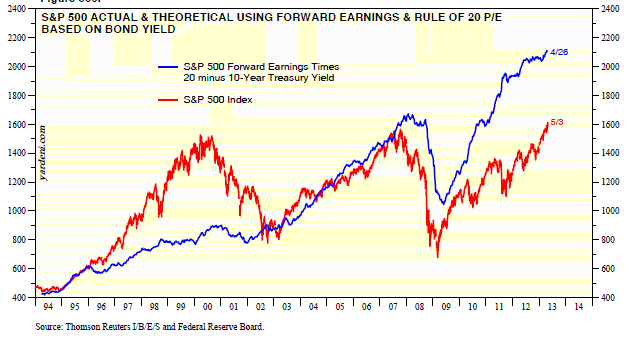
That’s what Ed Yardeni of Dr. Ed’s Blog does. From a big picture perspective, there are just two main variables in stock market valuation: earnings, and the multiple you put on those earnings. Lots of firms estimate aggregate S&P 500 earnings. (Top-down estimates actually tend to be a little more accurate than bottom-up estimates.) In this version, he uses the Thomson Reuters IBES estimate. For his estimate of the appropriate multiple, he uses 20 minus the 10-year yield. That kind of thinking makes sense. With low interest rates, the market has typically traded at a higher multiple. When interest rates or inflation are high, the PE multiple tends to get compressed. He points out that other versions of this chart, like using a multiple of 20 minus CPI inflation come out in the same ballpark.

Here’s the chart from his recent article on valuation:

YardeniValuation zps4bb27b89 Stock Market Valuation

Source: Dr. Ed’s Blog (click on image to enlarge)

It’s an interesting chart, is it not? Based on earnings, it suggested the market was significantly overvalued in the late 1990s, and then fairly valued from 2002 to 2007 or so. The market dropped appropriately in response to weak earnings during the financial crisis, but is now about 30% undervalued, not having kept up with the rapid earnings growth we’ve seen since then. The suggestion is that if earnings hold up, current stock prices are not out of line with the past decade.

It’s well worth reading the rest of the article, as Dr. Yardeni also discusses the relative valuation of stocks versus bonds. (The whole blog is worth reading! He is one of the more practically grounded economists out there.)

My takeaway on this is simply that the current market may not warrant the incredible amount of hand-wringing that we’ve seen as the S&P 500 has pushed to new highs. Given the powerful corporate earnings we’ve seen, coupled with very low interest rates, the market’s valuation may be reasonable. Yes, it feels scary because we are in new high ground, but the data looks different than we might feel emotionally.

Posted by:


From the Archives: Forecasting, Schmorecasting

May 6, 2013

We’ve written about the uselessness of forecasting in the past and even cited James Montier’s wonderful piece, The Seven Sins of Fund Management. This citation comes from Mebane Faber’s World Beta blog. Montier writes:

The two most common biases are over-optimism and overconfidence. Overconfidence refers to a situation whereby people are surprised more often than they expect to be. Effectively people are generally much too sure about their ability to predict. This tendency is particularly pronounced amongst experts. That is to say, experts are more overconfident than lay people. This is consistent with the illusion of knowledge driving overconfidence.

Dunning and colleagues have documented that the worst performers are generally the most overconfident. They argue that such individuals suffer a double curse of being unskilled and unaware of it. Dunning et al argue that the skills needed to produce correct responses are virtually identical to those needed to self-evaluate the potential accuracy of responses. Hence the problem.

This is irony in action. Knowledge drives overconfidence, so people who actually know something about a topic are more prone to think they can forecast, and they probably even sound more believable. And finally, the worst performers are the most overconfident!

This may be one of the few instances in which ignorance is bliss. If you have the Zen “beginner’s mind” and don’t make any assumptions about what might happen, you’re going to be better off than if you are knowledgeable and try to guess.

Systematic trend-following eliminates the need to forecast (although apparently not the desire, since we have clients constantly asking us what we think is going to happen). We use relative strength to drive our trend-following; it is able to pick out the strongest trends, and those are the trends we are interested in following. We stay with an asset as long as it remains strong. When it weakens, we kick it out of the portfolio and replace it with something stronger. This kind of casting-out method allows the portfolio to adapt to the market environment, as it is constantly refreshed with new, strong assets.

Despite having a logical and simple method that performs well over time and eliminates the need to forecast, soothsayers will probably always be with us—but your best bet is to ignore them.

—-this article originally appeared 3/2/2013. Of course the lesson is timeless.

Posted by:


Clueless: The Stock Market is not the Economy

May 3, 2013

Morgan Housel has a fun article at Motley Fool with a possible explanation for why investors are so clueless. His argument, essentially, is that investors confuse the stock market with the economy. If the economy is bad, they assume the stock market must be bad too. Although it’s certainly true that many investors are confused about the linkage between the stock market and the economy, I don’t know if that’s the real explanation or not—but it’s plausible. Maybe I’ve just given up hope that we’ll ever understand investor irrationality! To me, the most staggering part of his article is where he quotes an investor study from Franklin:

Take an annual survey by Franklin Templeton Investments. Near the start of each year, it asks 1,000 investors whether the S&P 500 went up or down in the previous year.

Now, we live in the age of CNBC and Yahoo! Finance and iPhone apps, where no one lacks the data to know a simple statistic like whether the market went up or down.

Yet year after year, the survey shows that swarms of investors are utterly clueless:

  • In 2010, 66% of investors said the S&P 500 fell in 2009. Yet it was actually up 26.5%.

  • In 2011, about half of investors said the market fell in 2010. Yet it was actually up 15%.

  • In 2012, 53% of investors said the market fell in 2011. Yet it was up 2%.

  • Just recently, 31% of investors said the market fell last year. Yet it was up 16%.

Mind-boggling, isn’t it? During a strong three-year run in the market (2009-2011), more than half of the investors they polled thought it was going down! Last year, the idea that the market might be going up began to sink in. Given that the economy was actually growing slowly during much of that time, perhaps investors are imagining market performance is related to their own economic confidence or linked to their own desire to invest. Whatever the linkage, it’s pretty clear they weren’t basing it on market data.

The more data-centric your investing approach is, the more likely it is that you’ll get somewhere close to reality. If you are looking at relative strength data, it’s easier to see where the strongest trending markets have been—and also to see what’s been sinking. A systematic investment process might be your best insurance policy.

Posted by:


From the Archives: Psychology That Drives Bull Markets

May 2, 2013

The Leuthold Group’s Doug Ramsey on the psychology that drives bull markets:

Cashing in on bull markets is not a matter of waiting for everything to line up, anyway. There must be a set of intellectually appealing bear arguments keeping some players on the sidelines…it is these same players who will eventually drive prices even higher when “new” and intellectually appealing bull arguments belatedly appear on the scene. I have found that some of the best bull market action occurs when the “bull/bear” arguments superficially appear to be in relative balance, confounding many market players. When the balance tips too heavily to one side or the other, the odds are that most of the related market move is already in the books.

—-this article originally appeared 3/3/2010. Thinking about this paradox is one of the things that led us to start our own sentiment survey focusing on client investment behavior. Even now, many years into the bull market, clients are still behaving fairly cautiously, indicating they do not yet fully believe the bull argument.

Posted by:


Financial Repression Primer

May 1, 2013

Research Affliliates published a very nice primer on financial repression on Advisor Perspectives. It’s well worth reading to get the lay of the land. Here’s how they define financial repression:

Financial repression refers to a set of governmental policies that keep real interest rates low or negative and regulate or manipulate a captive audience into investing in government debt. This results in cheap funding and will be a prime tool used by governments in highly indebted developed market economies to improve their balance sheets over the coming decades.

When you hear talk about “the new normal,” this is one of the features. Most of us have not had to deal with financial repression during our investment careers. In fact, for advisors in the 1970s and early 1980s, the problem was that interest rates were too high, not too low!

There are disparate views on the endgame from financial repression. Some are expecting Japanese-style deflation, while others are looking for Weimar Republic inflation. Maybe we will just muddle through. In truth, there are many possible outcomes depending on the myriad of policy decisions that will be made in coming years.

In our view, guessing at the outcome of the political and economic process is hazardous. We think it makes much more sense to be alert to the possibilities embedded in tactical asset allocation. That allows you to pursue returns wherever they can be found at the time, without having to have a strong opinion on the eventual outcome. Relative strength can often be a very useful guide in that process.

Posted by:


Retirement Success

April 30, 2013

Financial Advisor had a recent article in which they discussed a retirement success study conducted by Putnam. Quite logically, Putnam defined retirement success by being able to replace your income in retirement. They discovered three keys to retirement success:

  1. Working with a financial advisor
  2. Having access to an employer-sponsored retirement plan
  3. Being dedicated to personal savings

None of these things is particularly shocking, but taken together, they illustrate a pretty clear path to retirement success.

  • Investors who work with a financial advisor are on track to replace 80 percent of their income in retirement, Putnam says. Those who do not are on track to replace 56 percent.
  • Workers who are eligible for a workplace plan are on track to replace 73 percent of their income while those without access replace only 41 percent.
  • The ability to replace income in retirement is not tied to income level but rather to savings level, Putnam says. Those families that save 10 percent or more of their income, no matter what the income level, are on track to replace 106 percent of their income in retirement, which underscores the importance of consistent savings, the study says.

I added the bold. It’s encouraging that retirement success is tied to savings level, not income level. Everyone has a chance to succeed in retirement if they are willing to save and invest wisely. It’s not just an opportunity restricted to top earners. Although having a retirement plan at work is very convenient, you can still save on your own.

It’s also interesting to me how much working with a financial advisor can increase the ability to replace income in retirement. Maybe advisors are helping clients invest more wisely, or maybe they are just nagging them to save more. Whatever the combination of factors, it’s clearly making a big difference. Given that the average income replacement level found in the study was 61%, working with an advisor moved clients from below average (56%) to well above average (80%) success.

This study, like pretty much every other study of retirement success, also shows that nothing trumps savings. After all, no amount of clever investment management can help you if you have no capital to work with. For investors, Savings is Job One.

Posted by:


The Wonders of Momentum

April 18, 2013

Relative strength investors will be glad to know that James Picerno’s Capital Spectator blog has an article on the wonders of momentum. He discusses the momentum “anomaly” and its history briefly:

Momentum is one of the oldest and most persistent anomalies in the financial literature. The tendency of positive or negative returns to persist for a time seems like a ridiculously simple predictor, but it works. There’s an ongoing debate about why it works, but the results in numerous tests speak loud and clear. Unlike many (most?) reported sources of alpha, the market-beating and risk-lowering results linked to momentum strategies appear to be immune to arbitrage.

Informally, it’s fair to say that investors have been exploiting momentum in various forms for as long as humans have been trading assets. Formally, the concept dates to at least 1937, when Alfred Cowles and Herbert Jones reviewed momentum in their paper “Some A Priori Probabilities in Stock Market Action.” In the 21st century, an inquiring reader can easily find hundreds of papers on the subject, most of it published in the wake of Jegadeesh and Titman’s seminal 1993 work: “Returns to Buying Winners and Selling Losers: Implications for Stock Market Efficiency,” which marks the launch of the modern age of momentum research.

I think his observation that momentum (relative strength to us) has been around since humans have been trading assets is spot on. It’s important to keep that in mind when thinking about why relative strength works—and why it has been immune to arbitrage. He writes:

Momentum, it seems, is one of the rare risk factors with features that elude so many other strategies: It’s persistent, conceptually straightforward, robust across asset classes, and relatively easy to implement. It’s hardly a silver bullet, but nothing else is either.

The only mystery: Why are we still talking about this factor in glowing terms? We still don’t have a good answer to explain why this anomaly hasn’t been arbitraged away, or why it’s unlikely to meet an untimely demise anytime soon.

Mr. Picerno raises a couple of important points here. Relative strength does have a lot of attractive features. The reason it is not a silver bullet is that it underperforms severely from time to time. Although that is also true of other strategies, I think the periodic underperformance is one of the reasons why the excess returns have not been arbitraged away.

Although he suggests we don’t have a good answer about why momentum works, I’d like to offer my explanation. I don’t know if it’s a good answer or not, but it’s what I’ve arrived at after years of research and working with relative strength portfolios—not to mention a degree in psychology and a couple of decades of seeing real investors operate in the market laboratory.

  • Relative strength straddles both fundamental analysis and behavioral finance.
  • High relative strength securities or assets are generally strong because they are undergoing fundamental improvement or are in a sweet spot for fundamentals. In other words, if oil prices are trending strongly higher, it’s not surprising that certain energy stocks are strong. That’s to be expected from the fundamentals. Often there is improvement at the margin, perhaps in revenue growth or operating margin—and that improvement is often underestimated by analysts. (Research shows that investors are more responsive to changes at the margin than to the absolute level of fundamental factors. For example, while Apple’s operating margin grew from 2.2% in 2003 to 37.4% in 2012, the stock performed beautifully. Even though the operating margin is expected to be in the 35% range this year—which is an extremely high level—the stock is getting punished. Valero’s stock price plummeted when margins went from 10.0% in 2006 to 2.4% in 2009, but has doubled off the low as margins rebounded to 4.8% in 2012. Apple’s operating margin on an absolute basis is drastically higher than Valero’s, but the delta is going the wrong way.) High P/E multiples can often be maintained as long as margin improvement continues, and relative strength tends to take advantage of that trend. Often these trends persist much longer than investors expect.
  • From the behavioral finance side, social proof helps reinforce relative strength. Investors herd and they gravitate toward what is already in motion, and that reinforces the price movement. They are attracted to the popular and repelled by the unpopular.
  • Periodic bouts of underperformance help keep the excess returns of relative strength high. When momentum goes the wrong way it can be ugly. Perhaps margins begin to contract and financial results are worse than analysts expect. The security has been rewarded with a high P/E multiple, which now begins to unwind. The herd of investors begins to stampede away, just as they piled in when things were going well. Momentum can be volatile and investors hate volatility. Stretches of underperformance are psychologically painful and the unwillingness to bear pain (or appropriately manage risk) discourages investors from arbitraging the excess returns away.

In short, I think there are multiple reasons why relative strength works and why it is difficult to arbitrage away the excess returns. Those reasons are both fundamental and behavioral and I suspect will defy easy categorization. Judging from my morning newspaper, human nature doesn’t change much. Until it does, markets are likely to work the same way they always have—and relative strength is likely to continue to be a powerful return factor.

Posted by:


Nate Silver Interview

April 17, 2013

Here’s a link to a nice Nate Silver interview at Index Universe. Nate Silver is now a celebrity statistician due to his accurate election forecasts, although he started by doing statistics for baseball. In the interview, he discusses some of the ways that predictions can go wrong. In general, human beings are completely wrong about the stock market!

The typical retail investor frankly does things exactly wrong—they tend to buy at the top and sell at the bottom. Theoretically, you make this long-run average return, but a lot of people are buying at the market peaks. For many years, the Gallup Poll has periodically been asking investors whether it’s a good time to invest or not. There’s a strong historical negative correlation between when people think it’s a good time to invest and the five- or 10-year returns on the S&P 500.

Overconfidence can also kill predictions. Other studies have found that the more confident the forecaster the worse the forecast tends to be, something that makes watching articulate bulls and bears on CNBC particularly dangerous!

It’s worth a read.

Posted by:


Current Income

April 12, 2013

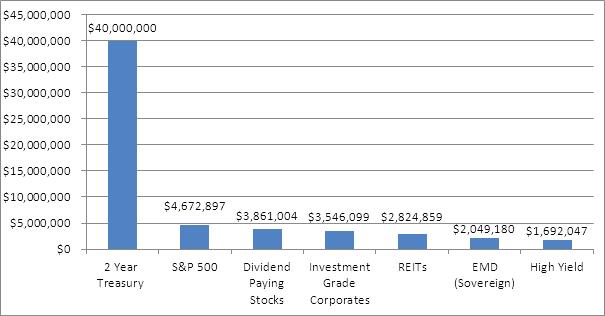
Investors lately are in a frenzy about current income. With interest rates so low, it’s tough for investors, especially those nearing or already in retirement, to come up with enough current income to live on. A recent article in Advisor Perspectives had a really interesting take on current income. The author constructed a chart to show how much money you would have to invest in various asset classes to “buy” $100,000 in income. Some of these asset classes might also be expected to produce capital gains and losses, but this chart is purely based on their current income generation ability. You can read the full original article to see exactly which asset classes were used, but the visual evidence is stunning.

100mIncome zps66939722 Current Income

Source: Advisor Perspectives/Pioneer Investments (click to enlarge)

There are two things that I think are important to recognize—and it’s hard not to with this chart.

  1. Short-term interest rates are incredibly low, especially for bonds presumed to have low credit risk. The days of rolling CDs or clipping a few bond coupons as an adequate supplement to Social Security are gone.
  2. In absolute terms, all of these amounts are relatively high. I can remember customers turning up their noses at 10% investment-grade tax-exempt bonds—they felt rates were sure to go higher—but it only takes a $1 million nest egg to generate a $100,000 income at that yield. Now, it would take more than $1.6 million, even if you were willing to pile 100% into junk bonds. (And we all know that more money has been lost reaching for yield than at the point of a gun.) A more realistic guess for the typical volatility tolerance of an average 60/40 balanced fund investor is probably something closer to $4.2 million. Even stocks aren’t super cheap, although they seem to be a bargain relative to short-term bonds.

That’s daunting math for the typical near-retiree. Getting anywhere close to that would require compounding significant savings for a long, long time—not to mention remarkable investment savvy. The typical advisor has only a handful of accounts that large, suggesting that much work remains to be done educating clients about savings, investment, and the reality of low current yields.

The pressure for current income might also entail some re-thinking of the entire investment process. Investors may need to focus more on total return, and realize that some capital gains can be spent as readily as dividends and interest. Relative strength may prove to be a useful discipline in the search for returns, wherever they may be found.

Posted by:


Investment Manager Selection

April 12, 2013

Investment manager selection is one of several challenges that an investor faces. However, if manager selection is done well, an investor has only to sit patiently and let the manager’s process work—not that sitting patiently is necessarily easy! If manager selection is done poorly, performance is likely to be disappointing.

For some guidance on investment manager selection, let’s turn to a recent article in Advisor Perspectives by C. Thomas Howard of AthenaInvest. AthenaInvest has developed a statistically validated method to forecast fund performance. You can (and should) read the whole article for details, but good investment manager selection boils down to:

  • investment strategy
  • strategy consistency
  • strategy conviction

This particular article doesn’t dwell on investment strategy, but obviously the investment strategy has to be sound. Relative strength would certainly qualify based on historical research, as would a variety of other return factors. (We particularly like low-volatility and deep value, as they combine well with relative strength in a portfolio context.)

Strategy consistency is just what it says—the manager pursues their chosen strategy without deviation. You don’t want your value manager piling into growth stocks because they are in a performance trough for value stocks (see Exhibit 1999-2000). Whatever their chosen strategy or return factor is, you want the manager to devote all their resources and expertise to it. As an example, every one of our portfolio strategies is based on relative strength. At a different shop, they might be focused on low-volatility or small-cap growth or value, but the lesson is the same—managers that pursue their strategy with single-minded consistency do better.

Strategy conviction is somewhat related to active share. In general, investment managers that are willing to run relatively concentrated portfolios do better. If there are 250 names in your portfolio, you might be running a closet index fund. (Our separate accounts, for example, typically have 20-25 positions.) A widely dispersed portfolio doesn’t show a lot of conviction in your chosen strategy. Of course, the more concentrated your portfolio, the more it will deviate from the market. For managers, career risk is one of the costs of strategy conviction. For investors, concentrated portfolios require patience and conviction too. There will be a lot of deviation from the market, and it won’t always be positive. Investors should take care to select an investment manager that uses a strategy the investor really believes in.

AthenaInvest actually rates mutual funds based on their strategy consistency and conviction, and the statistical results are striking:

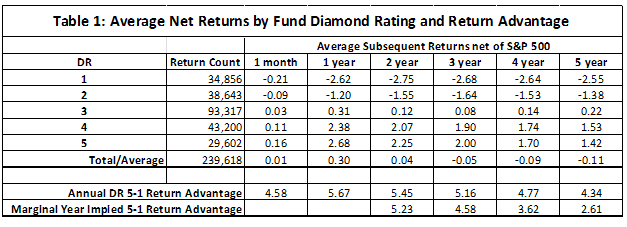
The higher the DR [Diamond Rating], the more likely it will outperform in the future. The superior performance of higher rated funds is evident in Table 1. DR5 funds outperform DR1 funds by more than 5% annually, based on one-year subsequent returns, and they continue to deliver outperformance up to five years after the initial rating was assigned. In this fashion, DR1 and DR2 funds underperform the market, DR3 funds perform at the market, and DR4 and DR5 funds outperform. The average fund matches market performance over the entire time period, consistent with results reported by Bollen and Busse (2004), Brown and Goetzmann (1995) and Fama and French (2010), among others.

Thus, strategy consistency and conviction are predictive of future fund performance for up to five years after the rating is assigned.

The bold is mine, as I find this remarkable!

I’ve reproduced a table from the article below. You can see that the magnitude of the outperformance is nothing to sniff at—400 to 500 basis points annually over a multi-year period.

diamondratings zps3970f53e Investment Manager Selection

Source: Advisor Perspectives/AthenaInvest (click on image to enlarge)

The indexing crowd is always indignant at this point, often shouting their mantra that “active managers don’t outperform!” I regret to inform them that their mantra is false, because it is incomplete. What they mean to say, if they are interested in accuracy, is that “in aggregate, active managers don’t outperform.” That much is true. But that doesn’t mean you can’t locate active managers with a high likelihood of outperformance, because, in fact, Tom Howard just demonstrated one way to do it. The “active managers don’t outperform” meme is based on a flawed experimental design. I tried to make this clear in another blog post with an analogy:

Although I am still 6’5″, I can no longer dunk a basketball like I could in college. I imagine that if I ran a sample of 10,000 random Americans and measured how close they could get to the rim, very few of them could dunk a basketball either. If I created a distribution of jumping ability, would I conclude that, because I had a large sample size, the 300 people would could dunk were just lucky? Since I know that dunking a basketball consistently is possible–just as Fama and French know that consistent outperformance is possible–does that really make any sense? If I want to increase my odds of finding a portfolio of people who could dunk, wouldn’t it make more sense to expose my portfolio to dunking-related factors–like, say, only recruiting people who were 18 to 25 years old and 6’8″ or taller?

In other words, if you look for the right characteristics, you have a shot at finding winning investment managers too. This is valuable information. Think of how investment manager selection is typically done: “What was your return last year, last three years, last five years, etc.?” (I know some readers are already squawking, but the research literature shows clearly that flows follow returns pretty closely. Most “rigorous due diligence” processes are a sham—and, unfortunately, research shows that trailing returns alone are not predictive.) Instead of focusing on trailing returns, investors would do better to locate robust strategies and then evaluate managers on their level of consistency and conviction.

Posted by:


Investors’ #1 Problem: Not Saving Enough

April 12, 2013

The Wall Street Journal had a small piece on Americans’ retirement readiness. In general, they’re not saving enough. Here’s an excerpt:

A separate study released today by investment firm Edward Jones finds that 79% of 1,008 U.S. adults surveyed in February said that they have committed a money mistake – and of those, 26% reported not having saved enough for retirement as their No. 1 problem. Also on the list: not paying attention to spending and making bad investments.

The EBRI research found that Americans are coming to grips with the dramatic improvements they need to make in their saving habits, with 20% of workers saying they need to save between 20 and 29% of their income to achieve a financially secure retirement, and 23% saying they need to save 30% – or more.

I added the bold. If you are a financial advisor, it’s really worth reading the entire EBRI research brief. It is absolutely eye-opening. You will discover that only 23% of workers ever obtained investment advice in the first place.

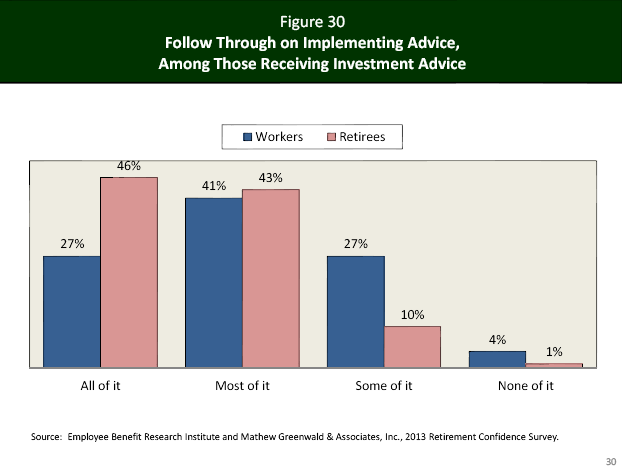
And, when they got advice, they ignored a lot of it! Here’s the graphic from EBRI on follow-through:

advice zps59e7514a Investors #1 Problem: Not Saving Enough

Only 27% fully implemented the advice. That makes about 6% of investors that got advice and followed it! (Elsewhere in the report, you will discover that a minority of investors have even tried to figure out what they might need in the way of retirement savings.) It seems obvious that you would have a large chance of falling short if you didn’t even have a goal.

As advisors, we often forget—as frustrated as we sometimes are with clients—that we are dealing with the cream of the crop. We work with investors who 1) have sought out professional advice and 2) follow all or most of it. We get cranky at anything less than 100% implementation, but many investors are doing less than that—if they bother to get advice at all.

So lighten up. Keep nudging your clients to save more, because you know it is their #1 problem. They might think you obnoxious, but they will thank you later. Help them construct a reasonable portfolio. And encourage them to get their friends and colleagues into some kind of planning and investment process. Their odds of success will be better if they get some help.

Posted by:


Smart Beta vs. Monkey Beta

April 9, 2013

Andy wrote a recent article entitled Smart Beta Gains Momentum. It’s gaining momentum for a good reason! A recent study at Cass Business School in London found that cap-weighting was not a very good way to construct an index. Lots of methods to get exposure to smart beta do better. The results were discussed in an article at Index Universe. Some excerpts:

Researchers have found that equity indices constructed randomly by ‘monkeys’ would produce higher risk-adjusted returns than an equivalent market capitalisation-weighted index over the last 40 years…

The findings come from a recent study by Cass Business School (CBS), which was based on monthly US share data from 1968 to 2011. The authors of the study found that a variety of alternative index weighting schemes all delivered superior returns to the market cap approach.

According to Dr. Nick Motson of CBS, co-author of the study, “all of the 13 alternative indices we studied produced better risk-adjusted returns than a passive exposure to a market-cap weighted index.”

The study included an experiment that saw a computer randomly pick and weight each of the 1,000 stocks in the sample. The process was then repeated 10 million times over each of the 43 years. Clare describes this as “effectively simulating the stock-picking abilities of a monkey”.

…perhaps most shockingly, we found that nearly every one of the 10 million monkey fund managers beat the performance of the market cap-weighted index,” said Clare.

The findings will be a boost to investors already looking at alternative indexing. Last year a number of European pension funds started reviewing their passive investment strategies, switching from capitalisation-weighting to alternative index methodologies.

Relative strength is one of the prominent smart beta methodologies. Of course, cap-weighting has its uses—the turnover is low and rebalancing is minimized. But purely in terms of performance, the researchers at Cass found that there are better ways to do things. Now that ETFs have given investors a way to implement some of these smart beta methods in a tax-efficient, low-cost manner, I suspect we will see more movement toward smart beta in the future.

Posted by:


From the Archives: I Want to Buy Losers

April 4, 2013

I cringe every time I read an article by a value investor that says something like, “You should buy stocks that are on sale, just like you buy [pick your consumer item] on sale.” In the financial markets that can be dangerous.

In a great essay titled, I Want to Buy Losers, Clay Allen of Market Dynamics discusses the problems with this analogy. [You've got to read the whole essay to really appreciate it.]

Many investors buy stocks the way many consumers buy paper towels or any other staple. They are attracted to a sale and loss leaders are a proven method for a retailer to increase the traffic in their store. The value of the item is well known and a sale price gets the attention of potential buyers.

Mr. Allen explains brilliantly and succinctly why this analogy is bunk:

But stocks are not like paper towels. Paper towels can be used to satisfy a need and this is what gives the item its value to the consumer. What gives a stock its value? A stock cannot be used to satisfy a need or accomplish a task. The value of a stock is derived from the financial performance of the company, either actual or expected. The fact that the stock is down in price is usually a sure sign that the financial performance of the company is declining.

…if the value of the stock was constant, then buying bargain stocks would be the correct way to invest in stocks. But stock values are constantly changing as business conditions change for the company and the expectations of investors change.

All in all, it seems to me that relative strength often more closely reflects what the expectations of investors are–and the expectations are what counts. Let’s face it: strong stocks are usually strong because business conditions or fundamentals are good, and weak stocks are usually weak for a reason.

—-this article was originally published 3/26/2010. In the intervening years, my friend Clay Allen has passed away. His wisdom, however, is still with us. His point that a stock is not a paper towel is absolutely correct. The only purpose of an equity investment is to make money.

Posted by:


Buy the Unloved

March 25, 2013

Morningstar has a market-beating strategy call “Buy the Unloved” that they update from time to time. Essentially, it consists of buying the fund categories with the most outflows and holding on to them for three years, on the theory that retail investors generally get things wrong. Sadly, “Buy the Unloved” has a good track record, indicating that their thesis is largely correct!

Here are a couple of key excerpts from their 2013 update on the Buy the Unloved strategy:

Morningstar has followed this strategy since the early 1990s, using annual net cash flows to identify each year’s three most unloved and loved equity categories, which feed into two separate portfolios (unloved and loved). We track the average returns for those categories for the subsequent three years, adding in new categories each year and swapping out categories after three years are up. We’ve found that holding a portfolio of the three most unpopular equity categories for at least three years is an effective approach: From 1993 through 2012, the “unloved” strategy gained 8.4% annualized to the “loved” strategy’s 5.1% annualized. The unloved strategy has also beaten the MSCI World Index’s 6.9% annualized gain and has slightly beat the Morningstar US Market Index’s 8.3% return.

According to Morningstar fund flow data, the most popular equity categories in 2012 were diversified emerging markets (inflows of $23.2 billion), foreign large value (inflows of $4.6 billion), and real estate (inflows of $3.8 billion). Those looking across asset classes might want to be cautious on sending new money to intermediate-term bond (inflows of $112.3 billion), short-term bond (inflows of $37.6 billion), and high-yield bond (inflows of $23.6 billion), particularly as interest rates have nowhere to go but up.

The most unloved equity categories are also the most unpopular overall: large growth (outflows of $39.5 billion), large value (outflows of $16 billion), and large blend (outflows of $14.4 billion). These categories have seen outflows despite posting double-digit gains in 2012. The money leaving from these categories reflects a broader trend of investors fleeing equity funds while piling into fixed-income offerings and passive ETFs.

Now that we are almost a full quarter into 2013, it might be worthwhile to think about what we have seen so far this year: good performance from large-cap equities and sluggish performance from bonds.

Morningstar should get a public service award for publishing this data—and it’s worth thinking about what you can learn from it. The most popular investment trends are not always the profitable ones. In fact, their work indicates that it could be valuable to spend time thinking about going into areas that are currently unpopular. Obviously, this does not need to be used (and probably shouldn’t be) as a stand-alone strategy, but it might be useful as a guide to portfolio adjustments.

Posted by:


The Ridiculous Efficient Frontier

March 22, 2013

It’s hard to believe this paper was not written ironically. Perhaps I am missing the author’s sense of dry humor? In a paper entitled Principal Component Analysis of Time Variations in the Mean-Variance Efficient Frontier, author Andreas Steiner subjects mean-variance optimization to principal component analysis, a mathematical way to determine the relative importance of factors. He extracted three important factors that determine the efficient frontier. The three factors together explained 99% of the shape of the efficient frontier.

In fact—and this is the funny part to me-one factor explained 95% of the shape of the efficient frontier. And what was that magic factor?

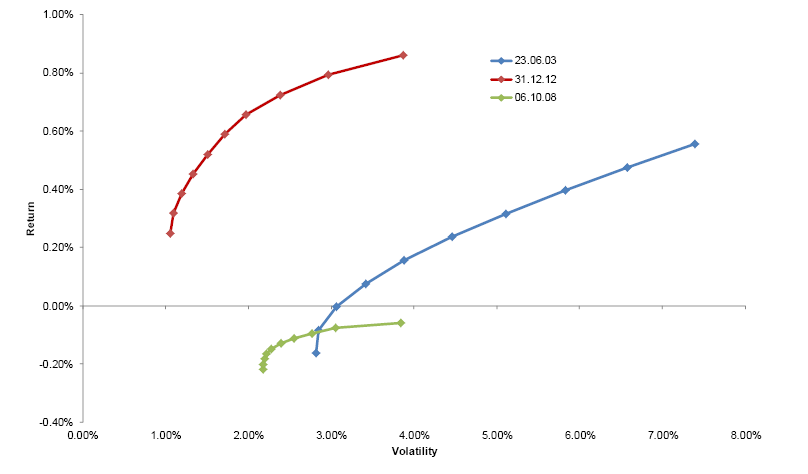
It was the level of returns. In other words, the shape of the efficient frontier depends on the returns of the various assets. If you can predict the returns, you will (mostly) know the shape of the efficient frontier. And, in case you were wondering, the shape of the efficient frontiers varies enormously depending on the time period. Below, for example, is a clip from the paper showing efficient frontiers calculated from trailing data at different times. I’m sure you can see the slight problem—the curves look nothing alike.

ridiculousfrontier zps5d9cf98d The Ridiculous Efficient Frontier

The Ridiculous Frontier

Source: Andreas Steiner/SSRN (click on image to enlarge)

The author writes:

We find that the level factor is highly correlated with average asset returns.

We interpret this result as evidence that successful investment management is mainly driven by return estimates and not “risk management” as has been in the spotlight since the Financial Crisis.

Here’s the immediate question that occurs to my feeble brain, although I’m guessing most 5th graders would be right there with me: If I could predict the return of each asset, why would I need an efficient frontier? Wouldn’t I just buy the best-performing asset?

Indeed, risk management is no big deal if I simply predict all of the asset returns. We’ve discussed many times before that mean-variance optimization is highly dependent upon returns, although correlations and standard deviation play a supporting role. All of these factors are moving targets, none more so than returns. Mean variance optimization, in practice, is a complete bust because obviously no one can reliably and consistently predict returns.

This kind of study—although mathematically rigorous—is silliness of the first degree. It reminds me certain academic follies, like the professors who wondered if monkeys at typewriters really could reproduce the works of Shakespeare. (The short answer is “no.”)

Modern portfolio theory would be relatively harmless if it remained in academia. However, when investors try to use it to build portfolios, it has the potential to cause a lot of damage. Although it is simply another theory that does not work in practice, it is enshrined in many finance textbooks and still taught to budding practitioners. Is it any wonder that we prefer tactical asset allocation driven by relative strength to guessing at future returns?

HT to CXO Advisory

Posted by:


Bond Math

March 22, 2013

Advisor Perspectives ran a recent research piece from Leuthold Weeden on bond math. Although this stuff is fairly well known within the advisor community—or at least I hope it is—it seems to be almost completely unknown to clients. The one bond math item that I think clients would be most shocked to know is this:

One of the better bond forecasting tools over the past several decades involves no inflation forecast whatsoever. It turns out the prevailing yield on the 10-year Treasury has provided a wonderfully accurate forecast of bond market total returns 10 years out. In fact, the correlation between current yields and the subsequent 10-year total return is a stunning 0.96 based on monthly data back to 1930!

The emphasis is theirs. A 96% correlation is exceptionally high, and here’s what it says about bonds going forward: your bond returns are likely to be low. As of 3/15, the 10-year constant-maturity Treasury yield was 2.04%. That’s also, it turns out, the best forecast for bond total returns for the next 10 years.

By the way, that’s not the real return adjusted for inflation. That’s the total return. Most of your clients are not going to be able to afford to retire on a 2% return. They are either going to have to liquidate their account over time or find some way to earn more than 2% over time. Fortunately, there are a lot of alternatives in a well-considered portfolio approach, from equities to tactical asset allocation that might own bonds only periodically.

You really should read the entire article. Doug Ramsey is not only tall, but also a nice guy. And it is his considered opinion that the 10-year Treasury forecast may even be too high. For the most part, I don’t think clients are thinking this way about bond returns. Perhaps you can help them do the math.

Posted by:


Retirement Stress

March 20, 2013

AdvisorOne ran an interesting article recently, reporting the results of a retirement study done by Franklin Templeton. Investors are feeling a lot of stress about retirement, even early on. And given how things are going for many of them, feeling retirement stress is probably the appropriate response! In no particular order, here are some of the findings:

A new survey from Franklin Templeton finds that nearly three-quarters (73%) of Americans report thinking about retirement saving and investing to be a source of stress and anxiety.

In contrast to those making financial sacrifices to save, three in 10 American adults have not started saving for retirement. The survey notes it’s not just young adults who are lacking in savings; 68% of those aged 45 to 54 and half of those aged 55 to 64 have $100,000 or less in retirement savings.

…two-thirds (67%) of pre-retirees indicated they were willing to make financial sacrifices now in order to live better in retirement.

“The findings reveal that the pressures of saving for retirement are felt much earlier than you might expect. Some people begin feeling the weight of affording retirement as early as 30 years before they reach that phase of their life,” Michael Doshier, vice president of retirement marketing for Franklin Templeton Investments, said in a statement. “Very telling, those who have never worked with a financial advisor are more than three times as likely to indicate a significant degree of stress and anxiety about their retirement savings as those who currently work with an advisor.”

As advisors, we need to keep in mind that our clients are often very anxious over money issues or feel a lot of retirement stress. We often labor over the math in the retirement income plan and neglect to think about how the client is feeling about things—especially new clients or prospects. (Of course, they do feel much better when the math works!)

The silver lining, to me, was that most pre-retirees were willing to work to improve their retirement readiness—and that those already working with an advisor felt much less retirement stress. I don’t know if clients of advisors are better off for simply working with an advisor (other studies suggest they are), but perhaps even having a roadmap would relieve a great deal of stress. As in most things, the unknown makes us anxious. Working with a qualified advisor might make things seem much more manageable.

Posted by:


From the Archives: Hobo Investing

March 12, 2013

Investing, at its core, is a simple process. You need to determine if the train is going north or south, or just sitting on a track siding doing nothing. Once you’ve found a train going north, you need only to hop aboard. If the train starts to go south, you need to jump off.

The concept is simple, but sometimes investors make the execution more complicated. For us, relative strength and trend following provide the tools and methodology to find the northbound trains. The same tools and methodology can be used to tell you when the switch engine has come along and started to move the train south.

The problems happen when investors deviate from the simple goal-directed hobo mentality and get too clever for their own good. Can you imagine how irrational some investor behavior must look to a hobo? Here are the top six dysfunctional hobo sayings:

1. I wanted to go north, so I hopped on an out-of-favor southbound train, hoping it would go north eventually. (value hobo)

2. I got on a northbound train, but it only went north a few miles. A switch engine came along and started to take my boxcar south. How embarrassing! This train owes me. I’m not getting off. (ego-attached hobo)

3. There are so many trains going north. I want to hop on one eventually, but I’m afraid it will go south right after I get on it. (failure to launch hobo)

4. This northbound train is picking up speed. I’d better get off. (premature ejection hobo)

5. I want to go north, but my train pulled on to a siding and stopped. Maybe I’ll just sit here and see what happens. (buy-and-hold hobo)

6. There are so many trains going north without me. Eventually they will all have to go south, and then I’ll have my revenge! (bitter hobo with economics background)

If you want to go north, get on a northbound train. KISS really applies here. On our good days, we all know this, but it’s so easy to forget.

—-this article originally appeared 5/26/2010. Investing need not be complicated. Relative strength investing, in fact, is pretty simple. However, simple is not the same thing as easy! There is a real skill to the disciplined execution of this strategy—or any other strategy.

Posted by:


Target Date Fund Follies

March 7, 2013

Target date and lifecycle funds have taken off since 2006, when they were deemed qualified default investment alternatives in the Pension Protection Act. I’m sure it seemed like a good idea at the time. Unfortunately, it planted the idea that a glidepath that moved toward bonds as the investor moved toward retirement was a good idea. Assets in target date funds were nearly $400 billion at the end of 2011—and they have continued to grow rapidly.

In fact, bonds will prove to be a good idea if they perform well and a lousy idea if they perform poorly. Since 10-year future returns correlate closely with the current coupon yield, prospects for bonds going forward aren’t particularly promising at the moment. I’ve argued before that tactical asset allocation may provide an alternative method of accumulating capital, as opposed to a restrictive target-date glidepath.

A new research paper by Javier Estrada, The Glidepath Illusion: An International Perspective, makes a much broader claim. He looks at typical glidepaths that move toward bonds over time, and then at a wide variety of alternatives, ranging from inverse glidepaths that move toward stocks over time to balanced funds. His findings are stunning.

This lifecycle strategy implies that investors are aggressive with little capital and conservative with much more capital, which may not be optimal in terms of wealth accumulation. This article evaluates three alternative types of strategies, including contrarian strategies that follow a glidepath opposite to that of target-date funds; that is, they become more aggressive as retirement approaches. The results from a comprehensive sample that spans over 19 countries, two regions, and 110 years suggest that, relative to lifecycle strategies, the alternative strategies considered here provide investors with higher expected terminal wealth, higher upside potential, more limited downside potential, and higher uncertainty but limited to how much better, not how much worse, investors are expected to do with these strategies.

In other words, the only real question was how much better the alternative strategies performed. (I added the bold.)

Every strategy option they considered performed better than the traditional glidepath! True, if they were more focused on equities, they were more volatile. But, for the cost of the volatility, you ended up with more money—sometimes appreciably more money. This data sample was worldwide and extended over 110 years, so it wasn’t a fluke. Staying equity-focused didn’t work occasionally in some markets—it worked consistently in every time frame in every region. Certainly the future won’t be exactly like the past, so there is no way to know if these results will hold going forward. However, bonds have had terrific performance over the last 30 years and the glidepath favoring them still didn’t beat alternative strategies over an investing lifetime.

Bonds, to me, make sense to reduce volatility. Some clients simply must have a reduced-volatility portfolio to sleep at night, and I get that. But Mr. Estrada’s study shows that the typical glidepath is outperformed even by a 60/40-type balanced fund. (Balanced funds, by the way, are also designated QDIAs in the Pension Protection Act.) Tactical asset allocation, where bonds are held temporarily for defensive purposes, might also allow clients to sleep at night while retaining a growth orientation. The bottom line is that it makes sense to reduce volatility just enough to keep the client comfortable, but no more.

I’d urge you to read this paper carefully. Maybe your conclusions will be different than mine. But my take-away is this: Over the course of an investing lifetime, it is very important to stay focused on growth.

Posted by:


Quote of the Week

March 4, 2013

The class of those who have the ability to think their own thoughts is separated by an unbridgeable gulf from the class of those who cannot—-Ludwig von Mises

Orthodox thinking will keep you out of trouble. In the investment industry, if you build a client’s portfolio in rigid conformance with Modern Portfolio Theory, your firm will back you and it is unlikely that you will ever be successfully sued, regardless of how horribly things turn out for the client. And make no mistake—building portfolios based on mean variance optimization doesn’t have a very good track record.

Unorthodox thinking, as uncomfortable as it may be for some, is also the only way the human race advances. After all, nearly every current orthodoxy was once out of the mainstream. It’s good to have new ideas bubbling up, prepared to take the place of our current king of the hill if they can demonstrate their worth in practice. (Theory that doesn’t work in practice isn’t much of a theory.)

I’m encouraged to see factor-based investing and broad diversification advancing at the expense of Modern Portfolio Theory. Relative strength tests well as a return factor, as do value and low volatility.


HT to Michael Covel

Posted by:


Buyer’s Remorse

March 1, 2013

Lots of investors have avoided the stock market since 2009, only to miss out on a long run of good performance. Now, of course, they are concerned about buying because the market is near a 52-week high. Essentially, they are worried about buyer’s remorse—that bittersweet feeling when the market goes down right after you decided to join the party. In practice, this usually just means they will wait even longer to get in and will thus buy at an even higher price.

While it is impossible to know what the market will do next, buyer’s remorse might not be as significant as it seems. World Beta reprised a recent piece from Steve Sjuggerud on what happened when buying near new 52-week highs and lows:

We looked at nearly 100 years of weekly data on the S&P 500 Index, not counting dividends. You might be surprised at what we found…

After the stock market hits a 52-week high, the compound annual gain over the next year is 9.6%. That is a phenomenal outperformance over the long-term “buy and hold” return, which was 5.6% a year.

On the flip side, buying when the stock market is at or near new lows leads to terrible performance over the next 12 months… Specifically, buying anytime stocks are within 6% of their 52-week lows leads to compound annual gain of 0%. That’s correct, no gain at all 12 months later.

Using monthly data, our True Wealth Systems databases go back to 1791. The results are similar… Buying at a 12-month high and holding for 12 months beats the return of buy-and-hold. And buying at a 12-month low and holding for a year does worse than buy-and-hold. Take a look…

11 Buyers Remorse

The same holds true for a more recent time period, this time starting in 1950…

2 Buyers Remorse

History’s verdict is clear… You’re much better off buying at new highs than at new lows.

I find this quite interesting in light of the fact that there is no shortage of articles discussing the sky falling with the sequester, or the debt ceiling, or the Greek default, of the ongoing collapse of the Yen. Well, you get the picture. Maybe investors are just afflicted with crisis fatigue at this point. In fact, PE multiples are around average right now. There’s no telling what will happen going forward, but buyer’s remorse need not be at the top of your list of fears.

Posted by:


From the Archives: Was It Really a Lost Decade?

February 28, 2013

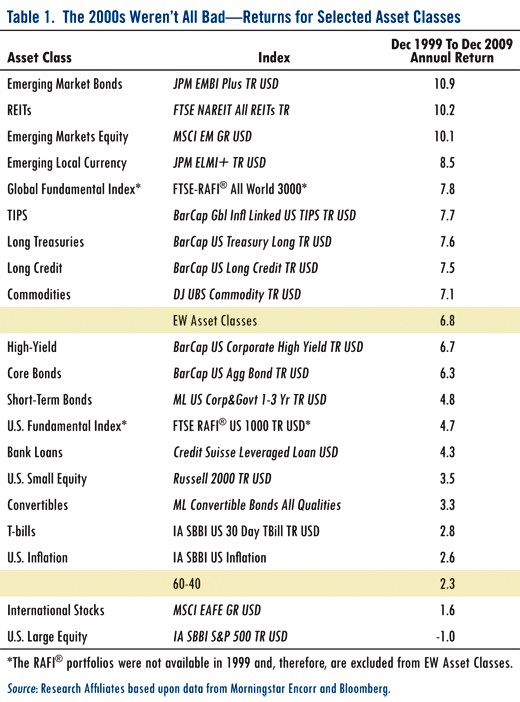
Index Universe has a provocative article by Rob Arnott and John West of Research Affiliates. Their contention is that 2000-2009 was not really a lost decade. Perhaps if your only asset was U.S. equities it would seem that way, but they point out that other, more exotic assets actually had respectable returns.

The table below shows total returns for some of the asset classes they examined.

 From the Archives: Was It Really a Lost Decade?

click to enlarge

What are the commonalities of the best performing assets? 1) Lots of them are highly volatile like emerging markets equities and debt, 2) lots of them are international and thus were a play on the weaker dollar, 3) lots of them were alternative assets like commodities, TIPs, and REITs.

In other words, they were all asset classes that would tend to be marginalized in a traditional strategic asset allocation, where the typical pie would primarily consist of domestic stocks and bonds, with only small allocations to very volatile, international, or alternative assets.

In an interesting way, I think this makes a nice case for tactical asset allocation. While it is true that most investors–just from a risk and volatility perspective–would be unwilling to have a large allocation to emerging markets for an entire decade, they might find that periodic significant exposure to emerging markets during strong trends would be quite acceptable. And even assets near the bottom of the return table like U.S. Treasury bills would have been very welcome in a portfolio during parts of 2008, for example. You can cover the waterfront and just own an equal-weighted piece of everything, but I don’t know if that is the most effective way to do things.

What’s really needed is a systematic method for determining which asset classes to own, and when. Our Systematic Relative Strength process does this pretty effectively, even for asset classes that might be difficult or impossible to grade from a valuation perspective. (How do you determine whether the Euro is cheaper than energy stocks, or whether emerging market debt is cheaper than silver or agricultural commodities?) Once a systematic process is in place, the investor can be slightly more comfortable with perhaps a higher exposure to high volatility or alternative assets, knowing that in a tactical approach the exposures would be adjusted if trends change.

—-this article originally appeared 2/17/2010. There is no telling what the weak or strong assets will be for the coming decade, but I think global tactical asset allocation still represents a reasonable way to deal with that uncertainty.

Posted by: