From the Archives: Rob Arnott and the Key to Better Returns

February 21, 2013

Rob Arnott is a thought leader in tactical asset allocation, currently well-known for his RAFI Fundamental Indexes. In his recent piece, Lessons from the Naughties, he discusses how investors will need to find return going forward.

The key to better returns will be to respond tactically to the shifting spectrum of opportunity, especially expanding and contracting one’s overall risk budget.

It’s a different way to view tactical asset allocation–looking at it from a risk budget point of view. The general concept is to own risk assets in good markets and safe assets in bad markets.

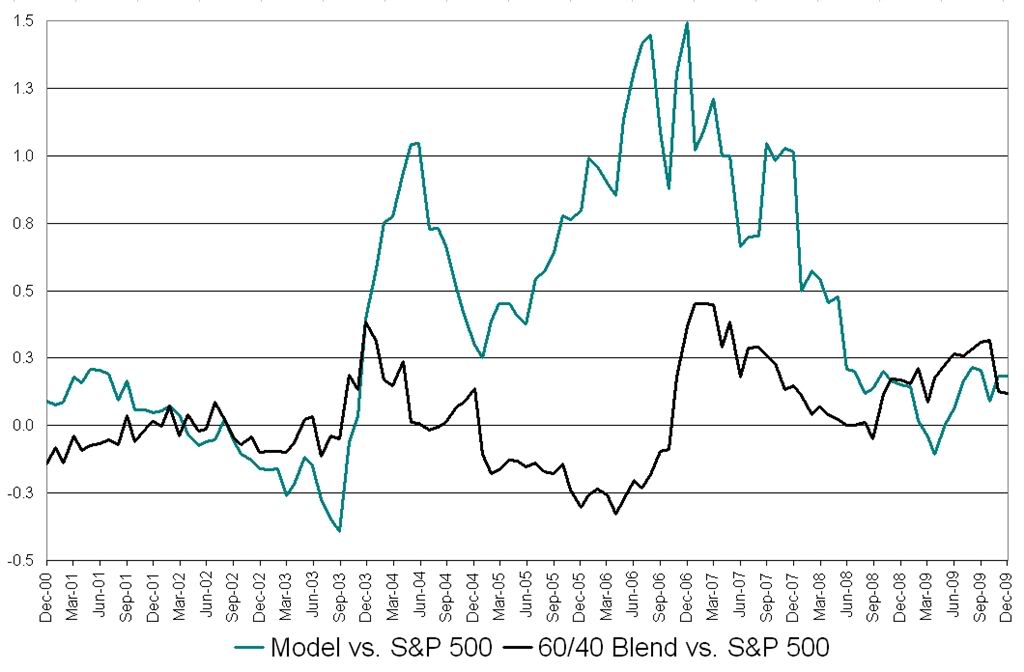
It turns out that systematic application of relative strength accomplishes this very well. The good folks at Arrow Funds recently asked us to take a look at how the beta in a tactically managed portfolio changed over time. When we examined that issue, it showed that as markets became risky, relative strength reduced the beta of the portfolio by moving toward low volatility (strong) assets. When markets were strong, allocating with relative strength pushed up the beta in the portfolio, thus taking good advantage of the market strength.

 From the Archives: Rob Arnott and the Key to Better Returns

click to enlarge

Using relative strength to do tactical asset allocation, the investor was not only able to earn an acceptable rate of return over time, but was able to have some risk mitigation going on the side. That’s a pretty tasty combination in today’s markets.

—-this article originally appeared on 2/26/2010. Amid all of the publicity given recently to risk parity, Arnott’s approach, which is to vary the risk budget over time depending on the opportunities available, has been largely ignored. I think this is unfortunate. His approach, although perhaps not easy, has merit. Tactical asset allocation driven by relative strength is one way to do that.

Posted by:


Hyperinflation

February 15, 2013

Apparently hyperinflation can occur anywhere!

Source: Greg Mankiw

Posted by:


Bonds and Risk Parity

February 13, 2013

I had risk parity in mind when I noted that a recent article at Financial Advisor quoted long-time awesome bond manager Dan Fuss on the state of the bond market:

Dan Fuss, whose Loomis Sayles Bond Fund beat 98 percent of its peers in the last three years, said the fixed-income market is more “overbought” than at any time in his 55-year career as he prepares to open a fund to British individual investors.

“This is the most overbought market I have ever seen in my life in the business,” Fuss, 79, who oversees $66 billion in fixed-income assets as vice chairman of Boston-based Loomis Sayles & Co., said in an interview in London. “What I tell my clients is, ‘It’s not the end of the world, but for heaven’s sakes don’t go out and borrow money to buy bonds right now.’”

The reason this intrigues me is the strong institutional interest in “risk parity” portfolios at the moment. The base idea behind risk parity is that in a typical investment portfolio, equities provide most of the volatility. A risk parity portfolio typically tries to equalize the volatility contribution of different asset classes, which often means reducing the equity allocation—and also often leveraging the bond allocation. (Equating volatility with risk is a whole different discussion.) In other words, risk parity portfolios often borrow money to buy bonds, just the thing Dan Fuss is urging his clients to avoid right now.

To me, the marker of a bubble is irrational behavior. By that standard, bonds are in a bubble. Consider that at the end of last week the 10-year Treasury could be purchased with a yield of about 2.00%. Yet, the 10-year breakeven yield was about 2.57%, indicating that a buyer of 10-year Treasurys expected a negative real return.

Is it rational to buy something with the expectation of a negative return? Think about it this way: Imagine telling a prospective client, “If you buy this stock portfolio, we expect that you’ll lose about a half percent a year for the next decade.” Think you would have any buyers? Would people bid at auction to get a piece of the action?

Expectations, of course, could be wrong. Maybe bonds will continue to do well for an extended period of time, or maybe buying with the expectation of a slight negative return will turn out to be a genius move because every other asset class does much worse.

The problem with bubbles is not really that they exist. Bubbles are great for investors and for the economy on the way up. Bubbles often have an evolutionary financial purpose as well—probably the foundation for many later businesses was laid during the internet bubble. Much of the first internet generation might have died off, but their offspring populate Silicon Valley now. We’ll always have bubbles, human nature being what it is.

The more specific problem with bubbles concerns the investors trapped in them as they deflate—and the absolute impossibility of determining when that might happen. It’s way easier to identify a bubble than to guess when it will pop. Trends of all types, including bubbles, can go on for a lot longer than people think.

The most practical way to handle bubbles, I think, is to use some type of trend following tactical approach. You’ll never be out at the top, of course, but you might be able to be along for much of the ride and be able to exit without extensive damage. If you’re a bond market investor today that might be one way to think about your exposure. Committing to bonds as a permanent part of a risk parity strategy, especially with leverage, is a different animal.

Posted by:


Quote of the Week

February 12, 2013

To attain knowledge, add things every day. To attain wisdom, subtract things every day.—-Lao-Tzu

There are many theories about investing in the market. Some are simple, while others are mind-numbingly complex. Relative strength is one of the simple methods. Because it is simple, it is robust and much more difficult to break than a multi-factor method that relies on many relationships between factors. Complicated things are fragile and tend to break easily. That’s not to say that relative strength is perfect—it will underperform periodically like every other method. But relative strength subtracts everything except price, and asserts that strong price action is typically a precursor of good relative performance. History bears that out.

Posted by:


Underfunded Pension Plans

February 4, 2013

Many large corporations still carrying defined benefit plans for their workers have underfunded pension plans. For example, here’s an excerpt from a Wall Street Journal article on the issue today:

“It is one of the top issues that companies are dealing with now,” said Michael Moran, pension strategist at investment adviser Goldman Sachs Asset Management.

The drain on corporate cash is a side effect of the U.S. monetary policy aimed at encouraging borrowing to stimulate the economy. Companies are required to calculate the present value of the future pension liabilities by using a so-called discount rate, based on corporate bond yields. As those rates fall, the liabilities rise.

If you think that underfunded pension plans are only a corporate or government problem, you would be wrong. Chances are that the underfunded pension plan is a personal problem, even if (or especially if) you have a defined contribution plan like a 401k. In a corporate plan, the corporation is on the hook for the money. If you have a 401k plan, you are on the hook for the money. And, since there is a contribution cap on 401ks, it may well be that you need to set aside additional money outside your retirement plan to make sure you hit your goals.

Figuring out whether your retirement is funded or not depends on some assumptions—and those assumptions are a moving target. The one thing you know for sure is how much you have saved for retirement right now. You might also have a handle on your current level on contributions. What you don’t know exactly is how many years it will be until you retire, although you can generate scenarios for different ages. What you don’t know at all is what the return on your retirement savings will be in those intervening years—or what the inflation rate will be during that time.

As interest rates fall, pensions are required to assume that their investment returns will fall too. That means they have to contribute much more to reach their funding goals.

Guess what? That means you should assume that you, too, will see lower returns and will need to save more money for retirement. When stock and bond yields are low, it’s realistic to assume that returns will be lower going forward. Investors right now, unfortunately, are stuck with rates that are near 50-year lows. It puts a big burden on investors to get cracking and save as much as they can while they are working. A qualified advisor should be able to give you some sense of your funding level so that you can plan for retirement.


Posted by:


Timeless Portfolio Lessons

February 1, 2013

The only thing new under the sun is the history you haven’t read yet.—-Mark Twain

Investors often have the conceit that they are living in a new era. They often resort to new-fangled theories, without realizing that all of the old-fangled things are still around mainly because they’ve worked for a long time. While circumstances often change, human nature doesn’t change much, or very quickly. You can generally count on people to behave in similar ways every market cycle. Most portfolio lessons are timeless.

As proof, I offer a compendium of quotations from an old New York Times article:

WHEN you check the performance of your fund portfolio after reading about the rally in stocks, you may feel as if there is a great party going on and you weren’t invited. Perhaps a better way to look at it is that you were invited, but showed up at the wrong time or the wrong address.

It isn’t just you. Research, especially lately, shows that many investors don’t match market performance, often by a wide margin, because they are out of sync with downturns and rallies.

Christine Benz, director of personal finance at Morningstar, agrees. “It’s always hard to speak generally about what’s motivating investors,” she said, “but it’s emotions, basically,” resulting in “a pattern we see repeated over and over in market cycles.”

Those emotions are responsible not only for drawing investors in and out of the broad market at inopportune times, but also for poor allocations to its niches.

Where investors should be allocated, many professionals say, is in a broad range of assets. That will smooth overall returns and limit the likelihood of big losses resulting from an excessive concentration in a plunging market. It also limits the chances of panicking and selling at the bottom.

In investing, as in party-going, it’s often safer to let someone else drive.

This is not ground-breaking stuff. In fact, investors are probably bored to hear this sort of advice over and over—but it gets repeated because investors ignore the advice repeatedly! This same article could be written today, or written 20 years from now.

You can increase your odds of becoming a successful investor by constructing a reasonable portfolio that is diversified by volatility, by asset class, and by complementary strategy. Relative strength strategies, for example, complement value and low-volatility equity strategies very nicely because the excess returns tend to be uncorrelated. Adding alternative asset classes like commodities or stodgy asset classes like bonds can often benefit a portfolio because they respond to different return drivers than stocks.

As always, the bottom line is not to get carried away with your emotions. Although this is certainly easier said than done, a diversified portfolio and a competent advisor can help a lot.

Posted by:


Are You the Millionaire Next Door?

January 31, 2013

Clients, in general, are bad about even trying to figure out what their retirement number is—that is, the pool of assets they will need to maintain their standard of living in retirement. Even more difficult is figuring out if they are on track. One simple method is mentioned in The Millionaire Next Door, by Thomas Stanley and William Danko. From Yahoo! Finance:

Thomas Stanley and William Danko, authors of the bestselling book “The Millionaire Next Door,” suggest that you simply take your age and multiply it by your current annual income before taxes from all sources (except for inheritances, which are only paid once). Divide the total by 10, and the quotient is what your net worth should be at that point in your life.

So, for example, if you are making $80,000 per year and you are now 45 years old, this simple formula suggests that to stay on track your net worth should be about $360,000. There are a lot of assumptions that go into this, obviously, and there are better and more accurate ways to figure out if you are on track (for example, we use a % funded spreadsheet), but it’s a start. Given current return expectations, this simple formula might understate what you will require, but anything that will motivate clients to get moving in the right direction is a help.


Posted by:


From the Archives: Getting Torched By Expert Opinion

January 29, 2013

Barry Ritholtz has posted a 5 minute clip of some of Ben Bernanke’s public comments between 2005-2007 on the housing market and the broader economy. The point of me posting this is not to say that Bernanke is a complete moron because I have little doubt that he is one of the brightest financial minds in the country. However, talk about being dead wrong! If you relied on these opinions in order to make investment decisions, you likely got torched. If you can’t rely on expert opinion when making investment decisions, then what options do you have?

This highlights the value of trend-following systems. Trend following requires zero reliance on expert opinion; it simply allows the investor to adapt to whatever trends the market offers, whether or not experts expected things to play out in a given way. With trend following, you’ll have plenty of losing trades, but you’ll also avoid sitting in losing trades for long periods of time. Furthermore, systematic trend-following has an excellent track record (see here and here.) Trend following allows you to cut your losses short and to hold on to your winners. Frequently, the strongest trends end up being very different from what even the brightest experts predicted.

—-this article originally appeared 2/11/2010. Well, heck, if you can’t trust Ben Bernanke, who can you trust? The answer should be obvious: follow the price trend and forget about the random guessing of experts.

Posted by:


Dealing With Financial Repression

January 28, 2013

James Montier, the investment strategist at GMO, published a long piece on financial repression in Advisor Perspectives in November 2012. It’s taken me almost that long to read it—and I’m still not sure I completely understand its implications. Financial repression itself is pretty easy to understand though. Along with a humorous description of Fed policy, Montier describes it like this:

Put another way, QE sets the short-term rate to zero, and then tries to persuade everyone to spend rather than save by driving down the rates of return on all other assets (by direct purchase and indirect effects) towards zero, until there is nothing left to hold savings in. Essentially, Bernanke’s first commandment to investors goes something like this: Go forth and speculate. I don’t care what you do as long as you do something irresponsible.

Not all of Bernanke’s predecessors would have necessarily shared his enthusiasm for recklessness. William McChesney Martin was the longest-serving Federal Reserve Governor of all time. He seriously considered training as a Presbyterian minister before deciding that his vocation lay elsewhere, a trait that earned him the beautifully oxymoronic moniker of “the happy puritan.” He is probably most famous for his observation that the central bank’s role was to “take away the punch bowl just when the party is getting started.” In contrast, Bernanke’s Fed is acting like teenage boys on prom night: spiking the punch, handing out free drinks, hoping to get lucky, and encouraging everyone to view the market through beer goggles.

So why is the Fed pursuing this policy? The answer, I think, is that the Fed is worried about the “initial condition” or starting point (if you prefer) of the economy, a position of over-indebtedness. When one starts from this position there are really only four ways out:

i. Growth is obviously the most “popular” but hardest route.

ii. Austerity is pretty much doomed to failure as it tends to lead to falling tax revenues, wider deficits, and public unrest. 2

iii. Abrogation runs the spectrum from default (entirely at the borrower’s discretion) to restructuring (a combination of borrower and lender) right out to the oft-forgotten forgiveness (entirely at the lender’s discretion).

iv. Inflation erodes the real value of the debt and transfers wealth from savers to borrowers. Inflating away debt can be delivered by two different routes: (a) sudden bursts of inflation, which catch participants off guard, or (b) financial repression.

Financial repression can be defined (somewhat loosely, admittedly) as a policy that results in consistent negative real interest rates. Keynes poetically called this the “euthanasia of the rentier.”3 The tools available to engineer this outcome are many and varied, ranging from explicit (or implicit) caps on interest rates to directed lending to the government by captive domestic audiences (think the postal saving system in Japan over the last two decades) to capital controls (favoured by emerging markets in days gone by).

The effects of financial repression are easy to see: very low yields in debt instruments, and the consequent temptation to reach for yield elsewhere. Advisors see the effects in clients every day.

If you are feeling jovial, I highly recommend reading Montier’s whole piece as an antidote to your good mood. His forecast is rather bleak—poor long-term returns in most all asset classes for a long period of time. My take-away was a little different.

Let’s assume for a moment that Montier is correct and long-term (they use seven years) equity real returns are approximately equivalent to zero. In fact, that’s pretty much exactly what we’ve seen during the last decade! The broad market has made very little progress since 1998, a period going on 15 years now. Buy-and-hold (we prefer the terminology “sit-and-take-it”) clearly didn’t work in that environment, but tactical asset allocation certainly did. Using relative strength to drive the process, tactical asset allocation steered you toward asset classes, sectors, and individual securities that were strong (for however long) and then pushed you out of them when they became weak.

I have no idea whether Montier’s forecast will pan out or not, but if it does, tactical asset allocation might end up being one of the few ways to survive. There’s almost always enough fluctuation around the trend—even if the trend is flat—to get a little traction with tactical asset allocation.

Source: Monty Python/Youtube

[In fact, might I suggest the Arrow DWA Balanced Fund and the Arrow DWA Tactical Fund as considerations? You can find more information at www.arrowfunds.com.]

Posted by:


Relative Strength: A Solid Investment Method

January 28, 2013

We are fond of relative strength. It’s a solid investment method that have proven itself over a long period of time. Sure, it has its challenges and there are certainly periods of time during which it underperforms, but all-in-all it works and it’s been good to us. It’s always nice, though, when I run across another credible source that sings its praises. Consider the following excerpt from an article on the Optimal Momentum blog:

Momentum, on the other hand, has always made sense. It is based on the phrase “cut your losses; let your profits run on,” coined by the famed economist David Ricardo in the 1700s. Ricardo became wealthy following his own advice. [Editor's note: We wrote about this in David Ricardo's Golden Rules.] Many others, such as Livermore, Gartley, Wycoff, Darvas, and Driehaus, have done likewise over the following years. Behavioral finance has given solid reasons why momentum works. The case for momentum is now so strong that two of the fathers of modern finance, Fama and French, call momentum “the premier market anomaly” that is “above suspicion.”

Momentum, on the other hand, is pretty simple. Every approach, including momentum, must determine what assets to use and when to rebalance a portfolio. The single parameter unique to momentum is the look back period for determining an asset’s relative strength. In a 1937, using data from 1920 through 1935, Cowles and Jones found stocks that performed best over the past twelve months continued to perform best afterwards. In 1967, Bob Levy came to the same conclusion using a six-month look back window applied to stocks from 1960 through 1965. In 1993, using data from 1962 through 1989 and rigorous testing methods, Jegadeesh and Titman (J&T) reaffirmed the validity of momentum. They found the same six and twelve months look back periods to be best. Momentum is not only simple, but it has been remarkably consistent over the past seventy-five years.

Momentum, on the other hand, is one of the most robust approaches in terms of its applicability and reliability. Following the 1993 seminal study by J&T, there have been nearly 400 published momentum papers, making it one of the most heavily researched finance topics over the past twenty years. Extensive academic research has shown that price momentum works in virtually all markets and time periods, from Victorian ages up to the present.

Of course, momentum is just the academic term for relative strength. For more on the history of relative strength—and how it became known as momentum in academia—see CSI Pasadena: Relative Strength Identity Theft. The bigger point is that relative strength has a lot of backing from both academics and practitioners. There are more complicated investment methods, but not many that are better than relative strength.

Posted by:


From the Archives: Why We Like Price

January 25, 2013

Relative strength calculations rely on a single input: price. We like price because it is a known quantity, not an assumption. In this deconstruction of the Price-to-Earnings Growth (PEG) ratio, the author, Tom Brakke, discusses all of the uncertainties when calculating even a simple ratio like PEG. And amidst all of the uncertainties he mentions is this:

In looking at that calculation, only one of the three variables has any precision: We can observe the market price (P) at virtually any time and be assured that we have an accurate number. The E is a different matter entirely. Which earnings? Forward, trailing, smoothed, operating, adjusted, owner? Why? How deep into accounting and the theory of finance do you want to go?

For most investors, not very far. We like our heuristics clean and easy, not hairy. So, in combining the first two variables we get the P/E ratio, the “multiple” upon which most valuation work rests, despite the questionable assumptions that may be baked in at any time. The addition of the third element, growth (G), gives us not the epiphany we seek, but even more confusion.

The emphasis is mine. This isn’t a knock on fundamental analysis. It can be valuable, but there is an inherent squishiness to it. The only precision is found in price. And price is dynamic: it adapts in real time as expectations of the asset change. (Fundamental data is often available only on a quarterly schedule.) As a result, systematic models built using relative strength adapt quite nicely as conditions change.

—-this article originally appeared 2/10/2010. We still like using prices as an input, especially now that there are so many cross-currents. Every pundit has a different take on what will happen down the road, but prices in a free market will eventually sort it all out.

Posted by:


Forecasting Follies

January 24, 2013

No one ever knows what is going to happen in any market. The best we can hope to do is accurately measure where the relative strength is—and then try to stay with it. Presented without much comment is an article from Business Insider dating back to December 2010, just over two years ago. Here’s the headline:

After 20 Years Of Misery, Here’s Why Japanese Stocks Are Ready To Soar

And here is a chart of the Japan ETF versus the S&P 500 over the last two years:

EWJ yahoo zps16d2942f Forecasting Follies

Source: Yahoo! Finance (click to image to enlarge)

As you can see, Japan is down more than 10%—and 25% in relative terms—despite its supposedly compelling valuation. In fact, it could be completely correct that Japan is incredibly undervalued. Certainly the CFA who wrote the article is more qualified than me to make a judgement. It may also be true that eventually this spread will go to other way, due to the difference in valuation—but even two years has not been enough to prove out this thesis so far.

So far it’s just been an expensive lesson in learning that markets can do whatever they want for as long as they want. The only way for a forecast to come true is for the price to move in the forecasted direction—and that means relative strength will shift too. Rather than guessing what will happen, we can trust relative strength to adjust if things change.

Posted by:


From the Archives: Irrational Loss Aversion

January 22, 2013

It’s well known in behavioral finance that investors experience a loss 2-3x more intensely than a gain of the same magnitude. This loss aversion leads investors to avoid even rational bets, according to a Reuters story on a recent study by a Cal Tech scientist.

Laboratory and field evidence suggests that people often avoid risks with losses even when they might earn a substantially larger gain, a behavioral preference termed ‘loss aversion’,” they wrote.

For instance, people will avoid gambles in which they are equally likely to either lose $10 or win $15, even though the expected value of the gamble is positive ($2.50).

The study indicates that people show fear at even the prospect of a loss. Markets are designed to generate fear, not to mention all of the bearish commentators on CNBC. Fear leads to poor decisions, like selling near the bottom of a correction. Unless you are planning to electrically lesion your amygdala, the fear is going to be there–so what’s the best way to deal with it?

The course we have chosen is to make our investment models systematic. That means the decisions are rules-based, not subject to whatever fear the portfolio managers may be experiencing at any given time. Once in a blue moon, excessive caution pays off, but studies suggest that more errors are made being excessively cautious than overly aggressive. A rules-based method treats risk in a even-handed, mathematical way. In other words, take risks that historically are likely to pay off, and keep taking them regardless of your emotional state. Given enough time, the math is likely to swing things in your favor.

—-this article originally appeared 2/10/2010. In the two years since this was written, investors have continued to pay a high price for their fear as the market has continued to advance. There are always scary things around the corner, but a rules-based process can often help you navigate through them. Investors seem to have a hard time learning that scary things don’t necessarily cause markets to perform poorly. In fact, the opposite is often true.

Posted by:


401k Abuse

January 18, 2013

With the elimination of traditional pensions in many workplaces, Americans are left to their own devices with their 401k plan. For many of them, it’s not going so well. Beyond the often-poor investment decisions that are made, many investors are also raiding the retirement kitty. Business Insider explains:

Dipping into your 401(k) plan is tantamount to journeying into the future, mugging your 65-year-old self, and then booking it back to present day life.

And still, it turns out one in four workers resorts to taking out 401(k) loans each year, according to a new report by HelloWallet –– to the tune of $70 billion, nationally.

To put that in perspective, consider how much workers contribute to retirement plans on average: $175 billion per year. That means people put money in only to take out nearly half that contribution later.

That’s not good. Saving for retirement is hard enough without stealing your own retirement money. Congress made you an investor whether you like it or not—now you need to figure out how to make the best of it.

Here are a couple of simple guidelines:

  • save 15% of your income for your entire working career.
  • if you can max out your 401k, do it.
  • diversify your portfolio intelligently, by volatility, asset class, and strategy.
  • resist all of the temptations to mess with your perfectly reasonable plan.
  • if you can’t discipline yourself, for heaven’s sake get help.

I know—easier said than done. But still, if you can manage it, you’ll have a big headstart on a good retirement. Your 401k is too important to abuse.

Posted by:


From the Archives: The 80/20 Rule in Action

January 17, 2013

According to a fascinating study discussed in Time Magazine based on 27 million hands of Texas Hold’em, it turns out that the more hands poker players win, the more money they lose! What’s going on here?

I suspect it has to do with investor preferences–gamblers often think the same way. Most people like to have a high percentage of winning trades; they are less happy with a lower percentage of winning trades, even if the occasional winner is a big one. In other words, investors will often prefer a system with 65% winning trades over a system with 45% winning trades, even if the latter method results in much greater overall profits.

People overweigh their frequent small gains vis-à-vis occasional large losses,” Siler says.

In fact, you are generally best off if you cut your losses and let your winners run. This is the way that systematic trend following tends to work. Often this results in a few large trades (the 20% in the 80/20 rule) making up a large part of your profits. Poker players and amateur investors obviously tend to work the other way, preferring lots of small profits–which all tend to be wiped away by a few large losses. Taking lots of small profits is the psychological path of least resistance, but the easy way is the wrong way in this case.

—-this article was originally published 2/10/2010. Investors still have irrational preferences about making money. They usually want profits—but apparently only if they are in a certain distribution! Real life doesn’t work that way. Making money is a fairly messy process. Only a few names turn out to be big winners, so you’ve got to give them a chance to run.

Posted by:


Keeping It Simple in the New Year

January 3, 2013

Barry Ritholtz at The Big Picture has some musings about portfolios for the New Year. I think he’s right about keeping it simple—but I also think his thought is incomplete. He writes:

May I suggest taking control of your portfolio as a worthwhile goal this year?

I have been thinking about this for awhile now. Last year (heh), I read a quote I really liked from Tadas Viskanta of Abnormal Returns. He was discussing the disadvantages of complexity when creating an investment plan:

“A simple, albeit less than optimal, investment strategy that is easily followed trumps one that will abandoned at the first sign of under-performance.”

I am always mindful that brilliant, complex strategies more often than not fail. Why? A simple inability of the Humans running them to stay with them whenever there are rising fear levels (typically manifested as higher volatility and occasional drawdowns).

Let me state this more simply: Any strategy that fails to recognize the psychological foibles and quirks of its users has a much higher probability of failure than one that anticipates and adjusts for that psychology.

Let me just say that there is a lot of merit to keeping things simple. It’s absolutely true that complex things break more easily than simple things, whether you’re talking about kid’s Christmas toys or investor portfolios. I believe in simplicity over complexity.

However, complexity is only the tip of the iceberg that is human nature. Mr. Ritholtz hints at it when he mentions human inability to stay with a strategy when fear comes into the picture. That is really the core issue, not complexity. Adjust for foibles all you want; many investors will still find a way to express their quirks. You can have an obscenely simple strategy, but most investors will still be unable to stay with it when they are fearful.

Trust me, human nature can foil any strategy.

Perhaps a simple strategy will be more resilient than a complex one, but I think it’s most important to work on our resilience as investors.

Tuning out news and pundits is a good start. Delving deeply into the philosophy and inner workings of your chosen strategy is critical too. Understand when it will do well and when it will do poorly. The better you understand your return factor, whether it is relative strength, value, or something else, the less likely you are to abandon it at the wrong time. Consider tying yourself to the mast like Ulysses—make it difficult or inconvenient to make portfolio strategy changes. Maybe use an outside manager in Borneo that you can only contact once per year by mail. I tell clients just to read the sports pages and skip the financial section. (What could be more compelling soap opera than the Jet’s season?) Whether you choose distraction, inconvenience, or steely resolve as your method, the goal is to prevent volatility and the attendant fear it causes from getting you to change course.

The best gift an investor has is self-discipline. As one of our senior portfolio managers likes to point out, “To the disciplined go the spoils.”

Posted by:


Fama and French Love Relative Strength?

December 17, 2012

Although relative strength investors are not always happy about having their return factor co-opted by academics (who re-named it “momentum”), it’s always nice to see that academics love the power of momentum. In their 2007 paper, Dissecting Anomalies, Eugene Fama and Ken French cover the waterfront on return anomalies, examining them both through style sorts and regression analysis. CXO Advisory put together a very convenient summary of their findings, reproduced below.

famafrench CXO Fama and French Love Relative Strength?

Source: CXO Advisory (click to enlarge)

CXO’s conclusion is especially succinct: In summary, some anomalies are stronger and more consistent than others. Momentum appears to be the strongest and most consistent.

We couldn’t have said it better ourselves.

Posted by:


Relative Strength Everywhere

December 14, 2012

Eric Falkenstein has an interesting argument in his paper Risk and Return in General: Theory and Evidence. He proposes what is essentially a relative strength argument about risk and return. He contends that investors care only about relative wealth and that risk is really about deviating from the social norm. Here is the summary of his draft from the excellent CXO Advisory:

Directly measured risk seldom relates positively to average returns. In fact, there is no measure of risk that produces a consistently linear scatter plot with returns across a variety of investments (stocks, banks, stock options, yield spread, corporate bonds, mutual funds, commodities, small businesses, movies, lottery tickets and bets on horse races).

  • Humans are social animals, and processing of social information (status within group) is built into our brains. People care only about relative wealth.
  • Risk is a deviation from what everyone else is doing (the market portfolio) and is therefore avoidable and unpriced. There is no risk premium.

The whole paper is a 150-page deconstruction of the flaws in the standard model of risk and return as promulgated by academics. The two startling conclusions are that 1) people care only about relative wealth and that 2) risk is simply a deviation from what everyone else is doing.

This is a much more behavioral interpretation of how markets operate than the standard risk-and-return tradeoff assumptions. After many years in the investment management industry dealing with real clients, I’ve got to say that Mr. Falkenstein re-interpretation has a lot going for it. It explains many of the anomalies that the standard model cannot, and it comports well with how real clients often act in relation to the market.

In terms of practical implications for client management, a few things occur to me.

  • Psychologists will tell you that clients respond more visually and emotionally than mathematically. Therefore, it may be more useful to motivate clients emotionally by showing them how saving money and managing their portfolio intelligently is allowing them to climb in wealth and status relative to their peers, especially if this information is presented visually.
  • Eliminating market-related benchmarks from client reports (i.e., the reference to what everyone else is doing) might allow the client to focus just on the growth of their relative wealth, rather than worrying about risk in Falkenstein’s sense of deviation from the norm. (In fact, the further one gets from the market benchmark, the better performance is likely to be, according to studies on active share.) If any benchmark is used at all, maybe it should be related to the wealth levels of the peer group to motivate the client to strive for higher status and greater wealth.

I’m sure there is a lot more to be gleaned from this paper and I’m looking forward to having time to read it again.

Posted by:


Legendary Investors

December 13, 2012

Certain kinds of investment and certain investors have been accorded legendary status in the investment community. Most of the time, this amounts to worshipping a false idol. Either that or legendary investors are just exceptionally good at public relations. Here are some stories about legendary investors you might find illuminating.


Ben Graham, the father of Value Investing (from the Psy-Fi blog)

Following the Wall Street Crash he geared up, borrowing money to invest in the huge range of cheap value stocks that were available in the market. Not being psychic he failed to divine that the recovery in ’30 was the prelude to the even greater drop in ’31.

Faced with ruination for himself and his clients he was lucky enough to be recapitalised by his partner’s father-in-law and restored his and their wealth over the next few years, as the markets stabilised and some sort of normality took hold again.

Yep, Ben Graham blew up and needed a bailout.


John Maynard Keynes, the father of Keynesian economics and manager of the King’s College, Cambridge endowment (from the Psy-Fi blog)

For Keynes investing was about figuring out what everyone else would want to buy and buying it ahead of them. Back in the Roaring Twenties he expressed this approach through currency speculation. Prior to the First World War this would have been an exercise in futility as major currencies were all pegged to the immovable Gold Standard: exchange rates didn’t move. However, the disruption to major economies caused by the conflict forced countries off gold and into a world of strangely shifting valuations.

In this new world Keynes saw the opportunity to apply his animal spirits philosophy and rapidly managed to generate a small fortune, by trading heavily on margin, as the German economy collapsed into hyperinflation, France struggled with an accelerating rate of change of governments and financial scandals, Britain failed to recognise its new place in the world order and the USA lapsed into protectionism. And then, as is the way of the investing world, there was a sudden and inexplicable reversal in the trajectory of exchange rates and Keynes found himself and his fellow investors suddenly short of the cash needed to make good their positions.

As Ben Graham found, when you’re in dire need the best thing to have handy is a wealthy friend. In this case it was Keynes’ father who bailed him out.

Yep, Keynes blew up and needed a bailout from Dad.


Warren Buffett, the King of Buy-and-Hold (from CXO Advisory)

In their July 2010 paper entitled “Overconfidence, Under-Reaction, and Warren Buffett’s Investments”, John Hughes, Jing Liu and Mingshan Zhang investigate how other experts/large traders contribute to market underreaction to Berkshire Hathaway’s moves. Using return, analyst recommendation, insider trading and institutional holdings data for publicly traded stocks listed in Berkshire Hathaway’s quarterly SEC Form 13F filings during 1980-2006 (2,140 quarter-stock observations), they find that:

The median holding period is one year, with approximately 20% (30%) of stocks held for more than two years (less than six months).

Yep, Warren Buffett has 100% turnover. He blew out 30% of his portfolio selections within six months, and held about 20% of his picks for the longer run. That is active trading by any definition.


All three of these investors were quite successful over time, but the reality varies from the perception. What can we learn from the actual trading of these legendary investors?

  • Using a lot of leverage probably isn’t a good idea. If you do use leverage, then make sure you have a big pile of cash set aside for when the margin call arrives. Because it will arrive.
  • A variety of investment methods probably work over time, but no method works all the time. All methods have the ability to create a painful drawdown. In other words, there is no magic method and no free lunch.
  • It makes sense to keep a portfolio fresh. In Buffett’s portfolio, about 20% of the holdings make the grade and turn into longer term investments. Things that are not working out should probably be sold. (In passing, I note that relative strength rankings make this upgrading process rather simple.) In Buffett’s portfolio, the bulk of the return obviously comes from the relative strength monsters—those stocks that have performed well for a very long period of time. Those are the stocks he holds on to. That merits some attention as a best practice.

As in most arenas in life, it is usually more productive to pay attention to what people do, not what they say!

Posted by:


Winners and Losers

December 12, 2012

If you’ve ever wondered why clients remember their winners so well—and are so quick to sell them-while forgetting the losers and how badly they have done, some academics have done you a favor. You can read this article for the full explanation. Or you can look at this handy graphic from CXO Advisory that explains how clients use different reference points for winners and losers. In short, the winners are compared with their highest-ever price, while losers are compared with their break-even purchase price.

winnersandlosers cxo Winners and Losers

Source: CXO Advisory

It explains a lot, doesn’t it? It explains why clients make bizarre self-estimates of their investment performance. And it explains why clients are perpetually disappointed with their advisors—because they are comparing their winners with the highest price achieved. Any downtick makes it a loser in their eyes. The losers are ignored, in hopes they will get back to even.

The antidote to this cognitive bias, of course, is to use a systematic investment process that ruthlessly evaluates every position against a common standard. If you are a value investor, presumably you are estimating future expected returns as your holding criterion. For relative strength investors like ourselves, we’re constantly evaluating the relative strength ranking of each security in the investment universe. Strong securities are retained, and securities that weaken are swapped out for stronger ones. Only a systematic process is going to keep you from looking at reference points differently for winners and losers.

Posted by:


Seven (Obvious) Steps to a Sound Retirement

December 11, 2012

When I first read this retirement article by Robert Powell at Marketwatch, I thought the advice was useful, but obvious. Subsequent experience has led me to believe that while it may be obvious to a financial professional, it’s not always obvious to clients. Clients, it seems, have pretty fuzzy thinking about retirement.

Here’s a retirement step that to me is obvious—but a lot of clients haven’t done it, or haven’t thought about it in a very complex way. From Mr. Powell’s article:

1. Quantify assets and net worth

The first order of business is taking a tally of all that you own — your financial and non-financial assets, including your home and a self-owned business, and all that you owe. Your home, given that it might be your largest asset, could play an especially important part in your retirement, according to Abkemeier.

And at minimum, you should evaluate the many ways you can create income from your home, such as selling and renting; selling and moving in with family; taking out a home-equity loan; renting out a room or rooms; taking a reverse mortgage; and paying off your mortgage.

Another point that sometimes gets lost in the fray is that assets have to be converted into income and income streams need to be converted into assets. “When we think of assets and income, we need to remember that assets can be converted to a monthly income and that retirement savings are important as a generator of monthly income or spending power,” according to SOA’s report. “Likewise, income streams like pensions have a value comparable to an asset.”

One reason retirement planning is so difficult, according to SOA, is that many people are not able to readily think about assets and income with equivalent values and how to make a translation between the two. Assets often seem like a lot of money, particularly when people forget that they will be using them to meet regular expenses.

Consider, for instance, the notion that $100,000 in retirement savings might translate into just $4,000 per year in retirement income.

I put in bold a section that I think is particularly important. With some effort, clients can usually get a handle on what their expenses are. If they have pension income or Social Security benefits, it’s pretty easy to match income and expenses. But if they have a lump sum in their 401k, it’s very difficult for them to understand what that asset means in terms of income.

After all, if they are just looking for an additional $3,000 per month in supplemental income, their $400,000 401k balance looks very large in comparison. They figure that it will last at least ten years even if they just draw the funds out of a money market, so 20 years or more should be no problem with some growth. At least I can only assume that’s what the thought process must be like.

Sustainable income is an entirely different matter, as clients almost never factor inflation into the thought process—and they are usually horrified by the thought of slowly liquidating their hard-earned assets. No, they want their principal to remain intact. They are often shocked when they are informed that, under current conditions, some practitioners consider a 4% or 5% income stream an aggressive assumption.

And, of course, all of this assumes that they have tallied up their retirement assets and net worth in the first place. Lots of retirement “planning,” it turns out, works on the “I have a pretty good 401k, so I think I’ll be all right” principle. I have a couple of thoughts about this whole problem. What is now obvious to me is that clients need a lot of help understanding what a lump sum means in terms of sustainable income. I’m sure that different advisors work with different assumptions, but they are still often not the assumptions your client is making.

Some practical steps for advisors occur to me.

  1. Encourage clients to track their assets and net worth, maybe quarterly, either on paper or on a spreadsheet. At least they will know where they stand. A surprising number of clients nowadays are carrying significant debt into retirement—and they don’t consider how that affects their net worth.
  2. Talk to them about what you consider reasonable assumptions for sustainable income. Maybe you’re still using the good old 4% rule, or perhaps you’ve moved on to more sophisticated methods. Whatever they are, start the conversation long before retirement so the client has a chance to build sufficient savings.

Sound retirement isn’t obvious, and planning for it isn’t simple or easy.

Note: The rest of the article is equally worthwhile.
Posted by:


Taxes are Rising

December 9, 2012

Taxes are rising all over. Swaziland may not have a fiscal cliff, but they are still scratching for more tax revenues. Business Insider explains their proposed tax policy:

Swaziland, the last absolute monarchy in Africa, is considering an increasing the size of a tax that doesn’t exist in much of the Western world.

Reuters reports that Mahajodvwa Khumalo, a Member of Parliament, advocates that the government raise the tax on witch doctors (known as ‘sangomas’). He claims these healers have quadrupled their prices, and wants to raise their licensing fee to help fix the budget deficit, which currently runs at about 15 percent of GDP.

Witch doctoring is apparently a wide-moat business if they have been able to quadruple their prices, although to my knowledge there are no publicly traded witch doctor stocks. I am also curious about what their licensing process is. Is there a witch doctor certification program?

Posted by:


Behavioral Finance: Volatility Edition

December 9, 2012

Volatility can cause investors to make terrible decisions. Blackrock recently featured an ugly chart comparing the returns of every major asset class since 1992 to the returns of the average investor. Amazingly enough, over that 20-year period investors underperformed every single major asset class including inflation!

Source: Blackrock (click to enlarge)

Here is Blackrock’s take on the chart:

Volatility is often the catalyst for poor decisions at inopportune times. Amidst difficult financial times, emotional instincts often drive investors to take actions that make no rational sense but make perfect emotional sense. Psychological factors such as fear often translate into poor timing of buys and sells. Though portfolio managers expend enormous efforts making investment decisions, investors often give up these extra percentage points in poorly timed decisions.

As Blackrock points out, good investing decisions are often ruined by one poorly timed emotional decision, typically brought about by a response to volatility. Volatility often engenders fear, and fear can overwhelm the client’s rational thought process.

One of the chief benefits of a good financial advisor is preventing clients from undermining themselves when the markets are rocky. From an objective point of view, if you are fearful, it’s going to be difficult to calm the client down. I don’t have any magic ideas about how to keep calm, but you could do worse than the British WWII propaganda poster: Keep calm and carry on.

Source: SkinIt (click to enlarge)

Posted by:


From the Archives: Zut Alors!

December 9, 2012

If you need another reason to hate the French, besides envy of their excellent cuisine, it turns out that a bevy of winemakers were fined and given suspended sentences for foisting cheap, lousy wine on American consumers and charging them premium prices for it.

On the other hand, it shows that cognitive biases are everywhere. Neither the American company the wine was shipped to nor consumers drinking it ever complained! Because the wine was labeled as premium pinot noir, wine enthusiasts apparently thought it tasted great. In fact, it turns out that wine drinkers think expensive wine tastes better, even when you trick them and give them two glasses of wine from the same bottle.

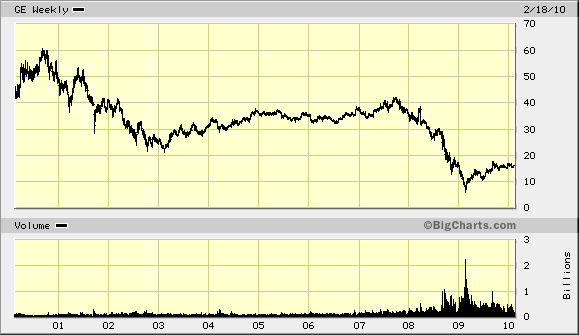
This behavior is not unknown in the stock market, where cognitive biases run unbridled down Wall Street. Ten years ago, everyone was in love with General Electic. It, too, was high-priced and tasted great. Ten years later, GE is considered cheap swill that leaves a bitter taste in the mouths of investors.

 From the Archives: Zut Alors!

The moral of the story is that you can’t fall in love with your stocks or your wine. You have to like it on its own merits. In the case of our Systematic RS accounts, we like a stock only as long as it has high relative strength. When it becomes weaker and drops in its ranking–indicating that other, stronger stocks are available–we sell it and move on to a better class of grape. (We’ve been known to break a bottle here and there, but the idea is to adapt as tastes change.) In this way, we strive to keep our wine cellar stocked with the best vintages all the time.

 From the Archives: Zut Alors!

—-this article originally appeared 2/19/2012. Cognitive biases are still running wild on Wall Street.

Posted by:


Coping With the New Normal

November 28, 2012

The “new normal” is a phrase that strikes fear into the heart of many investors. It is shorthand for the belief that the US economy will grow very slowly going forward, as opposed to resuming its typical growth rate. For example, here is the Research Affliliates version of the new normal, as presented in a recent article from AdvisorOne:

Unless the U.S. makes politically difficult changes in immigration, employment and investment policies, Americans should expect a long-term “new normal” rate of growth of just 1%. So says investment management firm Research Affiliates, in a research note that brings a wealth of demographic and historic data to bear on current fiscal projections.

Christopher Brightman, the report’s author and head of investment management for the Newport Beach, Calif. Firm founded by indexing guru Rob Arnott, is critical of White House and Congressional Budget Office growth projections that assume 2.5% long-term growth.

Brightman argues the U.S. will find it nearly impossible to recapture the 3.3% average annual growth that prevailed from 1951 to 2000 as a result of negative trends in the key areas that affect GDP: population growth, employment rate growth and productivity.

PIMCO and other firms have also been exponents of the new normal view, and although the specifics may vary from strategist to strategist, the general outlook for sluggish growth is the same.

Investor response to date has been less than constructive and has mostly resembled curling up into the fetal position. Although I have no idea how likely it is the new normal theory will pan out, let’s think for a moment about some of the possible implications.

  • if US economic growth is slow, it may slow growth overseas, especially when the US is their primary export market.
  • economies less linked to the US may decouple and retain strong growth characteristics.
  • inflation and interest rates may stay low, leading to better-than-expected bond returns (where default is not an issue).
  • ever more heroic measures to stimulate US economic growth may backfire, creating a debt bomb and high future inflation.
  • growth may be priced at a premium multiple for those stocks and sectors that are demonstrating strong fundamentals. In other words, if growth is hard to find, investors may be willing to pay up for it.
  • slow economic growth may cause a collapse in multiples, as future growth is discounted at a much lower rate.

In other words, you can still get pretty much any investment scenario out of new normal assumptions. It’s just about whether a particular strategist is feeling pessimistic or optimistic that day, or more cynically, whether they are talking their book.

To me, this is one of the best arguments in favor of tactical asset allocation driven by relative strength. Relative strength lets the market decide, based on which assets are strong, what to buy. At any given time it could be currencies, commodities, stocks, bonds, real estate, or even inverse funds. And it might change over time, as new perceptions creep into the market or as policy responses and market consequences interact in a feedback loop. Relative strength doesn’t make any assumptions about what will happen; it treats good performance favorably regardless of the source. Tactical asset allocation, then, is just an attempt to extract returns from wherever they might be available. That trait may come in handy in a tough market.

Posted by: