Coping With the New Normal

November 28, 2012

The “new normal” is a phrase that strikes fear into the heart of many investors. It is shorthand for the belief that the US economy will grow very slowly going forward, as opposed to resuming its typical growth rate. For example, here is the Research Affliliates version of the new normal, as presented in a recent article from AdvisorOne:

Unless the U.S. makes politically difficult changes in immigration, employment and investment policies, Americans should expect a long-term “new normal” rate of growth of just 1%. So says investment management firm Research Affiliates, in a research note that brings a wealth of demographic and historic data to bear on current fiscal projections.

Christopher Brightman, the report’s author and head of investment management for the Newport Beach, Calif. Firm founded by indexing guru Rob Arnott, is critical of White House and Congressional Budget Office growth projections that assume 2.5% long-term growth.

Brightman argues the U.S. will find it nearly impossible to recapture the 3.3% average annual growth that prevailed from 1951 to 2000 as a result of negative trends in the key areas that affect GDP: population growth, employment rate growth and productivity.

PIMCO and other firms have also been exponents of the new normal view, and although the specifics may vary from strategist to strategist, the general outlook for sluggish growth is the same.

Investor response to date has been less than constructive and has mostly resembled curling up into the fetal position. Although I have no idea how likely it is the new normal theory will pan out, let’s think for a moment about some of the possible implications.

  • if US economic growth is slow, it may slow growth overseas, especially when the US is their primary export market.
  • economies less linked to the US may decouple and retain strong growth characteristics.
  • inflation and interest rates may stay low, leading to better-than-expected bond returns (where default is not an issue).
  • ever more heroic measures to stimulate US economic growth may backfire, creating a debt bomb and high future inflation.
  • growth may be priced at a premium multiple for those stocks and sectors that are demonstrating strong fundamentals. In other words, if growth is hard to find, investors may be willing to pay up for it.
  • slow economic growth may cause a collapse in multiples, as future growth is discounted at a much lower rate.

In other words, you can still get pretty much any investment scenario out of new normal assumptions. It’s just about whether a particular strategist is feeling pessimistic or optimistic that day, or more cynically, whether they are talking their book.

To me, this is one of the best arguments in favor of tactical asset allocation driven by relative strength. Relative strength lets the market decide, based on which assets are strong, what to buy. At any given time it could be currencies, commodities, stocks, bonds, real estate, or even inverse funds. And it might change over time, as new perceptions creep into the market or as policy responses and market consequences interact in a feedback loop. Relative strength doesn’t make any assumptions about what will happen; it treats good performance favorably regardless of the source. Tactical asset allocation, then, is just an attempt to extract returns from wherever they might be available. That trait may come in handy in a tough market.

Posted by:


Never-Ending Bond Bubble Debate

November 20, 2012

In case you haven’t had enough of the debate about whether or not bonds are in a bubble (a debate which has gone on for several years now), see Jim Grant’s take below:

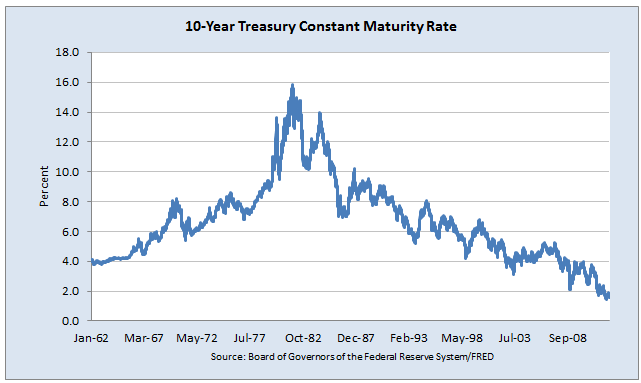
For some additional perspective, consider the chart of 10-year interest rates (which moves inversely to bond prices):

10 year Never Ending Bond Bubble Debate

If you think that there is a chance that Jim Grant may be right about bonds, it probably makes sense to have a game plan for tactically managing your fixed income exposure going forward.

Posted by:


Quote of the Week

November 14, 2012

Nervous energy is a great destroyer of wealth.—-Fayez Sarofim

This quote was embedded in an article written by Jim Goff, the research director at Janus. Along with making the case for equities, he talks about how important it is to have a reasonable allocation that you can stick with—and then to leave it alone.

Mr. Goff talks about the way in which many investors undermine their returns:

The average investor is far from contrarian. I remember vividly when a strategist from a top-tier investment firm in the mid-1990’s told me that while the S&P 500 had grown at 13% per year over the prior 10 years, the realized equity returns of his firm’s retail client base, on average, had compounded at only 5% per year. The S&P would have turned $100,000 into $339,000 during that period, but their average investor ended with $163,000.

Often this is caused by jumping in and out of an asset class, rather than by making tactical adjustments within the asset class. There’s nothing wrong with tactical asset allocation as long as it’s done systematically. Even a lousy version of strategic asset allocation—carried out effectively—will probably beat what most investors are doing! Either way, undisciplined fiddling often ruins investment results. Mr. Sarofim’s quote is something to take to heart.

There are a couple of points relevant to portfolio management.

  1. Think about a reasonable asset allocation for your situation, one you can stick with.
  2. Have a systematic process for making portfolio adjustments, not one that is undisciplined and responsive to the news environment.

Posted by:


Smaller Emerging Markets Soar

November 6, 2012

Words that are like music to the ears of relative strength managers (via Equities in Smaller Emerging Markets Soar, FT):

More broadly, the divergence of emerging markets is a sign that investors are increasingly differentiating between countries and even industries in the developing world, rather than lumping disparate countries into one homogenous group, says Ruchir Sharma, head of emerging markets at Morgan Stanley’s asset management arm.

“We’re done with the era where all emerging markets do well,” says Mr Sharma, author of a book, Breakout Nations, on the next clutch of promising developing countries. “We’re finally starting to see a wide divergence of performance of these markets.”

Also noted in the article, is that the BRICs (Brazil, Russia, India, and China) have been among the worst performers in the emerging markets. As expected, the BRICs are where the Powershares DWA Emerging Markets Technical Leaders ETF (PIE) is most underweight:
PIE 2 Smaller Emerging Markets Soar
See www.powershares.com for more information. A list of all holdings for the trailing 12 months is available upon request.
HT: Abnormal Returns

Posted by:


Beanbag Economics

October 31, 2012

We’ve written before about beanbag economics, the tendency of the world to adapt. When you smush down a beanbag chair in one area, it simply adapts by poofing out somewhere else. The global economy is no different.

Consider the beanbag economics at work in the following excerpt of an article on the bond market in the Financial Times:

Central bankers around the world have followed the lead of the Fed in forcing down interest rates in the hope of boosting economic recovery.

This has presented a dilemma for income investors, who can maintain previous levels of yield only by buying riskier or longer dated bonds.

For companies, though, it has been an unalloyed boon. Corporate treasurers have rushed to sell bonds, refinancing existing loans and expiring bonds with longer term debt paying low, fixed interest rates.

I put the relevant part in bold. Sure, low interest rates are tough on savers and bond buyers—but they’ve been great for companies. The full article points out that new corporate debt issuance has already hit a record this year, with a couple of months still to go. Some companies have been able to retire old debt and refinance it at very low rates.

From an investment point of view, the upside is that earnings leverage will be much more powerful. The drag from debt service will be much lower for companies that have been able to reduce their interest costs.

Thinking about global economics in terms of a beanbag can help underscore the idea that opportunities are always present. In a global economy, one sector’s loss may be another’s gain. Tracking the relative strength of a broad range of asset classes can help investors identify where those investment opportunities are.

Posted by:


Oil Demand and the New World Order

October 25, 2012

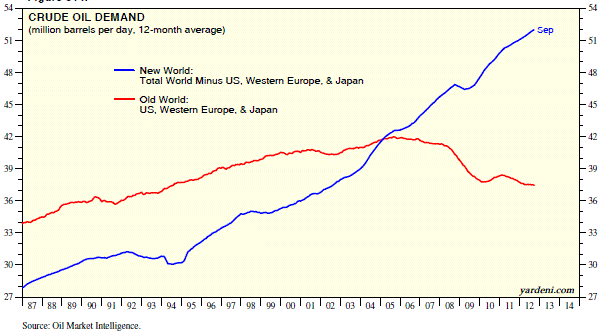
Ed Yardeni of Dr. Ed’s Blog had an interesting chart of oil demand. The interesting part was that he segmented the demand between Old World (US, Western Europe, and Japan) and New World (everyone else). There really is a new world order, something that your portfolio needs to reflect.

oildemand yardeni Oil Demand and the New World Order

Source: Dr. Ed’s Blog (click on image to enlarge)

In this case, a picture might be worth a few thousand words. You can see pretty clearly that the growth rate in oil demand is far higher outside the Old World. Up until 2004, aggregate demand was higher in the Old World, but that has changed too. The big engine of oil demand is no longer the large developed economies. The last recession created a downturn in oil demand in the Old World, but created barely a blip on the chart for the New World. I was surprised when I saw this chart, and I’m probably not the only one. I think most people in the investment industry would be surprised by this—and certainly many clients would be too.

To me, this is a good argument for global tactical asset allocation. Yes, the economy is slow—but clearly not everywhere. Based on oil demand, some economies are growing just fine. Global tactical asset allocation allows you to go where the returns are, regardless of where they may be. Relative strength is a good way to locate those returns.

Posted by:


Invest for the Long Run?

October 18, 2012

“Invest for the long-run” can ring hollow for a recent retiree looking to carefully manage his or her nest egg. Via an article in the New York Times by Paul Sullivan comes the following example:

How should people do the math to avoid dying broke? The answer depends as much on timing as spending.

Mark A. Cortazzo, senior partner at Macro Consulting Group, tells clients who ask this question about three fictional brothers. Each one retired with $1 million on Jan. 1 but three years apart — in 1997, 2000 and 2003. They all invested that $1 million in the Vanguard 500 Index Investor Fund.

Between when they retired and Aug. 31, 2012, each brother withdrew $5,000 a month. The brother who had been retired the longest had $1.14 million on Aug. 31. The one who retired most recently had $1.15 million left.

But the one in the middle, who began taking his monthly withdrawals in 2000, had only $160,568. The reason? The stock market went down for the first three years he was retired, and then plummeted again in 2008. He had to sell more shares to get $5,000 each month.

“Most clients say, ‘I don’t mind dying broke if I’m bouncing my last check to the undertaker,” Mr. Cortazzo said. “But I don’t want to run out at 80 if I’m going to live to 95.”

I can’t think of a better argument for employing our Global Macro strategy as part of the solution than this. Global tactical asset allocation seeks to be adaptive enough to respond to these types of adverse market conditions. The reality is that most recent retirees are in danger of running out of money in one of two ways: losing a substantial amount of money in a bear market or failing to earn enough of a return on their money to keep up with inflation. I think Global Macro does an effective job of balancing those two risks.

To view a video on our Global Macro strategy, click here.

Click here and here for disclosures. Past performance is no guarantee of future returns.

Posted by:


TINO: Tactical In Name Only

October 16, 2012

RINO (Republican In Name Only) is frequently used to castigate those Republicans who talk a good game, but then do little to follow through on conservative principles. Perhaps, there is room for another acronym: TINO (Tactical In Name Only). After highlighting the strong and rising demand for tactical strategies, the WSJ then points out that tactical means many things to many people. Many investment professionals quickly picked up on the fact that it makes good business sense to talk a good tactical investment game, but the implementation part becomes fuzzy.

The take-away may be that tactical is less a strategy than a philosophy—that markets demand attention and action. But how does an investor know what, exactly, his adviser means by “tactical”? And how can you tell smart tactical trading from trigger-happy market timing?

The Systematic in Systematic Relative Strength is the key. Relative strength is an effective tool for making tactical investment choices, but if applied haphazardly it is useless. I always enjoy the reaction from those who actually take the time to read our white papers (here and here). Those who do read and understand those papers will have a whole new appreciation for the role of disciplined execution when it comes to tactical investing.

For us, tactical is both philosophy and strategy.

Ideas are easy. It’s the execution of ideas that really separates the sheep from the goats. -Sue Grafton

HT: Abnormal Returns

Posted by:


Retirement Income Karma Boomerang

October 11, 2012

From time to time, I’ve written about karma boomerang: the harder you try to avoid getting nailed, the more likely it is that you’ll get nailed by exactly what you are trying to avoid. This concept came up again in the area of retirement income in an article I saw at AdvisorOne. The article discussed a talk given by Tim Noonan at Russell Investments. The excerpt in question:

In [Noonan's] talk, “Disengagement: Creating the Future You Fear,” he observed that lack of engagement in retirement planning is leading people toward the very financial insecurity they dread. What they need to know, and are not finding out, is simply whether they’ll have enough money for their needs.

I added the bold. This is a challenge for investment professionals. Individuals are not likely on their own to go looking for their retirement number. They are also not likely to go looking for you, the financial professional. They may realize they need help, but are perhaps intimidated to seek it—or fearful of what they might find out if they do investigate.

Retirement income is probably not an area where you want to tempt karma! Retirement income is less secure than ever for many Americans, due to under-funded pension plans, neglected 401k’s, and a faltering Social Security safety net. The only way to secure retirement income for investors is to reach out to them and get them engaged in the process.

Mr. Noonan, among other suggestions, mentioned the following:

  • “Personalization” is tremendously appealing. “Tailoring” may be an even more useful term, since “people don’t mind if the tailor reuses the pattern,” Noonan explained. They may even enjoy feeling part of an elite group.
  • “Tactical investing” is viewed positively. “People know they should be more adaptive, but they aren’t sure what of,” said Noonan. Financial plans should adapt to the outcomes they’re producing, not to hypothetical market forecasts.

Perhaps personalization and tactical investing can be used as hooks to get clients moving. To reach their retirement income goals, they are going to need to save big and invest intelligently, but none of that will happen if they aren’t engaged in the first place.

Posted by:


Inflation Also Rises

October 8, 2012

Inflation has been a big fear in the investment community for a few years now, but so far nothing has happened. An article at AdvisorOne suggests that the onset of inflation can sometimes be rapid and unexpected.

Someday, in the possibly near future, you will suddenly be paying $10 for a gallon of milk and wondering how the heck it happened so fast.

That is the strange and terrible way of inflation, said State Street Global senior portfolio manager Chris Goolgasian in a panel talk on Thursday at Morningstar ETF Invest 2012. Inflation has a way of appearing to be a distant threat before it sneaks up suddenly and starts driving prices through the roof.

Quoting from Ernest Hemingway’s novel “The Sun Also Rises,” Goolgasian took note of a passage where a man is asked how he went bankrupt. “Two ways,” the man answered. “Gradually, then suddenly.”

“The danger is in the future, and it’s important to manage portfolios for the future,” Goolgasian concluded. “Real assets can give you some assurance against that chance.”

That’s good to know—but which real assets, and when? After all, Japanese investors have probably been waiting for the inflation bogeyman for the last two decades. This is one situation in which tactical asset allocation driven by relative strength can be a big help. If you monitor a large number of asset classes continuously, you can identify when any particular real asset starts to surge in relative performance.

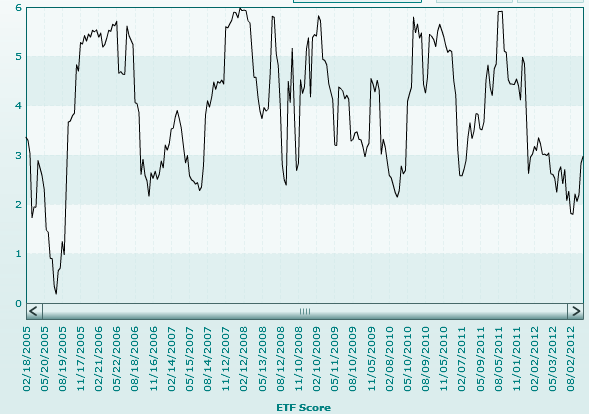
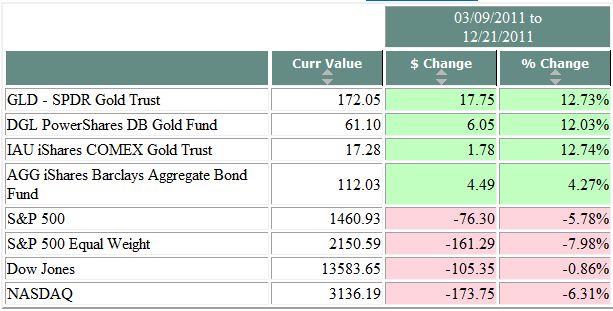
For example, on the Dorsey Wright database, the last extended run that gold had as a high relative strength asset class (ETF score > 3) was from 3/9/2011 to 12/21/2011. Below, I’ve got a picture of the ETF score chart, along with a performance snip during that same period. Perhaps because of investor concern about inflation—misplaced, as it turned out—gold outperformed fixed income over that stretch of time.

GLDetfscore Inflation Also Rises

ETF Score for GLD

GLDperformancesnip Inflation Also Rises

2011 Performance Snip

Source: Dorsey Wright (click on images to enlarge)

There’s no guarantee that gold will be an inflation hedge, of course. We never know what asset class will become strong when investors fear future inflation. Next time around it could be real estate, Swiss francs, TIPs, or energy stocks—or nothing. There are so many variables impacting performance that it is impractical (and impossible) to account for them all. However, relative strength has the simple virtue of pointing out—based on actual market performance—where the strength is appearing.

Investment history sometimes seems to be a never-ending cycle of discredited themes, but those themes can drive the market quite powerfully until they are discredited. (Remember the “new era” of the internet? Or how ”peak oil” was so compelling with crude at $140/barrel?) It’s helpful to know what those themes are, whether you are trying to take advantage of them or just trying to get out of the way.

Posted by:


Are 401k Investors Making a Mistake with Hybrid Funds?

September 26, 2012

I think this is an open question after reading some commentary by Bob Carey, the investment strategist for First Trust. He wrote, in his 9/11/2012 observations:

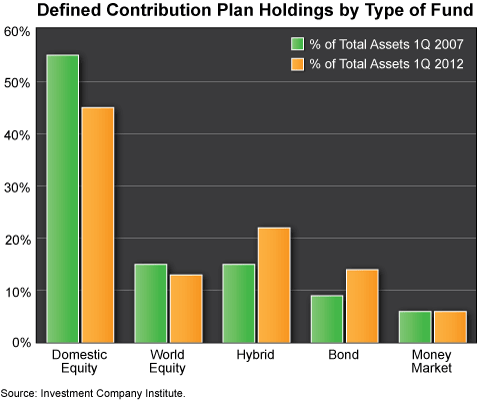
  • Hybrid funds, which tend to be comprised primarily of domestic and foreign stocks and bonds, but can extend into such areas as commodities and REITs, saw their share of the pie rise from 15% in Q1’07 to 22% in Q1’12.
  • One of the more popular hybrid funds for investors in recent years has been target-date funds. These funds adjust their asset mix to achieve a specific objective by a set date, such as the start of one’s retirement.
  • In 2010, target-date fund assets accounted for 12.5% of all holdings in employer-sponsored defined-contribution retirement accounts. They are expected to account for 48% by 2020, according to Kiplinger.
  • Plans are shifting away from the more traditional balanced funds to target-date funds for their qualified default investment alternative (QDIA).

There’s a nice graphic to go along with it to illustrate his point about the growing market share of hybrid funds.

hybrid Are 401k Investors Making a Mistake with Hybrid Funds?

Are 401k Investors Making a Mistake?

Source: First Trust, Investment Company Institute (click to enlarge)

He points out that 401k assets in hybrid funds are rising, but the growth area within the hybrid fund category has been target-date funds. It troubles me that many 401k plans are moving their QDIA option from balanced funds to target-date funds. QDIAs are designed to be capable of being an investor’s entire investment program, so the differences between them are significant.

There is a huge advantage that I think balanced funds have-much greater adaptability to a broader range of economic environments. Balanced funds, particularly those with some exposure to alternative assets, are pretty adaptable. The manager can move more toward fixed income in a deflationary environment and more toward equities (or alternative assets) in a strong economy or during a period of inflation.

Most target-date funds have a glide path that involves a heavier and heavier allocation to bonds as the investor ages. While this might be worthwhile in terms of reducing volatility, it could be ruinous in terms of inflation protection. Inflation is one of the worst possible environments for someone on a fixed income (i.e. someone living off the income from their retirement account). Owning bonds just because you are older and not because it is the right thing to do given the market environment seems like quite a leap of faith to me.

Asset allocation decisions, whether strategic or tactical, should be investment decisions.

Posted by:


The Inflation Mystery

September 17, 2012

Michael Sivy has a think piece on inflation in Time Magazine. His premise is that, based on what economists think they know about deficit spending, economic stimulus, and money creation, we should be having serious inflation. But so far that hasn’t happened.

The economy of the past three years has puzzled experts and policy makers in all sorts of ways, but the greatest mystery has been the recent decline in the rate of inflation. That may not seem remarkable in a stagnant economy, except that all the major economic theories suggest that prices should now be rising at a fast clip.

What’s most striking today is that all three of these factors are now at extremes that should be fanning the flames of inflation. Deficits of more than a trillion dollars a year are the highest in history. At close to zero, short-term interest rates are at their lowest level in more than 30 years. And the Fed’s monetary base has been expanding at an unprecedented rate. The remarkable thing is that none of this is translating into serious inflation. Over the past three years, some volatile prices, such as those for food and gasoline, have indeed gone up. But there still haven’t been sustained widespread price increases throughout the economy.

Mr. Sivy has a preferred explanation for this inflation mystery, and also suggests what may happen when things change.

The explanation is that all the money in the world won’t push up prices unless people are willing and able to spend it. So the dog that didn’t bark in this story is the money that didn’t get spent.

The current stagnation may simply have to run its course. But once it does and the economy really begins to rebound, it could well be accompanied by a surprisingly fast resurgence of inflation.

I think his viewpoint is worth considering. Inflation hasn’t been a problem so far, but that doesn’t mean it will never become a problem. Investors, many with bond-heavy portfolios, may be ill-equipped to deal with a bout of inflation. If inflation does occur, it may catch a lot of investors off guard, if only because they have seen declining inflation over their entire investing careers.

Relative strength might be a useful guide to solving the inflation mystery. If traditional inflation-sensitive assets like commodities or energy and basic materials stocks start to pick up significant relative strength versus other asset classes, it might be time to focus on portfolio protection.

Posted by:


Tactical Asset Allocation Using Relative Strength

September 14, 2012

As investors continue to seek adaptive approaches to investing, Tactical Asset Allocation has gained more and more attention. In this presentation, Tom Dorsey and John Lewis dig into our approach to Tactical Asset Allocation. We present our research on using relative strength to drive the allocation changes and we discuss the process employed to manage The Arrow DWA Balanced Fund (DWAFX) and The Arrow DWA Tactical Fund (DWTFX). Tactical Asset allocation is a topic that has been near and dear to our hearts at Dorsey Wright for a very long time and we have focused on creating what we believe are very valuable solutions for your clients.

TAAPresentation2091412 Tactical Asset Allocation Using Relative Strength

See www.arrowfunds.com to receive a prospectus.

Posted by:


Ray Dalio On Achieving Balance

September 12, 2012

Legendary hedge fund manager, Ray Dalio, explains why investors should allocate a portion of their money to “an all-weather portfolio.” Start at the 50 minute mark.

In every generation there is a ruinous asset class that will destroy wealth…

HT: Business Insider

Posted by:


Central Banks Are Busy These Days

September 8, 2012

The European Central Bank recently announced plans to bailout its bankrupt members by buying their short-term bonds with newly created money. There is wide expectation that Ben Bernanke will announce plans for further bond purchases at the Fed’s Sept. 12-13 meeting. Central banks are busy these days! Jeff Harding summarizes the calculation of central banks as follows:

Despite the overwhelming evidence that money printing doesn’t work, the Eurozone overlords will to do it anyway. Why do they do this? Monetary inflation is the last resort of governments who are over their heads in debt. Instead of going bankrupt (there is no way we or the overindebted Eurozone countries can repay the debt) they make the debt cheaper to pay off by inflating the money supply. It’s an age-old last resort of incompetent rulers.

As we pointed out in our 2011 blog post, “The Silence of the Lambs,” savers are taking a thumping at the hands of the Central Banks:

…today’s near-zero interest rates are no laughing matter for many American savers—not just my kids. They are my parents, my friend saving for a down payment on a home, and my retired neighbors down the street. You may be one of the many Americans trying to live off of your well-earned savings, whether those funds are in money market or checking accounts. In my mind, savers—as opposed to investors—are the proverbial “sacrificial lambs” of monetary policy.

The Federal Reserve has held its interest rate target between 0% and 0.25% since late 2008. Adjusted for inflation, the yield on 3-month Treasury bills is actually negative, as illustrated in the chart below. Quite frankly, yields on such savings vehicles are likely to remain that way for some time, with the Fed expected to keep its target rate near 0% at least for another year—and possibly longer.

Since December 2007, personal interest income has declined by close to $100 billion. The modest economic growth the nation has experienced since 2008 has come, to some extent, at the price of a negative real rate of return for savers. -Joe Davis,Vanguard

While savers may be getting hammered by these policies, it just might be a different story for investors. In fact, real estate and domestic equities are up sharply this year (and have made substantial gains since the March 2009 lows). Even European equities and commodities have shown some signs of life recently. Adhering to the adage, “Don’t Fight the Fed,” has surely paid off lately. Perhaps slow economic growth and psychological wounds from 2008 have been contributing factors to the weak risk appetite of many investors, but it’s important to remember that one of the primary reasons for exposing your portfolio to different asset classes is to preserve purchasing power. Inflation is exactly what the Central Banks are trying to achieve! Foreseeing all the effects of the policies of Central Banks is impossible. However, investors need to be cognizant of risks that these policies pose to their purchasing power. This is no time to sit on your hands (because the Central banks surely aren’t).

draghi bernanke gi blog Central Banks Are Busy These Days

Different men. Different continents. Same mission: More quantitative easing!

Source:CNN Money

Posted by:


Uncertainty and its Investment Implications

September 6, 2012

Uncertainty is usually problematic for investors. If the economy is clearly good or decidedly bad, it’s often easier to figure out what to do. I’d argue that investors typically overreact anyway, but they at least feel like they are justified in swinging for the fence or crawling into a bomb shelter. But when there is a lot of uncertainty and things are on the cusp—and could go either way—it’s tough to figure out what to do.

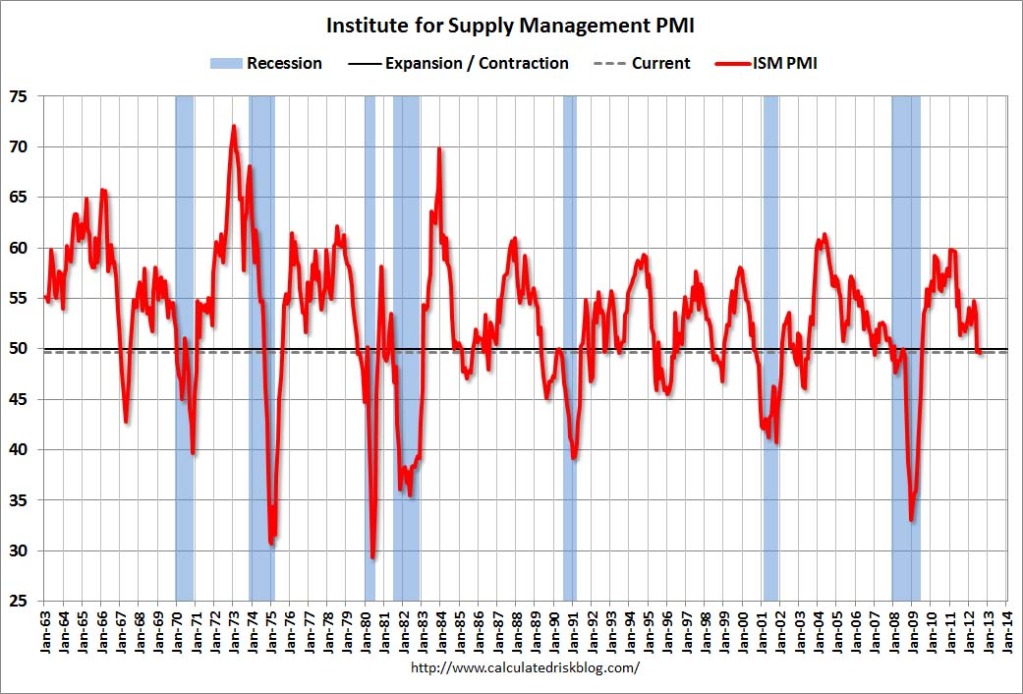
The chart below, from the wonderful Calculated Risk blog, demonstrates the point perfectly.

ISMAug2012 1 Uncertainty and its Investment Implications

Source: Calculated Risk (click to enlarge)

You can see the problem. The Purchasing Managers’ Index is hovering right near the line that separates an expanding economy from a contracting one. There’s no slam dunk either way—there are numerous cases of the PMI dropping below 50 that didn’t result in a recession, but also a number that did have a nasty outcome.

So what’s an investor to do?

One possibility is an all-weather fund that has the ability to adapt to a wide variety of environments. The old-school version of this is the traditional 60/40 balanced fund. The idea was that the stocks would behave well when the economy was good and that the bonds would provide an offset when the economy was bad. There are a lot of 60/40 funds still around, largely because they’ve actually done a pretty reasonable job for investors.

The new-school version is the global tactical asset allocation fund. The flexibility inherent in a tactical fund allows it to tilt toward stocks when the market is doing well, or to tilt toward bonds if equities are having a rough go. Many funds also have the potential to invest across alternative asset classes like real estate, commodities, or foreign currencies.

For a client that is wary of the stock market—and that might include most clients these days—a balanced fund or a global tactical asset allocation fund might be just the way to get them to dip their toe in the water. They are going to need exposure to growth assets over the long run anyway and a flexible fund might make that necessary exposure more palatable.

Click here to visit ArrowFunds.com for a prospectus & disclosures. Click here for disclosures from Dorsey Wright Money Management.

Posted by:


Life After Modern Portfolio Theory

August 31, 2012

Michael Kitces, partner and director of research, Pinnacle Advisory Group does an excellent job explaining the problems with Modern Portfolio Theory:

Why is this a problem? Well, it is a problem because this is the most widely used approach to asset allocation. I absolutely agree with his main point that “asset allocation has to become more dynamic.” However, I disagree that the solution is to find ways to improve your forecasting ability. It just isn’t going to happen. Tactical asset allocation driven by relative strength is not discussed in his video, but has been demonstrated to be an effective alternative to modern portfolio theory.

HT: Professional Planner

Posted by:


Modern Portfolio Theory Implodes: Mean Variance Optimization Bites the Dust

August 31, 2012

Andrew Ang of Columbia Business School has an important new paper out on SSRN. In it, he discusses mean variance optimization, the cornerstone of Modern Portfolio Theory. Unlike many other treatments in which portfolio construction through mean variance optimization is taken as gospel, Mr. Ang actually tests mean variance optimization against a wide variety of other diversification methods. This is the first article that I have seen that actually tries to put numbers to mean variance optimization. Here’s how he lays out his horserace:

I take four asset classes: U.S. government bonds (Barcap U.S. Treasury), U.S. corporate bonds (Barcap U.S. Credit), U.S. stocks (S&P 500), and international stocks (MSCI EAFE), and track performance of various portfolios from January 1978 to December 2011. The data are sampled monthly. The strategies implemented at time t are estimated using data over the past five years, t-60 to t. The first portfolios are formed at the end of January 1978 using data from January 1973 to January 1978. The portfolios are held for one month, and then new portfolios are formed at the end of the month. I use one-month T-bills as the risk-free rate. In constructing the portfolios, I restrict shorting down to -100% on each asset.

He tests a wide variety of diversification methods. As usual, simple is often better. Here’s his synopsis of the results:

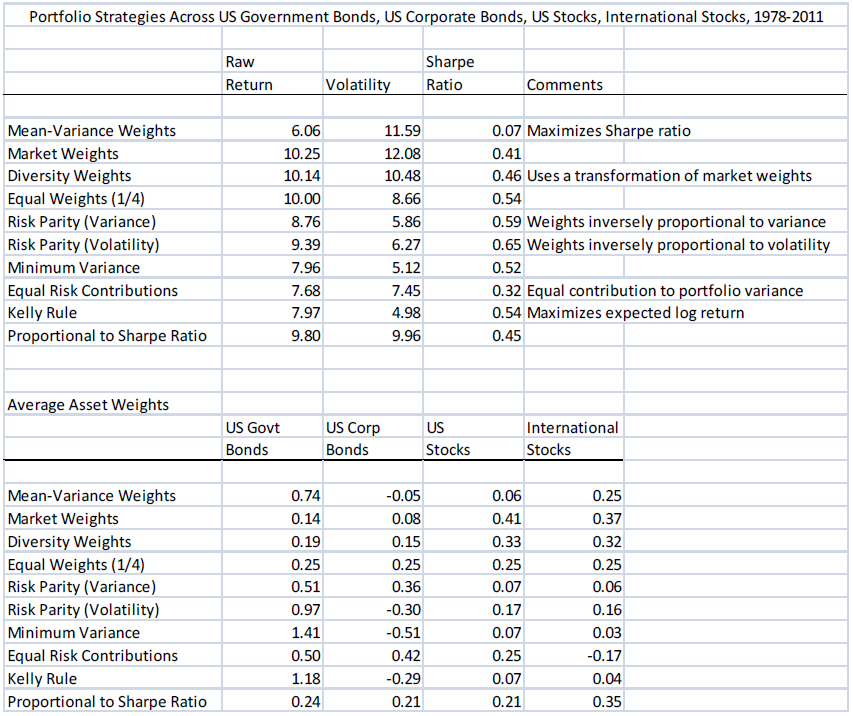
Table 14 reports the results of the horserace. Mean-variance weights perform horribly. The strategy produces a Sharpe ratio of just 0.07 and it is trounced by all the other strategies. Holding market weights does much better, with a Sharpe ratio of 0.41. This completely passive strategy outperforms the Equal Risk Contributions and the Proportional to Sharpe Ratio portfolios (with Sharpe ratios of 0.32 and 0.45, respectively). Diversity Weights tilt the portfolio towards the asset classes with smaller market caps, and this produces better results than market weights. The simple Equal Weight strategy does very well with a Sharpe ratio of 0.54. What a contrast with this strategy versus the complex mean-variance portfolio (with a Sharpe ratio of 0.07)! The Equal Weight strategy also outperforms the market portfolio (with a Sharpe ratio of 0.41). De Miguel, Garlappi and Uppal (2009) find that the simple 1/N rule outperforms a large number of other implementations of mean-variance portfolios, including portfolios constructed using robust Bayesian estimators, portfolio constraints, and optimal combinations of portfolios which I covered in Section 4.2. The 1/N portfolio also produces a higher Sharpe ratio than each individual asset class position.

That’s a lot to absorb. If we remove the academic flourishes, what he is saying is that mean variance optimization is dreadful and is easily outperformed by simply equal-weighting the asset classes. He references Table 14 of his paper, which I have reproduced below.

Table14 Modern Portfolio Theory Implodes: Mean Variance Optimization Bites the Dust

Table 14 Source: Andrew Ang/SSRN

(click to enlarge to full size)

(He points out later in the text that although risk parity approaches generate a slightly higher Sharpe ratio than equal weighting, it is mostly due to bonds performing so well over the 1978-2011 time period, a period of sharply declining interest rates. Like most observers of markets, he would be surprised to see interest rates decline dramatically from here, and thus thinks that the higher Sharpe ratios may be unsustainable. Mr. Ang also mentions in the article that using a five-year estimation period isn’t ideal, but that using 20-year or 50-year data is no better.)

I find it ironic that although mean variance optimization is designed to maximize the Sharpe ratio—to generate the most return for the least volatility—in real life it generates the worst results. As Yogi Berra said, in theory, theory and practice are the same. In practice, they aren’t!

Mr. Ang also asks and answers the question about why mean variance optimization does so poorly.

The optimal mean-variance portfolio is a complex function of estimated means, volatilities, and correlations of asset returns. There are many parameters to estimate. Optimized mean-variance portfolios can blow up when there are tiny errors in any of these inputs. In the horserace with four asset classes, there are just 14 parameters to estimate and even with such a low number mean-variance does badly. With 100 assets, there are 5,510 parameters to estimate. For 5,000 stocks (approximately the number listed in U.S. markets) the number of parameters to estimate is over 12,000. The potential for errors is enormous.

I put the fun part in bold. Tiny errors in estimating returns, volatilities, or correlations can cause huge problems. Attempting to estimate even 14 parameters ended in abject failure. We’ve written numerous pieces over the years about the futility of forecasting, yet this is exactly the process that Harry Markowitz, the father of Modern Portfolio Theory, would have you take!

Good luck with that.

To me, the implications are obvious. Diversification is always important, as it is a mathematical truism that combining any two assets that are not perfectly correlated will reduce volatility. But simple is almost always better. Mr. Ang draws the same conclusion. He writes:

Common to all these portfolio strategies is the fact that they are diversified. This is the message you should take from this chapter. Diversification works. Computing optimal portfolios using full mean-variance techniques is treacherous, but simple diversification strategies do very well.

The “simple is better” idea is not limited to asset class diversification. I think it also extends to diversification by investment strategy, like relative strength or value or low volatility. There’s an underlying logic to it—simple is better, because simple is more robust.

Some investors, it seems, are always chasing the holy grail or coming up with complicated theories that are designed to outperform the markets. In reality, you can probably dispense with all of the complex theory and use common sense. Staying the course with an intelligently diversified portfolio over the long term is probably the best way to reach your investing goals.

Posted by:


The Refrain of the Pessimists

August 29, 2012

Chuck Jaffe wrote a nice article for Marketwatch, pointing out that fund investors are actually more intelligent than they are given credit for. It’s worth pointing out because nearly every change in the industry is greeted with skepticism by the pessimists. His article ends with a nice summary:

“The knee-jerk reaction to almost all of the advances we have seen has been ‘Oh my goodness, what is going to happen to the industry?’ and ‘Investors will blow themselves up with this,’” said Geoff Bobroff of Bobroff Consulting, a leading fund industry observer. “Surprise, surprise, the world hasn’t come to an end yet and, in fact, the fund world has gotten better for each of these developments.

“Joe Six-Pack is going to do exactly what he has always done,” Bobroff added. “He is not going to change, just because the technology exists for him to do something different. He will adapt, and over time become comfortable with the newer products and newer ways. That doesn’t mean he will always make money; the market won’t always work for Joe Six-Pack, but that won’t be because the fund industry is evolving, it will be because that’s just what the way the market is sometimes.”

The article addresses the concern expressed by many that investors will blow themselves up with ETFs because of their daily liquidity. (John Bogle has expressed this view frequently and loudly.) Mr. Jaffe pulls out some data from a Vanguard (!) study that shows, in fact, that’s not how investors are acting.

Over the years, we’ve heard the same refrain about tactical asset allocation: investors will never be able to get it right, they’ll blow themselves up chasing performance, etc., etc. In fact, tactical allocation funds have acquitted themselves quite nicely over the past few years in a very difficult market environment. For the most part, they’ve behaved pretty much as advertised—better than the worst asset classes, and not as well as the best asset classes—somewhere in the middle of the pack. That kind of consistency, over time, can lead to reasonable returns with moderate volatility.

Reasonable returns with moderate volatility is a laudable goal, which probably explains why hybrid funds have seen new assets this year, even as equity funds are seeing outflows.

In markets, pessimism is almost never the way to go. It’s more productive to be optimistic and to try to find investment strategies that will work for you over the long run.

Posted by:


The Truth About the “Impending” Recession

August 15, 2012

Doug Short at Advisor Perspectives performs a very valuable public service. He presents very clear charts of major economic indicators without a lot of heavy interpretation and spin. Pundits who have forecast a recession—and therefore have a vested interest in a recession occurring—often pick and choose their indicators. There’s always some part of the economy that’s lagging, and with the right spin you can probably make it look like the sky is falling.

Here is Mr. Short’s brief comment:

Official recession calls are the responsibility of the NBER Business Cycle Dating Committee, which is understandably vague about the specific indicators on which they base their decisions. This committee statement is about as close as they get to identifying their method.

There is, however, a general understanding that there are four big indicators that the committee weighs heavily in their cycle identification process. They are:

  • Industrial Production
  • Real Income (excluding transfer payments)
  • Employment
  • Real Retail Sales

The weight of these four in the decision process is sufficient rationale for the St. Louis FRED repository to feature a chart four-pack of these indicators along with the statement that “the charts plot four main economic indicators tracked by the NBER dating committee.”

Bear in mind that the NBER dating committee identifies recessions after the fact. These are not leading indicators, but rather coincident indicators. Only after they have turned down solidly can the NBER agree that a recession has started.

So, what do the indicators actually look like? There are more charts in Mr. Short’s indicator update, but this chart summarizes it nicely.

BigFour The Truth About the Impending Recession

Are these indicators going up or down?

Source: Advisor Perspectives/Doug Short (click to enlarge)

I highly recommend reading the entire article, but even a cursory inspection of this chart shows no current evidence of a recession. The stock market is one of the leading indicators in the LEI also, and it is near the high for the year. Our global tactical allocation accounts hold a lot of domestic equity because that’s where the strength has been. (Despite, or maybe because of, investors’ reluctance to own stocks, the market is having a decent year so far.) Instead of freaking out about an impending recession, maybe you could just look at the primary source data.

It’s not impossible that a recession is on the way, of course, but you’d have to present data that the NBER is not using. Anything can happen, but it’s pretty tough to make the recession argument from the data in this chart.

Posted by:


The Dilemma for Bond Investors

July 31, 2012

A recent Vanguard commentary has a very good description of the confusion facing bond investors right now—and judging from the recent heavy flows into bond funds, that’s a lot of investors.

These days, the airwaves seem filled with market commentators offering one of three popular suggestions for bond investors. All three groups urge investors to alter their investment strategy in this low-rate environment.

The first group suggests bond investors take on more interest-rate risk in an effort to earn more income today, say, by moving your assets from a short-maturity bond fund to a longer-maturity bond fund. The second group suggests investors do the exact opposite and reduce interest rate risk, say, by moving assets out of one’s bond portfolio into a savings vehicle in an attempt to sidestep a future rise in interest rates. Obviously, both groups of investors are trading with each other. Which group “wins” will ultimately depend on the future path of interest rates (more on this in a moment).

Like the first group, a third group of market commentators suggests taking on more risk, but of a different sort. They point to the U.S. investment experience of the late 1940s and early 1950s—the last time U.S. interest rates were this low—as a rationale for moving strategically out of low-yielding conservative bond portfolios and into traditionally more-volatile assets, namely stock funds.

I think that is a pretty good encapsulation of what bond investors are hearing right now. And, exactly as Vanguard points out, the “right” answer if you go with a forecast will only be determined in hindsight. You could have a pretty horrific experience in the meantime if you guess wrong. Their article points out, correctly I think, that although some of these outcomes may be more probable than others, there’s no way to know what will happen. The endgame could be anything from Japan to hyper-inflation. There are just too many variables in play.

If you are a strategic asset allocator, Vanguard suggests broad diversification. I am a little surprised by this, as they make a salient point about bonds.

We as investors first need to recalibrate our expectations for future bond returns. Unfortunately, the most direct implication of this low-rate environment is that bond portfolio returns are likely to be fairly puny going forward. As I wrote in March (“Why I still own Treasuries“), arguably the single best predictor of the future return on a bond portfolio is its current yield to maturity, or coupon.

I would think that a strategic asset allocator would severely underweight bonds if future forecasted bond returns are going to be small. (At least that’s what Harry Markowitz says to do.)

Another path through this minefield is tactical asset allocation. Hold the asset classes that are strong and avoid the rest. If bonds are strong because rates continue to fall, because Treasurys continue to be a safe haven, or because the US enters a low-growth Japan-like environment, then they will be welcome in a portfolio. If bonds are weak because rates start to rise or because the US begins to flirt with solvency concerns at some point, then many other asset classes are likely to perform better.

In the end, tactical asset allocation might be safer. Bond returns may be low, but they might end up being higher than the returns from some alternatives. Or bonds could turn out to be an unmitigated disaster. Tactical asset allocation driven by relative strength frees you from the need to forecast. Bonds will be in your portfolio—or not—depending only upon their performance.

Bond Investors Have a Dilemma

Source: buzzle.com

Posted by:


Even Balanced Portfolios Correlate Strongly to Stocks

July 30, 2012

Those investors looking to build a portfolio with low correlation to the stock market are going to have to do more than just add bonds. BlackRock points out that the correlation of a 60/40 balanced portfolio and a 100% equity portfolio has been 0.99 over the past 15 years!

It is important for investors to understand the sources of risks in their portfolios. Take the traditional 60/40 portfolio as an example. Even though 40% of this portfolio is invested in bonds, almost all of the risk in the portfolio is equity risk. This chart shows that over the last 15 years, the correlation of returns between a 60/40 portfolio and a 100% equity portfolio was 0.99, meaning that they were almost perfectly correlated. Even a portfolio that is exceptionally overweight bonds shows a similar trend. A 30% stock/70% bond portfolio had a 0.82 correlation to a 100% stock portfolio. To us, that says that a long-only stock and bond portfolio isn’t full diversification.

However, when you also add commodities, currencies, and real estate into the portfolio it is a different story. Click here to learn how we incorporate a broad range of asset classes into our Global Macro portfolio (financial advisors only).

To receive the brochure for our Global Macro strategy, click here. For information about the Arrow DWA Tactical Fund (DWTFX), click here.

Click here and here for disclosures. Past performance is no guarantee of future returns.

Posted by:


Dow 20,000

July 23, 2012

Seth J. Masters, Chief Investment Officer of Bernstein Global Wealth Management says the odds of the Dow hitting 20,000 by the end of the decade are excellent:

Over 10-year periods since 1900, stocks have outperformed bonds 75 percent of the time, according to Bernstein’s calculations. But today, bond prices are relatively high — their yields, which move in the opposite direction, are extraordinarily low — and stock prices are relatively low. So the firm sees the chance of stocks beating bonds over the next 10 years at 88 percent.

Stocks have been cruel and it is hard to love them now. Still, Mr. Masters writes, “We think that 10 years from now, investors will wish they had stayed in stocks — or added to them.”

The damage done to investor psychology over the past decade is going to stay with investors for a long time, maybe even a generation. The fact that the S&P 500 has had an annualized return of 16.38% over the past three years ending 6/30 has not kept investors from scrambling to get out of equities and piling into fixed income (The Barclays Aggregate Bond Index has only had an annualized return of 6.94% over the past three years, ending 6/30).

Being optimistic about stocks is uncommon to say the least right now. Kind of like being pessimistic about stocks in 1999 was uncommon. It could be a big mistake to swear off stocks for the next 5-10 years. Understandably, investors feel an enormous amount of trepidation if they are made to feel that it is an either/or decision. Enter tactical asset allocation strategies that have the ability to increase or decrease exposure to multiple asset classes, including equities and fixed income. Having a framework for dispassionately allocating to strong asset classes, which is the goal of relative strength-driven tactical asset allocation strategies, can be an effective way to deal with the challenge of emotional asset allocation. Clients are open to tactical asset allocation because it speaks to both their hearts and their minds.

HT: Real Clear Markets

Posted by:


Q3 Technical Leaders Allocations

July 11, 2012

Each quarter the PowerShares DWA Technical Leaders Indexes are rebalanced; the stocks with strong relative strength stay in the index and those that have deteriorated are replaced. The tables below show where we are overweight and underweight compared to their benchmarks this quarter.

Source: Dorsey Wright, MSCI, Standard & Poor’s

Performance of the technical leaders indexes has generally been favorable so far this year:

See www.powershares.com for more information. A list of all holdings for the trailing 12 months is available upon request.

Posted by: