The Pragmatist’s Approach to Investing

September 27, 2012

Adam Davidson’s article “Hey, Big Saver!” in the New York Times is an excellent summary of the competing arguments on the merits of QE3. There truly are compelling arguments for why this will work and there are compelling arguments why it won’t. Effectiveness aside, Bernanke has made his intentions perfectly clear:

When Bernanke announced that the Fed would be investing in the mortgage market indefinitely, he signaled that he’s had it with short-term fixes. His Fed is committed, he said, to taking extraordinary measures until unemployment goes down. In Fed-speak, Q.E. 3 is a clear message to banks, investors and private companies that the economy is going to grow, and the riskiest thing they can do is to hold on to their cash and riskless securities and watch their competitors profit.

Are his policies working or not? This is why I love technical analysis. Rather than get caught up in theoretic debates, technical analysis cuts to the chase and asks a different question: What stocks, sectors, and asset classes have the best relative strength? Based on that information, relative strength investors can orient their portfolio to capitalize on those trends.

Investors are not interested in winning theoretical debates. Investors are interested in making money! Rather than focusing on what the Fed, Congress, the President, the ECB, banks, consumers, economists, investment strategists, your brother-in-law… have to say about what is going to happen in the market, take the pragmatist’s approach and let relative strength dictate your investment decisions.

pragmatic The Pragmatists Approach to Investing

Source: CBS News

HT: Real Clear Markets

Posted by:


Danger: Pundits Ahead

September 27, 2012

The danger of listening to the forecasts of pundits is obvious. For one thing, pundits are just as likely to get it wrong as anyone else. The Big Picture carried a list of bullish forecasts from the beginning of the internet bubble that is illustrative. (The original source was apparently Paul Farrell at Marketwatch.)

March 1999: Harry S. Dent, author of “The Roaring 2000s.” “There has been a paradigm shift.” The New Economy arrived, this time really is different.

October 1999: James Glassman, author, “Dow 36,000.” “What is dangerous is for Americans not to be in the market. We’re going to reach a point where stocks are correctly priced … it’s not a bubble … The stock market is undervalued.”

August 1999: Charles Kadlec, author, “Dow 100,000.” “The DJIA will reach 100,000 in 2020 after “two decades of above-average economic growth with price stability.”

December 1999: Joseph Battipaglia, market analyst. “Some fear a burst Internet bubble, but our analysis shows that Internet companies … carry expected long-term growth rates twice other rapidly growing segments within tech.”

December 1999: Larry Wachtel, Prudential. “Most of these stocks are reasonably priced. There’s no reason for them to correct violently in the year 2000.” Nasdaq lost over 50%.

December 1999: Ralph Acampora, Prudential Securities. “I’m not saying this is a straight line up. … I’m saying any kind of declines, buy them!”

February 2000: Larry Kudlow, CNBC host. “This correction will run its course until the middle of the year. Then things will pick up again, because not even Greenspan can stop the Internet economy.” He’s still hosting his own cable show.

April 2000: Myron Kandel, CNN. “The bottom line is in, before the end of the year, the Nasdaq and Dow will be at new record highs.”

September 2000: Jim Cramer, host of “Mad Money.” Sun Microsystems “has the best near-term outlook of any company I know.” It fell from $60 to below $3 in two years.

November 2000: Louis Rukeyser on CNN. “Over the next year or two the market will be higher, and I know over the next five to 10 years it will be higher.”

December 2000: Jeffrey Applegate, Lehman strategist. “The bulk of the correction is behind us, so now is the time to be offensive, not defensive.” Another sucker’s rally.

December 2000: Alan Greenspan. “The three- to five-year earnings projections of more than a thousand analysts … have generally held firm. Such expectations, should they persist, bode well for continued capital deepening and sustained growth.”

January 2001: Suze Orman, financial guru. “The QQQ, they’re a buy. They may go down, but if you dollar-cost average, where you put money every single month into them, I think, in the long run, it’s the way to play the Nasdaq.” The QQQ fell 60% further.

March 2001: Maria Bartiromo, CNBC anchor. “The individual out there is actually not throwing money at things that they do not understand, and is actually using the news and using the information out there to make smart decisions.”

April 2001: Abby Joseph Cohen, Goldman Sachs. “The time to be nervous was a year ago. The S&P was overvalued, it’s now undervalued.” Markets fell 18 more months.

August 2001: Lou Dobbs, CNN. “Let me make it very clear. I’m a bull, on the market, on the economy. And let me repeat, I am a bull.”

June 2002: Larry Kudlow, CNBC host. “The shock therapy of a decisive war will elevate the stock market by a couple thousand points.” He also predicted the Dow would hit 35,000 by 2010.

Note: The Dow didn’t bottom until October 2002 at 7,286, down from 11,722.

These examples are particularly egregious because they happened at a market turning point, but the danger from listening to pundits is continuous. You can always find pundits spouting their opinions on CNBC or other media. To the extent that they influence you into not executing your thoughtful, systematic investment plan, pundits are a problem.

Posted by:


Target-Date Fund-mageddon

September 26, 2012

Markets are rarely tractable, which is one reason why significant flexibility is required over an investment lifespan. Flexibility is something that target-date funds don’t have much of. In fact, target-date funds have a glidepath toward a fixed allocation at a specified time. I’ve written about the problems with target-date funds extensively—and why I think balanced funds are a much better QDIA (Qualified Default Investment Alternative). It appears that my concerns were justified, now that Rob Arnott at Research Affiliates has put some numbers to it. According to an article in Smart Money on target-date funds:

A target-date fund is a one-decision mutual fund that you can invest in over the course of your entire career.

Each fund is designed for those aiming to retire at a certain date. The fund starts with a lot of “risky” stocks, and over time it moves to “safer” bonds. The fundamental idea is that at any given moment between age 21 and age 65 you should be invested in a particular balance of assets — more stocks when you are younger, and more bonds when you are older.

The track to retirement, according to the industry jargon, is a “glidepath.”

Billions of dollars are invested in these target-date funds. They are today the default investment option in many 401(k) plans. Now comes Rob Arnott, the chairman of Research Affiliates and one of the handful of serious money managers in the country. In a new research paper he published yesterday, “The Glidepath Illusion,” he has blown this idea full of holes. “Shockingly,” he says, “the basic premise upon which these billions [of dollars] are invested is flawed.”

When Mr. Arnott investigated the results of such target-date funds, he found them to be incredibly variable—and possibly upside-down. (I put the fun part in bold.)

Arnott has mined data from the stock and bond markets going back to 1871 and then run simulations to see how these target-date portfolios would have worked in practice. He considered a fund that started out with 80% stocks and 20% bonds, and then adjusted gradually over an investing life of 41 years so that it ended up 80% bonds and 20% stocks. He considered an investor who invested $1,000 a year, adjusted for inflation, from the day she started work at age 22 to when she retired at 63.

Bottom line? This investor could have done very well — or very badly. Far from enjoying a smooth “glidepath” to a secure retirement, she could have retired with as little as $50,000 in savings or as much as $211,000. She could have ended up with a retirement annuity of $2,400 a year — or $13,100 a year. There was no way of knowing in advance.

That wasn’t all. Arnott found that in most eras, investors would have actually been better off if they had stood this target-date strategy on its head — in other words, if they had started out with 80% bonds, and then took on more risk as they got older, so that they ended up with 80% stocks.

No kidding. Really.

The median person following the target date strategy ended up with $120,000 in savings. The median person who did the opposite, Arnott’s team found, ended up with $148,000. The minimum outcome from doing the opposite was better. The maximum outcome of doing the opposite was also better.

Amazing. Even the minimum outcome from going opposite the glidepath was better! Using even a static 50/50 balanced fund was also better. Perhaps this will dissuade a client or two from piling into bonds only because they are older. No doubt path dependence had something to do with the way returns laid out, but it’s clear that age-based asset allocation is a cropper.

Asset allocation, diversification, and strategy selection are important. Decision of this magnitude need to be made consciously, not put on autopilot.

[You can read Mr. Arnott's full article here. Given that most 401k investors are unfortunately using target-date funds instead of balanced funds, this is a must read. I would modestly suggest the Arrow DWA Balanced Fund as a possible alternative!]

Click here to visit ArrowFunds.com for a prospectus & disclosures. Click here for disclosures from Dorsey Wright Money Management.

Posted by:


Are 401k Investors Making a Mistake with Hybrid Funds?

September 26, 2012

I think this is an open question after reading some commentary by Bob Carey, the investment strategist for First Trust. He wrote, in his 9/11/2012 observations:

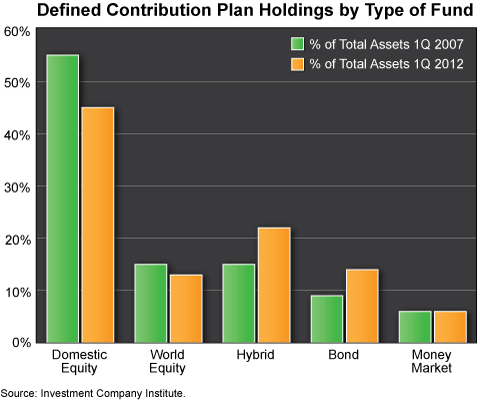
  • Hybrid funds, which tend to be comprised primarily of domestic and foreign stocks and bonds, but can extend into such areas as commodities and REITs, saw their share of the pie rise from 15% in Q1’07 to 22% in Q1’12.
  • One of the more popular hybrid funds for investors in recent years has been target-date funds. These funds adjust their asset mix to achieve a specific objective by a set date, such as the start of one’s retirement.
  • In 2010, target-date fund assets accounted for 12.5% of all holdings in employer-sponsored defined-contribution retirement accounts. They are expected to account for 48% by 2020, according to Kiplinger.
  • Plans are shifting away from the more traditional balanced funds to target-date funds for their qualified default investment alternative (QDIA).

There’s a nice graphic to go along with it to illustrate his point about the growing market share of hybrid funds.

hybrid Are 401k Investors Making a Mistake with Hybrid Funds?

Are 401k Investors Making a Mistake?

Source: First Trust, Investment Company Institute (click to enlarge)

He points out that 401k assets in hybrid funds are rising, but the growth area within the hybrid fund category has been target-date funds. It troubles me that many 401k plans are moving their QDIA option from balanced funds to target-date funds. QDIAs are designed to be capable of being an investor’s entire investment program, so the differences between them are significant.

There is a huge advantage that I think balanced funds have-much greater adaptability to a broader range of economic environments. Balanced funds, particularly those with some exposure to alternative assets, are pretty adaptable. The manager can move more toward fixed income in a deflationary environment and more toward equities (or alternative assets) in a strong economy or during a period of inflation.

Most target-date funds have a glide path that involves a heavier and heavier allocation to bonds as the investor ages. While this might be worthwhile in terms of reducing volatility, it could be ruinous in terms of inflation protection. Inflation is one of the worst possible environments for someone on a fixed income (i.e. someone living off the income from their retirement account). Owning bonds just because you are older and not because it is the right thing to do given the market environment seems like quite a leap of faith to me.

Asset allocation decisions, whether strategic or tactical, should be investment decisions.

Posted by:


What Scares Investors To Death

September 21, 2012

Suzanne McGee, The Fiscal Times, highlights investor’s dilemma:

Right now, there appear to be few “good” options available. As Nixon points out, the devil’s dilemma is that investors are being forced to choose between ensuring the return of their capital and having a return on their capital. Risk aversion today is completely rational – but that doesn’t matter when you’re trying to fight the Fed. Just because you are capitulating doesn’t mean that you are completely powerless; you may have to put your portfolio into risk assets to preserve its purchasing power, but it’s up to you to select which risk assets will pay off.

The part that I put in bold is what scares investors to death—the part about having to choose which assets to invest in. The fear of being wrong paralyzes investors. A wide range of compelling arguments are made constantly about the issues of the day. It can become very easy to feel completely confused about where to invest…unless you have a plan. Relative strength provides a logical framework for allocating assets in a global portfolio. It cuts out all of the conjecture and just systematically reacts to the market with the goal of capitalizing on market trends. Reliance on a logical game plan is essential in order to successfully navigate the global financial markets.

Here is how different investments have done over the past 12 months, 6 months, and month.

1PowerShares DB Gold, 2iShares MSCI Emerging Markets ETF, 3iShares DJ U.S. Real Estate Index, 4iShares S&P Europe 350 Index, 5Green Haven Continuous Commodity Index, 6iBoxx High Yield Corporate Bond Fund, 7JP Morgan Emerging Markets Bond Fund, 8PowerShares DB US Dollar Index, 9iBoxx Investment Grade Corporate Bond Fund, 10PowerShares DB Oil, 11iShares Barclays 20+ Year Treasury Bond

HT: Real Clear Markets

Posted by:


Stock Market Perception vs. Reality

September 21, 2012

It’s no secret that investors have had a fairly negative outlook toward the stock market lately. Their negative perception shows up both in flow of funds data and in our own advisor survey of investor sentiment.

One possible—and shocking—reason for the negative sentiment may be that the public thinks the stock market has been going down!

Investment News profiled recent research done by Franklin Templeton Funds. Here is the appropriate clip, which is just stunning to me:

One surprising finding shows that investors are likely so consumed by the negative economic news, including high unemployment and the weak housing market, that they haven’t even noticed the strength of the stock market.

For example, when 1,000 investors were asked whether they thought the S&P was up or down during each of the past three years, 66% thought it was down in 2009, 48% thought it was down in 2010, and 53% thought it was down last year.

In fact, the S&P gained 26.5% in 2009, 15.1% in 2010, and 2.1% last year.

That blows me away. I have never seen a clearer case of the distinction between perception and reality. This data shows clearly that many investors act on their perceptions—that the market has been declining for years—not the reality, which has been a choppy but steadily rising market.

The stock market is ahead again year-to-date and money is continuing to flow out of equity mutual funds. I understand that the market is scary sometimes and difficult always, but really? It amazes me that so many investors think the stock market has been dropping when it has actually been going up. Of course, perhaps investors’ aggregate investment decisions are more understandable when it becomes clear that only a minority of them are in touch with reality!

Advisors obviously have a lot of work to do with anxious clients. The stock market historically has been one of the best growth vehicles for investors, but it won’t do them any good if they choose to stay away. Some of the investor anxiety might be lessened if advisors stick with a systematic investment process using relative strength—and least that way, the client is assured that money will only be moved toward the strongest assets. If stocks really do have a long bear market, as is the current perception, clients may be somewhat shielded from it.

Posted by:


Why Is Trading So Hard?

September 20, 2012

Indeed, why is trading so hard? Adam Grimes of Waverly Advisors addresses exactly this issue in blog post. This is one of the most articulate expositions of the problems investors face with their own behavior that I have ever read.

What is it about markets that encourages people to do exactly the wrong thing at the wrong time, and why do many of the behaviors that serve us so well in other situations actually work against us in the market?

Part of the answer lies in the nature of the market itself. What we call “the market” is actually the end result of the interactions of thousands of traders across the gamut of size, holding period, and intent. Each trader is constantly trying to gain an advantage over the others; market behavior is the sum of all of this activity, reflecting both the rational analysis and the psychological reactions of all participants. This creates an environment that has basically evolved to encourage individual traders to make mistakes. That is an important point—the market is essentially designed to cause traders to do the wrong thing at the wrong time. The market turns our cognitive tools and psychological quirks against us, making us our own enemy in the marketplace. It is not so much that the market is against us; it is that the market sets us against ourselves.

I added the bold. This is just great writing, and powerful because it is true. Really competent people who are fantastic about making life decisions often have a rough time trading in the market, for just the reason Mr. Grimes’ points out.

He comes to the same solution that we have come to: a systematic investment process that can be implemented rigorously. There’s no shortage of robust return factors that offer potential outperformance—the trick is always implementing them in a disciplined way.

Posted by:


The Problem With Fundamental Data

September 18, 2012

A pointed rant from The Zikomo Letter on the value of fundamental data:

All fundamental data is wrong in some way. Some of it is incorrect, some of it is published by people with a vested interest, and some of it is lies. I am not angry about it, but I think we should face the sometimes harsh reality provided by the Red Pill.

Let us start with company-provided information. If the history of public corporations tells you anything, it is that anything a corporation tells you should be treated as a lie. Sometimes it is deliberately misleading, sometimes it obscures the truth, and sometimes it just lies to your face. If you do not believe me, then I point you to some of those who were caught: Enron and Lehman Bros stick in the mind, but the list is long.

Do not kid yourself that these are the rogues in an otherwise healthy bunch: every public corporation twists and tortures their information to meet their objectives. In a previous life I was a company auditor, and I can attest that there is plenty of scope for maneuver within the law.

Technicians have long looked at fundamental data with healthy suspicion. To be clear, I am not saying that fundamental data is useless. I am sure some are able to use it to their benefit. However, the risk of the “garbage in garbage out” problem with fundamental data is high. One of the great things about relative strength is that it largely avoids this problem by simply reacting to what is happening in the market as opposed to what we are being told is happening.

HT: Abnormal Returns

Posted by:


The Inflation Mystery

September 17, 2012

Michael Sivy has a think piece on inflation in Time Magazine. His premise is that, based on what economists think they know about deficit spending, economic stimulus, and money creation, we should be having serious inflation. But so far that hasn’t happened.

The economy of the past three years has puzzled experts and policy makers in all sorts of ways, but the greatest mystery has been the recent decline in the rate of inflation. That may not seem remarkable in a stagnant economy, except that all the major economic theories suggest that prices should now be rising at a fast clip.

What’s most striking today is that all three of these factors are now at extremes that should be fanning the flames of inflation. Deficits of more than a trillion dollars a year are the highest in history. At close to zero, short-term interest rates are at their lowest level in more than 30 years. And the Fed’s monetary base has been expanding at an unprecedented rate. The remarkable thing is that none of this is translating into serious inflation. Over the past three years, some volatile prices, such as those for food and gasoline, have indeed gone up. But there still haven’t been sustained widespread price increases throughout the economy.

Mr. Sivy has a preferred explanation for this inflation mystery, and also suggests what may happen when things change.

The explanation is that all the money in the world won’t push up prices unless people are willing and able to spend it. So the dog that didn’t bark in this story is the money that didn’t get spent.

The current stagnation may simply have to run its course. But once it does and the economy really begins to rebound, it could well be accompanied by a surprisingly fast resurgence of inflation.

I think his viewpoint is worth considering. Inflation hasn’t been a problem so far, but that doesn’t mean it will never become a problem. Investors, many with bond-heavy portfolios, may be ill-equipped to deal with a bout of inflation. If inflation does occur, it may catch a lot of investors off guard, if only because they have seen declining inflation over their entire investing careers.

Relative strength might be a useful guide to solving the inflation mystery. If traditional inflation-sensitive assets like commodities or energy and basic materials stocks start to pick up significant relative strength versus other asset classes, it might be time to focus on portfolio protection.

Posted by:


Retirement Income Failure Rates

September 13, 2012

Retirement income is the new buzzword. New sales initiatives are being planned by seemingly every fund company on the planet, and there’s no end in sight. Every week sees the launch of some new income product. There are two, probably inter-related, reasons for this. One is the buyers right now are generally leery of equities. That will probably be temporary. If the stock market gets going again, risk appetites could change in a hurry. The second reason is that the front-end of the post-WWII baby boom is hitting retirement age. The desire for retirement income in that demographic cohort probably won’t be temporary. The trailing edge of the baby boom will likely keep demand for retirement income high until at least 2030.

Much retirement income planning is done with the trusty 4% withdrawal rule. Often, however, investors don’t understand how many assumptions go into the idea that a portfolio can support a 4% withdrawal rate. The AdvisorOne article Retirement in a Yield-Free World makes some of those assumptions more explicit. The 4% rule is based on historical bond yields and historical equity returns—but when you look at the current situation, the yield is no longer there. In fact, many bonds currently have negative real yields. Stock market yields are also fairly low by historical standards, leading to lower expected future returns. Here’s what the author, professor Michael Finke, had to say:

Estimating withdrawal rate strategies without real yield is a gruesome task. So I asked my good friend, occasional co-author and withdrawal rate guru Wade Pfau, associate professor at the National Graduate Institute for Policy Studies, to calculate how zero real returns would impact traditional safe withdrawal rates.

When real rates of return on bonds are reduced to zero, Pfau estimates that the failure rate of a 4% withdrawal strategy increases the 30-year failure rate to 15%, or just over one out of every seven retirees. This near tripling of retirement default risk is disturbing, but it is not technically accurate because we also assume historical real equity returns.

If we use a more accurate set of equity returns with a market-correct risk-free rate of return, the results are even more alarming. The failure rate of a 4% strategy with zero bond yield and a zero risk-free rate on equities is 34% over a 30-year time horizon. If real bond rates of return do not increase during a new retiree’s lifetime, they will have a greater than one in three chance of running out of money in 30 years.

The bottom line is that low expected returns may not support a 4% withdrawal rate as easily as occurred in the past. (There may be a couple of more efficient ways to withdraw retirement income than the 4% rule, but the basic problem will remain.)

The practical implication of lower expected returns for future retirees is that they will have to save more and invest better to reach their goals. Retirement income will not be so easy to come by, and behavioral errors by investors will have a greater impact than ever before.

We may not like what Bill Gross calls the “new normal,” but we’ve got to deal with it. What can clients and advisors do proactively to ensure the best shot at a good retirement income stream?

  • encourage savings. Maybe boost that 401k contribution a few percentage points and hector the client for regular investment contributions.
  • diversify by asset class, investment strategy, and volatility. Don’t put all your eggs in one basket. It may become important to pursue returns wherever they are, not just in stocks and bonds. Diversifying your equity return factors may not be a bad idea. We love relative strength, but value and low volatility mix well. And it’s probably not a good idea to put all of your assets into cash or highly volatile categories.
  • get help. There’s a wealth of evidence that good advisors can make a big difference in client outcomes. A steady advisor may also reduce the chance of bad investor behavior, which can be one of the biggest barriers to good long-term returns.

Investing, even in good times, is not an easy endeavor. With low or non-existent real yields, it may be even tougher for a while.

Posted by:


Advisors Turning to ETFs

September 12, 2012

Most professionals have noticed the move to ETFs happening, but a recent article at AdvisorOne makes the magnitude of the shift more clear:

Since the beginning of 2012, investors have pulled almost $15 billion from U.S. stock funds, while boosting money put into ETFs by $16 billion, according to industry studies.

In the latest AdvisorBenchmarking report, for example, 54% of advisors say they are likely to increase their use of the ETFs in the near future, with 43% saying they expect their use of ETFs over the next three years to remain the same.

What is the strategic role of ETFs in portfolios? According to the survey, many strategies lie behind ETF implementation. While “core” and “sector” exposures were most common, several other approaches were all within a few points of each other, including: alternatives exposure, directional market positions, factor or asset class exposures and country/region exposure. Clearly, ETFs are providing advisors and investors with attractive options for expressing their views, and that is translating into strong, consistent growth for these vehicles.

AdvisorBenchmarking provided a nice graphic on the strategic uses of ETFs. It’s clear that ETFs are multipurpose vehicles because advisors are using them to meet a lot of different objectives!

Source: AdvisorBenchmarking/AdvisorOne (click on image to enlarge)

According to their survey, only 8% of ETF use is coming from directional market positions—far less than imagined by people who criticize ETF investors as reckless market timers. For the most part, advisors are using ETFs to get exposures that were unavailable before, whether it is to a specific sector, country, or asset class.

Most of the ETFs now available offer passive exposures to various indexes. More interesting to me are the small number of semi-active ETFs that are designed to provide factor exposure in an attempt to generate alpha. Research suggests that combining factor exposures might be a superior way to capture market returns.

The Technical Leaders indexes are constructed to provide exposure to the momentum (relative strength) factor and there are a couple of low-volatility ETFs around as well. There are a few ETFs explicitly designed for value exposure, although I don’t think this area has been well-exploited yet. (I’m sorry to see Russell close down their suite of ETFs, which I thought had a lot of promise.)

With more and more options available to advisors, I would not be surprised to see ETF use continue to surge.

Posted by:


Wealth Drivers in 401k Accounts

September 10, 2012

Putnam Investments recently completed a study in which they examined the wealth drivers in 401k plans for individuals. (I first saw the discussion of their study in this article at AdvisorOne. The full Putnam study is here.) What they did was very clever: they built a base case, and then made various modifications to see what changes had the most impact in driving wealth. Here was their base case:

They assumed that a 28-year-old in 1982 earned $25,000 per year with a 3% cost-of-living increase. The worker contributes 3% of gross salary to a 401(k) plan that receives a 50-cent match on the dollar up to 6% and has a conservative asset allocation across six asset classes. The hypothetical 401(k) also invests in funds in the bottom 25% of their Lipper peer group. By the time the worker turns 57 in 2011, income is $57,198, and the 401(k) balance is $136,400.

Then Putnam examined three sets of wealth drivers to see how they impacted the base case:

  1. They changed the 4th quartile mutual funds to 1st quartile funds, but kicked out funds after three years if they fell out of the 1st quartile.
  2. They looked at the effect of adding more equities to the mix, so they boosted stocks from 30% of the account to 60% and to 85%.
  3. They looked at quarterly rebalancing of the account.

The results were pretty interesting. Picking “better” funds, in concert with the replacement strategy, was actually $10,000 worse than the base case! The portfolios with more equities had their balances boosted by $14,000 and $23,000 respectively—but, of course, they were also more volatile. Rebalancing added $2,000 to the base portfolio balance, but slightly reduced the volatility as well.

All of these strategies—fund selection, asset allocation, and rebalancing—are commonly offered as value propositions to 401k investors, yet none of them really moved the needle much. (Even a “crystal ball” strategy that predicted which funds would become 1st quartile funds only helped balances by about $30,000.)

Then Putnam explored three variations of a mystery strategy. The first version improved the final balance by $45,000; the second version boosted the balance by an additional $136,000; and the third version blew away everything else by adding another $198,000 to the $136,000 base case, for a final balance of $334,000!

What was this amazing mystery strategy? Saving more!

The three variations simply involved moving the 401k deferral rate up from 3% to 4%, 6%, and 8%. That’s it.

The mathematics of compounding over time are very powerful. Because this study looked at the 1982-2011 time period, higher contributions had time to compound. Even moving up the contribution rate by 1% dominated all of the investment gyrations.

The power of compounded savings is often overlooked, almost always by clients and even frequently by advisors. Often one of the best things you can do for your clients is just to get them to boost their deferral rate by a percent or two. They might squawk, but in six months they will usually not even notice it. Then it’s time to get them to boost their deferral rate again! Over time, people are often shocked at how much they can save without really noticing.

Clients often obsess over their fund selection and investment strategy, when they really should be paying attention to their savings rate.

Posted by:


Inaction in Action

September 7, 2012

Lots of studies of investor behavior show that one of the big things that undermines investor returns is emotional behavior. Most often investors are better off constructing an intelligently diversified portfolio and then sticking with the strategy through thick and thin. Inaction is never a popular tactic, especially when things are rocky. Clients usually expect advisors to respond actively to changes in the market—even when those changes are just noise, rather than a fundamental change in the underlying trend.

A humorous view of this was recently expressed by John Bogle in an article at Marketwatch:

“What advisers have to do is respond to events. Activity is something investors expect,” Bogle told USA Today in an interview. “I was talking about buy and hold to some investment advisers, and one said, ‘I tell my investors to do this, and the next year, they ask what they should do, and I say, do nothing, and the third year, I say do nothing.’ The investor says, ‘Every year, you tell me to do nothing. What do I need you for?’ And I told them, ‘You need me to keep you from doing anything.‘”

I put the fun part in bold, although perhaps the correct phrasing is that the advisor is there to keep the client from doing anything stupid. This is noteworthy, because I rarely agree with John Bogle about anything!

I don’t agree with buy-and-hold or most of his other precepts, but he is right that good investing is sometimes as much about inaction as action. Pick a robust strategy like relative strength or value (or better yet, combine a couple of complementary strategies) and then stay the course. Whatever strategy you select will go in and out of favor from time to time, but you can’t let that throw you off your game. You’re much more likely to be rewarded by sticking with it.

With the right strategies, this sloth might make a good investor!

Source: 123rf.com

Posted by:


Uncertainty and its Investment Implications

September 6, 2012

Uncertainty is usually problematic for investors. If the economy is clearly good or decidedly bad, it’s often easier to figure out what to do. I’d argue that investors typically overreact anyway, but they at least feel like they are justified in swinging for the fence or crawling into a bomb shelter. But when there is a lot of uncertainty and things are on the cusp—and could go either way—it’s tough to figure out what to do.

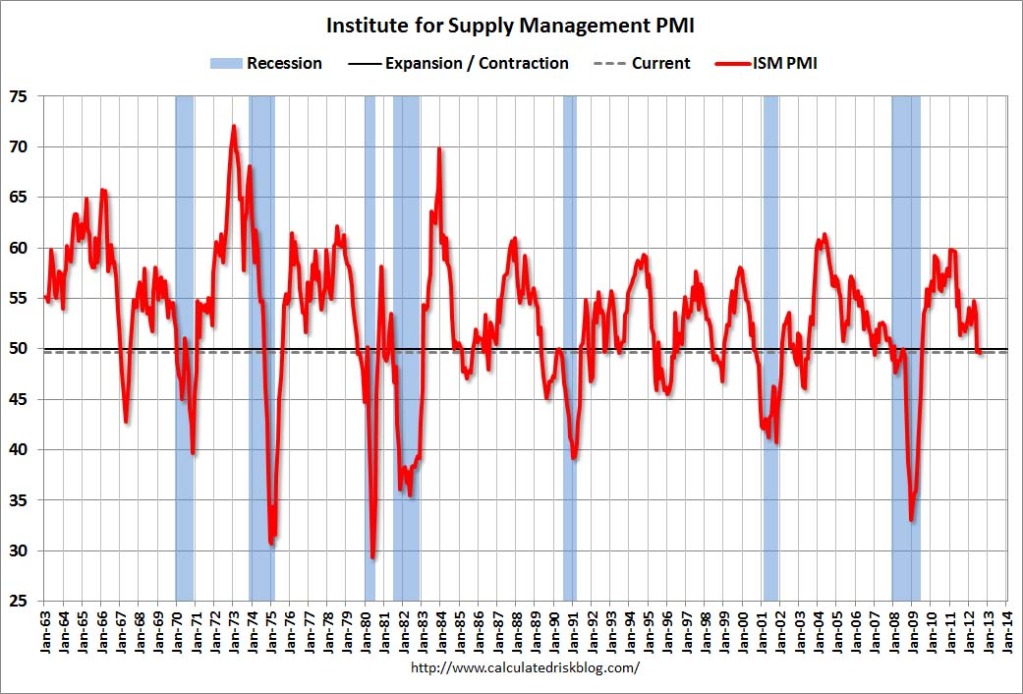
The chart below, from the wonderful Calculated Risk blog, demonstrates the point perfectly.

ISMAug2012 1 Uncertainty and its Investment Implications

Source: Calculated Risk (click to enlarge)

You can see the problem. The Purchasing Managers’ Index is hovering right near the line that separates an expanding economy from a contracting one. There’s no slam dunk either way—there are numerous cases of the PMI dropping below 50 that didn’t result in a recession, but also a number that did have a nasty outcome.

So what’s an investor to do?

One possibility is an all-weather fund that has the ability to adapt to a wide variety of environments. The old-school version of this is the traditional 60/40 balanced fund. The idea was that the stocks would behave well when the economy was good and that the bonds would provide an offset when the economy was bad. There are a lot of 60/40 funds still around, largely because they’ve actually done a pretty reasonable job for investors.

The new-school version is the global tactical asset allocation fund. The flexibility inherent in a tactical fund allows it to tilt toward stocks when the market is doing well, or to tilt toward bonds if equities are having a rough go. Many funds also have the potential to invest across alternative asset classes like real estate, commodities, or foreign currencies.

For a client that is wary of the stock market—and that might include most clients these days—a balanced fund or a global tactical asset allocation fund might be just the way to get them to dip their toe in the water. They are going to need exposure to growth assets over the long run anyway and a flexible fund might make that necessary exposure more palatable.

Click here to visit ArrowFunds.com for a prospectus & disclosures. Click here for disclosures from Dorsey Wright Money Management.

Posted by:


Modern Portfolio Theory Implodes: Mean Variance Optimization Bites the Dust

August 31, 2012

Andrew Ang of Columbia Business School has an important new paper out on SSRN. In it, he discusses mean variance optimization, the cornerstone of Modern Portfolio Theory. Unlike many other treatments in which portfolio construction through mean variance optimization is taken as gospel, Mr. Ang actually tests mean variance optimization against a wide variety of other diversification methods. This is the first article that I have seen that actually tries to put numbers to mean variance optimization. Here’s how he lays out his horserace:

I take four asset classes: U.S. government bonds (Barcap U.S. Treasury), U.S. corporate bonds (Barcap U.S. Credit), U.S. stocks (S&P 500), and international stocks (MSCI EAFE), and track performance of various portfolios from January 1978 to December 2011. The data are sampled monthly. The strategies implemented at time t are estimated using data over the past five years, t-60 to t. The first portfolios are formed at the end of January 1978 using data from January 1973 to January 1978. The portfolios are held for one month, and then new portfolios are formed at the end of the month. I use one-month T-bills as the risk-free rate. In constructing the portfolios, I restrict shorting down to -100% on each asset.

He tests a wide variety of diversification methods. As usual, simple is often better. Here’s his synopsis of the results:

Table 14 reports the results of the horserace. Mean-variance weights perform horribly. The strategy produces a Sharpe ratio of just 0.07 and it is trounced by all the other strategies. Holding market weights does much better, with a Sharpe ratio of 0.41. This completely passive strategy outperforms the Equal Risk Contributions and the Proportional to Sharpe Ratio portfolios (with Sharpe ratios of 0.32 and 0.45, respectively). Diversity Weights tilt the portfolio towards the asset classes with smaller market caps, and this produces better results than market weights. The simple Equal Weight strategy does very well with a Sharpe ratio of 0.54. What a contrast with this strategy versus the complex mean-variance portfolio (with a Sharpe ratio of 0.07)! The Equal Weight strategy also outperforms the market portfolio (with a Sharpe ratio of 0.41). De Miguel, Garlappi and Uppal (2009) find that the simple 1/N rule outperforms a large number of other implementations of mean-variance portfolios, including portfolios constructed using robust Bayesian estimators, portfolio constraints, and optimal combinations of portfolios which I covered in Section 4.2. The 1/N portfolio also produces a higher Sharpe ratio than each individual asset class position.

That’s a lot to absorb. If we remove the academic flourishes, what he is saying is that mean variance optimization is dreadful and is easily outperformed by simply equal-weighting the asset classes. He references Table 14 of his paper, which I have reproduced below.
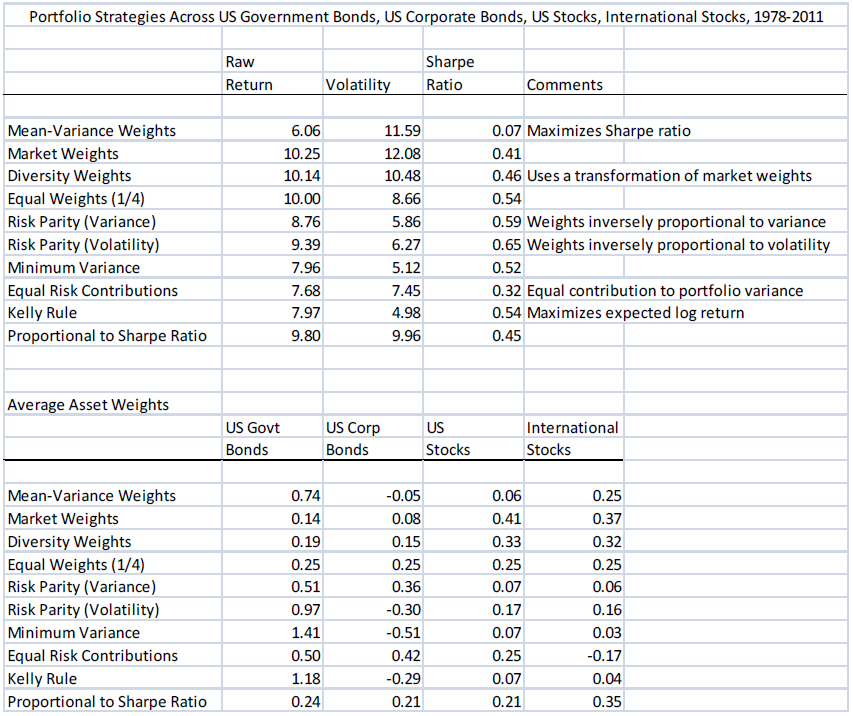
Table14 Modern Portfolio Theory Implodes: Mean Variance Optimization Bites the Dust

Table 14 Source: Andrew Ang/SSRN

(click to enlarge to full size)

(He points out later in the text that although risk parity approaches generate a slightly higher Sharpe ratio than equal weighting, it is mostly due to bonds performing so well over the 1978-2011 time period, a period of sharply declining interest rates. Like most observers of markets, he would be surprised to see interest rates decline dramatically from here, and thus thinks that the higher Sharpe ratios may be unsustainable. Mr. Ang also mentions in the article that using a five-year estimation period isn’t ideal, but that using 20-year or 50-year data is no better.)

I find it ironic that although mean variance optimization is designed to maximize the Sharpe ratio—to generate the most return for the least volatility—in real life it generates the worst results. As Yogi Berra said, in theory, theory and practice are the same. In practice, they aren’t!

Mr. Ang also asks and answers the question about why mean variance optimization does so poorly.

The optimal mean-variance portfolio is a complex function of estimated means, volatilities, and correlations of asset returns. There are many parameters to estimate. Optimized mean-variance portfolios can blow up when there are tiny errors in any of these inputs. In the horserace with four asset classes, there are just 14 parameters to estimate and even with such a low number mean-variance does badly. With 100 assets, there are 5,510 parameters to estimate. For 5,000 stocks (approximately the number listed in U.S. markets) the number of parameters to estimate is over 12,000. The potential for errors is enormous.

I put the fun part in bold. Tiny errors in estimating returns, volatilities, or correlations can cause huge problems. Attempting to estimate even 14 parameters ended in abject failure. We’ve written numerous pieces over the years about the futility of forecasting, yet this is exactly the process that Harry Markowitz, the father of Modern Portfolio Theory, would have you take!

Good luck with that.

To me, the implications are obvious. Diversification is always important, as it is a mathematical truism that combining any two assets that are not perfectly correlated will reduce volatility. But simple is almost always better. Mr. Ang draws the same conclusion. He writes:

Common to all these portfolio strategies is the fact that they are diversified. This is the message you should take from this chapter. Diversification works. Computing optimal portfolios using full mean-variance techniques is treacherous, but simple diversification strategies do very well.

The “simple is better” idea is not limited to asset class diversification. I think it also extends to diversification by investment strategy, like relative strength or value or low volatility. There’s an underlying logic to it—simple is better, because simple is more robust.

Some investors, it seems, are always chasing the holy grail or coming up with complicated theories that are designed to outperform the markets. In reality, you can probably dispense with all of the complex theory and use common sense. Staying the course with an intelligently diversified portfolio over the long term is probably the best way to reach your investing goals.

Posted by:


Money Goes Where It Is Treated Best

August 30, 2012

Further confirmation of this came in a Wall Street Journal article about corporate behavior. Companies are moving their corporate headquarters outside the US because they can save money—tens of millions of dollars—by incorporating overseas. Here’s just one example:

Eaton, a 101-year-old Cleveland-based maker of components and electrical equipment, announced in May that it would acquire Cooper Industries PLC, another electrical-equipment maker that had moved to Bermuda in 2002 and then to Ireland in 2009. It plans to maintain factories, offices and other operations in the U.S. while moving its place of incorporation—for now—to the office of an Irish law firm in downtown Dublin.

When Eaton announced the deal, it emphasized the synergies the two companies would generate. It also told analysts that the tax benefits would save the company about $160 million a year, beginning next year.

I added the bold. Money talks. $160 million yells pretty loudly.

Ironically, the goal of the 2004 legislation was to promote companies staying in the US. However, due to the poor tax treatment in the US relative to many other countries, it has not worked. The WSJ points out:

Since 2009, at least 10 U.S. public companies have moved their incorporation address abroad or announced plans to do so, including six in the last year or so, according to a Wall Street Journal analysis of company filings and statements. That’s up from just a handful from 2004 through 2008.

If the goal of corporations is to make money for their shareholders, of course they are going to take advantage of favorable tax treatment. If we want businesses—and thus jobs—here in the US, then we have to be competitive. Money really does go where it is treated best.

Incentives are a pretty important part of economics—some would say the most important part. It’s critical to get incentives right if we want the US economy to continue to be the strongest in the world.

money Money Goes Where It Is Treated Best

Source: The Murninghan Post

Posted by:


The Refrain of the Pessimists

August 29, 2012

Chuck Jaffe wrote a nice article for Marketwatch, pointing out that fund investors are actually more intelligent than they are given credit for. It’s worth pointing out because nearly every change in the industry is greeted with skepticism by the pessimists. His article ends with a nice summary:

“The knee-jerk reaction to almost all of the advances we have seen has been ‘Oh my goodness, what is going to happen to the industry?’ and ‘Investors will blow themselves up with this,’” said Geoff Bobroff of Bobroff Consulting, a leading fund industry observer. “Surprise, surprise, the world hasn’t come to an end yet and, in fact, the fund world has gotten better for each of these developments.

“Joe Six-Pack is going to do exactly what he has always done,” Bobroff added. “He is not going to change, just because the technology exists for him to do something different. He will adapt, and over time become comfortable with the newer products and newer ways. That doesn’t mean he will always make money; the market won’t always work for Joe Six-Pack, but that won’t be because the fund industry is evolving, it will be because that’s just what the way the market is sometimes.”

The article addresses the concern expressed by many that investors will blow themselves up with ETFs because of their daily liquidity. (John Bogle has expressed this view frequently and loudly.) Mr. Jaffe pulls out some data from a Vanguard (!) study that shows, in fact, that’s not how investors are acting.

Over the years, we’ve heard the same refrain about tactical asset allocation: investors will never be able to get it right, they’ll blow themselves up chasing performance, etc., etc. In fact, tactical allocation funds have acquitted themselves quite nicely over the past few years in a very difficult market environment. For the most part, they’ve behaved pretty much as advertised—better than the worst asset classes, and not as well as the best asset classes—somewhere in the middle of the pack. That kind of consistency, over time, can lead to reasonable returns with moderate volatility.

Reasonable returns with moderate volatility is a laudable goal, which probably explains why hybrid funds have seen new assets this year, even as equity funds are seeing outflows.

In markets, pessimism is almost never the way to go. It’s more productive to be optimistic and to try to find investment strategies that will work for you over the long run.

Posted by:


The Disciplined Pursuit of Less

August 23, 2012

Greg McKeown’s “The Disciplined Pursuit of Less” in the Harvard Business Review is thought-provoking on so many levels. The article must be read in full to really appreciate his point, but the concluding paragraph is a nice summary.

If success is a catalyst for failure because it leads to the “undisciplined pursuit of more,” then one simple antidote is the disciplined pursuit of less. Not just haphazardly saying no, but purposefully, deliberately, and strategically eliminating the nonessentials. Not just once a year as part of a planning meeting, but constantly reducing, focusing and simplifying. Not just getting rid of the obvious time wasters, but being willing to cut out really terrific opportunities as well. Few appear to have the courage to live this principle, which may be why it differentiates successful people and organizations from the very successful ones.

While this principle can be applied to nearly every aspect of our lives, it has a clear application to portfolio construction and financial planning. Some variation of the following story is common: An individual succeeds at earning a high income. Either on his own or with the help of a financial advisor, investments are made. The years pass. Additional investments are made. Money with a money manager here, a group of mutual funds there, positions in some individual stocks here… Pretty soon, this person has become a collector as opposed to an investor. In the collector scenario, it is just possible that everything works out okay. Perhaps there will be big enough winners in the mix to cover any losers. However, it is possible that some of those investments were ill-conceived and will be a major drag on the overall portfolio over time-all while not being carefully watched.

Contrast that approach with the investor who purposely employs an asset allocation with more limited, but thoroughly researched investment strategies (we have written many times before about the rationale for mixing relative strength, value, and low volatility strategies). It is quite possible that this more disciplined investor will be able to earn greater returns and amass greater wealth over time than the collector and still retain the benefits of diversification.

No realistic person has the expectation of a perpetual state of success. Setbacks are just part of life and investing. However, the investor who purposefully, deliberately, and strategically eliminates the nonessentials and focuses their resources on the areas where they are likely to achieve the greatest rewards has taken a big step towards putting the odds in their favor.

Posted by:


What You Should Focus On

August 17, 2012

Good advice from Carl Richards:

Posted by:


The Truth About the “Impending” Recession

August 15, 2012

Doug Short at Advisor Perspectives performs a very valuable public service. He presents very clear charts of major economic indicators without a lot of heavy interpretation and spin. Pundits who have forecast a recession—and therefore have a vested interest in a recession occurring—often pick and choose their indicators. There’s always some part of the economy that’s lagging, and with the right spin you can probably make it look like the sky is falling.

Here is Mr. Short’s brief comment:

Official recession calls are the responsibility of the NBER Business Cycle Dating Committee, which is understandably vague about the specific indicators on which they base their decisions. This committee statement is about as close as they get to identifying their method.

There is, however, a general understanding that there are four big indicators that the committee weighs heavily in their cycle identification process. They are:

  • Industrial Production
  • Real Income (excluding transfer payments)
  • Employment
  • Real Retail Sales

The weight of these four in the decision process is sufficient rationale for the St. Louis FRED repository to feature a chart four-pack of these indicators along with the statement that “the charts plot four main economic indicators tracked by the NBER dating committee.”

Bear in mind that the NBER dating committee identifies recessions after the fact. These are not leading indicators, but rather coincident indicators. Only after they have turned down solidly can the NBER agree that a recession has started.

So, what do the indicators actually look like? There are more charts in Mr. Short’s indicator update, but this chart summarizes it nicely.

BigFour The Truth About the Impending Recession

Are these indicators going up or down?

Source: Advisor Perspectives/Doug Short (click to enlarge)

I highly recommend reading the entire article, but even a cursory inspection of this chart shows no current evidence of a recession. The stock market is one of the leading indicators in the LEI also, and it is near the high for the year. Our global tactical allocation accounts hold a lot of domestic equity because that’s where the strength has been. (Despite, or maybe because of, investors’ reluctance to own stocks, the market is having a decent year so far.) Instead of freaking out about an impending recession, maybe you could just look at the primary source data.

It’s not impossible that a recession is on the way, of course, but you’d have to present data that the NBER is not using. Anything can happen, but it’s pretty tough to make the recession argument from the data in this chart.

Posted by:


The Problem With Seeing The Forest For The Trees

August 14, 2012

The proverbial wisdom is that it is a character flaw to be unable to view “the forest for the trees.” However, from an investor’s perspective, sometimes granularity can be a virtue. There are any number of data points that reveal that investor sentiment is sub-par, including our own bi-weekly survey. Retail investors continue to pull money out of domestic equity funds and put it into fixed income. Consumer confidence is low. The economy both here and in many developed economies is stagnant.

Investors often make the mistake of evaluating the economy and financial markets in a monolithic fashion. However, it is significantly more complicated than that. Even in a lukewarm economy, there are micro-bull markets taking place right under our nose. One way of observing this reality is to look at the YTD performance of the 100 stocks that currently comprise the PowerShares DWA Technical Leaders Index. PDP is the ticker of the ETF that tracks this index.

Within this index, there are currently 27 stocks up more than 30% YTD (some up as much as 70-80% YTD) and the median YTD performance of stocks in the index is +18%. Through 8/13/12, PDP is up 12.30% YTD, outperforming the S&P 500. In fact, PDP has performed favorably compared to the S&P 500 in this bull market and and since inception.

So, where are some of the micro-bull markets taking place? Consider the business of the Skyworks Solutions (SWKS)-the index constituent that currently has the best YTD performance:

Skyworks Solutions, Inc., together with its subsidiaries, offers analog and mixed signal semiconductors worldwide. The company provides power amplifiers and front-end solutions for cellular handsets from entry level to multimedia platforms, as well as smart phones.

Source: The Street

In full disclosure, not all of the constituents of the PowerShares DWA Technical Leaders Index are performing well. This index is re-constituted quarterly with high relative strength stocks. Sometimes, strong stocks are added to the index and they perform abysmally. Sometimes the index as a whole underperforms. The point of this article is not to say that relative strength is a panacea. That said, there is solid research that shows that relative strength has been an effective way to beat the market over time. Furthermore, the index construction process ensures that the process seeks to identify individual winners regardless of the macro environment.

Not all trees in a forest are the same.

Image source: Confused Capitalist

See www.powershares.com for more information. Dorsey Wright also currently owns SWKS in our separately managed accounts. Past performance is no guarantee of future returns. A list of all holding for the previous 12 months is available upon request.

Posted by:


Quote of the Week: The Ebb and Flow of Investment Style

August 14, 2012

Ninety percent of what passes for brilliance, or incompetence, in investing is the ebb and flow of investment style (i.e., growth, value, foreign vs. domestic, etc.). Since opportunities by style regress, past performance tends to be negatively correlated with future relative performance. Therefore, managers are often harder to pick than stocks. Clients have to choose between fact (past performance) and the conflicting marketing claims of various managers. As sensible businessmen, clients usually feel they have to go with the past facts. They therefore rotate into previously strong styles, which regress [to the mean], dooming most active clients to failure.—-Jeremy Grantham

This is a pretty long quote, but it’s a gem I found sandwiched into an Advisor Perspectives commentary by Jeffrey Saut. (I commend Mr. Saut for having the perspicacity to throw the quote out there in the first place.)

Mr. Grantham not only has a way with words—he has a valid point in every single sentence. That paragraph pretty much sums up everything that goes wrong for clients.

It’s also true from the standpoint of an investment manager. Our investment style constantly exposes clients to high relative strength stocks or asset classes. Some quarters they perceive us to be brilliant; other quarters, not so much! In reality, we are doing exactly the same thing all the time. Clients are actually reacting to the ebb and flow of investment style, as Mr. Grantham puts it, rather than to anything different we are doing.

The ebb and flow of investment style takes place over a fairly long cycle, often three to five years—in other words, usually an entire business cycle. During the flow period, clients are very excited by good performance and seem quite confident that it will never end. During the ebb period, it’s easy to become discouraged and to become convinced that somehow the investment process is “broken.” Clients become confident that performance will never improve! Grantham’s observation about the when and why of clients changing managers corresponds exactly with DALBAR’s reported poor investor performance and average 3-year holding periods.

Patience and the acknowledgment of ebb and flow would go a long way toward improving investor performance.

ebb and flow mike dawson Quote of the Week: The Ebb and Flow of Investment Style

Is the ocean broken, or does it just ebb and flow?

Source: Eve Sob blogspot

Posted by:


Slaughtering Sacred Cows: Economic Growth and Equity Performance

August 1, 2012

Vanguard’s Chief Economist, Joseph H. Davis, Ph.D. makes an important point about the relationship between economic growth and stock market performance:

And I would say for advisors, really, that the opportunity with their clients would be underscoring the fact that much more important for long-term equity market success and investing success is the price paid for growth, rather than economic growth per se. And our research, as well as others in the industry several years ago, was very, I think, important in underscoring the fact that the correlation across countries between long-term stock returns and long-term economic growth, was close to zero.

And it’s not that economic growth doesn’t matter, it’s just the price you pay for future growth. And that was the case in the past several years, where China had the highest growth rate across the world and yet has had a very disappointing equity performance.

Conversely, it would not shock me, ten years from now, if it turned out that Europe had, perhaps, the highest total return of any broad region. I’m certainly not suggesting that one should overweight Europe in a portfolio, but valuations are depressed. And so I think that can be a tailwind, but we have to be cognizant enough to look through the economic challenge, which is not easy to do. But I think those investors, certainly historically, that have been able to do that have been rewarded by doing so. And I think that’s an important message.

It is extremely common to hear investors express the belief that economic growth and stock market performance are highly correlated. To say otherwise is blasphemy to many. This is just one of those sacred cows that must be slaughtered in order to have a fighting chance of earning favorable returns in the financial markets. Fundamentalists believe that you deal with this by evaluating the price you are paying for future growth. I have seen plenty of research that would suggest that this is true. However, a major drawback of the fundamental approach is that you often end up waiting a very long time before a “good value” pays off.

As technicians, we take a more direct approach to dealing with the issue. We worry less about why a given market or security is moving and focus more on ranking those moves by their relative strength in order to identify and invest in the strongest trends available. The reality is that markets always move because of a combination of fundamental and psychological factors. Sometimes the markets are driven much more by one than the other. Relative strength ranks pick up those movements regardless of the motivational forces behind the aggregate buying and selling forces in the marketplace.

Posted by:


The Dilemma for Bond Investors

July 31, 2012

A recent Vanguard commentary has a very good description of the confusion facing bond investors right now—and judging from the recent heavy flows into bond funds, that’s a lot of investors.

These days, the airwaves seem filled with market commentators offering one of three popular suggestions for bond investors. All three groups urge investors to alter their investment strategy in this low-rate environment.

The first group suggests bond investors take on more interest-rate risk in an effort to earn more income today, say, by moving your assets from a short-maturity bond fund to a longer-maturity bond fund. The second group suggests investors do the exact opposite and reduce interest rate risk, say, by moving assets out of one’s bond portfolio into a savings vehicle in an attempt to sidestep a future rise in interest rates. Obviously, both groups of investors are trading with each other. Which group “wins” will ultimately depend on the future path of interest rates (more on this in a moment).

Like the first group, a third group of market commentators suggests taking on more risk, but of a different sort. They point to the U.S. investment experience of the late 1940s and early 1950s—the last time U.S. interest rates were this low—as a rationale for moving strategically out of low-yielding conservative bond portfolios and into traditionally more-volatile assets, namely stock funds.

I think that is a pretty good encapsulation of what bond investors are hearing right now. And, exactly as Vanguard points out, the “right” answer if you go with a forecast will only be determined in hindsight. You could have a pretty horrific experience in the meantime if you guess wrong. Their article points out, correctly I think, that although some of these outcomes may be more probable than others, there’s no way to know what will happen. The endgame could be anything from Japan to hyper-inflation. There are just too many variables in play.

If you are a strategic asset allocator, Vanguard suggests broad diversification. I am a little surprised by this, as they make a salient point about bonds.

We as investors first need to recalibrate our expectations for future bond returns. Unfortunately, the most direct implication of this low-rate environment is that bond portfolio returns are likely to be fairly puny going forward. As I wrote in March (“Why I still own Treasuries“), arguably the single best predictor of the future return on a bond portfolio is its current yield to maturity, or coupon.

I would think that a strategic asset allocator would severely underweight bonds if future forecasted bond returns are going to be small. (At least that’s what Harry Markowitz says to do.)

Another path through this minefield is tactical asset allocation. Hold the asset classes that are strong and avoid the rest. If bonds are strong because rates continue to fall, because Treasurys continue to be a safe haven, or because the US enters a low-growth Japan-like environment, then they will be welcome in a portfolio. If bonds are weak because rates start to rise or because the US begins to flirt with solvency concerns at some point, then many other asset classes are likely to perform better.

In the end, tactical asset allocation might be safer. Bond returns may be low, but they might end up being higher than the returns from some alternatives. Or bonds could turn out to be an unmitigated disaster. Tactical asset allocation driven by relative strength frees you from the need to forecast. Bonds will be in your portfolio—or not—depending only upon their performance.

Bond Investors Have a Dilemma

Source: buzzle.com

Posted by: