Polo Shirt Winner

September 28, 2012

This quarter’s polo shirt winner is Mark Sklar, who works at Wells Fargo Advisors. Mr. Sklar has been in the business since 1987, starting out with Prudential Bache around 25 years ago.

Thanks to Mark and all of our other advisors who consistently take the surveys. Remember, the more times you take the survey, the better the chances are your name will be drawn. Here’s to a great final quarter of 2012.

Posted by:


Dorsey Wright Client Sentiment Survey - 9/28/12

September 28, 2012

Here we have the next round of the Dorsey, Wright Sentiment Survey, the first third-party sentiment poll. Participate to learn more about our Dorsey, Wright Polo Shirt raffle! Just follow the instructions after taking the poll, and we’ll enter you in the contest. Thanks to all our participants from last round.

As you know, when individuals self-report, they are always taller and more beautiful than when outside observers report their perceptions! Instead of asking individual investors to self-report whether they are bullish or bearish, we’d like financial advisors to weigh in and report on the actual behavior of clients. It’s two simple questions and will take no more than 20 seconds of your time. We’ll construct indicators from the data and report the results regularly on our blog–but we need your help to get a large statistical sample!

Click here to take Dorsey, Wright’s Client Sentiment Survey.

Contribute to the greater good! It’s painless, we promise.

Posted by:


Sector and Capitalization Performance

September 28, 2012

The chart below shows performance of US sectors and capitalizations over the trailing 12, 6, and 1 month(s). Performance updated through 9/27/2012.

Numbers shown are price returns only.

Posted by:


Where Do You Get Your News?

September 27, 2012

While this will probably surprise no one (who has been conscious over the past decade), it is still pretty fascinating.

news 1 Where Do You Get Your News?

Trends are everywhere. You just need a plan to capitalize on them.

HT: Michael Kitces

Posted by:


The Pragmatist’s Approach to Investing

September 27, 2012

Adam Davidson’s article “Hey, Big Saver!” in the New York Times is an excellent summary of the competing arguments on the merits of QE3. There truly are compelling arguments for why this will work and there are compelling arguments why it won’t. Effectiveness aside, Bernanke has made his intentions perfectly clear:

When Bernanke announced that the Fed would be investing in the mortgage market indefinitely, he signaled that he’s had it with short-term fixes. His Fed is committed, he said, to taking extraordinary measures until unemployment goes down. In Fed-speak, Q.E. 3 is a clear message to banks, investors and private companies that the economy is going to grow, and the riskiest thing they can do is to hold on to their cash and riskless securities and watch their competitors profit.

Are his policies working or not? This is why I love technical analysis. Rather than get caught up in theoretic debates, technical analysis cuts to the chase and asks a different question: What stocks, sectors, and asset classes have the best relative strength? Based on that information, relative strength investors can orient their portfolio to capitalize on those trends.

Investors are not interested in winning theoretical debates. Investors are interested in making money! Rather than focusing on what the Fed, Congress, the President, the ECB, banks, consumers, economists, investment strategists, your brother-in-law… have to say about what is going to happen in the market, take the pragmatist’s approach and let relative strength dictate your investment decisions.

pragmatic The Pragmatists Approach to Investing

Source: CBS News

HT: Real Clear Markets

Posted by:


Danger: Pundits Ahead

September 27, 2012

The danger of listening to the forecasts of pundits is obvious. For one thing, pundits are just as likely to get it wrong as anyone else. The Big Picture carried a list of bullish forecasts from the beginning of the internet bubble that is illustrative. (The original source was apparently Paul Farrell at Marketwatch.)

March 1999: Harry S. Dent, author of “The Roaring 2000s.” “There has been a paradigm shift.” The New Economy arrived, this time really is different.

October 1999: James Glassman, author, “Dow 36,000.” “What is dangerous is for Americans not to be in the market. We’re going to reach a point where stocks are correctly priced … it’s not a bubble … The stock market is undervalued.”

August 1999: Charles Kadlec, author, “Dow 100,000.” “The DJIA will reach 100,000 in 2020 after “two decades of above-average economic growth with price stability.”

December 1999: Joseph Battipaglia, market analyst. “Some fear a burst Internet bubble, but our analysis shows that Internet companies … carry expected long-term growth rates twice other rapidly growing segments within tech.”

December 1999: Larry Wachtel, Prudential. “Most of these stocks are reasonably priced. There’s no reason for them to correct violently in the year 2000.” Nasdaq lost over 50%.

December 1999: Ralph Acampora, Prudential Securities. “I’m not saying this is a straight line up. … I’m saying any kind of declines, buy them!”

February 2000: Larry Kudlow, CNBC host. “This correction will run its course until the middle of the year. Then things will pick up again, because not even Greenspan can stop the Internet economy.” He’s still hosting his own cable show.

April 2000: Myron Kandel, CNN. “The bottom line is in, before the end of the year, the Nasdaq and Dow will be at new record highs.”

September 2000: Jim Cramer, host of “Mad Money.” Sun Microsystems “has the best near-term outlook of any company I know.” It fell from $60 to below $3 in two years.

November 2000: Louis Rukeyser on CNN. “Over the next year or two the market will be higher, and I know over the next five to 10 years it will be higher.”

December 2000: Jeffrey Applegate, Lehman strategist. “The bulk of the correction is behind us, so now is the time to be offensive, not defensive.” Another sucker’s rally.

December 2000: Alan Greenspan. “The three- to five-year earnings projections of more than a thousand analysts … have generally held firm. Such expectations, should they persist, bode well for continued capital deepening and sustained growth.”

January 2001: Suze Orman, financial guru. “The QQQ, they’re a buy. They may go down, but if you dollar-cost average, where you put money every single month into them, I think, in the long run, it’s the way to play the Nasdaq.” The QQQ fell 60% further.

March 2001: Maria Bartiromo, CNBC anchor. “The individual out there is actually not throwing money at things that they do not understand, and is actually using the news and using the information out there to make smart decisions.”

April 2001: Abby Joseph Cohen, Goldman Sachs. “The time to be nervous was a year ago. The S&P was overvalued, it’s now undervalued.” Markets fell 18 more months.

August 2001: Lou Dobbs, CNN. “Let me make it very clear. I’m a bull, on the market, on the economy. And let me repeat, I am a bull.”

June 2002: Larry Kudlow, CNBC host. “The shock therapy of a decisive war will elevate the stock market by a couple thousand points.” He also predicted the Dow would hit 35,000 by 2010.

Note: The Dow didn’t bottom until October 2002 at 7,286, down from 11,722.

These examples are particularly egregious because they happened at a market turning point, but the danger from listening to pundits is continuous. You can always find pundits spouting their opinions on CNBC or other media. To the extent that they influence you into not executing your thoughtful, systematic investment plan, pundits are a problem.

Posted by:


Fund Flows

September 27, 2012

The Investment Company Institute is the national association of U.S. investment companies, including mutual funds, closed-end funds, exchange-traded funds (ETFs), and unit investment trusts (UITs). Flow estimates are derived from data collected covering more than 95 percent of industry assets and are adjusted to represent industry totals.

This is starting to get ridiculous…

Posted by:


Target-Date Fund-mageddon

September 26, 2012

Markets are rarely tractable, which is one reason why significant flexibility is required over an investment lifespan. Flexibility is something that target-date funds don’t have much of. In fact, target-date funds have a glidepath toward a fixed allocation at a specified time. I’ve written about the problems with target-date funds extensively—and why I think balanced funds are a much better QDIA (Qualified Default Investment Alternative). It appears that my concerns were justified, now that Rob Arnott at Research Affiliates has put some numbers to it. According to an article in Smart Money on target-date funds:

A target-date fund is a one-decision mutual fund that you can invest in over the course of your entire career.

Each fund is designed for those aiming to retire at a certain date. The fund starts with a lot of “risky” stocks, and over time it moves to “safer” bonds. The fundamental idea is that at any given moment between age 21 and age 65 you should be invested in a particular balance of assets — more stocks when you are younger, and more bonds when you are older.

The track to retirement, according to the industry jargon, is a “glidepath.”

Billions of dollars are invested in these target-date funds. They are today the default investment option in many 401(k) plans. Now comes Rob Arnott, the chairman of Research Affiliates and one of the handful of serious money managers in the country. In a new research paper he published yesterday, “The Glidepath Illusion,” he has blown this idea full of holes. “Shockingly,” he says, “the basic premise upon which these billions [of dollars] are invested is flawed.”

When Mr. Arnott investigated the results of such target-date funds, he found them to be incredibly variable—and possibly upside-down. (I put the fun part in bold.)

Arnott has mined data from the stock and bond markets going back to 1871 and then run simulations to see how these target-date portfolios would have worked in practice. He considered a fund that started out with 80% stocks and 20% bonds, and then adjusted gradually over an investing life of 41 years so that it ended up 80% bonds and 20% stocks. He considered an investor who invested $1,000 a year, adjusted for inflation, from the day she started work at age 22 to when she retired at 63.

Bottom line? This investor could have done very well — or very badly. Far from enjoying a smooth “glidepath” to a secure retirement, she could have retired with as little as $50,000 in savings or as much as $211,000. She could have ended up with a retirement annuity of $2,400 a year — or $13,100 a year. There was no way of knowing in advance.

That wasn’t all. Arnott found that in most eras, investors would have actually been better off if they had stood this target-date strategy on its head — in other words, if they had started out with 80% bonds, and then took on more risk as they got older, so that they ended up with 80% stocks.

No kidding. Really.

The median person following the target date strategy ended up with $120,000 in savings. The median person who did the opposite, Arnott’s team found, ended up with $148,000. The minimum outcome from doing the opposite was better. The maximum outcome of doing the opposite was also better.

Amazing. Even the minimum outcome from going opposite the glidepath was better! Using even a static 50/50 balanced fund was also better. Perhaps this will dissuade a client or two from piling into bonds only because they are older. No doubt path dependence had something to do with the way returns laid out, but it’s clear that age-based asset allocation is a cropper.

Asset allocation, diversification, and strategy selection are important. Decision of this magnitude need to be made consciously, not put on autopilot.

[You can read Mr. Arnott's full article here. Given that most 401k investors are unfortunately using target-date funds instead of balanced funds, this is a must read. I would modestly suggest the Arrow DWA Balanced Fund as a possible alternative!]

Click here to visit ArrowFunds.com for a prospectus & disclosures. Click here for disclosures from Dorsey Wright Money Management.

Posted by:


ETF Trading Trends

September 26, 2012

Exchange traded funds comprise of groups of assets that are traded on the stock exchange. Similarly to mutual funds, ETFs track a basket of securities. This makes them more diversified than a single stock. Yet like stocks, they are easily traded, can be sold short, and often have lower transaction costs than mutual funds. ETFs tend to perform best under a buy-and-hold approach, but has the ease at which they trade caused investors to trade them more? Vanguard set out to answer this question.

They looked at “3.2 million transactions in more than 500,000 positions held in the mutual fund and ETF share classes of four different Vanguard funds from 2007-2011.” While ETFs were traded more often, mutual funds and exchange traded funds still had similar trading patterns.

Some in the investment community have suggested that ETFs tempt investors to increase their trading activity. Given the lack of investor-level analysis supporting or refuting this presumption, we examined the trading behavior of Vanguard investors. We found that, contrary to speculations in the popular media, most investments are held in a prudent, buy-and-hold manner, regardless of share class. Although behavior in ETFs is more active than behavior in traditional mutual funds, some of that difference is simply due to the fact that investors who are inclined to trade choose ETFs, not that investors who choose ETFs are induced to trade. We conclude that the ETF “temptation effect” is not a significant reason for long-term individual investors to avoid using appropriate ETF investments as part of a diversified investment portfolio.

In short, it is investors themselves that are responsible for increased trading of ETFs, not an inherent quality of the funds. Owning exchange traded funds won’t lure a long-term owner toward short-term trading.

Posted by:


Are 401k Investors Making a Mistake with Hybrid Funds?

September 26, 2012

I think this is an open question after reading some commentary by Bob Carey, the investment strategist for First Trust. He wrote, in his 9/11/2012 observations:

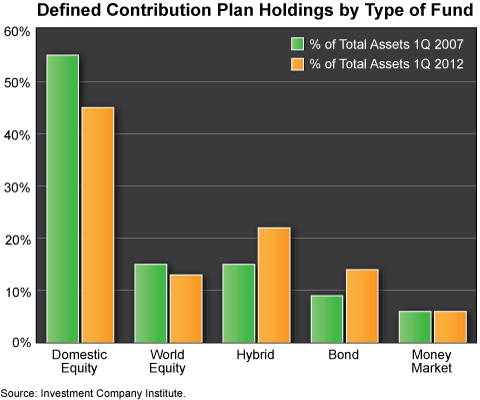
  • Hybrid funds, which tend to be comprised primarily of domestic and foreign stocks and bonds, but can extend into such areas as commodities and REITs, saw their share of the pie rise from 15% in Q1’07 to 22% in Q1’12.
  • One of the more popular hybrid funds for investors in recent years has been target-date funds. These funds adjust their asset mix to achieve a specific objective by a set date, such as the start of one’s retirement.
  • In 2010, target-date fund assets accounted for 12.5% of all holdings in employer-sponsored defined-contribution retirement accounts. They are expected to account for 48% by 2020, according to Kiplinger.
  • Plans are shifting away from the more traditional balanced funds to target-date funds for their qualified default investment alternative (QDIA).

There’s a nice graphic to go along with it to illustrate his point about the growing market share of hybrid funds.

hybrid Are 401k Investors Making a Mistake with Hybrid Funds?

Are 401k Investors Making a Mistake?

Source: First Trust, Investment Company Institute (click to enlarge)

He points out that 401k assets in hybrid funds are rising, but the growth area within the hybrid fund category has been target-date funds. It troubles me that many 401k plans are moving their QDIA option from balanced funds to target-date funds. QDIAs are designed to be capable of being an investor’s entire investment program, so the differences between them are significant.

There is a huge advantage that I think balanced funds have-much greater adaptability to a broader range of economic environments. Balanced funds, particularly those with some exposure to alternative assets, are pretty adaptable. The manager can move more toward fixed income in a deflationary environment and more toward equities (or alternative assets) in a strong economy or during a period of inflation.

Most target-date funds have a glide path that involves a heavier and heavier allocation to bonds as the investor ages. While this might be worthwhile in terms of reducing volatility, it could be ruinous in terms of inflation protection. Inflation is one of the worst possible environments for someone on a fixed income (i.e. someone living off the income from their retirement account). Owning bonds just because you are older and not because it is the right thing to do given the market environment seems like quite a leap of faith to me.

Asset allocation decisions, whether strategic or tactical, should be investment decisions.

Posted by:


High RS Diffusion Index

September 26, 2012

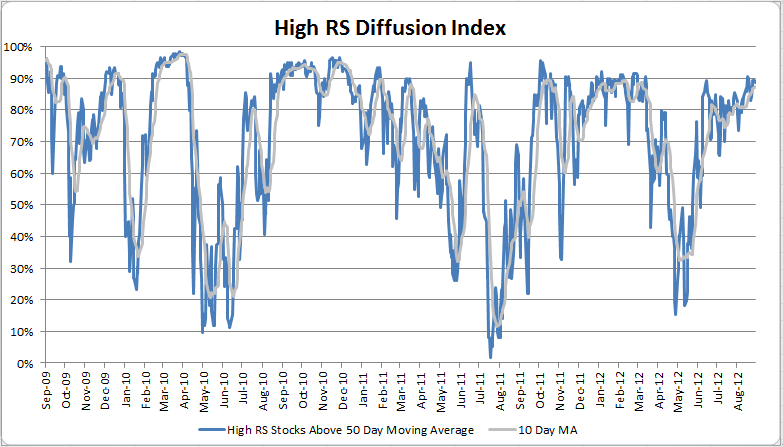
The chart below measures the percentage of high relative strength stocks that are trading above their 50-day moving average (universe of mid and large cap stocks.) As of 9/25/12.

The 10-day moving average of this indicator is 86% and the one-day reading is 77%.

Posted by:


Relative Strength Spread

September 25, 2012

The chart below is the spread between the relative strength leaders and relative strength laggards (universe of mid and large cap stocks). When the chart is rising, relative strength leaders are performing better than relative strength laggards. As of 9/24/2012:

This spread experiences sustained rising trends when market themes persist for more than a couple months at a time. We haven’t seen much of that over the past couple of years, thus the choppy spread.

A longer-term view of this spread is shown below, reflecting the superior performance of the RS leaders over time.

Past performance is no guarantee of future returns.

Posted by:


Dorsey Wright Client Sentiment Survey Results - 9/14/12

September 24, 2012

Our latest sentiment survey was open from 9/14/12 to 9/21/12. The Dorsey, Wright Polo Shirt Raffle continues to drive advisor participation, and we greatly appreciate your support! This round, we had 49 advisors participate in the survey. If you believe, as we do, that markets are driven by supply and demand, client behavior is important. We’re not asking what you think of the market—since most of our blog readers are financial advisors, we’re asking instead about the behavior of your clients. Then we’re aggregating responses exclusively for our readership. Your privacy will not be compromised in any way.

After the first 30 or so responses, the established pattern was simply magnified, so we are fairly comfortable about the statistical validity of our sample. Some statistical uncertainty this round comes from the fact that we only had four investors say that thier clients are more afraid of missing a stock upturn than being caught in a downdraft. Most of the responses were from the U.S., but we also had multiple advisors respond from at least two other countries. Let’s get down to an analysis of the data! Note: You can click on any of the charts to enlarge them.

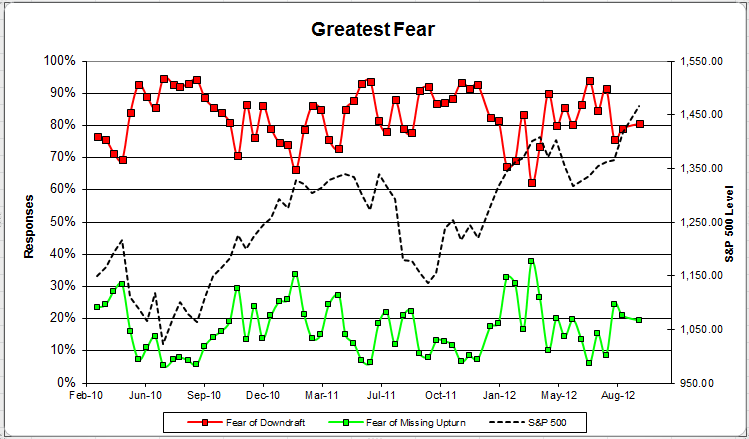
Question 1. Based on their behavior, are your clients currently more afraid of: a) getting caught in a stock market downdraft, or b) missing a stock market upturn?

greatestfear 57 Dorsey Wright Client Sentiment Survey Results   9/14/12

Chart 1: Greatest Fear. From survey to survey, the S&P 500 rose by just over 3%, and none of our indicators responded as expected! Despite a rising market, the greatest fear numbers rose from 79% to 81%. On the flip side, the opportunity group fell from 21% to 19%.

greatestfearspread 54 Dorsey Wright Client Sentiment Survey Results   9/14/12

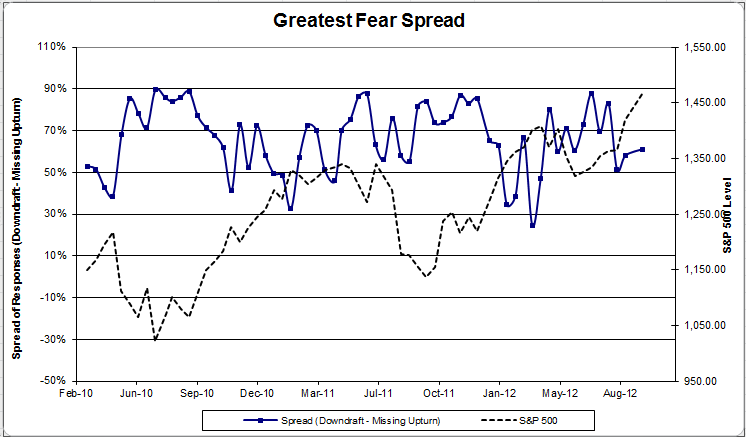
Chart 2: Greatest Fear Spread. Another way to look at this data is to examine the spread between the two groups. The spread rose slightly from 58% to 61%.

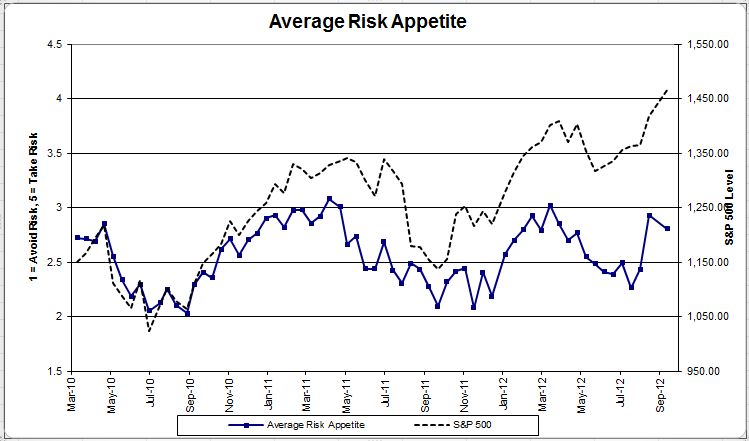
Question 2. Based on their behavior, how would you rate your clients’ current appetite for risk?

avgriskapp 44 Dorsey Wright Client Sentiment Survey Results   9/14/12

Chart 3: Average Risk Appetite. Average risk appetite fell slightly as the market rose. Last survey round we saw a big spike in client risk appetite; we might look at this reading as a sort of “breather” after last round’s big move. Client risk appetite went from 2.93 to 2.81.

riskappbellcurve 32 Dorsey Wright Client Sentiment Survey Results   9/14/12

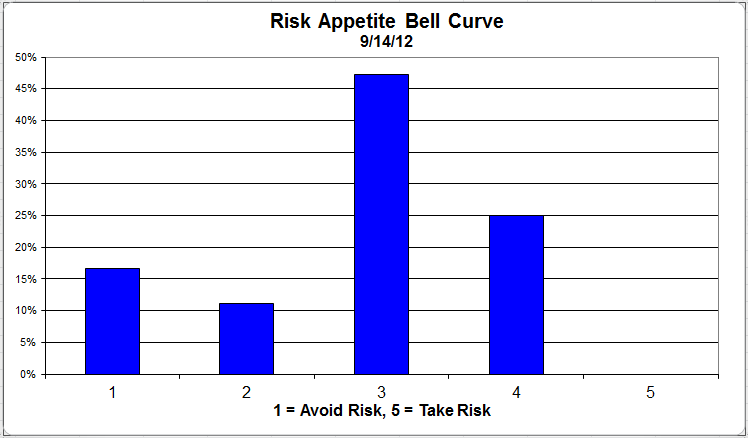
Chart 4: Risk Appetite Bell Curve. This chart uses a bell curve to break out the percentage of respondents at each risk appetite level. This round, we had a bit of a mixed bag. Nearly half of all respondents wanted a risk appetite of 3, and no one wanted a risk appetite of 5.

riskappgroupcurve Dorsey Wright Client Sentiment Survey Results   9/14/12

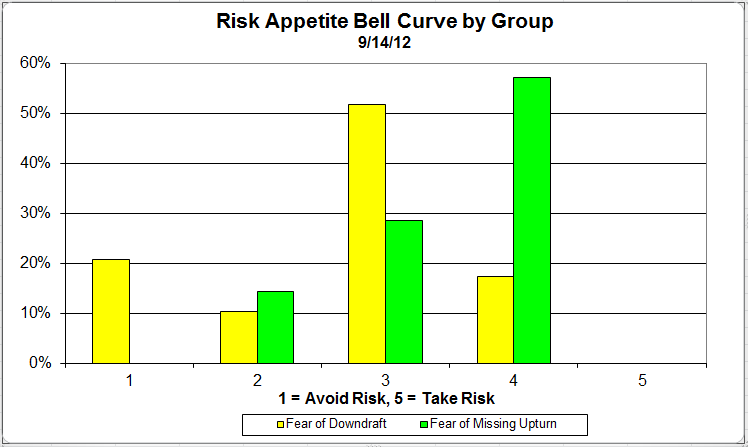
Chart 5: Risk appetite Bell Curve by Group. The next three charts use cross-sectional data. The chat plots the reported client risk appetite separately for the fear of downdraft and for the fear of missing upturn groups. This chart sorts out as expected, with the downturn group wanting less risk and the upturn group looking to add risk.

avgriskappgroup 31 Dorsey Wright Client Sentiment Survey Results   9/14/12

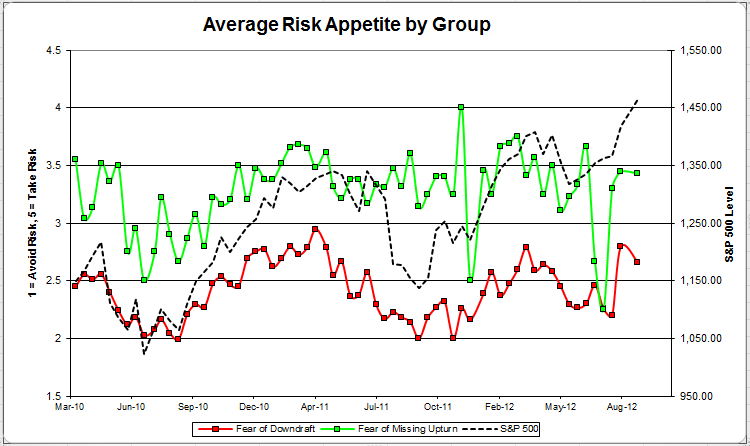
Chart 6: Average Risk Appetite by Group. The average risk appetite of both groups decreased this week, even as the market did well. Both groups want to add less risk relative to the last survey.

riskappspread 45 Dorsey Wright Client Sentiment Survey Results   9/14/12

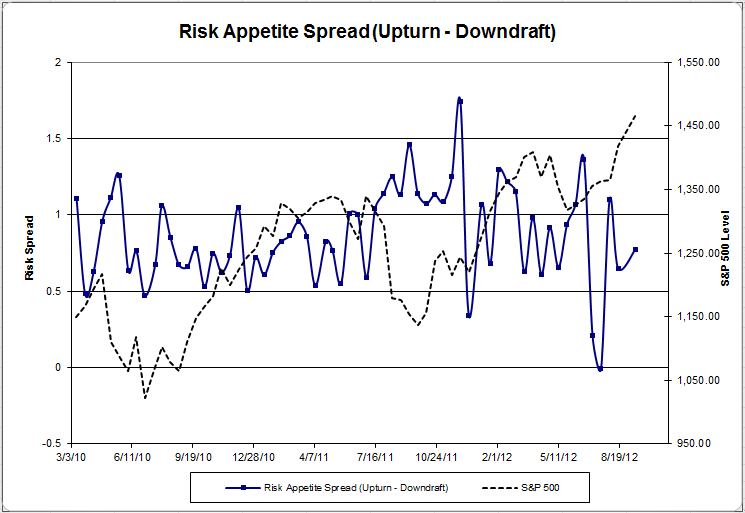
Chart 7: Risk Appetite Spread. This is a chart constructed from the data in Chart 6, where the average risk appetite of the downdraft group is subtracted from the average risk appetite of the missing upturn group. The spread is now back in its normal range.

The S&P 500 rallied over 3% from survey to survey, and none of our indicators performed as expected. The overall fear numbers moved in the opposite direction, and the overall risk appetite number as fell in the face of a rising market. We have seen this before though; unfortunately there is no crystal ball.

No one can predict the future, as we all know, so instead of prognosticating, we will sit back and enjoy the ride. A rigorously tested, systematic investment process provides a great deal of comfort for clients during these types of fearful, highly uncertain market environments. Until next time, good trading and thank you for participating.

Posted by:


Millionaire Status Is Fleeting

September 24, 2012

Interesting data on millionaires published by James Pethokoukis of the American Enterprise Institute:

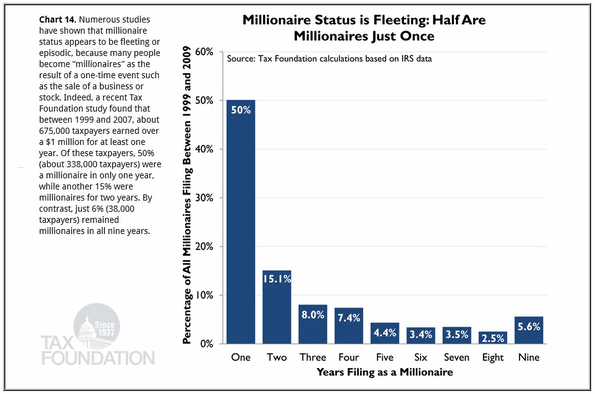
taxfoundation Millionaire Status Is Fleeting

Numerous studies have shown that millionaire status appears to be fleeting or episodic, because many people become “millionaires” as the result of a one-time even such as the sale of a business or stock. Indeed, a recent Tax Foundation study found that between 1999 and 2007, about 675,000 taxpayers earned over $1 million for at least one year. Of these taxpayers, 50% (about 338,000 taxpayers) were a millionaire in only one year, while another 15% were millionaires for two years. By contrast, just 6% (38,000 taxpayers) remained millionaires in all nine years.

This data made me think of the saying that “neither success nor failure is permanent.” Of course, many of these people could have dropped below millionaire status, but remained very high earners. That said, this does underscore the importance of not squandering a big pay day. Sadly, this seems to have been lost on many professional athletes as one recent study estimated that 78% of NFL players are bankrupt or in severe financial distress within two years of retirement and 60% of NBA players are broke within five years of retirement.

Posted by:


Weekly RS Recap

September 24, 2012

The table below shows the performance of a universe of mid and large cap U.S. equities, broken down by relative strength decile and quartile and then compared to the universe return. Those at the top of the ranks are those stocks which have the best intermediate-term relative strength. Relative strength strategies buy securities that have strong intermediate-term relative strength and hold them as long as they remain strong.

Last week’s performance (9/17/12 – 9/21/12) is as follows:

High RS stocks held up better than the universe last week. The laggards had a sharp pullback with the bottom quartile off over three percent for the week.

Posted by:


What Scares Investors To Death

September 21, 2012

Suzanne McGee, The Fiscal Times, highlights investor’s dilemma:

Right now, there appear to be few “good” options available. As Nixon points out, the devil’s dilemma is that investors are being forced to choose between ensuring the return of their capital and having a return on their capital. Risk aversion today is completely rational – but that doesn’t matter when you’re trying to fight the Fed. Just because you are capitulating doesn’t mean that you are completely powerless; you may have to put your portfolio into risk assets to preserve its purchasing power, but it’s up to you to select which risk assets will pay off.

The part that I put in bold is what scares investors to death—the part about having to choose which assets to invest in. The fear of being wrong paralyzes investors. A wide range of compelling arguments are made constantly about the issues of the day. It can become very easy to feel completely confused about where to invest…unless you have a plan. Relative strength provides a logical framework for allocating assets in a global portfolio. It cuts out all of the conjecture and just systematically reacts to the market with the goal of capitalizing on market trends. Reliance on a logical game plan is essential in order to successfully navigate the global financial markets.

Here is how different investments have done over the past 12 months, 6 months, and month.

1PowerShares DB Gold, 2iShares MSCI Emerging Markets ETF, 3iShares DJ U.S. Real Estate Index, 4iShares S&P Europe 350 Index, 5Green Haven Continuous Commodity Index, 6iBoxx High Yield Corporate Bond Fund, 7JP Morgan Emerging Markets Bond Fund, 8PowerShares DB US Dollar Index, 9iBoxx Investment Grade Corporate Bond Fund, 10PowerShares DB Oil, 11iShares Barclays 20+ Year Treasury Bond

HT: Real Clear Markets

Posted by:


Stock Market Perception vs. Reality

September 21, 2012

It’s no secret that investors have had a fairly negative outlook toward the stock market lately. Their negative perception shows up both in flow of funds data and in our own advisor survey of investor sentiment.

One possible—and shocking—reason for the negative sentiment may be that the public thinks the stock market has been going down!

Investment News profiled recent research done by Franklin Templeton Funds. Here is the appropriate clip, which is just stunning to me:

One surprising finding shows that investors are likely so consumed by the negative economic news, including high unemployment and the weak housing market, that they haven’t even noticed the strength of the stock market.

For example, when 1,000 investors were asked whether they thought the S&P was up or down during each of the past three years, 66% thought it was down in 2009, 48% thought it was down in 2010, and 53% thought it was down last year.

In fact, the S&P gained 26.5% in 2009, 15.1% in 2010, and 2.1% last year.

That blows me away. I have never seen a clearer case of the distinction between perception and reality. This data shows clearly that many investors act on their perceptions—that the market has been declining for years—not the reality, which has been a choppy but steadily rising market.

The stock market is ahead again year-to-date and money is continuing to flow out of equity mutual funds. I understand that the market is scary sometimes and difficult always, but really? It amazes me that so many investors think the stock market has been dropping when it has actually been going up. Of course, perhaps investors’ aggregate investment decisions are more understandable when it becomes clear that only a minority of them are in touch with reality!

Advisors obviously have a lot of work to do with anxious clients. The stock market historically has been one of the best growth vehicles for investors, but it won’t do them any good if they choose to stay away. Some of the investor anxiety might be lessened if advisors stick with a systematic investment process using relative strength—and least that way, the client is assured that money will only be moved toward the strongest assets. If stocks really do have a long bear market, as is the current perception, clients may be somewhat shielded from it.

Posted by:


Sector and Capitalization Performance

September 21, 2012

The chart below shows performance of US sectors and capitalizations over the trailing 12, 6, and 1 month(s). Performance updated through 9/20/2012.

Posted by:


Fund Flows

September 20, 2012

The Investment Company Institute is the national association of U.S. investment companies, including mutual funds, closed-end funds, exchange-traded funds (ETFs), and unit investment trusts (UITs). Flow estimates are derived from data collected covering more than 95 percent of industry assets and are adjusted to represent industry totals.

Posted by:


Why Is Trading So Hard?

September 20, 2012

Indeed, why is trading so hard? Adam Grimes of Waverly Advisors addresses exactly this issue in blog post. This is one of the most articulate expositions of the problems investors face with their own behavior that I have ever read.

What is it about markets that encourages people to do exactly the wrong thing at the wrong time, and why do many of the behaviors that serve us so well in other situations actually work against us in the market?

Part of the answer lies in the nature of the market itself. What we call “the market” is actually the end result of the interactions of thousands of traders across the gamut of size, holding period, and intent. Each trader is constantly trying to gain an advantage over the others; market behavior is the sum of all of this activity, reflecting both the rational analysis and the psychological reactions of all participants. This creates an environment that has basically evolved to encourage individual traders to make mistakes. That is an important point—the market is essentially designed to cause traders to do the wrong thing at the wrong time. The market turns our cognitive tools and psychological quirks against us, making us our own enemy in the marketplace. It is not so much that the market is against us; it is that the market sets us against ourselves.

I added the bold. This is just great writing, and powerful because it is true. Really competent people who are fantastic about making life decisions often have a rough time trading in the market, for just the reason Mr. Grimes’ points out.

He comes to the same solution that we have come to: a systematic investment process that can be implemented rigorously. There’s no shortage of robust return factors that offer potential outperformance—the trick is always implementing them in a disciplined way.

Posted by:


High RS Diffusion Index

September 19, 2012

The chart below measures the percentage of high relative strength stocks that are trading above their 50-day moving average (universe of mid and large cap stocks.) As of 9/18/12.

highrsdiffusion zps63e557de High RS Diffusion Index

The 10-day moving average of this indicator is 87% and the one-day reading is 88%.

Posted by:


The Real Effects of Debt

September 19, 2012

From the Bank of International Settlements, research that confirms what Ken Rogoff has been telling us all along. Here’s the abstract:

At moderate levels, debt improves welfare and enhances growth. But high levels can be damaging. When does debt go from good to bad? We address this question using a new dataset that includes the level of government, non-financial corporate and household debt in 18 OECD countries from 1980 to 2010. Our results support the view that, beyond a certain level, debt is a drag on growth. For government debt, the threshold is around 85% of GDP. The immediate implication is that countries with high debt must act quickly and decisively to address their fiscal problems. The longer-term lesson is that, to build the fiscal buffer required to address extraordinary events, governments should keep debt well below the estimated thresholds. Our examination of other types of debt yields similar conclusions. When corporate debt goes beyond 90% of GDP, it becomes a drag on growth. And for household debt, we report a threshold around 85% of GDP, although the impact is very imprecisely estimated.

You can read the whole paper here.

Households really aren’t any different. High levels of debt can impact their solvency also, and threats should be addressed quickly and decisively. Likewise, it’s a good idea to have a fiscal buffer for emergencies.

I’m not sure how quickly and decisively Congress is dealing with national fiscal issues, but you have control of your own response at the household level.

It’s pretty clear that there will be significant investment implications from high levels of debt, whether at the sovereign or corporate level. It’s not clear exactly what those implications will be. In fact, there is still a lot of disagreement about whether taking on more debt in QE3 will help the economy or hurt it. While we have a chance to see if Mr. Rogoff’s theory works in the real world, investors might do well to heed the message sent by relative strength. Theory is interesting, but it may be more profitable to see which asset classes get stronger as a result of continued easing.

Posted by:


Quote of the Week

September 18, 2012

The cult of equity may be dying, but the cult of inflation may only have just begun—-Bill Gross

I don’t know if Mr. Gross will be correct with this forecast—he certainly isn’t always—but it’s worth paying attention to his thinking.

Posted by:


The Problem With Fundamental Data

September 18, 2012

A pointed rant from The Zikomo Letter on the value of fundamental data:

All fundamental data is wrong in some way. Some of it is incorrect, some of it is published by people with a vested interest, and some of it is lies. I am not angry about it, but I think we should face the sometimes harsh reality provided by the Red Pill.

Let us start with company-provided information. If the history of public corporations tells you anything, it is that anything a corporation tells you should be treated as a lie. Sometimes it is deliberately misleading, sometimes it obscures the truth, and sometimes it just lies to your face. If you do not believe me, then I point you to some of those who were caught: Enron and Lehman Bros stick in the mind, but the list is long.

Do not kid yourself that these are the rogues in an otherwise healthy bunch: every public corporation twists and tortures their information to meet their objectives. In a previous life I was a company auditor, and I can attest that there is plenty of scope for maneuver within the law.

Technicians have long looked at fundamental data with healthy suspicion. To be clear, I am not saying that fundamental data is useless. I am sure some are able to use it to their benefit. However, the risk of the “garbage in garbage out” problem with fundamental data is high. One of the great things about relative strength is that it largely avoids this problem by simply reacting to what is happening in the market as opposed to what we are being told is happening.

HT: Abnormal Returns

Posted by:


Relative Strength Spread

September 18, 2012

The chart below is the spread between the relative strength leaders and relative strength laggards (universe of mid and large cap stocks). When the chart is rising, relative strength leaders are performing better than relative strength laggards. As of 9/17/2012:

The RS Spread has declined in recent weeks as the laggards have had the upper hand.

Posted by: