Factor Investing

July 18, 2013

Factor investing is one of the new frontiers in portfolio construction. We love this trend because relative strength (known as momentum to academics) is one of the premier factors typically used when constructing portfolios. The Technical Leaders ETFs that we construct for Powershares have really benefited from the movement toward factor investing.

Larry Swedroe recently wrote a glowing article on factor investing for Index Universe that serves as a good introduction. His article is full of great points distilled from a paper in the Journal of Index Investing. (The link to the journal paper is included in his article if you want to read the original source.)

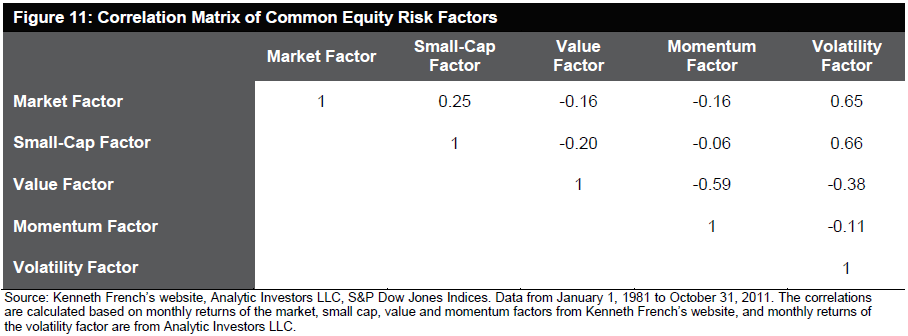
The basic idea is that you can generate superior performance by building a portfolio of return factors. A corollary benefit is that because some of the factors are negatively correlated, you can often reduce the portfolio volatility as well. A couple of excerpts from his article should give you the flavor:

The evidence keeps piling up that investors can benefit from building portfolios that diversify across factors that not only explain stock market returns but that also generate superior returns.

The authors found that investors benefited not only from the exposure to each of the factors individually, but also from the low or negative correlations across these factors. The result was more efficient portfolios than ones that were concentrated in a market portfolio or in single factors.

They concluded: “The fact that momentum and value independently deliver market outperformance, with negatively correlated active returns and a low probability of simultaneous market underperformance, provides the motivation for pursuing a momentum and value diversification strategy.”

We concur with the research that shows momentum and value make a great pairing in a portfolio. The table included in the article showed that these two factors were negatively correlated over the period of the study, 1979-2011.

What brought a smile is that Mr. Swedroe is a well-known and passionate advocate for “passive” investing. Factor investing is about as far from passive investing as you can get.

Think about how a value index or relative strength index is constructed—you have to build it actively, picking and choosing to get the focused factor exposure you want. What is a value stock at the beginning of one period may not be a value stock after an extended run-up in price, so activity is also required to reconstitute and rebalance the index on a regular basis. Stocks that lose their high relative strength ranking similarly need to be actively replaced at every rebalance. Whether the picking and choosing is done in a systematic, rules-based fashion or some other way is immaterial.

Market capitalization-weighted indexes, as a broad generality, might be able to “kinda sorta” claim the passive investing label because they don’t generally have to be constantly rebalanced—although the index component changes are active. A factor index, on the other hand, might require a lot of activity to reconstitute and rebalance it on a regular schedule. But that’s the point—the end result of the activity is focused factor exposure designed to generate superior performance and volatility characteristics.

And spare me the argument that indexing is passive investing. Take a look at the historical level of turnover in indexes like the S&P 500, the S&P Midcap 400, the S&P Smallcap 600, or the Russell 2000 and then try to make the argument that nothing active is going on. I don’t think you can do it. The only real difference is that you have hired the S&P index committee to manage your portfolio instead of some registered investment advisor. (In fact, the index committees typically incorporate some element of relative strength in their decisions as they dump out poor performers and add up-and-coming stocks. Look at the list of additions and deletions if you don’t believe me.) Certainly the level of turnover in a value or momentum index belies the passive label as well.

Index investing is active investing.

I think where passive investing advocates get confused is on the question of cost. Index investing is often low-cost investing—and cost is an important consideration for investors. I suspect that many fans of passive investing are more properly described as fans of low-cost investing. I’m not sure they are really even fans of indexing, since research shows that many so-called actively managed funds are really closet index funds. Presumably their objection is the big fee charged for indexing while masquerading as an active fund, not the indexing itself. (But the same research suggests that an active fund that is truly active—one with high active share—is not necessarily a bad deal.)

Even a factor index is active by definition, but if it is well-constructed and low cost to boot, it might worth taking a close look at.

Posted by:


Stock Market Sentiment Surveys: AAII Edition

July 2, 2013

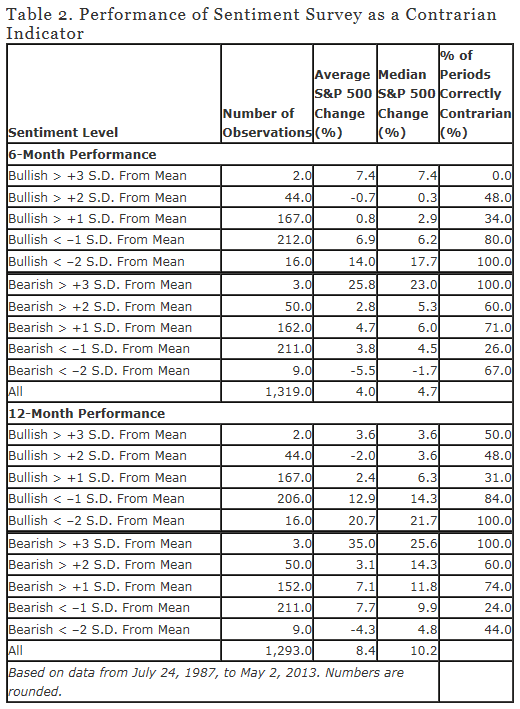
Greenbackd, a deep value blog, had a recent piece on the value of stock market sentiment. Stock market sentiment surveys have been a staple of technical analysis for decades, ever since the advent of Investors Intelligence in the 1960s, so I was curious to read it. The study that Greenbackd referenced was done by Charles Rotblut, CFA. The excerpts from Mr. Rotblut that are cited give the impression that the results from the survey are unimpressive. However, they showed a data table from the article. I’ll reproduce it here and let you draw your own conclusions.

AAIIsentiment zpsb291a50e Stock Market Sentiment Surveys: AAII Edition

Source: Greenbackd (click on image to enlarge)

From Greenbackd, here’s an explanation of what you are looking at:

Each week from Thursday 12:01 a.m. until Wednesday at 11:59 p.m. the AAII asks its members a simple question:

Do you feel the direction of the stock market over the next six months will be up (bullish), no change (neutral) or down (bearish)?

AAII members participate by visiting the Sentiment Survey page (www.aaii.com/sentimentsurvey) on AAII.com and voting.

Bullish sentiment has averaged 38.8% over the life of the survey. Neutral sentiment has averaged 30.5% and bearish sentiment has averaged 30.6% over the life of the survey.

In order to determine whether there is a correlation between the AAII Sentiment Survey and the direction of the market, Rotblut looked at instances when bullish sentiment or bearish sentiment was one or more standard deviations away from the average. He then calculated the performance of the S&P 500 for the following 26-week (six-month) and 52-week (12-month) periods. The data for conducting this analysis is available on the Sentiment Survey spreadsheet, which not only lists the survey’s results, but also tracks weekly price data for the S&P 500 index.

There are some possible methodological problems with the survey since it is not necessarily the same investors answering the question each week (Investors Intelligence uses something close to a fixed sample of newsletter writers), but let’s see if there is any useful information embedded in their responses.

The way I looked at it, even the problematic AAII poll results were very interesting at extremes. When there were few bulls (more than 2 standard deviations from the mean) or tons of bears (more than 3 standard deviations from the mean), the average 6-month and 12-month returns were 2x to 5x higher than normal for the 1987-2013 sample. These extremes were rare—only 19 instances in 26 years—but very useful when they did occur. (And it’s possible that there were really only 16 instances if they were coincident.)

Despite the methodology problems, the data shows that it is very profitable to go against the crowd at extremes. Extremes are times when the emotions of the crowd are likely to be most powerful and tempting to follow—and most likely to be wrong. Instead of bailing out at times when the crowd is negative, the data shows that it is better to add to your position.

HT to Abnormal Returns

Posted by:


Value, Quality, and Momentum in a Single Portfolio

June 5, 2013

Larry Swedroe’s “Look at Value, Quality, and Momentum” article in IndexUniverse is a must-read for anyone looking to understand the benefits of factor-based investing.

One reason that combining the strategies adds value is correlation.

Specifically, signals in gross profits-to-assets and momentum are both negatively correlated with valuation ratios, and profitability and momentum have low correlation. Thus, they hold very different stocks.

Swedroe cites a study by Robert Novy-Marx covering the period 1963-2011 that looked at the results of building a portfolio consisting of a combination of value, profitability, and momentum:

Marx then looked at combining the value and profitability strategies with momentum in a single portfolio. Over the same July 1963-December 2011 period, he found that a dollar invested in the market would have grown to more than $80; a dollar invested in large-cap winners (momentum stocks) would have grown to $597; a dollar invested in cheap large-cap winners would have grown to $411; a dollar invested in profitable, cheap large-cap stocks would have grown to $572 dollars; and a dollar invested in profitable, cheap, large-cap winners would have grown to $955.

Given that trading costs are relatively low in large-caps, even if turnover for a combined strategy was fairly high, the strategy seems to hold great appeal given the size of the premium.

Citing a different paper by AQR Capital also on the topic of combining value, quality, and momentum, Swedroe stated the following:

Another benefit of the core approach is more consistent performance. AQR’s study, which covered the period since 1980 in the U.S. and since 1990 in international markets, found that a simple value portfolio experiences significant five-year periods of underperformance, while the core portfolio effectively eliminates any such episodes, outperforming the market in every five-year period historically.

The key here is that combining different winning return factors—including value, quality, and momentum—has historically greatly benefited an investor both from a cumulative performance perspective and also from a performance consistency perspective. Both cumulative performance and performance consistency are critically important to a client.

Past performance is no guarantee of future results.

Posted by:


The Problem With Intrinsic Value

April 12, 2013

Howard Marks makes a compelling argument for using relative strength (without even referring to relative strength):

“If you are a value investor and you invest whenever you find a stock which is selling for one-third less than your estimate of intrinsic value, and you say, I don’t care about the macro, nor what I call the temperature of the market, then you are acting as if the world is always the same and the desirability of making investments is always the same. But the world changes radically, and sometimes the investing world is highly hospitable (when the prices are depressed) and sometimes it is very hostile (when prices are elevated).

“I guess what you are saying is we just look at the micro; we look at them one stock at a time; we buy them whenever they are cheap. I can’t argue with that. On the other hand, it is much easier to make money when the world is depressed, because when it stops being depressed, it’s like a compressed spring that comes back.

“…I think it is unrealistic and maybe hubristic to say, ‘I don’t care about what is going on in the world. I know a cheap stock when I see one.’ If you don’t follow the pendulum and understand the cycle, then that implies that you always invest as much money as aggressively. That doesn’t make any sense to me. I have been around too long to think that a good investment is always equally good all the time regardless of the climate.”

Buyers and sellers respond to the very same fundamental factors in very different ways depending on the environment. A stock can be cheap (and get cheaper) for a long period of time until which time as there are more buyers than sellers and the price begins to rise. Relative strength doesn’t even make an attempt to estimate intrinsic value. To a relative strength strategy, the concept of intrinsic value is meaningless. A security is worth whatever the market says it’s worth. Relative strength models simply allocate to the strongest trends in the market and therefore avoid the potential problems of sitting around waiting for the market to come around to your way of thinking.

As Marks correctly points out, the world changes radically over time. However, one constant is the law of supply and demand.

HT: Business Insider

Posted by:


Investment Manager Selection

April 12, 2013

Investment manager selection is one of several challenges that an investor faces. However, if manager selection is done well, an investor has only to sit patiently and let the manager’s process work—not that sitting patiently is necessarily easy! If manager selection is done poorly, performance is likely to be disappointing.

For some guidance on investment manager selection, let’s turn to a recent article in Advisor Perspectives by C. Thomas Howard of AthenaInvest. AthenaInvest has developed a statistically validated method to forecast fund performance. You can (and should) read the whole article for details, but good investment manager selection boils down to:

  • investment strategy
  • strategy consistency
  • strategy conviction

This particular article doesn’t dwell on investment strategy, but obviously the investment strategy has to be sound. Relative strength would certainly qualify based on historical research, as would a variety of other return factors. (We particularly like low-volatility and deep value, as they combine well with relative strength in a portfolio context.)

Strategy consistency is just what it says—the manager pursues their chosen strategy without deviation. You don’t want your value manager piling into growth stocks because they are in a performance trough for value stocks (see Exhibit 1999-2000). Whatever their chosen strategy or return factor is, you want the manager to devote all their resources and expertise to it. As an example, every one of our portfolio strategies is based on relative strength. At a different shop, they might be focused on low-volatility or small-cap growth or value, but the lesson is the same—managers that pursue their strategy with single-minded consistency do better.

Strategy conviction is somewhat related to active share. In general, investment managers that are willing to run relatively concentrated portfolios do better. If there are 250 names in your portfolio, you might be running a closet index fund. (Our separate accounts, for example, typically have 20-25 positions.) A widely dispersed portfolio doesn’t show a lot of conviction in your chosen strategy. Of course, the more concentrated your portfolio, the more it will deviate from the market. For managers, career risk is one of the costs of strategy conviction. For investors, concentrated portfolios require patience and conviction too. There will be a lot of deviation from the market, and it won’t always be positive. Investors should take care to select an investment manager that uses a strategy the investor really believes in.

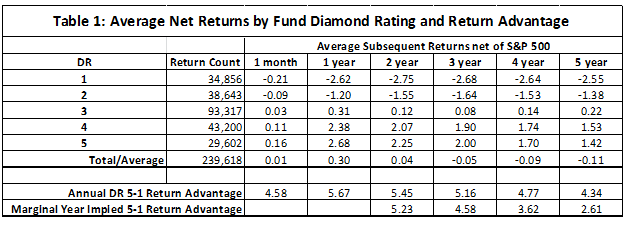
AthenaInvest actually rates mutual funds based on their strategy consistency and conviction, and the statistical results are striking:

The higher the DR [Diamond Rating], the more likely it will outperform in the future. The superior performance of higher rated funds is evident in Table 1. DR5 funds outperform DR1 funds by more than 5% annually, based on one-year subsequent returns, and they continue to deliver outperformance up to five years after the initial rating was assigned. In this fashion, DR1 and DR2 funds underperform the market, DR3 funds perform at the market, and DR4 and DR5 funds outperform. The average fund matches market performance over the entire time period, consistent with results reported by Bollen and Busse (2004), Brown and Goetzmann (1995) and Fama and French (2010), among others.

Thus, strategy consistency and conviction are predictive of future fund performance for up to five years after the rating is assigned.

The bold is mine, as I find this remarkable!

I’ve reproduced a table from the article below. You can see that the magnitude of the outperformance is nothing to sniff at—400 to 500 basis points annually over a multi-year period.

diamondratings zps3970f53e Investment Manager Selection

Source: Advisor Perspectives/AthenaInvest (click on image to enlarge)

The indexing crowd is always indignant at this point, often shouting their mantra that “active managers don’t outperform!” I regret to inform them that their mantra is false, because it is incomplete. What they mean to say, if they are interested in accuracy, is that “in aggregate, active managers don’t outperform.” That much is true. But that doesn’t mean you can’t locate active managers with a high likelihood of outperformance, because, in fact, Tom Howard just demonstrated one way to do it. The “active managers don’t outperform” meme is based on a flawed experimental design. I tried to make this clear in another blog post with an analogy:

Although I am still 6’5″, I can no longer dunk a basketball like I could in college. I imagine that if I ran a sample of 10,000 random Americans and measured how close they could get to the rim, very few of them could dunk a basketball either. If I created a distribution of jumping ability, would I conclude that, because I had a large sample size, the 300 people would could dunk were just lucky? Since I know that dunking a basketball consistently is possible–just as Fama and French know that consistent outperformance is possible–does that really make any sense? If I want to increase my odds of finding a portfolio of people who could dunk, wouldn’t it make more sense to expose my portfolio to dunking-related factors–like, say, only recruiting people who were 18 to 25 years old and 6’8″ or taller?

In other words, if you look for the right characteristics, you have a shot at finding winning investment managers too. This is valuable information. Think of how investment manager selection is typically done: “What was your return last year, last three years, last five years, etc.?” (I know some readers are already squawking, but the research literature shows clearly that flows follow returns pretty closely. Most “rigorous due diligence” processes are a sham—and, unfortunately, research shows that trailing returns alone are not predictive.) Instead of focusing on trailing returns, investors would do better to locate robust strategies and then evaluate managers on their level of consistency and conviction.

Posted by:


Smart Beta vs. Monkey Beta

April 9, 2013

Andy wrote a recent article entitled Smart Beta Gains Momentum. It’s gaining momentum for a good reason! A recent study at Cass Business School in London found that cap-weighting was not a very good way to construct an index. Lots of methods to get exposure to smart beta do better. The results were discussed in an article at Index Universe. Some excerpts:

Researchers have found that equity indices constructed randomly by ‘monkeys’ would produce higher risk-adjusted returns than an equivalent market capitalisation-weighted index over the last 40 years…

The findings come from a recent study by Cass Business School (CBS), which was based on monthly US share data from 1968 to 2011. The authors of the study found that a variety of alternative index weighting schemes all delivered superior returns to the market cap approach.

According to Dr. Nick Motson of CBS, co-author of the study, “all of the 13 alternative indices we studied produced better risk-adjusted returns than a passive exposure to a market-cap weighted index.”

The study included an experiment that saw a computer randomly pick and weight each of the 1,000 stocks in the sample. The process was then repeated 10 million times over each of the 43 years. Clare describes this as “effectively simulating the stock-picking abilities of a monkey”.

…perhaps most shockingly, we found that nearly every one of the 10 million monkey fund managers beat the performance of the market cap-weighted index,” said Clare.

The findings will be a boost to investors already looking at alternative indexing. Last year a number of European pension funds started reviewing their passive investment strategies, switching from capitalisation-weighting to alternative index methodologies.

Relative strength is one of the prominent smart beta methodologies. Of course, cap-weighting has its uses—the turnover is low and rebalancing is minimized. But purely in terms of performance, the researchers at Cass found that there are better ways to do things. Now that ETFs have given investors a way to implement some of these smart beta methods in a tax-efficient, low-cost manner, I suspect we will see more movement toward smart beta in the future.

Posted by:


The Ridiculous Efficient Frontier

March 22, 2013

It’s hard to believe this paper was not written ironically. Perhaps I am missing the author’s sense of dry humor? In a paper entitled Principal Component Analysis of Time Variations in the Mean-Variance Efficient Frontier, author Andreas Steiner subjects mean-variance optimization to principal component analysis, a mathematical way to determine the relative importance of factors. He extracted three important factors that determine the efficient frontier. The three factors together explained 99% of the shape of the efficient frontier.

In fact—and this is the funny part to me-one factor explained 95% of the shape of the efficient frontier. And what was that magic factor?

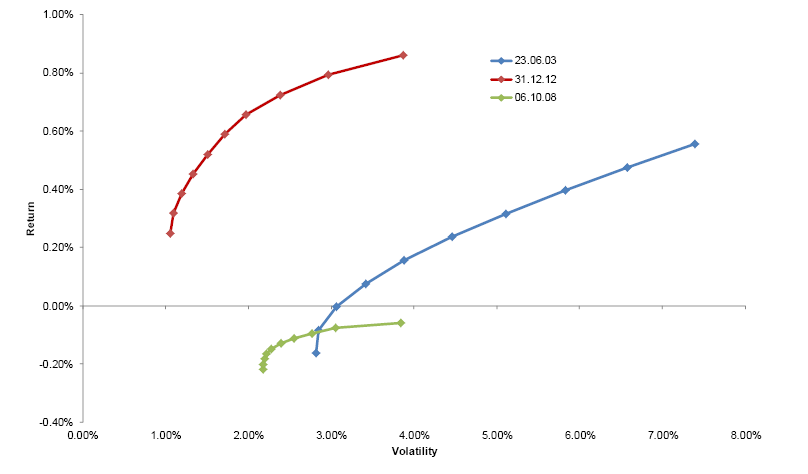
It was the level of returns. In other words, the shape of the efficient frontier depends on the returns of the various assets. If you can predict the returns, you will (mostly) know the shape of the efficient frontier. And, in case you were wondering, the shape of the efficient frontiers varies enormously depending on the time period. Below, for example, is a clip from the paper showing efficient frontiers calculated from trailing data at different times. I’m sure you can see the slight problem—the curves look nothing alike.

ridiculousfrontier zps5d9cf98d The Ridiculous Efficient Frontier

The Ridiculous Frontier

Source: Andreas Steiner/SSRN (click on image to enlarge)

The author writes:

We find that the level factor is highly correlated with average asset returns.

We interpret this result as evidence that successful investment management is mainly driven by return estimates and not “risk management” as has been in the spotlight since the Financial Crisis.

Here’s the immediate question that occurs to my feeble brain, although I’m guessing most 5th graders would be right there with me: If I could predict the return of each asset, why would I need an efficient frontier? Wouldn’t I just buy the best-performing asset?

Indeed, risk management is no big deal if I simply predict all of the asset returns. We’ve discussed many times before that mean-variance optimization is highly dependent upon returns, although correlations and standard deviation play a supporting role. All of these factors are moving targets, none more so than returns. Mean variance optimization, in practice, is a complete bust because obviously no one can reliably and consistently predict returns.

This kind of study—although mathematically rigorous—is silliness of the first degree. It reminds me certain academic follies, like the professors who wondered if monkeys at typewriters really could reproduce the works of Shakespeare. (The short answer is “no.”)

Modern portfolio theory would be relatively harmless if it remained in academia. However, when investors try to use it to build portfolios, it has the potential to cause a lot of damage. Although it is simply another theory that does not work in practice, it is enshrined in many finance textbooks and still taught to budding practitioners. Is it any wonder that we prefer tactical asset allocation driven by relative strength to guessing at future returns?

HT to CXO Advisory

Posted by:


Target Date Fund Follies

March 7, 2013

Target date and lifecycle funds have taken off since 2006, when they were deemed qualified default investment alternatives in the Pension Protection Act. I’m sure it seemed like a good idea at the time. Unfortunately, it planted the idea that a glidepath that moved toward bonds as the investor moved toward retirement was a good idea. Assets in target date funds were nearly $400 billion at the end of 2011—and they have continued to grow rapidly.

In fact, bonds will prove to be a good idea if they perform well and a lousy idea if they perform poorly. Since 10-year future returns correlate closely with the current coupon yield, prospects for bonds going forward aren’t particularly promising at the moment. I’ve argued before that tactical asset allocation may provide an alternative method of accumulating capital, as opposed to a restrictive target-date glidepath.

A new research paper by Javier Estrada, The Glidepath Illusion: An International Perspective, makes a much broader claim. He looks at typical glidepaths that move toward bonds over time, and then at a wide variety of alternatives, ranging from inverse glidepaths that move toward stocks over time to balanced funds. His findings are stunning.

This lifecycle strategy implies that investors are aggressive with little capital and conservative with much more capital, which may not be optimal in terms of wealth accumulation. This article evaluates three alternative types of strategies, including contrarian strategies that follow a glidepath opposite to that of target-date funds; that is, they become more aggressive as retirement approaches. The results from a comprehensive sample that spans over 19 countries, two regions, and 110 years suggest that, relative to lifecycle strategies, the alternative strategies considered here provide investors with higher expected terminal wealth, higher upside potential, more limited downside potential, and higher uncertainty but limited to how much better, not how much worse, investors are expected to do with these strategies.

In other words, the only real question was how much better the alternative strategies performed. (I added the bold.)

Every strategy option they considered performed better than the traditional glidepath! True, if they were more focused on equities, they were more volatile. But, for the cost of the volatility, you ended up with more money—sometimes appreciably more money. This data sample was worldwide and extended over 110 years, so it wasn’t a fluke. Staying equity-focused didn’t work occasionally in some markets—it worked consistently in every time frame in every region. Certainly the future won’t be exactly like the past, so there is no way to know if these results will hold going forward. However, bonds have had terrific performance over the last 30 years and the glidepath favoring them still didn’t beat alternative strategies over an investing lifetime.

Bonds, to me, make sense to reduce volatility. Some clients simply must have a reduced-volatility portfolio to sleep at night, and I get that. But Mr. Estrada’s study shows that the typical glidepath is outperformed even by a 60/40-type balanced fund. (Balanced funds, by the way, are also designated QDIAs in the Pension Protection Act.) Tactical asset allocation, where bonds are held temporarily for defensive purposes, might also allow clients to sleep at night while retaining a growth orientation. The bottom line is that it makes sense to reduce volatility just enough to keep the client comfortable, but no more.

I’d urge you to read this paper carefully. Maybe your conclusions will be different than mine. But my take-away is this: Over the course of an investing lifetime, it is very important to stay focused on growth.

Posted by:


Quote of the Week

March 4, 2013

The class of those who have the ability to think their own thoughts is separated by an unbridgeable gulf from the class of those who cannot—-Ludwig von Mises

Orthodox thinking will keep you out of trouble. In the investment industry, if you build a client’s portfolio in rigid conformance with Modern Portfolio Theory, your firm will back you and it is unlikely that you will ever be successfully sued, regardless of how horribly things turn out for the client. And make no mistake—building portfolios based on mean variance optimization doesn’t have a very good track record.

Unorthodox thinking, as uncomfortable as it may be for some, is also the only way the human race advances. After all, nearly every current orthodoxy was once out of the mainstream. It’s good to have new ideas bubbling up, prepared to take the place of our current king of the hill if they can demonstrate their worth in practice. (Theory that doesn’t work in practice isn’t much of a theory.)

I’m encouraged to see factor-based investing and broad diversification advancing at the expense of Modern Portfolio Theory. Relative strength tests well as a return factor, as do value and low volatility.


HT to Michael Covel

Posted by:


Timeless Portfolio Lessons

February 1, 2013

The only thing new under the sun is the history you haven’t read yet.—-Mark Twain

Investors often have the conceit that they are living in a new era. They often resort to new-fangled theories, without realizing that all of the old-fangled things are still around mainly because they’ve worked for a long time. While circumstances often change, human nature doesn’t change much, or very quickly. You can generally count on people to behave in similar ways every market cycle. Most portfolio lessons are timeless.

As proof, I offer a compendium of quotations from an old New York Times article:

WHEN you check the performance of your fund portfolio after reading about the rally in stocks, you may feel as if there is a great party going on and you weren’t invited. Perhaps a better way to look at it is that you were invited, but showed up at the wrong time or the wrong address.

It isn’t just you. Research, especially lately, shows that many investors don’t match market performance, often by a wide margin, because they are out of sync with downturns and rallies.

Christine Benz, director of personal finance at Morningstar, agrees. “It’s always hard to speak generally about what’s motivating investors,” she said, “but it’s emotions, basically,” resulting in “a pattern we see repeated over and over in market cycles.”

Those emotions are responsible not only for drawing investors in and out of the broad market at inopportune times, but also for poor allocations to its niches.

Where investors should be allocated, many professionals say, is in a broad range of assets. That will smooth overall returns and limit the likelihood of big losses resulting from an excessive concentration in a plunging market. It also limits the chances of panicking and selling at the bottom.

In investing, as in party-going, it’s often safer to let someone else drive.

This is not ground-breaking stuff. In fact, investors are probably bored to hear this sort of advice over and over—but it gets repeated because investors ignore the advice repeatedly! This same article could be written today, or written 20 years from now.

You can increase your odds of becoming a successful investor by constructing a reasonable portfolio that is diversified by volatility, by asset class, and by complementary strategy. Relative strength strategies, for example, complement value and low-volatility equity strategies very nicely because the excess returns tend to be uncorrelated. Adding alternative asset classes like commodities or stodgy asset classes like bonds can often benefit a portfolio because they respond to different return drivers than stocks.

As always, the bottom line is not to get carried away with your emotions. Although this is certainly easier said than done, a diversified portfolio and a competent advisor can help a lot.

Posted by:


Stocks and the Economy: It’s Complicated

January 15, 2013

Seeking to understand the relationship between the economy and the stock market is a rather complex undertaking. We can certainly argue that the economy impacts corporate earnings in terms of revenues and costs. Stock prices generally reflect investor expectations for future corporate earnings and future economic growth. As a result, one might expect that there is a fairly direct relationship between U.S. GDP growth and U.S. stock market performance. However, it is also generally accepted that the stock market is a leading indicator and its movements should precede U.S. economic growth. Stocks and the economy don’t always move in lockstep. Let’s look at some real life examples and see what conclusions can be drawn.

Consider the following chart which shows U.S. GDP growth since the early 1980s. The shaded areas indicate U.S. recessions.

FRED GDP Stocks and the Economy: Its Complicated

The table below shows GDP growth and stock market performance in the years following the last four recessions.

recession2 Stocks and the Economy: Its Complicated

It can be observed that U.S. economic growth following the most recent recession is weaker than that of the preceding three—and yet the stock market performance was the second highest return of those shown. In other words, the strength of U.S. economic growth has not always been a good indicator of stock market performance. What is driving those returns then? Monetary policy? Fiscal policy? Globalization? A combination of many, many different factors?

At Dorsey Wright, our investment decisions are based on relative strength models that seek to capitalize on trends. We spend little time trying to understand the exact relationship between price movement and the various fundamental factors influencing those price returns. After all, investors are not primarily concerned about making sure that whatever gains or losses they have in their portfolio are symbiotic with the prevailing economic and financial theories of the day. Rather, they want to make as much money as possible given their risk management considerations.

I suspect that many investors are failing to fully take advantage of the returns in the financial markets because they correctly observe the rather weak economic growth and then incorrectly assume that the stock market must necessarily also be doing poorly. The financial markets don’t wait for us to feel good before generating strong returns, nor do they seem to worry much about behaving in a way that fits anyone’s philosophical theories. It’s up to us to respond and seek to profit from whatever the financial markets throw our way. The good news for investors is that the financial markets have a long history of providing ample return (and risk) for investors who are seeking to build and manage wealth.

Source: National Bureau of Economic Research, U.S. Department of Commerce, Global Financial Data

In the table that shows subsequent three-year average GDP growth, I began measuring the three year GDP growth in the first full quarter following the end of the recession, as defined by the National Bureau of Economic Research. S&P 500 returns are total returns, inclusive of dividends. Past performance is no guarantee of future returns.

Posted by:


Relative Strength Everywhere

December 14, 2012

Eric Falkenstein has an interesting argument in his paper Risk and Return in General: Theory and Evidence. He proposes what is essentially a relative strength argument about risk and return. He contends that investors care only about relative wealth and that risk is really about deviating from the social norm. Here is the summary of his draft from the excellent CXO Advisory:

Directly measured risk seldom relates positively to average returns. In fact, there is no measure of risk that produces a consistently linear scatter plot with returns across a variety of investments (stocks, banks, stock options, yield spread, corporate bonds, mutual funds, commodities, small businesses, movies, lottery tickets and bets on horse races).

  • Humans are social animals, and processing of social information (status within group) is built into our brains. People care only about relative wealth.
  • Risk is a deviation from what everyone else is doing (the market portfolio) and is therefore avoidable and unpriced. There is no risk premium.

The whole paper is a 150-page deconstruction of the flaws in the standard model of risk and return as promulgated by academics. The two startling conclusions are that 1) people care only about relative wealth and that 2) risk is simply a deviation from what everyone else is doing.

This is a much more behavioral interpretation of how markets operate than the standard risk-and-return tradeoff assumptions. After many years in the investment management industry dealing with real clients, I’ve got to say that Mr. Falkenstein re-interpretation has a lot going for it. It explains many of the anomalies that the standard model cannot, and it comports well with how real clients often act in relation to the market.

In terms of practical implications for client management, a few things occur to me.

  • Psychologists will tell you that clients respond more visually and emotionally than mathematically. Therefore, it may be more useful to motivate clients emotionally by showing them how saving money and managing their portfolio intelligently is allowing them to climb in wealth and status relative to their peers, especially if this information is presented visually.
  • Eliminating market-related benchmarks from client reports (i.e., the reference to what everyone else is doing) might allow the client to focus just on the growth of their relative wealth, rather than worrying about risk in Falkenstein’s sense of deviation from the norm. (In fact, the further one gets from the market benchmark, the better performance is likely to be, according to studies on active share.) If any benchmark is used at all, maybe it should be related to the wealth levels of the peer group to motivate the client to strive for higher status and greater wealth.

I’m sure there is a lot more to be gleaned from this paper and I’m looking forward to having time to read it again.

Posted by:


Ceiling To Potential Returns, Rather Than A Floor

December 10, 2012

The Globe and Mail on quantitative strategies:

A huge pile of research points to an array of simple numerical stock strategies that boosts returns over the long term. Such methods range from low-ratio value strategies to momentum-oriented schemes.

If the studies are to be believed, it should be easy as pie to make a small fortune on Bay Street. (Even when you don’t start with a large one.) All you have to do is to select a strategy and stick with it, letting the cold, hard numbers determine your buying and selling for you.

Picking a good long-term approach is one thing. But actually following it for a long period is quite another. It turns out that there are more than a few devils in the practical details.

I was recently reminded of a big one when I watched Tobias Carlisle’s informative presentation to the UC Davis MBA Value Investing Class on quantitative techniques. He discussed James Montier’s suggestion that numerical methods might represent a ceiling to potential returns, rather than a floor, for those who tinker with them.

My emphasis added. Anyone who can read can see that the results of momentum strategies are compelling over time. The challenge for those inclined to tinker is resisting the urge to mess with a good model. There are very good reasons for the systematic in Systematic Relative Strength.

HT: Abnormal Returns

Posted by:


Nimble Enough to Adapt?

December 4, 2012

Institutional Investor says that the Australian dollar is no longer a risk-on currency:

currencies Nimble Enough to Adapt?

If true, will investors be nimble enough to adapt? Certain securities or asset classes can exhibit a given risk profile for an extended period of time…until they don’t. It can be a very risky proposition to say “this” is a safe asset class, “this” one is risky, “this” one goes up when “this” one goes down…

Alternatively, relative strength approaches asset allocation from the perspective of a meritocracy: Does its relative strength justify inclusion in the portfolio? If so, it’s in (or overweighted); if not, it’s out (or underweighted).

Dorsey Wright does not currently have a position in the Australian dollar. A list of all holding for the trailing 12 months is available upon request.

Posted by:


Fed Model Casualty of Paradigm Shift

November 30, 2012

The Economist details the Fed Model’s reversal of fortune:

If you invested in equities in the 1990s, you were bound to hear, sooner or later, about the “Fed model”. This, I should hasten to add, was not the official position of the Federal Reserve but the name given to a relationship found by three economists between Treasury bond yields and stockmarket valuations. Lower bond yields lead to higher price-earnings ratios or, if you invert the latter, lower earnings yields. Those who thought that equities were ridiculously overvalued in the late 1990s were told that they “just didn’t get it”.

The idea was fairly simple. The present value of a stock was its future cashflows, discounted at some rate that was derived from the bond market. The lower the discount rate, the higher the present value. The brilliant thing about this measure, from the bulls’ point of view, was that it was based on the prospective earnings ratio. So you could forecast rapid earnings growth, thereby lowering the prospective p/e, and claim that the market was “cheap”. At the level of individual stocks, the trick was even simpler - investment banks needed to show that a stock was cheap in order to sell it. So they simply persuaded analysts to forecast future earnings growth that was sufficiently high to make the prospective p/e look cheap.

If you look at the chart, you can see that the Fed model did appear to work for about 15 years, and then it didn’t. The two ratios have gone their separate ways over the last decade; low bond yields have not meant higher stock valuations, but the reverse.

fed model Fed Model Casualty of Paradigm Shift

Ah, the beauty of trend following. Conceptually simple, but effective. Sure, it goes through periods of being out of sync with the market, but the risk of trend following fundamentally breaking (like the Fed Model apparently has) is remote.


Posted by:


Yet Another Blow to Modern Portfolio Theory

November 19, 2012

Modern Portfolio Theory is predicated on the ability to construct an efficient frontier based on returns, correlations, and volatility. Each of these parameters needs to be accurate for the efficient frontier to be accurate. Since forecasting is tough, often historical averages are used. Since the next five or ten years is never exactly like the last 50 years, that method has significant problems. Apologists for modern portfolio theory claim that better efficient frontiers can be generated by estimating the inputs. Let’s imagine, for a moment, that this can actually be done with some accuracy.

There’s still a big problem. Volatility bumps up during adverse market conditions, as reported by Research Affiliates. And correlations change during declines—and not in a good way.

From the abstract of a recent paper, Quantifying the Behavior of Stock Correlations Under Market Stress:

Understanding correlations in complex systems is crucial in the face of turbulence, such as the ongoing financial crisis. However, in complex systems, such as financial systems, correlations are not constant but instead vary in time. Here we address the question of quantifying state-dependent correlations in stock markets. Reliable estimates of correlations are absolutely necessary to protect a portfolio. We analyze 72 years of daily closing prices of the 30 stocks forming the Dow Jones Industrial Average (DJIA). We find the striking result that the average correlation among these stocks scales linearly with market stress reflected by normalized DJIA index returns on various time scales. Consequently, the diversification effect which should protect a portfolio melts away in times of market losses, just when it would most urgently be needed.

I bolded the part that is most inconvenient for modern portfolio theory. By the way, this isn’t really cutting edge. The rising correlation problem isn’t new, but I find it interesting that academic papers are still being written on it in 2012.

The quest for the magical efficient portfolio should probably be ended, especially since there are a number of useful ways to build durable portfolios. We’re just never going to get to some kind of optimal portfolio. Mean variance optimization, in fact, turns out to be one of the worst methods in real life. We’ll have to make do with durable portfolio construction. It may be messy, but a broadly diversified portfolio should be serviceable under a broad range of market conditions.

Posted by:


Factor-Based Investing Continued

November 14, 2012

IndexUniverse recently profiled two relatively new value ETFs (TILT and VLU):

Who needs another value-oriented ETF? Maybe you.

SSgA launched the SPDR S&P 1500 Value Tilt ETF (NYSEArca: VLU) in late October, bringing a second choice to a somewhat-overlooked corner of the U.S. equity space.

VLU, along with the more-established FlexShares Morningstar U.S. Market Factor Tilt ETF (NYSEArca: TILT), aren’t your typical value funds. VLU just launched and TILT is a $150 million fund that came to market about a year ago.

The typical style fund sorts the equity universe into value and growth stocks using fundamental ratios. These ratios can include price-to-earnings and price-to-book among others. But, the most basic distinction is that the typical value funds hold some stocks but not others. For example, an S&P 500 value fund might hold about 250 stocks.

Funds like VLU and TILT use a different approach. They hold all of the stocks in the universe but give the value stocks more weight.

This is good news that more factor-based ETFs are coming to market. In fact, I hope to see even more variations of value-based ETFs launched because it presents a great opportunity for investors who are looking to diversify by return factors as opposed to by style box. Our criticism of style box investing is that, because style boxes tend to be highly correlated, the diversification benefits are limited. Readers can click here to read different articles that we have written over the years about the potential benefits of combining relative strength (a trend continuation strategy) and value (a mean reversion strategy).

There isn’t yet much price history for VLU, but TILT has now been out for over a year. Using monthly returns, I was interested to see that PDP (DWA Technical Leaders ETF) and TILT have had a correlation of excess returns of -0.07. Not bad, but I look forward to finding value ETFs that have an even lower correlation of excess returns to relative strength. Finding different winning return factors that also have negative correlation of excess returns looks to be very promising for investors who are seeking to build diversified portfolios.

See www.powershares.com for more information about PDP.


Posted by:


Durable Portfolio Construction

November 14, 2012

Durable portfolio construction comes from diversification, but diversification can mean a lot of different things. Most investors, unfortunately, give portfolio construction very little thought. As a result, their portfolios are not durable. In fact, they tend to come unglued during every downturn. Why does that happen?

I think there are a couple of inter-related problems.

  • Volatility tends to increase during downturns
  • Certain correlations tend to increase during declines

Volatility is an artifact of uncertainty. Once a downturn starts, no one is sure where the bottom is. That uncertainty often creates selling, which may cause the market to decline, which in turn may create more selling. We’ve all seen this happen. Eventually there is capitulation and the market bottoms, but it can be quite frightening in the middle of the move when no one knows where the bottom will be.

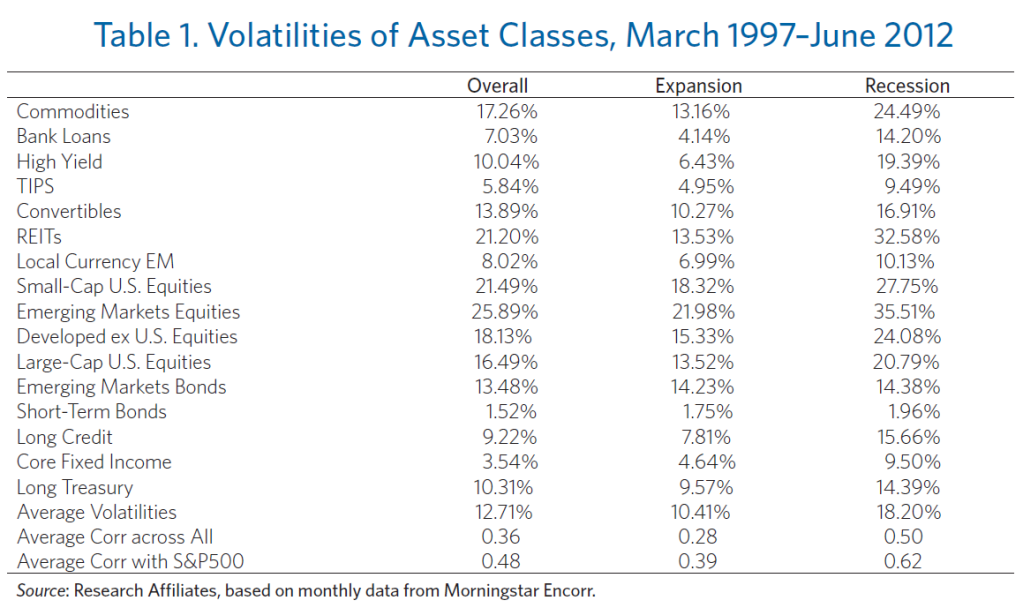
Research Affiliates had a recent article on diversification, and included in it was a table that showed the change in volatility that accompanied recessions. The bump is typically pretty large.

volatility rafi Durable Portfolio Construction

Source: Research Affiliates, via RealClearMarkets (click to enlarge image)

In general, riskier assets had the biggest jumps in volatility when the economy was under pressure. Thus, it makes perfect sense how a relatively sedate portfolio under typical conditions becomes much more volatile when conditions are tough.

Correlations are also observed to rise during declines. ”Risk on” assets, especially, often have rising correlations among themselves as risk is shunned. Similarly, “risk off” assets may see their internal correlations rise. However, it may be the case that correlations between dissimilar asset classes don’t change nearly as much. In other words, risk-on and risk-off assets might not have rising correlations during a period of market stress. In fact, it wouldn’t be surprising to see those correlations actually fall. So, one way to make portfolios more durable is to diversify by volatility.

There are probably multiple ways to do this. You could use volatility buckets for low-volatility assets like bonds and high-volatility assets like stocks. Or, you could just make sure that your portfolios have exposure to a broad range of asset classes, including asset classes with different responses to market stress.

Within an individual asset class, you are likely to see rising correlations between members of your investment universe. For example, during a sharp market decline, you’re likely to see increasing correlations among stocks. However, it’s possible to think about diversifying by return factor within an asset class.

AQR and others have shown, for example, that the excess returns of value and relative strength stocks are uncorrelated. That means that years where relative strength outperforms the market are likely to be years when value lags, and vice versa. Both types of stocks might go up in a rising market or fall in a declining market, but they will likely have different performance profiles. Diversifying by using complementary strategies is another way to make portfolios more durable.

As Research Affiliates points out, simple diversification is not a panacea. As their table shows, almost every asset class (possible exception: short-term bonds) has higher volatility in a bad economy.

Durable portfolio construction, then, might consist of multiple forms of diversification:

  • diversification by volatility
  • diversification by asset class
  • diversification by strategy

While there might be rising correlations between some types of assets, you are also likely to see falling correlations between others. Although the entire portfolio might have an elevated level of volatility, an absence of surging cross-correlations might make tail events a little more manageable. Good portfolio construction obviously won’t eliminate market risk, but it might make regular market volatility a little more palatable for a broad range of investors.

Posted by:


What You Don’t Own

October 31, 2012

Did you know that Japan made up approximately 60% of the MSCI EAFE Index in 1989? It’s true. Even today, Japan makes up about 20 percent of the MSCI EAFE Index. The horror show for Japanese equities since its 1989 peak is shown below:

japan2 What You Dont Own

Source: Yahoo! Finance

Relative strength strategies are often known for their ability to own the strong areas of the market, but just as important as what you own is what you don’t own. Current exposure to Japan in the PowerShares DWA Developed Markets Technical Leaders ETF (PIZ) is shown below:

piz 4 What You Dont Own

Japan is currently our biggest underweight.

See www.powershares.com for more details.

Posted by:


Net Wealth Shock and Portfolio Diversification

October 19, 2012

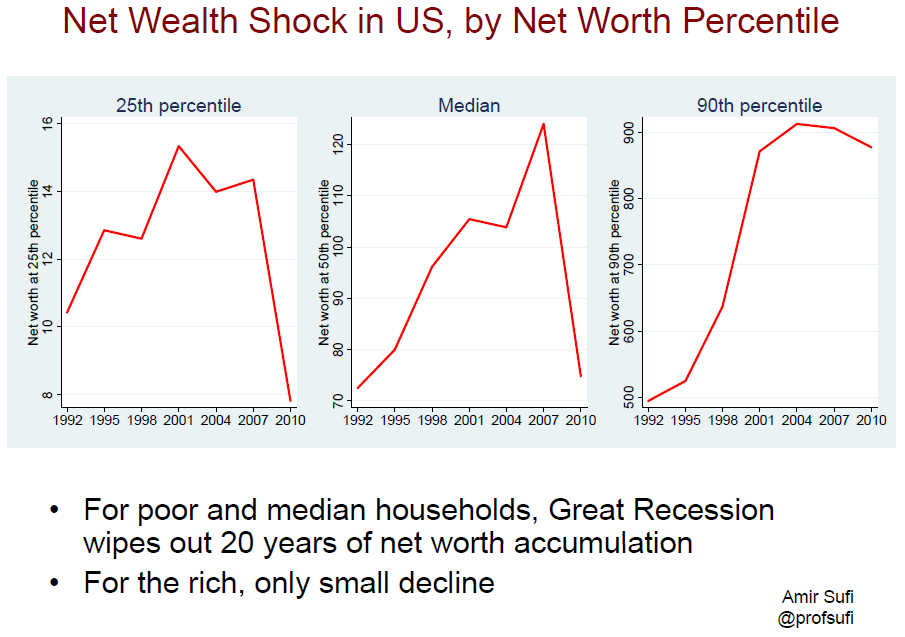
Professor Amir Sufi (University of Chicago Booth School of Business) is an interesting researcher. He recently tweeted a picture of what he called “net wealth shock” to show how the recession had affected various families. It’s reproduced below, but in effect, it shows that low and median net worth families have had a large negative impact from the recession while high net worth families have been impacted much less. I think portfolio diversification has everything to do with it.

netwealthshock Net Wealth Shock and Portfolio Diversification

The Effect of Buying One Stock on Margin

Source: Amir Sufi (click on image to enlarge)

For clues to why this happened, consider an earlier paper that Dr. Sufi co-wrote on household balance sheets. I’ve linked to the entire paper here (you should read it for insight into very clever experimental design), but here’s the front end of the abstract:

The large accumulation of household debt prior to the recession in combination with the decline in house prices has been the primary explanation for the onset, severity, and length of the subsequent consumption collapse.

Later in the paper, he reiterates that it is the combination of these two things that is deadly.

The household balance sheet shock in high leverage counties came from two sources: high ex ante debt levels and a large decline in house prices. One natural question to ask is: could the decline in house prices alone explain the collapse in consumption in these areas?

Our answer to this question is a definitive no-it was the combination of house price declines and high debt levels that drove the consumption decline.

And he and his co-authors, through clever data analysis, proceed to explain why they believe that to be the case.

Now consider what this is saying from a portfolio management point of view: why was the impact of falling home prices so devastating to low and median net worth households?

The negative impact came primarily from lack of diversification. Low and median net worth households had essentially one stock on margin. I know people don’t think they are buying their house on margin, but the net effect of a home loan—magnifying gains and losses—is the same. When that stock (their house) went south, their net worth went right along with it.

High net worth households were simply better diversified. It’s not that their houses didn’t decline in value also; it’s just that their house was not their only asset. In addition, they were less leveraged.

There are probably a couple of things to take away from this.

  • Diversify broadly. It’s no fun to have everything in one asset when things go wrong, whether it’s your house or Enron stock in your pension plan.
  • Debt kills. Having a single asset that nosedives is bad, but having it on margin is disastrous. There’s no room for error with leverage—and no way to wait things out.

Perhaps high net worth families are more diversified simply because they have greater wealth. Maybe they took the same path as everyone else and just got lucky not to have a recession in the middle of their journey. However, I think it’s also worth contemplating the converse: maybe those families achieved greater wealth because they diversified more broadly and opted to use less leverage.

Posted by:


Complementary Strategies: One Key to Diversification

October 18, 2012

We use relative strength (known as “momentum” to academics) in our investment process. We’ve written extensively how complementary strategies like low volatility and value can be used alongside relative strength in a portfolio. S&P is now on board the train, as they show in this research paper how alternative beta strategies are often negatively correlated. In fact, here’s the correlation matrix from the paper:

Altbetacorrelation Complementary Strategies: One Key to Diversification

Source: Standard & Poors (click to enlarge image)

You can see that relative strength/momentum is negatively correlated with both value and low volatility. This is why we prefer diversification through complementary strategies.

They conclude:

…combining alternative beta strategies that are driven by distinct sets of risk factors may help to reduce the active risk and improve the information ratio.

Diversification is important for portfolios, but it’s not easily achieved. For example, if you decide to segment the market by style box rather than by return factors, you will find that the style boxes are all fairly correlated. Although it’s a mathematical truism that anything that isn’t 100% correlated will help diversification, diversification is far more efficient when correlations are low or negative.

We think using factor returns to identify complementary strategies is one of the more effective keys to diversification.

Posted by: