In a world where almost nothing can be predicted with any accuracy, investor behavior is one of the rare exceptions. You can take it to the bank that investors will continue to be driven by impatience, social conformity, conventional wisdom, fear, greed and a confusion of volatility with risk. By standing apart and being driven solely by the facts, the value investor can take advantage of the opportunities caused by those behaviors—and be in the optimal position to create and preserve wealth.
His article was focused on value investing, but I think it is equally applicable to relative strength investing. In fact, maybe even more so, as value investors often differ about what they consider a good value, while relative strength is just a mathematical calculation with little room for interpretation.
Mr. Jaffe’s main point—that investors are driven by all sorts of irrational and incorrect cognitive forces—is quite valid. Dozens of studies point it out and there is a shocking lack of studies (i.e., none!) that show the average investor to be a patient, independent thinker devoid of fear and greed.
What’s the best way to take advantage of this observation about investor behavior? I think salvation may lie in using a systematic investment process. If you start with an investment methodology likely to outperform over time, like relative strength or value, and construct a rules-based systematic process to follow for entry and exit, you’ve got a decent chance to avoid some of the cognitive errors that will assail everyone else.
Of course, you will construct your rules during a period of calm and contemplation—but that’s never when rules are difficult to apply! The real test is sticking to your rules during the periods of fear and greed that occur routinely in financial markets. Devising the rules may be relatively simple, but following them in trying circumstances never is! As with most things, the harder it is to do, the bigger the potential payoff usually is.
According to a recent Gallup Poll, most Americans don’t think much of the stock market as a way to build wealth. I find that quite distressing, and not just because stocks are my business. Stocks are equity—and equity is ownership. If things are being done right, the owner should end up making more than the employee as the business grows. I’ve reproduced a table from Gallup’s article below.
Source: Gallup (click on image to enlarge)
You can see that only 37% felt that the stock market was a good way to build wealth—and only 50% among investors with more than $100,000 in assets.
Perhaps investors will reconsider after reading an article from the Wall Street Journal, here republished on Yahoo! Finance. In the article, they asked 40 prominent people about the best financial advice they’d ever received. (Obviously you should read the whole thing!) Two of the comments that struck me most are below:
Charles Schwab, chairman of Charles Schwab Corp.
A friend said to me, Chuck, you’re better off being an owner. Go out and start your own business.
Richard Sylla, professor of the history of financial institutions and markets at New York University
The best financial advice I ever received was advice that I also provided, both to myself and to Edith, my wife. It was more than 40 years ago when I was a young professor of economics and she was a young professor of the history of science. I based the advice on what were then relatively new developments in modern finance theory and empirical findings that supported the theory.
The advice was to stash every penny of our university retirement contributions in the stock market.
As new professors we were offered a retirement plan with TIAA-CREF in which our own pretax contributions would be matched by the university. Contributions were made with before-tax dollars, and they would accumulate untaxed until retirement, when they could be withdrawn with ordinary income taxes due on the withdrawals.
We could put all of the contributions into fixed income or all of it into equities, or something in between. Conventional wisdom said to do 50-50, or if one could not stomach the ups and downs of the stock market, to put 100% into bonds, with their “guaranteed return.”
Only a fool would opt for 100% stocks and be at the mercies of fickle Wall Street. What made the decision to be a fool easy was that in those paternalistic days the university and TIAA-CREF told us that we couldn’t touch the money until we retired, presumably about four decades later when we hit 65.
Aware of modern finance theory’s findings that long-term returns on stocks should be higher than returns on fixed-income investments because stocks were riskier—people had to be compensated to bear greater risk—I concluded that the foolishly sensible thing to do was to put all the money that couldn’t be touched for 40 years into equities.
At the time (the early 1970s) the Dow was under 1000. Now it is around 16000. I’m now a well-compensated professor, but when I retire in a couple of years and have to take minimum required distributions from my retirement accounts, I’m pretty sure my income will be higher than it is now. Edith retired recently, and that is what she has discovered.
Not everyone has the means to start their own business, but they can participate in thousands of existing great businesses through the stock market! Richard Sylla’s story is fascinating in that he put 100% of his retirement assets into stocks and has seen them grow 16-fold! I’m sure he had to deal with plenty of volatility along the way, but it is remarkable how effective equity can be in creating wealth. His wife discovered that her income in retirement—taking the required minimum distribution!—was greater than when she was working! (The italics in the quote above are mine.)
Equity is ownership, and ownership of productive assets is the way to wealth.
The only way that you can know what the future valuation of stocks will be–so as to estimate future returns–is to apply some conception of what’s fair, appropriate, reasonable, normal. But the range of what can be rationalized as fair, appropriate, reasonable, normal is extremely wide, too wide to be useful, and far too wide to provide reliable pushback against a supply-driven market advance.
Say what you will about trend following, but at least the price is not up for debate!
From our analysts in the 12/19/13 Dorsey Wright Daily Equity Report:
The market cares about what it wants, when it wants, and for this reason we find that listening to the market and following its trends is a better approach than trying to adapt an economic premise to a market prayer.
Without an understanding of this reality, the markets can much more frustrating (and less profitable) than they need to be.
One of the ongoing difficulties for investors is finding some kind of simple method for investing. Relative strength is just such a simple method. Even simple methods, however, have to be applied!
…having a plan, even a sub-optimal one, that you can stick to is preferable to having no plan at all. The ongoing challenge for advisors and investors alike is to find a plan that they will not abandon at the first sign of trouble.
That’s an important point. If you can’t follow a method because it is too complex and if you bail in panic during the first downturn, you’re not going to succeed with any method.
Abnormal Returns revisited this theme recently, in connection with a discussion about systems versus optimization. Mr. Viskanta pulled a quote from Scott Adams:
Optimizing is often the strategy of people who have specific goals and feel the need to do everything in their power to achieve them. Simplifying is generally the strategy of people who view the world in terms of systems. The best systems are simple, and for good reason. Complicated systems have more opportunities for failure. Human nature is such that we’re good at following simple systems and not so good at following complicated systems.
This has a great deal of applicability to the investing process. Simple systems are generally more robust than complex systems, and relative strength is about as simple as you can get. Relative strength is not an optimized system—like most simple systems, it will make plenty of mistakes but its simplicity makes it robust. (I would note that Modern Portfolio Theory relies on mean variance optimization to construct the “ideal” portfolio. Optimized systems are both complicated and fragile.)
In practice, complicated systems tend to blow up. Robust systems are generally more resilient to failure, but will certainly struggle from time to time.
Human nature, I think, makes it difficult to follow any system, whether simple or complex, so discipline is also required. Investors will improve their chances for success with a simple, robust methodology and the discipline to stick with it.
Lots of economists have talked about the deleveraging of the consumer and how it has slowed down the economy. Consumers are reducing their debt loads, perhaps because they are uncertain about the future. When consumers feel more confident, they often borrow to buy consumer goods, homes, or to invest in businesses.
Even more important than the debt itself is usually the ability of the consumer to service the debt. The ability to borrow is often fuel for a bull market—at the least, those two data series often move in tandem.
Did you realize that consumer debt service is now as low as before the huge bull market starting in the 1980s? This chart, from the Fed, is the household financial obligations ratio. It’s a ratio of financial obligations to disposable personal income. Financial obligations consist of payments on mortgage debt, consumer debt, auto leases, rental housing, plus homeowner’s insurance and property taxes.
Are you surprised we are at 1982 levels?
(click on image to enlarge)
Periods when the consumer was adding leverage, from 1982-1987, from 1994-2000, and from 2003-2007 were outstanding for the stock market.
Right now, with debt service at a relatively low level, the consumer has the capacity to take on more debt. That’s a lot of fuel for a new bull market. We will have to see going forward whether the consumer has the confidence or propensity to take on more debt. If re-leveraging does start to happen, the stock market could be much better than most expect.
“I can’t buy now—the stock market is at all-time highs.” I’ve heard that, or some version of it, from multiple clients in the last few weeks. I understand where clients are coming from. Their past experience involves waiting too long to buy and then getting walloped. That’s because clients often wait for the bubble phase to invest. Not only is the stock market at all-time highs, but valuations tend to be stretched as well.
Here’s the thing: buying at all-time highs really doesn’t contain much information about whether you are making an investing mistake or not.
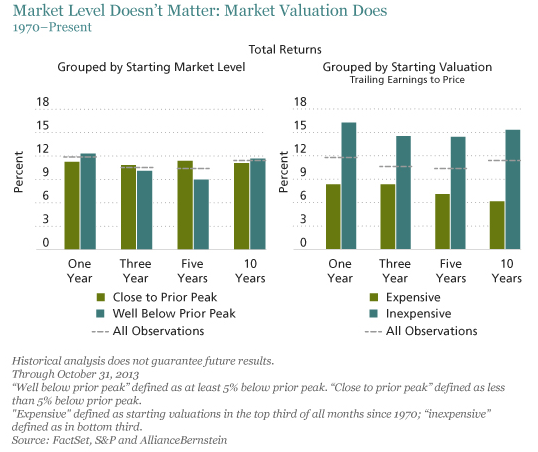
With the US stock market repeatedly reaching all-time highs in recent weeks, many investors are becoming leery of investing in stocks. Focusing on the market’s level is a mistake, in our view. It’s market valuation, not level, that matters.
Since 1900, the S&P 500 Index has been close to (within 5%) of its prior peak almost half the time. There’s a simple reason for this. The stock market goes up over time, along with the economy and corporate earnings.
Fear of investing at market peaks is understandable. In the short term, there’s always the risk that other investors will decide to take gains, or that geopolitical, economic or company-specific news will trigger a market pullback.
But for longer-term investors, market level has no predictive power. Market valuation—not market level—is what historically has mattered to future returns.
They have a nice graphic to show that investing near the high—or not near the high—is inconsequential. They show that future returns are much more correlated to valuation.
Source: Advisor Perspective (click on image to enlarge)
I’m no fundamental analyst, but commentators from Warren Buffett to Ed Yardeni to Howard Marks have suggested that valuations are reasonable, although slightly higher than average. There’s obviously no guarantee that stocks will go up, but you are probably not tap dancing on a landmine. Or let’s put it this way: if the stock market goes down from here, it won’t be because we are at all-time highs. The trend is your friend until it ends.
…talk about the best advice they have even gotten in a short piece from Fortune. I think it clarifies the difference between a blind value investor and an investor who is looking for good companies (not coincidentally, many of those good companies have good relative strength). Warren Buffett and Charlie Munger have made a fortune implementing this advice.
Buffett: I had been oriented toward cheap securities. Charlie said that was the wrong way to look at it. I had learned it from Ben Graham, a hero of mine. [Charlie] said that the way to make really big money over time is to invest in a good business and stick to it and then maybe add more good businesses to it. That was a big, big, big change for me. I didn’t make it immediately and would lapse back. But it had a huge effect on my results. He was dead right.
Munger:I have a habit in life. I observe what works and what doesn’t and why.
I highlighted the fun parts. Buffett started out as a Ben Graham value investor. Then Charlie wised him up.
Valuation has its place, obviously. All things being equal, it’s better to buy cheaply than to pay up. But Charlie Munger had observed that good businesses tended to keep on going. The same thing is typically true of strong stocks—and most often those are the stocks of strong businesses.
Buy strong businesses and stick with them as long as they remain strong.
Another prominent bear throws in the towel. Last week, hedge fund manager Hugh Hendry said the following:
I can no longer say I am bearish. When markets become parabolic, the people who exist within them are trend followers, because the guys who are qualitative have got taken out,
I have been prepared to underperform for the fun of being proved right when markets crash. But that could be in three-and-a-half-years’ time.
I cannot look at myself in the mirror; everything I have believed in I have had to reject. This environment only makes sense through the prism of trends.
I may be providing a public utility here, as the last bear to capitulate. You are well within your rights to say ‘sell’. The S&P 500 is up 30% over the past year: I wish I had thought this last year.
Crashing is the least of my concerns. I can deal with that, but I cannot risk my reputation because we are in this virtuous loop where the market is trending.
Whether Hendry is correct in his theory that there is a disconnect between the fundamentals and the technicals or whether he is just not looking at the right fundamentals is up for debate. Pragmatists, like us, are more comfortable simply following the trends.
Fans of the free lunch will disappointed to find out that option income isn’t really income—it’s just part of the total return stream of an option income strategy. There’s nothing wrong with option income, but a buy-write strategy is just a way to slightly reduce the volatility of an equity portfolio by trading away some of the potential upside. I get concerned when I see articles promoting it as a way to generate extra income, especially when the trade-off is not fully explained.
So far this year more than $3.4 billion in options contracts have changed hands on U.S. exchanges, according to the Options Industry Council in Chicago. That’s almost as much as 2008′s full-year volume and is on pace to be the second-best year in options trading history. The all-time record came in 2011 with $4.6 billion in contracts changing hands.
A buy-write strategy to generate option income might make sense if it is part of a total-return strategy. All too often, investors have the wrong idea.
How big of a dent can it make on a portfolio’s long-term prospects? A lot, says Philip Guziec, a Morningstar analyst who studies various options strategies. He recently looked at six years worth of performance data through April 2010 using the CBOE S&P 500 BuyWrite Index, which follows a strategy of selling call options on the S&P 500 Index every month and reinvesting premiums.
During that period, a covered-call strategy where premiums were reinvested would have increased the portfolio’s return by around 19%. By contrast, spending each month’s options payments resulted in reducing the options portfolio’s value by more than 50%, according to Mr. Guziec.
“Too many people sell covered calls to generate extra income to live on, not realizing how severely that type of a strategy can eat into a portfolio’s upside over time,” he says.
Many investors would be shocked to learn that their portfolio could take a 50% haircut in only six years if they spent the option income! As always, the bottom line is total return.
The main thing that should matter to a long-term investor is real return. Real return is return after inflation is factored in. When your real return is positive, you are actually increasing your purchasing power— and purchasing goods and services is the point of having a medium of exchange (money) in the first place.
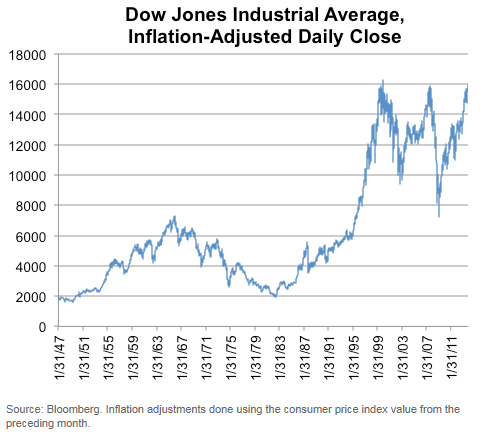
The Dow Jones industrial average broke through 16,000 on Monday for the first time on record — well, at least in nominal terms. If you adjust for inflation, technically the highest level was on Jan. 14, 2000.
Adjusting for price changes, the Dow’s high today was still about 1.3 percent below its close on Jan. 14, 2000 (and about 1.6 percent below its intraday high from that date).
There’s a handy graphic as well, of the Dow Jones Industrial Average adjusted for inflation.
Source: New York Times/Bloomberg
(click on image to enlarge)
This chart, I think, is a good reminder that buy-and-hold (known in our office as “sit-and-take-it”) is not always a good idea. In most market environments there are asset classes that are providing real return, but that asset class is not always the broad stock market. There is value in tactical asset allocation, market segmentation, strategy diversification, and other ways to expose yourself to assets that are appreciating fast enough to augment your purchasing power.
I’ve read a number of pieces recently that contend that “risk-adjusted” returns are the most important investment outcome. Really? This would be awesome if I could buy a risk-adjusted basket of groceries at my local supermarket, but strangely, they seem to prefer the actual dollars. Your client could have wonderful risk-adjusted returns rolling Treasury bills, but would then also get to have a lovely risk-adjusted retirement in a mud hut. If those dollars are growing more slowly than inflation, you’re just moving in reverse.
I’m still getting back into the swing of things after having the flu most of last week. In the midst of my stock market reading, I was struck by an article over the weekend from Abnormal Returns, a blog you should be reading, if you aren’t already. The editor had a selection of the blog posts that were most heavily trafficked from the prior week. Without further ado:
Josh Brown, “If the entities in control of trillions of dollars all want asset prices to be higher at the same time, what the hell else should you be positioning for?” (The Reformed Broker)
Guess what stock has added the most points to the S&P 500 this year? (Businessweek)
Everything you need to know about stock market crashes. (The Reformed Broker)
Jim O’Neil is swapping BRICs for MINTs. (Bloomberg)
I count five of the top ten on the topic of market tops/bubbles/crashes!
Markets tend to top out when investors are feeling euphoric, not when they are tremendously concerned about the downside. In my opinion, investors are still quite nervous—and fairly far from euphoric right now.
Have you ever been to a football game and never seen a punt? Yeah, me neither. You would probably think that coach was crazy. I would have thought so too, but the numbers say otherwise.
It seems like most of the comparisons between advanced statistical metrics in sports and investing have revolved around baseball. This is the first example I have seen of a football coach really thinking outside of the box to give his team a statistical advantage every game. Sure, football coaches have used statistics to game plan and find tendencies, but what this coach is doing goes way beyond that.
How does this relate to investing? This coach has found an edge and relentless exploits the edge no matter what the cost. He knows that statistically he is better off never giving the ball to the other team. He never punts the ball to them. When he kicks off, it is always an onside kick. If the other team wants the ball they have to earn it. He readily admits they only have a 50% fourth down conversion rate so it isn’t like this is some sort of offensive juggernaut that can never be stopped. This coach is wrong a lot. He no doubt looks like a fool quite often. But he has done the math and knows his methods give him a clear statistical advantage to win games over time. It might not work on any given play, series, quarter, or half. Winning investment strategies don’t work every day, week, quarter, or even every year. But over time they do, and the only thing preventing you from realizing those gains buckling under the pressure and failing to execute the strategy. The edges are small, but they add up over time.
Good portfolio management is difficult, while poor portfolio management is almost effortless! In the spirit of David Letterman’s Top Ten list, here is my contribution to the genre of things to avoid, with a special nod to our brand of investing. I made a version of this presentation originally at a 1996 Dorsey Wright Broker Institute.
THE TOP TEN WAYS TO SABOTAGE YOUR PORTFOLIO
1. BE ARROGANT. Assume your competition is lazy and stupid. Don’t do your homework and don’t bother with a game plan. Panic if things don’t go well.
2. WHEN A SECTOR OR THE MARKET REVERSES UP, WAIT UNTIL YOU FEEL COMFORTABLE TO BUY. This is an ideal method for catching stocks 10 points higher.
3. BE AFRAID TO BUY STRONG STOCKS. This way you can avoid the big long-term relative strength winners.
4. SELL A STOCK ONLY BECAUSE IT HAS GONE UP. This is an excellent way to cut your profits short. (If you can’t stand prosperity, trim if you must, but don’t sell it all.)
5. BUY STOCKS IN SECTORS THAT ARE SUPER EXTENDED BECAUSE IT’S DIFFERENT THIS TIME. Not.
6. TRY TO BOTTOMFISH A STOCK IN A DOWNTREND. Instead, jump off a building and try to stop 5 floors before you hit the ground. Ouch.
7. BUY A STOCK ONLY BECAUSE IT’S A GOOD VALUE. There are two problems with this. 1) It can stay a good value by not moving for the next decade, or worse 2) it can become an even better value by dropping another 10 points.
8. HOLD ON TO LOSING STOCKS AND HOPE THEY COME BACK. An outstanding way to let your losses run. Combined with cutting your profits short, over time you can construct a diversified portfolio of losers and register it with the Kennel Club.
9. PURSUE PERFECTION. There are two diseases. 1) Hunting for the perfect method. Trying a new “system” each week will not get you to your goal. It requires remaining focused on one method, maintaining consistency and discipline, and making incremental improvements. 2) Waiting for the perfect trade. The sector is right, the market is supporting higher prices, the chart is good—try to buy it a point cheaper and miss it entirely. Doh. Better to be approximately right than precisely wrong.
10. MAKE INVESTMENT DECISIONS BASED ON A MAGAZINE COVER, MEDIA ARTICLES, OR PUNDITS. Take investment advice from a journalist or a hedge fund manager talking his book! Get fully engaged with your emotions of fear and greed! This is the method of choice for those interested in the fastest route to the poorhouse.
We use a systematic process for investment because we think that’s the best way to go. Our systematic process also happens to be adaptive because we think adaptation to the current market environment is also an important consideration. (If you don’t adapt you die.) Our decision to use a systematic process is grounded in evidence that, over time, systematic processes tend to win out over inconsistent human decision making. (See here, for example.)
In 2012, Julian Baggini, a British philosophy writer and coffee aficionado, wondered why dozens of Europe’s Michelin-starred restaurants were serving guests coffee that came out of vacuum-sealed plastic capsules manufactured by Nespresso. So he conducted a taste test on a small group of experts. A barista using the best, freshly-roasted beans went head to head with a Nespresso capsule coffee brewing machine. It’s the tale of John Henry all over again, only now it was a question of skill and grace rather than brute strength.
As the chefs at countless restaurants could have predicted, the Nespresso beat the barista.
Suffice it to say that most manufacturing nowadays is done by machine because it is usually faster, less expensive, and more accurate than a human. Perhaps you will miss terribly your nose-ringed, pink-haired, tatooed barista, but then again, maybe not so much.
Systematic investing has its problems—sometimes the adaptation seems too slow or too fast. Sometimes your process is just out of favor. But like a manufacturing process, a systematic investment process holds the promise of consistency and potential improvement as technology and new techniques are incorporated over time. While it may seem less romantic than the lone stock picker, systematic investment could well be the wave of the future.
In multiple studies (most prominently those by Edwards and Estes, as reported by Philip Tetlock in his book Expert Political Judgment), subjects were asked to predict which side of a “T-maze” held food for a rat. The maze was rigged such that the food was randomly placed (no pattern), but 60% of the time on one side and 40% on the other. The rat quickly “gets it” and waits at the “60% side” every time and is thus correct 60% of the time. Human observers keep looking for patterns and choose sides in rough proportion to recent results. As a consequence, the humans were right only 52% of the time—they (we!) are much dumber than rats. We routinely misinterpret probabilistic strategies that accept the inevitability of randomness and error.
Even rats get probability better than people! It is for this reason that a systematic investing process can be so valuable. Away from the pressure and hubbub of the markets, strategies can be researched and probabilities investigated and calculated. Decisions can be made on the basis of probability because a systematic process incorporates the notion that there is a certain amount of randomness that cannot be overcome with clever decision-making.
Ironically, because humans have sophisticated pattern recognition skills built in, we see patterns in probability where there are none. A systematic investment process can reduce or eliminate the “overinterpretation” inherent in our own cleverness. When we can base our decisions only on the actual probabilities embedded in the data, those decisions will be much better over a large number of trials.
Good investing is never easy, but a systematic investing process can eliminate at least one barrier to good performance.
John Rekenthaler at Morningstar, who usually has some pretty smart stuff to say, took on the topic of smart beta in a recent article. Specifically, he examined a variety of smart beta factors with an eye to determining which ones were real and might persist. He also thought some factors might be fool’s gold.
Here’s what he had to say about value:
The value premium has long been known and continues to persist.
And here’s what he had to say about relative strength (momentum):
I have trouble seeing how momentum can succeed now that its existence is well documented.
The italics are mine. I didn’t take logic in college, but it seems disingenuous to argue that one factor will continue to work after it is well-known, while becoming well-known will cause the other factor to fail! (If you are biased in favor of value, just say so, but don’t use the same argument to reach two opposite conclusions.)
There are a variety of explanations about why momentum works, but just because academics can’t agree on which one is correct doesn’t mean it won’t continue to work. It is certainly possible that any anomaly could be arbitraged away, but Robert Levy’s relative strength work has been known since the 1960s and our 2005 paper in Technical Analysis of Stocks & Commodities showed it continued to work just fine just the way he published it. Academics under the spell of efficient markets trashed his work at the time too, but 40 years of subsequent returns shows the professors got it wrong.
However, I do have a background in psychology and I can hazard a guess as to why boththe value and momentum factors will continue to persist—they are both uncomfortable to implement. It is very uncomfortable to buy deep value. There is a terrific fear that you are buying a value trap and that the impairment that created the value will continue or get worse. It also goes against human nature to buy momentum stocks after they have already outperformed significantly. There is a great fear that the stock will top and collapse right after you add it to your portfolio. Investors and clients are quite resistant to buying stocks after they have already doubled, for example, because there is a possibility of looking really dumb.
Here’s the reason I think both factors are psychological in origin: it is absurdly easy to screen for either value or momentum. Any idiot can implement either strategy with any free screener on the web. Pick your value metric or your momentum lookback period and away you go. In fact, this is pretty much exactly what James O’Shaughnessy did in What Works on Wall Street. Both factors worked well—and continue to work despite plenty of publicity. So the barrier is not that there is some secret formula, it’s just that investors are unwilling to implement either strategy in a systematic way-because of the psychological discomfort.
If I were to make an argument—the behavioral finance version—about which smart beta factor could potentially be arbitraged away over time, I would have to guess low volatility. If you ask clients whether they would prefer to buy stocks that a) had already dropped 50%, b) had already gone up 50%, or c) had low volatility, I think most of them would go with “c!” (Although I think it’s also possible that aversion to leverage will keep this factor going.)
Value and momentum also happen to work very well together. Value is a mean reversion factor, while momentum is a trend continuation factor. As AQR has shown, the excess returns of these two factors (unsurprisingly, once you understand how they are philosophical opposites) are uncorrelated. Combining them may have the potential to smooth out an equity return stream a little bit. Regardless, two good return factors are better than one!
Gary Antonacci has a very nice article at Optimal Momentum regarding long-only momentum. Most academic studies look at long-short momentum, while most practitioners (like us) use long-only momentum (also known as relative strength). Partly this is because it is somewhat impractical to short across hundreds of managed accounts, and partly because clients don’t usually want to have short positions. The article has another good reason, quoting from an Israel & Moskowitz paper:
Using data over the last 86 years in the U.S. stock market (from 1926 to 2011) and over the last four decades in international stockmarkets and other asset classes (from 1972 to 2011), we find that the importance of shorting is inconsequential for all strategies when looking at raw returns. For an investor who cares only about raw returns, the return premia to size, value, and momentum are dominated by the contribution from long positions.
In other words, most of your return comes from the long positions anyway.
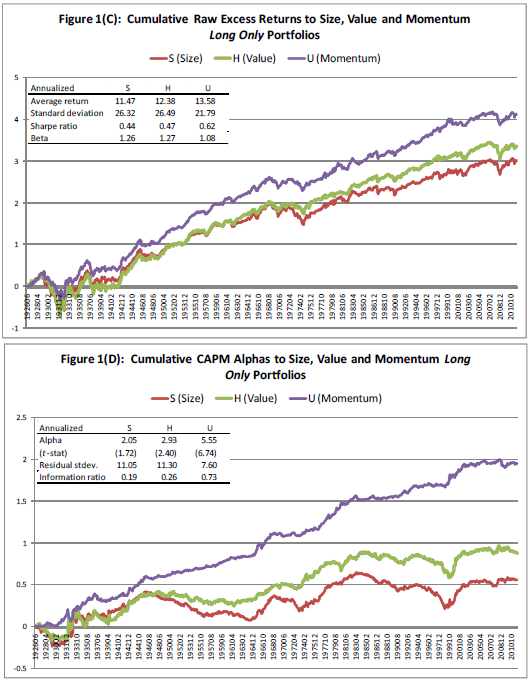
The Israel & Moskowitz paper looks at raw long-only returns from capitalization, value, and momentum. Perhaps even more importantly, at least for the Modern Portfolio Theory crowd, it looks at CAPM alphas from these same segments on a long-only basis. The CAPM alpha, in theory, is the amount of excess return available after adjusting for each factor. Here’s the chart:
Source: Optimal Momentum
(click on image to enlarge)
From the Antonacci article, here’s what you are looking at and the results:
I&M charts and tables show the top 30% of long-only momentum US stocks from 1927 through 2011 based on the past 12-month return skipping the most recent month. They also show the top 30% of value stocks using the standard book-to-market equity ratio, BE/ME, and the smallest 30% of US stocks based on market capitalization.
Long-only momentum produces an annual information ratio almost three times larger than value or size. Long-only versions of size, value, and momentum produce positive alphas, but those of size and value are statistically weak and only exist in the second half of the data. Momentum delivers significant abnormal performance relative to the market and does so consistently across all the data.
Looking at market alphas across decile spreads in the table above, there are no significant abnormal returns for size or value decile spreads over the entire 1926 to 2011 time period. Alphas for momentum decile portfolio spread returns, on the other hand, are statistically and economically large.
Mind-boggling right? On a long-only basis, momentum smokes both value and capitalization!
Israel & Moskowitz’s article is also quoted in the post, and here is what they say about their results:
Looking at these finer time slices, there is no significant size premium in any sub period after adjusting for the market. The value premium is positive in every sub period but is only statistically significant at the 5% level in one of the four 20-year periods, from 1970 to 1989. The momentum premium, however, is positive and statistically significant in every sub period, producing reliable alphas that range from 8.9 to 10.3% per year over the four sub periods.
Looking across different sized firms, we find that the momentum premium is present and stable across all size groups—there is little evidence that momentum is substantially stronger among small cap stocks over the entire 86-year U.S. sample period. The value premium, on the other hand, is largely concentrated only among small stocks and is insignificant among the largest two quintiles of stocks (largest 40% of NYSE stocks). Our smallest size groupings of stocks contain mostly micro-cap stocks that may be difficult to trade and implement in a real-world portfolio. The smallest two groupings of stocks contain firms that are much smaller than firms in the Russell 2000 universe.
What is this saying? Well, the value premium doesn’t appear to exist in the biggest NYSE stocks (the stuff your firm’s research covers). You can find value in micro-caps, but the effect is still not very significant relative to momentum in long-only portfolios. And momentum works across all cap levels, not just in the small cap area.
All of this is quite important if you are running long-only portfolios for clients, which is what most of the industry does. Relative strength (momentum) is a practical tool because it appears to generate excess return over many time periods and across all capitalizations.
According to Morningstar, the whole idea of income-producing securities is flawed—and I think they are right. In an article entitled “Option Selling Is Not Income,” author Philip Guziec points out that option income is not mysterious free money. Option selling can modify the risk-reward tradeoff for a portfolio, but the income is part of the total return, not some extra money that happens to be lying around.
By way of explanation, he shows a chart of an option income portfolio without the reinvestment of the income. As you can see below, it’s pretty grim.
Source: Morningstar
(click on image to enlarge)
Why is that? Well, the plummeting line is the one where you spend the income instead of reinvesting it in the portfolio. So much for an income-producing security that has “free” income. In this graphic context, it is very clear that the income is just one part of the total return. (You can read the whole article—the link is above—if you want more information on the specifics of an option income portfolio.)
However, I thought the article was great for another reason. Mr. Guziec generalizes the case of option income funds to all income securities. He writes:
In fact, the very concept of an income-producing security is a fallacy. A dollar of return is a dollar of return, whether that return comes from capital gains, coupons, dividends, or option premium.
I put the whole thing in bold because 1) I think it is important, and 2) most investors do not understand this apparently simple point. This can be generalized to investors who refuse to buy certain stocks because they don’t “have enough yield” or who prefer high-yield bonds to investment-grade bonds simply because they “have more yield.” In both cases, income is just part of the total return—and may also move you to a different part of the risk-return spectrum. There is nothing magic about income-producing securities, whether they are MLPs, dividend stocks, bonds, or anything else. What matters is the total return.
From a mathematical standpoint, shaving 25 basis points off of your portfolio every month to spend is no different than spending a 3% dividend yield. Once you can wrap your head around this concept, it’s easy to pursue the best opportunities in the market because you aren’t wearing blinders or forcing investments through a certain screen or set of filters. If your portfolio grows, that 25 basis points keeps getting to be a bigger number and that’s really what matters.
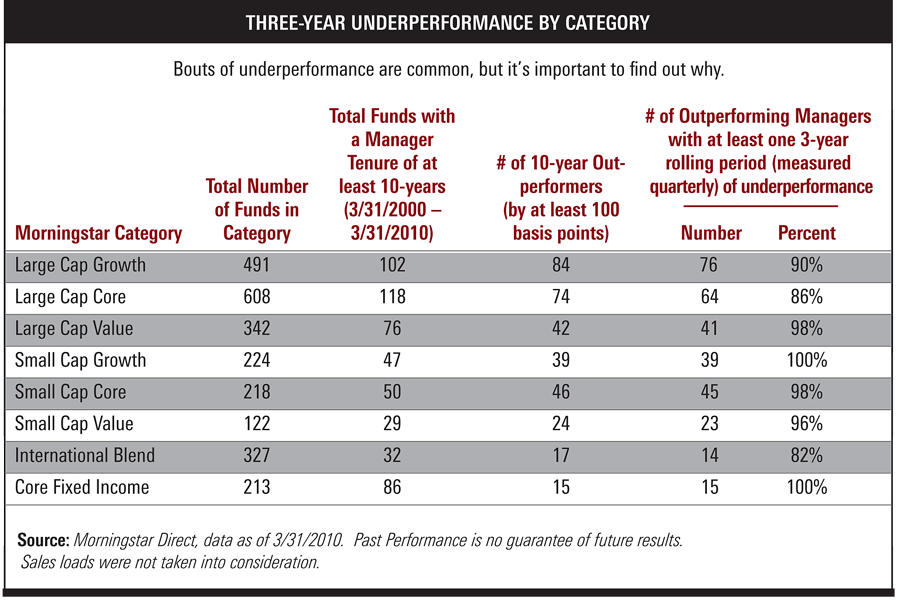
Source: Morningstar, ThinkAdvisor (click on image to enlarge)
Now, this chart is a little biased because it is looking at long periods of underperformance—3-year rolling periods—from managers that had top 10-year track records. In other words, these are exactly the kinds of managers you would hope to hire, and even they have long stretches of underperformance. When things are going well, clients are euphoric. Clients, though, often feel like even short periods of underperformance mean something is horribly wrong.
The entire article, written by Envestnet’s J. Gibson Watson, is worth reading because it makes the point that simply knowing about the underperformance is not very helpful until you know why the underperformance is occurring. Some underperformance may simply be a style temporarily out of favor, while other causes of underperformance might suggest an intervention is in order.
It’s quite possible to have a poor experience with a good manager if you bail out when you should hang in. Investing well can be simple, but that doesn’t mean it will be easy!
A recent article in the Personal Finance section of the Wall Street Journal had a prescription for anxious investors that Andy has been talking about for more than a year: consider asset allocation funds. Our Global Macro separate account has been very popular, partly because it allows investors to get into the market in a way that can be conservative when needed, but one that doesn’t lock investors into a product that can only be conservative.
The stock market’s powerful rally over the past year has gone a long way toward reducing the losses that many mutual-fund investors suffered in late 2007 and 2008.
But the rebound—with the Standard & Poor’s 500-stock index up 74% from its March 9, 2009, low—has done nothing for one group of investors: those who bailed out of stocks and have remained on the sidelines. Some of these investors have poured large sums into bond funds, even though those holdings may take a beating whenever interest rates rise from today’s unusually low levels, possibly later this year. Some forecasters, meanwhile, believe that stocks may finish 2010 up as much as 10%.
So, for investors who want to step back into stocks but are still anxious, here’s a modest suggestion: You don’t have to take your stock exposure straight up. You can dilute it by buying an allocation fund that spreads its assets across many market sectors, from stocks and bonds to money-market instruments and convertible securities.
While the WSJ article is a good general introduction to the idea, I think there are a few caveats that should be mentioned.
There’s still a big difference between a strategic asset allocation fund and a tactical asset allocation fund.
Many [asset allocation funds] keep their exposures within set ranges, while others may vary their mix widely.
Your fund selection will probably depend a lot on the individual client. A strategic asset allocation fund will more often have a tight range or even a fixed or target allocation for stocks or bonds. This can often target the volatility successfully–but can hurt returns if the asset classes themselves are out of favor. Tactical funds will more often have broader ranges or be unconstrained in terms of allocations. This additional flexibility can lead to higher returns, but it could be accompanied by higher volatility.
One thing the article does not mention at all, unfortunately, is that you also have a choice between a purely domestic asset allocation fund or a global asset allocation fund. A typical domestic asset allocation fund will provide anxious investors with a way to ease into the market, but will ignore many of the opportunities in international markets or in alternative assets like real estate, currencies, and commodities. With a variety of possible scenarios for the domestic economy, it might make sense to cast your net a little wider. Still, the article’s main point is valid: an asset allocation fund, especially a global asset allocation fund, is often a good way to deal with a client’s Market Anxiety Disorder and get them back into the game.
—-this article originally appeared 4/7/2010. Investors still don’t like this rally, even though we are a long way down the road from 2010! An asset allocation fund might still be a possible solution.
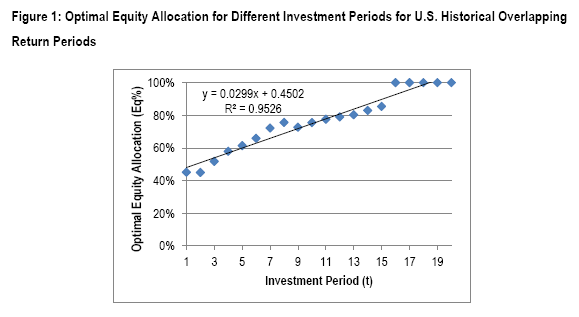
We find strong historical evidence to support the notion that a higher allocation to equities is optimal for investors with longer time horizons, and that the time diversification effect is relatively consistent across countries and that it persists for different levels of risk aversion.
When they examine optimal equity weightings in a portfolio by time horizon, the findings are rather striking. Here’s a reproduction of one of their figures from the paper:
Source: SSRN/Blanchett, Finke, Pfau (click to enlarge)
They describe the findings very simply:
Figure 1 also demonstrates how to interpret the results we include later in Tables 2 and 3. In Figure 1 we note an intercept (α) of 45.02% (which we will assume is 45% for simplicity purposes) and a slope (β) of .0299 (which for simplicity purposes we will assume is .03). Therefore the optimal historical allocation to equities for an investor with a 5 year holding period would be 60% stocks, which would be determined by: 45% + 5(3%) = 60%.
In other words, if your holding period is 15-20 years or longer, the optimal portfolio is 100% stocks!
Reality, of course, can be different from statistical probability, but their point is that it makes sense to own a greater percentage of stocks the longer your time horizon is. The equity risk premium—the little extra boost in returns you tend to get from owning stocks—is both persistent and decently high, enough to make owning stocks a good long-term bet.
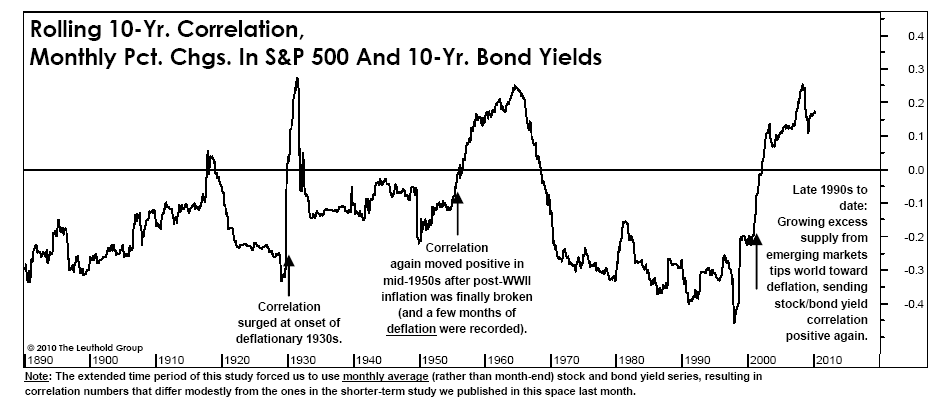
Rather, it is a post on the inherently unstable nature of correlations between securities and between asset classes. This is important because the success of many of the approaches to portfolio management make the erroneous assumption that correlations are fairly stable over time. I was reminded just how false this belief is while reading The Leuthold Group‘s April Green Book in which they highlighted the rolling 10-year correlations in monthly percentage changes between the S&P 500 and the 10-year bond yield. Does this look stable to you? Chart is shown by permission from The Leuthold Group.
(Click to Enlarge)
If you are trying to use this data, would you conclude that higher bond yields are good for the stock market or bad? The answer is that the correlations are all over the map. In 2006, William J. Coaker II published The Volatility of Correlations in the FPA Journal. That paper details the changes in correlations between 15 different asset classes and the S&P 500 over a 34-year time horizon. To give you a flavor for his conclusions, he pointed out that Real Estate’s rolling 5-year correlations to the S&P 500 ranged from 0.17 to 0.75, and for Natural Resources the range was -0.34 to 0.49. History is conclusive – correlations are unstable.
This becomes a big problem for strategic asset allocation models that use historical data to calculate an average correlation between securities or asset classes over time. Those models use that stationary correlation as one of the key inputs into determining how the model should currently be allocated. That may well be of no help to you over the next five to ten years. Unstable correlations are also a major problem for “financial engineers” who use their impressive physics and computer programming abilities to identify historical relationships between securities. They may find patterns in the historical data that lead them to seek to exploit those same patterns in the future (i.e. LTCM in the 1990′s.) The problem is that the future is under no obligation to behave like the past.
Many of the quants are smart enough to recognize that unstable correlations are a major problem. The solution, which I have heard from several well-known quants, is to constantly be willing to reexamine your assumptions and to change the model on an ongoing basis. That logic may sound intelligent, but the reality is that many, if not most, of these quants will end up chasing their tail. Ultimately, they end up in the forecasting game. These quants are rightly worried about when their current model is going to blow up.
Relative strength relies on a different premise. The only historical pattern that must hold true for relative strength to be effective in the future is for long-term trends to exist. That is it. Real estate (insert any other asset class) and commodities (insert any other asset class) can be positively or negatively correlated in the future and relative strength models can do just fine either way. Relative strength models make zero assumptions about what the future should look like. Again, the only assumption that we make is that there will be longer-term trends in the future to capitalize on. Relative strength keeps the portfolio fresh with those securities that have been strong relative performers. It makes no assumptions about the length of time that a given security will remain in the portfolio. Sure, there will be choppy periods here and there where relative strength models do poorly, but there is no need (and it is counterproductive) to constantly tweak the model.
Ultimately, the difference between an adaptive relative strength model and most quant models is as different as a mule is from a horse. Both have four legs, but they are very different animals. One has a high probability of being an excellent performer in the future, while the other’s performance is a big unknown.
—-this article originally appeared 4/16/2010. It’s important to understand the difference between a model that relies on historical correlations and a model that just adapts to current trends.