From the Archives: Perfect Sector Rotation

June 4, 2013

CXO Advisory has a very interesting blog piece on this topic. They review an academic paper that looks at the way conventional sector rotation is done. Typically, various industry sectors are categorized as early cycle, late cycle, etc. and then you are supposed to own those sectors at that point in the business cycle. Any number of money management firms (not including us) hang their hat on this type of cycle analysis.

In order to determine the potential of traditional sector rotation, the study assumes that you get to have perfect foresight into the business cycle and then you rotate your holdings with the conventional wisdom of when various industries perform best. A couple of disturbing things crop up, given that this is the best you could possibly do with this system.

1) You can squeak by with about 2.3% annual outperformance if you had a crystal ball. If you are even a month or two early or late on the cycle turns, your performance is statistically indistinguishable from zero.

2) 28 of the 48 industries studied (58.3%) underperformed during the times when they were supposed to perform well. There’s obviously enough noise in the system that a sector that is supposed to be strong or weak during a particular part of the cycle often isn’t.

CXO notes, somewhat ironically:

Note that NBER can take as long as two years after a turning point to designate its date and that one business cycle can be very different from another.

In other words, it’s clear that traditional business cycle analysis is not going to help you. You won’t be able to forecast the cycle turning points accurately and the cycles differ so much that industry performance is not consistent.

Sector rotation using relative strength is a big contrast to this. Relative strength makes no a priori assumptions about which industries are going to be strong or weak at various points in the business cycle. A systematic strategy just buys the strong sectors and avoids the weak ones. Lots of studies show that significant outperformance can be earned using relative strength (momentum) with absolutely no insight into the business cycle at all, including some studies done by CXO Advisory. Tactical asset allocation is finally coming into its own and various ways of implementing are available. Business cycle forecasting does not appear to be a feasible way to do it, but relative strength certainly is!

—-this article originally appeared 3/30/2010. Although the link to CXO Advisory is no longer live, you can get the gist of things from the article. Things don’t always perform in the expected fashion, and paying attention to relative strength can be some protection from the problem. Instead of making assumptions about strong or weak performance, relative strength just adapts.

Posted by:


From the Archives: Trend Following Beats Market Timing

May 30, 2013

Mark Hulbert has been tracking advisory newsletters for more than 20 years. Lots of these newsletters do active market timing, so in a recent column, he asked an obvious question:

The first question: How many stock market timers, of the several hundred monitored by the Hulbert Financial Digest, called the bottom of the bear market a year ago?

And a follow-up: Of those that did, how many also called the top of the bull market in March 2000 — or, for that matter, the major market turning points in October 2002 and October 2007?

If you are relying on some type of market timing to get you out of the way of bear markets and to get you into bull markets, this is exactly what you want to know. Although there are pundits who claim to have called the bottom to the day, Mr. Hulbert allowed a far more generous window for labeling a market timing call as correct.

… my analysis actually relied on a far more relaxed definition: Instead of moving 100% from cash to stocks in the case of a bottom, or 100% the other way in the case of a top, I allowed exposure changes of just ten percentage points to qualify.

Furthermore, rather than requiring the change in exposure to occur on the exact day of the market’s top or bottom, I looked at a month-long trading window that began before the market’s juncture and extending a couple of weeks thereafter.

That’s a pretty liberal definition: the market timer gets a four-week window and only has to change allocations by 10% to be considered to have “called” the turn. And here’s the bottom line:

Even with these relaxed criteria, however, none of the market timers that the Hulbert Financial Digest has tracked over the last decade were able to call the market tops and bottoms since March 2000.

Yep, zero. [The bold and underline is from me.] It’s not that advisors aren’t trying; it’s just that no one can do it successfully, even with a one-month window and a very modest change in allocations. Obviously, there is lots of hindsight bias going on where advisors claim to have detected market turning points, but when Mr. Hulbert goes back to look at the actual newsletters, not one got it right! You can safely assume anyone who claims to be able to time the market is lying. At the very least, the burden on proof is on them.

We don’t bother trying to figure out what the market will do going forward. We simply follow trends as they present themselves. We use relative strength in a systematic way to identify the trends we want to follow: the strongest ones. We stay with the trend as long as it continues, whether that is for a short time or an extended period. When a trend weakens, as evidenced by its relative strength ranking, we knock that asset out of the portfolio and replace it with a stronger asset. The two white papers we have produced (Relative Strength and Asset Class Rotation and Bringing Real World Testing to Relative Strength) show quite clearly that it is possible to have very favorable investment results over time without any recourse to market timing at all. Discipline and patience are needed, of course, but you don’t have to have a crystal ball.

—-this article originally appeared 3/17/2010. It is especially apropos now that many market pundits are busy predicting a top. It’s certainly possible they are right—but probably equally likely is the proposition that they are just guessing. Over the long run there is weak evidence that market timing is effective.

Posted by:


The Pullback in Japan

May 23, 2013

In light of Thursday’s 7.3% drop in the Nikkei 225, we wanted to review Japan from a trend and relative strength perspective. Performance over the last two years is show below. The explosive move higher in Japanese equities has been driven in large part by expectations for Prime Minister Shinzo Abe’s plan which can be summed up in his own words, “With the strength of my entire cabinet, I will implement bold monetary policy, flexible fiscal policy and a growth strategy that encourages private investment, and with these three policy pillars, achieve results.”

Japan

Source: Yahoo! Finance (click to enlarge)

A longer-term view of the Nikkei 225 reveals just how poor the performance for Japanese equities has been since its 1989 peak:

Japan2

Source: Yahoo! Finance (click to enlarge)

As expected from a trend following methodology, Japan also started to rise to the top of our relative strength ranks in recent months. In fact, the iShares MSCI Japan ETF (EWJ) was added to the Arrow DWA Tactical Fund (DWTFX) in April of this year. The strength in EWJ is just one of the reasons that DWTFX is currently outperforming 98% of its peers in the Morningstar World Allocation Category YTD. The relative strength of Japan can also be seen in the Dorsey Wright Fund Score Rank:

fund score

Source: Dorsey Wright (click to enlarge)

So, let’s get to the question on everyone’s mind: What happens from here? Will Japan bounce back and resume its explosive move higher or is it the beginning of a trend reversal? Unfortunately, we don’t have the answer to that. As we do with every trade, we buy strength and stay with it as long as it remains strong. If a position weakens sufficiently in our relative strength ranks we will replace it with a stronger security.

However, I do think it is interesting to note the potential comparison to a position in China that we had in the Arrow DWA Balanced Fund from 2006 to 2008. That transaction had a cumulative return of 103% from its initial purchase, but during the start of this magical ride there was a 21% correction. This is documented in the chart below.

China

Source: Arrow Funds (click to enlarge)

The mere fact that Japan is back on the radar for relative strength strategies is a powerful reminder of the need to remain adaptive. New themes are constantly developing and relative strength is adept at capitalizing on these trends. There are plenty of pundits who are betting that Japan will continue its move higher, including Marc Faber. This could well be a good opportunity to get exposure to DWTFX during a temporary period of weakness after the fund has climbed over 13% YTD.

Past performance is not indicative of future results. Potential for profits is accompanied by possibility of loss. See www.arrowfunds.com for more information. A list of all holdings for the trailing 12 months is available upon request.

Posted by:


Financial Repression Primer

May 1, 2013

Research Affliliates published a very nice primer on financial repression on Advisor Perspectives. It’s well worth reading to get the lay of the land. Here’s how they define financial repression:

Financial repression refers to a set of governmental policies that keep real interest rates low or negative and regulate or manipulate a captive audience into investing in government debt. This results in cheap funding and will be a prime tool used by governments in highly indebted developed market economies to improve their balance sheets over the coming decades.

When you hear talk about “the new normal,” this is one of the features. Most of us have not had to deal with financial repression during our investment careers. In fact, for advisors in the 1970s and early 1980s, the problem was that interest rates were too high, not too low!

There are disparate views on the endgame from financial repression. Some are expecting Japanese-style deflation, while others are looking for Weimar Republic inflation. Maybe we will just muddle through. In truth, there are many possible outcomes depending on the myriad of policy decisions that will be made in coming years.

In our view, guessing at the outcome of the political and economic process is hazardous. We think it makes much more sense to be alert to the possibilities embedded in tactical asset allocation. That allows you to pursue returns wherever they can be found at the time, without having to have a strong opinion on the eventual outcome. Relative strength can often be a very useful guide in that process.

Posted by:


Current Income

April 12, 2013

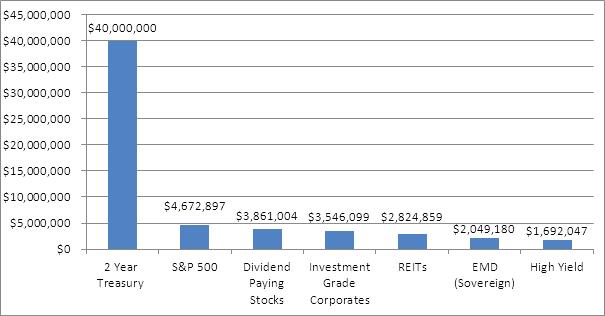
Investors lately are in a frenzy about current income. With interest rates so low, it’s tough for investors, especially those nearing or already in retirement, to come up with enough current income to live on. A recent article in Advisor Perspectives had a really interesting take on current income. The author constructed a chart to show how much money you would have to invest in various asset classes to “buy” $100,000 in income. Some of these asset classes might also be expected to produce capital gains and losses, but this chart is purely based on their current income generation ability. You can read the full original article to see exactly which asset classes were used, but the visual evidence is stunning.

Source: Advisor Perspectives/Pioneer Investments (click to enlarge)

There are two things that I think are important to recognize—and it’s hard not to with this chart.

  1. Short-term interest rates are incredibly low, especially for bonds presumed to have low credit risk. The days of rolling CDs or clipping a few bond coupons as an adequate supplement to Social Security are gone.
  2. In absolute terms, all of these amounts are relatively high. I can remember customers turning up their noses at 10% investment-grade tax-exempt bonds—they felt rates were sure to go higher—but it only takes a $1 million nest egg to generate a $100,000 income at that yield. Now, it would take more than $1.6 million, even if you were willing to pile 100% into junk bonds. (And we all know that more money has been lost reaching for yield than at the point of a gun.) A more realistic guess for the typical volatility tolerance of an average 60/40 balanced fund investor is probably something closer to $4.2 million. Even stocks aren’t super cheap, although they seem to be a bargain relative to short-term bonds.

That’s daunting math for the typical near-retiree. Getting anywhere close to that would require compounding significant savings for a long, long time—not to mention remarkable investment savvy. The typical advisor has only a handful of accounts that large, suggesting that much work remains to be done educating clients about savings, investment, and the reality of low current yields.

The pressure for current income might also entail some re-thinking of the entire investment process. Investors may need to focus more on total return, and realize that some capital gains can be spent as readily as dividends and interest. Relative strength may prove to be a useful discipline in the search for returns, wherever they may be found.

Posted by:


Investment Manager Selection

April 12, 2013

Investment manager selection is one of several challenges that an investor faces. However, if manager selection is done well, an investor has only to sit patiently and let the manager’s process work—not that sitting patiently is necessarily easy! If manager selection is done poorly, performance is likely to be disappointing.

For some guidance on investment manager selection, let’s turn to a recent article in Advisor Perspectives by C. Thomas Howard of AthenaInvest. AthenaInvest has developed a statistically validated method to forecast fund performance. You can (and should) read the whole article for details, but good investment manager selection boils down to:

  • investment strategy
  • strategy consistency
  • strategy conviction

This particular article doesn’t dwell on investment strategy, but obviously the investment strategy has to be sound. Relative strength would certainly qualify based on historical research, as would a variety of other return factors. (We particularly like low-volatility and deep value, as they combine well with relative strength in a portfolio context.)

Strategy consistency is just what it says—the manager pursues their chosen strategy without deviation. You don’t want your value manager piling into growth stocks because they are in a performance trough for value stocks (see Exhibit 1999-2000). Whatever their chosen strategy or return factor is, you want the manager to devote all their resources and expertise to it. As an example, every one of our portfolio strategies is based on relative strength. At a different shop, they might be focused on low-volatility or small-cap growth or value, but the lesson is the same—managers that pursue their strategy with single-minded consistency do better.

Strategy conviction is somewhat related to active share. In general, investment managers that are willing to run relatively concentrated portfolios do better. If there are 250 names in your portfolio, you might be running a closet index fund. (Our separate accounts, for example, typically have 20-25 positions.) A widely dispersed portfolio doesn’t show a lot of conviction in your chosen strategy. Of course, the more concentrated your portfolio, the more it will deviate from the market. For managers, career risk is one of the costs of strategy conviction. For investors, concentrated portfolios require patience and conviction too. There will be a lot of deviation from the market, and it won’t always be positive. Investors should take care to select an investment manager that uses a strategy the investor really believes in.

AthenaInvest actually rates mutual funds based on their strategy consistency and conviction, and the statistical results are striking:

The higher the DR [Diamond Rating], the more likely it will outperform in the future. The superior performance of higher rated funds is evident in Table 1. DR5 funds outperform DR1 funds by more than 5% annually, based on one-year subsequent returns, and they continue to deliver outperformance up to five years after the initial rating was assigned. In this fashion, DR1 and DR2 funds underperform the market, DR3 funds perform at the market, and DR4 and DR5 funds outperform. The average fund matches market performance over the entire time period, consistent with results reported by Bollen and Busse (2004), Brown and Goetzmann (1995) and Fama and French (2010), among others.

Thus, strategy consistency and conviction are predictive of future fund performance for up to five years after the rating is assigned.

The bold is mine, as I find this remarkable!

I’ve reproduced a table from the article below. You can see that the magnitude of the outperformance is nothing to sniff at—400 to 500 basis points annually over a multi-year period.
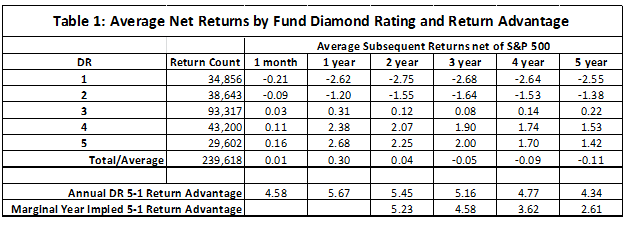
Source: Advisor Perspectives/AthenaInvest (click on image to enlarge)

The indexing crowd is always indignant at this point, often shouting their mantra that “active managers don’t outperform!” I regret to inform them that their mantra is false, because it is incomplete. What they mean to say, if they are interested in accuracy, is that “in aggregate, active managers don’t outperform.” That much is true. But that doesn’t mean you can’t locate active managers with a high likelihood of outperformance, because, in fact, Tom Howard just demonstrated one way to do it. The “active managers don’t outperform” meme is based on a flawed experimental design. I tried to make this clear in another blog post with an analogy:

Although I am still 6’5″, I can no longer dunk a basketball like I could in college. I imagine that if I ran a sample of 10,000 random Americans and measured how close they could get to the rim, very few of them could dunk a basketball either. If I created a distribution of jumping ability, would I conclude that, because I had a large sample size, the 300 people would could dunk were just lucky? Since I know that dunking a basketball consistently is possible–just as Fama and French know that consistent outperformance is possible–does that really make any sense? If I want to increase my odds of finding a portfolio of people who could dunk, wouldn’t it make more sense to expose my portfolio to dunking-related factors–like, say, only recruiting people who were 18 to 25 years old and 6’8″ or taller?

In other words, if you look for the right characteristics, you have a shot at finding winning investment managers too. This is valuable information. Think of how investment manager selection is typically done: “What was your return last year, last three years, last five years, etc.?” (I know some readers are already squawking, but the research literature shows clearly that flows follow returns pretty closely. Most “rigorous due diligence” processes are a sham—and, unfortunately, research shows that trailing returns alone are not predictive.) Instead of focusing on trailing returns, investors would do better to locate robust strategies and then evaluate managers on their level of consistency and conviction.

Posted by:


Smart Beta vs. Monkey Beta

April 9, 2013

Andy wrote a recent article entitled Smart Beta Gains Momentum. It’s gaining momentum for a good reason! A recent study at Cass Business School in London found that cap-weighting was not a very good way to construct an index. Lots of methods to get exposure to smart beta do better. The results were discussed in an article at Index Universe. Some excerpts:

Researchers have found that equity indices constructed randomly by ‘monkeys’ would produce higher risk-adjusted returns than an equivalent market capitalisation-weighted index over the last 40 years…

The findings come from a recent study by Cass Business School (CBS), which was based on monthly US share data from 1968 to 2011. The authors of the study found that a variety of alternative index weighting schemes all delivered superior returns to the market cap approach.

According to Dr. Nick Motson of CBS, co-author of the study, “all of the 13 alternative indices we studied produced better risk-adjusted returns than a passive exposure to a market-cap weighted index.”

The study included an experiment that saw a computer randomly pick and weight each of the 1,000 stocks in the sample. The process was then repeated 10 million times over each of the 43 years. Clare describes this as “effectively simulating the stock-picking abilities of a monkey”.

…perhaps most shockingly, we found that nearly every one of the 10 million monkey fund managers beat the performance of the market cap-weighted index,” said Clare.

The findings will be a boost to investors already looking at alternative indexing. Last year a number of European pension funds started reviewing their passive investment strategies, switching from capitalisation-weighting to alternative index methodologies.

Relative strength is one of the prominent smart beta methodologies. Of course, cap-weighting has its uses—the turnover is low and rebalancing is minimized. But purely in terms of performance, the researchers at Cass found that there are better ways to do things. Now that ETFs have given investors a way to implement some of these smart beta methods in a tax-efficient, low-cost manner, I suspect we will see more movement toward smart beta in the future.

Posted by:


Emerging Markets ETFs

March 21, 2013

Morningstar came out with a piece yesterday titled Are There Better Emerging-Markets ETF Choices? The article discussed the availability of alternative beta funds in the area, and had this to say, in part, about momentum:

While there has been relatively little academic research done on momentum in emerging-markets stocks, it has been observed in this asset class. There is currently one ETF that looks to capitalize on momentum in emerging-markets stocks–PowerShares DWA Emerging Markets (PIE), which was launched in December 2007. Over the five year period ending Feb. 28, 2013, this fund’s benchmark index produced annualized returns that outstripped the MSCI Emerging Markets Index by 155 basis points while exhibiting fairly similar levels of volatility.

Risk-tolerant investors looking for more growth-oriented exposure to emerging markets may want to consider PIE; it is currently the only emerging-markets ETF of reasonable size to provide a growth tilt.

The article also discusses some of the funds that offer low-volatility exposure, but did not mention that the low-vol and high relative strength return factors often complement one another nicely. In the domestic market, we’ve seen that these factors have excess returns that are negatively correlated. Although usage of low volatility in emerging markets has a much shorter history, it’s possible that we’ll see the same thing there over time.

It’s nice to see Morningstar give relative strength some attention!

Source: Yahoo! Finance

See www.powershares.com for more information. Past performance is no guarantee of future returns.

Posted by:


Quote of the Week

March 4, 2013

The class of those who have the ability to think their own thoughts is separated by an unbridgeable gulf from the class of those who cannot—-Ludwig von Mises

Orthodox thinking will keep you out of trouble. In the investment industry, if you build a client’s portfolio in rigid conformance with Modern Portfolio Theory, your firm will back you and it is unlikely that you will ever be successfully sued, regardless of how horribly things turn out for the client. And make no mistake—building portfolios based on mean variance optimization doesn’t have a very good track record.

Unorthodox thinking, as uncomfortable as it may be for some, is also the only way the human race advances. After all, nearly every current orthodoxy was once out of the mainstream. It’s good to have new ideas bubbling up, prepared to take the place of our current king of the hill if they can demonstrate their worth in practice. (Theory that doesn’t work in practice isn’t much of a theory.)

I’m encouraged to see factor-based investing and broad diversification advancing at the expense of Modern Portfolio Theory. Relative strength tests well as a return factor, as do value and low volatility.

HT to Michael Covel

Posted by:


From the Archives: Was It Really a Lost Decade?

February 28, 2013

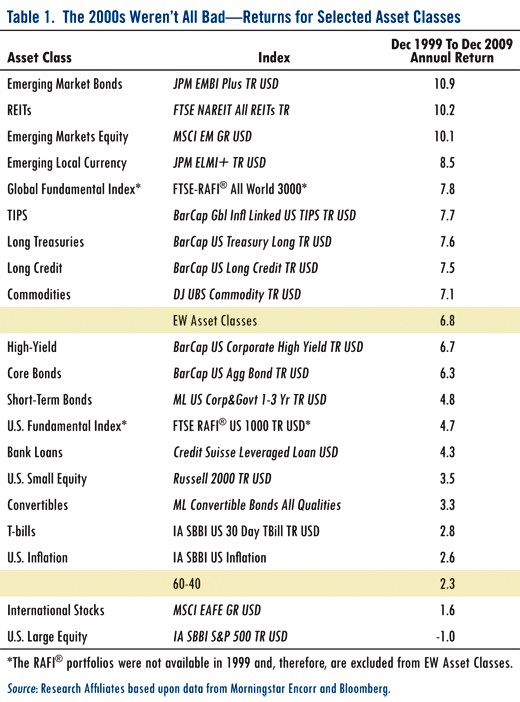
Index Universe has a provocative article by Rob Arnott and John West of Research Affiliates. Their contention is that 2000-2009 was not really a lost decade. Perhaps if your only asset was U.S. equities it would seem that way, but they point out that other, more exotic assets actually had respectable returns.

The table below shows total returns for some of the asset classes they examined.

 Was It Really a Lost Decade?

click to enlarge

What are the commonalities of the best performing assets? 1) Lots of them are highly volatile like emerging markets equities and debt, 2) lots of them are international and thus were a play on the weaker dollar, 3) lots of them were alternative assets like commodities, TIPs, and REITs.

In other words, they were all asset classes that would tend to be marginalized in a traditional strategic asset allocation, where the typical pie would primarily consist of domestic stocks and bonds, with only small allocations to very volatile, international, or alternative assets.

In an interesting way, I think this makes a nice case for tactical asset allocation. While it is true that most investors–just from a risk and volatility perspective–would be unwilling to have a large allocation to emerging markets for an entire decade, they might find that periodic significant exposure to emerging markets during strong trends would be quite acceptable. And even assets near the bottom of the return table like U.S. Treasury bills would have been very welcome in a portfolio during parts of 2008, for example. You can cover the waterfront and just own an equal-weighted piece of everything, but I don’t know if that is the most effective way to do things.

What’s really needed is a systematic method for determining which asset classes to own, and when. Our Systematic Relative Strength process does this pretty effectively, even for asset classes that might be difficult or impossible to grade from a valuation perspective. (How do you determine whether the Euro is cheaper than energy stocks, or whether emerging market debt is cheaper than silver or agricultural commodities?) Once a systematic process is in place, the investor can be slightly more comfortable with perhaps a higher exposure to high volatility or alternative assets, knowing that in a tactical approach the exposures would be adjusted if trends change.

—-this article originally appeared 2/17/2010. There is no telling what the weak or strong assets will be for the coming decade, but I think global tactical asset allocation still represents a reasonable way to deal with that uncertainty.

Posted by:


Small Caps Shining in 2013

February 22, 2013

So far, 2013 has offered some pretty impressive returns for equity investors—especially in the small-cap space. Through 2/21/13, the Russell 2000 (small caps) is up 6.60%, outpacing the S&P; 500 (large caps) by over 1.25%. Chances are good that many investors have not given a whole lot of thought to allocating to small caps. After all, the natural tendency for investors is to just focus on the more recognizable large-cap companies. However, I think there are some good reasons why investors can benefit from adding small-cap exposure to their portfolios. The Borneo Post recently wrote up some of the compelling reasons for considering small caps in a portfolio, including the following:

Stronger earnings growth

While earnings growth of the broader stock market is usually dependent on the pace of growth of the underlying economy, smaller or mid-sized companies may possess the ability to grow earnings at a much quicker pace.

Larger companies may find it more difficult to grow their revenues more quickly than the overall pace of economic growth, especially when they already hold a sizable market share in a particular industry. On the other hand, it is more plausible for a smaller company which has a negligible market share to grow its revenues by double digits each year, which could lead to a doubling or tripling of profits over a shorter period of time.

This trend is evident from a look at the historical earnings of global small caps versus the broader market, with small cap stocks delivering a 7.8 per cent annualised growth in earnings between 1999 to 2012, versus the more modest 5.2 per cent earnings growth for the broader market.

Last July, Dorsey Wright began providing a relative strength based index to PowerShares for the PowerShares DWA Small-Cap Technical Leaders Portfolio (DWAS). This ETF differs from many of the other small-cap ETFs in the marketplace in that it is not cap-weighted. Rather, it is an index of 200 small-cap stocks with strong relative strength. Through 2/21/13, DWAS is up an impressive 9.59% for the year.

Source: Yahoo! Finance

For more information about DWAS, please see www.powershares.com. Past performance is no guarantee of future returns.

Posted by:


From the Archives: Rob Arnott and the Key to Better Returns

February 21, 2013

Rob Arnott is a thought leader in tactical asset allocation, currently well-known for his RAFI Fundamental Indexes. In his recent piece, Lessons from the Naughties, he discusses how investors will need to find return going forward.

The key to better returns will be to respond tactically to the shifting spectrum of opportunity, especially expanding and contracting one’s overall risk budget.

It’s a different way to view tactical asset allocation–looking at it from a risk budget point of view. The general concept is to own risk assets in good markets and safe assets in bad markets.

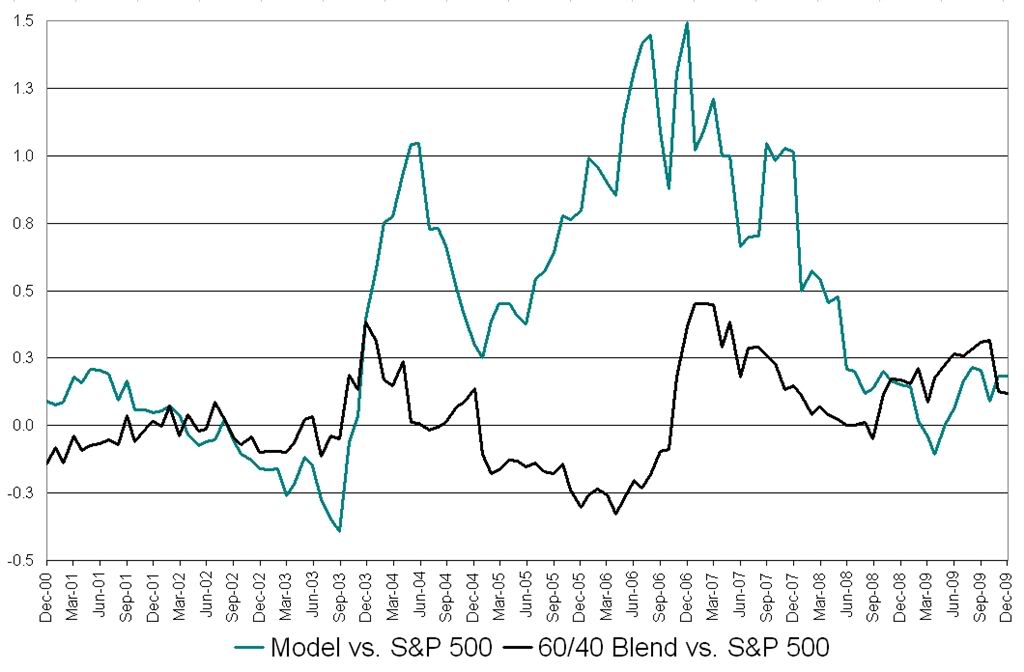
It turns out that systematic application of relative strength accomplishes this very well. The good folks at Arrow Funds recently asked us to take a look at how the beta in a tactically managed portfolio changed over time. When we examined that issue, it showed that as markets became risky, relative strength reduced the beta of the portfolio by moving toward low volatility (strong) assets. When markets were strong, allocating with relative strength pushed up the beta in the portfolio, thus taking good advantage of the market strength.

 Rob Arnott and the Key to Better Returns

click to enlarge

Using relative strength to do tactical asset allocation, the investor was not only able to earn an acceptable rate of return over time, but was able to have some risk mitigation going on the side. That’s a pretty tasty combination in today’s markets.

—-this article originally appeared on 2/26/2010. Amid all of the publicity given recently to risk parity, Arnott’s approach, which is to vary the risk budget over time depending on the opportunities available, has been largely ignored. I think this is unfortunate. His approach, although perhaps not easy, has merit. Tactical asset allocation driven by relative strength is one way to do that.

Posted by:


Quote of the Week

February 12, 2013

To attain knowledge, add things every day. To attain wisdom, subtract things every day.—-Lao-Tzu

There are many theories about investing in the market. Some are simple, while others are mind-numbingly complex. Relative strength is one of the simple methods. Because it is simple, it is robust and much more difficult to break than a multi-factor method that relies on many relationships between factors. Complicated things are fragile and tend to break easily. That’s not to say that relative strength is perfect—it will underperform periodically like every other method. But relative strength subtracts everything except price, and asserts that strong price action is typically a precursor of good relative performance. History bears that out.

Posted by:


86 Years of High Relative Strength

February 5, 2013

Ken French’s database is an unparalleled and *free* source of all types of stock market data. We’ve used this database to track high relative strength performance versus the broad market, other indices, against moving averages, and other return factors (like value).

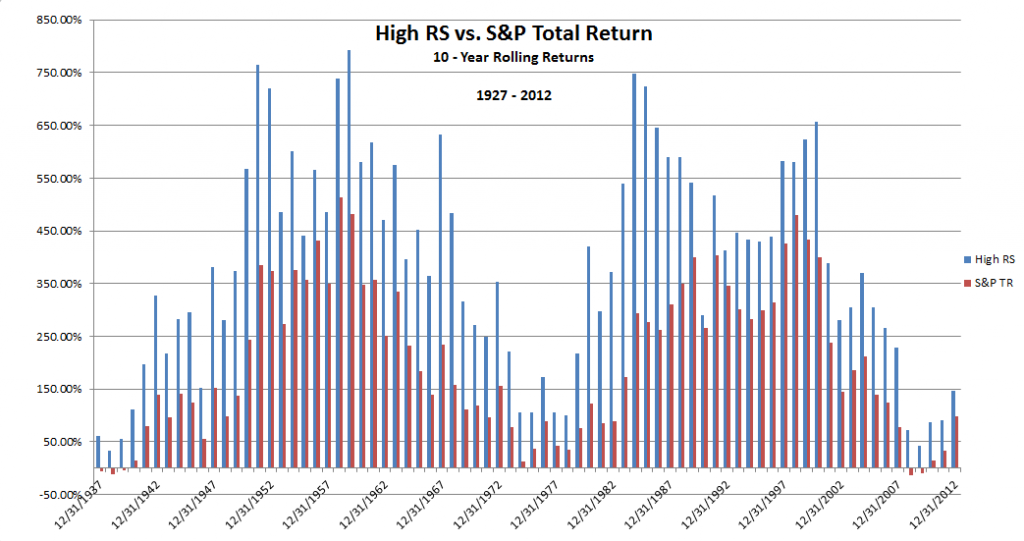
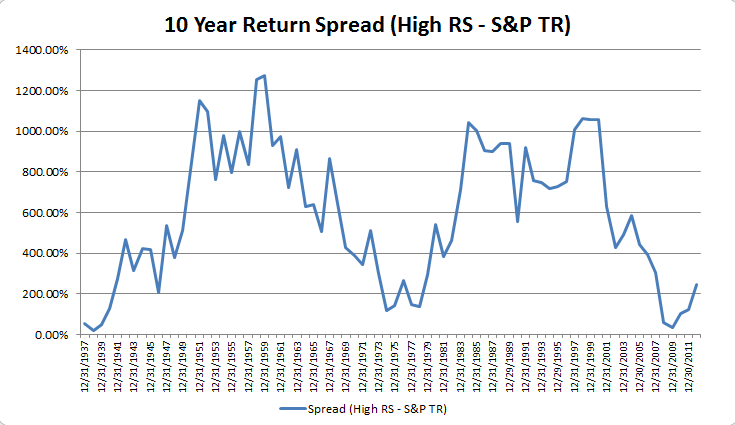
Let’s dip back into the well for another go-round. Today, we updated our database to account for the full year of 2012. The chart below shows the 10-year rolling return numbers for the High RS portfolio on the Ken French website. Click here to read the description of how this portfolio is constructed. In layman’s terms, it’s the biggest stocks by market capitalization (top half), and the best performing stocks by price performance (top third). The results speak for themselves. Since 1927, the 10-year rolling return of the High RS portfolio has outperformed the S&P; 500 Total Return index an astonishing 100% of the time.

“All I do is win”

Source: Ken French Database, Global Financial Data, Click to enlarge

Using that data, we constructed a linear graph of the spread between the two indexes. The spread was constructed by subtracting the 10-year rolling return of the S&P; Total Return from the returns of the High RS portfolio.

Source: Ken French Database, Click to enlarge

The spread looks to be exiting a recent low. Over the last near-century, these types of lows in the High RS Spread have led to extreme outperformance in the 10-year rolling numbers. Of course, there is no way to tell what will happen in the future. However, using the past as our guide, we believe that going forward, the relative strength factor will continue to be a source for outperformance in a constantly changing market.

Posted by:


Timeless Portfolio Lessons

February 1, 2013

The only thing new under the sun is the history you haven’t read yet.—-Mark Twain

Investors often have the conceit that they are living in a new era. They often resort to new-fangled theories, without realizing that all of the old-fangled things are still around mainly because they’ve worked for a long time. While circumstances often change, human nature doesn’t change much, or very quickly. You can generally count on people to behave in similar ways every market cycle. Most portfolio lessons are timeless.

As proof, I offer a compendium of quotations from an old New York Times article:

WHEN you check the performance of your fund portfolio after reading about the rally in stocks, you may feel as if there is a great party going on and you weren’t invited. Perhaps a better way to look at it is that you were invited, but showed up at the wrong time or the wrong address.

It isn’t just you. Research, especially lately, shows that many investors don’t match market performance, often by a wide margin, because they are out of sync with downturns and rallies.

Christine Benz, director of personal finance at Morningstar, agrees. “It’s always hard to speak generally about what’s motivating investors,” she said, “but it’s emotions, basically,” resulting in “a pattern we see repeated over and over in market cycles.”

Those emotions are responsible not only for drawing investors in and out of the broad market at inopportune times, but also for poor allocations to its niches.

Where investors should be allocated, many professionals say, is in a broad range of assets. That will smooth overall returns and limit the likelihood of big losses resulting from an excessive concentration in a plunging market. It also limits the chances of panicking and selling at the bottom.

In investing, as in party-going, it’s often safer to let someone else drive.

This is not ground-breaking stuff. In fact, investors are probably bored to hear this sort of advice over and over—but it gets repeated because investors ignore the advice repeatedly! This same article could be written today, or written 20 years from now.

You can increase your odds of becoming a successful investor by constructing a reasonable portfolio that is diversified by volatility, by asset class, and by complementary strategy. Relative strength strategies, for example, complement value and low-volatility equity strategies very nicely because the excess returns tend to be uncorrelated. Adding alternative asset classes like commodities or stodgy asset classes like bonds can often benefit a portfolio because they respond to different return drivers than stocks.

As always, the bottom line is not to get carried away with your emotions. Although this is certainly easier said than done, a diversified portfolio and a competent advisor can help a lot.

Posted by:


Dealing With Financial Repression

January 28, 2013

James Montier, the investment strategist at GMO, published a long piece on financial repression in Advisor Perspectives in November 2012. It’s taken me almost that long to read it—and I’m still not sure I completely understand its implications. Financial repression itself is pretty easy to understand though. Along with a humorous description of Fed policy, Montier describes it like this:

Put another way, QE sets the short-term rate to zero, and then tries to persuade everyone to spend rather than save by driving down the rates of return on all other assets (by direct purchase and indirect effects) towards zero, until there is nothing left to hold savings in. Essentially, Bernanke’s first commandment to investors goes something like this: Go forth and speculate. I don’t care what you do as long as you do something irresponsible.

Not all of Bernanke’s predecessors would have necessarily shared his enthusiasm for recklessness. William McChesney Martin was the longest-serving Federal Reserve Governor of all time. He seriously considered training as a Presbyterian minister before deciding that his vocation lay elsewhere, a trait that earned him the beautifully oxymoronic moniker of “the happy puritan.” He is probably most famous for his observation that the central bank’s role was to “take away the punch bowl just when the party is getting started.” In contrast, Bernanke’s Fed is acting like teenage boys on prom night: spiking the punch, handing out free drinks, hoping to get lucky, and encouraging everyone to view the market through beer goggles.

So why is the Fed pursuing this policy? The answer, I think, is that the Fed is worried about the “initial condition” or starting point (if you prefer) of the economy, a position of over-indebtedness. When one starts from this position there are really only four ways out:

i. Growth is obviously the most “popular” but hardest route.

ii. Austerity is pretty much doomed to failure as it tends to lead to falling tax revenues, wider deficits, and public unrest. 2

iii. Abrogation runs the spectrum from default (entirely at the borrower’s discretion) to restructuring (a combination of borrower and lender) right out to the oft-forgotten forgiveness (entirely at the lender’s discretion).

iv. Inflation erodes the real value of the debt and transfers wealth from savers to borrowers. Inflating away debt can be delivered by two different routes: (a) sudden bursts of inflation, which catch participants off guard, or (b) financial repression.

Financial repression can be defined (somewhat loosely, admittedly) as a policy that results in consistent negative real interest rates. Keynes poetically called this the “euthanasia of the rentier.”3 The tools available to engineer this outcome are many and varied, ranging from explicit (or implicit) caps on interest rates to directed lending to the government by captive domestic audiences (think the postal saving system in Japan over the last two decades) to capital controls (favoured by emerging markets in days gone by).

The effects of financial repression are easy to see: very low yields in debt instruments, and the consequent temptation to reach for yield elsewhere. Advisors see the effects in clients every day.

If you are feeling jovial, I highly recommend reading Montier’s whole piece as an antidote to your good mood. His forecast is rather bleak—poor long-term returns in most all asset classes for a long period of time. My take-away was a little different.

Let’s assume for a moment that Montier is correct and long-term (they use seven years) equity real returns are approximately equivalent to zero. In fact, that’s pretty much exactly what we’ve seen during the last decade! The broad market has made very little progress since 1998, a period going on 15 years now. Buy-and-hold (we prefer the terminology “sit-and-take-it”) clearly didn’t work in that environment, but tactical asset allocation certainly did. Using relative strength to drive the process, tactical asset allocation steered you toward asset classes, sectors, and individual securities that were strong (for however long) and then pushed you out of them when they became weak.

I have no idea whether Montier’s forecast will pan out or not, but if it does, tactical asset allocation might end up being one of the few ways to survive. There’s almost always enough fluctuation around the trend—even if the trend is flat—to get a little traction with tactical asset allocation.

Source: Monty Python/Youtube

[In fact, might I suggest the Arrow DWA Balanced Fund and the Arrow DWA Tactical Fund as considerations? You can find more information at www.arrowfunds.com.]

Posted by:


Relative Strength: A Solid Investment Method

January 28, 2013

We are fond of relative strength. It’s a solid investment method that have proven itself over a long period of time. Sure, it has its challenges and there are certainly periods of time during which it underperforms, but all-in-all it works and it’s been good to us. It’s always nice, though, when I run across another credible source that sings its praises. Consider the following excerpt from an article on the Optimal Momentum blog:

Momentum, on the other hand, has always made sense. It is based on the phrase “cut your losses; let your profits run on,” coined by the famed economist David Ricardo in the 1700s. Ricardo became wealthy following his own advice. [Editor’s note: We wrote about this in David Ricardo’s Golden Rules.] Many others, such as Livermore, Gartley, Wycoff, Darvas, and Driehaus, have done likewise over the following years. Behavioral finance has given solid reasons why momentum works. The case for momentum is now so strong that two of the fathers of modern finance, Fama and French, call momentum “the premier market anomaly” that is “above suspicion.”

Momentum, on the other hand, is pretty simple. Every approach, including momentum, must determine what assets to use and when to rebalance a portfolio. The single parameter unique to momentum is the look back period for determining an asset’s relative strength. In a 1937, using data from 1920 through 1935, Cowles and Jones found stocks that performed best over the past twelve months continued to perform best afterwards. In 1967, Bob Levy came to the same conclusion using a six-month look back window applied to stocks from 1960 through 1965. In 1993, using data from 1962 through 1989 and rigorous testing methods, Jegadeesh and Titman (J&T;) reaffirmed the validity of momentum. They found the same six and twelve months look back periods to be best. Momentum is not only simple, but it has been remarkably consistent over the past seventy-five years.

Momentum, on the other hand, is one of the most robust approaches in terms of its applicability and reliability. Following the 1993 seminal study by J&T;, there have been nearly 400 published momentum papers, making it one of the most heavily researched finance topics over the past twenty years. Extensive academic research has shown that price momentum works in virtually all markets and time periods, from Victorian ages up to the present.

Of course, momentum is just the academic term for relative strength. For more on the history of relative strength—and how it became known as momentum in academia—see CSI Pasadena: Relative Strength Identity Theft. The bigger point is that relative strength has a lot of backing from both academics and practitioners. There are more complicated investment methods, but not many that are better than relative strength.

Posted by:


From the Archives: Why We Like Price

January 25, 2013

Relative strength calculations rely on a single input: price. We like price because it is a known quantity, not an assumption. In this deconstruction of the Price-to-Earnings Growth (PEG) ratio, the author, Tom Brakke, discusses all of the uncertainties when calculating even a simple ratio like PEG. And amidst all of the uncertainties he mentions is this:

In looking at that calculation, only one of the three variables has any precision: We can observe the market price (P) at virtually any time and be assured that we have an accurate number. The E is a different matter entirely. Which earnings? Forward, trailing, smoothed, operating, adjusted, owner? Why? How deep into accounting and the theory of finance do you want to go?

For most investors, not very far. We like our heuristics clean and easy, not hairy. So, in combining the first two variables we get the P/E ratio, the “multiple” upon which most valuation work rests, despite the questionable assumptions that may be baked in at any time. The addition of the third element, growth (G), gives us not the epiphany we seek, but even more confusion.

The emphasis is mine. This isn’t a knock on fundamental analysis. It can be valuable, but there is an inherent squishiness to it. The only precision is found in price. And price is dynamic: it adapts in real time as expectations of the asset change. (Fundamental data is often available only on a quarterly schedule.) As a result, systematic models built using relative strength adapt quite nicely as conditions change.

—-this article originally appeared 2/10/2010. We still like using prices as an input, especially now that there are so many cross-currents. Every pundit has a different take on what will happen down the road, but prices in a free market will eventually sort it all out.

Posted by:


Forecasting Follies

January 24, 2013

No one ever knows what is going to happen in any market. The best we can hope to do is accurately measure where the relative strength is—and then try to stay with it. Presented without much comment is an article from Business Insider dating back to December 2010, just over two years ago. Here’s the headline:

After 20 Years Of Misery, Here’s Why Japanese Stocks Are Ready To Soar

And here is a chart of the Japan ETF versus the S&P; 500 over the last two years:

Source: Yahoo! Finance (click to image to enlarge)

As you can see, Japan is down more than 10%—and 25% in relative terms—despite its supposedly compelling valuation. In fact, it could be completely correct that Japan is incredibly undervalued. Certainly the CFA who wrote the article is more qualified than me to make a judgement. It may also be true that eventually this spread will go to other way, due to the difference in valuation—but even two years has not been enough to prove out this thesis so far.

So far it’s just been an expensive lesson in learning that markets can do whatever they want for as long as they want. The only way for a forecast to come true is for the price to move in the forecasted direction—and that means relative strength will shift too. Rather than guessing what will happen, we can trust relative strength to adjust if things change.

Posted by:


From the Archives: The 80/20 Rule in Action

January 17, 2013

According to a fascinating study discussed in Time Magazine based on 27 million hands of Texas Hold’em, it turns out that the more hands poker players win, the more money they lose! What’s going on here?

I suspect it has to do with investor preferences–gamblers often think the same way. Most people like to have a high percentage of winning trades; they are less happy with a lower percentage of winning trades, even if the occasional winner is a big one. In other words, investors will often prefer a system with 65% winning trades over a system with 45% winning trades, even if the latter method results in much greater overall profits.

People overweigh their frequent small gains vis-à-vis occasional large losses,” Siler says.

In fact, you are generally best off if you cut your losses and let your winners run. This is the way that systematic trend following tends to work. Often this results in a few large trades (the 20% in the 80/20 rule) making up a large part of your profits. Poker players and amateur investors obviously tend to work the other way, preferring lots of small profits–which all tend to be wiped away by a few large losses. Taking lots of small profits is the psychological path of least resistance, but the easy way is the wrong way in this case.

—-this article was originally published 2/10/2010. Investors still have irrational preferences about making money. They usually want profits—but apparently only if they are in a certain distribution! Real life doesn’t work that way. Making money is a fairly messy process. Only a few names turn out to be big winners, so you’ve got to give them a chance to run.

Posted by:


Keeping It Simple in the New Year

January 3, 2013

Barry Ritholtz at The Big Picture has some musings about portfolios for the New Year. I think he’s right about keeping it simple—but I also think his thought is incomplete. He writes:

May I suggest taking control of your portfolio as a worthwhile goal this year?

I have been thinking about this for awhile now. Last year (heh), I read a quote I really liked from Tadas Viskanta of Abnormal Returns. He was discussing the disadvantages of complexity when creating an investment plan:

“A simple, albeit less than optimal, investment strategy that is easily followed trumps one that will abandoned at the first sign of under-performance.”

I am always mindful that brilliant, complex strategies more often than not fail. Why? A simple inability of the Humans running them to stay with them whenever there are rising fear levels (typically manifested as higher volatility and occasional drawdowns).

Let me state this more simply: Any strategy that fails to recognize the psychological foibles and quirks of its users has a much higher probability of failure than one that anticipates and adjusts for that psychology.

Let me just say that there is a lot of merit to keeping things simple. It’s absolutely true that complex things break more easily than simple things, whether you’re talking about kid’s Christmas toys or investor portfolios. I believe in simplicity over complexity.

However, complexity is only the tip of the iceberg that is human nature. Mr. Ritholtz hints at it when he mentions human inability to stay with a strategy when fear comes into the picture. That is really the core issue, not complexity. Adjust for foibles all you want; many investors will still find a way to express their quirks. You can have an obscenely simple strategy, but most investors will still be unable to stay with it when they are fearful.

Trust me, human nature can foil any strategy.

Perhaps a simple strategy will be more resilient than a complex one, but I think it’s most important to work on our resilience as investors.

Tuning out news and pundits is a good start. Delving deeply into the philosophy and inner workings of your chosen strategy is critical too. Understand when it will do well and when it will do poorly. The better you understand your return factor, whether it is relative strength, value, or something else, the less likely you are to abandon it at the wrong time. Consider tying yourself to the mast like Ulysses—make it difficult or inconvenient to make portfolio strategy changes. Maybe use an outside manager in Borneo that you can only contact once per year by mail. I tell clients just to read the sports pages and skip the financial section. (What could be more compelling soap opera than the Jet’s season?) Whether you choose distraction, inconvenience, or steely resolve as your method, the goal is to prevent volatility and the attendant fear it causes from getting you to change course.

The best gift an investor has is self-discipline. As one of our senior portfolio managers likes to point out, “To the disciplined go the spoils.”

Posted by:


Fama and French Love Relative Strength?

December 17, 2012

Although relative strength investors are not always happy about having their return factor co-opted by academics (who re-named it “momentum”), it’s always nice to see that academics love the power of momentum. In their 2007 paper, Dissecting Anomalies, Eugene Fama and Ken French cover the waterfront on return anomalies, examining them both through style sorts and regression analysis. CXO Advisory put together a very convenient summary of their findings, reproduced below.

Source: CXO Advisory (click to enlarge)

CXO’s conclusion is especially succinct: In summary, some anomalies are stronger and more consistent than others. Momentum appears to be the strongest and most consistent.

We couldn’t have said it better ourselves.

Posted by:


Relative Strength Everywhere

December 14, 2012

Eric Falkenstein has an interesting argument in his paper Risk and Return in General: Theory and Evidence. He proposes what is essentially a relative strength argument about risk and return. He contends that investors care only about relative wealth and that risk is really about deviating from the social norm. Here is the summary of his draft from the excellent CXO Advisory:

Directly measured risk seldom relates positively to average returns. In fact, there is no measure of risk that produces a consistently linear scatter plot with returns across a variety of investments (stocks, banks, stock options, yield spread, corporate bonds, mutual funds, commodities, small businesses, movies, lottery tickets and bets on horse races).

  • Humans are social animals, and processing of social information (status within group) is built into our brains. People care only about relative wealth.
  • Risk is a deviation from what everyone else is doing (the market portfolio) and is therefore avoidable and unpriced. There is no risk premium.

The whole paper is a 150-page deconstruction of the flaws in the standard model of risk and return as promulgated by academics. The two startling conclusions are that 1) people care only about relative wealth and that 2) risk is simply a deviation from what everyone else is doing.

This is a much more behavioral interpretation of how markets operate than the standard risk-and-return tradeoff assumptions. After many years in the investment management industry dealing with real clients, I’ve got to say that Mr. Falkenstein re-interpretation has a lot going for it. It explains many of the anomalies that the standard model cannot, and it comports well with how real clients often act in relation to the market.

In terms of practical implications for client management, a few things occur to me.

  • Psychologists will tell you that clients respond more visually and emotionally than mathematically. Therefore, it may be more useful to motivate clients emotionally by showing them how saving money and managing their portfolio intelligently is allowing them to climb in wealth and status relative to their peers, especially if this information is presented visually.
  • Eliminating market-related benchmarks from client reports (i.e., the reference to what everyone else is doing) might allow the client to focus just on the growth of their relative wealth, rather than worrying about risk in Falkenstein’s sense of deviation from the norm. (In fact, the further one gets from the market benchmark, the better performance is likely to be, according to studies on active share.) If any benchmark is used at all, maybe it should be related to the wealth levels of the peer group to motivate the client to strive for higher status and greater wealth.

I’m sure there is a lot more to be gleaned from this paper and I’m looking forward to having time to read it again.

Posted by:


Legendary Investors

December 13, 2012

Certain kinds of investment and certain investors have been accorded legendary status in the investment community. Most of the time, this amounts to worshipping a false idol. Either that or legendary investors are just exceptionally good at public relations. Here are some stories about legendary investors you might find illuminating.

Ben Graham, the father of Value Investing (from the Psy-Fi blog)

Following the Wall Street Crash he geared up, borrowing money to invest in the huge range of cheap value stocks that were available in the market. Not being psychic he failed to divine that the recovery in ’30 was the prelude to the even greater drop in ’31.

Faced with ruination for himself and his clients he was lucky enough to be recapitalised by his partner’s father-in-law and restored his and their wealth over the next few years, as the markets stabilised and some sort of normality took hold again.

Yep, Ben Graham blew up and needed a bailout.

John Maynard Keynes, the father of Keynesian economics and manager of the King’s College, Cambridge endowment (from the Psy-Fi blog)

For Keynes investing was about figuring out what everyone else would want to buy and buying it ahead of them. Back in the Roaring Twenties he expressed this approach through currency speculation. Prior to the First World War this would have been an exercise in futility as major currencies were all pegged to the immovable Gold Standard: exchange rates didn’t move. However, the disruption to major economies caused by the conflict forced countries off gold and into a world of strangely shifting valuations.

In this new world Keynes saw the opportunity to apply his animal spirits philosophy and rapidly managed to generate a small fortune, by trading heavily on margin, as the German economy collapsed into hyperinflation, France struggled with an accelerating rate of change of governments and financial scandals, Britain failed to recognise its new place in the world order and the USA lapsed into protectionism. And then, as is the way of the investing world, there was a sudden and inexplicable reversal in the trajectory of exchange rates and Keynes found himself and his fellow investors suddenly short of the cash needed to make good their positions.

As Ben Graham found, when you’re in dire need the best thing to have handy is a wealthy friend. In this case it was Keynes’ father who bailed him out.

Yep, Keynes blew up and needed a bailout from Dad.

Warren Buffett, the King of Buy-and-Hold (from CXO Advisory)

In their July 2010 paper entitled “Overconfidence, Under-Reaction, and Warren Buffett’s Investments”, John Hughes, Jing Liu and Mingshan Zhang investigate how other experts/large traders contribute to market underreaction to Berkshire Hathaway’s moves. Using return, analyst recommendation, insider trading and institutional holdings data for publicly traded stocks listed in Berkshire Hathaway’s quarterly SEC Form 13F filings during 1980-2006 (2,140 quarter-stock observations), they find that:

The median holding period is one year, with approximately 20% (30%) of stocks held for more than two years (less than six months).

Yep, Warren Buffett has 100% turnover. He blew out 30% of his portfolio selections within six months, and held about 20% of his picks for the longer run. That is active trading by any definition.

All three of these investors were quite successful over time, but the reality varies from the perception. What can we learn from the actual trading of these legendary investors?

  • Using a lot of leverage probably isn’t a good idea. If you do use leverage, then make sure you have a big pile of cash set aside for when the margin call arrives. Because it will arrive.
  • A variety of investment methods probably work over time, but no method works all the time. All methods have the ability to create a painful drawdown. In other words, there is no magic method and no free lunch.
  • It makes sense to keep a portfolio fresh. In Buffett’s portfolio, about 20% of the holdings make the grade and turn into longer term investments. Things that are not working out should probably be sold. (In passing, I note that relative strength rankings make this upgrading process rather simple.) In Buffett’s portfolio, the bulk of the return obviously comes from the relative strength monsters—those stocks that have performed well for a very long period of time. Those are the stocks he holds on to. That merits some attention as a best practice.

As in most arenas in life, it is usually more productive to pay attention to what people do, not what they say!

Posted by:


Winners and Losers

December 12, 2012

If you’ve ever wondered why clients remember their winners so well—and are so quick to sell them–while forgetting the losers and how badly they have done, some academics have done you a favor. You can read this article for the full explanation. Or you can look at this handy graphic from CXO Advisory that explains how clients use different reference points for winners and losers. In short, the winners are compared with their highest-ever price, while losers are compared with their break-even purchase price.

Source: CXO Advisory

It explains a lot, doesn’t it? It explains why clients make bizarre self-estimates of their investment performance. And it explains why clients are perpetually disappointed with their advisors—because they are comparing their winners with the highest price achieved. Any downtick makes it a loser in their eyes. The losers are ignored, in hopes they will get back to even.

The antidote to this cognitive bias, of course, is to use a systematic investment process that ruthlessly evaluates every position against a common standard. If you are a value investor, presumably you are estimating future expected returns as your holding criterion. For relative strength investors like ourselves, we’re constantly evaluating the relative strength ranking of each security in the investment universe. Strong securities are retained, and securities that weaken are swapped out for stronger ones. Only a systematic process is going to keep you from looking at reference points differently for winners and losers.

Posted by: